SOCS2 (suppressor of cytokine signaling 2)
2015-08-01 Indranil Paul , Leandro Fernández-Pérez , Amilcar Flores-Morales AffiliationIdentity
HGNC
LOCATION
12q21.3-q23 (Yandava et al., 1999). Plus strand.
LOCUSID
ALIAS
CIS2,Cish2,SOCS-2,SSI-2,SSI2,STATI2
FUSION GENES
Abstract
Review on SOCS2, with data on DNA, on the protein encoded, and where the gene is implicated.
DNA/RNA
Description
NCBI Reference Sequence: NC_000012.12; Coding positions from 93,966,674 to 93,968,952 (length: 2,279 bp). Mouse SOCS2 gene is composed of 3 exons and 2 introns (Metcalf et al., 2000). Human SOCS-2 comprises 3 exons spanning approximately 6,38 kb of genomic DNA.
Transcription
2888 bp mRNA. There are 6 transcript variants. Transcript variant 5 is the largest and is cited here. The variants differ in their 5 UTR. All variants encode the same protein.
Proteins
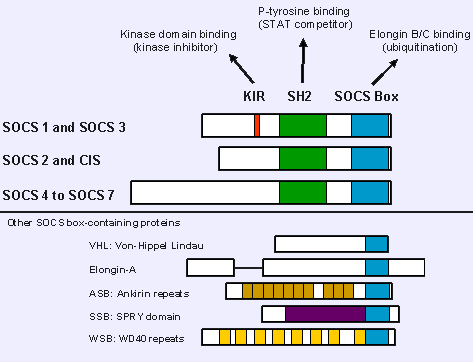
Diagram representing the structure of SOCS proteins. At least eight proteins belonging to the SOCS family of proteins are shown (upper panel). They are characterized by the presence of an SH2 central domain and the SOCS box domain at the C-terminus. A small domain called kinase inhibitory region (KIR), only found in SOCS1 and SOCS3, is shown as a small box at the N-terminal region. SOCS proteins can interact with phosphotyrosine phosphorylated proteins through their SH2 domain and with Elongin BC through their SOCS box domain. Other proteins containing a SOCS box domain but lacking a SH2 domain are also shown (lower panel). Adapted from Elliot and Johnston (Elliott and Johnston, 2004) with modifications.
Description
Reference sequence for SOCS2 protein: NP_001257399.1. SOCS2 contains 198 amino acid residues with a molecular weight of 22172 Da.
SOCS2 belongs to the SOCS box family. SOCS2 contains a C terminal SOCS box (residue 151-197) for ElonginB,C/Cullin5/Rbx2 interaction. The unstructured N-terminal region (residue 1-47) and the SH2 domain (residue 48-156) is implicated in substrate interaction. The SH2 domain is known to interact with conserved phosphotyrosine residues on target proteins imparting substrate specificity to SOCS box proteins.
SOCS2 belongs to the SOCS box family. SOCS2 contains a C terminal SOCS box (residue 151-197) for ElonginB,C/Cullin5/Rbx2 interaction. The unstructured N-terminal region (residue 1-47) and the SH2 domain (residue 48-156) is implicated in substrate interaction. The SH2 domain is known to interact with conserved phosphotyrosine residues on target proteins imparting substrate specificity to SOCS box proteins.
Expression
SOCS mRNA and protein levels are constitutively low in unstimulated cells, but their expression is rapidly induced upon cytokine stimulation, thereby creating a negative feedback loop. Although constitutively expressed SOCS2 mRNA has been detected in several tissues and cell types, its expression is, in general, induced by stimulation with different cytokines and hormones (Rico-Bautista et al., 2006). SOCS2 promoter analysis indicates the presence of AhR and STAT5 binding sites that confer responsiveness to dioxin (Boverhof et al., 2004) and GH (Vidal et al., 2006), respectively.
Localisation
Intracellular, cytoplasm. SOCS2 can be located in the nuclear compartment when overexpressed in cell cultures.
Function
The function of SOCS proteins rely, on one hand, in their ability to bind tyrosine phosphorylated proteins through their SH2 domains and, on the other hand, to bind Elongins B/C through their SOCS box domains which in turn engages with the Cullin5/Rbx2 complex to assemble an E3 ubiquitin ligase. SOCS family proteins form part of a classical negative feedback system that regulates cytokine signal transduction (Rico-Bautista et al., 2006). Being a substrate recognition module for Cullin5/Rbx2 E3 ligase complex, SOCS2 is involved in regulating protein turnover by targeting proteins for proteasome-mediated degradation. SOCS2 binds and promote the ubiquitination of the Growth Hormone receptor (GHR) controlling GHR content in different tissues (Metcalf et al., 2000; Vesterlund et al., 2011). Through the negative regulation of GHR signaling, SOCS2 exerts multiple actions in growth and metabolisms (Greenhalgh et al., 2005; Zadjali et al., 2012). SOCS2 is also a critical regulator of inflammatory responses and immune cell differentiation (Machado et al., 2006; Hu et al., 2009a). Recently, SOCS2 is being implicated in the progression of multiple human cancers (Schultheis et al., 2002; Harris et al., 2006; Newton et al., 2010; Iglesias-Gato et al., 2014).
Homology
HomoloGene (NCBI) Genes identified as putative homologs: NP_003868.1 SOCS2, H.sapiens; XP_001139989.1 SOCS2, P.troglodytes; XP_002798772.1 SOCS2, M.mulatta; XP_005629280.1 SOCS2, C.lupus; NP_803489.1 SOCS2, B.taurus; NP_001162126.1 Socs2, M.musculus; NP_478115.1 Socs2, R.norvegicus; NP_989871.1 SOCS2, G.gallus; NP_001120898.1 socs2, X.tropicalis; NP_001108022.1 socs2, D.rerio
Mutations
Note
There are 8 SNPs in coding regions of human SOCS2 which result in missense protein residues (NCBI dbSNP). Homozygous null mice display gigantism (Metcalf et al., 2000), impaired innate immune cell differentiation and hypersensitivity to infections (Baetz et al., 2004; Yoshimura et al., 2005; Yoshimura et al., 2007). Homozygous null mice also display altered metabolic and inflammatory response to high fat feeding (Zadjali et al., 2012;). SNP: increasing the risk of type 2 diabetes (Kato et al., 2006)
Implicated in
Entity name
Neural development
Note
SOCS2 plays a critical role in neuronal development, growth, and stem cell differentiation (Turnley et al., 2002).
Entity name
Inflammation
Note
SOCS2 deficient dendritic cells and macrophages are hyper-responsive to microbial stimulation. SOCS2 deficient animals have uncontrolled production of inflammatory cytokines (IL-12, IFNγand TNFα ) and succumb to endotoxic shock, polymicrobial sepsis and other microbial infections (Esper et al., 2012). SOCS2 plays a central role in differentiation and maturation of innate immune cells. Specifically, SOCS2 promotes generation of regulatory dendritic cells and macrophages (Novak et al., 1999; Jackson et al., 2004; Hu et al., 2012) and Treg population (Knosp et al., 2013). Conversely, SOCS2 inhibits Th2 differentiation (Knosp et al., 2011). Upon induced inflammatory challenge, absence of SOCS2 has been shown to render multiple immune cell types incapable of mounting anti-inflammatory responses. Under resting conditions, SOCS2 null animals also display a population-bias towards a pro-inflammatory phenotype (Machado et al., 2006; Lee et al., 2010; Knosp et al., 2011; Posselt et al., 2011; Hu et al., 2012).
SOCS2 is known to inhibit TGFβ, IL-4, IL-5, IL-10, IL-13 and IFNγ signaling (Knosp et al., 2011, Knosp et al., 2013). In general, SOCS2 inhibits expression/secretion of pro-inflammatory cytokines and promotes generation of regulatory phenotype (anti-inflammatory) of immune cells. SOCS2 is thought to function in both MyD88 dependent and independent TLR4 signaling pathways because its downregulation negatively affects SAPK/JNK, p38 MAPK, ERK and NFkB signaling (Hu et al., 2009b). Being an E3 ligase, SOCS2 regulates a number of proteins highly implicated in regulation of immune responses such as FoxP3 (Knosp et al., 2013) and TRAF6 (McBerry et al., 2012). SOCS2 also accelerates degradation of other members of the SOCS family such as SOCS1 and SOCS3 thus further impinging on downstream STAT signaling (Piessevaux et al., 2006; Tannahill et al., 2005). In turn, SOCS2 gene itself is under regulation of various inflammatory signals (e.g., LPS, dioxins, LipoxinA4) (Machado et al., 2006; Hu et al., 2009b, 2012) and cytokines (e.g.,IL-4, IL-10, IFNβ, IFNγ) (Knosp et al., 2011; Posselt et al., 2011).
SOCS2 is known to inhibit TGFβ, IL-4, IL-5, IL-10, IL-13 and IFNγ signaling (Knosp et al., 2011, Knosp et al., 2013). In general, SOCS2 inhibits expression/secretion of pro-inflammatory cytokines and promotes generation of regulatory phenotype (anti-inflammatory) of immune cells. SOCS2 is thought to function in both MyD88 dependent and independent TLR4 signaling pathways because its downregulation negatively affects SAPK/JNK, p38 MAPK, ERK and NFkB signaling (Hu et al., 2009b). Being an E3 ligase, SOCS2 regulates a number of proteins highly implicated in regulation of immune responses such as FoxP3 (Knosp et al., 2013) and TRAF6 (McBerry et al., 2012). SOCS2 also accelerates degradation of other members of the SOCS family such as SOCS1 and SOCS3 thus further impinging on downstream STAT signaling (Piessevaux et al., 2006; Tannahill et al., 2005). In turn, SOCS2 gene itself is under regulation of various inflammatory signals (e.g., LPS, dioxins, LipoxinA4) (Machado et al., 2006; Hu et al., 2009b, 2012) and cytokines (e.g.,IL-4, IL-10, IFNβ, IFNγ) (Knosp et al., 2011; Posselt et al., 2011).
Entity name
Breast cancer
Note
SOCS2 expression inversely correlates with histological grades and is a positive prognostic factor (Farabegoli et al., 2005; Haffner et al., 2007). SOCS2 expression is induced by estrogen receptor (ER) activity. Estrogen treatment activates ER which in turn upregulates miR-191 which through downregulation of SATB1, a global chromatic remodeller, enhances SOCS2 transcription (Nagpal et al., 2013). Upregulation of SOCS2 upon estrogen administration antagonizes growth hormone action mediated through JAK2/STAT3 and STAT5 (Leung et al., 2003).
Entity name
Colon cancer
Note
Both heterozygous and homozygous deletions of SOCS2 promoted spontaneous tumorigenesis in ApcMin/+ mice model of colorectal cancer. This is accompanied with a dramatic increase in AP-1 DNA binding (Newton et al., 2010). Acromegalic patients are prone to colonic polyp formation. These patients with hyperplastic polyps have increased SOCS2 transcripts (Bogazzi et al., 2009).
Entity name
Myeloproliferative disorder
Note
SOCS2 gene is also hypermethylated in myeloproliferative disorders (Zhou et al., 2009; Zhang et al., 2013). SOCS2 is an important negative regulator of a constitutive active mutant of JAK2 (JAK2 V617F) (Etienne et al., 2007).
Entity name
Prostate cancer
Note
SOCS2 is upregulated at both mRNA and protein levels in primary prostate cancer tissues relative to normal prostate. This upregulation is correlated to lower Gleason score, absence of metastasis and low PSA failure (Zhu et al., 2013). In contrast, SOCS2 expression is downregulated in castration resistant prostate cancer. This is partly explained by the fact that SOCS2 is transcriptionally upregulated by androgen receptor and inhibits GH signaling in prostate (Iglesias-Gato et al., 2014).
Entity name
Other cancers
Note
SOCS2 gene is hypermethylated in melanoma and ovarian carcinoma (Marini et al., 2006; Liu et al., 2008). Lower SOCS2 expressions are also correlated to higher grades of hepatocellular carcinoma (Qiu et al., 2013).
Entity name
Gigantism
Note
SOCS2 null mice are giants but not obese (Metcalf et al., 2000). SOCS2 deficient mice have growth and metabolic characteristics that can be related to the enhanced GH actions (Rico-Bautista et al., 2005). On the other hand, the gigantic phenotype displayed by SOCS2 null mice is mechanistically different from that of human acromegalic patients as they do not exhibit increased circulating IGF-1 levels and seems to express reduced levels of GH (Greenhalgh 2005 and Zadjali 2012).
Disease
Gigantism is a condition characterized by excessive growth, significantly above average. This is caused due to an overactivation of growth hormone signaling.
Entity name
Diabetes
Note
Genomic linkage analysis identified SOCS2 as a susceptibility gene for type 2 diabetes in a cohort of Japanese individuals. In the same study, adenovirus-mediated expression of the SOCS2 gene in MIN6 cells or isolated rat islets significantly suppressed glucose-stimulated insulin secretion (Kato et al., 2006). Constitutive SOCS2 expression in mice pancreatic beta cells interferes with proinsulin processing and leads to decreased insulin secretion (Lebrun et al., 2010). In contrast, SOCS2 null mice does not exhibit obvious defects in pancreatic beta cell function. When challenged with high fat diet SOCS2 null mice are protected from hepatic steatosis but exhibit an exacerbated inflammatory response and a worsening of insulin sensitivity as compared to wild-type mice on a similar diet.
Disease
Diabetes is a condition characterized by high blood sugar levels. This is caused due to inadequate insulin production or insulin resistance.
Entity name
Osteoarthritis
Note
Analysis of SOCS2 null mice has revealed that the absence of SOCS2 induces a reduction in the trabecular and cortical volumetric bone mineral density (Lorentzon et al., 2005). SOCS2 induces the differentiation of C2C12 mesenchymal cells into myoblasts or osteoblasts (Ouyang et al., 2006).
Disease
Osteoarthritis is a condition characterized by mechanical degeneration of joints resulting in pain and restricted movement. This is caused due to hereditary and metabolic reasons.
Article Bibliography
| Pubmed ID | Last Year | Title | Authors |
|---|---|---|---|
| 15491991 | 2004 | Suppressor of cytokine signaling (SOCS) proteins indirectly regulate toll-like receptor signaling in innate immune cells. | Baetz A et al |
| 18844680 | 2009 | Changes in the expression of suppressor of cytokine signalling (SOCS) 2 in the colonic mucosa of acromegalic patients are associated with hyperplastic polyps. | Bogazzi F et al |
| 15371557 | 2004 | 2,3,7,8-Tetrachlorodibenzo-p-dioxin induces suppressor of cytokine signaling 2 in murine B cells. | Boverhof DR et al |
| 15275643 | 2004 | SOCS: role in inflammation, allergy and homeostasis. | Elliott J et al |
| 22658486 | 2012 | Role of SOCS2 in modulating heart damage and function in a murine model of acute Chagas disease. | Esper L et al |
| 17574970 | 2007 | Rearrangements involving 12q in myeloproliferative disorders: possible role of HMGA2 and SOCS2 genes. | Etienne A et al |
| 16189149 | 2005 | Suppressor of cytokine signalling 2 (SOCS-2) expression in breast carcinoma. | Farabegoli F et al |
| 15690087 | 2005 | SOCS2 negatively regulates growth hormone action in vitro and in vivo. | Greenhalgh CJ et al |
| 17651480 | 2007 | Favorable prognostic value of SOCS2 and IGF-I in breast cancer. | Haffner MC et al |
| 16469767 | 2006 | Socs2 and elf5 mediate prolactin-induced mammary gland development. | Harris J et al |
| 22291912 | 2012 | LPS regulates SOCS2 transcription in a type I interferon dependent autocrine-paracrine loop. | Hu J et al |
| 19779605 | 2009 | SOCS2 influences LPS induced human monocyte-derived dendritic cell maturation. | Hu J et al |
| 24031028 | 2014 | SOCS2 mediates the cross talk between androgen and growth hormone signaling in prostate cancer. | Iglesias-Gato D et al |
| 14764699 | 2004 | Dendritic cell maturation requires STAT1 and is under feedback regulation by suppressors of cytokine signaling. | Jackson SH et al |
| 16406727 | 2006 | Association of single-nucleotide polymorphisms in the suppressor of cytokine signaling 2 (SOCS2) gene with type 2 diabetes in the Japanese. | Kato H et al |
| 21646394 | 2011 | SOCS2 regulates T helper type 2 differentiation and the generation of type 2 allergic responses. | Knosp CA et al |
| 23455506 | 2013 | Regulation of Foxp3+ inducible regulatory T cell stability by SOCS2. | Knosp CA et al |
| 20499047 | 2010 | The suppressor of cytokine signalling 2 (SOCS2) is a key repressor of insulin secretion. | Lebrun P et al |
| 20543098 | 2010 | Suppressor of cytokine signaling 2 regulates IL-15-primed human NK cell function via control of phosphorylated Pyk2. | Lee SH et al |
| 12552091 | 2003 | Estrogen inhibits GH signaling by suppressing GH-induced JAK2 phosphorylation, an effect mediated by SOCS-2. | Leung KC et al |
| 18627528 | 2008 | Identification of novel epigenetically modified genes in human melanoma via promoter methylation gene profiling. | Liu S et al |
| 15585682 | 2005 | Reduced bone mineral density in SOCS-2-deficient mice. | Lorentzon M et al |
| 16415877 | 2006 | Anti-inflammatory actions of lipoxin A4 and aspirin-triggered lipoxin are SOCS-2 dependent. | Machado FS et al |
| 16374457 | 2006 | Epigenetic inactivation of tumor suppressor genes in serum of patients with cutaneous melanoma. | Marini A et al |
| 22693634 | 2012 | SOCS2-induced proteasome-dependent TRAF6 degradation: a common anti-inflammatory pathway for control of innate immune responses. | McBerry C et al |
| 10890450 | 2000 | Gigantism in mice lacking suppressor of cytokine signalling-2. | Metcalf D et al |
| 23542418 | 2013 | MicroRNA-191, an estrogen-responsive microRNA, functions as an oncogenic regulator in human breast cancer. | Nagpal N et al |
| 20348236 | 2010 | Suppressor of cytokine signaling-2 gene disruption promotes Apc(Min/+) tumorigenesis and activator protein-1 activation. | Newton VA et al |
| 10427504 | 1999 | Differential ability of SOCS proteins to regulate IL-6 and CSF-1 induced macrophage differentiation. | Novak U et al |
| 16419040 | 2006 | SOCS-2 interferes with myotube formation and potentiates osteoblast differentiation through upregulation of JunB in C2C12 cells. | Ouyang X et al |
| 16956890 | 2006 | Functional cross-modulation between SOCS proteins can stimulate cytokine signaling. | Piessevaux J et al |
| 21844389 | 2011 | Suppressor of cytokine signaling 2 is a feedback inhibitor of TLR-induced activation in human monocyte-derived dendritic cells. | Posselt G et al |
| 23475171 | 2013 | Reduced expression of SOCS2 and SOCS6 in hepatocellular carcinoma correlates with aggressive tumor progression and poor prognosis. | Qiu X et al |
| 17070092 | 2006 | Suppressor of cytokine signaling (SOCS) 2, a protein with multiple functions. | Rico-Bautista E et al |
| 11861294 | 2002 | Overexpression of SOCS-2 in advanced stages of chronic myeloid leukemia: possible inadequacy of a negative feedback mechanism. | Schultheis B et al |
| 16199887 | 2005 | SOCS2 can enhance interleukin-2 (IL-2) and IL-3 signaling by accelerating SOCS3 degradation. | Tannahill GM et al |
| 12368809 | 2002 | Suppressor of cytokine signaling 2 regulates neuronal differentiation by inhibiting growth hormone signaling. | Turnley AM et al |
| 21980433 | 2011 | The SOCS2 ubiquitin ligase complex regulates growth hormone receptor levels. | Vesterlund M et al |
| 17008382 | 2007 | In vivo transcript profiling and phylogenetic analysis identifies suppressor of cytokine signaling 2 as a direct signal transducer and activator of transcription 5b target in liver. | Vidal OM et al |
| 10512686 | 1999 | Radiation hybrid and cytogenetic mapping of SOCS1 and SOCS2 to chromosomes 16p13 and 12q, respectively. | Yandava CN et al |
| 17525754 | 2007 | SOCS proteins, cytokine signalling and immune regulation. | Yoshimura A et al |
| 22562833 | 2012 | SOCS2 deletion protects against hepatic steatosis but worsens insulin resistance in high-fat-diet-fed mice. | Zadjali F et al |
| 24131863 | 2013 | Methylation profiling of SOCS1, SOCS2, SOCS3, CISH and SHP1 in Philadelphia-negative myeloproliferative neoplasm. | Zhang MY et al |
| 19144991 | 2009 | Enhanced activation of STAT pathways and overexpression of survivin confer resistance to FLT3 inhibitors and could be therapeutic targets in AML. | Zhou J et al |
| 23666742 | 2013 | Expression of SOCSs in human prostate cancer and their association in prognosis. | Zhu JG et al |
Other Information
Locus ID:
NCBI: 8835
MIM: 605117
HGNC: 19382
Ensembl: ENSG00000120833
Variants:
dbSNP: 8835
ClinVar: 8835
TCGA: ENSG00000120833
COSMIC: SOCS2
RNA/Proteins
Expression (GTEx)
Pathways
Protein levels (Protein atlas)
References
| Pubmed ID | Year | Title | Citations |
|---|---|---|---|
| 37594110 | 2024 | Overexpression of SOCS2 Inhibits EMT and M2 Macrophage Polarization in Cervical Cancer via IL-6/JAK2/STAT3 Pathway. | 0 |
| 37948135 | 2024 | Inhibition of miR-578 through SOCS2-dependent manner reverses gefitinib resistance in NSCLC cells. | 0 |
| 38103096 | 2024 | Analysis of epigenetic clocks links yoga, sleep, education, reduced meat intake, coffee, and a SOCS2 gene variant to slower epigenetic aging. | 0 |
| 37594110 | 2024 | Overexpression of SOCS2 Inhibits EMT and M2 Macrophage Polarization in Cervical Cancer via IL-6/JAK2/STAT3 Pathway. | 0 |
| 37948135 | 2024 | Inhibition of miR-578 through SOCS2-dependent manner reverses gefitinib resistance in NSCLC cells. | 0 |
| 38103096 | 2024 | Analysis of epigenetic clocks links yoga, sleep, education, reduced meat intake, coffee, and a SOCS2 gene variant to slower epigenetic aging. | 0 |
| 36735705 | 2023 | Upregulation of SOCS2 causes mitochondrial dysfunction and promotes ferroptosis in pancreatic cancer cells. | 2 |
| 37085288 | 2023 | MiR-532-3p inhibited the methylation of SOCS2 to suppress the progression of PC by targeting DNMT3A. | 2 |
| 38071211 | 2023 | SOCS2 inhibits hepatoblastoma metastasis via downregulation of the JAK2/STAT5 signal pathway. | 0 |
| 38084702 | 2023 | CTRP6 protects against ferroptosis to drive lung cancer progression and metastasis by destabilizing SOCS2 and augmenting the xCT/GPX4 pathway. | 1 |
| 36735705 | 2023 | Upregulation of SOCS2 causes mitochondrial dysfunction and promotes ferroptosis in pancreatic cancer cells. | 2 |
| 37085288 | 2023 | MiR-532-3p inhibited the methylation of SOCS2 to suppress the progression of PC by targeting DNMT3A. | 2 |
| 38071211 | 2023 | SOCS2 inhibits hepatoblastoma metastasis via downregulation of the JAK2/STAT5 signal pathway. | 0 |
| 38084702 | 2023 | CTRP6 protects against ferroptosis to drive lung cancer progression and metastasis by destabilizing SOCS2 and augmenting the xCT/GPX4 pathway. | 1 |
| 35037826 | 2022 | miR-3648 promotes lung adenocarcinoma-genesis by inhibiting SOCS2 (suppressor of cytokine signaling 2). | 5 |
Citation
Indranil Paul ; Leandro Fernández-Pérez ; Amilcar Flores-Morales
SOCS2 (suppressor of cytokine signaling 2)
Atlas Genet Cytogenet Oncol Haematol. 2015-08-01
Online version: http://atlasgeneticsoncology.org/gene/44123/socs2-(suppressor-of-cytokine-signaling-2)
Historical Card
2007-10-01 SOCS2 (suppressor of cytokine signaling 2) by Leandro Fernández-Pérez,Amilcar Flores-Morales Affiliation
