GLS (Glutaminase)
2019-02-01 José A. Campos-Sandoval , Mercedes Martín-Rufián , Javier Márquez AffiliationIdentity
Abstract
After metabolic reprogramming, many cancer cells become glutamine addicted, that is, they depend on a high consumption of this amino acid for their survival and proliferation. Glutaminase catalyzes the stoichiometric conversion of L-glutamine to L-glutamate and ammonium ions, the first step of glutaminolysis. GLS gene encodes two isoforms, known as kidney-type glutaminase (KGA) and glutaminase C (GAC). Upregulation of GLS is a common feature of many tumors and, in recent years, this enzyme and its interacting partners have attracted much attention as potential new targets for cancer therapy. Considerable effort is being devoted towards the development of small-molecule inhibitors of GLS.
DNA/RNA
Description
Transcription
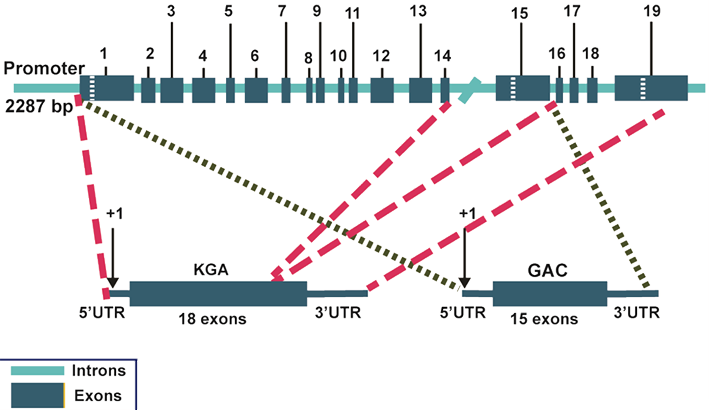
Several mechanisms regulate glutaminase expression. The first one to be described is based on the presence of AU-rich pH-responsive instability elements within the 3-nontranslated region of GLS mRNA. These elements are implicated in the rapid turnover of mRNAs by exonucleolytic degradation. The onset of metabolic acidosis results in the increased binding activity of a RNA-binding protein CRYZ (identified as ζ-crystallin/NADPH quinone reductase) with high affinity for the pH-responsive elements, that selectively stabilizes GLS mRNA (Hansen et al., 1996; Tang and Curthoys, 2001). Upregulation of GAC by the long non-coding RNA (lncRNA) colon cancer-associated transcript 2 ( CCAT2) has recently been reported in colon cancer. This lncRNA interacts with the cleavage factor I (CFIm) complex in an allele-specific manner and select the poly(A) site within 14th intron of GLS pre-mRNA, resulting in the preferential splicing of GAC isoform (Redis et al., 2016). MicroRNAs (miRNAs) are also implicated in GLS expression. Through downregulation of MIR23A / MIR23B, which target GLS mRNA, the oncogenic transcription factor MYC (v?myc myelocytomatosis viral oncogene homolog) indirectly relieves repression of GLS in lymphoma and prostate cancer cells (Gao et al., 2009). The MTOR complex 1/ RPS6KB1 (mTORC1/S6K1 (mammalian target of rapamycin complex 1/ribosomal protein S6 kinase beta-1)) signaling pathway positively regulates GLS expression by enhancing the translation efficiency of Myc mRNA. After inhibition of mTORC1 with rapamycin, an increase in miR-23a/b levels was observed (Csibi et al., 2014). The activation of RELA (v-rel avian reticuloendotheliosis viral oncogene homolog A, also known as p65), a member of nuclear factor kappa B (NF-kB) family, also decreases miR-23a expression in leukemic cells, inducing GLS expression (Rathore et al., 2012). Another transcription factor, JUN (v-jun avian sarcoma virus 17 oncogene homolog), when activated downstream of oncogenic Rho GTPase signaling, increases GLS expression in breast cancer cells by direct binding to its gene promoter (Lukey et al., 2016). After being activated by transforming growth factor (TGF)-β and Wnt (Wingless-type MMTV integration site family)-3a, the homeodomain transcription factor DLX2 (distal-less homeobox-2), involved in embryonic and tumor development, also upregulates GLS expression (Lee SY et al., 2016a). Transcription of GLS gene is also activated in HIV-1 infected cells by interferon (IFN)-α through signal transducer and activator of transcription 1 ( STAT1) phosphorylation, leading to glutamate overproduction (Zhao et al., 2012). Retinoblastoma protein ( RB1), a tumor suppressor that modulates cell cycle checkpoints, also regulates glutamine metabolism. Deletion of RB family revealed an increase in GLS protein and activity (Reynolds et al., 2014).
Proteins
Note
Description
A 10000-fold purification of glutaminase (KGA) from pig kidney was achieved by Kvamme et al. (1970) using alternative solubilization and precipitacion steps, based on its property to aggregate in phosphate-borate buffers and to disaggregate in Tris-HCl buffers. KGA may appear as three different forms: a dimeric and inactive form in Tris-HCl buffer; a tetrameric and active form after combination of two dimers when dialyzed against phosphate buffer; and a polymeric form with mass higher that 2000 kDa in the presence of phosphate-borate buffer. These polymers consist of double-stranded helices (Kvamme at al., 1970; Olsen et al., 1970; Godfrey et al., 1977).
Structure:
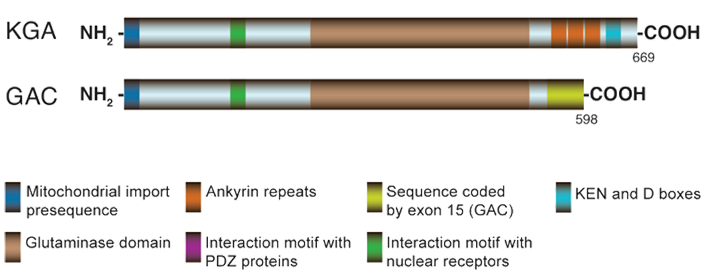
KGA transcript (ORF: 2010 nt) codes a 669-residues protein, with a predicted molecular mass of 73.5 kDa. GAC transcript (ORF: 1797 nt) codes a 598-residues protein, with a predicted molecular mass of 65.5 kDa. Both precursors are identical in almost all their primary structure (exons 1-14, residues 1-550), except in the C-terminal region (residues 551-669 for KGA; 551-598 for GAC). They are composed of a N-terminal domain folded into an EF-hand-like four-helix bundle (Pasquali et al., 2017) and a central glutaminase domain from residues 220 to 530, which belongs to the beta lactamase/transpeptidase-like superfamily and contains the catalytic active site (Thangavelu et al., 2012). In addition, the C-terminal region of KGA possesses three ankyrin repeats, also present in GLS2 proteins but not in the GAC isoform (Pasquali et al., 2017), and KEN (Lys-Glu-Asn) and D (destruction) boxes. The ankyrin repeats are protein-protein interaction modules of 33 residues that have been found in many important proteins such as transcriptional factors, cell cycle regulators, cytoskeletal organizers, etc. (Sedgwick and Smerdon, 1999; Mosavi et al., 2004). Both KEN and D boxes are recognized by the ubiquitin ligase APC/C-Cdh1 (anaphase-promoting complex/cyclosome-Cdh1) which targets KGA for degradation by the proteasome (Colombo et al., 2011). The GLS precursor also has a putative N-terminal mitochondrial targeting sequence of 16 residues (Shapiro et al., 1991). The Curthoys laboratory, in a series of studies on the biosynthesis and processing of the rat KGA, found that the 74 kDa precursor is processed in the mitochondria by a matrix processing peptidase to yield two subunits of 66 (cleavage site at residue 72) and 68 kDa with a 3:1 stoichiometry (Perera et al., 1990; Srinivasan et al., 1995). For the human GLS, only a 66 kDa protein has been detected when expressed as a recombinant protein using the baculovirus expression system (Holcomb et al., 2000). As previously described for GLS2 (Olalla et al., 2002), GLS proteins show a LXXLL motif or nuclear receptor box from Leu144 to Leu148 (Cassago et al., 2012). In recent years, several groups have revealed the structure of GLS based on X-ray crystallography. In the asymmetric unit, GLS is organized as a tetramer where the monomers interact through two sets of interfaces at the glutaminase domains. This domain is composed of two subdomains: an α/β subdomain that contains five-stranded anti-parallel β-sheet surrounded by several α-helices, and an α-helical subdomain with seven α-helices. Two GLS monomers are joined by a long interface of their respective α-helical subdomains to form an inactive dimer. Two opposing dimers then associate by a short interface involving two pairs of equivalent anti-parallel α-helices (α-13) at the α /β subdomains, which come into contact by hydrophobic interactions. (DeLaBarre et al., 2011; Cassago et al., 2012; Thangavelu et al, 2012). When a phenylalanine residue (Phe394 in the mouse GAC) in the short dimer interface was mutated to a serine one, GAC persisted as an inactive dimer even at high concentrations of phosphate (Cassago et al., 2012). The presence of salt bridges between Asp391 and Lys401 at both ends of the pairing helices further stabilizes the quaternary structure. The replacement of Asp391 by a lysine residue had a similar effect to that caused by the phenylalanine substitution (Li et al., 2016).
Kinetic properties:
Both GLS isoforms require a polyvalent anion to be active. A decade after Krebs (1935) proposed the existence of two different types of glutaminase, one of them (GLS) strongly inhibited by the product glutamic acid, Carter and Greenstein (1947) observed an accelerated deamidation of glutamine in aqueous rat-liver extracts in the presence of phosphate, arsenate or sulfate and suggested that this effect could be due to an augmentation of the activity of glutaminase enzyme. Errera and Greenstein (1949) characterized it as phosphate-activated glutaminase. It was later found that phosphate induced the association of catalytically inactive dimers into active tetramers, whereas glutamate caused inhibition of glutaminase by reversing this process (Godfrey et al., 1977; Morehouse and Curthoys, 1981). At a concentration of phosphate of 100 mM, tetramerization of glutaminase is produced and the enzyme reaches its maximum activity. The activation by phosphate is sigmoidal, with a K0.5 of 25 mM and a Hill index of 1.5. When phosphate concentration is increased, both the inhibition by glutamate -which is competitive with respect to glutamine- and the KM for glutamine decrease (Haser et al., 1985). Although the activity of the purified enzyme is completely dependent on added phosphate, it was not known if the high concentration of phosphate required for the in vitro reaction could also occur in the intracellular site of glutaminase action or whether phosphate was the substitute of an unknown natural activator (Sayre and Roberts, 1958). In addition to phosphate, a wide variety of physiological compounds (tricarboxylic acids, nucleotide triphosphates, acyl-CoA derivatives) was found that could act as activators (or inhibitors) of glutaminase (ODonovan and Lotspeich, 1966; Weil-Malherbe, 1969; Kvamme and Torgner, 1975). However, recent X-ray analysis has provided support for the candidature of phosphate as a relevant in vivo effector: crystal structure of glutaminase shows that each GAC monomer encloses a single phosphate ion inside its active site. It has been proposed that, after binding of phosphate, a flexible activation loop located near the short dimer interface undergoes a major conformational change that stabilizes the active site and promotes catalytic turnover (Thangavelu et al., 2012; Li et al., 2016, Stalnecker et al., 2017).
Interacting partners:
The first binding partner for KGA to be described was the caytaxin ATCAY (or BNIP-H for BNIP-2 homology), a protein exclusively expressed in neural tissues and encoded by a gene linked to Cayman ataxia and dystonia. This protein interacts with KGA through a conserved protein-protein interaction domain known as the BNIP-2 and Cdc42GAP homology (BCH) domain. Caytaxin regulates the intracellular localization and activity of KGA: it relocalized KGA from cell body to neurite terminals and reduced glutamate levels by inhibiting its activity (Buschdorf et al., 2006). Subsequently, another member of the family of BCH-domain containing proteins, PRUNE2 (prune homolog 2 with BCH domain, also known as BMCC1s), has been shown to directly interact with KGA. This protein, associated to microtubules and intermediate filaments in astrocytes and neurons, may influence import of KGA to mitochondria: overexpression of PRUNE2 in mouse neurons led to an accumulation of KGA within the cytoplasm (Boulay et al., 2013). Very recently, GLS has been reported to interact with peroxisome proliferator-activated receptor gamma ( PPARG) in the nuclei of prostate cancer cells, and this interaction decreased the nuclear receptor activity (de Guzzi Cassago et al., 2018).
Post-translational modifications:
Aside from the regulation of GLS gene expression, several post-translational modifications affect glutaminase activity, with implications for cancer cells metabolism. Most of the identified modifications correspond to phosphorylation of serine, tyrosine and threonine residues (see Ascenção et al., 2018 for references), although the effect of specific modified residues on GLS activity has only recently been studied. Thangavelu et al. (2012) revealed that GLS activity in human breast adenocarcinoma cells was dependent on phosphorylation by epidermal growth factor ( EGF) via the RAF/MEK/ERK signaling module and was completely abolished after treatment with MEK inhibitors or co-expression with protein phosphatase PP2A. Han et al. (2018) have recently found that GLS activity is drastically reduced when one of the ten identified phosphorylation sites, Ser314 at the glutaminase domain, is mutated to alanine. A remarkable reduction in Ser314 phosphorilation and GLS activity occurs when cell lysates of several tumor types are treated with alkaline phosphatase. This phosphorylation is regulated by the NF-kB-PKCε ( PRKCE protein kinase C-epsilon) axis. After treatment with a NF-kB inhibitor, GLS activity could be restored with the overexpression of PKCε (Han et al., 2018). In contrast, phosphorylation of Ser95 at the N-terminal domain inhibits GLS activity, but its mechanism of deregulation in cancer cells is still unknown (Ascenção et al., 2018). Another post-translational modification that affects GLS activity is succinylation. The mitochondrial protein sirtuin 5 ( SIRT5), which removes short-chain acyl moieties from lysine residues, regulates GLS activity by reducing its level of succinylation (Polleta et al., 2015). Acetylation has also been speculated to regulate GLS activity. Several lysine residues that occur at the α-helix-13 has been identified as sites of this modification and their acetylation could prevent the formation of active tetramers (McDonald et al., 2015). As already mentioned above, KGA is also modified by ubiquitination at its C-terminal region (Colombo et al., 2011).
Drug inhibitors:
The first glutaminase inhibitors to be discovered several decades ago were L-glutamine analogs isolated from Streptomyces, such as azaserine, diazo-O-norleucine (DON) and acivicin. They act as irreversible competitive inhibitors for GLS and other glutamine-utilizing enzymes: DON binds covalently to residue Ser286 at the GLS active site (Thangavelu et al., 2014). Although they show a significant inhibitory effect on several types of tumors in preclinical tests, their pronounced toxicity has compromised the therapeutical potential of these compounds (Ahluwalia et al., 1990). The bisthiadiazole derivatives form the second important group of inhibitors that was described the past few years, the prototype being BPTES (Robinson et al., 2007). A more potent derivative of BPTES, CB-839 (Gross et al., 2014), is being tested in clinical trials (more information at http://www.clinicaltrials.gov database). These non-competitive allosteric inhibitors bind to the interface between two dimers, stabilizing an inactive tetrameric form of GLS (DeLaBarre et al., 2011; Thangavelu et al., 2012). The newest molecule in this group is the compound UPGL00004, with similar binding affinity as CB-839 but with better microsomal stability (Huang et al., 2018). The third group of inhibitors is represented by compound 968, a benzophenanthridinone that binds to a pocket at the interface between two GLS monomers. Unlike BPTES, compound 968 preferentially binds to the monomeric, inactive form of GLS, and is unable to inhibit GLS which has been pre-activated with phosphate (Wang et al., 2010; Stalnecker et al., 2017). Other new GLS inhibitors recently described are physapubescin K, (Cheng et al., 2017; Wu et al., 2017), zaprinast (Elhammali et al., 2014) and brachyantheraoside A8 (Li et al., 2017). One essential point of GLS inhibition is that these novel compounds lack the high degree of toxicity observed with glutamine mimetics (Matés et al., 2018). For an overview of glutaminase inhibitors, see: Katt et al., 2017; Song et al., 2018; Wu et al., 2018; Xu et al, 2018.
Expression
Localisation
Function
Besides its role in normal tissues, glutaminase is highly expressed in tumors, where its activity has been correlated with malignancy (Knox et al., 1967; Linder-Horowitz et al., 1969; Kovacevik and McGivan, 1983). Many cancer cells develop what has been called "glutamine addiction", a term now widely used to reflect the strong dependence for this essential nitrogen substrate after metabolic reprogramming (Wise et al., 2008). Silencing GLS expression by genetic knockdown or inhibiting its activity with drug inhibitors reveal the critical role of GLS in this addiction. Thus, the specific inhibition of GLS by antisense mRNA slowed tumor cell growth and induced phenotypic changes that made these cells vulnerable to the hosts immune system (Lobo et al., 2000; Segura et al., 2001). In addition, GLS enables cancer cells to counteract ROS. Glutamate is the precursor of glutathione (GSH) and a source or reducing equivalents (Hensley et al., 2013). Based on the abundant published data on recent years on the role of glutaminase in cancer, this enzyme has become a potential drug target for therapeutic intervention (Matés et al., 2018).
Implicated in
Article Bibliography
| Pubmed ID | Last Year | Title | Authors |
|---|---|---|---|
| 2108451 | 1990 | Metabolism and action of amino acid analog anti-cancer agents. | Ahluwalia GS et al |
| 11130979 | 2000 | Identification of two human glutaminase loci and tissue-specific expression of the two related genes. | Aledo JC et al |
| 9042341 | 1997 | Submitochondrial localization and membrane topography of Ehrlich ascitic tumour cell glutaminase. | Aledo JC et al |
| 1714509 | 1991 | Identification of mitochondrial and non-mitochondrial glutaminase within select neurons and glia of rat forebrain by electron microscopic immunocytochemistry. | Aoki C et al |
| 30092248 | 2018 | N-terminal phosphorylation of glutaminase C decreases its enzymatic activity and cancer cell migration. | Ascenção CFR et al |
| 23246912 | 2013 | Bmcc1s interacts with the phosphate-activated glutaminase in the brain. | Boulay AC et al |
| 16899818 | 2006 | Brain-specific BNIP-2-homology protein Caytaxin relocalises glutaminase to neurite terminals and reduces glutamate levels. | Buschdorf JP et al |
| 25837287 | 2015 | Glutaminases in brain: Multiple isoforms for many purposes. | Campos-Sandoval JA et al |
| 20257045 | 1947 | Acceleration of enzymatic desamidation of glutamine by several inorganic anions. | CARTER CE et al |
| 22228304 | 2012 | Mitochondrial localization and structure-based phosphate activation mechanism of Glutaminase C with implications for cancer metabolism. | Cassago A et al |
| 28597996 | 2017 | Sensitization of melanoma cells to temozolomide by overexpression of microRNA 203 through direct targeting of glutaminase-mediated glutamine metabolism. | Chang X et al |
| 28174105 | 2017 | Physapubescin, a natural withanolide as a kidney-type glutaminase (KGA) inhibitor. | Cheng L et al |
| 21555572 | 2011 | Pyruvate carboxylase is required for glutamine-independent growth of tumor cells. | Cheng T et al |
| 22106309 | 2011 | Molecular basis for the differential use of glucose and glutamine in cell proliferation as revealed by synchronized HeLa cells. | Colombo SL et al |
| 25220053 | 2014 | The mTORC1/S6K1 pathway regulates glutamine metabolism through the eIF4B-dependent control of c-Myc translation. | Csibi A et al |
| 8527215 | 1995 | Regulation of glutaminase activity and glutamine metabolism. | Curthoys NP et al |
| 11533299 | 2001 | Role of mitochondrial glutaminase in rat renal glutamine metabolism. | Curthoys NP et al |
| 10736375 | 2000 | Compartmentation of brain glutamate metabolism in neurons and glia. | Daikhin Y et al |
| 19935646 | 2009 | Cancer-associated IDH1 mutations produce 2-hydroxyglutarate. | Dang L et al |
| 22049910 | 2011 | Full-length human glutaminase in complex with an allosteric inhibitor. | DeLaBarre B et al |
| 29988727 | 2018 | Nuclear factor-κB p65 regulates glutaminase 1 expression in human hepatocellular carcinoma. | Dong M et al |
| 30009389 | 2018 | NRH:quinone oxidoreductase 2 (NQO2) and glutaminase (GLS) both play a role in large extracellular vesicles (LEV) formation in preclinical LNCaP-C4-2B prostate cancer model of progressive metastasis. | Dorai T et al |
| 11015561 | 1999 | Cloning and analysis of unique human glutaminase isoforms generated by tissue-specific alternative splicing. | Elgadi KM et al |
| 24740997 | 2014 | A high-throughput fluorimetric assay for 2-hydroxyglutarate identifies Zaprinast as a glutaminase inhibitor. | Elhammali A et al |
| 24333121 | 2014 | Inhibition of glutaminase selectively suppresses the growth of primary acute myeloid leukemia cells with IDH mutations. | Emadi A et al |
| 18112132 | 1949 | Phosphate-activated glutaminase in kidney and other tissues. | ERRERA M et al |
| 19219026 | 2009 | c-Myc suppression of miR-23a/b enhances mitochondrial glutaminase expression and glutamine metabolism. | Gao P et al |
| 26710269 | 2015 | MiRNA-192 [corrected] and miRNA-204 Directly Suppress lncRNA HOTTIP and Interrupt GLS1-Mediated Glutaminolysis in Hepatocellular Carcinoma. | Ge Y et al |
| 845154 | 1977 | Correlation between activation and dimer formation of rat renal phosphate-dependent glutaminase. | Godfrey S et al |
| 28947392 | 2018 | Glutaminase inhibition improves FLT3 inhibitor therapy for acute myeloid leukemia. | Gregory MA et al |
| 24523301 | 2014 | Antitumor activity of the glutaminase inhibitor CB-839 in triple-negative breast cancer. | Gross MI et al |
| 13709552 | 1961 | Intracellular localization of glutaminase I in rat liver. | GUHA SR et al |
| 26894601 | 2016 | Blockage of glutaminolysis enhances the sensitivity of ovarian cancer cells to PI3K/mTOR inhibition involvement of STAT3 signaling. | Guo L et al |
| 29515166 | 2018 | Phosphorylation of glutaminase by PKCε is essential for its enzymatic activity and critically contributes to tumorigenesis. | Han T et al |
| 8760253 | 1996 | The 3'-nontranslated region of rat renal glutaminase mRNA contains a pH-responsive stability element. | Hansen WR et al |
| 23999442 | 2013 | Glutamine and cancer: cell biology, physiology, and clinical opportunities. | Hensley CT et al |
| 26390244 | 2015 | Metabolic reprogramming induces resistance to anti-NOTCH1 therapies in T cell acute lymphoblastic leukemia. | Herranz D et al |
| 30103008 | 2018 | Activation of p53 by costunolide blocks glutaminolysis and inhibits proliferation in human colorectal cancer cells. | Hu M et al |
| 24696726 | 2014 | Expression of glutaminase is upregulated in colorectal cancer and of clinical significance. | Huang F et al |
| 27191653 | 2016 | Altered glutamine metabolism in platinum resistant ovarian cancer. | Hudson CD et al |
| 26186940 | 2015 | Targeting glutaminolysis has antileukemic activity in acute myeloid leukemia and synergizes with BCL-2 inhibition. | Jacque N et al |
| 26422827 | 2016 | Alterations in cellular metabolome after pharmacological inhibition of Notch in glioblastoma cells. | Kahlert UD et al |
| 28111979 | 2017 | A tale of two glutaminases: homologous enzymes with distinct roles in tumorigenesis. | Katt WP et al |
| 5603270 | 1967 | Organ specific control of glutamine metabolism. | Katunuma N et al |
| 23507704 | 2013 | Expression of glutamine metabolism-related proteins according to molecular subtype of breast cancer. | Kim S et al |
| 13549426 | 1958 | Partial purification and properties of renal glutaminase. | KLINGMAN JD et al |
| 6047874 | 1967 | Glutaminase activities in normal and neoplastic tissues of the rat. | Knox WE et al |
| 21779461 | 2010 | MYC and Prostate Cancer. | Koh CM et al |
| 6132422 | 1983 | Mitochondrial metabolism of glutamine and glutamate and its physiological significance. | Kovacevic Z et al |
| 16745865 | 1935 | Metabolism of amino-acids: The synthesis of glutamine from glutamic acid and ammonia, and the enzymic hydrolysis of glutamine in animal tissues. | Krebs HA et al |
| 10431175 | 1999 | The ankyrin repeat: a diversity of interactions on a common structural framework. | Sedgwick SG et al |
| 21852960 | 2011 | Glutamine synthetase is a genetic determinant of cell type-specific glutamine independence in breast epithelia. | Kung HN et al |
| 499555 | 1979 | Evidence for two species of mammalian phosphate-activated glutaminase having different regulatory properties. | Kvamme E et al |
| 2071598 | 1991 | Evidence indicating that pig renal phosphate-activated glutaminase has a functionally predominant external localization in the inner mitochondrial membrane. | Kvamme E et al |
| 4985904 | 1970 | Glutaminase from pig renal cortex. I. Purification and general properties. | Kvamme E et al |
| 28950000 | 2017 | Glutaminase is essential for the growth of triple-negative breast cancer cells with a deregulated glutamine metabolism pathway and its suppression synergizes with mTOR inhibition. | Lampa M et al |
| 27929535 | 2016 | Dual targeting of glutaminase 1 and thymidylate synthase elicits death synergistically in NSCLC. | Lee JS et al |
| 26771232 | 2016 | Dlx-2 and glutaminase upregulate epithelial-mesenchymal transition and glycolytic switch. | Lee SY et al |
| 26573871 | 2016 | Inhibition of glutamine utilization sensitizes lung cancer cells to apigenin-induced apoptosis resulting from metabolic and oxidative stress. | Lee YM et al |
| 30555042 | 2019 | Targeting glutaminase 1 attenuates stemness properties in hepatocellular carcinoma by increasing reactive oxygen species and suppressing Wnt/beta-catenin pathway. | Li B et al |
| 29730197 | 2018 | Heat Shock Factor 1 Epigenetically Stimulates Glutaminase-1-Dependent mTOR Activation to Promote Colorectal Carcinogenesis. | Li J et al |
| 4307782 | 1969 | Glutaminase activities and growth rates of rat hepatomas. | Linder-Horowitz M et al |
| 28218035 | 2017 | MicroRNA-153 regulates glutamine metabolism in glioblastoma through targeting glutaminase. | Liu Z et al |
| 10816417 | 2000 | Inhibition of glutaminase expression by antisense mRNA decreases growth and tumourigenicity of tumour cells. | Lobo C et al |
| 29097210 | 2018 | miR-137 inhibits glutamine catabolism and growth of malignant melanoma by targeting glutaminase. | Luan W et al |
| 27089238 | 2016 | The oncogenic transcription factor c-Jun regulates glutaminase expression and sensitizes cells to glutaminase-targeted therapy. | Lukey MJ et al |
| 27885629 | 2016 | Glutaminases. | Márquez J et al |
| 24276018 | 2014 | Both GLS silencing and GLS2 overexpression synergize with oxidative stress against proliferation of glioma cells. | Martín-Rufián M et al |
| 29633308 | 2018 | Molecular targeting of glutaminase sensitizes ovarian cancer cells to chemotherapy. | Masamha CP et al |
| 16641247 | 2006 | Mice lacking brain/kidney phosphate-activated glutaminase have impaired glutamatergic synaptic transmission, altered breathing, disorganized goal-directed behavior and die shortly after birth. | Masson J et al |
| 30053497 | 2018 | Glutaminase isoenzymes in the metabolic therapy of cancer. | Matés JM et al |
| 27806325 | 2016 | Inhibiting glutaminase in acute myeloid leukemia: metabolic dependency of selected AML subtypes. | Matre P et al |
| 30220459 | 2018 | Transaminase Inhibition by 2-Hydroxyglutarate Impairs Glutamate Biosynthesis and Redox Homeostasis in Glioma. | McBrayer SK et al |
| 25510640 | 2015 | Effect of lysine to alanine mutations on the phosphate activation and BPTES inhibition of glutaminase. | McDonald CJ et al |
| 25857301 | 2015 | Large oncosomes contain distinct protein cargo and represent a separate functional class of tumor-derived extracellular vesicles. | Minciacchi VR et al |
| 29763624 | 2018 | The GSK3 Signaling Axis Regulates Adaptive Glutamine Metabolism in Lung Squamous Cell Carcinoma. | Momcilovic M et al |
| 7305957 | 1981 | Properties of rat renal phosphate-dependent glutaminase coupled to Sepharose. Evidence that dimerization is essential for activation. | Morehouse RF et al |
| 15152081 | 2004 | The ankyrin repeat as molecular architecture for protein recognition. | Mosavi LK et al |
| 10048485 | 1998 | Prediction of the coding sequences of unidentified human genes. XII. The complete sequences of 100 new cDNA clones from brain which code for large proteins in vitro. | Nagase T et al |
| 2884147 | 1987 | Interactions between neurons and glia in glutamate/glutamine compartmentation. | Nicklas WJ et al |
| 6005667 | 1966 | Activation of kidney mitochondrial glutaminase by inorganic phosphate and organic acids. | O'Donovan DJ et al |
| 12163477 | 2002 | Nuclear localization of L-type glutaminase in mammalian brain. | Olalla L et al |
| 5530398 | 1970 | Formation and ultrastructure of enzymically active polymers of pig renal glutaminase. | Olsen BR et al |
| 15496140 | 2005 | Co-expression of glutaminase K and L isoenzymes in human tumour cells. | Pérez-Gómez C et al |
| 25482439 | 2015 | Elevated expression of glutaminase confers glucose utilization via glutaminolysis in prostate cancer. | Pan T et al |
| 28526749 | 2017 | The origin and evolution of human glutaminases and their atypical C-terminal ankyrin repeats. | Pasquali CC et al |
| 2211660 | 1990 | Biosynthesis and processing of renal mitochondrial glutaminase in cultured proximal tubular epithelial cells and in isolated mitochondria. | Perera SY et al |
| 900947 | 1977 | Phosphate-dependent glutaminase of small intestine: localization and role in intestinal glutamine metabolism. | Pinkus LM et al |
| 25700560 | 2015 | SIRT5 regulation of ammonia-induced autophagy and mitophagy. | Polletta L et al |
| 12045296 | 2002 | Complexity and species variation of the kidney-type glutaminase gene. | Porter LD et al |
| 24122876 | 2014 | ErbB2 activation upregulates glutaminase 1 expression which promotes breast cancer cell proliferation. | Qie S et al |
| 22634383 | 2012 | The NF-κB member p65 controls glutamine metabolism through miR-23a. | Rathore MG et al |
| 26853146 | 2016 | Allele-Specific Reprogramming of Cancer Metabolism by the Long Non-coding RNA CCAT2. | Redis RS et al |
| 23353822 | 2014 | Control of glutamine metabolism by the tumor suppressor Rb. | Reynolds MR et al |
| 8845737 | 1995 | The orientation of phosphate activated glutaminase in the inner mitochondrial membrane of synaptic and non-synaptic rat brain mitochondria. | Roberg B et al |
| 17581113 | 2007 | Novel mechanism of inhibition of rat kidney-type glutaminase by bis-2-(5-phenylacetamido-1,2,4-thiadiazol-2-yl)ethyl sulfide (BPTES). | Robinson MM et al |
| 11169963 | 2001 | Ehrlich ascites tumor cells expressing anti-sense glutaminase mRNA lose their capacity to evade the mouse immune system. | Segura JA et al |
| 21045145 | 2010 | Inhibition of glutaminase preferentially slows growth of glioma cells with mutant IDH1. | Seltzer MJ et al |
| 2998280 | 1985 | The orientation of phosphate-dependent glutaminase on the inner membrane of rat renal mitochondria. | Shapiro RA et al |
| 2191954 | 1990 | Molecular cloning of a cDNA for rat hepatic glutaminase. Sequence similarity to kidney-type glutaminase. | Smith EM et al |
| 29793408 | 2018 | Recent Development of Small Molecule Glutaminase Inhibitors. | Song M et al |
| 28970582 | 2017 | Role of the Transforming Growth Factor-β in regulating hepatocellular carcinoma oxidative metabolism. | Soukupova J et al |
| 7836378 | 1995 | In vitro characterization of the mitochondrial processing and the potential function of the 68-kDa subunit of renal glutaminase. | Srinivasan M et al |
| 25548170 | 2015 | Mechanism by which a recently discovered allosteric inhibitor blocks glutamine metabolism in transformed cells. | Stalnecker CA et al |
| 17940881 | 2008 | Relative expression of mRNAS coding for glutaminase isoforms in CNS tissues and CNS tumors. | Szeliga M et al |
| 25798620 | 2015 | Compensatory glutamine metabolism promotes glioblastoma resistance to mTOR inhibitor treatment. | Tanaka K et al |
| 11294877 | 2001 | Identification of zeta-crystallin/NADPH:quinone reductase as a renal glutaminase mRNA pH response element-binding protein. | Tang A et al |
| 22538822 | 2012 | Structural basis for the allosteric inhibitory mechanism of human kidney-type glutaminase (KGA) and its regulation by Raf-Mek-Erk signaling in cancer cell metabolism. | Thangavelu K et al |
| 25502225 | 2014 | Mesenchymal phenotype predisposes lung cancer cells to impaired proliferation and redox stress in response to glutaminase inhibition. | Ulanet DB et al |
| 27835669 | 2016 | The Glutaminase-1 Inhibitor 968 Enhances Dihydroartemisinin-Mediated Antitumor Efficacy in Hepatocellular Carcinoma Cells. | Wang D et al |
| 20832749 | 2010 | Targeting mitochondrial glutaminase activity inhibits oncogenic transformation. | Wang JB et al |
| 24923593 | 2014 | Glutaminase 1 is essential for the differentiation, proliferation, and survival of human neural progenitor cells. | Wang Y et al |
| 5822627 | 1969 | Activators and inhibitors of brain glutaminase. | Weil-Malherbe H et al |
| 19033189 | 2008 | Myc regulates a transcriptional program that stimulates mitochondrial glutaminolysis and leads to glutamine addiction. | Wise DR et al |
| 30273516 | 2018 | Glutaminase inhibitors: a patent review. | Wu C et al |
| 29371926 | 2017 | A natural inhibitor of kidney-type glutaminase: a withanolide from Physalis pubescens with potent anti-tumor activity. | Wu C et al |
| 26575584 | 2016 | Inhibition of mitochondrial glutaminase activity reverses acquired erlotinib resistance in non-small cell lung cancer. | Xie C et al |
| 26317652 | 2015 | Tumor suppressor NDRG2 inhibits glycolysis and glutaminolysis in colorectal cancer cells by repressing c-Myc expression. | Xu X et al |
| 30148361 | 2019 | Overview of the Development of Glutaminase Inhibitors: Achievements and Future Directions. | Xu X et al |
| 26833123 | 2016 | The Ephrin-A1/EPHA2 Signaling Axis Regulates Glutamine Metabolism in HER2-Positive Breast Cancer. | Youngblood VM et al |
| 25844758 | 2015 | Kidney-type glutaminase (GLS1) is a biomarker for pathologic diagnosis and prognosis of hepatocellular carcinoma. | Yu D et al |
| 27830010 | 2016 | Glutaminase inhibitor compound 968 inhibits cell proliferation and sensitizes paclitaxel in ovarian cancer. | Yuan L et al |
| 27902968 | 2017 | Selenite inhibits glutamine metabolism and induces apoptosis by regulating GLS1 protein degradation via APC/C-CDH1 pathway in colorectal cancer cells. | Zhao J et al |
| 22479354 | 2012 | Interferon-α regulates glutaminase 1 promoter through STAT1 phosphorylation: relevance to HIV-1 associated neurocognitive disorders. | Zhao L et al |
| 30295466 | 2018 | Glutaminase Affects the Transcriptional Activity of Peroxisome Proliferator-Activated Receptor γ (PPARγ) via Direct Interaction. | de Guzzi Cassago CA et al |
| 22892846 | 2012 | Analysis of glutamine dependency in non-small cell lung cancer: GLS1 splice variant GAC is essential for cancer cell growth. | van den Heuvel AP et al |
Other Information
Locus ID:
NCBI: 2744
MIM: 138280
HGNC: 4331
Ensembl: ENSG00000115419
Variants:
dbSNP: 2744
ClinVar: 2744
TCGA: ENSG00000115419
COSMIC: GLS
RNA/Proteins
Expression (GTEx)
Pathways
Protein levels (Protein atlas)
References
| Pubmed ID | Year | Title | Citations |
|---|---|---|---|
| 38353358 | 2024 | Glutaminase potentiates the glycolysis in esophageal squamous cell carcinoma by interacting with PDK1. | 0 |
| 38662258 | 2024 | CircCOL1A1 promotes proliferation, migration, and invasion of colorectal cancer (CRC) cells and glutamine metabolism through GLS1 up-regulation by sponging miR-214-3p. | 0 |
| 38353358 | 2024 | Glutaminase potentiates the glycolysis in esophageal squamous cell carcinoma by interacting with PDK1. | 0 |
| 38662258 | 2024 | CircCOL1A1 promotes proliferation, migration, and invasion of colorectal cancer (CRC) cells and glutamine metabolism through GLS1 up-regulation by sponging miR-214-3p. | 0 |
| 36560881 | 2023 | Combined thioredoxin reductase and glutaminase inhibition exerts synergistic anti-tumor activity in MYC-high high-grade serous ovarian carcinoma. | 4 |
| 37258469 | 2023 | Association between GLS Gene Polymorphisms and the Susceptibility to Lung Cancer in the Chinese Han Population. | 0 |
| 37401860 | 2023 | LncRNA PVT1 Confers Cisplatin Resistance of Esophageal Cancer Cells through Modulating the miR-181a-5p-Glutaminase (GLS) Axis. | 0 |
| 37541633 | 2023 | SIRT4 protects against intestinal fibrosis by facilitating GLS1 degradation. | 3 |
| 37679553 | 2023 | Glutaminase (GLS1) gene expression in primary breast cancer. | 0 |
| 36560881 | 2023 | Combined thioredoxin reductase and glutaminase inhibition exerts synergistic anti-tumor activity in MYC-high high-grade serous ovarian carcinoma. | 4 |
| 37258469 | 2023 | Association between GLS Gene Polymorphisms and the Susceptibility to Lung Cancer in the Chinese Han Population. | 0 |
| 37401860 | 2023 | LncRNA PVT1 Confers Cisplatin Resistance of Esophageal Cancer Cells through Modulating the miR-181a-5p-Glutaminase (GLS) Axis. | 0 |
| 37541633 | 2023 | SIRT4 protects against intestinal fibrosis by facilitating GLS1 degradation. | 3 |
| 37679553 | 2023 | Glutaminase (GLS1) gene expression in primary breast cancer. | 0 |
| 35563778 | 2022 | Regulation of Cardiac Fibroblast GLS1 Expression by Scleraxis. | 2 |
Citation
José A. Campos-Sandoval ; Mercedes Martín-Rufián ; Javier Márquez
GLS (Glutaminase)
Atlas Genet Cytogenet Oncol Haematol. 2019-02-01
Online version: http://atlasgeneticsoncology.org/gene/45600/haematological-explorer/
