Abstract
Review on HOXC8, with data on DNA\/RNA, on the protein encoded and functions in which this gene is implicated.
DNA/RNA
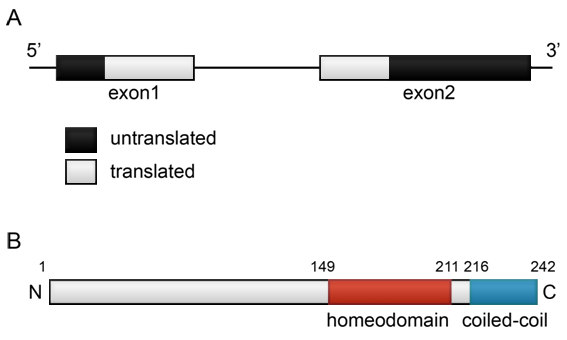
Figure 1. A. Schematic representation of human HOXC8 gene. B. Human HOXC8 protein with the indicated position of homeodomain (red color) and coiled-coil (blue color).
Description
The HOXC8 gene is 3658 nucleotide long and consists of two exons. There are 112 known SNPs in HOXC8 gene and most of them locate on the 5 end of the gene.
Transcription
The transcribed matured mRNA is 2290 nucleotide in length.
Transcription regulators: 1) CDX1, which is a member of the caudal-related homeobox transcription factor gene family, activates HOXC8 transcription by binding to its early enhancer (Schyr et al., 2012). 2) Activating protein 2 delta (AP2δ) transcription factor, which is one of AP2 five family members (AP2α, AP2β, AP2γ, AP2δ and AP2ε), recruits Ash2I and ALR to the HOXC8 locus, resulting in H3K4me3-mediated gene activation (Tan et al., 2008). 3) Menin, which is a tumor suppressor gene associated with a syndrome known as multiple endocrine neoplasia type 1, binds to HOXC8 locus by associating with a histone methyltransferase complex containing two trithorax family proteins, MLL2 and Ash2L (MacConaill et al., 2006). 4) GTF2IRD1, which is a TFII-I family of transcription factors, interacts with HOXC8 early enhancer and represses the gene transcription (Thompson et al., 2007).
Transcription regulators: 1) CDX1, which is a member of the caudal-related homeobox transcription factor gene family, activates HOXC8 transcription by binding to its early enhancer (Schyr et al., 2012). 2) Activating protein 2 delta (AP2δ) transcription factor, which is one of AP2 five family members (AP2α, AP2β, AP2γ, AP2δ and AP2ε), recruits Ash2I and ALR to the HOXC8 locus, resulting in H3K4me3-mediated gene activation (Tan et al., 2008). 3) Menin, which is a tumor suppressor gene associated with a syndrome known as multiple endocrine neoplasia type 1, binds to HOXC8 locus by associating with a histone methyltransferase complex containing two trithorax family proteins, MLL2 and Ash2L (MacConaill et al., 2006). 4) GTF2IRD1, which is a TFII-I family of transcription factors, interacts with HOXC8 early enhancer and represses the gene transcription (Thompson et al., 2007).
Proteins
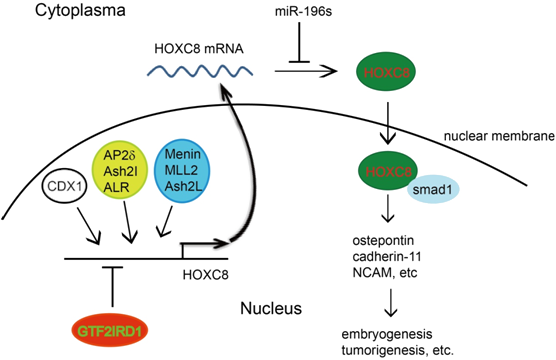
Figure 2. HOXC8 transcription can be regulated by CDX1, AP2d, menin and GTF2IRD1, respectively. The translation of HOXC8 protein can be blocked by the binding of miR-196s to its 3UTR. As a transcription factor, HOXC8 is involved in the transcription of a variety of genes implicated in embryogenesis and tumorigenesis.
Description
HOXC8 protein contains 242 amino acids and is 27755 Da. HOXC8 contains a ~60 amino acid homeodomain with helix-turn-helix (HTH) motif which functions as a DNA binding domain. HOXC8 binds to DNA as monomers or homo- and/or heterodimers in a sequence-specific manner.
Expression
In mouse embryogenesis: HOXC8 is expressed in the neural tube and somatic mesoderm as well as in the prospective thorax. During embryogenesis, Hoxc8 is initially expressed with the identical boundaries in the mesoderm and neurectoderm. Subsequently, Hoxc8 expression creeps forward and the boundaries in mesoderm and neural tube diverge. The gene is also expressed in both the neural tube and the somites in the prospective thorax (Pollock et al., 1992; Shashikant and Ruddle, 1996).
Cancers: Elevated HOXC8 expression is detected in breast cancer (Li et al., 2014; Li et al., 2010), cervical cancer (Alami et al., 1999), prostate cancer (Waltregny et al., 2002), esophageal cancer (Du et al., 2014), pancreatic cancer (Adwan et al., 2011).
Organs: HOXC8 is expressed in hematopoietic organs, brain, breast, placenta, liver, bone marrow, kidney, intestine and nervous systems, etc.
Cell types: HOXC8 is expressed on a variety of cell types, including fibroblasts, neurons, hair, adipose, skeletal and smooth muscle cells, lymph T cells, endothelial and epithelial cells, mesenchymal and stem cells, etc.
Translation regulation: Members of microRNA 196 family (miR-196a1, miR-196a2 and miR-196b) can bind to the 3-UTR of HOXC8 mRNA, leading to the repression of HOXC8 translation (Li et al., 2010).
Cancers: Elevated HOXC8 expression is detected in breast cancer (Li et al., 2014; Li et al., 2010), cervical cancer (Alami et al., 1999), prostate cancer (Waltregny et al., 2002), esophageal cancer (Du et al., 2014), pancreatic cancer (Adwan et al., 2011).
Organs: HOXC8 is expressed in hematopoietic organs, brain, breast, placenta, liver, bone marrow, kidney, intestine and nervous systems, etc.
Cell types: HOXC8 is expressed on a variety of cell types, including fibroblasts, neurons, hair, adipose, skeletal and smooth muscle cells, lymph T cells, endothelial and epithelial cells, mesenchymal and stem cells, etc.
Translation regulation: Members of microRNA 196 family (miR-196a1, miR-196a2 and miR-196b) can bind to the 3-UTR of HOXC8 mRNA, leading to the repression of HOXC8 translation (Li et al., 2010).
Localisation
Nucleus.
Function
HOXC8 serves as a transcription factor to regulate the expression of genes that are implicated in skeletal and neural development in embryogenesis and cancer progression.
Embryogenesis: Like other HOX proteins, HOXC8 plays an essential role in embryo anterior-posterior patterning and is responsible for skeletal and neural development (Juan et al., 2006; Thickett and Morgan, 2002). Null mutants of HOXC8 show neuromuscular defects in the forelimb and skeletal defects in the ribs and vertebrae of the thorax (Le Mouellic et al., 1992). Overexpression of a Hoxc8 transgene has been shown to cause cartilage defects by inhibiting the maturation and stimulating the proliferation of chondrocytes (Yueh et al., 1998).
Transcriptional regulation: As a transcription factor, microarray data indicate that HOXC8 regulates the expression of genes that are involved in cell proliferation, migration, adhesion, and differentiation (Lei et al., 2005). In response to bone morphogenetic protein (BMP) stimulation, HOXC8 activates the transcription of osteopontin (OPN) by interacting with Smad1 (Shi et al., 1999). In breast cancer cells, HOXC8 functions as a transcription factor to regulate cadherin 11 (Cdh11) transcription (Li et al., 2014; Li et al., 2011). ChIP assays demonstrate that HOXC8 can bind to the promoter of target genes including NCAM (neural cell adhesion molecule), PEDF (pigment epithelium-derived factor), ZAC1 (the zinc finger protein regulator of apoptosis) and PCNA (proliferating cell nuclear antigen) (Lei et al., 2006; Min et al., 2010). In addition, HOXC8 has also been identified as a transcription repressor. For instance, HOXC8 can downregulate the expression of Mgl1 and Smad6 by directly binding to the promoter regions of these 2 genes (Kang et al., 2010; Ruthala et al., 2011).
Stem cells: HOXC8 is expressed in vascular wall-resident multi-potent stem cells (VW-MPSCs), and silencing its expression significantly reduces cell sprouting capacity and increases expression of the smooth muscle cells marker genes (Klein et al., 2013).
Cancers: HOXC8 plays an essential role in cancer development, including breast, prostate, cervical and pancreatic cancers by facilitating cell migration and invasion (Adwan et al., 2011; Alami et al., 1999; Axlund et al., 2010; Du et al., 2014; Li et al., 2010).
Embryogenesis: Like other HOX proteins, HOXC8 plays an essential role in embryo anterior-posterior patterning and is responsible for skeletal and neural development (Juan et al., 2006; Thickett and Morgan, 2002). Null mutants of HOXC8 show neuromuscular defects in the forelimb and skeletal defects in the ribs and vertebrae of the thorax (Le Mouellic et al., 1992). Overexpression of a Hoxc8 transgene has been shown to cause cartilage defects by inhibiting the maturation and stimulating the proliferation of chondrocytes (Yueh et al., 1998).
Transcriptional regulation: As a transcription factor, microarray data indicate that HOXC8 regulates the expression of genes that are involved in cell proliferation, migration, adhesion, and differentiation (Lei et al., 2005). In response to bone morphogenetic protein (BMP) stimulation, HOXC8 activates the transcription of osteopontin (OPN) by interacting with Smad1 (Shi et al., 1999). In breast cancer cells, HOXC8 functions as a transcription factor to regulate cadherin 11 (Cdh11) transcription (Li et al., 2014; Li et al., 2011). ChIP assays demonstrate that HOXC8 can bind to the promoter of target genes including NCAM (neural cell adhesion molecule), PEDF (pigment epithelium-derived factor), ZAC1 (the zinc finger protein regulator of apoptosis) and PCNA (proliferating cell nuclear antigen) (Lei et al., 2006; Min et al., 2010). In addition, HOXC8 has also been identified as a transcription repressor. For instance, HOXC8 can downregulate the expression of Mgl1 and Smad6 by directly binding to the promoter regions of these 2 genes (Kang et al., 2010; Ruthala et al., 2011).
Stem cells: HOXC8 is expressed in vascular wall-resident multi-potent stem cells (VW-MPSCs), and silencing its expression significantly reduces cell sprouting capacity and increases expression of the smooth muscle cells marker genes (Klein et al., 2013).
Cancers: HOXC8 plays an essential role in cancer development, including breast, prostate, cervical and pancreatic cancers by facilitating cell migration and invasion (Adwan et al., 2011; Alami et al., 1999; Axlund et al., 2010; Du et al., 2014; Li et al., 2010).
Implicated in
Entity name
Breast cancer
Note
Elevated expression of HOXC8 is found in invasive breast cell lines when compared with noninvasive breast cell lines. Immunohistochemistry staining shows that the level of HOXC8 is higher in breast cancer tissues than normal breast tissues (Li et al., 2010). Ectopic HOXC8 expression induces Cdh11 expression and promotes breast tumorigenesis (Li et al., 2012). Importantly, forced Cdh11 expression reverses the inhibitory effect in breast tumorigenesis elicited by HOXC8 knockdown (Li et al., 2014). Moreover, the analysis of publically available human breast tumor microarray gene expression database demonstrates a strong positive linear association between HOXC8 and CDH11 expression (R = 0.801, p < 0.001). Survival analysis (Kaplan-Meier method, log-rank test) show that both high HOXC8 and CDH11 expression correlates with poor recurrence-free survival rate of patients (Li et al., 2014). Together, these findings suggest that HOXC8 promotes breast tumorigenesis by maintaining high level of CDH11 expression in breast cancer cells.
Entity name
Prostate cancer
Note
HOXC8 is upregulated in primary prostate tumors, lymph node metastases and malignant prostate cell lines. HOXC8 overexpression has also been found to be correlated with loss of differentiation in prostate cancer cell lines and higher Gleason grade in prostate tissues. These observations suggest that HOXC8 plays a role in the acquisition of invasion and metastasis of prostate cancer (Miller et al., 2003; Waltregny et al., 2002).
Entity name
Pancreatic cancer
Note
In human pancreatic cancer cell lines, the level of HOXC8 mRNA is inversely related to their growth. Down-regulation of HOXC8 expression causes increased proliferation, migration and colony formation, which indicates that HOXC8 is a negative regulator of pancreatic cancer cell growth and metastasis. In primary and metastatic tumor samples, immunohistochemistry staining shows that grading of primary carcinomas is negatively associated with the extent and intensity of HOXC8 staining (Adwan et al., 2011).
Entity name
Cervical cancer
Note
The expression of HOXC8 is turned in in human cervical cancer cells while is off in normal cervical keratinocytes. This observation indicates that HOXC8 is probably involved in the process of cervical keratinocytes transformation (Alami et al., 1999).
Entity name
Esophageal cancer
Note
Immunohistochemistry staining of 274 patients tissues with esophageal squamous cell carcinoma (ESCC) show that HOXC8 expression has a strong correlation with 5-year survival rate and increases significantly from TNM (tumor & regional lymph node & metastasis) stage I to TNM stage III. This study indicates that HOXC8 expression may be used as prognostic markers in patients with ESCC (Du et al., 2014).
Article Bibliography
| Pubmed ID | Last Year | Title | Authors |
|---|---|---|---|
| 21712827 | 2011 | Expression of HOXC8 is inversely related to the progression and metastasis of pancreatic ductal adenocarcinoma. | Adwan H et al |
| 10208853 | 1999 | HOXC5 and HOXC8 expression are selectively turned on in human cervical cancer cells compared to normal keratinocytes. | Alami Y et al |
| 21047772 | 2010 | HOXC8 inhibits androgen receptor signaling in human prostate cancer cells by inhibiting SRC-3 recruitment to direct androgen target genes. | Axlund SD et al |
| 12713673 | 2003 | Normal proliferation and differentiation of Hoxc-8 transgenic chondrocytes in vitro. | Cormier SA et al |
| 24525058 | 2014 | The survival predictive significance of HOXC6 and HOXC8 in esophageal squamous cell carcinoma. | Du YB et al |
| 16831908 | 2006 | Multiple roles of hoxc8 in skeletal development. | Juan AH et al |
| 19071237 | 2009 | Morpholino-mediated knockdown in primary chondrocytes implicates Hoxc8 in regulation of cell cycle progression. | Kamel S et al |
| 20016939 | 2010 | Hoxc8 represses BMP-induced expression of Smad6. | Kang M et al |
| 24145756 | 2013 | Hox genes are involved in vascular wall-resident multipotent stem cell differentiation into smooth muscle cells. | Klein D et al |
| 1348969 | 1992 | Homeosis in the mouse induced by a null mutation in the Hox-3.1 gene. | Le Mouellic H et al |
| 16793922 | 2006 | Identification of a Hoxc8-regulated transcriptional network in mouse embryo fibroblast cells. | Lei H et al |
| 15699330 | 2005 | The identification of Hoxc8 target genes. | Lei H et al |
| 24810778 | 2014 | HOXC8 promotes breast tumorigenesis by transcriptionally facilitating cadherin-11 expression. | Li Y et al |
| 22593800 | 2011 | HOXC8-Dependent Cadherin 11 Expression Facilitates Breast Cancer Cell Migration through Trio and Rac. | Li Y et al |
| 20736365 | 2010 | Ratio of miR-196s to HOXC8 messenger RNA correlates with breast cancer cell migration and metastasis. | Li Y et al |
| 17050672 | 2006 | Phosphorylation of the menin tumor suppressor protein on serine 543 and serine 583. | MacConaill LE et al |
| 14522913 | 2003 | Aberrant HOXC expression accompanies the malignant phenotype in human prostate. | Miller GJ et al |
| 20097160 | 2010 | Proliferating cell nuclear antigen (Pcna) as a direct downstream target gene of Hoxc8. | Min H et al |
| 1360875 | 1992 | Altering the boundaries of Hox3.1 expression: evidence for antipodal gene regulation. | Pollock RA et al |
| 21773674 | 2011 | Hoxc8 downregulates Mgl1 tumor suppressor gene expression and reduces its concomitant function on cell adhesion. | Ruthala K et al |
| 22426122 | 2012 | Cdx1 is essential for the initiation of HoxC8 expression during early embryogenesis. | Schyr RB et al |
| 8901587 | 1996 | Combinations of closely situated cis-acting elements determine tissue-specific patterns and anterior extent of early Hoxc8 expression. | Shashikant CS et al |
| 10224145 | 1999 | Smad1 interacts with homeobox DNA-binding proteins in bone morphogenetic protein signaling. | Shi X et al |
| 18495928 | 2008 | Transcription factor Ap2delta associates with Ash2l and ALR, a trithorax family histone methyltransferase, to activate Hoxc8 transcription. | Tan CC et al |
| 12617829 | 2002 | Hoxc-8 expression shows left-right asymmetry in the posterior lateral plate mesoderm. | Thickett C et al |
| 17346708 | 2007 | GTF2IRD1 regulates transcription by binding an evolutionarily conserved DNA motif 'GUCE'. | Thompson PD et al |
| 11813208 | 2002 | Overexpression of the homeobox gene HOXC8 in human prostate cancer correlates with loss of tumor differentiation. | Waltregny D et al |
| 9707582 | 1998 | Evidence for regulation of cartilage differentiation by the homeobox gene Hoxc-8. | Yueh YG et al |
Other Information
Locus ID:
NCBI: 3224
MIM: 142970
HGNC: 5129
Ensembl: ENSG00000037965
Variants:
dbSNP: 3224
ClinVar: 3224
TCGA: ENSG00000037965
COSMIC: HOXC8
RNA/Proteins
| Gene ID | Transcript ID | Uniprot |
|---|---|---|
| ENSG00000037965 | ENST00000040584 | P31273 |
Expression (GTEx)
Protein levels (Protein atlas)
References
| Pubmed ID | Year | Title | Citations |
|---|---|---|---|
| 38348790 | 2024 | Human papillomavirus type 16 E7 promotes cell viability and migration in cervical cancer by regulating the miR-23a/HOXC8 axis. | 0 |
| 38531796 | 2024 | DNA Methylation-Regulated HOXC8's Role in HER2-Positive Breast Cancer Function and its Contribution to Herceptin Resistance. | 0 |
| 38641828 | 2024 | N6-methyladenosine-modified circSLCO1B3 promotes intrahepatic cholangiocarcinoma progression via regulating HOXC8 and PD-L1. | 0 |
| 38348790 | 2024 | Human papillomavirus type 16 E7 promotes cell viability and migration in cervical cancer by regulating the miR-23a/HOXC8 axis. | 0 |
| 38531796 | 2024 | DNA Methylation-Regulated HOXC8's Role in HER2-Positive Breast Cancer Function and its Contribution to Herceptin Resistance. | 0 |
| 38641828 | 2024 | N6-methyladenosine-modified circSLCO1B3 promotes intrahepatic cholangiocarcinoma progression via regulating HOXC8 and PD-L1. | 0 |
| 36308681 | 2023 | HOXC8 alleviates high glucose-triggered damage of trophoblast cells during gestational diabetes mellitus via activating TGFβ1-mediated Notch1 pathway. | 0 |
| 36308681 | 2023 | HOXC8 alleviates high glucose-triggered damage of trophoblast cells during gestational diabetes mellitus via activating TGFβ1-mediated Notch1 pathway. | 0 |
| 34763232 | 2021 | HOXC6/8/10/13 predict poor prognosis and associate with immune infiltrations in glioblastoma. | 5 |
| 34763232 | 2021 | HOXC6/8/10/13 predict poor prognosis and associate with immune infiltrations in glioblastoma. | 5 |
| 32246725 | 2020 | Homeobox C8 inhibited the osteo-/dentinogenic differentiation and migration ability of stem cells of the apical papilla via activating KDM1A. | 10 |
| 32772270 | 2020 | MiR-148a-3p may contribute to flawed decidualization in recurrent implantation failure by modulating HOXC8. | 8 |
| 32877504 | 2020 | An Integrated Genomic Approach Identifies HOXC8 as an Upstream Regulator in Ovarian Endometrioma. | 8 |
| 32246725 | 2020 | Homeobox C8 inhibited the osteo-/dentinogenic differentiation and migration ability of stem cells of the apical papilla via activating KDM1A. | 10 |
| 32772270 | 2020 | MiR-148a-3p may contribute to flawed decidualization in recurrent implantation failure by modulating HOXC8. | 8 |
Citation
Shuang Huang ; Yong Li
HOXC8 (homeobox C8)
Atlas Genet Cytogenet Oncol Haematol. 2014-07-01
Online version: http://atlasgeneticsoncology.org/gene/45912/hoxc8-(homeobox-c8)
