GLS2 (Glutaminase 2)
2019-04-01 José A Campos-Sandoval , Mercedes Martín-Rufián , Javier Márquez AffiliationIdentity
Abstract
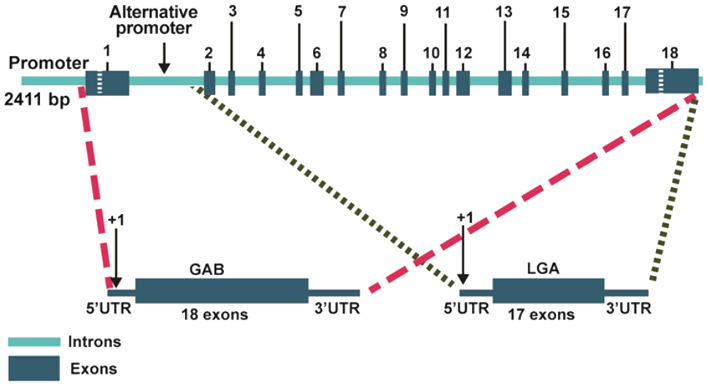
Mammalian glutaminases are encoded by two paralogous genes, Gls and Gls2, presumably derived by gene duplication of a common ancestor. Each gene codes for two different isoforms. The two transcripts of Gls2, named GAB and LGA, arise through a surrogate promoter usage mechanism. In certain types of malignancies, such as glioblastoma and liver cancers, expression of GLS2 gene is repressed by promoter hypermethylation, which could contribute to the malignant process. The finding that ectopic expression of GLS2 could inhibit proliferation of these tumors led to the hypothesis that this isoenzyme, a transcriptional target of TP53, might play a role as tumor suppressor, in opposition to GLS, regulated by oncogenes and associated to tumorigenesis. However, recent findings indicate that GLS2 is upregulated in some types of cancer (NMYC-amplified neuroblastoma, cervical, colon and lung cancers) and this upregulation paradoxically correlates with poor clinical outcomes.
DNA/RNA
Description
Transcription
The molecular basis for GLS2 regulation is now starting to be uncovered. GLS2 has been identified as a transcriptional target of tumor suppressor TP53 that mediates its new revealed functions in tumor metabolism and antioxidant defense, under both non-stressed and stressed conditions. This tumor suppressor directly associates with response elements in the GLS2 promoter (Hu et al., 2010; Suzuki et al., 2010). Cells with heightened GLS2 levels showed increased production of glutamate and alpha-ketoglutarate, which resulted in enhanced oxydative phosphorylation, higher GSH/GSSG ratios and decreased reactive oxygen species (ROS) levels, which provided protection against ROS induced apoptosis (Hu et al., 2010; Suzuki et al., 2010). Two other transcription factors belonging to the TP53 family, TP73 and TP63, also drive the expression of GLS2 during neuronal differentiation of neuroblastoma cells after induction with retinoic acid (Velletri et al., 2013) and during epidermal differentiation and in cancer cells exposed to oxidative stress (Giacobbe et al., 2013), respectively. The GLS2 downregulation observed in liver and colon cancer cell lines and in hepatocellular carcinoma has been attributed to its promoter hypermethylation, a mechanism that has been proposed as a marker to identify novel tumor suppressor genes. Chemical demethylation treatment increased the GLS2 mRNA levels in these cells (Zhang et al., 2013; Liu et al., 2014). This mechanism is also responsible for the GLS2 silencing detected in highly malignant glioblastomas, and occurs regardless of their TP53 status (Szeliga et al., 2016). Other factors that regulate GLS2 expression are the MYCN oncoprotein (v-myc avian myelocytomatosis viral oncogene neuroblastoma derived homolog, encoded by MYCN gene) and the NR5A2 (nuclear receptor subfamily 5 group A member 2), also known as LRH-1 (liver receptor homolog 1). MYCN, an essential MYC family member, directly activates GLS2 transcription in MYCN-amplified neuroblastoma cells. Depletion of MYCN expression by short hairpin RNA caused a pronounced decrease in GLS2 (but not GLS) levels in these cells. Conversely, inhibition of TP53 had no effect on GLS2 induction (Xiao et al., 2015). In hepatoma cells, GLS2 is subjected to direct transcriptional regulation by NR5A2. Silencing of NR5A2 mediated by small interfering RNA reduced GLS2 transcript and protein levels (Xu et al., 2016). Long non-coding RNA (lncRNA) and microRNAs (miRNAs) are also implicated in GLS2 regulation. The lncRNA urothelial carcinoma-associated 1 ( UCA1) regulates GLS2 expression levels through interfering with MIR16-1, which binds to the 3-UTR (untranslated region) of GLS2 mRNA (Li et al., 2016).
Pseudogene
Proteins
Description
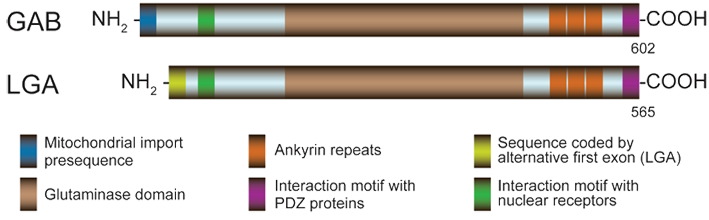
Structure: human GAB transcript (ORF: 1809 nt) codes a 602-residues protein, with a predicted molecular mass of 66.3 kDa. Human LGA transcript (ORF: 1698 nt) codes a 565-residues protein, with a predicted molecular mass of 62.5 kDa. The precursor of human LGA isoform lacks the first 61 residues of GAB precursor (coded by exon 1), but it displays an additional extension of 24 novel residues at the N-terminus coded by an alternative first exon. This extension and the first six amino acids coded by exon 2 are not present in its rat and mouse counterparts (Martèn-Rufián et al., 2012). GLS2 contains a central glutaminase domain of approximately 300 residues, which belongs to the beta lactamase/transpeptidase-like superfamily, and three ankyrin repeats at the C-terminal region (Pasquali et al., 2017). The ankyrin repeats are protein-protein interaction modules of 33 residues that have been found in many important proteins such as transcriptional factors, cell cycle regulators, cytoskeletal organizers, etc. (Sedgwick and Smerdon, 1999; Mosavi et al., 2004). At its C-terminal end there is a consensus sequence of four residues required for specific interaction with PDZ (postsynaptic density protein, disc large, zona occludens) proteins (Olalla et al., 2001). The N-terminal end (first 14 residues) of GAB precursor contains a putative mitochondrial import presequence (Gómez-Fabre et al., 2000). It is worth mentioning the presence of a consensus LXXLL motif of interaction with nuclear receptors at N-terminal region of GLS2 (Olalla et al., 2002). It is in the regions involved with organelle targeting (exon 1) and protein-protein interactions (exon 18) that the main differences between GAB and kydney-type glutaminase reside (Pérez-Gómez et al., 2003). Studies on processing and molecular structure of native GLS2 protein are lacking. An apparent subunit molecular mass of 57-58 kDa for the rat liver isoform was determined by denaturing gel electrophoresis of purified protein (Heini et al., 1987; Smith and Watford, 1988). Sequencing by Edman degradation of the mature form of human GAB expressed in baculovirus system showed cleavage between amino acids 38-39 and 39-40 of the deduced protein sequence. These cleavages are consistent with known substrate sites for the mitochondrial processing peptidase (MPP), having an Arg residue at position -2 or -3. Nevertheless, processing in baculovirus system may somehow differ from the native processing in mammals (Campos-Sandoval et al., 2007). The molecular mass (Mr) of native GLS2 has not been determined accurately. Smith and Watford (1988) reported an Mr of ≥ 300000 from HPLC gel filtration but obtained a value of 162000 by sucrose gradient centrifugation, regardless of phosphate concentration (5 or 100 mM).
Kinetic properties: the distinct kinetic behavior of mammalian kydney-type and liver-type isoenzymes was first noted by Krebs (1935). In contrast with kydney-type isoenzyme, the rat liver-type glutaminase showed a lower dependence on the activator inorganic phosphate (Pi), lower affinity for the substrate glutamine, lack of inhibition by glutamate (up to 50 mM) and a requirement for ammonia as an obligatory activator (Verhoeven et al., 1983; Patel and McGivan, 1984; Smith and Watford, 1988). The only human GLS2 protein characterized in a purified form is the recombinant GAB expressed in insect cells. It showed an allosteric behavior (Hill index of 2.7) with low affinity for glutamine (S0.5 values of 32 and 64 mM for high (150 mM) and low (5 mM) Pi, respectively), and low dependence for Pi as expected for a GLS2 isoenzyme. Surprisingly, GAB was inhibited by glutamate, a characteristic only shown by GLS isoforms, with an IC50 value of 50 mM at low Pi concentrations (5 mM) and suboptimal glutamine concentration (20 mM), and scarcely activated by ammonia (Campos-Sandoval et al., 2007).
Post-translational modifications: several acetylated and succinylated lysine residues have been identified in GLS2 by large-scale proteomic approaches (Rardin et al., 2013; Park et al., 2013).
Expression
Localisation
Function
Interacting partners: the first protein-interacting partners of GLS2 were discovered by two-hybrid genetic screening of a human brain cDNA library, using the C-terminal region of GLS2 as bait. Two PDZ domain-containing proteins were isolated: SNTA1 (alpha 1-syntrophin) and TAX1BP3 (Tax1-binding protein 3, also known as Tax-interacting protein 1 (TIP-1) or glutaminase-interacting protein (GIP)). The C-terminal end of human GLS2, -ESMV, matches the consensus sequence X-Ser/Thr-X-Val required for interaction with PDZ proteins (Olalla et al., 2001). A dissociation constant of 1.66 μM was determined for the GLS2-GIP binding, which indicates a moderate affinity suitable for regulatory functions (Banerjee et al., 2008). Two recent findings have revealed the important role that GLS2 plays in tumor suppression through its interactions with other proteins in a glutaminase activity independent manner. GLS2 binds through its C-terminal region to RAC1 (Rac family small GTPase 1), a critical promoter of metastasis frequently activated in several types of cancer, and inhibits its activation by guanine-nucleotide exchange factors (GEFs). Thus, as a direct target of TP53, GLS2 mediates TP 53s function in metastasis suppression (Zhang et al., 2016). GLS2 also binds to and stabilizes DICER1, a key component of the microRNAs processing machinery, promoting MIR34A maturation. Upregulation of this miRNA represses metastasis in hepatoma cells through expression inhibition of SNAI1 (snail family transcriptional repressor 1), a transcriptional repressor of cadherin 1 ( CDH1, also known as E-cadherin) (Kuo et al., 2016).
Implicated in
Article Bibliography
| Pubmed ID | Last Year | Title | Authors |
|---|---|---|---|
| 11130979 | 2000 | Identification of two human glutaminase loci and tissue-specific expression of the two related genes. | Aledo JC et al |
| 18690705 | 2008 | Probing the structure and function of human glutaminase-interacting protein: a possible target for drug design. | Banerjee M et al |
| 12758143 | 2003 | Expression of recombinant human L-glutaminase in Escherichia coli: polyclonal antibodies production and immunological analysis of mouse tissues. | Campos JA et al |
| 25837287 | 2015 | Glutaminases in brain: Multiple isoforms for many purposes. | Campos-Sandoval JA et al |
| 25297978 | 2015 | Expression of Gls and Gls2 glutaminase isoforms in astrocytes. | Cardona C et al |
| 14722097 | 2004 | Granule localization of glutaminase in human neutrophils and the consequence of glutamine utilization for neutrophil activity. | Castell L et al |
| 27079415 | 2016 | The combination of three molecular markers can be a valuable predictive tool for the prognosis of hepatocellular carcinoma patients. | Chen SS et al |
| 9164856 | 1997 | Rat hepatic glutaminase: identification of the full coding sequence and characterization of a functional promoter. | Chung-Bok MI et al |
| 10620514 | 2000 | Molecular cloning, sequencing and expression studies of the human breast cancer cell glutaminase. | Gómez-Fabre PM et al |
| 23574722 | 2013 | p63 regulates glutaminase 2 expression. | Giacobbe A et al |
| 3830157 | 1987 | Purification and characterization of rat liver glutaminase. | Heini HG et al |
| 20378837 | 2010 | Glutaminase 2, a novel p53 target gene regulating energy metabolism and antioxidant function. | Hu W et al |
| 954714 | 1976 | A comparative study of glytaminase isozymes in rat tissues. | Huang YZ et al |
| 16745865 | 1935 | Metabolism of amino-acids: The synthesis of glutamine from glutamic acid and ammonia, and the enzymic hydrolysis of glutamine in animal tissues. | Krebs HA et al |
| 27725225 | 2016 | Glutaminase 2 stabilizes Dicer to repress Snail and metastasis in hepatocellular carcinoma cells. | Kuo TC et al |
| 25026281 | 2014 | Discovery of selective inhibitors of Glutaminase-2, which inhibit mTORC1, activate autophagy and inhibit proliferation in cancer cells. | Lee YZ et al |
| 26373319 | 2015 | Long non-coding RNA UCA1 promotes glutamine metabolism by targeting miR-16 in human bladder cancer. | Li HJ et al |
| 24797434 | 2014 | Glutaminase 2 negatively regulates the PI3K/AKT signaling and shows tumor suppression activity in human hepatocellular carcinoma. | Liu J et al |
| 27885629 | 2016 | Glutaminases. | Márquez J et al |
| 30669455 | 2019 | Transfection with GLS2 Glutaminase (GAB) Sensitizes Human Glioblastoma Cell Lines to Oxidative Stress by a Common Mechanism Involving Suppression of the PI3K/AKT Pathway. | Majewska E et al |
| 24276018 | 2014 | Both GLS silencing and GLS2 overexpression synergize with oxidative stress against proliferation of glioma cells. | Martín-Rufián M et al |
| 15152081 | 2004 | The ankyrin repeat as molecular architecture for protein recognition. | Mosavi LK et al |
| 11163757 | 2001 | The C-terminus of human glutaminase L mediates association with PDZ domain-containing proteins. | Olalla L et al |
| 12163477 | 2002 | Nuclear localization of L-type glutaminase in mammalian brain. | Olalla L et al |
| 12444921 | 2003 | Genomic organization and transcriptional analysis of the human l-glutaminase gene. | Pérez-Gómez C et al |
| 23806337 | 2013 | SIRT5-mediated lysine desuccinylation impacts diverse metabolic pathways. | Park J et al |
| 28526749 | 2017 | The origin and evolution of human glutaminases and their atypical C-terminal ankyrin repeats. | Pasquali CC et al |
| 6743288 | 1984 | Partial purification and properties of rat liver glutaminase. | Patel M et al |
| 23576753 | 2013 | Label-free quantitative proteomics of the lysine acetylome in mitochondria identifies substrates of SIRT3 in metabolic pathways. | Rardin MJ et al |
| 30871151 | 2019 | Multiomics Analysis Reveals that GLS and GLS2 Differentially Modulate the Clinical Outcomes of Cancer. | Saha SK et al |
| 10431175 | 1999 | The ankyrin repeat: a diversity of interactions on a common structural framework. | Sedgwick SG et al |
| 3277537 | 1988 | Rat hepatic glutaminase: purification and immunochemical characterization. | Smith EM et al |
| 20351271 | 2010 | Phosphate-activated glutaminase (GLS2), a p53-inducible regulator of glutamine metabolism and reactive oxygen species. | Suzuki S et al |
| 26258493 | 2016 | Downregulation of GLS2 in glioblastoma cells is related to DNA hypermethylation but not to the p53 status. | Szeliga M et al |
| 19062176 | 2009 | Transfection with liver-type glutaminase cDNA alters gene expression and reduces survival, migration and proliferation of T98G glioma cells. | Szeliga M et al |
| 15663956 | 2005 | Lack of expression of the liver-type glutaminase (LGA) mRNA in human malignant gliomas. | Szeliga M et al |
| 22888977 | 2012 | Transfection of a human glioblastoma cell line with liver-type glutaminase (LGA) down-regulates the expression of DNA-repair gene MGMT and sensitizes the cells to alkylating agents. | Szeliga M et al |
| 12408749 | 2003 | Glutaminase isoform expression in cell lines derived from human colorectal adenomas and carcinomas. | Turner A et al |
| 24121663 | 2013 | GLS2 is transcriptionally regulated by p73 and contributes to neuronal differentiation. | Velletri T et al |
| 6852030 | 1983 | Control of rat-liver glutaminase by ammonia and pH. | Verhoeven AJ et al |
| 8262331 | 1993 | Hepatic glutaminase expression: relationship to kidney-type glutaminase and to the urea cycle. | Watford M et al |
| 23954443 | 2013 | Knock-down of glutaminase 2 expression decreases glutathione, NADH, and sensitizes cervical cancer to ionizing radiation. | Xiang L et al |
| 25915584 | 2015 | Targeted inhibition of tumor-specific glutaminase diminishes cell-autonomous tumorigenesis. | Xiang Y et al |
| 26528759 | 2015 | Myc promotes glutaminolysis in human neuroblastoma through direct activation of glutaminase 2. | Xiao D et al |
| 27298334 | 2016 | LRH-1-dependent programming of mitochondrial glutamine processing drives liver cancer. | Xu P et al |
| 22326218 | 2012 | The metabolic profile of tumors depends on both the responsible genetic lesion and tissue type. | Yuneva MO et al |
| 26751560 | 2016 | Glutaminase 2 is a novel negative regulator of small GTPase Rac1 and mediates p53 function in suppressing metastasis. | Zhang C et al |
| 24330717 | 2013 | Epigenetic silencing of glutaminase 2 in human liver and colon cancers. | Zhang J et al |
Citation
José A Campos-Sandoval ; Mercedes Martín-Rufián ; Javier Márquez
GLS2 (Glutaminase 2)
Atlas Genet Cytogenet Oncol Haematol. 2019-04-01
Online version: http://atlasgeneticsoncology.org/gene/46328/gls2-%28glutaminase-2%29
Historical Card
2015-12-01 GLS2 (Glutaminase 2) by José A Campos-Sandoval,Mercedes Martín-Rufián,Javier Márquez Affiliation
