PTBP1 (polypyrimidine tract binding protein 1)
2012-02-01 Laura Fontana AffiliationDepartment of Medicine, Surgery, Dentistry, Medical Genetics, Universita degli Studi di Milano, Italy
Identity
HGNC
LOCATION
19p13.3
LOCUSID
ALIAS
HNRNP-I,HNRNPI,HNRPI,PTB,PTB-1,PTB-T,PTB2,PTB3,PTB4,pPTB
FUSION GENES
DNA/RNA
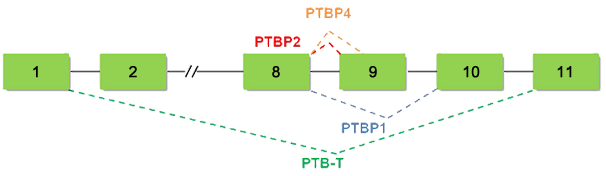
Shematic representation of PTB mRNA alternative splicing. Alternative splicing of PTB mRNA, as described below, originates four isoforms. Green boxes represent exons and thin black lines represent introns (not to scale).
Description
The PTBP1 locus spans 14936 bases on the short arm of chromosome 19 and is composed of 14 exons.
Transcription
PTBP1 results from skipping of exon 9 (3203 bp mRNA and 531 amino acid protein). Three additional isoforms are generated by alternative splicing: PTBP2 (3260 bp mRNA and 550 amino acid protein) and PTBP4 (3281 mRNA protein and 557 amino acid protein) derive from exon 9 inclusion using two alternative 3 splice sites, while PTB-T has been reported to result from alternative splicing of exons 2-10 (Sawicka et al., 2004).
Pseudogene
PTBP1P (polypyrimidine tract binding protein 1 pseudogene), chromosome location 14q23.3, starts at 65745938 and ends at 65748375 bp from pter (according to hg19-Feb_2009).
Proteins
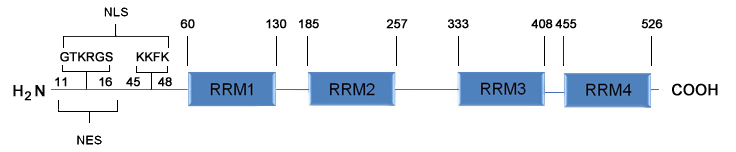
Schematic representation of PTBP1 protein structure. Each RNA recognition motif (RRM) has different binding affinity for pyrimidine-rich sequences on mRNA. The N-terminal domain encloses partially overlapping nuclear localisation (NLS) and export signals (NES). Blue boxes representing RRMs are not drawn to scale.
Description
57 kDa protein belonging to the heterogeneous nuclear ribonucleoprotein family (hnRNP). PTBP1 has four RNA recognition motifs (RRMs) and a conserved N-terminal domain that harbors both nuclear localisation and export signals (NLS and NES). Through the RRMs, PTBP1 binds to the transcript at multiple sites within large pyrimidine tracts leading to conformational changes suitable for functional mRNA processing (Sawicka et al., 2004).
Expression
PTBP1 is ubiquitously expressed in human tissues emerging as a pleiotropic splicing regulator. PTBP1 expression levels have been associated with myoblast and neural precursor differentiation through specific modulation of the splicing pattern (Clower et al., 2010). In the brain, in particular, the switch from PTBP1 to nPTB expression drives the differentiation towards the neuronal lineage: PTBP1 is expressed in neural precursors and glial cells, while post-mitotic neurons express only nPTB (Boutz et al., 2007). Recently a strong PTBP1 expression has been found in embryonic stem cells, particularly those in the brain cortex and subventricular zone, where PTBP1 appears essential for cell division after implantation (Shibayama et al., 2009; Suckale et al., 2011).
Localisation
PTBP1 shuttles between the nucleus and the cytoplasm. Cytoplasmic localisation is mainly achieved by PKA-mediated phosphorylation of a specific serine residue (Ser-16) within the nuclear localisation signal. Cytoplasmic accumulation of PTB occurs during cell stress (Sawicka et al., 2008). PTBP1 has also been identified as a key component in maintaining the integrity of the perinucleolar compartment, a sub-nuclear structure predominantly found in transformed cells (Wang et al., 2003).
Function
PTB was originally identified as a regulator of alternative splicing (Garcia-Blanco et al., 1989) but other roles in mRNA processing have been described (Sawicka et al., 2008).
Alternative splicing regulation: PTBP1 commonly acts as repressor of alternative splicing favouring skipping of alternative exons. Different models of PTBP1 activity have been proposed (Spellman and Smith, 2006): 1) binding competition with the splicing factor U2AF65 at the 3 splice site of alternative exons; 2) polymerization of PTBP1 molecules on the alternative exon masking splicing enhancer sequences; and 3) looping out of alternative exon by PTBP1 binding of flanking intronic sequences. Targets of PTBP1-mediated repression of exon inclusion comprise α-tropomiosin, α-actinin, GABAAγ2 (gamma-aminobutyric acid Aγ2), c-src and FGFR2 (fibroblast growth factor receptor 2) (Li et al., 2007; Spellman et al., 2005). Recent evidences indicate that PTBP1 may also favour exon inclusion depending on the position of its binding sites relative to the target exon. Upon binding to the upstream intron and/or within the exon, PTBP1 represses exon inclusion, while by binding to the downstream intron, it activates exon inclusion. The PTBP1 position-dependent activity relies on the splice site features: in particular included exons show weaker 5 splice sites, whereas skipped exons have longer polypyrimidine tracts (Llorian et al., 2010).
PTBP1 pre-mRNA undergoes PTBP1-mediated alternative splicing too, as part of an autoregulatory feedback loop: high levels of PTBP1 induce skipping of exon 11 and hence mRNA degradation via the nonsense-mediated mRNA decay (Spellman et al., 2005).
3-end processing: PTBP1 both promotes and inhibits the mRNA 3-end cleavage required for polyadenylation. PTBP1 may prevent mRNA polyadenylation through competition with the cleavage stimulating factor (CstF), or stimulate polyadenylation by binding to pyrimidine-rich upstream elements (USEs).
mRNA transport: evidences for a role of PTBP1 in mRNA transport come from experiments in Xenopus, where the PTBP1 homologue (VgRBP60) is involved in the localisation of the Vg1 mRNA. In vertebrates PKA-activated PTBP1 is involved in α-actin mRNA localisation at neurite terminals.
mRNA stability: PTBP1 increases the stability of specific transcript by binding to the untraslated regions of mRNA and consequently competing with factors involved in mRNA degradation. Transcripts with PTB-mediated increased stability include those of insulin, VEGF (vascular endothelial growth factor), CD154 (cluster of differentiation 154) and iNOS (inducible nitric oxide synthase).
Viral translation and replication: PTBP1 acts as an ITAF (IRES -internal ribosomal entry site- trans-acting factor) for mRNA translation of virus belonging to the Picornaviridae family and lacking cap structure. PTBP1 seems to have a role as a viral RNA chaperone that stabilizes or alters IRES structure to direct ribosomes to the correct start codon.
IRES-mediated translation: PTBP1 favours cap-independent translation of few cellular RNAs under cell stress, apoptosis or infection through ribosome recruitment to IRES. In this case, PTBP1 cytoplasmic relocalisation is required.
Alternative splicing regulation: PTBP1 commonly acts as repressor of alternative splicing favouring skipping of alternative exons. Different models of PTBP1 activity have been proposed (Spellman and Smith, 2006): 1) binding competition with the splicing factor U2AF65 at the 3 splice site of alternative exons; 2) polymerization of PTBP1 molecules on the alternative exon masking splicing enhancer sequences; and 3) looping out of alternative exon by PTBP1 binding of flanking intronic sequences. Targets of PTBP1-mediated repression of exon inclusion comprise α-tropomiosin, α-actinin, GABAAγ2 (gamma-aminobutyric acid Aγ2), c-src and FGFR2 (fibroblast growth factor receptor 2) (Li et al., 2007; Spellman et al., 2005). Recent evidences indicate that PTBP1 may also favour exon inclusion depending on the position of its binding sites relative to the target exon. Upon binding to the upstream intron and/or within the exon, PTBP1 represses exon inclusion, while by binding to the downstream intron, it activates exon inclusion. The PTBP1 position-dependent activity relies on the splice site features: in particular included exons show weaker 5 splice sites, whereas skipped exons have longer polypyrimidine tracts (Llorian et al., 2010).
PTBP1 pre-mRNA undergoes PTBP1-mediated alternative splicing too, as part of an autoregulatory feedback loop: high levels of PTBP1 induce skipping of exon 11 and hence mRNA degradation via the nonsense-mediated mRNA decay (Spellman et al., 2005).
3-end processing: PTBP1 both promotes and inhibits the mRNA 3-end cleavage required for polyadenylation. PTBP1 may prevent mRNA polyadenylation through competition with the cleavage stimulating factor (CstF), or stimulate polyadenylation by binding to pyrimidine-rich upstream elements (USEs).
mRNA transport: evidences for a role of PTBP1 in mRNA transport come from experiments in Xenopus, where the PTBP1 homologue (VgRBP60) is involved in the localisation of the Vg1 mRNA. In vertebrates PKA-activated PTBP1 is involved in α-actin mRNA localisation at neurite terminals.
mRNA stability: PTBP1 increases the stability of specific transcript by binding to the untraslated regions of mRNA and consequently competing with factors involved in mRNA degradation. Transcripts with PTB-mediated increased stability include those of insulin, VEGF (vascular endothelial growth factor), CD154 (cluster of differentiation 154) and iNOS (inducible nitric oxide synthase).
Viral translation and replication: PTBP1 acts as an ITAF (IRES -internal ribosomal entry site- trans-acting factor) for mRNA translation of virus belonging to the Picornaviridae family and lacking cap structure. PTBP1 seems to have a role as a viral RNA chaperone that stabilizes or alters IRES structure to direct ribosomes to the correct start codon.
IRES-mediated translation: PTBP1 favours cap-independent translation of few cellular RNAs under cell stress, apoptosis or infection through ribosome recruitment to IRES. In this case, PTBP1 cytoplasmic relocalisation is required.
Homology
PTBP1 shares 70-80% homology with other two proteins: nPTB (neural PTB), expressed in adult brain, muscle and testis, and ROD1 (regulator of differentiation 1) only expressed in hematopoietic cells. PTB also regulates alternative splicing of its homologues, in particular the nonsense-mediated decay of nPTB transcripts and the non-productive splicing of ROD1 (Sawicka et al., 2008).
Mutations
Somatic
Three synonymous mutations have been reported in cancer samples: c.510C>T (p.A170A) in kidney carcinoma (Dalgliesh et al., 2010), c.1416C>T (p.F472F) in melanoma (Wei et al., 2011) and c.501G>A (p.S167S) in squamous cell carcinoma of the mouth (Stransky et al., 2011). Moreover five missense mutations have been identified in other cancer samples: c.932C>T (p.A311V) in ovarian carcinoma (Cancer Genome Atlas Research Network, 2011), c.413C>T (p.T138I) in skin squamous cell carcinoma (Durinck et al., 2011), c.212C>T (p.T71M), c.666C>G (p.F222L) and c.928G>A (p.G310R) in squamous cell carcinomas of the mouth and larynx (Durinck et al., 2011; Stransky et al., 2011).
Implicated in
Entity name
Glioma
Note
PTBP1 is aberrantly overexpressed in glioma with expression levels correlated with glial cell transformation. The increased expression of PTBP1 contributes to gliomagenesis by deregulating the alternative splicing of genes involved in cell proliferation and migration (McCutcheon et al., 2004; Cheung et al., 2006; Cheung et al., 2009).
FGFR-1 (fibroblast growth factor receptor-1): PTBP1 overexpression increases FGFR-1 α-exon skipping and hence the synthesis of a receptor with higher affinity for fibroblast growth factor, favouring transformed cell growth (Jin et al., 2000).
PKM (pyruvate kinase): PTBP1 overexpression leads to the re-expression of the embryonic pyruvate kinase isoform, PKM2, in transformed glial cells. The switch from PKM1, normally expressed in terminally differentiated cells, to PKM2 is achieved through the PTBP1-mediated inclusion in the PKM mRNA of exon 10, instead of exon 9. In transformed cells PKM2 promotes aerobic glycolysis and proliferation. Recently c-Myc overexpression has been demonstrated to upregulate PTBP1 transcription in transformed glial cells (David et al., 2010).
USP5 (ubiquitin specific peptidase 5): PTBP1 overexpression in GBM forces the expression of USP5 isoform 2, a protein involved in ubiquitination. USP5 isoform 2 has a low activity and favours cell growth and migration (Izaguirre et al., 2011).
FGFR-1 (fibroblast growth factor receptor-1): PTBP1 overexpression increases FGFR-1 α-exon skipping and hence the synthesis of a receptor with higher affinity for fibroblast growth factor, favouring transformed cell growth (Jin et al., 2000).
PKM (pyruvate kinase): PTBP1 overexpression leads to the re-expression of the embryonic pyruvate kinase isoform, PKM2, in transformed glial cells. The switch from PKM1, normally expressed in terminally differentiated cells, to PKM2 is achieved through the PTBP1-mediated inclusion in the PKM mRNA of exon 10, instead of exon 9. In transformed cells PKM2 promotes aerobic glycolysis and proliferation. Recently c-Myc overexpression has been demonstrated to upregulate PTBP1 transcription in transformed glial cells (David et al., 2010).
USP5 (ubiquitin specific peptidase 5): PTBP1 overexpression in GBM forces the expression of USP5 isoform 2, a protein involved in ubiquitination. USP5 isoform 2 has a low activity and favours cell growth and migration (Izaguirre et al., 2011).
Entity name
Ovarian tumour
Note
PTBP1 is overexpressed in the majority of epithelial ovarian tumours and deregulates cell proliferation, anchorage-dependent growth and invasiveness. PTBP1 targets in ovarian transformed cells have not yet been identified (He et al., 2007).
Entity name
Alzheimers disease (AD)
Note
Recent evidences delineate PTBP1 as a regulator of the amyloid precursor protein (APP) in neurons. In particular, PTBP1 altered expression in neuronal cells, likely mediated by miR-124, enhances the expression of APP isoforms including exon 7 and/or 8. These isoforms have been found enriched in AD patients and associated with β-amyloid production (Smith et al., 2011).
Article Bibliography
| Pubmed ID | Last Year | Title | Authors |
|---|---|---|---|
| 17606642 | 2007 | A post-transcriptional regulatory switch in polypyrimidine tract-binding proteins reprograms alternative splicing in developing neurons. | Boutz PL et al |
| 21720365 | 2011 | Integrated genomic analyses of ovarian carcinoma. | |
| 16729017 | 2006 | Polypyrimidine tract binding protein and Notch1 are independently re-expressed in glioma. | Cheung HC et al |
| 19506066 | 2009 | Splicing factors PTBP1 and PTBP2 promote proliferation and migration of glioma cell lines. | Cheung HC et al |
| 20133837 | 2010 | The alternative splicing repressors hnRNP A1/A2 and PTB influence pyruvate kinase isoform expression and cell metabolism. | Clower CV et al |
| 20010808 | 2010 | HnRNP proteins controlled by c-Myc deregulate pyruvate kinase mRNA splicing in cancer. | David CJ et al |
| 21984974 | 2011 | Temporal dissection of tumorigenesis in primary cancers. | Durinck S et al |
| 2533575 | 1989 | Identification and purification of a 62,000-dalton protein that binds specifically to the polypyrimidine tract of introns. | García-Blanco MA et al |
| 17310993 | 2007 | Knockdown of polypyrimidine tract-binding protein suppresses ovarian tumor cell growth and invasiveness in vitro. | He X et al |
| 21976412 | 2012 | PTBP1-dependent regulation of USP5 alternative RNA splicing plays a role in glioblastoma tumorigenesis. | Izaguirre DI et al |
| 10728679 | 2000 | Fibroblast growth factor receptor-1 alpha-exon exclusion and polypyrimidine tract-binding protein in glioblastoma multiforme tumors. | Jin W et al |
| 17895907 | 2007 | Neuronal regulation of alternative pre-mRNA splicing. | Li Q et al |
| 20711188 | 2010 | Position-dependent alternative splicing activity revealed by global profiling of alternative splicing events regulated by PTB. | Llorian M et al |
| 14769134 | 2004 | Expression of the splicing regulator polypyrimidine tract-binding protein in normal and neoplastic brain. | McCutcheon IE et al |
| 18631133 | 2008 | Polypyrimidine-tract-binding protein: a multifunctional RNA-binding protein. | Sawicka K et al |
| 19843185 | 2009 | Polypyrimidine tract-binding protein is essential for early mouse development and embryonic stem cell proliferation. | Shibayama M et al |
| 21062284 | 2011 | In vivo regulation of amyloid precursor protein neuronal splicing by microRNAs. | Smith P et al |
| 16403634 | 2006 | Novel modes of splicing repression by PTB. | Spellman R et al |
| 21798893 | 2011 | The mutational landscape of head and neck squamous cell carcinoma. | Stransky N et al |
| 21423341 | 2011 | PTBP1 is required for embryonic development before gastrulation. | Suckale J et al |
| 12808040 | 2003 | RNA polymerase III transcripts and the PTB protein are essential for the integrity of the perinucleolar compartment. | Wang C et al |
Other Information
Locus ID:
NCBI: 5725
MIM: 600693
HGNC: 9583
Ensembl: ENSG00000011304
Variants:
dbSNP: 5725
ClinVar: 5725
TCGA: ENSG00000011304
COSMIC: PTBP1
RNA/Proteins
Expression (GTEx)
Pathways
Protein levels (Protein atlas)
References
| Pubmed ID | Year | Title | Citations |
|---|---|---|---|
| 37890873 | 2024 | A novel link between melatonin and circ_0005753/PTBP1/TXNIP regulatory network in the modulation of osteogenic potential in mesenchymal stem cells. | 0 |
| 38230456 | 2024 | PTBP1 promotes the progression of hepatocellular carcinoma by enhancing the oncogenic splicing switch of FGFR2. | 0 |
| 38247832 | 2024 | RNA Binding Protein PTBP1 Promotes the Metastasis of Gastric Cancer by Stabilizing PGK1 mRNA. | 0 |
| 38290414 | 2024 | The leader RNA of SARS-CoV-2 sequesters polypyrimidine tract binding protein (PTBP1) and influences pre-mRNA splicing in infected cells. | 0 |
| 38563050 | 2024 | Inhibition of IGF2BP1 attenuates the progression of endometriosis through PTBP1. | 0 |
| 37890873 | 2024 | A novel link between melatonin and circ_0005753/PTBP1/TXNIP regulatory network in the modulation of osteogenic potential in mesenchymal stem cells. | 0 |
| 38230456 | 2024 | PTBP1 promotes the progression of hepatocellular carcinoma by enhancing the oncogenic splicing switch of FGFR2. | 0 |
| 38247832 | 2024 | RNA Binding Protein PTBP1 Promotes the Metastasis of Gastric Cancer by Stabilizing PGK1 mRNA. | 0 |
| 38290414 | 2024 | The leader RNA of SARS-CoV-2 sequesters polypyrimidine tract binding protein (PTBP1) and influences pre-mRNA splicing in infected cells. | 0 |
| 38563050 | 2024 | Inhibition of IGF2BP1 attenuates the progression of endometriosis through PTBP1. | 0 |
| 36529521 | 2023 | A feedback loop between NONHSAT024276 and PTBP1 inhibits tumor progression and glycolysis in HCC by increasing the PKM1/PKM2 ratio. | 3 |
| 36635270 | 2023 | CircRNA MBOAT2 promotes intrahepatic cholangiocarcinoma progression and lipid metabolism reprogramming by stabilizing PTBP1 to facilitate FASN mRNA cytoplasmic export. | 14 |
| 36635500 | 2023 | PTBP1 drives c-Myc-dependent gastric cancer progression and stemness. | 1 |
| 36635762 | 2023 | Lactobacillus rhamnosus GG ameliorates radiation-induced lung fibrosis via lncRNASNHG17/PTBP1/NICD axis modulation. | 1 |
| 36660932 | 2023 | The PTBP1‑NCOA4 axis promotes ferroptosis in liver cancer cells. | 6 |
Citation
Laura Fontana
PTBP1 (polypyrimidine tract binding protein 1)
Atlas Genet Cytogenet Oncol Haematol. 2012-02-01
Online version: http://atlasgeneticsoncology.org/gene/46504/ptbp1-(polypyrimidine-tract-binding-protein-1)
