DND1 (DND microRNA-mediated repression inhibitor 1)
2015-12-01 Angabin Matin AffiliationUniversity of Texas, MD Anderson Cancer Center, Houston, TX 77030 [email protected]
Identity
Abstract
DND1 is a RNA binding protein. Initially identified in the zebrafish, where knockdown of dnd in the early embryo resulted in loss of primordial germ cells (Weidinger et al., 2003). Mutations in Dnd1 in mice and rats, thought to result in expression of a truncated DND1 protein, are oncogenic and result in germ cell depletion as well as germ cell tumors (Youngren et al., 2005; Northrup et al., 2012). DND1 is required for the survival of primordial germ cells during early development. Primordial germ cells are the stem cells from which germ cell tumors arise (Stevens, 1967). Total deficiency of DND1 in mice results in early embryonic lethality (Zechel et al., 2013). In humans, mutations and deregulation of DND1 expression have been reported in testicular cancer as well as other types of cancers (Bhandari et al., 2012; Linger et al., 2008; Liu et al., 2010; Sijmons et al., 2010). One function of DND1 is as a translational regulator (Kedde et al., 2007).
DNA/RNA
Transcription
Proteins
Description
Expression
Localisation
The Xenopus Dnd protein has a germplasm localization signal and nuclear localization signal. In the fertilized embryo, Dnd moves from the cortex to the perinuclear region with germplasm and enters the nucleus. It is speculated that Dnd carries RNA into the nucleus to trigger germline specification (Taguchi et al., 2014).
Function
(a) DND1 binds to the 3-UTR (untranslated region) of mRNAs to displace miRNA interaction with specific mRNAs (Kedde et al., 2007; Liu et al., 2010). For example, DND1 blocks access of specific miRNAs to their 3 target in CDKN1B (P27) and LATS2 mRNA. Human and mouse DND1 interacts with mRNAs that encode pluripotency factors (POU5F1 (OCT4), SOX2 , NANOG, LIN28), regulators of cell cycle (LATS2, TP53, p21 and p27) and apoptotic factors (BCL2L1 (BCLX) andBAX) (Cook et al., 2011; Zhu et al., 2011).
Zebrafish DND1 blocks miR-430 from huB, Nanos and TDRD7 3-UTR and also regulates translation of geminin mRNA through binding to its 3? -UTR (Chen et al., 2010; Kedde et al., 2007; Mickoleit et al., 2011).
(b) DND1 interacts with apolipoprotein B editing complex 3 (APOBEC3) (Bhattacharya et al., 2008). Human APOBEC3G inhibits DND1 function. APOBEC3G blocks DND1 function to restore the translational inhibitory effect of miRNAs on the 3-UTR of P27, LATS2 and GJA1 (CX43) (Ali et al., 2013).
Mouse c-JUN interacts with DND1 and co-localizes to the nuclei. DND1 and c-JUN caused increased transcriptional activity of activator protein 1 (Zhang et al., 2015).
(c) Mouse DND1 directly interacts with NANOS2 to load specific mRNAs into the CCR4-NOT (CNOT) deadenylase complex (Suzuki et al., 2015). This results in translational suppression of specific RNAs that are required during germ cell development and thus conditional deletion of DND1 disrupts male germ cell differentiation.
(d) Zebrafish DND1 protein possesses Mg(2+)-dependent ATPase activity that is required for primordial germ cell viability and formation. The ATPase region is mapped to the C terminus of DND1 (Liu and Collodi, 2010).
(e) DND1 transports mRNA transcripts from germ cell nuclei to germ cell granules (Slanchev et al., 2009).
(f) Deletion of DND1 in mice indicates it is essential for embryonic viability (Zechel et al., 2013). Repression or ablation of Dnd In Xenopus and zebrafish embryos results in loss of primordial germ cells and their failure to migrate into the developing gonads (Horvay et al., 2006; Weidinger et al., 2003).
(g) In the early embryo of Xenopus, Dnd is required to regionally anchor key regulators of the vegetal cortical microtubule assembly for axis specification. Dnd binds to 3-UTR of trim36, an E3 ubiquitin ligase, which is essential for microtubule assembly. The microtubules translocate dorsal determinants. Lack of Dnd causes ventralization of frog embryos (Mei et al., 2013).
In turn, Xenopus Dnd mRNA is localized vegetally to the RNP complex by Celf, a component of the vegetal localization RNP complex (Bauermeister et al., 2015). Celf interacts with the late element (LE) of Dnd RNA. LE of Dnd mRNA also interacts with Elavl1 and Elav2 (Arthur et al., 2009).
Implicated in
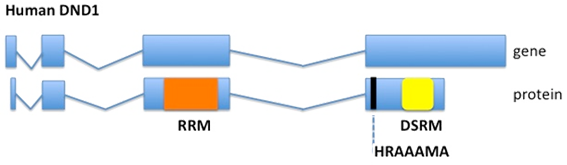
In one study, DNA from 263 familial and sporadic TGCT patients were sequenced. A possible pathogenic missense mutation in exon 3 (c.A301C, p.Glu86Ala) was identified in one patient. This mutation resides within the functional, evolutionary conserved RNA recognition motif (Linger et al., 2008).
In another study, sequencing exons 1 to 4 of DND1 from peripheral blood lymphocytes in 272 men, with both sporadic and familial TGCT, detected one non familial mutation (c.C657G, p.Asp219Glu) in exon 4. The wild-type DND1 was not lost in the patient (Sijmons et al., 2010).
Analysis of the human DND promoter revealed 15 CpG sites. However, no significant differences in CpG methylation levels have been observed in DNA from blood of patients with TGCT cases compared to controls (Mirabello et al., 2012).
The Ter mutation is a single base substitution in exon 3 of Dnd1 that transforms an arginine residue to a premature stop codon (p.Arg178X) (Youngren et al., 2005). In the 129 mouse, the Ter mutation (in DND1) has been characterized as a modifier gene for amplifying the incidence of spontaneous TGCTs (Asada et al., 1994; Noguchi and Stevens, 1982). The 129-Ter mouse is a model for prepubertal type I testicular germ cell tumors (Oosterhuis and Looijenga, 2005). Neoplastic transformation of germ cells and tumorigenesis takes place during embryogenesis (Noguchi and Noguchi, 1985; Stevens, 1967). The germ cells in Ter male mice fail to enter mitotic arrest in G0 (Cook et al., 2011)
A complete loss-of-function of DND1 leads to early embryonic lethality. However, the loss-of-function Dnd1 allele does not cause TGCT (Zechel et al., 2013).
In Ter-WKY/Ztm rats, a point mutation in exon 4 of rat Dnd1 introduces a premature stop codon that likely results in expression of a C-terminus truncated DND1 protein. This results in congenital ovarian germ cell tumors (OGCTs) in females and TGCTs in males (Northrup et al., 2012). Thus DND1/Ter acts as a tumor suppressor in the rat.
Germ cells derived from rat Ter embryos are more easily transformed into pluripotent cells in culture compared to their wild type counterparts (Northrup et al., 2011).
Article Bibliography
| Pubmed ID | Last Year | Title | Authors |
|---|---|---|---|
| 23890083 | 2013 | APOBEC3 inhibits DEAD-END function to regulate microRNA activity. | Ali S et al |
| 19458392 | 2009 | Participation of Xenopus Elr-type proteins in vegetal mRNA localization during oogenesis. | Arthur PK et al |
| 8054975 | 1994 | A mutation in the Ter gene causing increased susceptibility to testicular teratomas maps to mouse chromosome 18. | Asada Y et al |
| 21779484 | 2011 | MicroRNA-375 and MicroRNA-221: Potential Noncoding RNAs Associated with Antiproliferative Activity of Benzyl Isothiocyanate in Pancreatic Cancer. | Basu A et al |
| 26164657 | 2015 | A novel role for Celf1 in vegetal RNA localization during Xenopus oogenesis. | Bauermeister D et al |
| 22614019 | 2013 | The Grainyhead transcription factor Grhl3/Get1 suppresses miR-21 expression and tumorigenesis in skin: modulation of the miR-21 target MSH2 by RNA-binding protein DND1. | Bhandari A et al |
| 17291453 | 2007 | The mouse dead-end gene isoform alpha is necessary for germ cell and embryonic viability. | Bhattacharya C et al |
| 20587335 | 2010 | Zebrafish Dnd protein binds to 3'UTR of geminin mRNA and regulates its expression. | Chen S et al |
| 21115610 | 2011 | Regulation of male germ cell cycle arrest and differentiation by DND1 is modulated by genetic background. | Cook MS et al |
| 10952776 | 2000 | Allelic losses in carcinoma in situ and testicular germ cell tumours of adolescents and adults: evidence suggestive of the linear progression model. | Faulkner SW et al |
| 16448642 | 2006 | Xenopus Dead end mRNA is a localized maternal determinant that serves a conserved function in germ cell development. | Horvay K et al |
| 18155131 | 2007 | RNA-binding protein Dnd1 inhibits microRNA access to target mRNA. | Kedde M et al |
| 18069663 | 2008 | Analysis of the DND1 gene in men with sporadic and familial testicular germ cell tumors. | Linger R et al |
| 20371629 | 2010 | Zebrafish dead end possesses ATPase activity that is required for primordial germ cell development. | Liu W et al |
| 20816961 | 2010 | MicroRNA-24 targeting RNA-binding protein DND1 in tongue squamous cell carcinoma. | Liu X et al |
| 23615278 | 2013 | Maternal Dead-End1 is required for vegetal cortical microtubule assembly during Xenopus axis specification. | Mei W et al |
| 21337467 | 2011 | Regulation of hub mRNA stability and translation by miR430 and the dead end protein promotes preferential expression in zebrafish primordial germ cells. | Mickoleit M et al |
| 23050052 | 2012 | Promoter methylation of candidate genes associated with familial testicular cancer. | Mirabello L et al |
| 3860691 | 1985 | A recessive mutation (ter) causing germ cell deficiency and a high incidence of congenital testicular teratomas in 129/Sv-ter mice. | Noguchi T et al |
| 6956766 | 1982 | Primordial germ cell proliferation in fetal testes in mouse strains with high and low incidences of congenital testicular teratomas. | Noguchi T et al |
| 22655094 | 2012 | The ter mutation in the rat Dnd1 gene initiates gonadal teratomas and infertility in both genders. | Northrup E et al |
| 15738984 | 2005 | Testicular germ-cell tumours in a broader perspective. | Oosterhuis JW et al |
| 10359533 | 1999 | Chromosomal deletions occur in restricted regions of 5q in testicular germ cell cancer. | Peng HQ et al |
| 20411342 | 2010 | Screening for germline DND1 mutations in testicular cancer patients. | Sijmons RH et al |
| 19013519 | 2009 | Control of Dead end localization and activity--implications for the function of the protein in antagonizing miRNA function. | Slanchev K et al |
| 6025005 | 1967 | Origin of testicular teratomas from primordial germ cells in mice. | Stevens LC et al |
| 26589352 | 2016 | Dead end1 is an essential partner of NANOS2 for selective binding of target RNAs in male germ cell development. | Suzuki A et al |
| 26154321 | 2014 | Intracellular localizations of the Dead End protein in Xenopus primordial germ cells. | Taguchi A et al |
| 12932328 | 2003 | dead end, a novel vertebrate germ plasm component, is required for zebrafish primordial germ cell migration and survival. | Weidinger G et al |
| 15902260 | 2005 | The Ter mutation in the dead end gene causes germ cell loss and testicular germ cell tumours. | Youngren KK et al |
| 23773267 | 2013 | Contrasting effects of Deadend1 (Dnd1) gain and loss of function mutations on allelic inheritance, testicular cancer, and intestinal polyposis. | Zechel JL et al |
| 25405725 | 2015 | Mouse dead end 1-β interacts with c-Jun and stimulates activator protein 1 transactivation. | Zhang Y et al |
| 21851623 | 2011 | Transcripts that associate with the RNA binding protein, DEAD-END (DND1), in embryonic stem (ES) cells. | Zhu R et al |
| 7547632 | 1995 | Loss of heterozygosity on chromosome arms 5q, 11p, 11q, 13q, and 16p in human testicular germ cell tumors. | al-Jehani RM et al |
Other Information
Locus ID:
NCBI: 373863
MIM: 609385
HGNC: 23799
Ensembl: ENSG00000256453
Variants:
dbSNP: 373863
ClinVar: 373863
TCGA: ENSG00000256453
COSMIC: DND1
RNA/Proteins
| Gene ID | Transcript ID | Uniprot |
|---|---|---|
| ENSG00000256453 | ENST00000542735 | Q8IYX4 |
References
| Pubmed ID | Year | Title | Citations |
|---|---|---|---|
| 38311675 | 2024 | Circular RNA circFCHO2(hsa_circ_0002490) promotes the proliferation of melanoma by directly binding to DND1. | 0 |
| 38311675 | 2024 | Circular RNA circFCHO2(hsa_circ_0002490) promotes the proliferation of melanoma by directly binding to DND1. | 0 |
| 35705038 | 2022 | A cooperative mechanism of target RNA selection via germ-cell-specific RNA-binding proteins NANOS2 and DND1. | 3 |
| 35705038 | 2022 | A cooperative mechanism of target RNA selection via germ-cell-specific RNA-binding proteins NANOS2 and DND1. | 3 |
| 33860980 | 2021 | Human DND1-RRM2 forms a non-canonical domain swapped dimer. | 2 |
| 34721738 | 2021 | High DND1 Level Indicates a Poor Prognostic Factor in Prostate Cancer. | 1 |
| 33860980 | 2021 | Human DND1-RRM2 forms a non-canonical domain swapped dimer. | 2 |
| 34721738 | 2021 | High DND1 Level Indicates a Poor Prognostic Factor in Prostate Cancer. | 1 |
| 32521898 | 2020 | MicroRNA-24 inhibits the proliferation, migration and invasion and enhances chemosensitivity of human gastric cancer by targeting DND1. | 4 |
| 32521898 | 2020 | MicroRNA-24 inhibits the proliferation, migration and invasion and enhances chemosensitivity of human gastric cancer by targeting DND1. | 4 |
| 28191469 | 2017 | RNA-Binding Protein Dnd1 Promotes Breast Cancer Apoptosis by Stabilizing the Bim mRNA in a miR-221 Binding Site. | 16 |
| 28593479 | 2017 | RNA-binding protein Dnd1 inhibits epithelial-mesenchymal transition and cancer stem cell-related traits on hepatocellular carcinoma cells. | 12 |
| 28191469 | 2017 | RNA-Binding Protein Dnd1 Promotes Breast Cancer Apoptosis by Stabilizing the Bim mRNA in a miR-221 Binding Site. | 16 |
| 28593479 | 2017 | RNA-binding protein Dnd1 inhibits epithelial-mesenchymal transition and cancer stem cell-related traits on hepatocellular carcinoma cells. | 12 |
| 26740055 | 2016 | The RNA binding proteins RBM38 and DND1 are repressed in AML and have a novel function in APL differentiation. | 22 |
Citation
Angabin Matin
DND1 (DND microRNA-mediated repression inhibitor 1)
Atlas Genet Cytogenet Oncol Haematol. 2015-12-01
Online version: http://atlasgeneticsoncology.org/gene/50139/dnd1-(dnd-microrna-mediated-repression-inhibitor-1)
