Classical Hodgkin lymphoma
2016-04-01 Annunziata Gloghini , Antonino Carbone Affiliation1.Department of Pathology Centro di Riferimento Oncologico Aviano (CRO), Istituto Nazionale Tumori, IRCCS, Aviano, Italy; [email protected] (AC); Department of Diagnostic Pathology and Laboratory Medicine, Fondazione IRCCS Istituto Nazionale dei Tumori, Milano, Italy; [email protected] (AG)
2.Department of Pathology Centro di Riferimento Oncologico Aviano (CRO), Istituto Nazionale Tumori, IRCCS, Aviano, Italy; [email protected] (AC); Department of Diagnostic Pathology and Laboratory Medicine, Fondazione IRCCS Istituto Nazionale dei Tumori, Milano, Italy; [email protected] (AG)
Abstract
Hodgkin lymphoma (HL) was one of the earliest cancers to be cured with multiagent chemotherapy even before its biology was understood.
Clinics and Pathology
Disease
Classical HL is a distinct neoplastic entity with typical clinical, epidemiological, pathological, genetic, and virological features. It accounts for approximately 10% of all malignant lymphomas.
Phenotype stem cell origin
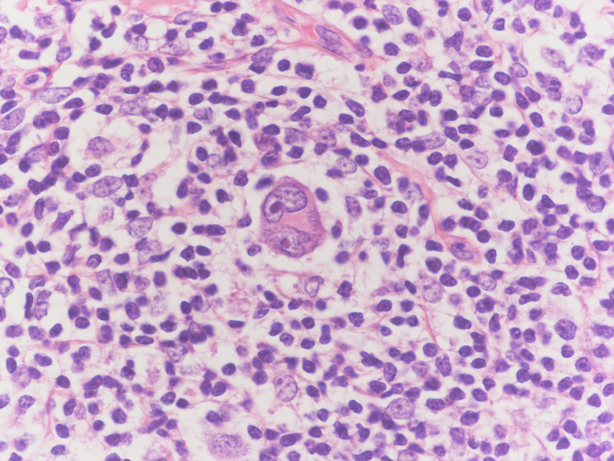
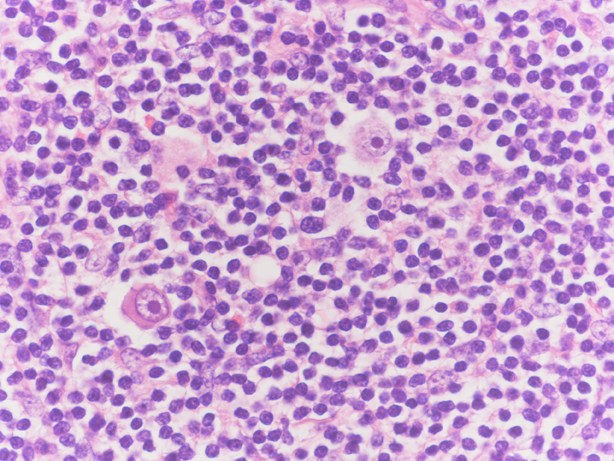
Hodgkin and Reed-Sternberg (HRS) cells, the tumour cells of cHL, derive from preapoptotic crippled germinal center (GC) B cells. In fact, molecular features of HRS cells in cHL demonstrate that they are derived from GC B cells that have acquired disadvantageous immunoglobulin variable chain gene mutations and normally would have undergone apoptosis (Kuppers et al., 2012).
As shown in gene expression profiling (GEP) studies, HRS cells have lost the expression of most B-cell genes and acquired expression of genes that are typical for other types of immune cells (Greaves and Gribben 2012; Steidl et al. 2012; Tiacci et al., 2012).
PHENOTYPE
Phenotypically, HRS cells of cHL are consistently positive for CD30, CD15, CD40, and IRF4/MUM1 (Stein et al., 2008).
Expression of molecular markers in cHL include (Younes et al., 2014)
- B-cell markers (CD20 and CD79) usually negative
- GC B-cell markers (BCL6 and AID) usually negative
- Plasma cell markers (MUM1/IRF4) usually positive
- Molecules involved in Ag presentation (MHC class II, CD40, CD80, CD86) positive
A surfaceoma study by TMA analysis indicated that gamma-glutamyltranspeptidase 1 is a potential additional marker for differential diagnosis of cHL versus non Hodgkin lymphoma (Hofmann et al., 2015).
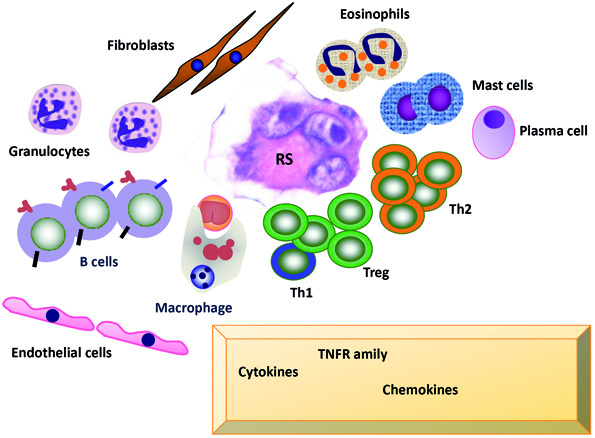
Cellular components of the cHL microenvironment express molecules involved in cancer cell growth and survival (such as CD30L or CD40L), and in immune escape (programmed death 1 (PD-1). For example, CD30L+ eosinophils and mast cells, and proliferation-inducing ligand (APRIL)+ neutrophils, are consistently admixed to HRS cells, whereas CD40L-expressing CD4+ T lymphocytes rosette HRS cells. A fraction of infiltrating CD4+ T cells are regulatory T (Treg) cells. Treg cells and PD-1+ T cells also interact with HRS cells (Aldinucci et al., 2010; Liu et al., 2014; Carbone et al., 2015).
Epidemiology
Cytology
Pathology
Based on the characteristics of the HRS cells (lacunar cells, multinucleated giant cells, pseudosarcomatous cells) and of the reactive infiltrate, four histologic subtypes have been distinguished: lymphocyte-rich cHL (LRCHL) , nodular sclerosis (NS) cHL , mixed cellularity (MC) cHL , and lymphocyte depletion (LD) cHL . Most cHL can be classified as NS or MC subtypes. The remaining LRCHL and LD subtypes are uncommon. LRCHL cases display histological and clinical features intermediate between those of cHL and NLPHL (Poppema et al., 2008; Stein et al., 2008; Swerdlow et al., 2016).
In cHL, microenvironmental cell types include T- and B-reactive lymphocytes, eosinophils, granulocytes, histiocytes/macrophages, plasma cells, mast cells. In addition, a great number of fibroblast-like cells and fibrosis are frequently found (Aldinucci et al., 2010).
Other features
The immunophenotypic and genetic features of HRS cells are identical in the different histologic subtypes of cHL. Conversely, the association with EBV shows differences. EBV is found in HRS cells preferentially in cases of MC and LD cHL, and less frequently in NS and LRCHL. Notably, EBV is found in HRS cells in nearly all cases of cHL occurring in patients infected with HIV (Younes et al., 2014; Dolcetti et al., 2016).
The virologic characteristics of cHL vary according to the immunocompetence status of the host and cHL subtype (IARC, 2012) as follows:
cHL of the general population
- NS cHL, usually EBV negative
- MC cHL, usually EBV positive
- LRCHL, variably EBV positive
- LD cHL, variably EBV positive
Immunodeficiency-associated cHL
- HIV-associated cHL, EBV positive
- Post-transplant cHL, EBV positive
- Iatrogenic (methotrexate), variaby EBV positive
Treatment
Prognosis
Note
Genes Involved and Proteins
Article Bibliography
| Pubmed ID | Last Year | Title | Authors |
|---|---|---|---|
| 20527019 | 2010 | The classical Hodgkin's lymphoma microenvironment and its role in promoting tumour growth and immune escape. | Aldinucci D et al |
| 9678329 | 1998 | Cytogenetics of Hodgkin's disease. | Atkin NB et al |
| 24441526 | 2014 | Treatment of Hodgkin lymphoma: a 50-year perspective. | Canellos GP et al |
| 25953622 | 2015 | Primary refractory and early-relapsed Hodgkin's lymphoma: strategies for therapeutic targeting based on the tumour microenvironment. | Carbone A et al |
| 26773045 | 2016 | A lymphomagenic role for HIV beyond immune suppression? | Dolcetti R et al |
| 23197579 | 2012 | Lymphoid neoplasia. Laser-capturing the essence of Hodgkin lymphoma. | Greaves P et al |
| 18641027 | 2008 | Detection of genomic imbalances in microdissected Hodgkin and Reed-Sternberg cells of classical Hodgkin's lymphoma by array-based comparative genomic hybridization. | Hartmann S et al |
| 19017178 | 2008 | Infectious aetiology of Hodgkin and non-Hodgkin lymphomas: a review of the epidemiological evidence. | Hjalgrim H et al |
| 26076441 | 2015 | Surfaceome of classical Hodgkin and non-Hodgkin lymphoma. | Hofmann A et al |
| 9713340 | 1998 | Chromosomal abnormalities in Hodgkin's disease are not restricted to Hodgkin/Reed-Sternberg cells. | Jansen MP et al |
| 23023715 | 2012 | Hodgkin lymphoma. | Küppers R et al |
| 23867303 | 2014 | The microenvironment in classical Hodgkin lymphoma: an actively shaped and essential tumor component. | Liu Y et al |
| 24561519 | 2014 | BIM upregulation and ROS-dependent necroptosis mediate the antitumor effects of the HDACi Givinostat and Sorafenib in Hodgkin lymphoma cell line xenografts. | Locatelli SL et al |
| 2433409 | 1987 | Long-term results of combined chemotherapy-radiotherapy approach in Hodgkin's disease: superiority of ABVD plus radiotherapy versus MOPP plus radiotherapy. | Santoro A et al |
| 19380639 | 2009 | TNFAIP3 (A20) is a tumor suppressor gene in Hodgkin lymphoma and primary mediastinal B cell lymphoma. | Schmitz R et al |
| 21483001 | 2011 | Molecular pathogenesis of Hodgkin's lymphoma: increasing evidence of the importance of the microenvironment. | Steidl C et al |
| 22955918 | 2012 | Gene expression profiling of microdissected Hodgkin Reed-Sternberg cells correlates with treatment outcome in classical Hodgkin lymphoma. | Steidl C et al |
| 20339089 | 2010 | Genome-wide copy number analysis of Hodgkin Reed-Sternberg cells identifies recurrent imbalances with correlations to treatment outcome. | Steidl C et al |
| 26980727 | 2016 | The 2016 revision of the World Health Organization classification of lymphoid neoplasms. | Swerdlow SH et al |
| 22955914 | 2012 | Analyzing primary Hodgkin and Reed-Sternberg cells to capture the molecular and cellular pathogenesis of classical Hodgkin lymphoma. | Tiacci E et al |
Citation
Annunziata Gloghini ; Antonino Carbone
Classical Hodgkin lymphoma
Atlas Genet Cytogenet Oncol Haematol. 2016-04-01
Online version: http://atlasgeneticsoncology.org/haematological/1569/submit-meetings/
