MAPK14 (mitogen-activated protein kinase 14)
2010-12-01 Almudena Porras , Carmen Guerrero AffiliationDepartamento de Bioquimica y Biologia Molecular II, Facultad de Farmacia, UCM, Ciudad Universitaria, 28040 Madrid, Spain (AP); Centro de Investigacion del Cancer, IBMCC, Universidad de Salamanca-CSIC, 37007 Salamanca, Spain (CG)
Identity
HGNC
LOCATION
6p21.31
IMAGE

LEGEND
Schematic representation of human chromosome 6 indicating the position of MAPK14 locus (p21.31) (red bar).
LOCUSID
ALIAS
CSBP,CSBP1,CSBP2,CSPB1,EXIP,Mxi2,PRKM14,PRKM15,RK,SAPK2A,p38,p38ALPHA
FUSION GENES
DNA/RNA

MAPK14 gene locus. Representation of the MAPK14 gene organization indicating the position of the exons (coding region) and untranslated regions.
Description
The gene spans a region of 83.53 kb and the coding part is divided into 41 different exons. Larger transcripts contain 12 or 13 exons. (GATExplorer).
Transcription
9 types of transcripts have been described, although only 5 are protein coding transcripts. The larger 4319-nucleotide transcript encodes a protein of 360 amino acid residues. The first and last exons are partially untranslated.
Pseudogene
None described so far.
Proteins

MAPK14 protein domains. Schematic representation of MAPK14 protein indicating the position of its functional domains. 30-54: protein kinase ATP signature, ATP-binding region; 59-162: MAPK signature; 24-308: protein kinase domain.
Description
MAPK14 is a Ser/Thr kinase composed of 90 to 360 residues depending on the transcript variant.
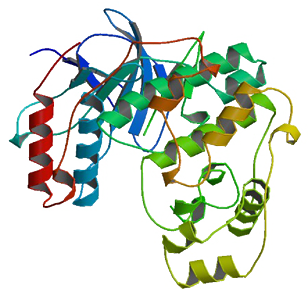
Crystal structure of MAPK14 at 2.3 A resolution. From PDB (access number: 1WFC).
Expression
p38alpha MAPK is ubiquitously expressed, being the p38 most abundant isoform.
Localisation
p38alpha is mainly present in the cytosol, but it can translocate to the nucleus. In addition, it can be localized in the mitochondria or in other subcellular compartments.
Function
p38alpha is mainly activated by various environmental stresses and proinflammatory cytokines, but many other extracellular signals, including growth factors, also lead to p38alpha activation. The canonical activation requires its phosphorylation in threonine and tyrosine residues by dual-specificity MAP kinase kinases (MKKs), MKK3, MKK6 and MKK4. Substrates of this kinase include transcription factors, such as ATF1, ATF2, ATF6, p53, MEF2 or C/EBPbeta and protein kinases, such as MAPKAP-K2 and MAPKAP-K3 (also known as MK-2 and MK-3), MSK-1, MNK-1/MNK-2 and other proteins. p38alpha MAPK is essential for embryonic development and it regulates different cellular functions such as proliferation, differentiation, cell death, adhesion, migration, as well as the response to stress and many metabolic pathways, among others. It does so through regulation of transcription, mRNA stability, chromatin remodelling, protein synthesis, etc. Concerning cell death, although p38alpha plays an important role as a pro-apoptotic signal, it can play a dual role, acting as either a mediator of cell survival or of cell death, depending on the cell type and the stimuli. Related with its function as a negative regulator of proliferation and a mediator of apoptosis, p38alpha acts as a tumor suppressor in the initial stages of a tumorigenic process, while at later stages it can promote metastasis.
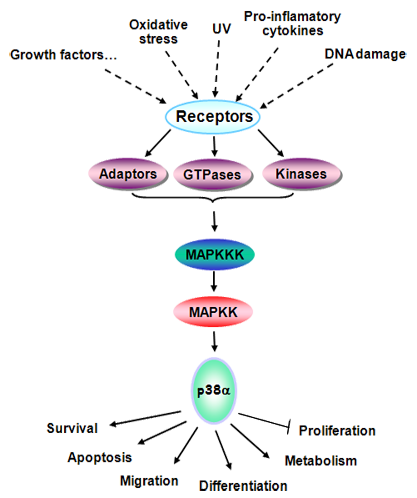
Signaling through p38alphaMAPK. Signaling through MAPK14 cascade and its role in the regulation of cellular functions. MAPK14 is involved in signaling pathways triggered by a variety of stimuli such as growth factors, oxidative stress, UV, cytokines and DNA damage. Depending on the stimulus, different receptors and intermediates (adaptors, GTPases or kinases) are activated leading to the activation of the p38alpha MAPK cascade. This cascade is initiated by activation of MAPKKKs, which phosphorylate and activate MAPKKs (MKK3/6/4), which in turn lead to activation of MAPK14 through dual phosphorylation in Tyr and Thr. Once phosphorylated, MAPK14 phosphorylates a number of cytosolic and nuclear substrates, including transcription factors, which lead to the control of many cellular responses.
Mutations
Somatic
4 somatic mutations according to Ensembl: COSM21366; COSM20563; COSM35409; COSM12875.
Implicated in
Entity name
Hematopoietic malignancies
Disease
p38 MAPK, mainly the p38alpha isoform, is a key player in the maintenance of hematopoiesis homeostasis, as it balances both proliferative and growth inhibitory signals triggered by the growth factors and cytokines that regulate normal hematopoiesis. Alterations in this p38 MAPK-controlled balance may result in either overproduction or depletion of myelosuppressive cytokines leading to the development of certain bone marrow failure syndromes. For example, p38alpha is responsible for the enhanced stem cell apoptosis characteristic of low grade myeolodysplastic syndromes (MDSs). On the other hand, imbalance toward the proliferative side may conduct to the development of myeloproliferative syndromes (MPSs), such as leukemia, lymphomas and myelomas. In particular, p38alpha MAPK plays a pro-apoptotic role in chronic myeloid leukemia (CML). In fact, p38alpha MAP kinase pathway mediates the growth inhibitory effects of IFNalpha and STI-571, two drugs used in the CML treatment, which underscores the importance of this pathway in the generation of antileukemic responses.
Entity name
Alzheimers disease
Disease
Alzheimer is an incurable, neurodegenerative disease characterized by a progressive deterioration of the cognitive, memory and learning ability due to the accumulation of plaques containing amyloidogenic Abeta proteins and tangles containing hyperphosphorylated tau protein. The ASK1-MKK6-p38 signaling pathway participates in amyeloid precursor protein (APP) and tau phosphorylation in response to oxidative stress and contributes to the expression of the beta-secretase gene and the induction of neuronal apoptosis triggered by ROS.
Entity name
Parkinson disease
Disease
Parkinson is a degenerative disorder of the central nervous system characterized by muscle rigidity, tremor and loss of physical movement caused by a progressive loss of dopaminergic neurons. Mutations in alpha-synuclein are one of the main causes of Parkinson. alpha-synuclein activates p38alpha MAPK in human microglia promoting a potent inflammatory stimulation of microglial cells. Additionally, the p38alpha MAPK plays a role in dopaminergic neural apoptosis through the phosphorylation of p53 and expression of the pro-apoptotic protein Bax.
Entity name
Amyotrophic lateral sclerosis
Disease
ALS is a progressive, lethal, degenerative disorder of motor neurons leading to paralysis of voluntary muscles. Numerous evidences point to a role of p38 MAPK in the development and progression of ALS induced by mutations in SOD1 (superoxide dismutase 1) gene. Mutant SOD1 provokes aberrant oxyradical reactions that increase the activation of p38 MAPK in motor neurons and glial cells. This increase in active p38 MAPK may phosphorylate cytoskeletal proteins and activate cytokines and nitric oxide, thus contributing to neurodegeneration through different mechanisms including apoptosis.
Article Bibliography
| Pubmed ID | Last Year | Title | Authors |
|---|---|---|---|
| 10949032 | 2000 | Essential role of p38alpha MAP kinase in placental but not embryonic cardiovascular development. | Adams RH et al |
| 16909017 | 2005 | Inter- and intracellular signaling in amyotrophic lateral sclerosis: role of p38 mitogen-activated protein kinase. | Bendotti C et al |
| 10581258 | 1999 | Phosphorylation of human p53 by p38 kinase coordinates N-terminal phosphorylation and apoptosis in response to UV radiation. | Bulavin DV et al |
| 20626350 | 2010 | Mechanisms and functions of p38 MAPK signalling. | Cuadrado A et al |
| 17481747 | 2007 | p38 MAP-kinases pathway regulation, function and role in human diseases. | Cuenda A et al |
| 10915780 | 2000 | The integrin-linked kinase regulates the cyclin D1 gene through glycogen synthase kinase 3beta and cAMP-responsive element-binding protein-dependent pathways. | D'Amico M et al |
| 9365241 | 1997 | Pro-apoptotic effect of the c-Abl tyrosine kinase in the cellular response to 1-beta-D-arabinofuranosylcytosine. | Huang Y et al |
| 19020042 | 2008 | Selective activation of p38 mitogen-activated protein kinase in dopaminergic neurons of substantia nigra leads to nuclear translocation of p53 in 1-methyl-4-phenyl-1,2,3,6-tetrahydropyridine-treated mice. | Karunakaran S et al |
| 15019567 | 2004 | Inhibition of mixed lineage kinase 3 attenuates MPP+-induced neurotoxicity in SH-SY5Y cells. | Mathiasen JR et al |
| 11571231 | 2001 | Involvement of p38 kinase in hydroxyurea-induced differentiation of K562 cells. | Park JI et al |
| 12725866 | 2003 | The p38 mitogen-activated protein kinase pathway and its role in interferon signaling. | Platanias LC et al |
| 14617800 | 2004 | P38 alpha mitogen-activated protein kinase sensitizes cells to apoptosis induced by different stimuli. | Porras A et al |
| 15488025 | 2004 | Expression of stress-activated kinases c-Jun N-terminal kinase (SAPK/JNK-P) and p38 kinase (p38-P), and tau hyperphosphorylation in neurites surrounding betaA plaques in APP Tg2576 mice. | Puig B et al |
| 7923353 | 1994 | A novel kinase cascade triggered by stress and heat shock that stimulates MAPKAP kinase-2 and phosphorylation of the small heat shock proteins. | Rouse J et al |
| 10811125 | 2000 | A role for the p38 mitogen-acitvated protein kinase pathway in the transcriptional activation of p53 on genotoxic stress by chemotherapeutic agents. | Sanchez-Prieto R et al |
| 15719422 | 2005 | Mixed lineage kinase-c-jun N-terminal kinase signaling pathway: a new therapeutic target in Parkinson's disease. | Silva RM et al |
| 12684028 | 2003 | H2O2 and 4-hydroxynonenal mediate amyloid beta-induced neuronal apoptosis by activating JNKs and p38MAPK. | Tamagno E et al |
| 12812752 | 2003 | Persistent activation of p38 mitogen-activated protein kinase in a mouse model of familial amyotrophic lateral sclerosis correlates with disease progression. | Tortarolo M et al |
| 19629069 | 2009 | Signal integration by JNK and p38 MAPK pathways in cancer development. | Wagner EF et al |
| 8910361 | 1996 | Crystal structure of p38 mitogen-activated protein kinase. | Wilson KP et al |
| 17351344 | 2007 | p38 MAP kinase regulates stem cell apoptosis in human hematopoietic failure. | Zhou L et al |
| 16844343 | 2007 | Negative regulation of Akt activity by p38alpha MAP kinase in cardiomyocytes involves membrane localization of PP2A through interaction with caveolin-1. | Zuluaga S et al |
Other Information
Locus ID:
NCBI: 1432
MIM: 600289
HGNC: 6876
Ensembl: ENSG00000112062
Variants:
dbSNP: 1432
ClinVar: 1432
TCGA: ENSG00000112062
COSMIC: MAPK14
RNA/Proteins
Expression (GTEx)
Pathways
Protein levels (Protein atlas)
PharmGKB
| Entity ID | Name | Type | Evidence | Association | PK | PD | PMIDs |
|---|---|---|---|---|---|---|---|
| PA134963361 | MAFA | Gene | Pathway | associated | 23922006 | ||
| PA162392499 | JDP2 | Gene | Pathway | associated | 23922006 | ||
| PA25084 | ATF2 | Gene | Pathway | associated | 23922006 | ||
| PA25085 | ATF3 | Gene | Pathway | associated | 23922006 | ||
| PA25268 | BATF | Gene | Pathway | associated | 23922006 | ||
| PA28212 | FOS | Gene | Pathway | associated | 23922006 | ||
| PA28213 | FOSB | Gene | Pathway | associated | 23922006 | ||
| PA28214 | FOSL1 | Gene | Pathway | associated | 23922006 | ||
| PA28215 | FOSL2 | Gene | Pathway | associated | 23922006 | ||
| PA284 | MAP2K7 | Gene | Pathway | associated | 20124951 | ||
| PA30006 | JUN | Gene | Pathway | associated | 23922006 | ||
| PA30007 | JUNB | Gene | Pathway | associated | 23922006 | ||
| PA30008 | JUND | Gene | Pathway | associated | 23922006 | ||
| PA30534 | MAF | Gene | Pathway | associated | 23922006 | ||
| PA30535 | MAFB | Gene | Pathway | associated | 23922006 | ||
| PA30538 | MAFF | Gene | Pathway | associated | 23922006 | ||
| PA30539 | MAFG | Gene | Pathway | associated | 23922006 | ||
| PA30540 | MAFK | Gene | Pathway | associated | 23922006 | ||
| PA30584 | MAP2K1 | Gene | Pathway | associated | 20124951 | ||
| PA30587 | MAP2K2 | Gene | Pathway | associated | 20124951 | ||
| PA30588 | MAP2K3 | Gene | Pathway | associated | 20124951, 23922006 | ||
| PA30589 | MAP2K4 | Gene | Pathway | associated | 20124951 | ||
| PA30590 | MAP2K5 | Gene | Pathway | associated | 20124951 | ||
| PA30591 | MAP2K6 | Gene | Pathway | associated | 20124951, 23922006 | ||
| PA31781 | NRL | Gene | Pathway | associated | 23922006 | ||
| PA7000 | sorafenib | Chemical | Pathway | associated | 20124951 |
References
| Pubmed ID | Year | Title | Citations |
|---|---|---|---|
| 37318032 | 2024 | miR-200a-3p regulates epithelial-mesenchymal transition and inflammation in chronic rhinosinusitis with nasal polyps by targeting ZEB1 via ERK/p38 pathway. | 0 |
| 37522419 | 2024 | Up-regulation of Trim28 in pregnancy-induced hypertension is involved in the injury of human umbilical vein endothelial cells through the p38 signaling pathway. | 0 |
| 37865350 | 2024 | The lncRNA MEG3/miRNA-21/P38MAPK axis inhibits coxsackievirus 3 replication in acute viral myocarditis. | 0 |
| 38301965 | 2024 | CXCL13 promotes TNF-α synthesis in rheumatoid arthritis through activating ERK/p38 pathway and inhibiting miR-330-3p generation. | 0 |
| 38368696 | 2024 | Hepatic expression of tumor necrosis factor-α and evaluation of MAPK-p38 and NFκB signaling pathways in autoimmune hepatitis. | 0 |
| 38395872 | 2024 | Crosstalk with renal proximal tubule cells drives acidosis-induced inflammatory response and dedifferentiation of fibroblasts via p38-singaling. | 0 |
| 38441376 | 2024 | Phosphorylated p38 MAP kinase expression by leucocytes is increased in allergic humans and associated with IgE responses. | 0 |
| 38533556 | 2024 | YKL40 potentially via activating the P38 pathway in decreasing atherosclerotic plaque stability. | 0 |
| 38597327 | 2024 | Dynamically changed HSP70 after reperfusion following cerebral infarction in human and rats: correlation with p38 MAPK. | 0 |
| 38597420 | 2024 | CLCA1 exacerbates lung inflammation via p38 MAPK pathway in acute respiratory distress syndrome. | 0 |
| 38730210 | 2024 | Lack of p38 activation in T cells increases IL-35 and protects against obesity by promoting thermogenesis. | 0 |
| 37318032 | 2024 | miR-200a-3p regulates epithelial-mesenchymal transition and inflammation in chronic rhinosinusitis with nasal polyps by targeting ZEB1 via ERK/p38 pathway. | 0 |
| 37522419 | 2024 | Up-regulation of Trim28 in pregnancy-induced hypertension is involved in the injury of human umbilical vein endothelial cells through the p38 signaling pathway. | 0 |
| 37865350 | 2024 | The lncRNA MEG3/miRNA-21/P38MAPK axis inhibits coxsackievirus 3 replication in acute viral myocarditis. | 0 |
| 38301965 | 2024 | CXCL13 promotes TNF-α synthesis in rheumatoid arthritis through activating ERK/p38 pathway and inhibiting miR-330-3p generation. | 0 |
Citation
Almudena Porras ; Carmen Guerrero
MAPK14 (mitogen-activated protein kinase 14)
Atlas Genet Cytogenet Oncol Haematol. 2010-12-01
Online version: http://atlasgeneticsoncology.org/gene/41292/mapk14
