Identity
HGNC
LOCATION
6p25.3
LOCUSID
ALIAS
LSIRF,MUM1,NF-EM5,SHEP8
FUSION GENES
DNA/RNA
Description
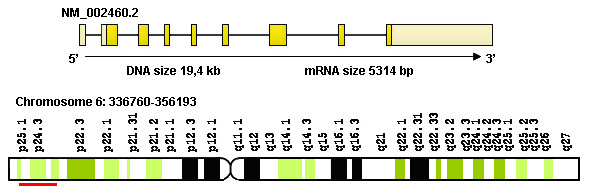
Gene of 19,4 kb with 9 exons and 8 introns.
Exon 1, the 5 part of exon 2 and the 3 part of exon 9 are non coding.
Exon 1, the 5 part of exon 2 and the 3 part of exon 9 are non coding.
Transcription
Length of the transcript is 5314 bp.
Coding sequence: CDS 114-1469.
mRNA is expressed at high levels in lymphoid tissues, in skin and in tonsils.
Coding sequence: CDS 114-1469.
mRNA is expressed at high levels in lymphoid tissues, in skin and in tonsils.
Proteins
Description
Protein length: 451 amino acids.
Calculated molecular weight of 51,8 kDa.
Calculated molecular weight of 51,8 kDa.
Expression
IRF4 protein is expressed predominantly in blood cells. However, its expression can also be detected in adipocytes and melanocytes. In blood cells, expression of IRF4 can be detected in T, B, DC and macrophages. Expression of IRF4 in T and B cells is strongly induced by antigen receptor signaling.
Localisation
Nucleus.
Function
In the immune system, IRF4 is critical for development and maturation of multiple lineages of blood cells. In T cells development, IRF4 is essential for the differentiation of Th1, Th2, Th9, Th17 and T reg subsets. In B lymphocytes, IRF4 promotes light chain rearrangement and transcription and is critical for B cell development at the pre-B stage. IRF4 antagonizes Notch signaling and limits the size of marginal zone B cells (Simonetti et al., 2013). In addition, IRF4 is essential for class-switching and plasma cell differentiation. In B cells, IRF4 interacts with Ets family of trancription factor (PU.1/spi-B) through EICE site whereas in T cells, IRF4 interacts with AP-1 family of trancription factor (BATF) through AICE site. Also, IRF4 is required for the differentiation of dendritic cells (DCs), particularly the CD11b(+) subset (Schlitzer et al., 2013). In macrophages, IRF4 promotes the differentiation and polarisation to the M2 subtype also known as the tumor associated macrophages.
Recent studies have identified a role of IRF4 in adipocyte biology. IRF4 has been shown to regulate enzymes required for lipolysis in adipocytes. Therefore, an adipocyte specific deletion of IRF4 causes enhanced lipid synthesis, dysregulated lipid homeostasis eventually leading to obesity.
Interestingly, in melanocytes IRF4 was recently identified to cooperate with another transcription factor, MITF to positively regulate the expression of tyrosinase gene required for melanin synthesis. Additionally, the SNPs in the IRF4 gene locus have been identified as risk alleles for developing melanoma.
Recent studies have identified a role of IRF4 in adipocyte biology. IRF4 has been shown to regulate enzymes required for lipolysis in adipocytes. Therefore, an adipocyte specific deletion of IRF4 causes enhanced lipid synthesis, dysregulated lipid homeostasis eventually leading to obesity.
Interestingly, in melanocytes IRF4 was recently identified to cooperate with another transcription factor, MITF to positively regulate the expression of tyrosinase gene required for melanin synthesis. Additionally, the SNPs in the IRF4 gene locus have been identified as risk alleles for developing melanoma.
Homology
Among IRF family members, IRF4 is highly homologous to IRF8.
Mutations
Germinal
SNPs in the IRF4 gene locus have been identified in patients with chronic lymphocytic leukemia and melanoma.
Somatic
Somatic mutations in DNA binding domain of IRF4 have been identified in a small subset (1,5%) of chronic lymphocytic leukemia (CLL) patients.
Implicated in
Entity name
Multiple myeloma (MM)
Disease
Multiple myeloma (MM) is a plasma cell derived malignancy with a particularly aggressive clinical course. IRF4 is obligatory required for the terminal differetiation of mature B cells to plasma cells and has been shown to play a central role in the pathogenesis of MM. IRF4 is recurrently translocated and juxtaposed to the IgH promoter t(6;14)(p25;q32) in a significant proportion (~21%) of MM cases. More commonly, IRF4 have been shown to be overexpressed without genetic alterations in majority of MM cases and MM cells are particularly sensitive to the down-regulation of IRF4.
Cytogenetics
t(6;14)(p25;q32) --> IRF4 - IgH.
Hybrid gene
The translocation juxtaposes the IgH locus to the IRF4 gene.
Oncogenesis
The precise mechanism for pathogenesis of MM in presence of high levels of IRF4 is mediated by an autoregulatory loop established between IRF4 and c-myc in MM cells. Recently, IRF4 has been shown to regulate caspase-10 leading to disruption of normal autophagy mechanisms in MM cells thereby, causing prolonged survival of these cells.
Entity name
Chronic lymphocytic leukemia (CLL)
Disease
CLL is the most common adult leukemia in the western countries. It is a heterogeneous B-cell malignancy marked by progressive accumulation of CD5 positive mature B lymphocytes. A Genome Wide Association Study (GWAS) recently identified SNPs in the 3 UTR of IRF4 gene locus in patients with CLL. The individuals carrying the risk alleles harboring the SNPs have lower levels of IRF4 and poorer outcomes compared to individuals carrying the non-risk allele. Another study identified mutations in the DNA binding domain of IRF4 in a small subset (1,5%) of CLL cases. More recently, using two distinct murine genetic models, it has been shown that low levels of IRF4 are causally related to the development of CLL.
Prognosis
CLL patients with low levels of IRF4 have aggressive disease course and poor prognosis.
Cytogenetics
Although reciprocal translocations are extremely rare in CLL, a translocation disrupting IRF4 gene locus t(1;6)(p35.3;p25.2) was identified in a small subset of CLL patients with aggressive disease.
Hybrid gene
Mutations in the DNA binding domain of IRF4 with a yet undefined function in B cells were identified in a small subset of CLL cases.
Oncogenesis
The precise mechanism for oncogenesis of CLL in presence of low levels of IRF4 is not yet known.
Entity name
Diffused large B cell lymphoma (DLBCL)
Disease
Diffuse large B cell lymphoma represents a heterogeneous malignancy that arises spontaneously or develop from pre-existing leukemia. On the basis of gene expression profiling DLBCL is divided into three distinct subtypes namely the germinal center subtype (GCB), the activated B cell subtype (ABC) and the mediastinal subtype. The three subtypes presumably arise from three distinct B cell subtypes. IRF4 is primarily overexpressed in the ABC type of DLBCL while GCB subtype is marked by lower expression of IRF4.
Prognosis
IRF4 is overexpressed in the ABC type DLBCL which is most aggressive form of DLBCL and have poorer patient outcomes compared to other subtypes.
Cytogenetics
IRF4 is overexpressed in a small group of patients with a reciprocal translocation between IgG locus and the IRF4 t(1;6)(p35.3;p25.2). The patients carrying the translocation primarily belong to GCB or follicular lymphoma grade 3 type is associated with favorable patient outcomes.
Oncogenesis
IRF4 induces the expression of transcription factor Blimp-1 and directly suppresses the expression of Bcl-6 to allow terminal differentiation of activated B cells to plasma cells. However, this molecular network is short circuited in ABC DLBCL by recurrent mutational inactivation of Blimp-1. Additionally, mutations located in the promoter region of Bcl-6 that disrupt the IRF4 binding sites and leads to enhanced expression of Bcl-6 were identified in a small group of patients. These genetic events disrupt the molecular network required for plasma cell differentiation. However, the precise functional role of IRF4 in pathogenesis of ABC type DLBCL is not well defined.
Entity name
Hodgkins lymphoma (HL)
Disease
Hodgkins lymphoma (HL) is an enigmatic B cell malignancy that is characterized by lack of expression of several B cell markers. The Hodgkin and Reed Sternberg (HRS) cells present in HL cases are presumably derived from germinal center B cells. IRF4 is overexpressed in majority of classical HL cases and is shown to mediate the survival of these cells. Paradoxically, the SNPs in IRF4 linked to its lower expression levels and associated with the development of CLL are also shown to be linked to the risk of developing HL.
Oncogenesis
Whether the overexpression of IRF4 in HRS cells of HL is causal is unclear. However, some studies have linked the survival and proliferation of HRS cells to the expression of IRF4.
Entity name
Disease
Primary cutaneous anaplastic large cell lymphoma (C-ALCL) is a T cell lymphoma with an indolent disease course and presence of tumor lesions in the skin. The lesions in C-ALCL almost never spread extra-cutaneously and often regress spontaneously. IRF4 is overexpressed in C-ALCL but not in the more aggressive form of the disease known as peripheral T cell lymphoma not otherwise specified (PTCL-NOS). The overexpression of IRF4 in some cases is associated with a recurrent translocations a subset of them placing the IRF4 gene next to the T cell receptor alpha (TCRA) promoter t(6;14)(p25;q11.2). Other translocations identified do not involve TCRA.
Cytogenetics
IRF4 is translocated primarily in the C-ALCL however the precise breakpoints are not defined. In a small subset of the cases with translocations IRF4 is juxtaposed to the TCRA locus t(6;14)(p25;q11.2).
Entity name
B cell acute lymphoblastic leukemia (B-ALL)
Disease
B cell acute lymphoblastic leukemia (B-ALL) is a B cell malignancy derived from early B cells. IRF4 is shown to play a tumor suppressive role in B-ALL. IRF4 is shown to suppress the oncogenesis of both BCR-ABL and c-myc induced B-ALL.
Oncogenesis
IRF4 inhibits B-ALL by regulating the expression of negative regulators of cell cycle p27.
Entity name
Chronic myeloid leukemia (CML)
Disease
Chronic myeloid leukemia (CML) is a myeloproliferative disorder marked by clonal expansion of granulocytes. It is associated with a hallmark translocation and presence of a fusion BCR-ABL protein in majority of patients. IRF4 is shown to be underexpressed in CML patients along with its highly homologous family member IRF8. However the functional role of IRF4 in CML is not well characterized.
Entity name
Virus implicated malignancies
Disease
Viruses like Epstein Barr virus (EBV), human T cell leukemia virus-1 (HTLV1) and Kaposi Sarcoma associated herpes virus (KSHV/HHV-8) are implicated in B cell malignancies, adult T cell leukemia (ATL) and primary effusion lymphoma (PEL) respectively. The proteins encoded by these viruses, directly or indirectly activate NF-kB signaling which in turn activates the expression of IRF4. As a result IRF4 is overexpressed in these virus implicated malignancies. The knockdown of IRF4 in EBV transformed B cells lead to down-regulation of genes involved in cellular proliferation. The role of IRF4 in HTLV-1 induced ATL is not clear however few reports indicate its involvement in regulation of cell cycle associated genes. The role of IRF4 in KSHV induced kaposis sarcoma and PEL is ambiguous. KSHV encodes viral homologs of cellular IRFs called vIRFs. The vIRF4 is shown to inhibit the function of cellular IRF4 leading to induction of lytic cycle for KSHV replication.
Oncogenesis
The role of IRF4 in these viral implicated malignancies is still unclear. However, the activation status of NF-kB by these viruses invariably co-relates with IRF4 expression in these cells.
Entity name
Skin cancer
Disease
Skin cancer is associated with malignant or non-malignant lesions on the skin. Based on the cell of origin, skin cancer can be divided into three types: basal cell carcinoma, squamous cell carcinoma and melanoma. The differential skin pigmentation induced by melanin production alters the risk for skin cancer. Particularly individuals with light skin tones and hence low melanin secretion are more predisposed to developing skin cancer. Until recently there were no known reports for a role of IRF4 in melanocytes. However recently, SNPs identified in the IRF4 gene locus have been shown to be associated with skin pigmentation and the risk for developing skin cancer. The SNP identified in the screen map to a putative enhancer region in the IRF4 gene locus.
Oncogenesis
Recently, the SNP identified in IRF4 locus were demonstrated to decrease IRF4 expression by disruption of specific transcription factor binding sites. Additionally, IRF4 corroborates with micropthalmia associated transcription factor (MITF) to regulate the expression of enzyme tyrosinase responsible for melanin production. These studies point towards a critical role for IRF4 in melanocyte biology and also its association with skin cancer.
Article Bibliography
| Pubmed ID | Last Year | Title | Authors |
|---|---|---|---|
| 18713947 | 2008 | IRF-4 functions as a tumor suppressor in early B-cell development. | Acquaviva J et al |
| 12393648 | 2002 | Expression of MUM1/IRF4 correlates with clinical outcome in patients with B-cell chronic lymphocytic leukemia. | Chang CC et al |
| 18758461 | 2008 | A genome-wide association study identifies six susceptibility loci for chronic lymphocytic leukemia. | Di Bernardo MC et al |
| 21356515 | 2011 | Transcriptional control of adipose lipid handling by IRF4. | Eguchi J et al |
| 11781220 | 2002 | Proteins encoded by genes involved in chromosomal alterations in lymphoma and leukemia: clinical value of their detection by immunocytochemistry. | Falini B et al |
| 18987657 | 2009 | Recurrent translocations involving the IRF4 oncogene locus in peripheral T-cell lymphomas. | Feldman AL et al |
| 22983707 | 2012 | A genomic regulatory element that directs assembly and function of immune-specific AP-1-IRF complexes. | Glasmacher E et al |
| 8921401 | 1996 | Cloning of human lymphocyte-specific interferon regulatory factor (hLSIRF/hIRF4) and mapping of the gene to 6p23-p25. | Grossman A et al |
| 16243976 | 2005 | Interferon regulatory factor 4 negatively regulates the production of proinflammatory cytokines by macrophages in response to LPS. | Honma K et al |
| 9326949 | 1997 | Deregulation of MUM1/IRF4 by chromosomal translocation in multiple myeloma. | Iida S et al |
| 12079517 | 2002 | MUM1/IRF4 expression is an unfavorable prognostic factor in B-cell chronic lymphocytic leukemia (CLL)/small lymphocytic lymphoma (SLL). | Ito M et al |
| 18775669 | 2008 | Interferon regulatory factor 4 and 8 in B-cell development. | Lu R et al |
| 12360402 | 2002 | Repression of IRF-4 target genes in human T cell leukemia virus-1 infection. | Mamane Y et al |
| 8999800 | 1997 | Requirement for the transcription factor LSIRF/IRF4 for mature B and T lymphocyte function. | Mittrücker HW et al |
| 16236719 | 2005 | Negative regulation of Toll-like-receptor signaling by IRF-4. | Negishi H et al |
| 15261457 | 2004 | Identification of a novel GC-rich binding protein that binds to an indispensable element for constitutive IRF-4 promoter activity in B cells. | Nishiya N et al |
| 16396836 | 2005 | Down-regulation of interferon regulatory factor 4 gene expression in leukemic cells due to hypermethylation of CpG motifs in the promoter region. | Ortmann CA et al |
| 24267888 | 2013 | A polymorphism in IRF4 affects human pigmentation through a tyrosinase-dependent MITF/TFAP2A pathway. | Praetorius C et al |
| 20729857 | 2010 | The Jmjd3-Irf4 axis regulates M2 macrophage polarization and host responses against helminth infection. | Satoh T et al |
| 23706669 | 2013 | IRF4 transcription factor-dependent CD11b+ dendritic cells in human and mouse control mucosal IL-17 cytokine responses. | Schlitzer A et al |
| 19383829 | 2009 | IRF4: Immunity. Malignancy! Therapy? | Shaffer AL et al |
| 23926303 | 2013 | A role for IRF4 in the development of CLL. | Shukla V et al |
| 24323359 | 2013 | IRF4 controls the positioning of mature B cells in the lymphoid microenvironments by regulating NOTCH2 expression and activity. | Simonetti G et al |
| 10720141 | 2000 | MUM1/IRF4 expression as a frequent event in mature lymphoid malignancies. | Tsuboi K et al |
| 22698399 | 2012 | Exploiting synthetic lethality for the therapy of ABC diffuse large B cell lymphoma. | Yang Y et al |
| 19182775 | 2009 | Regulatory T-cell suppressor program co-opts transcription factor IRF4 to control T(H)2 responses. | Zheng Y et al |
Other Information
Locus ID:
NCBI: 3662
MIM: 601900
HGNC: 6119
Ensembl: ENSG00000137265
Variants:
dbSNP: 3662
ClinVar: 3662
TCGA: ENSG00000137265
COSMIC: IRF4
RNA/Proteins
| Gene ID | Transcript ID | Uniprot |
|---|---|---|
| ENSG00000137265 | ENST00000380956 | Q15306 |
| ENSG00000137265 | ENST00000493114 | F2Z3D5 |
Expression (GTEx)
Pathways
Protein levels (Protein atlas)
References
| Pubmed ID | Year | Title | Citations |
|---|---|---|---|
| 37876327 | 2024 | Clinical boundaries in adult cases of large B cell lymphoma with IRF4 rearrangement. | 0 |
| 37876327 | 2024 | Clinical boundaries in adult cases of large B cell lymphoma with IRF4 rearrangement. | 0 |
| 36195064 | 2023 | IRF4 Gene Expression on the Trail of Molecular Response: Looking at Chronic Myeloid Leukemia from Another Perspective. | 1 |
| 36470475 | 2023 | Large B-cell lymphoma with IRF4 gene rearrangements: Differences in clinicopathologic, immunophenotypic and cytogenetic features between pediatric and adult patients. | 3 |
| 36662884 | 2023 | A multimorphic mutation in IRF4 causes human autosomal dominant combined immunodeficiency. | 8 |
| 36797470 | 2023 | IRF4 as a novel target involved in malignant transformation of oral submucous fibrosis into oral squamous cell carcinoma. | 2 |
| 36800915 | 2023 | MUM-1 in canine lymphoma: A pilot study. | 0 |
| 36810796 | 2023 | Prevalence of IRF4 rearrangement in large B-cell lymphomas of the Waldeyer's ring in adults. | 3 |
| 36917008 | 2023 | A neomorphic mutation in the interferon activation domain of IRF4 causes a dominant primary immunodeficiency. | 2 |
| 37478314 | 2023 | NOTCH4 potentiates the IL-13 induced genetic program in M2 alternative macrophages through the AP1 and IRF4-JMJD3 axis. | 2 |
| 37555980 | 2023 | Emerging entities: high-grade/large B-cell lymphoma with 11q aberration, large B-cell lymphoma with IRF4 rearrangement, and new molecular subgroups in large B-cell lymphomas. A report of the 2022 EA4HP/SH lymphoma workshop. | 3 |
| 37683642 | 2023 | Molecular basis for the functional roles of the multimorphic T95R mutation of IRF4 causing human autosomal dominant combined immunodeficiency. | 0 |
| 37809068 | 2023 | Human inborn errors of immunity associated with IRF4. | 0 |
| 37935654 | 2023 | Transcriptional reprogramming by mutated IRF4 in lymphoma. | 1 |
| 36195064 | 2023 | IRF4 Gene Expression on the Trail of Molecular Response: Looking at Chronic Myeloid Leukemia from Another Perspective. | 1 |
Citation
Vipul Shukla ; Runqing Lu
IRF4 (interferon regulatory factor 4)
Atlas Genet Cytogenet Oncol Haematol. 2014-02-01
Online version: http://atlasgeneticsoncology.org/gene/231/irf4
Historical Card
2009-01-01 IRF4 (interferon regulatory factor 4) by Silvia Rasi,Gianluca Gaidano Affiliation
Division of Hematology, Department of Clinical, Experimental Medicine & Center of Biotechnologies for Applied Medical Research, Amedeo Avogadro University of Eastern Piedmont, Via Solaroli 17, 28100 Novara, Italy
