FGF8 (fibroblast growth factor 8 (androgen-induced))
2011-03-01 Mirjami Mattila , Pirkko Härkönen AffiliationDepartment of Anatomy, University of Turku, Kiinamyllynkatu 10, 20520 Turku, Finland
DNA/RNA
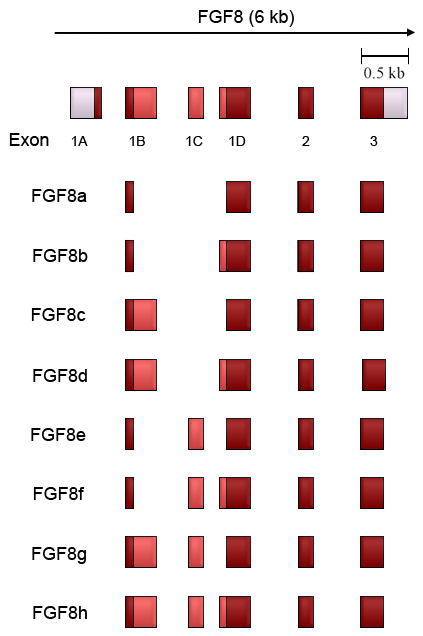
Figure 1. Exon representation of FGF8 isoforms (modified from Gemel et al., 1996).
Transcription
Alternative splicing of FGF8 gene gives rise to eight potential protein isoforms in the mouse (FGF8a-h) and four in the human (a, b, e, f) (Gemel et al., 1996, see Figure 1).
Proteins
Description
Fibroblast growth factor 8 is a secreted protein mitogen which belongs to fibroblast growth factor family. It exerts its action by binding cell surface tyrosine kinase recetors FGFR1-4 (Powers et al., 2000; Sleeman et al., 2001). It is implicated in embryonic development, tumor growth and angiogenesis. FGF8 was originally found as an androgen-induced growth factor (AIGF) from the conditioned medium of the androgen-dependent mouse mammary carcinoma cell line SC-3 (Tanaka et al., 1992). Whether its expression is directly androgen regulated is not clear (Gnanapragasam et al., 2002; Erdeich-Epstein et al., 2005). However, it has been shown to be co-expressed with androgen receptor in breast and prostate cancer. FGF8 is also called Kal-6 since it belongs to genes which have been shown to be mutated in a subset of patients with Kallmans syndrome (combination of hypogonadotropic hypogonadism and anosmia). In addition, FGF8 belongs to growth factors that could be isolated by affinity chromatography on Heparin-Sepharose columns and are thus called heparin-binding growth factors (HBGF). The interaction of heparin with FGF stabilizes FGF to denaturation (Gospodarowicz and Cheng, 1986) and proteolysis and is required for FGF mediated FGFR activation (Ornitz, 2000).
Expression
In the adult human, FGF8 is expressed in kidney, testis, prostate, breast, peripheral blood leukocytes and in bone marrow (Ghosh et al., 1996; Marsh et al., 1999; Tanaka et al., 1998). However, during embryonal development, its expression is more widely distributed. The expression pattern of FGF8 during mouse embryonal development suggested roles for FGF8 in the morphogenesis of limbs, central nervous system and face, pharyngeal and cardiac systems, and the urogenital organs (Ohuchi et al., 1994; Heikinheimo et al., 1994; Crossley et al., 1996a; Crossley et al., 1996b; Haraguchi et al., 2000). Importantly, FGF8 expression is essential in gastrulation since homozygous loss of FGF8 leads to early embryonic lethality (Sun et al., 1999).
Of the cancer cell lines, FGF8 expression has been detected in LNCaP, DU145, ALVA-31 and PC-3 prostate cancer cell lines, in MCF-7, ZR-75-1, T47-D, MDA-MB-231, SKBR-1, BT-549 and Hs578T breast cancer cell lines (Tanaka et al., 1995; Ghosh et al., 1996; Johnson et al., 1998; Marsh et al., 1999) and in UT-OV-2, UT-OV-4, UT-OV-5, UT-OV-6, UT-OV-10, UT-OV-11 and SK-OV-3 ovarian cancer cell lines (Valve et al., 2000). FGF8 has been shown to be expressed in benign breast and prostate lesions and in breast and prostate cancer (Leung et al., 1996; Tanaka et al., 1998; Dorkin et al., 1999). FGF8 expression is correlated with the expression of androgen receptor in both breast and prostate cancer (Wang et al., 1999; Tanaka et al., 2002). In prostate cancer the expression of FGF8 correlates with the poor prognosis (Dorkin et al., 1999). FGF8b is the primary isoform detected in breast cancer (Marsh et al., 1999) but in prostate cancer in addition to FGF8b, also FGF8a and FGF8e have been detected (Valve et al., 2001). Ovarian cancers of wide variety of histological types express FGF8 and its receptors and increased staining intensity of FGF8 has been associated with loss of differentiation within the tumors (Valve et al., 2000).
Of the cancer cell lines, FGF8 expression has been detected in LNCaP, DU145, ALVA-31 and PC-3 prostate cancer cell lines, in MCF-7, ZR-75-1, T47-D, MDA-MB-231, SKBR-1, BT-549 and Hs578T breast cancer cell lines (Tanaka et al., 1995; Ghosh et al., 1996; Johnson et al., 1998; Marsh et al., 1999) and in UT-OV-2, UT-OV-4, UT-OV-5, UT-OV-6, UT-OV-10, UT-OV-11 and SK-OV-3 ovarian cancer cell lines (Valve et al., 2000). FGF8 has been shown to be expressed in benign breast and prostate lesions and in breast and prostate cancer (Leung et al., 1996; Tanaka et al., 1998; Dorkin et al., 1999). FGF8 expression is correlated with the expression of androgen receptor in both breast and prostate cancer (Wang et al., 1999; Tanaka et al., 2002). In prostate cancer the expression of FGF8 correlates with the poor prognosis (Dorkin et al., 1999). FGF8b is the primary isoform detected in breast cancer (Marsh et al., 1999) but in prostate cancer in addition to FGF8b, also FGF8a and FGF8e have been detected (Valve et al., 2001). Ovarian cancers of wide variety of histological types express FGF8 and its receptors and increased staining intensity of FGF8 has been associated with loss of differentiation within the tumors (Valve et al., 2000).
Function
FGF receptors, to which FGF8 binds, are transmembrane proteins containing three extracellular immunoglobulin-like domains (IgI, IgII, IgIII), an acidic region between IgI and IgII, a transmembrane domain, and an intracellular tyrosine kinase domain. The involvement of receptor tyrosine phosphorylation in FGF signalling was first suggested by early binding studies (Moscatelli et al., 1987). An important mechanism by which FGF receptors determine specificity for different FGFs is by alternate exon usage of the IgIII forms. The exons coding for the three possible IgIII domains (IgIIIa, IgIIIb, IgIIIc) are situated contiguously and in the same order in FGFR1, FGFR2 and FGFR3 (Johnson et al., 1991; Chellaiah et al., 1994). The FGFR4 gene is unique in that there is only one possible form of its IgIII domain (Vainikka et al., 1992). IgIIIa splice variant codes for a secreted truncated protein which is not capable of transducing signals but instead may act to sequester released FGFs and potentially inhibit FGF signaling. FGF8 predominantly activates c-spliceforms of the receptors which are expressed mainly by the cells of mesenchymal origin. Thus, epithelially secreted FGF8 signals to neighbouring mesenchyme and may have a role in the epithelial-mesenchymal transition important in carcinogenesis. However, FGF8 is also well known as an autocrine growth factor in the stimulation of cancer cell proliferation, anchorage independent growth and migration (Figure 2). Full FGF receptor activation requires a coreceptor, a cell surface heparan sulfate proteoglycan (HSPG), which traps the growth factor on the cell surface and stabilizes the FGF/FGFR complex (Ornitz, 2000). Tissue-specific heparan fragments and tissue specific sulfation patterns of heparans may regulate FGFs by controlling their diffusion in the extracellular matrix and their ability to activate specific receptors (Chang et al., 2000). Strong binding of FGFs to heparin and heparan sulfated proteoglycans leads to deposition and sequestration of secreted or exocytosed FGFs in the extracellular matrix. Storage of FGFs in the extracellular matrix may serve as an angiogenesis regulatory reservoir released in response to degradation of the matrix (Folkman et al., 1988).
FGF activation of FGFRs results in activation of signalling cascades such as phospholipase C gamma, phosphatidiylinositol-3 kinase and MAPK pathways that lead to expression of target genes and increased cell proliferation, survival and migration. Negative modulators of FGF signalling that have been found to be co-expressed with FGF8 include sprouty proteins (Spry1, Spry2), MAP-kinase phosphatase 3 (Mkp3) and Sef (Similar expression to FGFs) genes. Recently, FGF8 has been shown to downregulate the expression of thrombospondin-1 (TSP-1) (Mattila et al., 2006) through two independent pathways, MEK1/MEK2 and PI3K (Tarkkonen et al., 2010). Repression of TSP-1 may be an important mechanism involved in the induction of an angiogenic phenotype and growth of FGF8-expressing cancer.
FGF activation of FGFRs results in activation of signalling cascades such as phospholipase C gamma, phosphatidiylinositol-3 kinase and MAPK pathways that lead to expression of target genes and increased cell proliferation, survival and migration. Negative modulators of FGF signalling that have been found to be co-expressed with FGF8 include sprouty proteins (Spry1, Spry2), MAP-kinase phosphatase 3 (Mkp3) and Sef (Similar expression to FGFs) genes. Recently, FGF8 has been shown to downregulate the expression of thrombospondin-1 (TSP-1) (Mattila et al., 2006) through two independent pathways, MEK1/MEK2 and PI3K (Tarkkonen et al., 2010). Repression of TSP-1 may be an important mechanism involved in the induction of an angiogenic phenotype and growth of FGF8-expressing cancer.
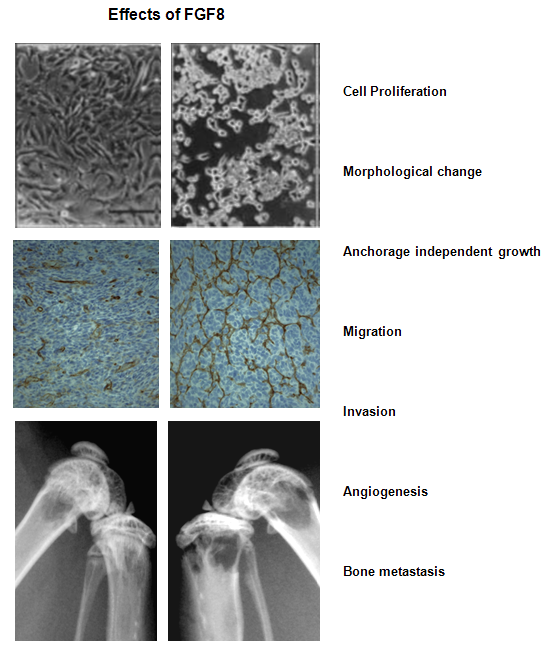
Figure 2. Schematic view of the effects of FGF8 on tumor growth and progression. Morphological change in S115 breast cancer cells in vitro (up), induction of angiogenesis in nude mouse S115 tumors (middle, immunohistochemical staining for CD34), increase in nude mouse bone metastasis of MDA-MB-231 breast cancer cells (bottom, x-ray picture).
Mutations
Note
Loss-of-function mutations of FGF8 are associated with isolated hypogonadotropic hypogonadism with variable sense of smell (Kallmann syndrome), cleft lip/palate, deafness and flat nasal bridge camplodactyly and hyperlaxity in the human (Trarbach et al., 2010).
Implicated in
Entity name
Breast and prostate cancers
Disease
In humans FGF8 has been shown to be expressed in benign breast and prostate lesions and in breast and prostate cancer (Tanaka et al., 1998; Leung et al., 1996; Dorkin et al., 1999). Furthermore, it has been detected in bone metastases of prostate cancer (Valta et al., 2008). The expression of FGF8 has been shown to be increased in breast cancer when compared to non-malignant breast tissue (Marsh et al., 1999). FGF8 expression is correlated with the expression of androgen receptor in both breast and prostate cancer (Tanaka et al., 2002; Wang et al., 1999).
Prognosis
In prostate cancer the expression of FGF8 correlates with the poor prognosis (Dorkin et al., 1999). FGF8b is the primary isoform detected in breast cancer (Marsh et al., 1999) but in prostate cancer in addition to FGF8b, also FGF8a and FGF8e have been detected (Valve et al., 2001). Interestingly, both FGF8 isoforms a and e are expressed more commonly in prostate cancer than in benign prostate samples used as controls (Valve et al., 2001). Surprisingly, FGF8b, despite of being the most transforming isoform (Ghosh et al., 1996) is expressed in a similar manner in both benign and malignant prostate samples (Valve et al., 2001). The clinical data and experimental evidence strongly suggest that FGF8 has a role in the promotion of growth and progression of hormonal cancers. FGF8 has been shown to function as a potent autocrine growth factor in the stimulation of proliferation of breast and prostate cancer cells. In addition, its paracrine effects in terms of induction of angiogenesis and osteoblastic differentiation may contribute to tumor progression.
Oncogenesis
When transfected to NIH-3T3 cells FGF8 induces anchorage independent growth of the cells and tumorigenesis in nude mice (Kouhara et al., 1994). MMTV-Fgf8 transgenic mice develop mammary and salivary gland neoplasia and ovarian stromal hyperplasia (Daphna-Iken et al., 1998). Targeted expression of FGF8 in transgenic mouse prostate has been shown to result in prostatic intraepithelial neoplasia, stromal hyperplasia and increased inflammation (Song et al., 2002; Elo et al., 2010). Several breast and prostate cancer cell lines transfected with FGF8 have been shown to exhibit increased growth properties. Also morphology and motility of the cells are reportedly altered in response to FGF8 overexpression (Mattila et al., 2001; Ruohola et al., 2001) indicating that FGF8 may affect cytoskeletal and adhesion molecule expression of cancer cells. Similar to FGF2, FGF8 has been shown to have angiogenic potential (Mattila et al., 2001). Increased FGF8 expression is associated with rich vasculature of fast growing tumors (Valta et al., 2008; Valta et al., 2009; Tuomela et al., 2010). As FGF8 has a central role in hormonal cancers which preferentially metastasize to bone, recent studies have focused on the question whether FGF8 has a role in bone metastasis. The first results show that FGF8 is involved in bone metastasis of prostate cancer (Valta et al., 2006; Valta et al., 2008).
Article Bibliography
| Pubmed ID | Last Year | Title | Authors |
|---|---|---|---|
| 10627288 | 2000 | Differential ability of heparan sulfate proteoglycans to assemble the fibroblast growth factor receptor complex in situ. | Chang Z et al |
| 7512569 | 1994 | Fibroblast growth factor receptor (FGFR) 3. Alternative splicing in immunoglobulin-like domain III creates a receptor highly specific for acidic FGF/FGF-1. | Chellaiah AT et al |
| 8548816 | 1996 | Roles for FGF8 in the induction, initiation, and maintenance of chick limb development. | Crossley PH et al |
| 9840935 | 1998 | MMTV-Fgf8 transgenic mice develop mammary and salivary gland neoplasia and ovarian stromal hyperplasia. | Daphna-Iken D et al |
| 10629559 | 1999 | aFGF immunoreactivity in prostate cancer and its co-localization with bFGF and FGF8. | Dorkin TJ et al |
| 21076617 | 2010 | Stromal activation associated with development of prostate cancer in prostate-targeted fibroblast growth factor 8b transgenic mice. | Elo TD et al |
| 16252261 | 2006 | Androgen inducibility of Fgf8 in Shionogi carcinoma 115 cells correlates with an adjacent t(5;19) translocation. | Erdreich-Epstein A et al |
| 8661131 | 1996 | Structure and sequence of human FGF8. | Gemel J et al |
| 8891346 | 1996 | Molecular cloning and characterization of human FGF8 alternative messenger RNA forms. | Ghosh AK et al |
| 12140757 | 2002 | Regulation of FGF8 expression by the androgen receptor in human prostate cancer. | Gnanapragasam VJ et al |
| 3528177 | 1986 | Heparin protects basic and acidic FGF from inactivation. | Gospodarowicz D et al |
| 10804187 | 2000 | Molecular analysis of external genitalia formation: the role of fibroblast growth factor (Fgf) genes during genital tubercle formation. | Haraguchi R et al |
| 7873403 | 1994 | Fgf-8 expression in the post-gastrulation mouse suggests roles in the development of the face, limbs and central nervous system. | Heikinheimo M et al |
| 1652059 | 1991 | The human fibroblast growth factor receptor genes: a common structural arrangement underlies the mechanisms for generating receptor forms that differ in their third immunoglobulin domain. | Johnson DE et al |
| 9632141 | 1998 | FGF signaling activates STAT1 and p21 and inhibits the estrogen response and proliferation of MCF-7 cells. | Johnson MR et al |
| 8290257 | 1994 | Transforming activity of a newly cloned androgen-induced growth factor. | Kouhara H et al |
| 8622905 | 1996 | Over-expression of fibroblast growth factor-8 in human prostate cancer. | Leung HY et al |
| 7884899 | 1995 | Fgf-8, activated by proviral insertion, cooperates with the Wnt-1 transgene in murine mammary tumorigenesis. | MacArthur CA et al |
| 10023681 | 1999 | Increased expression of fibroblast growth factor 8 in human breast cancer. | Marsh SK et al |
| 9651520 | 1998 | Comparison of the expression of three highly related genes, Fgf8, Fgf17 and Fgf18, in the mouse embryo. | Maruoka Y et al |
| 16723184 | 2006 | Androgen and fibroblast growth factor 8 (FGF8) downregulation of thrombospondin 1 (TSP1) in mouse breast cancer cells. | Mattila MM et al |
| 3032990 | 1987 | High and low affinity binding sites for basic fibroblast growth factor on cultured cells: absence of a role for low affinity binding in the stimulation of plasminogen activator production by bovine capillary endothelial cells. | Moscatelli D et al |
| 7980556 | 1994 | Involvement of androgen-induced growth factor (FGF-8) gene in mouse embryogenesis and morphogenesis. | Ohuchi H et al |
| 11276432 | 2001 | Fibroblast growth factors. | Ornitz DM et al |
| 10655030 | 2000 | FGFs, heparan sulfate and FGFRs: complex interactions essential for development. | Ornitz DM et al |
| 8700553 | 1996 | The human FGF-8 gene localizes on chromosome 10q24 and is subjected to induction by androgen in breast cancer cells. | Payson RA et al |
| 11021964 | 2000 | Fibroblast growth factors, their receptors and signaling. | Powers CJ et al |
| 11358849 | 2001 | Enhanced invasion and tumor growth of fibroblast growth factor 8b-overexpressing MCF-7 human breast cancer cells. | Ruohola JK et al |
| 11418238 | 2001 | Identification of a new fibroblast growth factor receptor, FGFR5. | Sleeman M et al |
| 11118059 | 2000 | The effect of fibroblast growth factor 8, isoform b, on the biology of prostate carcinoma cells and their interaction with stromal cells. | Song Z et al |
| 10421635 | 1999 | Targeted disruption of Fgf8 causes failure of cell migration in the gastrulating mouse embryo. | Sun X et al |
| 9605740 | 1998 | High frequency of fibroblast growth factor (FGF) 8 expression in clinical prostate cancers and breast tissues, immunohistochemically demonstrated by a newly established neutralizing monoclonal antibody against FGF 8. | Tanaka A et al |
| 12404063 | 2002 | Fibroblast growth factor 8 expression in breast carcinoma: associations with androgen receptor and prostate-specific antigen expressions. | Tanaka A et al |
| 7737407 | 1995 | Human androgen-induced growth factor in prostate and breast cancer cells: its molecular cloning and growth properties. | Tanaka A et al |
| 20463092 | 2010 | Nonsense mutations in FGF8 gene causing different degrees of human gonadotropin-releasing deficiency. | Trarbach EB et al |
| 21034500 | 2010 | Fast growth associated with aberrant vasculature and hypoxia in fibroblast growth factor 8b (FGF8b) over-expressing PC-3 prostate tumour xenografts. | Tuomela J et al |
| 1385111 | 1992 | Fibroblast growth factor receptor-4 shows novel features in genomic structure, ligand binding and signal transduction. | Vainikka S et al |
| 16439448 | 2006 | Regulation of osteoblast differentiation: a novel function for fibroblast growth factor 8. | Valta MP et al |
| 19415685 | 2009 | FGF-8b induces growth and rich vascularization in an orthotopic PC-3 model of prostate cancer. | Valta MP et al |
| 11072239 | 2000 | Expression of fibroblast growth factor (FGF)-8 isoforms and FGF receptors in human ovarian tumors. | Valve E et al |
| 11406643 | 2001 | Increased expression of FGF-8 isoforms and FGF receptors in human premalignant prostatic intraepithelial neoplasia lesions and prostate cancer. | Valve EM et al |
| 10343609 | 1999 | Correlation between androgen receptor expression and FGF8 mRNA levels in patients with prostate cancer and benign prostatic hypertrophy. | Wang Q et al |
Other Information
Locus ID:
NCBI: 2253
MIM: 600483
HGNC: 3686
Ensembl: ENSG00000107831
Variants:
dbSNP: 2253
ClinVar: 2253
TCGA: ENSG00000107831
COSMIC: FGF8
RNA/Proteins
Expression (GTEx)
Pathways
References
| Pubmed ID | Year | Title | Citations |
|---|---|---|---|
| 37118562 | 2023 | NMR resonance assignment of a fibroblast growth factor 8 splicing isoform b. | 0 |
| 37762545 | 2023 | Unveiling the Significance of FGF8 Overexpression in Orchestrating the Progression of Ovarian Cancer. | 0 |
| 37118562 | 2023 | NMR resonance assignment of a fibroblast growth factor 8 splicing isoform b. | 0 |
| 37762545 | 2023 | Unveiling the Significance of FGF8 Overexpression in Orchestrating the Progression of Ovarian Cancer. | 0 |
| 33580754 | 2021 | FGF8 and BMP2 mediated dynamic regulation of dental mesenchyme proliferation and differentiation via Lhx8/Suv39h1 complex. | 3 |
| 33649301 | 2021 | FGF8 induces epithelial-mesenchymal transition and promotes metastasis in oral squamous cell carcinoma. | 15 |
| 34433009 | 2021 | Position effects at the FGF8 locus are associated with femoral hypoplasia. | 2 |
| 33580754 | 2021 | FGF8 and BMP2 mediated dynamic regulation of dental mesenchyme proliferation and differentiation via Lhx8/Suv39h1 complex. | 3 |
| 33649301 | 2021 | FGF8 induces epithelial-mesenchymal transition and promotes metastasis in oral squamous cell carcinoma. | 15 |
| 34433009 | 2021 | Position effects at the FGF8 locus are associated with femoral hypoplasia. | 2 |
| 31718875 | 2020 | FGF8, FGF10 and FGF receptor 2 in foreskin of children with hypospadias: an analysis of immunohistochemical expression patterns and gene transcription. | 3 |
| 32664970 | 2020 | Mutations in fibroblast growth factor (FGF8) and FGF10 identified in patients with conotruncal defects. | 7 |
| 33019532 | 2020 | Dissecting the Interaction of FGF8 with Receptor FGFRL1. | 3 |
| 31718875 | 2020 | FGF8, FGF10 and FGF receptor 2 in foreskin of children with hypospadias: an analysis of immunohistochemical expression patterns and gene transcription. | 3 |
| 32664970 | 2020 | Mutations in fibroblast growth factor (FGF8) and FGF10 identified in patients with conotruncal defects. | 7 |
Citation
Mirjami Mattila ; Pirkko Härkönen
FGF8 (fibroblast growth factor 8 (androgen-induced))
Atlas Genet Cytogenet Oncol Haematol. 2011-03-01
Online version: http://atlasgeneticsoncology.org/gene/40566/fgf8
