SPARC (secreted protein acidic and cysteine-rich)
2016-12-01 Ana C. Pavanelli , Flávia Regina Mangone , Maria A. Nagai. AffiliationAbstract
Review on SPARC, with data on DNA, on the protein encoded, and where the gene is implicated.
DNA/RNA
Description
DNA size: 26,070 kb; Exon count: 10; mRNA size: 3604 bp NM_003118. A CPG-rich sequence has been identified at the 5 region of the SPARC gene, characterizing the presence of CpG island spanning from exon 1 to intron 1 (Yang et al., 2007).
Transcription
Three transcript variants encoding different isoforms have been found for this gene.
NM_003118.3 - Homo sapiens secreted protein acidic and cysteine-rich (SPARC), transcript variant 1, mRNA: NP_003109.1. Transcript size: 3604 bp. Variant 1 encodes the predominant isoform.
NM_001309443.1 - Homo sapiens secreted protein acidic and cysteine-rich (SPARC), transcript variant 2, mRNA: NP_001296372.1. Transcript size: 3601 bp. Variant 2 uses an alternate in-frame splice junction at the 5 end of an exon compared to variant 1. The resulting isoform has the same N- and C-termini but is 1 aa shorter compared to isoform 1.
NM_001309444.1 - Homo sapiens secreted protein acidic and cysteine-rich (SPARC), transcript variant 3, mRNA: NP_001296373.1 . Transcript size: 3602 bp. Variant 3 uses an alternate splice junction at the 5 end of the last exon compared to variant 1 that causes a frameshift. The resulting isoform has a longer and distinct C-terminus compared to isoform 1.
NM_003118.3 - Homo sapiens secreted protein acidic and cysteine-rich (SPARC), transcript variant 1, mRNA: NP_003109.1. Transcript size: 3604 bp. Variant 1 encodes the predominant isoform.
NM_001309443.1 - Homo sapiens secreted protein acidic and cysteine-rich (SPARC), transcript variant 2, mRNA: NP_001296372.1. Transcript size: 3601 bp. Variant 2 uses an alternate in-frame splice junction at the 5 end of an exon compared to variant 1. The resulting isoform has the same N- and C-termini but is 1 aa shorter compared to isoform 1.
NM_001309444.1 - Homo sapiens secreted protein acidic and cysteine-rich (SPARC), transcript variant 3, mRNA: NP_001296373.1 . Transcript size: 3602 bp. Variant 3 uses an alternate splice junction at the 5 end of the last exon compared to variant 1 that causes a frameshift. The resulting isoform has a longer and distinct C-terminus compared to isoform 1.
Proteins
Note
SPARC encodes a cysteine-rich acidic matrix-associated protein that belongs to a family of SPARC-related proteins composed of others six members, that include SPOCK1, SPOCK2, SPOCK3, SPARCL1, SMOC1, SMOC2 (testican-1, -2, -3, SPARC-like 1 (or hevin, Mast9), and SPARC-related modular calcium binding (SMOC)-1, and -2). All members of this protein family share the three similar domains (Bradshaw and Sage, 2001; Brekken and Sage, 2000). SPARC protein is required for the collagen in the bone to become calcified. SPARC is also involved in extracellular matrix synthesis and remodeling being associated with the promotion of changes in cell shape. SPARC protein has been associated with tumor suppression but has also been correlated with metastasis based on changes to cell shape which can promote tumor cell invasion (GeneCard RefSeq).
molecular weight: 303aa, 43 kDa; Isoelectric point: 4.4719. Although, after cleavage of the signal sequence, SPARC is a 32-kDa protein (Mason et al. 1986), the secreted form is identified as a 43 kDa protein on SDS-PAGE, which is due to the addition of carbohydrate (Sage et al. 1984).
NP_003109.1: molecular weight: 303 aa; NP_001296372.1: molecular weight: 302 aa; NP_001296373.1: molecular weight: 341 aa
molecular weight: 303aa, 43 kDa; Isoelectric point: 4.4719. Although, after cleavage of the signal sequence, SPARC is a 32-kDa protein (Mason et al. 1986), the secreted form is identified as a 43 kDa protein on SDS-PAGE, which is due to the addition of carbohydrate (Sage et al. 1984).
NP_003109.1: molecular weight: 303 aa; NP_001296372.1: molecular weight: 302 aa; NP_001296373.1: molecular weight: 341 aa
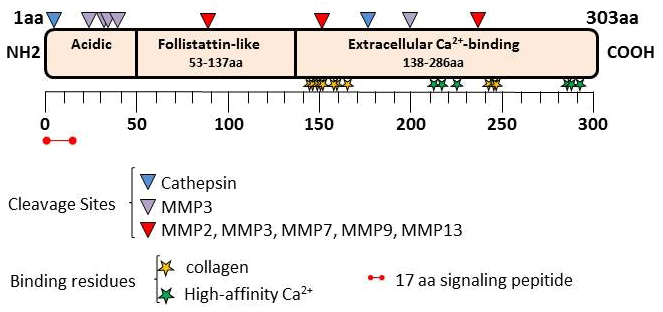
Figure 1 - Schematic representation of the 303 aa human SPARC protein with its functional and structural domains. Box represents the three functional domains: acidic domain (18-52aa), follistatin-like (53-137aa), extracellular Ca2+-binding (138- 286aa). The first seventeen amino acids correspond to the signaling peptide. Stars and triangles represent some of the structural domains: yellow and green stars represent collagen-binding and high-affinity Ca2+-binding residues, respectively. Triangles represent cleavage sites for cathepsin (blue), MMP2, MMP3, MMP7, MMP9, and MMP13 (red), and MMP3 (purple). (based on Brekken and Sage, 2001; Chlenski and Cohn, 2010)
Description
SPARC is a 43kDa protein, composed of 303 aminoacids. The first 17 amino acids containing the signaling peptide sequence is removed during protein processing. SPARC protein has three structural domains: N-terminal domain (NT; aa 3-51) encoded by exons 3 and 4, follistatin-like domain (FS; 53-137 aa) encoded by exons 5 and 6, the Extra Cellular domain (EC; aa 138-286) encoded by exons 7 to 9. It has eleven collagen- and six high-affinity Ca2+ binding residues. Also, the protein presents cleavage sites for cathepsin and members of the metalloproteinases family (Brekken and Sage, 2000; figure 1).
The NT domain binds hydroxyapatite and calcium ions. The FS domain contains several internal disulfide bonds that stabilize two weakly interacting modules. The N-terminus region of the FS domain has a very twisted-hairpin structure that is linked by disulfide bonds at cysteines 1-3, and 2-4. This distribution of disulfide bonds makes the FS-domain structurally homologous to epidermal growth factor (EGF)-like domain of factor IX, a coagulation factor. At the other end of the FS-domain, its C-terminus region has structural similarity to Kazal family of serine proteases. It has antiparallel alpha-helices connected to small three-stranded antiparallel alpha-sheets with disulfide bonds linking cysteines 5-9, 6-8, 7-10. The EC domain contains two E-F hand motifs that bind calcium with high affinity, and comprise almost entirely of alpha-helices (Hohenester et al., 1997).
The NT domain binds hydroxyapatite and calcium ions. The FS domain contains several internal disulfide bonds that stabilize two weakly interacting modules. The N-terminus region of the FS domain has a very twisted-hairpin structure that is linked by disulfide bonds at cysteines 1-3, and 2-4. This distribution of disulfide bonds makes the FS-domain structurally homologous to epidermal growth factor (EGF)-like domain of factor IX, a coagulation factor. At the other end of the FS-domain, its C-terminus region has structural similarity to Kazal family of serine proteases. It has antiparallel alpha-helices connected to small three-stranded antiparallel alpha-sheets with disulfide bonds linking cysteines 5-9, 6-8, 7-10. The EC domain contains two E-F hand motifs that bind calcium with high affinity, and comprise almost entirely of alpha-helices (Hohenester et al., 1997).
Expression
The evaluation of the expression pattern of SPARC protein and mRNA during human embryonic and fetal development revealed that it is usually expressed in tissues undergoing rapid proliferation (Mundlos et al., 1992). These authors also showed that earlier developmental stages showed a more general distribution, changing to more heterogeneity expression pattern in later stages. SPARC expression was observed in bone, cartilage, teeth, kidney, gonads, adrenal gland, lung, eye, vessels (Mundlos et al., 1992). In adults SPARC is expressed in different tissues and organs, including bone marrow, whole blood, lymph node, thymus, brain, cerebellum, retina, heart, smooth muscle, skeletal muscle, spinal cord, intestine, colon, adipocyte, kidney, liver, pancreas, thyroid, salivary gland, skin, ovary, uterus, placenta, cervix and prostate (Wang et al, 2014). It is also described that SPARC is expressed by different cell types including active osteoblasts, bone marrow progenitor cells, odontoblasts endothelial cells, fibroblasts, pericytes, astrocytes and macrophages (McCurdy et al. 2010; Rosseta and Bradshaw, 2016).
In cancer, according to PrognoScan database, SPARC expression was observed in bladder, blood, brain, breast, colorectal, eye tumors, glioma, head and neck cancer, lung, esophagus, ovarian, and skin cancer tissues (Wang et al., 2014).
There are evidences that SPARC expression is transcriptionally regulated by methylation in different types of neoplasia such as ovarian cancer (Socha et al, 2009), pancreatic cancer (Vaz et al, 2015), hepatocellular carcinoma (Zhang et al, 2012) colorectal (Cheetham et al., 2008) and breast (Matteucci et al, 2016). Loss of heterozygosity (LOH) at 5q has been demonstrated in pancreatic cancer (Hahn et al., 1995), in pulmonary fibrosis (Demopoulos et al., 2002) and myelodysplastic syndromes (Giagounidis et al., 2014).
In cancer, according to PrognoScan database, SPARC expression was observed in bladder, blood, brain, breast, colorectal, eye tumors, glioma, head and neck cancer, lung, esophagus, ovarian, and skin cancer tissues (Wang et al., 2014).
There are evidences that SPARC expression is transcriptionally regulated by methylation in different types of neoplasia such as ovarian cancer (Socha et al, 2009), pancreatic cancer (Vaz et al, 2015), hepatocellular carcinoma (Zhang et al, 2012) colorectal (Cheetham et al., 2008) and breast (Matteucci et al, 2016). Loss of heterozygosity (LOH) at 5q has been demonstrated in pancreatic cancer (Hahn et al., 1995), in pulmonary fibrosis (Demopoulos et al., 2002) and myelodysplastic syndromes (Giagounidis et al., 2014).
Localisation
SPARC is a secreted glycoprotein found mainly in the extracellular compartment. However, it has also been described to be localized both to cell nucleus and to cytoplasm (Hudson et al., 2005; Baldini et al. 2008).
Function
SPARC is an evolutionarily conserved matricellular glycoprotein that is involved in diverse biological processes, including tissue remodeling, wound repair, morphogenesis, cell differentiation, proliferation, migration, and angiogenesis. Matricellular glycoprotein proteins are a family of proteins that can be associated with structural elements and mediates cell-matrix interaction rather than functions as extracellular matrix (ECM) structural elements (Bornstein, 1995).
SPARC was first described in skeletal tissue as a bone-specific protein that binds selectively to both hydroxyapatite and collagen (Termine et al., 1981). Posteriorly, it was shown that this protein is broadly expressed both in mineralized and non-mineralized tissues being associated to ECM, regulating cell-matrix interactions and cellular functions, than contributing to ECM organization (Bornstein, 2000; Bradshaw, 2012).
SPARC has also been shown to regulate the activity of matrix metalloproteinases (MMP), a family of enzymes capable of breaking down proteins, such as collagen, normally found in ECM and considered to be the mediators of ECM proteolysis and turnover. Angiogenesis, healing and metastasis, processes that require ECM restructuring are associated with higher SPARC production.
The influence of SPARC on MMP-1, MMP-3, and MMP-9 activity was first described by Tremble et al., 1993. Further studies were carried out in transformed cells and tumor, and it was demonstrated that SPARC could increase MMP-2 activity in glioma cells and breast cancer cells but not in melanoma cells (McClung et al., 2007, Nischt et al., 2001, Gilles et al., 1998).
SPARC was first described in skeletal tissue as a bone-specific protein that binds selectively to both hydroxyapatite and collagen (Termine et al., 1981). Posteriorly, it was shown that this protein is broadly expressed both in mineralized and non-mineralized tissues being associated to ECM, regulating cell-matrix interactions and cellular functions, than contributing to ECM organization (Bornstein, 2000; Bradshaw, 2012).
SPARC has also been shown to regulate the activity of matrix metalloproteinases (MMP), a family of enzymes capable of breaking down proteins, such as collagen, normally found in ECM and considered to be the mediators of ECM proteolysis and turnover. Angiogenesis, healing and metastasis, processes that require ECM restructuring are associated with higher SPARC production.
The influence of SPARC on MMP-1, MMP-3, and MMP-9 activity was first described by Tremble et al., 1993. Further studies were carried out in transformed cells and tumor, and it was demonstrated that SPARC could increase MMP-2 activity in glioma cells and breast cancer cells but not in melanoma cells (McClung et al., 2007, Nischt et al., 2001, Gilles et al., 1998).
Homology
The human SPARC gene shows 92% and 31% identity with the mouse and nematode homologs, respectively.
SPARC is conserved in a wide variety of evolutionarily diverse organisms (e.g., C. elegans, Drosophila, brine shrimp, trout, chicken, mice, and humans), suggesting that it plays an important function in multicellular biology (Bradshaw and Sage, 2001).
SPARC is conserved in a wide variety of evolutionarily diverse organisms (e.g., C. elegans, Drosophila, brine shrimp, trout, chicken, mice, and humans), suggesting that it plays an important function in multicellular biology (Bradshaw and Sage, 2001).
Implicated in
Entity name
Osteogenesis Imperfecta, Type XVII
Note
SPARC gene mutations have been correlated with a severe disease known as osteogenesis imperfecta, a connective tissue disorder characterized by low bone mass, bone fragility and susceptibility to fractures after minimal trauma. Whole-exome sequencing was carried out in 2 unrelated girls carrying osteogenesis imperfecta (OI17; 616507) leading to the identification of two different homozygous missense mutations, R166H (VAR_075142) and E263K (VAR_075143) (Mendoza-Londono et al., 2015). Previous studies described diminished expression of SPARC in osteoblasts from patients with osteogenesis imperfecta (Muriel et al., 1991) and in osteoblasts obtained from the fro/fro mouse, an animal with fragile bones (Vetter et al., 1991)
Entity name
Osteoporosis
Note
The involvement of SPARC in bone remodeling has been described, and its expression is observed in osteoblasts express (Kelm et al., 1992). SPARC-null mice were reported to have decreased numbers of osteoblasts and osteoclasts, indicating decreased bone turnover, resulting in low turnover osteoporosis-like phenotype affecting trabecular bone (Delany, et al., 2000). Also, in osteonectin-null mice, osteonectin levels have been shown to play a role in modulating the balance of bone formation and resorption in response to PTH treatment (Machado do Reis et al., 2008).
Entity name
Pulmonary and Cardiac Fibrosis
Note
Fibrosis is characterized by excessive deposition of extracellular matrix, resulting in tissue remodeling and thus interfering with normal tissue architecture and function.
SPARC expression and up-regulation have been reported in multiple types of fibrosis both human and animal fibrotic models. It has been shown that SPARC can influence TGFB1 (TGF-beta), a known regulator of fibrosis. Thus it is suggested that SPARC may regulate TGF-beta activity in fibrotic tissues (Trombetta and Bradshaw, 2012).
SPARC expression and up-regulation have been reported in multiple types of fibrosis both human and animal fibrotic models. It has been shown that SPARC can influence TGFB1 (TGF-beta), a known regulator of fibrosis. Thus it is suggested that SPARC may regulate TGF-beta activity in fibrotic tissues (Trombetta and Bradshaw, 2012).
Entity name
Cardiac disease
Note
SPARC expression was reported in cardiac disease. It is highly expressed in fibroblasts and endothelial cells and less expressed in cardiac myocytes. By screening analysis, SPARC was found as differentially expressed and potentially associated with myocardial infarction and transverse aortic constriction (Wang et al., 2015). Also, SPARC demonstrated to have potential therapeutic applications in inhibiting cardiac dilatation and dysfunction after myocardial infarction (Schelling et al., 2009).
Entity name
Cancer
Note
SPARC protein modulates different cell functions like as adhesion, proliferation, angiogenesis, cell survival, and has been associated with tumor development and progression (Arnold and Brekken, 2009; Nagaraju et al., 2014).
SPARC is differentially expressed in different types of cancer, and its ability to inhibit or promote tumor progression is dependent on the cellular type, tumoral stage and the type of established interactions among the different components of cellular microenvironment (Arnold and Brekken, 2009).
The pleiotropic effects of SPARC reflect the complexity of actions of this protein, which can act as an oncogene or tumor suppressor (Podhajcer et al.,2008; Arnold and Brekken, 2009). Hence, the role of SPARC in the process of tumorigenesis and as a tumor biomarker is still controversial. Higher levels of SPARC were observed in malignant tumors, including breast, esophagus, brain, prostate, glioma, and melanoma, suggesting that increased SPARC expression is associated with tumor progression (Framson and Sage, 2004; Bos et al.,2004; Watkins et al.,2005; Koblinski et al.,2005). On the other hands, other studies have suggested that SPARC may act as a tumor suppressor, promoting apoptosis in ovarian cancer cells and presenting an anti-tumoral effect in pancreatic and breast cancers (Chlenski and Cohn, 2010; Nagai et al.,2011).
Tumor with high metastatic potentials such as glioblastomas, melanoma, breast and prostate cancer, express higher levels of SPARC while less metastatic tumor-like ovarian, pancreatic and colorectal tumors, expresses lower or undetectable SPARC (Feng and Tang, 2014).
The diversity of SPARC expression effects has been observed in different types of cancers. SPARC has been associated with tumor development in melanoma, esophagus cancer, gastric cancer and glioma, and data suggests that higher expression is correlated with a more aggressive phenotype such as tumor size, metastasis and poor prognosis (Yamashita K et al., 2003; Bos et al.,2004; Framson and Sage, 2004; Wang et al., 2004; Koblinsk et al.,2005; Zhao et al., 2010; Fenouille et al., 2011; Liu et al., 2011; Rocco et al., 2011; McClung et al., 2012; Kim et al., 2013) The expression of SPARC does not seem to directly influence cellular transformation since SPARC knockout mice do not develop tumors. However, SPARC might significantly influence tumor-stroma interactions contributing to tumor progression and therapy response (Said et al., 2013).
In different tumor types such as prostatic carcinoma, neuroblastoma, pulmonary carcinoma, leukemia, pancreatic and colorectal cancer, it was described that SPARC inhibits tumor growth and reverts drug resistance increasing chemotherapy response. (Brekken et al., 2003; Sato et al., 2003; Puolakkainen et al., 2004; Said and Motamed, 2005; Tai et al., 2005; DiMartino et al., 2006; Tai and Tang, 2007; Cheetam et al., 2008; Pan et al., 2008; Wong et al., 2008; Socha et al., 2009; Bhoopathi et al., 2011; Davids and Steensma, 2010; Chew et al., 2011; Rahman et al., 2011).
Cheetham et al., 2008, showed that the demethylating agent 5-Aza-2deoxycytidine (5-Aza) leads to the expression of SPARC and increased chemosensitivity in colon cancer cells. In irinotecan-resistant cancer cells, endogenous or exogenous SPARC exposure triggers senescence associated with increased levels of p16 and TP53 phosphorylation (Chan et al., 2010). Also, in vitro and in vivo studies have demonstrated that over-expression of the NT-domain of SPARC leads to a significantly greater sensitivity to chemotherapy and tumor regression that involves an interplay between the NT-domain, BCL2 and CASP8 (caspase 8), which increases apoptosis and confers greater chemosensitivity (Rahman et al., 2011). More recently, Fan et al., demonstrated that over-expression of SPARC increased gemcitabine-induced apoptosis in pancreatic cancer cells via up-regulation of the expression of apoptosis-related proteins. These findings provide insight on the role played by SPARC in drug sensitivity and that its re-expression has a potential to restore chemosensitivity.
SPARC is differentially expressed in different types of cancer, and its ability to inhibit or promote tumor progression is dependent on the cellular type, tumoral stage and the type of established interactions among the different components of cellular microenvironment (Arnold and Brekken, 2009).
The pleiotropic effects of SPARC reflect the complexity of actions of this protein, which can act as an oncogene or tumor suppressor (Podhajcer et al.,2008; Arnold and Brekken, 2009). Hence, the role of SPARC in the process of tumorigenesis and as a tumor biomarker is still controversial. Higher levels of SPARC were observed in malignant tumors, including breast, esophagus, brain, prostate, glioma, and melanoma, suggesting that increased SPARC expression is associated with tumor progression (Framson and Sage, 2004; Bos et al.,2004; Watkins et al.,2005; Koblinski et al.,2005). On the other hands, other studies have suggested that SPARC may act as a tumor suppressor, promoting apoptosis in ovarian cancer cells and presenting an anti-tumoral effect in pancreatic and breast cancers (Chlenski and Cohn, 2010; Nagai et al.,2011).
Tumor with high metastatic potentials such as glioblastomas, melanoma, breast and prostate cancer, express higher levels of SPARC while less metastatic tumor-like ovarian, pancreatic and colorectal tumors, expresses lower or undetectable SPARC (Feng and Tang, 2014).
The diversity of SPARC expression effects has been observed in different types of cancers. SPARC has been associated with tumor development in melanoma, esophagus cancer, gastric cancer and glioma, and data suggests that higher expression is correlated with a more aggressive phenotype such as tumor size, metastasis and poor prognosis (Yamashita K et al., 2003; Bos et al.,2004; Framson and Sage, 2004; Wang et al., 2004; Koblinsk et al.,2005; Zhao et al., 2010; Fenouille et al., 2011; Liu et al., 2011; Rocco et al., 2011; McClung et al., 2012; Kim et al., 2013) The expression of SPARC does not seem to directly influence cellular transformation since SPARC knockout mice do not develop tumors. However, SPARC might significantly influence tumor-stroma interactions contributing to tumor progression and therapy response (Said et al., 2013).
In different tumor types such as prostatic carcinoma, neuroblastoma, pulmonary carcinoma, leukemia, pancreatic and colorectal cancer, it was described that SPARC inhibits tumor growth and reverts drug resistance increasing chemotherapy response. (Brekken et al., 2003; Sato et al., 2003; Puolakkainen et al., 2004; Said and Motamed, 2005; Tai et al., 2005; DiMartino et al., 2006; Tai and Tang, 2007; Cheetam et al., 2008; Pan et al., 2008; Wong et al., 2008; Socha et al., 2009; Bhoopathi et al., 2011; Davids and Steensma, 2010; Chew et al., 2011; Rahman et al., 2011).
Cheetham et al., 2008, showed that the demethylating agent 5-Aza-2deoxycytidine (5-Aza) leads to the expression of SPARC and increased chemosensitivity in colon cancer cells. In irinotecan-resistant cancer cells, endogenous or exogenous SPARC exposure triggers senescence associated with increased levels of p16 and TP53 phosphorylation (Chan et al., 2010). Also, in vitro and in vivo studies have demonstrated that over-expression of the NT-domain of SPARC leads to a significantly greater sensitivity to chemotherapy and tumor regression that involves an interplay between the NT-domain, BCL2 and CASP8 (caspase 8), which increases apoptosis and confers greater chemosensitivity (Rahman et al., 2011). More recently, Fan et al., demonstrated that over-expression of SPARC increased gemcitabine-induced apoptosis in pancreatic cancer cells via up-regulation of the expression of apoptosis-related proteins. These findings provide insight on the role played by SPARC in drug sensitivity and that its re-expression has a potential to restore chemosensitivity.
Entity name
Breast cancer
Note
In breast cancer, SPARC is expressed in more invasive but not in non-invasive cell lines (Giles et al., 1998). In normal mammary tissue, SPARC expression was undetectable or slightly detectable and in benign mammary lesions the expression was weakly positive. However, the stromal cell of 75% of in situ and invasive breast cancer samples was strongly positive for SPARC (Bellahcène and Castronovo, 1995; Barth et al., 2005; Matteucci et al., 2016).
As previous described, the role of SPARC in breast cancer is also controversial. SPARC expression is not detected in MCF-7 breast cancer cell line, however, in response to c-Jun overexpression, SPARC expression is highly induced being associated to increased invasive and migration potential (Briggs et al., 2002). Instead, in the tumorigenic model of breast cancer cells, MDA-MD-231, SPARC expression inhibited invasion and metastasis (Koblinski et al., 2005).
In breast tumors increased SPARC expression was associated with tumor progression and aggressiveness phenotype (Watkins et al., 2005 and Helleman et al. 2008). On the other hand, the reduction of SPARC protein expression was associated with poor prognosis of breast cancer patients (Hsiao et al., 2010 e Nagai et al., 2011). In breast cancer brain metastasis SPARC expression was down-regulated in comparison to primary tumors, apart from the tumoral subtype. However, among the primary tumors evaluated, triple negative subtype expressed the higher protein level (Wikman et al., 2014). Previous data of our group, have already shown that association between SPARC and triple negative tumors, and positivity to SPARC was a marker of good prognosis in comparison to those patients with reduced SPARC level (Nagai et al., 2011).
As previous described, the role of SPARC in breast cancer is also controversial. SPARC expression is not detected in MCF-7 breast cancer cell line, however, in response to c-Jun overexpression, SPARC expression is highly induced being associated to increased invasive and migration potential (Briggs et al., 2002). Instead, in the tumorigenic model of breast cancer cells, MDA-MD-231, SPARC expression inhibited invasion and metastasis (Koblinski et al., 2005).
In breast tumors increased SPARC expression was associated with tumor progression and aggressiveness phenotype (Watkins et al., 2005 and Helleman et al. 2008). On the other hand, the reduction of SPARC protein expression was associated with poor prognosis of breast cancer patients (Hsiao et al., 2010 e Nagai et al., 2011). In breast cancer brain metastasis SPARC expression was down-regulated in comparison to primary tumors, apart from the tumoral subtype. However, among the primary tumors evaluated, triple negative subtype expressed the higher protein level (Wikman et al., 2014). Previous data of our group, have already shown that association between SPARC and triple negative tumors, and positivity to SPARC was a marker of good prognosis in comparison to those patients with reduced SPARC level (Nagai et al., 2011).
Article Bibliography
| Pubmed ID | Last Year | Title | Authors |
|---|---|---|---|
| 19809893 | 2009 | SPARC: a matricellular regulator of tumorigenesis. | Arnold SA et al |
| 18442048 | 2008 | Sparc localizes to the blebs of hobit cells and human primary osteoblasts. | Baldini G et al |
| 15838642 | 2005 | Stromal remodeling and SPARC (secreted protein acid rich in cysteine) expression in invasive ductal carcinomas of the breast. | Barth PJ et al |
| 7856741 | 1995 | Increased expression of osteonectin and osteopontin, two bone matrix proteins, in human breast cancer. | Bellahcène A et al |
| 21613407 | 2011 | SPARC stimulates neuronal differentiation of medulloblastoma cells via the Notch1/STAT3 pathway. | Bhoopathi P et al |
| 19779848 | 2009 | Matricellular proteins: an overview. | Bornstein P et al |
| 15230275 | 2004 | International Hermelin brain tumor symposium on matricellular proteins in normal and cancer cell-matrix interactions. | Bos TJ et al |
| 22249026 | 2012 | Diverse biological functions of the SPARC family of proteins. | Bradshaw AD et al |
| 11342565 | 2001 | SPARC, a matricellular protein that functions in cellular differentiation and tissue response to injury. | Bradshaw AD et al |
| 11223341 | 2001 | SPARC, a matricellular protein: at the crossroads of cell-matrix communication. | Brekken RA et al |
| 12370830 | 2002 | Transcriptional upregulation of SPARC, in response to c-Jun overexpression, contributes to increased motility and invasion of MCF7 breast cancer cells. | Briggs J et al |
| 20164124 | 2010 | Secreted protein acidic and rich in cysteine-induced cellular senescence in colorectal cancers in response to irinotecan is mediated by P53. | Chan JM et al |
| 18458674 | 2008 | SPARC promoter hypermethylation in colorectal cancers can be reversed by 5-Aza-2'deoxycytidine to increase SPARC expression and improve therapy response. | Cheetham S et al |
| 21818290 | 2011 | SPARC, FOXP3, CD8 and CD45 correlation with disease recurrence and long-term disease-free survival in colorectal cancer. | Chew A et al |
| 19958839 | 2010 | Modulation of matrix remodeling by SPARC in neoplastic progression. | Chlenski A et al |
| 20592488 | 2010 | The molecular pathogenesis of myelodysplastic syndromes. | Davids MS et al |
| 10749571 | 2000 | Osteopenia and decreased bone formation in osteonectin-deficient mice. | Delany AM et al |
| 12169206 | 2002 | MYCL1, FHIT, SPARC, p16(INK4) and TP53 genes associated to lung cancer in idiopathic pulmonary fibrosis. | Demopoulos K et al |
| 16424866 | 2006 | Low or absent SPARC expression in acute myeloid leukemia with MLL rearrangements is associated with sensitivity to growth inhibition by exogenous SPARC protein. | DiMartino JF et al |
| 26358255 | 2016 | Secreted protein acidic and rich in cysteine enhances the chemosensitivity of pancreatic cancer cells to gemcitabine. | Fan X et al |
| 24947586 | 2014 | SPARC in Tumor Pathophysiology and as a Potential Therapeutic Target. | Feng J et al |
| 21685937 | 2011 | SPARC functions as an anti-stress factor by inactivating p53 through Akt-mediated MDM2 phosphorylation to promote melanoma cell survival. | Fenouille N et al |
| 15211566 | 2004 | SPARC and tumor growth: where the seed meets the soil? | Framson PE et al |
| 24018623 | 2014 | Lenalidomide as a disease-modifying agent in patients with del(5q) myelodysplastic syndromes: linking mechanism of action to clinical outcomes. | Giagounidis A et al |
| 9850090 | 1998 | SPARC/osteonectin induces matrix metalloproteinase 2 activation in human breast cancer cell lines. | Gilles C et al |
| 7553647 | 1995 | Allelotype of pancreatic adenocarcinoma using xenograft enrichment. | Hahn SA et al |
| 18765548 | 2008 | Association of an extracellular matrix gene cluster with breast cancer prognosis and endocrine therapy response. | Helleman J et al |
| 9233787 | 1997 | Crystal structure of a pair of follistatin-like and EF-hand calcium-binding domains in BM-40. | Hohenester E et al |
| 20210803 | 2010 | SPARC (osteonectin) in breast tumors of different histologic types and its role in the outcome of invasive ductal carcinoma. | Hsiao YH et al |
| 15389586 | 2005 | Spreading of embryologically distinct urothelial cells is inhibited by SPARC. | Hudson AE et al |
| 1467517 | 1992 | Characterization of human osteoblast and megakaryocyte-derived osteonectin (SPARC). | Kelm RJ Jr et al |
| 23862126 | 2013 | Expression of Secreted Protein Acidic and Rich in Cysteine in the Stroma of a Colorectal Carcinoma is Associated With Patient Prognosis. | Kim JY et al |
| 16103089 | 2005 | Endogenous osteonectin/SPARC/BM-40 expression inhibits MDA-MB-231 breast cancer cell metastasis. | Koblinski JE et al |
| 22145659 | 2011 | Knockdown of secreted protein acidic and rich in cysteine (SPARC) expression diminishes radiosensitivity of glioma cells. | Liu H et al |
| 18499553 | 2008 | Accentuated osteoclastic response to parathyroid hormone undermines bone mass acquisition in osteonectin-null mice. | Machado do Reis L et al |
| 26481505 | 2016 | Coordinate regulation of microenvironmental stimuli and role of methylation in bone metastasis from breast carcinoma. | Matteucci E et al |
| 22114076 | 2012 | Deletion of the SPARC acidic domain or EGF-like module reduces SPARC-induced migration and signaling through p38 MAPK/HSP27 in glioma. | McClung HM et al |
| 19577572 | 2010 | Cardiac extracellular matrix remodeling: fibrillar collagens and Secreted Protein Acidic and Rich in Cysteine (SPARC). | McCurdy S et al |
| 26027498 | 2015 | Recessive osteogenesis imperfecta caused by missense mutations in SPARC. | Mendoza-Londono R et al |
| 1552170 | 1992 | Distribution of osteonectin mRNA and protein during human embryonic and fetal development. | Mundlos S et al |
| 1793673 | 1991 | Morphological and biochemical studies of a mouse mutant (fro/fro) with bone fragility. | Muriel MP et al |
| 20369286 | 2011 | Prognostic value of NDRG1 and SPARC protein expression in breast cancer patients. | Nagai MA et al |
| 24675529 | 2014 | Molecular mechanisms underlying the divergent roles of SPARC in human carcinogenesis. | Nagaraju GP et al |
| 11146229 | 2001 | BM-40 and MMP-2 expression are not coregulated in human melanoma cell lines. | Nischt R et al |
| 18367635 | 2008 | The nonsteroidal anti-inflammatory drug NS398 reactivates SPARC expression via promoter demethylation to attenuate invasiveness of lung cancer cells. | Pan MR et al |
| 18542844 | 2008 | The role of the matricellular protein SPARC in the dynamic interaction between the tumor and the host. | Podhajcer OL et al |
| 15140943 | 2004 | Enhanced growth of pancreatic tumors in SPARC-null mice is associated with decreased deposition of extracellular matrix and reduced tumor cell apoptosis. | Puolakkainen PA et al |
| 22069448 | 2011 | A peptide of SPARC interferes with the interaction between caspase8 and Bcl2 to resensitize chemoresistant tumors and enhance their regression in vivo. | Rahman M et al |
| 21815687 | 2011 | Proteomic profiling of human melanoma metastatic cell line secretomes. | Rocco M et al |
| 26851678 | 2016 | SPARC/osteonectin in mineralized tissue. | Rosset EM et al |
| 6368555 | 1984 | Characterization of a novel serum albumin-binding glycoprotein secreted by endothelial cells in culture. | Sage H et al |
| 23321672 | 2013 | Loss of SPARC in bladder cancer enhances carcinogenesis and progression. | Said N et al |
| 16314484 | 2005 | Absence of host-secreted protein acidic and rich in cysteine (SPARC) augments peritoneal ovarian carcinomatosis. | Said N et al |
| 12902985 | 2003 | SPARC/osteonectin is a frequent target for aberrant methylation in pancreatic adenocarcinoma and a mediator of tumor-stromal interactions. | Sato N et al |
| 19103879 | 2009 | Absence of SPARC results in increased cardiac rupture and dysfunction after acute myocardial infarction. | Schellings MW et al |
| 19177197 | 2009 | Aberrant promoter methylation of SPARC in ovarian cancer. | Socha MJ et al |
| 15902309 | 2005 | Genome-wide expression analysis of therapy-resistant tumors reveals SPARC as a novel target for cancer therapy. | Tai IT et al |
| 17897953 | 2007 | A novel interaction between procaspase 8 and SPARC enhances apoptosis and potentiates chemotherapy sensitivity in colorectal cancers. | Tang MJ et al |
| 7034958 | 1981 | Osteonectin, a bone-specific protein linking mineral to collagen. | Termine JD et al |
| 8509459 | 1993 | SPARC, a secreted protein associated with morphogenesis and tissue remodeling, induces expression of metalloproteinases in fibroblasts through a novel extracellular matrix-dependent pathway. | Tremble PM et al |
| 22802913 | 2012 | The Function of SPARC as a Mediator of Fibrosis. | Trombetta-Esilva J et al |
| 2068957 | 1991 | Osteogenesis imperfecta: changes in noncollagenous proteins in bone. | Vetter U et al |
| 24938427 | 2014 | Integrative genomic analyses of secreted protein acidic and rich in cysteine and its role in cancer prediction. | Wang B et al |
| 15558074 | 2004 | Overexpression of SPARC gene in human gastric carcinoma and its clinic-pathologic significance. | Wang CS et al |
| 26770566 | 2015 | Association of serum SPARC level with severity of coronary artery lesion in type 2 diabetic patients with coronary heart disease. | Wang Z et al |
| 15763438 | 2005 | Increased levels of SPARC (osteonectin) in human breast cancer tissues and its association with clinical outcomes. | Watkins G et al |
| 24833255 | 2014 | Loss of CADM1 expression is associated with poor prognosis and brain metastasis in breast cancer patients. | Wikman H et al |
| 18058030 | 2008 | Analyses of the role of endogenous SPARC in mouse models of prostate and breast cancer. | Wong SY et al |
| 12733139 | 2003 | Clinical significance of secreted protein acidic and rich in cystein in esophageal carcinoma and its relation to carcinoma progression. | Yamashita K et al |
| 17397030 | 2007 | Frequent inactivation of SPARC by promoter hypermethylation in colon cancers. | Yang E et al |
| 22563191 | 2012 | Aberrant methylation of SPARC in human hepatocellular carcinoma and its clinical implication. | Zhang Y et al |
| 20028745 | 2010 | SPARC is associated with gastric cancer progression and poor survival of patients. | Zhao ZS et al |
Other Information
Locus ID:
NCBI: 6678
MIM: 182120
HGNC: 11219
Ensembl: ENSG00000113140
Variants:
dbSNP: 6678
ClinVar: 6678
TCGA: ENSG00000113140
COSMIC: SPARC
RNA/Proteins
Expression (GTEx)
Pathways
Protein levels (Protein atlas)
PharmGKB
| Entity ID | Name | Type | Evidence | Association | PK | PD | PMIDs |
|---|---|---|---|---|---|---|---|
| PA128406956 | fluorouracil | Chemical | VariantAnnotation | ambiguous | PD | 28687963 | |
| PA166123026 | progression-free survival | Disease | VariantAnnotation | ambiguous | PD | 28687963 | |
| PA166123207 | overall survival | Disease | VariantAnnotation | not associated | PD | 28687963 | |
| PA445218 | Pancreatic Neoplasms | Disease | VariantAnnotation | ambiguous | PD | 28687963 | |
| PA448771 | capecitabine | Chemical | VariantAnnotation | ambiguous | PD | 28687963 | |
| PA449748 | gemcitabine | Chemical | VariantAnnotation | ambiguous | PD | 28687963 |
References
| Pubmed ID | Year | Title | Citations |
|---|---|---|---|
| 37907830 | 2024 | Peritumoral SPARC expression induced by exosomes from nasopharyngeal carcinoma infected Epstein-Barr virus: A poor prognostic marker. | 1 |
| 38048752 | 2024 | The association of SPARC with hypertension and its function in endothelial-dependent relaxation. | 0 |
| 38199134 | 2024 | Osteonectin (SPARC) prognostic value in prostate cancer. | 0 |
| 38245817 | 2024 | Citric acid promotes SPARC release in pancreatic cancer cells and inhibits the progression of pancreatic tumors in mice on a high-fat diet. | 0 |
| 38347494 | 2024 | Immunohistochemical expression of SPARC in odontogenic keratocysts: a comparative study with other odontogenic cysts. | 0 |
| 37907830 | 2024 | Peritumoral SPARC expression induced by exosomes from nasopharyngeal carcinoma infected Epstein-Barr virus: A poor prognostic marker. | 1 |
| 38048752 | 2024 | The association of SPARC with hypertension and its function in endothelial-dependent relaxation. | 0 |
| 38199134 | 2024 | Osteonectin (SPARC) prognostic value in prostate cancer. | 0 |
| 38245817 | 2024 | Citric acid promotes SPARC release in pancreatic cancer cells and inhibits the progression of pancreatic tumors in mice on a high-fat diet. | 0 |
| 38347494 | 2024 | Immunohistochemical expression of SPARC in odontogenic keratocysts: a comparative study with other odontogenic cysts. | 0 |
| 36018492 | 2023 | The role of SPARC (secreted protein acidic and rich in cysteine) in the pathogenesis of obesity, type 2 diabetes, and non-alcoholic fatty liver disease. | 3 |
| 36229930 | 2023 | SPARC expression in tumor microenvironment induces partial epithelial-to-mesenchymal transition of esophageal adenocarcinoma cells via cooperating with TGF-β signaling. | 3 |
| 36346290 | 2023 | SPARC in cancer-associated fibroblasts is an independent poor prognostic factor in non-metastatic triple-negative breast cancer and exhibits pro-tumor activity. | 10 |
| 36454505 | 2023 | CircRNA circ_POSTN promotes the malignancy of glioma by regulating the miR-433-3p/SPARC axis. | 3 |
| 36642579 | 2023 | SPARC promotes fibroblast proliferation, migration, and collagen production in keloids by inactivation of p53. | 2 |
Citation
Ana C. Pavanelli ; Flávia Regina Mangone ; Maria A. Nagai.
SPARC (secreted protein acidic and cysteine-rich)
Atlas Genet Cytogenet Oncol Haematol. 2016-12-01
Online version: http://atlasgeneticsoncology.org/gene/42369
