TFAP2A (transcription factor AP-2 alpha (activating enhancer binding protein 2 alpha))
2009-09-01 Francesca Orso , Daniela Taverna AffiliationIdentity
HGNC
LOCATION
6p24.3
IMAGE

LEGEND
Figure 1 : TFAP2A human gene including promoter, 7 exons and 6 introns.
LEGEND
Modified from Entrez Gene (Genomic DNA).
LOCUSID
ALIAS
AP-2,AP-2alpha,AP2TF,BOFS,TFAP2
FUSION GENES
DNA/RNA
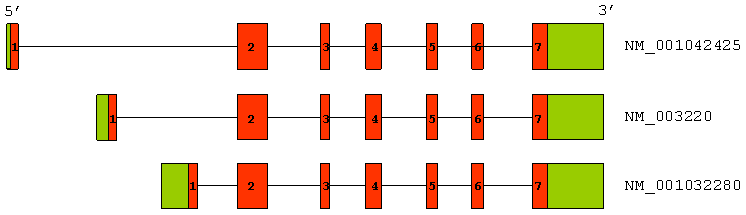
Figure 2 : Three main transcripts are shown. Exons: red and green. Red: protein-coding sequences; Green: 5 and 3 Untranslated (UTR) regions. Black lines: introns.
Modified from Entrez Gene (Transcripts).
Description
The gene encompasses 22.882 kb of DNA; 7 exons.
Transcription
mRNA, NM_001042425; NM_003220; NM_001032280.
Proteins

Figure 3.
Modified from Williams and Tjian, 1991.
Description
The main TFAP2A isoform consists of 437 amino acids and has a molecular weight of 52 kDa. TFAP2A proteins contain a unique, highly conserved helix-span-helix dimerization motif at the C-terminal half of the protein, a central basic region and a less conserved proline- and glutamine-rich domain at the amino terminus. The helix-span-helix motif and the basic region mediate DNA binding and dimerization while the proline- and glutamine-rich region is responsible for transcriptional transactivation (see figure 3).
Expression
Ubiquitous. Abnormal expression is found in a variety of human tumours.
Localisation
Located predominantly in the nucleus.
Function
The TFAP2A proteins are able to form hetero- as well as homo-dimers and bind to GC-rich DNA sequences within regulatory regions of their target genes, mediating both activation and repression of gene transcription. Functional TFAP2 binding sites, such as 5-GCCN3GGC-3 or 5-GCCN4GGC-3 or 5-GCCN3/4GGG-3 or 5-CCCCAGGC-3 have been identified and regulate genes involved in physiological or pathological processes such as development, cell growth, differentiation, apoptosis and tumorigenesis. Examples of activated genes are CDKN1A, TGFA, estrogen receptor, keratinocyte-specific genes, KIT, ERBB2 and IGFBP5 while MCAM/MUC18, C/EBPA, MYC and DCBLD2/ESDN/CLCP1 are repressed by TFAP2A. TFAP2A protein expression is highly cell-type specific, showing different spatial and temporal expression during development and in various tissues. The TFAP2A proteins are essential during embryogenesis as demonstrated by mouse genetic studies. Loss of TFAP2A impairs cranial closure and leads to severe dismorphogenesis of different organs and death at birth. Loss of TFAP2A activity in general alters proliferation and induces premature differentiation and/or apoptosis in various cell types as demonstrated by in vivo and in vitro studies. Because of their involvement in these fundamental cellular processes TFAP2A proteins are essential for maintaining cellular homeostasis. Deregulation of TFAP2A protein levels alter the cell functions in such a drastic way that it can eventually lead to cancer formation and/or progression. In fact, several studies have associated aberrant TFAP2A activity with tumorigenesis (see below).
Mutations
Note
Found in branchio-oculo-facial syndrome (BOFS).
A de novo 10529A-G transition in exon 4 of the TFAP2A human gene was found in an 18-year-old man with branchio-oculo-facial syndrome (BOFS), a rare autosomal-dominant cleft palate-craniofacial disorder with variable expressivity. The mutation leads to arg255-to-gly (R255G) substitution in a highly conserved residue in the basic region of the DNA-binding domain, a change that replaces a charged polar side chain with a nonpolar side chain with a predicted conformational space change. Four additional BOFS patients were found to have de novo missense mutations in the highly conserved exons 4 and 5. No mutations were found in more than 300 controls. (Milunsky et al., 2008).
A de novo deletion of 18 and insertion of 6 nucleotides, resulting in LPGARR deletion and RI insertion between amino acids 276 and 281, was found within the basic DNA binding and dimerization domains of TFAP2A in a 4-year-old girl with congenital sensorineural deafness associated with inner ear malformation. The girl also had pseudocleft lips, skin defects, auricle abnormalities, and unilateral multicystic dysplastic kidney, leading to the diagnosis of branchio-oculo-facial (BOF) syndrome. (Tekin et al., 2009).
A de novo 10529A-G transition in exon 4 of the TFAP2A human gene was found in an 18-year-old man with branchio-oculo-facial syndrome (BOFS), a rare autosomal-dominant cleft palate-craniofacial disorder with variable expressivity. The mutation leads to arg255-to-gly (R255G) substitution in a highly conserved residue in the basic region of the DNA-binding domain, a change that replaces a charged polar side chain with a nonpolar side chain with a predicted conformational space change. Four additional BOFS patients were found to have de novo missense mutations in the highly conserved exons 4 and 5. No mutations were found in more than 300 controls. (Milunsky et al., 2008).
A de novo deletion of 18 and insertion of 6 nucleotides, resulting in LPGARR deletion and RI insertion between amino acids 276 and 281, was found within the basic DNA binding and dimerization domains of TFAP2A in a 4-year-old girl with congenital sensorineural deafness associated with inner ear malformation. The girl also had pseudocleft lips, skin defects, auricle abnormalities, and unilateral multicystic dysplastic kidney, leading to the diagnosis of branchio-oculo-facial (BOF) syndrome. (Tekin et al., 2009).
Implicated in
Entity name
Various cancers
Note
TFAP2A has been implicated in various cancers, first of all in melanoma and breast tumors. However several evidences link deregulation of TFAP2A to prostate and ovarian carcinomas as well as gliomas.
Entity name
Melanoma
Note
Malignant melanoma follows the transformation and proliferation of melanocytes, normally present in the basal cell layer of the epidermis. Tumor growth consists of a horizontal or radial initial growth phase (RGP) followed by a subsequent vertical growth phase (VGP) corresponding to the infiltration of the dermis and hypodermis (biphasic growth). Alternatively the growth pattern can be only vertical (monophasic growth). When the lesion enters the vertical growth phase, the expression of adhesion molecules changes as the tumor enters the dermis and acquires the capacity to metastasize. Deregulated expression or activity of a number of transcription factors and their downstream target genes (including those involved in invasion and motility) has been found and TFAP2A is one of them. In fact, in cutaneous malignant melanoma, reduced nuclear TFAP2A expression has been associated with aggressive clinicopathological outcomes. Moreover low TFAP2A levels predict shorter recurrence-free survival. In melanoma cell lines, loss of TFAP2A associates with enhanced invasion, metastasis formation as well as angiogenesis as tested in mouse models, due to events such as overexpression of the cell adhesion molecule MCAM/MUC18, protease protease-activated receptor 1 (F2R/PAR1), MMP2 as well as downregulation of the tyrosine kinase receptor KIT. On the other hand TFAP2A re-expression in melanoma cells suppresses tumorigenicity and metastatic potential.
Entity name
Breast cancer
Note
TFAP2A nuclear or total expression is significantly reduced in invasive carcinomas compared to benign breast epithelium (BBE) or ductal carcinoma in situ (DCIS) and associates with adverse clinicopathological parameters suggesting a tumor suppressor function for this transcription factor. However, there are reports showing increased TFAP2A expression in breast tumors. Discrepancies could be related to the low specificity of the tools (mostly antibodies) used to analyze TFAP2A expression. In fact, other TFAP2-family members with biological or pathological functions, could have been identified in those experiments. One possible mechanism by which TFAP2A could function as a tumor suppressor is by inducing growth arrest and apoptosis via induction of p21WAF1 expression, inhibition of MYC-related transactivation and BCL2 expression. TFAP2A expression in breast cancer has also been related to high sensitiveness to chemotherapeutic drugs due to massive induction of apoptosis in TFAP2A highly expressing cells.
Entity name
Prostate cancer
Note
TFAP2A expression is associated with luminal differentiation of normal prostate tissues but its expression is lost early when prostate adenocarcinomas develop. Increase cell proliferation has been observed in prostate tumors with low cytoplasmic TFAP2A expression. In TFAP2A-negative prostate cancer cells, TFAP2A expression inhibits tumorigenicity and leads to deregulation of relevant genes such as VEGF.
Entity name
Ovarian cancer
Note
Reduced cytoplasmic TFAP2A expression predicts poor overall survival of epithelial ovarian tumors and in ovarian cancer cells this transcription factor suppresses cell proliferation and invasion parallel to decreased phosphorylation of HER2, AKT and ERK pathways, reduced pro-MMP2 levels and increased CDH1/ECAD expression.
Entity name
Gliomas
Note
High nuclear levels of TFAP2A associate with better differentiation of human gliomas, absence of MMP2 and VEGF expression and offer some survival advantage to the patients.
Article Bibliography
| Pubmed ID | Last Year | Title | Authors |
|---|---|---|---|
| 8895516 | 1996 | A family of AP-2 proteins regulates c-erbB-2 expression in mammary carcinoma. | Bosher JM et al |
| 7846046 | 1995 | The developmentally regulated transcription factor AP-2 is involved in c-erbB-2 overexpression in human mammary carcinoma. | Bosher JM et al |
| 16420676 | 2005 | The AP-2 family of transcription factors. | Eckert D et al |
| 7729426 | 1995 | Transcriptional activation by Myc is under negative control by the transcription factor AP-2. | Gaubatz S et al |
| 10629551 | 1999 | Immunohistochemical analysis reveals a tumour suppressor-like role for the transcription factor AP-2 in invasive breast cancer. | Gee JM et al |
| 11137286 | 2000 | Regulatory roles of AP-2 transcription factors in vertebrate development, apoptosis and cell-cycle control. | Hilger-Eversheim K et al |
| 9687504 | 1998 | Loss of AP-2 results in downregulation of c-KIT and enhancement of melanoma tumorigenicity and metastasis. | Huang S et al |
| 18181213 | 2008 | Mouse genetic models of cleft lip with or without cleft palate. | Juriloff DM et al |
| 9817279 | 1998 | Downregulation of transcription factor AP-2 predicts poor survival in stage I cutaneous malignant melanoma. | Karjalainen JM et al |
| 18698165 | 2008 | Transcriptional control of the melanoma malignant phenotype. | Melnikova VO et al |
| 18423521 | 2008 | TFAP2A mutations result in branchio-oculo-facial syndrome. | Milunsky JM et al |
| 12741683 | 2003 | Transcriptional regulation of metastasis-related genes in human melanoma. | Nyormoi O et al |
| 18443366 | 2008 | AP-2alpha and AP-2gamma regulate tumor progression via specific genetic programs. | Orso F et al |
| 17330235 | 2007 | Activator protein-2 in carcinogenesis with a special reference to breast cancer--a mini review. | Pellikainen JM et al |
| 10645007 | 2000 | AP-2 transcription factors in the regulation of ERBB2 gene transcription by oestrogen. | Perissi V et al |
| 8622765 | 1996 | Transcription factor AP-2 essential for cranial closure and craniofacial development. | Schorle H et al |
| 19206157 | 2009 | A complex TFAP2A allele is associated with branchio-oculo-facial syndrome and inner ear malformation in a deaf child. | Tekin M et al |
| 16533807 | 2006 | Apoptosis induction by activator protein 2alpha involves transcriptional repression of Bcl-2. | Wajapeyee N et al |
| 9162057 | 1997 | Transcription factor AP-2 controls transcription of the human transforming growth factor-alpha gene. | Wang D et al |
| 1998122 | 1991 | Characterization of a dimerization motif in AP-2 and its function in heterologous DNA-binding proteins. | Williams T et al |
| 8988173 | 1997 | AP2 inhibits cancer cell growth and activates p21WAF1/CIP1 expression. | Zeng YX et al |
Other Information
Locus ID:
NCBI: 7020
MIM: 107580
HGNC: 11742
Ensembl: ENSG00000137203
Variants:
dbSNP: 7020
ClinVar: 7020
TCGA: ENSG00000137203
COSMIC: TFAP2A
RNA/Proteins
Expression (GTEx)
Pathways
Protein levels (Protein atlas)
References
| Pubmed ID | Year | Title | Citations |
|---|---|---|---|
| 38219531 | 2024 | Tyrosine phosphorylation-mediated YAP1-TFAP2A interactions coordinate transcription and trastuzumab resistance in HER2+ breast cancer. | 0 |
| 38237728 | 2024 | AP-2α/AP-2β Transcription Factors Are Key Regulators of Epidermal Homeostasis. | 0 |
| 38265973 | 2024 | Potential prognosis and immunotherapy predictor TFAP2A in pan-cancer. | 0 |
| 38605348 | 2024 | Endomucin selectively regulates vascular endothelial growth factor receptor-2 endocytosis through its interaction with AP2. | 1 |
| 38890750 | 2024 | TFAP2A downregulation mediates tumor-suppressive effect of miR-8072 in triple-negative breast cancer via inhibiting SNAI1 transcription. | 0 |
| 38219531 | 2024 | Tyrosine phosphorylation-mediated YAP1-TFAP2A interactions coordinate transcription and trastuzumab resistance in HER2+ breast cancer. | 0 |
| 38237728 | 2024 | AP-2α/AP-2β Transcription Factors Are Key Regulators of Epidermal Homeostasis. | 0 |
| 38265973 | 2024 | Potential prognosis and immunotherapy predictor TFAP2A in pan-cancer. | 0 |
| 38605348 | 2024 | Endomucin selectively regulates vascular endothelial growth factor receptor-2 endocytosis through its interaction with AP2. | 1 |
| 38890750 | 2024 | TFAP2A downregulation mediates tumor-suppressive effect of miR-8072 in triple-negative breast cancer via inhibiting SNAI1 transcription. | 0 |
| 36410635 | 2023 | The oncogenic role of TFAP2A in bladder urothelial carcinoma via a novel long noncoding RNA TPRG1-AS1/DNMT3A/CRTAC1 axis. | 6 |
| 36469904 | 2023 | AP2a-Mediated Upregulation of miR-125a-5p Ameliorates Radiation-Induced Oxidative Stress Injury via BRD4/Nrf2/HO-1 Signaling. | 1 |
| 36707053 | 2023 | Transcription factor AP-2α activates RNA polymerase III-directed transcription and tumor cell proliferation by controlling expression of c-MYC and p53. | 1 |
| 37083077 | 2023 | TFAP2A promotes cervical cancer via a positive feedback pathway with PD‑L1. | 3 |
| 37330579 | 2023 | Epigenetically modified AP-2α by DNA methyltransferase facilitates glioma immune evasion by upregulating PD-L1 expression. | 6 |
Citation
Francesca Orso ; Daniela Taverna
TFAP2A (transcription factor AP-2 alpha (activating enhancer binding protein 2 alpha))
Atlas Genet Cytogenet Oncol Haematol. 2009-09-01
Online version: http://atlasgeneticsoncology.org/gene/42526/tfap2a
