REPS2 (RALBP1 associated Eps domain containing 2)
2010-06-01 Salvatore Corallino , Luisa Castagnoli AffiliationDepartment of Biology, University of Rome Tor Vergata, via ricerca scientifica, 00133 Rome, Italy
DNA/RNA
Description
Transcription
Proteins
Description
Expression
Localisation
Function
REPS2 downregulates receptor signaling and endocytosis: REPS2/POB1 interacts with Eps15, epsin EPN1, 14-3-3 isoforms, Grb2, amphiphysin
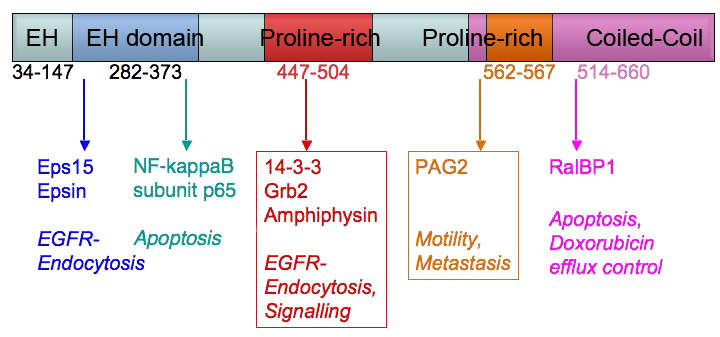
The presence of EH domains in REPS2/POB1 is symptomatic of a role of this gene in receptor endocytosis. In fact, REPS2/POB1 EH domain binds to Eps15 and to epsin that are both proteins present in clathrin-coated pits, involved in receptor endocytosis and receptor down regulation. The EH domain interacts specifically with the three Asn-Pro-Phe (NPF) motifs in the C-terminal region of epsin and their binding regulates receptor-mediated endocytosis (Morinaka et al., 1999).
Augmented expression of full-length POB1 in A431 cells does not affect either binding or internalization of EGF, on the contrary, over-expression of either the EH domain or the C-terminal region of REPS2/POB1 affects the ligand dependent internalization pathway of EGF and insulin without interfering with the constitutive transferrin pathway (Nakashima et al., 1999).
Santonico et al. have demonstrated that the EH domain of REPS2/POB1 binds Eps15 through an unconventional recognition specificity, since it binds to both NPF and DPF (Asp-Prp-Phe) motifs. The region of Eps15 responsible for the interaction with the EH domain of REPS2/POB1 maps within a 18 amino acid peptide (residues 623-640) that includes three DPF repeats. Accordingly, the authors identify a cluster of solvent exposed Lys residues, which are only found in the EH domain of REPS2/POB1, and influence binding to both NPF and DPF motifs (Santonico et al., 2007).
RalBP1, REPS2/POB1, epsin, and Eps15 form a complex with alpha-adaptin of AP-2 in Chinese hamster ovary cells and this complex is reduced in mitotic phase, when REPS2/POB1 and epsin are found phosphorylated. They are both phosphoryated by p34 cdc2 kinase, in vitro. POB1 is found phosphorylated in Ser551 and Ser493, in vivo. Phosphorylation of epsin in Ser 357 inhibits binding to POB1, causing disassembly of the complex, thus inhibiting receptor mediated endocytosis (Kariya et al., 2000). This data explains the contribution of the EH domain of POB1 to the formation of a protein complex that favours receptor internalization and that it is dismantled in mitosis. It is suggested that EGF stimulation induces also tyrosine-phosphorylation of POB1 and subsequent formation of a EGFR-POB1 complex in COS cells (Ikeda et al., 1998).
REPS2/POB1 shorter isoform2 is downregulated during human prostate cancer progression from androgen-dependent to androgen-independent (Oosterhoff et al., 2003). It was observed that a high level of REPS2 correlates with reduced EGF-internalisation and signaling since the induced expression of REPS2 exerts an inhibiting effect on several EGF-responsive genes (EGF-receptor, EGR-1, Fos and Jun) (Oosterhoff et al., 2005). Accordingly, increased expression of POB1 isoform 2 correlates with a decrease of EGF-induced phosphorylation of Erk1-Erk2 and Shc (Tomassi et al., 2008). From these experiments, it can be concluded that increased REPS2/POB1 expression negatively affects EGF receptor internalisation and subsequent signaling. Therefore, the decreased REPS2 expression observed during prostate cancer progression, results in enhanced EGF receptor expression and signaling, which could add to the androgen-independent state of advanced prostate cancer.
The central region of REPS2/POB1 plays a regulatory role in epidermal growth factor receptor endocytosis and signaling. Overexpression of the central region of POB1 (447-504), inhibits EGF endocytosis, titrating essential proteins away, thus depauperating the receptor down-regulation machinery. In fact, this region of POB1/REPS2 plays its regulatory role in EGFR endocytosis by binding: (i) to 14-3-3 proteins in a phosphorylation dependent way (i.e., phospho-Ser493 of POB1), (ii) to the C-SH3 domain of Grb2 and (iii) to the SH3 of amphiphysin II. The target of the SH3 domain of amphiphysin and of the carboxy-terminal SH3 of Grb2 is a short peptide flanking Arg483 in POB1. These interactions are not EGF dependent and are probably exclusive, since the binding motifs are only nine amino acids apart. These findings suggest that 14-3-3 could work by bridging the EGF receptor and the scaffold protein POB1/REPS2. The 14-3-3 binding motif HSRASSLD, flanking the Ser493 of POB1, is conserved in the mouse orthologs and in the 14-3-3 binding motif that flanks the Ser510 of human REPS1 protein, found phosphorylated in vivo in A431 cells (Stover DR et al. Phosphosite). The POB1 Ser493 is predicted to be phosphorylated by Akt. In agreement, when cells are treated with PI3K/Akt inhibitor wortmannin, 14-3-3 binding to REPS2/POB1 is abolished (Tomassi et al., 2008). The 14-3-3 zeta has already been reported as associating with the EGFR, epidermal growth factor receptor, cytoplasmic tail and co-localizing along the plasma membrane with EGFR upon EGF stimulation (Jin et al., 2004). Thus a 14-3-3 dimer could bridge REPS2/POB1 to the EGFR upon EGF induction.
Cell migration and paxillin localization: REPS2/POB1 antagonises PAG2/ASAP1
POB1 forms a complex with PAG2/ASAP1 in intact cells. PAG2 is a paxillin-associated protein with ADP-ribosylation factor GTPase-activating protein activity, also called ASAP1 (ArfGAP with SH3 domain, ankyrin repeat and PH domain UniProtKB: Q9ULH1). The SH3 of PAG2 binds the proline motif (562PSKPIR567) at the carboxyl-terminal region of POB1. This motif is essential for PAG2-POB1 interaction since substitution of the two proline residues with alanines in mutant POB1(PA), impaired its binding to PAG2. POB1 may therefore form a complex with paxillin through PAG2. Paxillin is a focal adhesion-associated scaffolding protein that recruits signaling molecules to the focal adhesions and forms protein complexes that coordinate signaling, cell spreading and motility. PAG2 overexpression causes loss of endogenous paxillin recruitment to focal contacts and also impaires cell migratory activities. The ability to suppress fibronectin-dependent migration depends on the ArfGAP domain of PAG2, but not on the POB1-binding domain, of PAG2. On the other end, POB1, but not POB1(PA), can suppress the inhibitory action of PAG2 on paxillin localization to focal adhesion (Oshiro et al., 2002). These results suggest that POB1, by binding to PAG2, suppresses the inhibitory action of PAG2 on the paxillin recruitment to focal contacts. This suggests that POB1 may function as a scaffold protein that interacts with proteins involved in endocytosis and migration, thus regulating signaling and motility. PAG2/ASAP1 gene was found associated with prostate cancer metastasis since it is up-regulated in a human metastatic prostate subline and immunohistochemistry of xenograft sections show a significantly strong cytoplasmic ASAP1 protein staining in tumor-nonmetastatic PCa2 tissue, compared to a non-staining in benign tissue, and an even stronger staining in PCa1-metastatic tissue. Moreover, additional ASAP1 gene copies are detected in 58% of the primary prostate cancer clinical specimens. A small interfering RNA reducing ASAP1 protein expression, can suppress in vitro PC-3 cell migration and matrigel invasion. Therefore PAG2/ASAP1 represents a therapeutic target and a biomarker for metastatic disease (Lin et al., 2008) while REPS2/POB1 can suppress PAG2 oncogenic-metastatic activity.
Mutations
Somatic
- V67M, cds mutation 199G>A homozygous in malignant melanoma.
- No high level gene amplification (>7), 1 homozygous deletion in breast cancer, 559 LOH (Loss of Heterozygosity).
Implicated in
Ikeda et al. (1998) cloned POB1 (partner of Ralbp1) as the first known binding partner of Ralbp1 by the yeast two-hybrid method using Ralbp1/RLIP76 as bait and clearly demonstrated specific binding and complex formation between Ralbp1 and REPS2/POB1. The binding to RalBP1 did not affect the GTPase activating activity of RalBP1. The interaction of POB1 with RalBP1 induces cell death in human prostate cancer cell ines LNCaP-FGC and LNCaP-LNO. Oosterhoff et al. show that REPS2/POB1-induces apoptosis in 45% of transfected cells, within 48 hours. When prostate cancer cell lines are transfected with a deletion mutant of REPS2/POB1, lacking the RalBP1 binding domain, only 30-40% of the transfected cells became apoptotic after 72-96 hours (Oosterhoff et al., 2003).
REPS2/POB1 (514-660) binds RalBP1 C-terminal amino acids, 499-655, while an almost overlapping region of RalBP1 (440-655) binds the heat shock factor 1 Hsf-1 (Hu and Mivechi, 2003). Shingal et al. show a ternary complex formation between RalBP1, Hsf-1, and REPS2/POB1. RalBP1, Hsf1, HSP90 and tubulin make a complex in cell (Singhal et al., 2008). Hsf-1 and REPS2/POB1 induce drug sensitivity and apoptosis by inhibiting RalBP1.
Binding of REPS2/POB1 to RALBP1 inhibits the transport activity of the Ral-binding nucleotidase, which functions as an energy-dependent transporter for GSH-conjugates as well as unrelated xenobiotics. RALBP1 (RLIP76) is the major transporter of the anthracycline antibiotic, doxorubicin, which is one of the most widely used anticancer drugs (Singhal et al., 2007). Therefore, REPS2/POB1 is a specific and saturable inhibitor of the glutathione-electrophile conjugates and of the doxorubicin transport activity of RalBP1. Yadav et al. show that REPS2/POB1 can regulate the transport function of RalBP1/RLIP76 and, in agreement with previous studies, show that inhibition of RalBP1 induces apoptosis in cancer cells through the accumulation of endogenously formed GSH-conjugates (Yadav et al., 2005). Hence, REPS2/POB1 over-expression inhibits RalBP1-mediated transport of glutathione-conjugates thus promoting apoptosis and can influence drug-efflux mechanisms that cause resistance to cancer treatment. Hsf-1 also causes specific and saturable inhibition of the transport activity of RalBP1. The combined augmentation of Hsf-1 and REPS2/POB1 causes nearly complete inhibition of RalBP1 and a dramatic apoptosis in NSLC (non-small cell lung cancer) cell line H358 through Ralbp1 binding (Singhal et al., 2008). The marked apoptotic effect caused by the increase of Hsf-1 and REPS2/POB1 in lung cancer cells, suggests a novel targeted therapy in which liposomally encapsulated Hsf-1 and POB1 could be used clinically as a therapeutic agent.
- Apoptosis in prostate cancer cells: REPS2/POB1 counteracts the apoptosis inhibitor NF-kappaB p65
The NF-kappaB subunit p65 is identified as a human REPS2/POB1 protein partner, since the NPF-motif in p65 acts as binding site for the EH domain in REPS2. However, in cultured prostate cancer cells, the REPS2-p65 interaction is triggered upon stimulation with the phorbol ester, phorbol-12-myristate-13-acetate (PMA). During prostate cancer progression from androgen-dependent to androgen-independent growth, the observed downregulation of REPS2 is accompanied by upregulation of NF-kappaB activity, that inhibits apoptosis (Penninkhof et al., 2004). Hence, the authors suggest that a decreased expression of REPS2 might be a key factor in causing prostate cancer cells to avoid apoptosis.
Article Bibliography
| Pubmed ID | Last Year | Title | Authors |
|---|---|---|---|
| 19776672 | 2009 | TMEM25, REPS2 and Meis 1: favourable prognostic and predictive biomarkers for breast cancer. | Doolan P et al |
| 12621024 | 2003 | HSF-1 interacts with Ral-binding protein 1 in a stress-responsive, multiprotein complex with HSP90 in vivo. | Hu Y et al |
| 9422736 | 1998 | Identification and characterization of a novel protein interacting with Ral-binding protein 1, a putative effector protein of Ral. | Ikeda M et al |
| 15324660 | 2004 | Proteomic, functional, and domain-based analysis of in vivo 14-3-3 binding proteins involved in cytoskeletal regulation and cellular organization. | Jin J et al |
| 10764745 | 2000 | Regulation of complex formation of POB1/epsin/adaptor protein complex 2 by mitotic phosphorylation. | Kariya K et al |
| 9928989 | 1999 | Solution structure of the Eps15 homology domain of a human POB1 (partner of RalBP1). | Koshiba S et al |
| 18519696 | 2008 | ASAP1, a gene at 8q24, is associated with prostate cancer metastasis. | Lin D et al |
| 10557078 | 1999 | Epsin binds to the EH domain of POB1 and regulates receptor-mediated endocytosis. | Morinaka K et al |
| 10393179 | 1999 | Small G protein Ral and its downstream molecules regulate endocytosis of EGF and insulin receptors. | Nakashima S et al |
| 15455380 | 2005 | EGF signalling in prostate cancer cell lines is inhibited by a high expression level of the endocytosis protein REPS2. | Oosterhoff JK et al |
| 19369195 | 2009 | Large-scale proteomics analysis of the human kinome. | Oppermann FS et al |
| 12149250 | 2002 | Interaction of POB1, a downstream molecule of small G protein Ral, with PAG2, a paxillin-binding protein, is involved in cell migration. | Oshiro T et al |
| 18772396 | 2008 | An integrated genomic analysis of human glioblastoma multiforme. | Parsons DW et al |
| 15184881 | 2004 | Identification of REPS2 as a putative modulator of NF-kappaB activity in prostate cancer cells. | Penninkhof F et al |
| 18154663 | 2007 | Binding to DPF-motif by the POB1 EH domain is responsible for POB1-Eps15 interaction. | Santonico E et al |
| 18474607 | 2008 | Hsf-1 and POB1 induce drug sensitivity and apoptosis by inhibiting Ralbp1. | Singhal SS et al |
| 18647389 | 2008 | The central proline rich region of POB1/REPS2 plays a regulatory role in epidermal growth factor receptor endocytosis by binding to 14-3-3 and SH3 domain-containing proteins. | Tomassi L et al |
| 15707977 | 2005 | POB1 over-expression inhibits RLIP76-mediated transport of glutathione-conjugates, drugs and promotes apoptosis. | Yadav S et al |
Other Information
Locus ID:
NCBI: 9185
MIM: 300317
HGNC: 9963
Ensembl: ENSG00000169891
Variants:
dbSNP: 9185
ClinVar: 9185
TCGA: ENSG00000169891
COSMIC: REPS2
RNA/Proteins
| Gene ID | Transcript ID | Uniprot |
|---|---|---|
| ENSG00000169891 | ENST00000303843 | Q8NFH8 |
| ENSG00000169891 | ENST00000357277 | Q8NFH8 |
Expression (GTEx)
Pathways
Protein levels (Protein atlas)
References
| Pubmed ID | Year | Title | Citations |
|---|---|---|---|
| 35690292 | 2022 | REPS2 downregulation facilitates FGF-induced adhesion and migration in human lens epithelial cells through FAK/Cdc42 signaling and contributes to posterior capsule opacification. | 1 |
| 35690292 | 2022 | REPS2 downregulation facilitates FGF-induced adhesion and migration in human lens epithelial cells through FAK/Cdc42 signaling and contributes to posterior capsule opacification. | 1 |
| 28579616 | 2017 | Enhancement of endocytic uptake of HIV-1 virions into CD4-negative epithelial cells by HIV-1 gp41 via its interaction with POB1. | 2 |
| 28579616 | 2017 | Enhancement of endocytic uptake of HIV-1 virions into CD4-negative epithelial cells by HIV-1 gp41 via its interaction with POB1. | 2 |
| 27120794 | 2016 | miR-675-5p enhances tumorigenesis and metastasis of esophageal squamous cell carcinoma by targeting REPS2. | 30 |
| 27120794 | 2016 | miR-675-5p enhances tumorigenesis and metastasis of esophageal squamous cell carcinoma by targeting REPS2. | 30 |
| 23803043 | 2013 | Expression and clinical significance of REPS2 in human esophageal squamous cell carcinoma. | 5 |
| 23803043 | 2013 | Expression and clinical significance of REPS2 in human esophageal squamous cell carcinoma. | 5 |
| 19776672 | 2009 | TMEM25, REPS2 and Meis 1: favourable prognostic and predictive biomarkers for breast cancer. | 31 |
| 19776672 | 2009 | TMEM25, REPS2 and Meis 1: favourable prognostic and predictive biomarkers for breast cancer. | 31 |
| 18474607 | 2008 | Hsf-1 and POB1 induce drug sensitivity and apoptosis by inhibiting Ralbp1. | 38 |
| 18474607 | 2008 | Hsf-1 and POB1 induce drug sensitivity and apoptosis by inhibiting Ralbp1. | 38 |
| 15455380 | 2005 | EGF signalling in prostate cancer cell lines is inhibited by a high expression level of the endocytosis protein REPS2. | 11 |
| 15707977 | 2005 | POB1 over-expression inhibits RLIP76-mediated transport of glutathione-conjugates, drugs and promotes apoptosis. | 16 |
| 15455380 | 2005 | EGF signalling in prostate cancer cell lines is inhibited by a high expression level of the endocytosis protein REPS2. | 11 |
Citation
Salvatore Corallino ; Luisa Castagnoli
REPS2 (RALBP1 associated Eps domain containing 2)
Atlas Genet Cytogenet Oncol Haematol. 2010-06-01
Online version: http://atlasgeneticsoncology.org/gene/44120/reps2
