PLCB4 (phospholipase C beta 4)
2020-12-01 Roberto Brusamolino, MD , Alessandro Beghini, PhD AffiliationUniversity of Milan, Department of Health Sciences, Milan Italy [email protected]; [email protected]
Identity


Abstract
The gene PLCB4 codes for the homonymous enzymatic protein PLCβ4, one of the four isoforms belonging to the PCLβ subfamily, a subcategory of the PLC (phospholipases C) family. The cDNA characterization, sub-chromosomal localization and polypeptide product prediction have been studied primarily in the human retina. Human PLCB4 is strictly related to the Drosophila gene PLC-NorpA, which is critical in photo-transduction. In the human retina tissue PLCB4 is pivotal in the intracellular transduction of several extracellular signals, but it has a large pattern of tissue expression and certainly plays an important general role in intracellular molecular signaling. Moreover, this gene is involved in embryonic development as one of the enzymes of the endothelin pathway. These functional aspects (high level eye expression and homeotic role) take account of the two main pathological conditions in which the gene is etiologically involved: 1) Uveal melanoma (UM). In UM, PLCB4 promotes tumorigenesis by a gain-of-function mutation that activates the pathway of GNAQ\/GNA11, the genes of which PLCB4 is the downstream target 2) Auriculo-condylar syndrome. This uncommon craniofacial malformation syndrome is characterized by missense mutations of PLCB4, whose protein product is a core signaling component of the endothelin-1-distal-less homeobox 5 and 6 (EDN1-DLX5-DLX6). PLCB4 gene mutations have been associated with various neoplasms and this is not surprising considering the involvement of the PLCs, as a group, in several cellular signaling pathways influencing cell proliferation, differentiation, migration and growth.
DNA/RNA
Note
Description
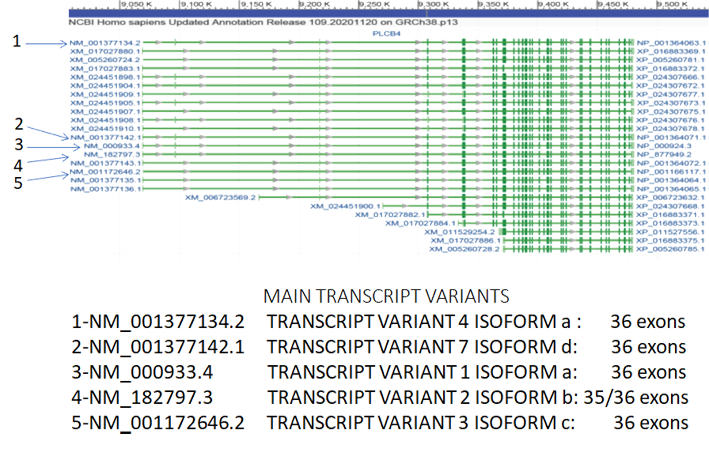
Gene length: 412131 bp genomic DNA related to the transcript variant 4 isoform "a" (NM 001377134.2, NP 001364063.1, NC_000020.11) and 411722 bp variant 1 isoform "a" (NM 000933.4, NP 000933.4).
Exon number: 46 (Gene ID 5332)
Transcription
Proteins
Description
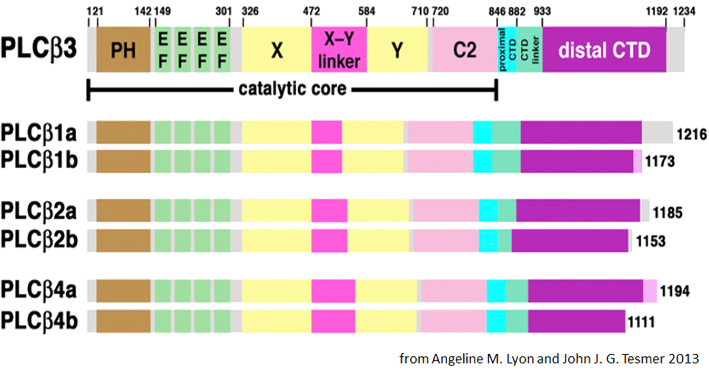
The PLCβ subfamily is distinguished by a C-terminal extension (≈ 400 aa) with highly conserved N-terminal segments (C-terminal domain [CTD] including: proximal CTD, a CTD linker 28-61 aa long, distal CTD with coiled-coil structure and a length of 300 aa). (Lyon AM and Tesmer JJG, 2013).
PLCβ4 protein exists in different isoforms. Four isoforms are produced by alternative splicing and it is considered as reference sequence the isoform 2 (UniProtKB identifier Q 15147-1). This variant is characterized as follows: A) Length=1175 aa B) M.W.=134,4 KDa. Isoform 3 is 1194 aa (identifier Q15147-4).
All the PLCβ4 isoforms are characterized by a similar domains architecture and by the same enzymatic catalytic core involved in the PIP2 hydrolysis (spanning from N terminus to the end of C2 domain).
The structural protein elements from N terminus to C terminus are listed below (Lyon AM and Tesmer JJG, 2013; Owusu Obeng et al., 2020; Nakamura Y and Fukami K, 2017):
1- PH (pleckstrin homology): regulatory domain, binding site for PtdIns(4,5)P2 (Owusu Obeng et al., 2020). N-end of PH corresponds to the start of the catalytic core.
2- EF (E and F helices of parvalbumin) hand repeats (four tandem): involved in GTP hydrolysis induced by Gαq.
3- PIPLC_X-box (phosphatidylinositol-specific phospholipase X-box domain) from 313 to 463 position (151 aa).
4- X-Y linker. The length of this element varies significantly in the different isoforms.
5- PIPLC_Y-box (phosphatidylinositol-specific phospholipase Y-box domain) from 565 to 681 position (117 aa).
6- C2 (C2 domain) from 684 to 809 position (126 aa). Intra- and intermolecular regulatory binding site and in particular for Ca++-dependent membrane attachment. C-end of C2 corresponds to the end of the catalytic core.
7- proximal CTD is the site of Gαq binding.
8- CTD linker. Length and sequence varying in different isoforms
9- distal CTD is involved in membrane binding
PIPLC_X-box, X-Y linker and PIPLC_Y-box together contribute to form the so-called triose phosphate isomerase (TIM)-like barrel domain. The TIM-like barrel is divided in the 2 halves X and Y by the X-Y linker and is home of the Ca++ dependent active site. X-box and Y-box are two regions of homology typical of all eukaryotic PIPLC. In all different isoforms the TIM-like barrel has the same relative position in the sequence (NH2-X-Y-COOH) with possible modification of spacing. They are the most relevant part of the catalytic site (Jiang H et al., 1996; Rhee SG and Choi KD, 1992).
Expression
Localisation
Function
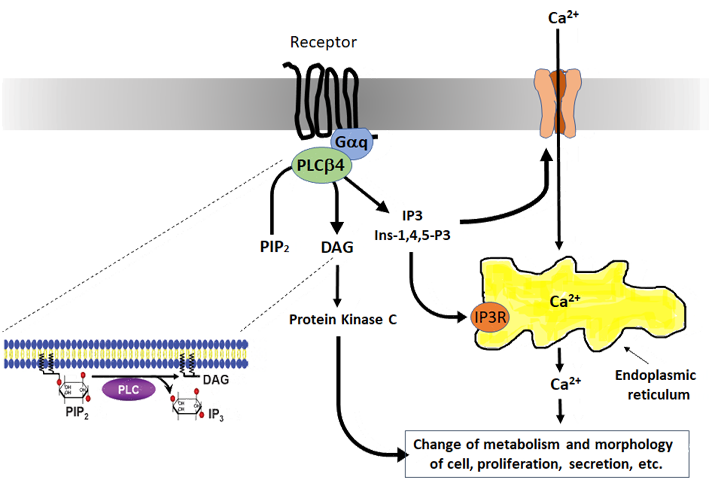
All PLCβ subtypes are activated via the classical G-protein pathway (Rhee SG and Bae YS 1997). GPCRs (heterotrimeric G-Protein-Coupled Receptors) activate PLCβs, including PLCB4, by virtue of coordinated intervention of Gq family proteins (Gq, G11, G14, G15, G16). The activation may be cell type-specific and dependent on variable external stimuli (Suh PG et al. 2008, Rebecchi MJ and Pentyala SN 2000, Balla T 2010).
Interactions:
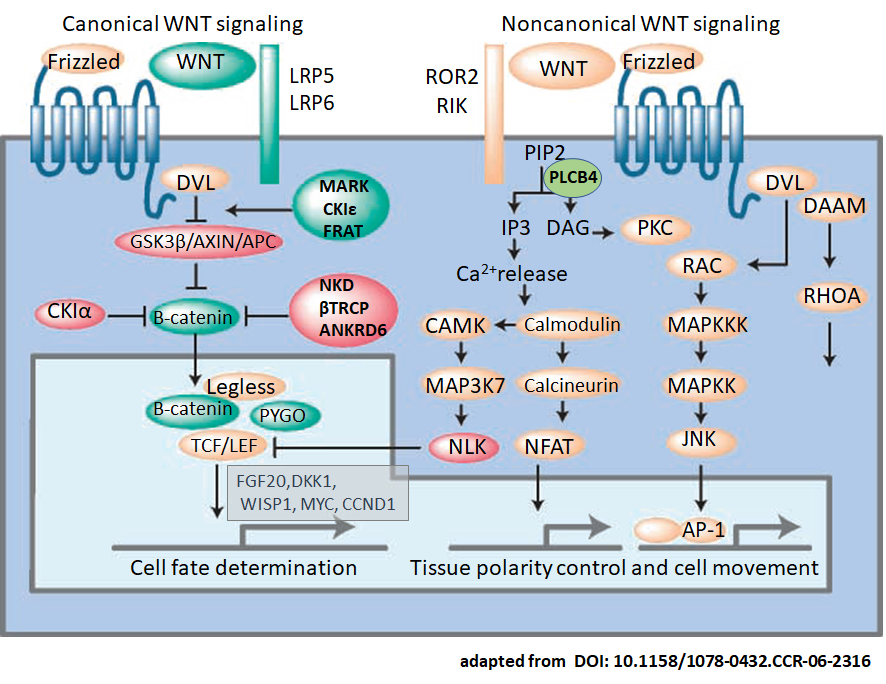
Environmental information processing is one of the basic functions of the cell and the three cornerstones of this function in the cell are: 1- membrane transport, 2- signal transduction, 3-signaling molecules and interaction. Phosphatidylinositol signaling system and Wnt signaling pathway both are involved in signal transduction and evidence has emerged of complex relationships between them. Two effective pathways for Wnt signals are known: 1- Canonical (cell fate determination), 2- Non-canonical (cell movement and tissue polarity). As it pertains to the links between Wnt signaling and PLCs, it is noteworthy that non-canonical Wnt signals are transduced to the Ca ++-dependent ( NLK and NFAM1 (NFAT)) signaling cascades through FZD family receptors with the intervention of coreceptors ( ROR2 and RYK). This transduction modality requires PLCs intervention in order to produce the two second messengers InsP3 and DAG (see figure 6).
Homology
Mutations
Note
Germinal
variant c. 986A>C (p.Asn329Ser); variant c.1861C>T (p.Asn>621Cys); variant c.1862G>A (p.Arg621His); variant c.1868A>G (p.Tyr623Cys); variant c.1948A>C (p.Asn>650His). All mutations spare the catalytic domain but compromise the substrate binding efficiency of the enzyme. It has been shown a dominant-negative effect of PLCB4 mutations that leads to downregulation of DLX5 and DLX6 genes (endothelin pathway), effectors of mandibular patterning and strongly under-expressed (6 and 8-fold respectively) in mandibular osteoblasts of A.C.S. patients (Rieder MJ et al., 2012).
Somatic
Implicated in
Phosphoinositides are chemically phospholipids and are the specific substrate of all PLCs, including PLCB4. Phosphoinositides have an established role in cancer development as they can affect proliferation, survival and spreading of cancer cells. The two second messengers produced by PLCB4, InsP3 and DAG, are responsible for the Ca++ increase in the cytosol and the activation of Protein Kinase C (PKC) respectively. Both are factors capable of influencing neoplastic growth. PIs (phosphoinositides) and their metabolic enzymes modulate apoptosis, proliferation, differentiation, vesicular trafficking, cell adhesion, and cell migration (Owusu Obeng et al., 2020).
A very recent observation has drawn attention to the causal link between ocular melanocytosis and UM. Ocular melanocytosis strongly predisposes to UM (Singh AD et al. 1998) with risk of UM increased from 1 in 230,000 to 1 in 400. A case report focusing on this clinical correlation (Durante MA et al., 2019) refers to a patient affected by UM arose from a pre-existing ocular melanocytosis. Slightly less than 25% of the melanocytosis cells and 100% of the melanoma cells revealed to be affected by PLBC4 D630Y in the absence of germinal mutation. Genetic complete characterization showed that PLCB4 mutation was the initiating, but not the transformation factor in the described case report. In the context of melanocytosis a condition of loss of heterozygosity arising in the chromosome 3 likely represents the "threshold event" on the way to malignant transformation of the PLCB4-mutated clone.
Survivors at 5-years follow-up had a median value of PLCB4 mRNA expression significantly lower with an overall survival of 60.7 months vs 28.5, and an event-free survival of 16.3 months vs 12.5. Patients with long-term CR and lower relapse rate had a median value of PLCB4 mRNA expression significantly low. Moreover, white blood count correlates positively with PLCB4 expression observing the highest PLCB4 expression in CD34+CD38- cells compared to CD34-CD38+ or CD34+CD38+ cells (Wu S et al., 2019). These results are confirmed by other study (Zheng GH et al, 2009) who found upregulation of PLCB4 in an AML cell-line (HL-60/MDR) with multi-drug resistance. Furthermore, there are other studies where PLCB4 appears to behave in the opposite way, for example in the case of PLCB4 upregulation manifested by breast cancer patients with complete response to chemotherapy (Li Y et al., 2017).
Studies were conducted to define a gene expression profile linkable to NST response. Li and coworkers analyzed two small groups (3 vs 3) of breast cancer patients on the base of complete or not-complete pathologic response (NST-responding or NST-non responding) to chemotherapy (Li Y et al., 2017). A set of 673 differentially expressed genes (DEG) emerged and a pathway enrichment analysis was performed. Results identified a set of 18 genes, including PLCB4, that effectively stratified the sample in responders and non-responders. Four out of these 18 genes are considered key genes on the base of their protein-protein interaction pattern (PLCB4, ADCY6, CNR1, MAPK14). In particular upregulated PLCB4 is positively involved in pathological complete response to chemotherapy, intervening in multiple pathways (renin secretion, gastric acid secretion, gap junction, inflammatory mediator regulation of TRP channels, retrograde endocannabinoid signaling, melanogenesis, cGMP-PKG signaling pathway, calcium signaling pathway, chemokine signaling pathway, c-AMP signaling pathway, rap1 signaling pathway). At least two other isozymes of the PLCB family ( PLCB1 and PLCB2) are reported as possible prognostic markers (Cai S et al., 2017). Overexpressed PLCB4 and PLCB2 have been associated with multidrug resistance (MDR) in breast cancer. The identification of differentially expressed genes between the breast cancer cell lines MCF-7 and MCF-7/MDR cells confirmed PLCB4 as an overexpressed hub gene (Yang M et al., 2018).
PLCB4 is one of the primary target genes of TFAP2C, an important transcription factor playing a role in the oncogenesis of breast cancer. In mammary tumors TFAP2C induces a very large number of genes belonging to different functional groups, including a set of intracellular signaling genes such as PLCB4 (Woodfield GW et al. , 2010).
Genomic data of 9 cases of RCOAD and 9 of LCOAD have been recovered from open-source platform GEO (Gene Expression Omnibus-GEO database), selection of DEGs (differentially expressed genes) between these two groups of colon cancers identified 286 DEG genes. Construction of protein-protein interaction network of the DEGs and identification of hub genes have been performed. PLCB4 resulted downregulated in RCOAD compared to LCOAD. A gene set was therefore able to differentiate between RCOAD and LCOAD. Despite the fact that PLCB4 belongs to the hub gene group and is markedly downregulated in RCOAD no association with pathological stage nor statistically significant effect on overall survival have been demonstrated and this excludes a causal role of PLCB4 in the worse prognosis of RCOAD vs LCOAD.
Disruption of Gq signaling (the pathway including PLCB4) by a competitive inhibition mechanism reduces the basal activity of PKC and promotes inhibition of small cell lung cancer growth (Beekman A et al, 1998).
Comparative gene expression analysis reveals overexpression of PLCB4 in YAPS127A-transformed cells vs control cells (Kakiuchi T et al., 2016). Moreover YAP knockdown (Mizuno T et al., 2012) downregulates PLCB4 in Hippo-disrupted mesothelioma cell lines and PLCB4 knockdown inhibits the cell growth in 8 mesothelioma cell lines (4 YAP-active and 4 YAP-non active) only if they are YAP active. These effects are evidence of the activating function of YAP on its downstream effector gene PLCB4. PLCB4 is critical for proliferation and anchorage- independent growth of YAP-dependent mesothelioma cells and represents a potential pharmacological target in YAP-active mesotheliomas. In addition to Hypo other pathways are involved in mesothelioma molecular mechanisms such as Wnt (Guo G et al., 2015) and Ras/mitogen activated protein kinase. Wnt can be affected by NF2 (neurofibromin 2) knockdown and dasatinib, a tyrosine kinase inhibitor antagonizing the YAP- CTNNB1 (β catenin)- TBX5 complex, impairs growth of NF2-knocked cells (Kakiuchi T et al., 2016).
This study seems to suggest that more interesting results can be obtained by studying the PLCB gene network rather than individual members alone.
270 somatic single nucleotide variations (SNV) and a large number of copy number variation (CNV) were found. The observation that many of the genes harboring CNVs are members of different tumour-related pathways suggests that they can somehow influence the disease susceptibility. In sporadic tumours five genes, including PLCB4, were affected by CNVs. In familial tumours three genes had CNVs. In particular PLCB4-copy number deletion was present in 2 patients and amplification in 4 patients. Possible underlying mechanisms relating PLCB4-CNVs to HB tumorigenesis was not investigated.
Article Bibliography
| Pubmed ID | Last Year | Title | Authors |
|---|---|---|---|
| 2457447 | 1988 | Isolation of a putative phospholipase C gene of Drosophila, norpA, and its role in phototransduction. | Bloomquist BT et al |
| 23344900 | 2013 | Network analysis of genomic alteration profiles reveals co-altered functional modules and driver genes for glioblastoma. | Gu Y et al |
| 31024753 | 2019 | Next-Generation Sequencing of Uveal Melanoma for Detection of Genetic Alterations Predicting Metastasis. | Afshar AR et al |
| 8530101 | 1995 | cDNA sequence and gene locus of the human retinal phosphoinositide-specific phospholipase-C beta 4 (PLCB4). | Alvarez RA et al |
| 20100889 | 2010 | Putting G protein-coupled receptor-mediated activation of phospholipase C in the limelight. | Balla T et al |
| 9500449 | 1998 | Expression of catalytically inactive phospholipase Cbeta disrupts phospholipase Cbeta and mitogen-activated protein kinase signaling and inhibits small cell lung cancer growth. | Beekman A et al |
| 23762353 | 2013 | Promoter DNA methylation pattern identifies prognostic subgroups in childhood T-cell acute lymphoblastic leukemia. | Borssén M et al |
| 2811235 | 1989 | [Effect of "unfavorable" days on the development of myocardial infarction]. | Guglina ME et al |
| 28223438 | 2017 | Dysregulated GPCR Signaling and Therapeutic Options in Uveal Melanoma. | Chua V et al |
| 27648773 | 2016 | Declines in Cancer Death Rates Among Children and Adolescents in the United States, 1999-2014. | Curtin SC et al |
| 15685537 | 2005 | Mechanisms of resistance to imatinib mesylate in gastrointestinal stromal tumors and activity of the PKC412 inhibitor against imatinib-resistant mutants. | Debiec-Rychter M et al |
| 31186267 | 2019 | Genomic evolution of uveal melanoma arising in ocular melanocytosis. | Durante MA et al |
| 25488749 | 2015 | Whole-exome sequencing reveals frequent genetic alterations in BAP1, NF2, CDKN2A, and CUL1 in malignant pleural mesothelioma. | Guo G et al |
| 30575306 | 2019 | An integrated transcriptome analysis in T-cell acute lymphoblastic leukemia links DNA methylation subgroups to dysregulated TAL1 and ANTP homeobox gene expression. | Haider Z et al |
| 32420374 | 2020 | Screening and Identification of Differentially Expressed Genes Expressed among Left and Right Colon Adenocarcinoma. | Han J et al |
| 8962098 | 1996 | Phospholipase C beta 4 is involved in modulating the visual response in mice. | Jiang H et al |
| 26683228 | 2016 | Deep sequencing of uveal melanoma identifies a recurrent mutation in PLCB4. | Johansson P et al |
| 27559111 | 2016 | Modeling mesothelioma utilizing human mesothelial cells reveals involvement of phospholipase-C beta 4 in YAP-active mesothelioma cell proliferation. | Kakiuchi T et al |
| 17634527 | 2007 | WNT signaling pathway and stem cell signaling network. | Katoh M et al |
| 17998286 | 2007 | Recommendations from an international expert panel on the use of neoadjuvant (primary) systemic treatment of operable breast cancer: new perspectives 2006. | Kaufmann M et al |
| 23502430 | 2013 | Identification of prognostic gene signatures of glioblastoma: a study based on TCGA data analysis. | Kim YW et al |
| 28212550 | 2017 | PLCB4 copy gain and PLCß4 overexpression in primary gastrointestinal stromal tumors: Integrative characterization of a lipid-catabolizing enzyme associated with worse disease-free survival. | Li CF et al |
| 28880852 | 2017 | RNA Sequencing Uncovers Molecular Mechanisms Underlying Pathological Complete Response to Chemotherapy in Patients with Operable Breast Cancer. | Li Y et al |
| 23880553 | 2013 | Structural insights into phospholipase C-β function. | Lyon AM et al |
| 28742274 | 2017 | Whole exome sequencing identified genetic variations in Chinese hemangioblastoma patients. | Ma D et al |
| 22286761 | 2012 | YAP induces malignant mesothelioma cell proliferation by upregulating transcription of cell cycle-promoting genes. | Mizuno T et al |
| 27089179 | 2016 | Recurrent activating mutations of G-protein-coupled receptor CYSLTR2 in uveal melanoma. | Moore AR et al |
| 28130414 | 2017 | Regulation and physiological functions of mammalian phospholipase C. | Nakamura Y et al |
| 32276377 | 2020 | Phosphoinositide-Dependent Signaling in Cancer: A Focus on Phospholipase C Isozymes. | Owusu Obeng E et al |
| 11015615 | 2000 | Structure, function, and control of phosphoinositide-specific phospholipase C. | Rebecchi MJ et al |
| 9182519 | 1997 | Regulation of phosphoinositide-specific phospholipase C isozymes. | Rhee SG et al |
| 22560091 | 2012 | A human homeotic transformation resulting from mutations in PLCB4 and GNAI3 causes auriculocondylar syndrome. | Rieder MJ et al |
| 9442799 | 1998 | Lifetime prevalence of uveal melanoma in white patients with oculo(dermal) melanocytosis. | Singh AD et al |
| 18593525 | 2008 | Multiple roles of phosphoinositide-specific phospholipase C isozymes. | Suh PG et al |
| 28499758 | 2017 | Activating CYSLTR2 and PLCB4 Mutations in Primary Leptomeningeal Melanocytic Tumors. | van de Nes JAP et al |
| 31109147 | 2019 | New Insights into Molecular Oncogenesis and Therapy of Uveal Melanoma. | Violanti SS et al |
| 30896816 | 2019 | Diagnostic and prognostic value of mRNA expression of phospholipase C β family genes in hepatitis B virus‑associated hepatocellular carcinoma. | Wang X et al |
| 25502460 | 2016 | Chromosomal Instability and Phosphoinositide Pathway Gene Signatures in Glioblastoma Multiforme. | Waugh MG et al |
| 20629094 | 2010 | Identification of primary gene targets of TFAP2C in hormone responsive breast carcinoma cells. | Woodfield GW et al |
| 31788080 | 2019 | PLCB4 upregulation is associated with unfavorable prognosis in pediatric acute myeloid leukemia. | Wu S et al |
| 29512753 | 2018 | Identification of genes and pathways associated with MDR in MCF-7/MDR breast cancer cells by RNA-seq analysis. | Yang M et al |
| 31080817 | 2019 | Distinct Prognostic Values of Phospholipase C Beta Family Members for Non-Small Cell Lung Carcinoma. | Zhang T et al |
Other Information
Locus ID:
NCBI: 5332
MIM: 600810
HGNC: 9059
Ensembl: ENSG00000101333
Variants:
dbSNP: 5332
ClinVar: 5332
TCGA: ENSG00000101333
COSMIC: PLCB4
RNA/Proteins
Expression (GTEx)
Pathways
Protein levels (Protein atlas)
PharmGKB
| Entity ID | Name | Type | Evidence | Association | PK | PD | PMIDs |
|---|---|---|---|---|---|---|---|
| PA134864200 | GNB4 | Gene | Pathway | associated | |||
| PA174 | GNAQ | Gene | Pathway | associated | 19741567 | ||
| PA176 | GNB3 | Gene | Pathway | associated | |||
| PA26097 | CASR | Gene | Pathway | associated | |||
| PA28776 | GNB1 | Gene | Pathway | associated | |||
| PA28777 | GNB1L | Gene | Pathway | associated | |||
| PA28778 | GNB2 | Gene | Pathway | associated | |||
| PA28784 | GNG2 | Gene | Pathway | associated | |||
| PA28785 | GNG3 | Gene | Pathway | associated | |||
| PA28786 | GNG4 | Gene | Pathway | associated | |||
| PA28787 | GNG5 | Gene | Pathway | associated | |||
| PA28789 | GNG7 | Gene | Pathway | associated | |||
| PA33759 | PRKCA | Gene | Pathway | associated | |||
| PA33761 | PRKCB | Gene | Pathway | associated | |||
| PA33766 | PRKCG | Gene | Pathway | associated | |||
| PA33767 | PRKCH | Gene | Pathway | associated | |||
| PA33768 | PRKCI | Gene | Pathway | associated | |||
| PA33771 | PRKD1 | Gene | Pathway | associated | |||
| PA33775 | PRKCZ | Gene | Pathway | associated | |||
| PA39 | ADRB2 | Gene | Pathway | associated |
References
| Pubmed ID | Year | Title | Citations |
|---|---|---|---|
| 38715801 | 2024 | Interaction between MARK3 (rs11623869), PLCB4 (rs6086746) and GEMIN2 (rs2277458) variants with bone mineral density and serum 25-hidroxivitamin D levels in Mexican Mestizo women. | 0 |
| 38715801 | 2024 | Interaction between MARK3 (rs11623869), PLCB4 (rs6086746) and GEMIN2 (rs2277458) variants with bone mineral density and serum 25-hidroxivitamin D levels in Mexican Mestizo women. | 0 |
| 35284927 | 2022 | Auriculocondylar syndrome 2 results from the dominant-negative action of PLCB4 variants. | 8 |
| 35284927 | 2022 | Auriculocondylar syndrome 2 results from the dominant-negative action of PLCB4 variants. | 8 |
| 34899595 | 2021 | The Polymorphism at PLCB4 Promoter (rs6086746) Changes the Binding Affinity of RUNX2 and Affects Osteoporosis Susceptibility: An Analysis of Bioinformatics-Based Case-Control Study and Functional Validation. | 4 |
| 34905385 | 2021 | Uveal melanoma-associated mutations in PLCβ4 are constitutively activating and promote melanocyte proliferation and tumorigenesis. | 6 |
| 34899595 | 2021 | The Polymorphism at PLCB4 Promoter (rs6086746) Changes the Binding Affinity of RUNX2 and Affects Osteoporosis Susceptibility: An Analysis of Bioinformatics-Based Case-Control Study and Functional Validation. | 4 |
| 34905385 | 2021 | Uveal melanoma-associated mutations in PLCβ4 are constitutively activating and promote melanocyte proliferation and tumorigenesis. | 6 |
| 31614358 | 2020 | Mutations of GNAQ, GNA11, SF3B1, EIF1AX, PLCB4 and CYSLTR in Uveal Melanoma in Chinese Patients. | 6 |
| 32201334 | 2020 | A familial PLCB4 mutation causing auriculocondylar syndrome 2 with variable severity. | 9 |
| 31614358 | 2020 | Mutations of GNAQ, GNA11, SF3B1, EIF1AX, PLCB4 and CYSLTR in Uveal Melanoma in Chinese Patients. | 6 |
| 32201334 | 2020 | A familial PLCB4 mutation causing auriculocondylar syndrome 2 with variable severity. | 9 |
| 28212550 | 2017 | PLCB4 copy gain and PLCß4 overexpression in primary gastrointestinal stromal tumors: Integrative characterization of a lipid-catabolizing enzyme associated with worse disease-free survival. | 14 |
| 28328130 | 2017 | Targeted molecular investigation in patients within the clinical spectrum of Auriculocondylar syndrome. | 6 |
| 28212550 | 2017 | PLCB4 copy gain and PLCß4 overexpression in primary gastrointestinal stromal tumors: Integrative characterization of a lipid-catabolizing enzyme associated with worse disease-free survival. | 14 |
Citation
Roberto Brusamolino, MD ; Alessandro Beghini, PhD
PLCB4 (phospholipase C beta 4)
Atlas Genet Cytogenet Oncol Haematol. 2020-12-01
Online version: http://atlasgeneticsoncology.org/gene/47059/plcb4-(phospholipase-c-beta-4)
