PIMREG (PICALM interacting mitotic regulator)
2017-01-01 Leticia Fröhlich Archangelo AffiliationDepartment of Cellular and Molecular Biology and Pathogenic Bioagents, Ribeirão Preto Medical School, University of São Paulo, Ribeirão Preto, São Paulo, Brazil. [email protected]
Identity
Abstract
PIMREG (FAM64) was initially identified as CATS, the CALM (PICALM) interacting protein expressed in thymus and spleen. Mounting evidence suggests the involvement of FAM64A in tumorigenesis. Through interaction with PICALM, FAM64 was able to influence the subcellular localization of the leukemic fusion protein PICALM\/MTT10 (CALM\/AF10). FAM64A is highly expressed in leukemia, lymphoma and tumor cell lines and its levels are strongly correlated with cellular proliferation in both malignant and normal cells. FAM64A is a mitotic regulator that controls chromosome segregation during cell division, and its transcripts covariate with that of cell cycle regulation genes in tumorigenesis. Nevertheless, a precise role of FAM64A in tumorigenesis is yet to be defined.
DNA/RNA
Description
Transcription
Proteins
Description
Expression
Expression analysis of the murine Fam64a homolog revealed a strong expression throughout mouse embryogenesis, in particular at the developing central nervous system (CNS). The expression decreases gradually and proportionally as embryos develop to later stages (Archangelo, et al. 2008). In the hematopoietic compartment, Fam64A is widely expressed in different cell subpopulations (Archangelo, et al. 2008). Moreover, RNA-Seq analysis of individual hematopoietic stem cells (HSCs) to resolve heterogeneity within HSC population, revealed that Fam64a is highly expressed in the HSC population primed for proliferation (Wilson, et al. 2015).
Localisation
Function
Furthermore, Zhao and coworkers described FAM64A as a regulator of chromosome segregation. FAM64A is a substrate of the APC/C complex that controls the metaphase to anaphase transition and its knock-down resulted in accelerated anaphase onset. Thus FAM64A plays an important role in determining the kinetics of mitotic progression (Zhao, et al. 2008). Although the literature indicates a putative function of FAM64A in controlling cell cycle progression, division and tumorigenesis, the impairment of cell proliferation upon FAM64A depletion was modest and not sufficient to inhibit tumor growth of xenotransplanted U937 cells in an in vivo model (Barbutti, et al. 2016). Similarly, the faster metaphase-to-anaphase transition observed in FAM64A depleted cells was not sufficient to produce any of the mitotic defects often observed in cancer cells. Rather, mitotic index, spindle assembly, chromosome congregation/segregation and cytokinesis proceeded normally in FAM64A depleted cells (Zhao, et al. 2008).
FAM64A has also been described to function as a transcriptional repressor in a GAL4-based reporter gene assay (Archangelo, et al. 2006). Additionally, FAM64A was able to repress the transactivation capacity of the leukemic fusion protein PICALM/MTT10 (CALM/AF10) (Archangelo, et al. 2013). Evidence further supporting the transcriptional inhibitory properties of FAM64A were provided by Zhao and colleagues, who described the interaction between FAM64A and components of the nucleosome remodeling and deacetylase (NuRD) complex, such as MTA2, HDAC1/HDAC2 and RBBP7 / RBBP4 (RBAp46/48) (Zhao, et al. 2008). The NuRD complex is implicated in transcriptional regulation and plays a role in modifying chromatin structures to initiate and maintain gene repression.
Since its discovery a number of FAM64 interacting proteins have been described (e.g. PICALM (Archangelo, et al. 2006), UHMK1 (KIS) (Archangelo, et al. 2013), PRNP (PrPC) (Satoh, et al. 2009), PTBP3 (ROD1) (Brazao, et al. 2012) and NuRD complex (Zhao, et al. 2008), shedding light on the putative function of this protein.
The interaction of FAM64A with the Phosphatidylinositol Binding Clathrin Assembly Protein (PICALM) was identified in a yeast two hybrid screen (Y2H) and confirmed by GST pull-down and co-immunoprecipitation experiments for both FAM64A isoforms. The FAM64A interaction region was mapped to amino acids 221 to 294 of PICALM. Through this interaction FAM64A was able to alter the subcellular localization of PICALM. The fluorescently-tagged protein YFP-PICALM localized mainly in the cytoplasm and plasma membrane of transfected NIH3T3 cells. However, when CFP-FAM64A was co-expressed, PICALM was observed both at the cytoplasm/membrane and in the nucleus of some cells at almost equal levels (Archangelo, et al. 2006).
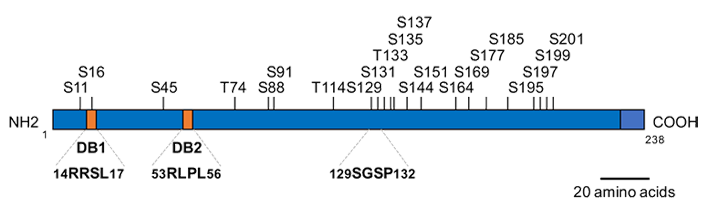
The interaction between FAM64A and the Kinase Interacting Stathmin (KIS and UHMK1) was identified in Y2H screen and confirmed by GST pull-down, co-immunoprecipitation and co-localization experiments. KIS interacts with amino-acids 136-187 of FAM64A. Kinase assay showed that FAM64A is a substrate of KIS at serine 131 (S131). In a GAL4-based reporter gene assay KIS enhanced the transcriptional repressor activity of FAM64A, independently of phosphorylation on S131 but dependent on KIS kinase activity (Archangelo, et al. 2013).
RNA immunoprecipitation sequencing (RIP-seq) described the interaction between FAM64A and ROD1 (PTBP3), an RNA-binding protein involved in nonsense-mediated decay (NMD) (Brazao, et al. 2012).
Protein microarray analysis identified FAM64A as an interacting partner of the cellular prion protein (PrPC). The interaction was confirmed by co-immunoprecipitation of the overexpressed tagged-proteins (Satoh, et al. 2009).
Homology
Table 1. Homology between the human FAM64A and other species
| Homo sapiens FAM64A | Symbol | Identity (%) Protein DNA | |
| vs. P.troglodytes | FAM64A | 96.6 | 98.6 |
| vs. vs. M. mulatta | LOC712701 | 91.6 | 95.9 |
| vs. C. lupus | FAM64A | 73.3 | 81.2 |
| vs. B. taurus | FAM64A | 83.2 | 85.9 |
| vs. M. musculus | Fam64a | 74.8 | 77.5 |
| vs. R. norvegicus | Fam64a | 76.7 | 79.1 |
(Source: http://www.ncbi.nlm.nih.gov/homologene/)
Mutations
Somatic
Implicated in
In a recent report, FAM64A silencing in the PICALM/MLLT10 (CALM/AF10)-positive U937 leukemia cell line resulted in somewhat reduced proliferation, altered cell cycle progression, lower migratory ability in vitro, and reduced clonogenicity of FAM64A-depleted U937 cells. Nonetheless, FAM64A silencing was not capable of interfering with the expression of the PICALM/MLLT10 (CALM/AF10)-leukemia deregulated genes (HOXA gene cluster, MEIS1 and BMI1) nor sufficient to hinder tumor growth of U937 xenografts (Barbutti, et al. 2016).
In the same study FAM64A was also detected among a number of cancer outlier genes (CoGs), being highly expressed in 8 cancer tissue samples (Seo, et al. 2012).
Article Bibliography
| Pubmed ID | Last Year | Title | Authors |
|---|---|---|---|
| 23419774 | 2013 | The CATS (FAM64A) protein is a substrate of the Kinase Interacting Stathmin (KIS). | Archangelo LF et al |
| 27588395 | 2016 | CATS (FAM64A) abnormal expression reduces clonogenicity of hematopoietic cells. | Barbutti I et al |
| 22575643 | 2012 | A new function of ROD1 in nonsense-mediated mRNA decay. | Brazão TF et al |
| 20011102 | 2009 | Fine-scale variation and genetic determinants of alternative splicing across individuals. | Coulombe-Huntington J et al |
| 25030904 | 2014 | SigFuge: single gene clustering of RNA-seq reveals differential isoform usage among cancer samples. | Kimes PK et al |
| 18482256 | 2009 | Protein microarray analysis identifies human cellular prion protein interactors. | Satoh J et al |
| 22975805 | 2012 | The transcriptional landscape and mutational profile of lung adenocarcinoma. | Seo JS et al |
| 26004780 | 2015 | Combined Single-Cell Functional and Gene Expression Analysis Resolves Heterogeneity within Stem Cell Populations. | Wilson NK et al |
| 24676531 | 2014 | Integrated analysis of expression profiling data identifies three genes in correlation with poor prognosis of triple-negative breast cancer. | Zhang C et al |
| 18757745 | 2008 | RCS1, a substrate of APC/C, controls the metaphase to anaphase transition. | Zhao WM et al |
Other Information
Locus ID:
NCBI: 54478
MIM: 617611
HGNC: 25483
Ensembl: ENSG00000129195
Variants:
dbSNP: 54478
ClinVar: 54478
TCGA: ENSG00000129195
COSMIC: PIMREG
RNA/Proteins
Protein levels (Protein atlas)
References
| Pubmed ID | Year | Title | Citations |
|---|---|---|---|
| 37081231 | 2023 | Cell Cycle-Related FAM64A Could be Activated by TGF-β Signaling to Promote Glioma Progression. | 2 |
| 37227120 | 2023 | A bioinformatics analysis of the clinicopathological and prognostic significance of FAM64A mRNA expression in gynecological cancers. | 0 |
| 37081231 | 2023 | Cell Cycle-Related FAM64A Could be Activated by TGF-β Signaling to Promote Glioma Progression. | 2 |
| 37227120 | 2023 | A bioinformatics analysis of the clinicopathological and prognostic significance of FAM64A mRNA expression in gynecological cancers. | 0 |
| 35878427 | 2022 | Excessive activation of HOXB13/PIMREG axis promotes hepatocellular carcinoma progression and drug resistance. | 3 |
| 35878427 | 2022 | Excessive activation of HOXB13/PIMREG axis promotes hepatocellular carcinoma progression and drug resistance. | 3 |
| 33177704 | 2021 | Molecular pathogenesis of breast cancer: impact of miR-99a-5p and miR-99a-3p regulation on oncogenic genes. | 12 |
| 34215720 | 2021 | FAM64A is an androgen receptor-regulated feedback tumor promoter in prostate cancer. | 9 |
| 33177704 | 2021 | Molecular pathogenesis of breast cancer: impact of miR-99a-5p and miR-99a-3p regulation on oncogenic genes. | 12 |
| 34215720 | 2021 | FAM64A is an androgen receptor-regulated feedback tumor promoter in prostate cancer. | 9 |
| 32932948 | 2020 | FAM64A: A Novel Oncogenic Target of Lung Adenocarcinoma Regulated by Both Strands of miR-99a (miR-99a-5p and miR-99a-3p). | 12 |
| 32932948 | 2020 | FAM64A: A Novel Oncogenic Target of Lung Adenocarcinoma Regulated by Both Strands of miR-99a (miR-99a-5p and miR-99a-3p). | 12 |
| 30695070 | 2019 | Aberrant FAM64A mRNA expression is an independent predictor of poor survival in pancreatic cancer. | 40 |
| 30979502 | 2019 | Up-regulation of FAM64A promotes epithelial-to-mesenchymal transition and enhances stemness features in breast cancer cells. | 11 |
| 30979686 | 2019 | Overexpression of PIMREG promotes breast cancer aggressiveness via constitutive activation of NF-κB signaling. | 21 |
Citation
Leticia Fröhlich Archangelo
PIMREG (PICALM interacting mitotic regulator)
Atlas Genet Cytogenet Oncol Haematol. 2017-01-01
Online version: http://atlasgeneticsoncology.org/gene/54310/teaching-explorer/new-content/
