ATR (ataxia telangiectasia and Rad3 related)
2010-05-01 Mary E Gagou , Mark Meuth AffiliationInstitute for Cancer Studies, The University of Sheffield, Medical School, Beech Hill Road, Sheffield, S10 2RX, UK
Identity
DNA/RNA
Note
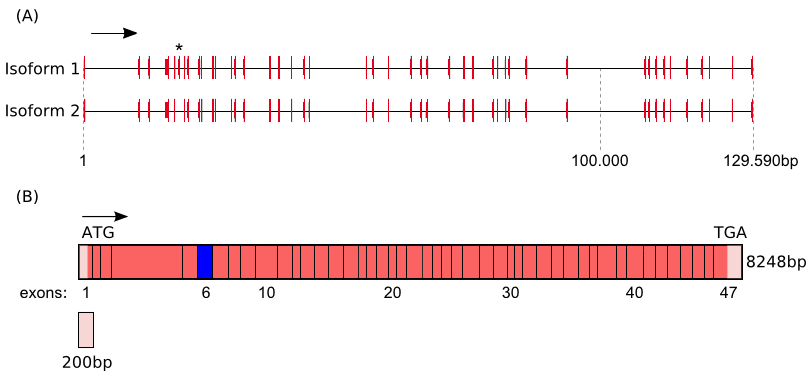
Description
Transcription
Proteins
Note
Description
Isoform ATR-202 (ENSP00000372581): 2580 aa (predicted MW 294218.33 Da).
Biochemical studies of ATR protein do not distinguish between the two different isoforms.
ATR protein contains a PI3/4 kinase catalytic domain, 1 FAT domain, 1 FATC domain, 1 UME domain, and 2 HEAT repeats.
Expression
Forced expression of ATR inhibits MyoD function, leading to loss of differentiation, as well as induces cell-cycle abnormalities (increased aneuploidy and elimination of IR-induced G1 arrest). Limited expression of ATR or overexpression of kinase dead forms of this protein increases cell sensitivity to a variety of DNA damage agents and replication inhibitors, such as ionizing radiation (IR), cis-platinum, hydroxy urea (HU), methylmethanesulfonate (MMS) and ultra violet (UV) irradiation, leading to significant losses in checkpoint control and cell viability. Loss of ATR results in DNA fragile site expression, a specific type of genomic instability.
Localisation
Kinase dead forms of ATR do not relocalize in response to IR and block nuclear translocation of RPA complex in a cell cycle-dependent manner.
Function
ATR-mediated activation of S-phase checkpoint
ATR is activated during every S-phase and in response to many different types of damage, including double strand breaks (DSB), base adducts, crosslinks and replication stress. The structural requirement for ATR activation is a RPA-coated single-stranded DNA with a 5 double stranded primer junction. ATR recognition of the above DNA structure depends upon a protein co-factor, ATRIP (ATR-interacting protein), that regulates ATR localization and activation. The activity of ATR-ATRIP complex is directly stimulated by TOPBP1 (DNA topoisomerase II binding protein 1), which recruitment to DNA is facilitated by the 9-1-1 (Rad9-Rad1-Hus1) checkpoint clamp.
Activated ATR signals to coordinate cell cycle transitions and repair through the phosphorylation of numerous of substrates including RAD17, p53, TopBP1 (via a feed-forward signalling loop that amplifies ATR-mediated signals), the mediator protein CEP164 and the downstream effector Chk1 (checkpoint kinase 1), which is the best characterized target of the ATR activity. Recombination proteins BRCA1 (breast cancer susceptibility gene 1), WRN (Werners syndrome helicase), and BLM (Blooms syndrome helicase) are ATR sunstrates as well. ATR also phosphorylates the Fanconi-anemia protein FANCD2 to regulate inter-strand crosslink repair as well as the nucleotide excision repair protein XPA to regulate its intracellular localization. Moreover, ATR interacts with the mismatch repair protein MSH2 (mutS homolog 2) to form a signalling module and regulate the phosphorylation of Chk1 and SMC1 (structure maintenance of chromosome 1). Upon replication stress ATR also phosphorylates the Ser-139 of H2AX/H2AFX, while is associated with the tyrosine kinase oncogene BCR-ABL after genotoxic stress.
ATR-mediated stabilization of replication forks
ATR has a crucial role in the maintenance of functional replication forks independent of its function in the activation of Rad53 (yeast homolog of checkpoint kinase 2). Among substrates of ATR on the replication forks are the proteins RPA1, RPA2, MCM2-7 (minichromosome maintenance 2-7) complex, MCM10, PCNA, replication factor C, Tim (Timeless)-Tipin complex, SMARCAL1 (HARP)-a SNF2 ATP-dependent annealing helicase, and several polymerases, such as Pol alpha and Pol epsilon. Furthermore, a key target of ATR-ATRIP complex is Claspin, and is important both for S-phase checkpoint activation (via regulation of Chk1 phosphorylation) but also for replication forks stabilization (via interactions with Pol epsilon) even in normal cycling cells. ATR is found also associated with two components of the nucleosome remodelling and deacetylating complex, the chromodomain-helicase-DNA-binding protein 4 (CHD4) and the histone-deacetylase-2 (HDAC2).
ATR also functions to stabilize fragile sites. In effect of all the above, the ATRs essential function for cell viability may be to respond to abundant sources of replication stress in normal cycling cells as well as after exposure to DNA damage agents.
ATR implication in centrosomal function via:
(a) Direct interaction with NBS1 (Nijmegen breakage syndrome 1) and BRCA1 pathway.
(b) Signalling to Chk1 and control of centrosome overduplication after DNA damage.
(c) Direct phosphorylation and delocalization from centrosome of CEP63 in the presence of chromosomal breaks.
Homology
- Chimpanzee (Pan troglodytes) XP_516792.2, 2646 aa
- Dog (Canis lupus familiaris) XP_534295.2, 2644 aa
- Cattle (Bos taurus) XP_581054.3, 2644 aa
- Rat (Rattus norvegicus) XP_001062084.1, 2166 aa
- Zebrafish (Danio rerio) XP_696163.3, 2638 aa
Mutations
Somatic
Implicated in
Impaired ATR signalling is also characteristic of cells derived from other disorders with microcephaly and growth delay such as pericentrin-mutated Seckel syndrome (PCNT-SS), primary autosomal recessive microcephaly (MCPH) and Nijmegen breakage syndrome.
Article Bibliography
| Pubmed ID | Last Year | Title | Authors |
|---|---|---|---|
| 16783362 | 2006 | Regulation of mitotic entry by microcephalin and its overlap with ATR signalling. | Alderton GK et al |
| 15314022 | 2004 | ATR couples FANCD2 monoubiquitination to the DNA-damage response. | Andreassen PR et al |
| 19793861 | 2009 | The annealing helicase SMARCAL1 maintains genome integrity at stalled replication forks. | Bansbach CE et al |
| 11418864 | 2001 | ATR/ATM-mediated phosphorylation of human Rad17 is required for genotoxic stress responses. | Bao S et al |
| 12814551 | 2003 | ATR kinase activity regulates the intranuclear translocation of ATR and RPA following ionizing radiation. | Barr SM et al |
| 17468739 | 2007 | DNA damage induces Chk1-dependent centrosome amplification. | Bourke E et al |
| 10691732 | 2000 | ATR disruption leads to chromosomal fragmentation and early embryonic lethality. | Brown EJ et al |
| 15833913 | 2005 | Functional uncoupling of MCM helicase and DNA polymerase activities activates the ATR-dependent checkpoint. | Byun TS et al |
| 12526805 | 2002 | ATR regulates fragile site stability. | Casper AM et al |
| 12766152 | 2003 | Human claspin is required for replication checkpoint control. | Chini CC et al |
| 18594563 | 2008 | ATR: an essential regulator of genome integrity. | Cimprich KA et al |
| 9427750 | 1998 | Overexpression of a kinase-inactive ATR protein causes sensitivity to DNA-damaging agents and defects in cell cycle checkpoints. | Cliby WA et al |
| 15210935 | 2004 | Minichromosome maintenance proteins are direct targets of the ATM and ATR checkpoint kinases. | Cortez D et al |
| 11721054 | 2001 | ATR and ATRIP: partners in checkpoint signaling. | Cortez D et al |
| 14871897 | 2004 | Recruitment of the cell cycle checkpoint kinase ATR to chromatin during S-phase. | Dart DA et al |
| 15050919 | 2004 | BCR/ABL translocates to the nucleus and disrupts an ATR-dependent intra-S phase checkpoint. | Dierov J et al |
| 15758953 | 2005 | Conserved modes of recruitment of ATM, ATR and DNA-PKcs to sites of DNA damage. | Falck J et al |
| 15282542 | 2004 | ATR functions as a gene dosage-dependent tumor suppressor on a mismatch repair-deficient background. | Fang Y et al |
| 19230642 | 2009 | ATR/Mec1: coordinating fork stability and repair. | Friedel AM et al |
| 17344846 | 2007 | Patterns of somatic mutation in human cancer genomes. | Greenman C et al |
| 18157127 | 2008 | Mutations in pericentrin cause Seckel syndrome with defective ATR-dependent DNA damage signaling. | Griffith E et al |
| 10597277 | 1999 | ATR is a caffeine-sensitive, DNA-activated protein kinase with a substrate specificity distinct from DNA-PK. | Hall-Jackson CA et al |
| 11865061 | 2002 | Hypoxia links ATR and p53 through replication arrest. | Hammond EM et al |
| 19570909 | 2009 | Reduced ATR or Chk1 expression leads to chromosome instability and chemosensitization of mismatch repair-deficient colorectal cancer cells. | Jardim MJ et al |
| 19470916 | 2009 | ATR mutations in endometrial cancer: a window into the role of mismatch repair defects. | Kauff ND et al |
| 19473885 | 2009 | Human DNA damage response and repair deficiency syndromes: linking genomic instability and cell cycle checkpoint proficiency. | Kerzendorfer C et al |
| 10608806 | 1999 | Substrate specificities and identification of putative substrates of ATM kinase family members. | Kim ST et al |
| 17879369 | 2007 | Mutations in the ataxia telangiectasia and rad3-related-checkpoint kinase 1 DNA damage response axis in colon cancers. | Lewis KA et al |
| 16103057 | 2005 | Heterozygous ATR mutations in mismatch repair-deficient cancer cells have functional significance. | Lewis KA et al |
| 10859164 | 2000 | Chk1 is an essential kinase that is regulated by Atr and required for the G(2)/M DNA damage checkpoint. | Liu Q et al |
| 18851837 | 2008 | Mrc1 and DNA polymerase epsilon function together in linking DNA replication and the S phase checkpoint. | Lou H et al |
| 19889979 | 2009 | Functional genomic screens identify CINP as a genome maintenance protein. | Lovejoy CA et al |
| 11470508 | 2001 | Evidence for alternate splicing within the mRNA transcript encoding the DNA damage response kinase ATR. | Mannino JL et al |
| 11691784 | 2001 | Somatic mutations in the DNA damage-response genes ATR and CHK1 in sporadic stomach tumors with microsatellite instability. | Menoyo A et al |
| 17384679 | 2007 | Frequent alteration of DNA damage signalling and repair pathways in human colorectal cancers with microsatellite instability. | Miquel C et al |
| 19782648 | 2009 | Mouse models for ATR deficiency. | O'Driscoll M et al |
| 17531546 | 2007 | The ATR pathway: fine-tuning the fork. | Paulsen RD et al |
| 18371340 | 2007 | Deletion of the developmentally essential gene ATR in adult mice leads to age-related phenotypes and stem cell loss. | Ruzankina Y et al |
| 10545197 | 1999 | Molecular association between ATR and two components of the nucleosome remodeling and deacetylating complex, HDAC2 and CHD4. | Schmidt DR et al |
| 18593882 | 2008 | Separate roles for the DNA damage checkpoint protein kinases in stabilizing DNA replication forks. | Segurado M et al |
| 19244116 | 2009 | Inactivation of the Nijmegen breakage syndrome gene leads to excess centrosome duplication via the ATR/BRCA1 pathway. | Shimada M et al |
| 19158338 | 2009 | ATR signaling at a glance. | Shiotani B et al |
| 18283122 | 2008 | Cep164 is a mediator protein required for the maintenance of genomic stability through modulation of MDC1, RPA, and CHK1. | Sivasubramaniam S et al |
| 19182792 | 2009 | An ATM- and ATR-dependent checkpoint inactivates spindle assembly by targeting CEP63. | Smith E et al |
| 19805627 | 2009 | Tim-Tipin dysfunction creates an indispensible reliance on the ATR-Chk1 pathway for continued DNA synthesis. | Smith KD et al |
| 9590286 | 1998 | Duplication of ATR inhibits MyoD, induces aneuploidy and eliminates radiation-induced G1 arrest. | Smith L et al |
| 11114888 | 2000 | Functional interactions between BRCA1 and the checkpoint kinase ATR during genotoxic stress. | Tibbetts RS et al |
| 19546241 | 2009 | Microcephalin and pericentrin regulate mitotic entry via centrosome-associated Chk1. | Tibelius A et al |
| 14729973 | 2004 | Quaternary structure of ATR and effects of ATRIP and replication protein A on its DNA binding and kinase activities. | Unsal-Kaçmaz K et al |
| 14657349 | 2003 | MSH2 and ATR form a signaling module and regulate two branches of the damage response to DNA methylation. | Wang Y et al |
| 11673449 | 2001 | Histone H2AX is phosphorylated in an ATR-dependent manner in response to replicational stress. | Ward IM et al |
| 14742437 | 2004 | UV-induced ataxia-telangiectasia-mutated and Rad3-related (ATR) activation requires replication stress. | Ward IM et al |
| 17431119 | 2007 | Loss of ataxia telangiectasia mutated- and Rad3-related function potentiates the effects of chemotherapeutic drugs on cancer cell survival. | Wilsker D et al |
| 9636169 | 1998 | Protein kinase mutants of human ATR increase sensitivity to UV and ionizing radiation and abrogate cell cycle checkpoint control. | Wright JA et al |
| 19470935 | 2009 | ATR mutation in endometrioid endometrial cancer is associated with poor clinical outcomes. | Zighelboim I et al |
| 12791985 | 2003 | Sensing DNA damage through ATRIP recognition of RPA-ssDNA complexes. | Zou L et al |
Other Information
Locus ID:
NCBI: 545
MIM: 601215
HGNC: 882
Ensembl: ENSG00000175054
Variants:
dbSNP: 545
ClinVar: 545
TCGA: ENSG00000175054
COSMIC: ATR
RNA/Proteins
Expression (GTEx)
Pathways
PharmGKB
| Entity ID | Name | Type | Evidence | Association | PK | PD | PMIDs |
|---|---|---|---|---|---|---|---|
| PA110 | CHEK1 | Gene | Pathway | associated | |||
| PA404 | CHEK2 | Gene | Pathway | associated |
References
| Pubmed ID | Year | Title | Citations |
|---|---|---|---|
| 37806848 | 2024 | TuBG1 promotes hepatocellular carcinoma via ATR/P53-apoptosis and cycling pathways. | 2 |
| 37930853 | 2024 | ATR phosphorylates DHX9 at serine 321 to suppress R-loop accumulation upon genotoxic stress. | 4 |
| 38554113 | 2024 | SIRT2 promotes base excision repair by transcriptionally activating OGG1 in an ATM/ATR-dependent manner. | 0 |
| 38721777 | 2024 | EXO1 and DNA2-mediated ssDNA gap expansion is essential for ATR activation and to maintain viability in BRCA1-deficient cells. | 0 |
| 37806848 | 2024 | TuBG1 promotes hepatocellular carcinoma via ATR/P53-apoptosis and cycling pathways. | 2 |
| 37930853 | 2024 | ATR phosphorylates DHX9 at serine 321 to suppress R-loop accumulation upon genotoxic stress. | 4 |
| 38554113 | 2024 | SIRT2 promotes base excision repair by transcriptionally activating OGG1 in an ATM/ATR-dependent manner. | 0 |
| 38721777 | 2024 | EXO1 and DNA2-mediated ssDNA gap expansion is essential for ATR activation and to maintain viability in BRCA1-deficient cells. | 0 |
| 36749285 | 2023 | The "extreme phenotype approach" applied to male breast cancer allows the identification of rare variants of ATR as potential breast cancer susceptibility alleles. | 0 |
| 37144518 | 2023 | Replisome dysfunction upon inducible TIMELESS degradation synergizes with ATR inhibition to trigger replication catastrophe. | 3 |
| 37227155 | 2023 | The FBXO32/ATR/ATM axis acts as a molecular switch to control the sensitivity of osteosarcoma cells to irradiation through its regulation of EXO1 expression. | 1 |
| 37338595 | 2023 | Expression variations of DNA damage response genes ATM and ATR in blood cancer patients. | 0 |
| 37378431 | 2023 | Alteration of replication protein A binding mode on single-stranded DNA by NSMF potentiates RPA phosphorylation by ATR kinase. | 2 |
| 37454295 | 2023 | ATR protects ongoing and newly assembled DNA replication forks through distinct mechanisms. | 5 |
| 37592023 | 2023 | Exome sequencing identifies breast cancer susceptibility genes and defines the contribution of coding variants to breast cancer risk. | 7 |
Citation
Mary E Gagou ; Mark Meuth
ATR (ataxia telangiectasia and Rad3 related)
Atlas Genet Cytogenet Oncol Haematol. 2010-05-01
Online version: http://atlasgeneticsoncology.org/gene/728/atr
