t(2;12)(p12;p13) IGK/CCND2
t(12;14)(p13;q32) IGH/CCND2
t(12;22)(p13;q11) IGL/CCND2
2009-12-01 Jean-Loup Huret
Affiliation
1.Genetics, Dept Medical Information, University of Poitiers, CHU Poitiers Hospital, F-86021 Poitiers, France
Clinics and Pathology
Disease
Mantle cell lymphoma (MCL)
Note
This review does not include a case of t(2;12)(p12;p13) found in myeloid malignancy (Lai et al., 1995), a case of acute lymphoblastic leukemia with a t(12;14)(p13;q32) and IgH/ETV6 involvement (Lu et al., 2002); five cases of t(12;22)(p13;q11), not herein included either, have also been described in lymphoid malignancies, but with an unknown CCND2 status (see Mitelman database). Finally, there are a number of chronic myeloid leukemia aberrant translocations with t(12;22), which again represent other diseases.
Phenotype stem cell origin
The cases of mantle cell lymphomas with the above translocations were typical mantle cell cases, with CD5+, CD20+, CD10-, CD23- expression, except for the lack of CCND1 expression.
Epidemiology
Five cases are available: 4 cases of MCL (Gesk et al., 2006; Herens et al., 2008; Wlodarska et al., 2008), and a case of chronic lymphocytic leukemia (CLL) transforming into a Richter disease (Qian et al., 1999).
Clinics
The patients are in stage IV of the disease, with a nodular, or nodular/diffuse pattern. There was 3 male and 2 female patients, aged 33, 52, 65, 70, and ? years.
Prognosis
Data is missing in most cases; the two patients with data on prognosis died: the patient with Richter disease, and a MCL case, who died 64 months after diagnosis.
Cytogenetics
Cytogenetics morphological
There was two cases of t(2;12), one case of cryptic t(12;14), one case of t(12;22), and one case with no metaphase.
Additional anomalies
+3 was found in two cases, +21 in one case, a complex karyotype in one case, and +12 and a t(14;19)(q32;q13) in the CLL/Richter case.
Genes Involved and Proteins
Gene name
CCND2 (cyclin D2)
Location
12p13.32
Protein description
CCND2 promotes cell cycle progression at the G1/S start transition. Interacts with CDK4 and CDK6. CCND2 is activated through B-cell antigen receptor-induced, and CD19-induced signal transduction pathways, including the RAS/RAF/MAPK pathway, the PLC gamma pathway, and the IKK/NF-KB pathway. CCND2 is critical in B-cell development (review in Chiles, 2004).
Result of the Chromosomal Anomaly
Oncogenesis
Overexpression of cyclin D2.
Article Bibliography
| Pubmed ID | Last Year | Title | Authors |
|---|---|---|---|
| 15322145 | 2004 | Regulation and function of cyclin D2 in B lymphocyte subsets. | Chiles TC et al |
| 16861358 | 2006 | A chromosomal translocation in cyclin D1-negative/cyclin D2-positive mantle cell lymphoma fuses the CCND2 gene to the IGK locus. | Gesk S et al |
| 18223179 | 2008 | Cyclin D1-negative mantle cell lymphoma with cryptic t(12;14)(p13;q32) and cyclin D2 overexpression. | Herens C et al |
| 7885035 | 1995 | Myelodysplastic syndromes and acute myeloid leukemia with 17p deletion. An entity characterized by specific dysgranulopoïesis and a high incidence of P53 mutations. | Lai JL et al |
| 12399965 | 2002 | The utility of spectral karyotyping in the cytogenetic analysis of newly diagnosed pediatric acute lymphoblastic leukemia. | Lu XY et al |
| 10460609 | 1999 | Cyclin D2 promoter disrupted by t(12;22)(p13;q11.2) during transformation of chronic lymphocytic leukaemia to non-Hodgkin's lymphoma. | Qian L et al |
| 18391076 | 2008 | Translocations targeting CCND2, CCND3, and MYCN do occur in t(11;14)-negative mantle cell lymphomas. | Wlodarska I et al |
Summary
Fusion gene
IGH/CCND2 IGH (14q32.33) CCND2 (12p13.32) M t(12;14)(p13;q32)
Note
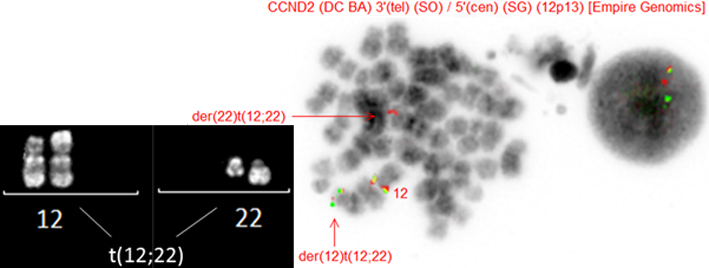
t(12;22)(p13;q11) IGL/CCND2 R-banded karyotype (left) and FISH using dual color break apart probe CCND2 (12p13) (Empire genomics) (right) - Courtesy Karolien Beel, Peter Meeus, Geneviu00e8ve Ameye and Lucienne Michaux
Citation
Jean-Loup Huret
t(2;12)(p12;p13) IGK/CCND2
t(12;14)(p13;q32) IGH/CCND2
t(12;22)(p13;q11) IGL/CCND2
Atlas Genet Cytogenet Oncol Haematol. 2009-12-01
Online version: http://atlasgeneticsoncology.org/haematological/1487/t(2
