Primary Cutaneous B-Cell Lymphomas
2019-07-01 Ayad M. Al-Katib , Anwar N. Mohamed Affiliation1.Lymphoma Research Laboratory, Department of Medicine, Gordon H. Scott Hall for Basic Medical Sciences, Room #8229, 540 East Canfield (AMAK) and the Cytogenetics Laboratory, Department of Pathology, [email protected] (ANM), Wayne State University School of Medicine, Detroit, MI 48202 USA
Abstract
Primary cutaneous B-cell lymphomas (PCBCL) are a heterogeneous group of mature B-cells neoplasms that present in the skin without evidence of nodal or systemic involvement. The clinical and pathologic features of PCBCL differ significantly from the equivalent nodal lymphomas. Three main subtypes of PCBCL are recognized by the 2016 revised WHO classification. Studies have shown that PCBCLs are characterized by distinct immunophenotypic features, chromosomal aberrations and gene rearrangements which provide further support for their classification as separate entities from their nodal types.
Clinics and Pathology
Phenotype stem cell origin
Embryonic origin
Epidemiology
Clinics
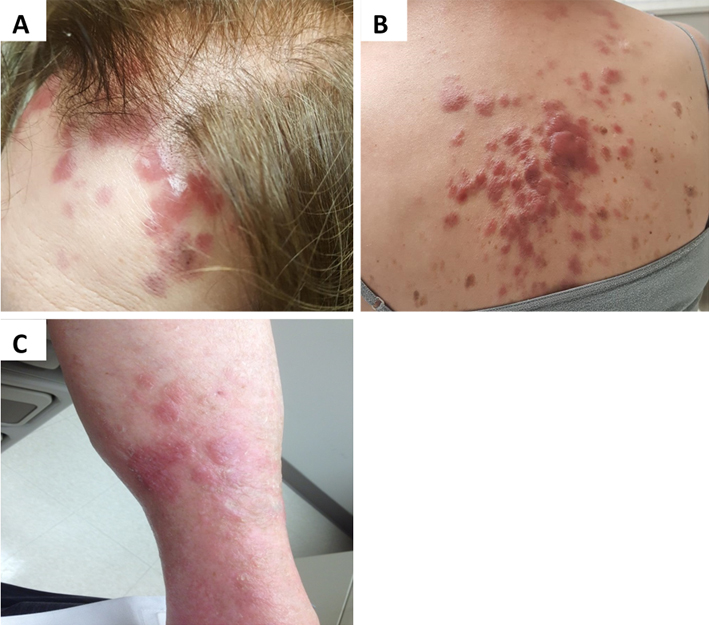
PCMZL manifests as solitary or multiple reddish, dome-shaped papules, nodules or erythematous plaques. The disease frequently presents in the trunk or extremities, and to a lesser extent in the head and neck area.
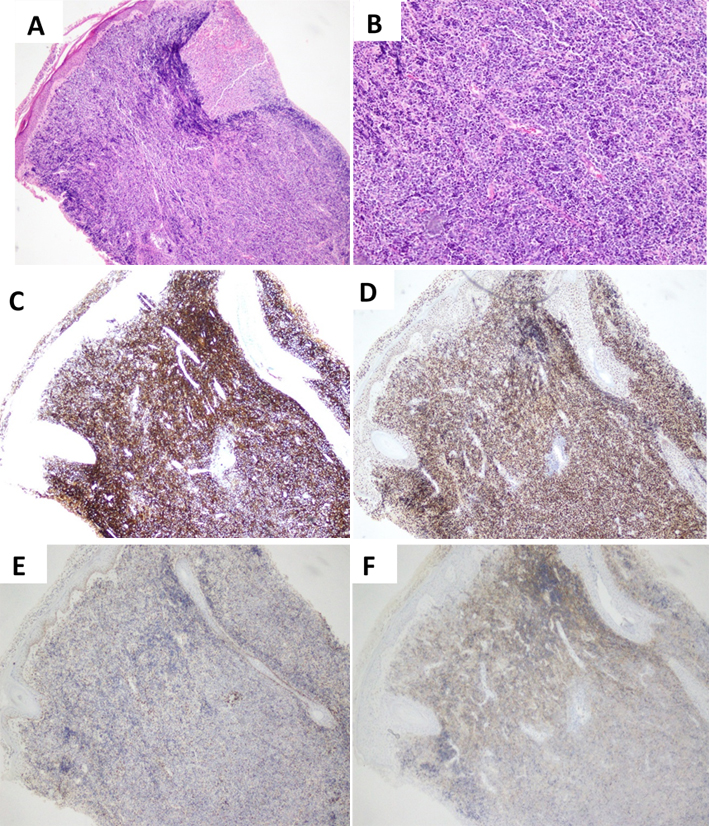
PCFCL commonly presents in the scalp and forehead (Figure 1A) but can involve the trunk and limbs. Lesions can be solitary or grouped and vary from pink papules to violaceous nodules. PCFCL that presents in the trunk (Figure 1B) used to be called reticulohistiocytoma of the dorsum or Crosti lymphoma (Berti 1988).
PCDLBCL can be divided into 2 distinct sub-entities: PCDLBCL-leg type, and PCDLBCL-other (Paulli 2012). The leg type (LT) is commonly seen in older women and usually presents in the lower extremities although other sites of the body can be involved. The disease presents as rapidly growing solitary or multiple nodules or plaques (Figure 1C). The lesions are pink, red, bluish-red or violaceous in color. Unlike PCMZL and PCFCL, DLBCL-LT is an aggressive disease where most patients will have local recurrence and/or extracutaneous progression and poor overall survival (Grange 2007). PCDLBCL-other includes T-cell/histiocyte-rich DLBCL, plasmablastic lymphoma, intravascular large B-cell lymphoma and other types that are distinct from PCDLBCL-LT.
Pathology
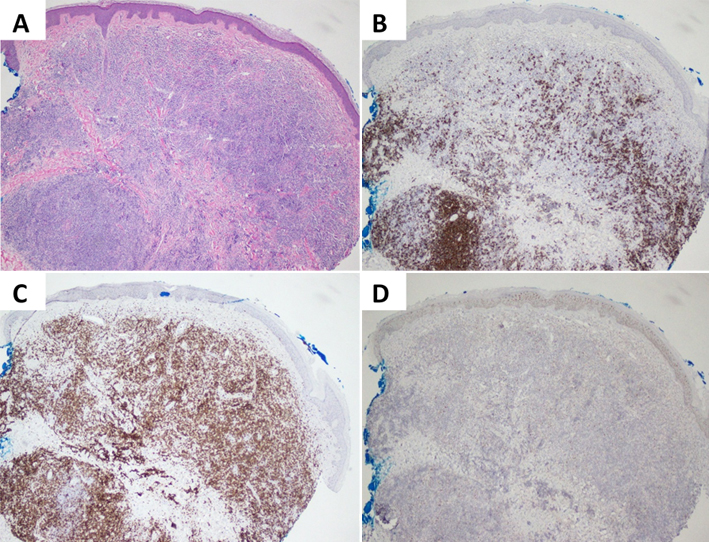
Histopathologic findings of PCMZL include a nodular or diffuse nonepidermotropic infiltrate composed of small to medium-size lymphoid cells (Figure 3A). The nuclei are indented, and cells have abundant cytoplasm. Lymphoid cell infiltrate can be admixed with various number of plasma cells and reactive T-cells. Asian cases with PCMZL were reported to show tissue eosinophilia in tumor specimens, a feature not found in cases from Germany or United States (Takino 2008). Immunophenotypically, PCMZL tumor cells express B-cell markers like CD20 (Figure 3B), and CD79a. CD3 highlights reactive T-cells which sometimes are present in larger numbers than the malignant B-cells (Figure 3C). In such cases, it is important to document B-cell monoclonality which can be demonstrated using IHC techniques like in situ hybridization for immunoglobulin light chain staining. Malignant B-cells are negative for germinal center markers like CD10 and BCL6 (Figure 3D).
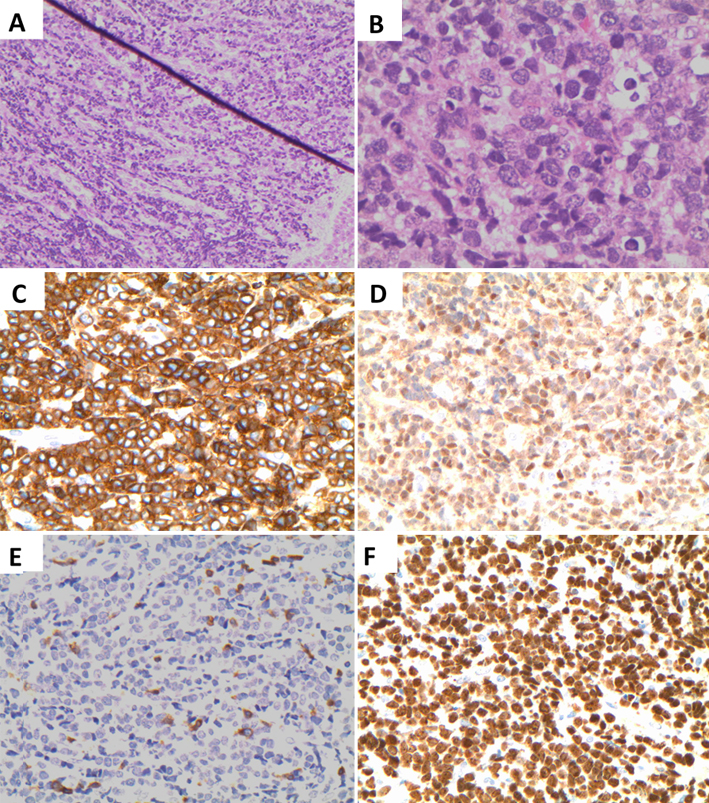
PCDLBCL, LT is characterized histologically by diffuse infiltrate covering the entire dermis but usually spares a thin subepidermal grenz zone and the epidermis (Figure 4A). Tumor cell infiltrate destroys adnexal structures and extends to subcutaneous tissue. As the name implies, cells are large B-cells (also referred to as centroblasts or immunoblasts) (Figure 4B). The immunophenotype of tumor cells typically is positive for CD19, CD20 (Figure 4C), CD79a, BCL2, and MUM1 (Figure 4D). Cells are usually negative for CD3 (Figure 4E), CD5, CD21, CD138, CD10, and cyclin D1. Cell proliferation is high (Figure 4F). Strong expression of BCL2 and MUM1 in PCDLBCL, LT helps distinguish this entity from diffuse type PCFCL which is negative for these 2 markers.
Treatment
Prognosis
Note
On the contrary, the PCDLBCL, LT shows many genetic similarities with diffuse large B cell lymphomas arising at other sites. Interphase FISH analysis frequently shows translocation involving MYC/8q24, BCL6/3q27 and IGH/14q32 genes in PCDLBCL, LT but not in patients with a PCFCL (Hallermann 2004 July). Comparative genomic hybridization (CGH), using microarrays and subsequently confirmed by FISH analysis showed that most of PCDLBCL, LT cases had chromosomal aberrations including gains in chromosomes 1, 2, 3, 7, and 12, losses in 6q, 13, 14, and 18q (Dijkman 2006). In contrast, PCFCL had fewer imbalances and lacked translocations affecting the IGH locus (Hallermann June 2004). Most PCFCL do not exhibit t(14;18)(q32;q21) that determines BCL2/IGH rearrangement and features of nodal follicular lymphoma (Abdul-Wahab 2014). The most recurrent alterations in PCFCL were high-level DNA amplifications at 2p16.1 (63%) and deletion of chromosome 14q32.33 (68%). FISH analysis confirmed REL amplification in patients with gains at 2p16.1. The same study showed that PCDLBCL, LT have a high-level DNA amplification of 18q21.31-q21.33 (67%), including the BCL2 and MALT1 genes as confirmed by FISH. This may explain the strong BCL2 expression in these cases although lacking t(14;18) (BCL2/IGH) translocation. Recurrent homozygous DNA deletions in region 9p21.3 which contains CDKN2A, CDKN2B and NSG-x genes are found in 67% of PCDLBCL, LT cases but not in any of the PCFCL patients (Belaud-Rotureau 2008). In addition, some PCDLBCL, LT (17%) had a complete hypermethylation of CDKN2A gene promoter. In contrast, deletions of chromosome 9p21.3 containing the CDKN2A and CDKN2B gene loci, and MYD88 mutations are not or only rarely found in PCFCL. In conclusion, these studies clearly demonstrate distinct chromosomal and genomic aberrations in PCFCL and PCDLBCL, LT which provides further support for their categorization in the WHO-EORTC classification as separate entities. Finally, loss of chromosome 9p21.3 might prove to be an important prognostic marker in PCDLBCL, LT associated with inferior outcome (Sneff 2009) although confirmation on a larger group of patients is required. PCFCL shows the gene expression profile of germinal center-like large B cell lymphomas, and often shows amplifications of the REL gene (Hoefnagel 2005). Deletion of chromosome 14q32.33 has been also reported in PCFCL (Dijkman 2006).
Genes Involved and Proteins
Article Bibliography
| Pubmed ID | Last Year | Title | Authors |
|---|---|---|---|
| 24679486 | 2014 | Chromosomal anomalies in primary cutaneous follicle center cell lymphoma do not portend a poor prognosis. | Abdul-Wahab A et al |
| 30294921 | 2019 | Primary cutaneous lymphoma in Argentina: a report of a nationwide study of 416 patients. | Abeldaño A et al |
| 18311490 | 2008 | Inactivation of p16INK4a/CDKN2A gene may be a diagnostic feature of large B cell lymphoma leg type among cutaneous B cell lymphomas. | Belaud-Rotureau MA et al |
| 19279331 | 2009 | Cutaneous lymphoma incidence patterns in the United States: a population-based study of 3884 cases. | Bradford PT et al |
| 9331890 | 1997 | Infection by Borrelia burgdorferi and cutaneous B-cell lymphoma. | Cerroni L et al |
| 27641754 | 2017 | Primary cutaneous B-cell lymphoma: systemic spread is rare while cutaneous relapses and secondary malignancies are frequent. | Chan SA et al |
| 25113753 | 2014 | Recommendations for initial evaluation, staging, and response assessment of Hodgkin and non-Hodgkin lymphoma: the Lugano classification. | Cheson BD et al |
| 16330669 | 2006 | Array-based comparative genomic hybridization analysis reveals recurrent chromosomal alterations and prognostic parameters in primary cutaneous large B-cell lymphoma. | Dijkman R et al |
| 15461623 | 2004 | Intravascular lymphoma: clinical presentation, natural history, management and prognostic factors in a series of 38 cases, with special emphasis on the 'cutaneous variant'. | Ferreri AJ et al |
| 17875875 | 2007 | Primary cutaneous diffuse large B-cell lymphoma, leg type: clinicopathologic features and prognostic analysis in 60 cases. | Grange F et al |
| 15175042 | 2004 | Chromosomal aberration patterns differ in subtypes of primary cutaneous B cell lymphomas. | Hallermann C et al |
| 15308563 | 2005 | Distinct types of primary cutaneous large B-cell lymphoma identified by gene expression profiling. | Hoefnagel JJ et al |
| 24698939 | 2014 | Primary cutaneous marginal zone lymphoma in children: a report of 3 cases and review of the literature. | Kempf W et al |
| 29481902 | 2018 | Panel Sequencing Shows Recurrent Genetic FAS Alterations in Primary Cutaneous Marginal Zone Lymphoma. | Maurus K et al |
| 23149705 | 2012 | Primary cutaneous diffuse large B-cell lymphoma (PCDLBCL), leg-type and other: an update on morphology and treatment. | Paulli M et al |
| 25055137 | 2014 | High frequency and clinical prognostic value of MYD88 L265P mutation in primary cutaneous diffuse large B-cell lymphoma, leg-type. | Pham-Ledard A et al |
| 18567836 | 2008 | European Organization for Research and Treatment of Cancer and International Society for Cutaneous Lymphoma consensus recommendations for the management of cutaneous B-cell lymphomas. | Senff NJ et al |
| 19020554 | 2009 | Fine-mapping chromosomal loss at 9p21: correlation with prognosis in primary cutaneous diffuse large B-cell lymphoma, leg type. | Senff NJ et al |
| 26759546 | 2015 | Primary cutaneous lymphomas: diagnosis and treatment. | Sokołowska-Wojdyło M et al |
| 26980727 | 2016 | The 2016 revision of the World Health Organization classification of lymphoid neoplasms. | Swerdlow SH et al |
| 18820662 | 2008 | Primary cutaneous marginal zone B-cell lymphoma: a molecular and clinicopathological study of cases from Asia, Germany, and the United States. | Takino H et al |
| 15692063 | 2005 | WHO-EORTC classification for cutaneous lymphomas. | Willemze R et al |
| 27861728 | 2017 | Myeloid differentiation primary response 88 mutations in a distinct type of cutaneous marginal-zone lymphoma with a nonclass-switched immunoglobulin M immunophenotype. | Wobser M et al |
| 16492713 | 2006 | Prognostic factors in primary cutaneous B-cell lymphoma: the Italian Study Group for Cutaneous Lymphomas. | Zinzani PL et al |
Summary
Note
Classification:
Currently, the CBCL classified according to WHO-EORTC classification into three main subtypes (Swerdlow 2017) which are the following:
The WHO classification was updated in 2018 to include additional provisional entity, EBV-positive mucocutaneous ulcer and to recognize 2 subsets of PCMZL (Willemze 2019). Intravascular large B-cell lymphoma was also included as part of CBCL. While it has a cutaneous variant (Ferreri 2004), this entity will not be discussed further in this review. It is critical to distinguish PCBCL from systemic B cell lymphomas with secondary skin involvement because the clinical behaviors, prognosis, and management differ considerably.
Citation
Ayad M. Al-Katib ; Anwar N. Mohamed
Primary Cutaneous B-Cell Lymphomas
Atlas Genet Cytogenet Oncol Haematol. 2019-07-01
Online version: http://atlasgeneticsoncology.org/haematological/1851/primary-cutaneous-b-cell-lymphomas
