t(2;19)(p12;q13.3) IGK/BCL3
t(14;19)(q32;q13.3) IGH/BCL3
t(19;22)(q13.3;q11) BCL3/IGL
2008-06-01 Jean-Loup Huret
Affiliation
1.Genetics, Dept Medical Information, University of Poitiers; CHU Poitiers Hospital, F-86021 Poitiers, France
2.Centrum voor Menselijke Erfelijkheid, UZ Gasthuisberg, Herestraat 49, 3000 Leuven, Belgie
Clinics and Pathology
Disease
Chronic lymphocytic leukemia/small lymphocytic lymphoma (B-CLL/SLL); most are the atypical form (at times reported as variant CLL, or transformed CLL), because of an atypical morphology and phenotype (Michaux et al., 1996; Michaux et al., 1997), but also for the presence of lymphocytosis (Soma et al., 2006), the frequency of lymphadenopathy (Huh et al., 2007), young age (median 50-60 years), male predominence (about 2M/1F), and an aggressive course of the disease (Michaux et al., 1997).
Other diseases: marginal zone lymphoma (MZL), splenic marginal zone lymphoma (SMZL), diffuse large B-cell lymphoma (DLBCL), mantle cell lymphoma, low grade B-cell non Hodgkin lymphoma (NHL) not otherwise specified, aggressive B-cell NHL, and even one case of biphenotypic (B/M) acute leukemia.
A recent study reascertained and split the entity into the following subgroups herein below described; the accuracy of this proposal remains to be confirmed by further studies, inasmuch as there is a real problem of classification of t(14;19)(q32;q13) in chronic B-cell lymphoproliferative disorders, as has been pointed out (Soma et al., 2006; Huh et al., 2007):
"7q rearrangements cluster": 15% of cases: diagnosis of MZL/SMZL or aggressive B-cell NHL mostly. Medium complexity of the karyotype. IgVH mutated. Aggressive diseases. Median age 65 (49-85).
"Deletion 17p cluster": 10% of cases: diagnosis of CLL frequent. Complex karyotypes. IgVH mutated. Median age 54.
"1q rearrangements, deletions 6q and 13q cluster": 30% of cases: diagnosis of DLBCL or MZL and MZL in transformation, less often, CLL. Complex karyotypes. IgVH mutated. Aggressive diseases. Median age 65 (27-92).
"Trisomy 12 cluster": 45% of cases: diagnosis of CLL in most cases, low complexity of the karyotype, IgVH mutation rate low. This is the only cluster with an unequal sex ratio: 14M/4F; median age 65 (35-95).
Other diseases: marginal zone lymphoma (MZL), splenic marginal zone lymphoma (SMZL), diffuse large B-cell lymphoma (DLBCL), mantle cell lymphoma, low grade B-cell non Hodgkin lymphoma (NHL) not otherwise specified, aggressive B-cell NHL, and even one case of biphenotypic (B/M) acute leukemia.
A recent study reascertained and split the entity into the following subgroups herein below described; the accuracy of this proposal remains to be confirmed by further studies, inasmuch as there is a real problem of classification of t(14;19)(q32;q13) in chronic B-cell lymphoproliferative disorders, as has been pointed out (Soma et al., 2006; Huh et al., 2007):
"7q rearrangements cluster": 15% of cases: diagnosis of MZL/SMZL or aggressive B-cell NHL mostly. Medium complexity of the karyotype. IgVH mutated. Aggressive diseases. Median age 65 (49-85).
"Deletion 17p cluster": 10% of cases: diagnosis of CLL frequent. Complex karyotypes. IgVH mutated. Median age 54.
"1q rearrangements, deletions 6q and 13q cluster": 30% of cases: diagnosis of DLBCL or MZL and MZL in transformation, less often, CLL. Complex karyotypes. IgVH mutated. Aggressive diseases. Median age 65 (27-92).
"Trisomy 12 cluster": 45% of cases: diagnosis of CLL in most cases, low complexity of the karyotype, IgVH mutation rate low. This is the only cluster with an unequal sex ratio: 14M/4F; median age 65 (35-95).
Phenotype stem cell origin
Chronic B-cell lymphoproliferation
Epidemiology
103 published cases (40 reviewed in Soma et al., 2006; 7 cases in Huh et al., 2007; and 56 cases in Martin-Subero et al., 2007). Annual incidence 30/106. The t(14;19) occurs in less than 0.2 % of B-cell malignancies.
Clinics
Often a slow evolutive disease.
Prognosis
Highly variable according to the staging: from staging A: where the survival is not reduced compared to age matched population, to staging C: with a median survival of 2 yrs. t(14;19) is often associated with rapidly progressive disease, and overall prognosis is poor compared to the expected survival in chronic lymphocytic leukemia and low-grade B-cell lymphoma. The prognosis has to be reascertained according to new (or further) sub-classification of the the disease.
Cytogenetics
Cytogenetics morphological
The t(14;19)(q32.3;q13.2) is reciprocal and results in 14q+ and a 19q- derivative chromosomes.
Cytogenetics molecular
FISH is useful for identifying variant translocations.
Additional anomalies
t(14;19) is rarely the sole cytogenetic aberration. Trisomy 12 is the most frequent associated abnormality, and is observed in 50% of cases. del(6q), del(7q), del(13q), del(17p) and additional 14q32 rearrangements can be found. Other chromosomes involved in structural aberrations are 1q, 3p, 3q, 6p, 7q, 11q, 12p.
Variants
t(2;19)(p12;q13) IGK/BCL3 and t(19;22)(q13;q11) BCL3/IGL, variants of the t(14;19)(q32;q13) IGH/BCL3, have been described; they are found in the same proportions as for the variants of the t(8;14)(q24;q32).
Genes Involved and Proteins
Gene name
IGH (Immunoglobulin Heavy)
Location
14q32.33
Gene name
BCL3 (B-cell CLL/lymphoma 3)
Location
19q13.32
Dna rna description
9 exons, spanning 11.5 kb. BCL3 mRNA is expressed in a variety of tissues, particularly in spleen, liver and lung.
Protein description
Result of the Chromosomal Anomaly
Description
The breakpoint is located in the 5 untranslated region of the BCL3 gene. BCL3 is juxtaposed to the immunoglobulin heavy chain gene locus on chromosome 14 (often in the switch alpha region) in a "head-to-head" configuration.
Oncogenesis
Article Bibliography
| Pubmed ID | Last Year | Title | Authors |
|---|---|---|---|
| 17129229 | 2007 | The t(14;19)(q32;q13)-positive small B-cell leukaemia: a clinicopathologic and cytogenetic study of seven cases. | Huh YO et al |
| 17495977 | 2007 | A comprehensive genetic and histopathologic analysis identifies two subgroups of B-cell malignancies carrying a t(14;19)(q32;q13) or variant BCL3-translocation. | Martín-Subero JI et al |
| 9078289 | 1997 | t(14;19)/BCL3 rearrangements in lymphoproliferative disorders: a review of 23 cases. | Michaux L et al |
| 8824724 | 1996 | BCL3 rearrangement and t(14;19)(q32;q13) in lymphoproliferative disorders. | Michaux L et al |
| 16426923 | 2006 | Splenic small B-cell lymphoma with IGH/BCL3 translocation. | Soma LA et al |
Summary
Fusion gene
IGK/BCL3 IGK (14q32.33) BCL3 (19q13.32) M t(2;19)(p11;q13)
Note
The t(14;19)(q32.3;q13.3) -as well as the variants t(2;19) and t(19;22)- is a recurrent translocation found in patients with chronic B-cell lymphoproliferative disorders.
This abnormality is cytogenetically identical but molecularly distinct from the t(14;19)(q32;q13) with IGH and CEBPA (or CEBPG) involvements, seen in acute B-cell lymphoblastic leukaemia.
This abnormality is cytogenetically identical but molecularly distinct from the t(14;19)(q32;q13) with IGH and CEBPA (or CEBPG) involvements, seen in acute B-cell lymphoblastic leukaemia.
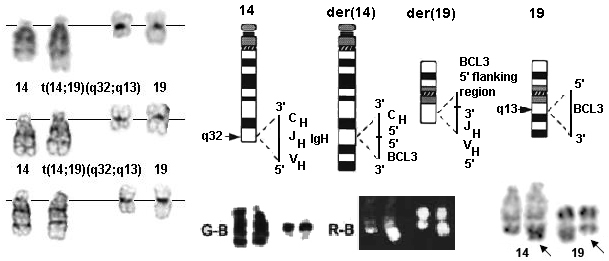
t(14;19)(q32;q13) G-banding Left: - Courtesy Jean-Luc Lai (top) and Diane H Norback, Eric B Johnson, and Sara Morrison-Delap, http://www.slh.wisc.edu/cytogenetics (middle and bottom); right: top: ideograms, bottom middle two: G and R-bandings - Courtesy Peter Meus; R-banding (right) : Coutesy Chrystèle Bilhou-Nabera and Nasséra Abermil.
Citation
Jean-Loup Huret
t(2;19)(p12;q13.3) IGK/BCL3
t(14;19)(q32;q13.3) IGH/BCL3
t(19;22)(q13.3;q11) BCL3/IGL
Atlas Genet Cytogenet Oncol Haematol. 2008-06-01
Online version: http://atlasgeneticsoncology.org/haematological/2050/t(14
Historical Card
2001-08-01 t(2;19)(p12;q13.3) IGK/BCL3
t(14;19)(q32;q13.3) IGH/BCL3
t(19;22)(q13.3;q11) BCL3/IGL by Lucienne Michaux,Peter Meeus
Affiliation
Centrum voor Menselijke Erfelijkheid, UZ Gasthuisberg, Herestraat 49, 3000 Leuven, Belgie
