STAT5B (signal transducer and activator of transcription 5B)
2011-08-01 Amanda M Del Rosario , Teresa M Bernaciak , Corinne M Silva AffiliationIdentity
HGNC
LOCATION
17q21.2
LOCUSID
ALIAS
GHISID2,STAT5
FUSION GENES
DNA/RNA
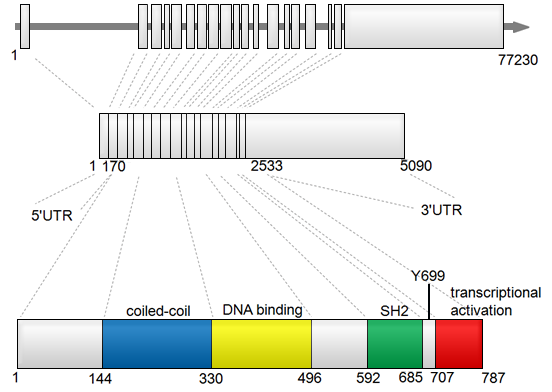
The STAT5b gene. The STAT5b gene is composed of 19 exons that are transcribed as a 5090 nucleotide RNA transcript. The RNA is translated into the STAT5b protein containing 787 amino acids.
Description
The STAT5b gene is composed of 77229 base pairs and contains 19 exons. As exon 1 contains only the 5 UTR, there are 18 coding exons. The mRNA is composed of 5090 base pairs.
Transcription
There is one major transcript.
Proteins
Note
STAT5b is composed of 787 amino acids (92 kD).
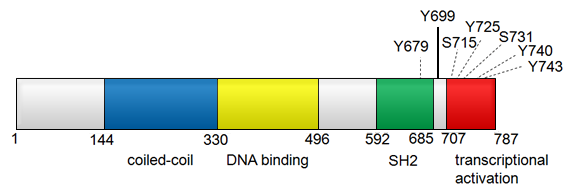
Schematic of the STAT5b protein. The STAT5b protein contains several conserved domains: the coiled-coil domain, the DNA binding domain, the SH2 domain, and the carboxy-terminal transactivation domain. While phosphorylation of Y699 is required for transcriptional activity, there are multiple tyrosine and serine phosphorylation sites that have been identified under specific conditions and in certain cell types.
Description
STAT5b is a member of the signal transducer and activator of transcription (STAT) family. The STAT proteins contain several conserved domains: the coiled-coil domain, the DNA binding domain, the SH2 domain, and the carboxy-terminal transactivation domain. STATs remain latent in the cytoplasm until the binding of a cytokine or growth factor to its receptor, resulting in recruitment of the STAT to the ligand receptor complex (Levy and Darnell, 2002; Herrington et al., 1999; Heim et al., 1995). The STAT protein is then phosphorylated by receptor tyrosine kinases or non-receptor tyrosine kinases, such as Janus kinases (JAKs) and Src family members. This phosphorylation results in SH2 domain mediated dimerization of STATs and their translocation to the nucleus. In the nucleus, STAT dimers bind to consensus DNA sequences and recruit additional transcription machinery to initiate specific gene regulation. To date, seven members of the STAT family have been identified (STAT1, STAT2, STAT3, STAT4, STAT5a, STAT5b, and STAT6) (Silva, 2004; Calò et al., 2003; Moriggl et al., 1996; Liu et al., 1996; Liu et al., 1997).
STAT5b is activated by a variety of stimuli, including interleukins, erythropoietin, growth hormone (GH), prolactin (Prl), and epidermal growth factor (EGF). Activation of STAT5b results in phosphorylation of tyrosine 699. Phosphorylation of this tyrosine is required for DNA binding and transcriptional activity. Mutation of Y699 of STAT5b inhibits stimulant-induced tyrosine phosphorylation, DNA binding, and transcriptional activity (Gebert et al., 1997; Gouilleux et al., 1994; Kloth et al., 2003). Additional tyrosine phosphorylation sites (Y679, Y725, Y740, and Y743) and serine phosphorylation sites (S715, S731) have been shown to alter STAT5b transcriptional activity (Kloth et al., 2002; Weaver and Silva, 2006; Yamashita et al., 2001; Park et al., 2001; Decker and Kovarik, 2000).
While no classic nuclear localization signal (NLS) composed of a cluster of basic amino acids has been reported for the STAT5b, the STAT5b dimer is actively translocated through the nuclear pore complex and accumulates in the nucleus upon phosphorylation (Xu and Massagué, 2004).
STAT5b can be negatively regulated by phosphatase-mediated dephosphorylation, ubiquitination-promoting proteosome degradation, or by negative feedback loops.
STAT5b is activated by a variety of stimuli, including interleukins, erythropoietin, growth hormone (GH), prolactin (Prl), and epidermal growth factor (EGF). Activation of STAT5b results in phosphorylation of tyrosine 699. Phosphorylation of this tyrosine is required for DNA binding and transcriptional activity. Mutation of Y699 of STAT5b inhibits stimulant-induced tyrosine phosphorylation, DNA binding, and transcriptional activity (Gebert et al., 1997; Gouilleux et al., 1994; Kloth et al., 2003). Additional tyrosine phosphorylation sites (Y679, Y725, Y740, and Y743) and serine phosphorylation sites (S715, S731) have been shown to alter STAT5b transcriptional activity (Kloth et al., 2002; Weaver and Silva, 2006; Yamashita et al., 2001; Park et al., 2001; Decker and Kovarik, 2000).
While no classic nuclear localization signal (NLS) composed of a cluster of basic amino acids has been reported for the STAT5b, the STAT5b dimer is actively translocated through the nuclear pore complex and accumulates in the nucleus upon phosphorylation (Xu and Massagué, 2004).
STAT5b can be negatively regulated by phosphatase-mediated dephosphorylation, ubiquitination-promoting proteosome degradation, or by negative feedback loops.
Expression
Ubiquitous.
Localisation
STAT5b is localized in the cytoplasm and translocates to the nucleus upon phosphorylation of Y699. However, unphosphorylated STAT5b has also been reported to be found in the nucleus (Brown and Zeidler, 2008; Iyer and Reich, 2008; Zeng et al., 2002).
Function
Transcription factor. STAT5b mediates the transcription of numerous genes in various cell signaling pathways involved in cellular proliferation, differentiation, and cell survival. The STATs bind TTC(N3)GAA gamma-interferon-activating sequence (GAS) sites in the promoters of target genes.
Homology
Shares homology with the other STAT family members (STAT1, 2, 3, 4, 5a, and 6). Additionally, STAT5a and STAT5b are 94% similar at the amino acid level, differing primarily at the C-terminus (Teglund et al., 1998; Silva et al., 1996; Lin et al., 1996; Liu et al., 1995).
Mutations
Note
To date, there are 6 reported cases of humans having a mutant STAT5b, and these cases result from five different STAT5b mutations. The first STAT5b mutation in a human to be reported was the A630P STAT5b mutant. This single point mutation in the SH2 domain causes missfolding of STAT5b. A nonsense mutation in the coiled-coil domain (R152X) results in the absence of detectable STAT5b protein. Insertion of a nucleotide in the DBD at position 1102 (Q368fsX376) or 1191 (N398E) causes a frameshift mutation resulting in a non-functional truncated STAT5b. Likewise, a single nucleotide deletion in the linker domain at position 1680 (E561R) also results in a truncated STAT5b. In each of the 6 cases, STAT5b protein is not detectable, but STAT5a protein levels are unchanged. These reports are from homozygous patients while the parents are heterozygous for the STAT5b mutation and display a normal phenotype. The phenotype of each STAT5b mutant is similar: pronounced short stature, growth hormone insensitivity despite normal to high levels of GH in the serum, and extremely low IGF-I and IGFBP-3 levels (Chia et al., 2006; Hwa et al., 2007; Nadeau et al., 2011).
Implicated in
Entity name
Solid tumors
Note
STAT5b is implicated in prostate cancer (Koptyra et al., 2011; Clevenger, 2004), breast cancer (Bernaciak et al., 2009; Peck et al., 2011; Strauss et al., 2006; Sultan et al., 2005; Yamashita et al., 2003), lung cancer (Sánchez-Ceja et al., 2006), head and neck cancer (Koppikar et al., 2008), ovarian cancer (Chen et al., 2004), hepatocellular carcinoma (Lee et al., 2006), cervical cancer (Lopez et al., 2011), and colorectal cancer (Du et al., 2011).
Entity name
Leukemias and lymphomas
Note
STAT5b is involved in the proliferation of chronic myeloid leukemia (CML) and acute myeloid leukemia (AML) cells (Baśkiewicz-Masiuk and Machalińkski, 2004; Sternberg and Gilliland, 2004; Hoover et al., 2001; de Groot et al., 1999). Additionally, STAT5b has been found to fuse with the retinoic acid receptor-alpha (RARalpha) gene in a subset of acute promyelocytic leukemias (APLL) (Arnould et al., 1999). Furthermore, STAT5b plays a role in the development of lymphoblastic lymphoma (Bessette et al., 2008; Nieborowska-Skorska et al., 2001).
Entity name
Laron type dwarfism II
Note
Laron type dwarfism II (LTD2) is mediated by defects in STAT5b (Nadeau et al., 2011; Freeth et al., 1998; Chia et al., 2006).
Entity name
Graft-versus-host disease
Note
Constitutively active STAT5b increases expansion of regulatory T cells (Treg), and these Tregs are more potent suppressors of graft-versus-host disease in vivo, compared to wild-type Tregs (Vogtenhuber et al., 2010).
Entity name
Crohns disease/colitis
Note
Growth hormone reduces mucosal inflammation in colitis by activating STAT5b, such that STAT5b deficient mice demonstrated more severe colitis compared to wild-type mice (Han et al., 2006).
Entity name
Diabetes and metabolic disorder
Note
Upon leptin stimulation, the leptin receptor can mediate STAT5b tyrosine phosphorylation and transcriptional activity in the liver, gastrointestinal tract, and brain (Mütze et al., 2007; Ghilardi et al., 1996; Gong et al., 2007).
Article Bibliography
| Pubmed ID | Last Year | Title | Authors |
|---|---|---|---|
| 10441338 | 1999 | The signal transducer and activator of transcription STAT5b gene is a new partner of retinoic acid receptor alpha in acute promyelocytic-like leukaemia. | Arnould C et al |
| 15128421 | 2004 | The role of the STAT5 proteins in the proliferation and apoptosis of the CML and AML cells. | Baśkiewicz-Masiuk M et al |
| 19630967 | 2009 | A novel role for signal transducer and activator of transcription 5b (STAT5b) in beta1-integrin-mediated human breast cancer cell migration. | Bernaciak TM et al |
| 17890450 | 2008 | A Stat5b transgene is capable of inducing CD8+ lymphoblastic lymphoma in the absence of normal TCR/MHC signaling. | Bessette K et al |
| 18840523 | 2008 | Unphosphorylated STATs go nuclear. | Brown S et al |
| 14502555 | 2003 | STAT proteins: from normal control of cellular events to tumorigenesis. | Calò V et al |
| 15350351 | 2004 | VEGF, VEGFRs expressions and activated STATs in ovarian epithelial carcinoma. | Chen H et al |
| 16303763 | 2006 | Aberrant folding of a mutant Stat5b causes growth hormone insensitivity and proteasomal dysfunction. | Chia DJ et al |
| 15509516 | 2004 | Roles and regulation of stat family transcription factors in human breast cancer. | Clevenger CV et al |
| 10851062 | 2000 | Serine phosphorylation of STATs. | Decker T et al |
| 21826656 | 2012 | STAT5 isoforms regulate colorectal cancer cell apoptosis via reduction of mitochondrial membrane potential and generation of reactive oxygen species. | Du W et al |
| 9421393 | 1998 | Activation of the signal transducers and activators of transcription signaling pathway by growth hormone (GH) in skin fibroblasts from normal and GH binding protein-positive Laron Syndrome children. | Freeth JS et al |
| 9092792 | 1997 | Regulation of signal transducer and activator of transcription (STAT) 5b activation by the temporal pattern of growth hormone stimulation. | Gebert CA et al |
| 8692797 | 1996 | Defective STAT signaling by the leptin receptor in diabetic mice. | Ghilardi N et al |
| 17726024 | 2007 | The long form of the leptin receptor regulates STAT5 and ribosomal protein S6 via alternate mechanisms. | Gong Y et al |
| 7925280 | 1994 | Prolactin induces phosphorylation of Tyr694 of Stat5 (MGF), a prerequisite for DNA binding and induction of transcription. | Gouilleux F et al |
| 17148664 | 2006 | Signal transducer and activator of transcription 5b promotes mucosal tolerance in pediatric Crohn's disease and murine colitis. | Han X et al |
| 7871432 | 1995 | Contribution of STAT SH2 groups to specific interferon signaling by the Jak-STAT pathway. | Heim MH et al |
| 9988763 | 1999 | A functional DNA binding domain is required for growth hormone-induced nuclear accumulation of Stat5B. | Herrington J et al |
| 11593388 | 2001 | Cooperative and redundant effects of STAT5 and Ras signaling in BCR/ABL transformed hematopoietic cells. | Hoover RR et al |
| 17389811 | 2007 | Growth hormone insensitivity and severe short stature in siblings: a novel mutation at the exon 13-intron 13 junction of the STAT5b gene. | Hwa V et al |
| 17846080 | 2008 | Constitutive nuclear import of latent and activated STAT5a by its coiled coil domain. | Iyer J et al |
| 11751923 | 2002 | Novel activation of STAT5b in response to epidermal growth factor. | Kloth MT et al |
| 12429742 | 2003 | STAT5b, a Mediator of Synergism between c-Src and the Epidermal Growth Factor Receptor. | Kloth MT et al |
| 19047094 | 2008 | Constitutive activation of signal transducer and activator of transcription 5 contributes to tumor growth, epithelial-mesenchymal transition, and resistance to epidermal growth factor receptor targeting. | Koppikar P et al |
| 21704724 | 2011 | Signal transducer and activator of transcription 5a/b: biomarker and therapeutic target in prostate and breast cancer. | Koptyra M et al |
| 17047057 | 2006 | Signal transducers and activators of transcription 5b activation enhances hepatocellular carcinoma aggressiveness through induction of epithelial-mesenchymal transition. | Lee TK et al |
| 12209125 | 2002 | Stats: transcriptional control and biological impact. | Levy DE et al |
| 8631883 | 1996 | Cloning of human Stat5B. Reconstitution of interleukin-2-induced Stat5A and Stat5B DNA binding activity in COS-7 cells. | Lin JX et al |
| 9009201 | 1997 | Stat5a is mandatory for adult mammary gland development and lactogenesis. | Liu X et al |
| 21442620 | 2011 | Autocrine/paracrine erythropoietin signalling promotes JAK/STAT-dependent proliferation of human cervical cancer cells. | Lopez TV et al |
| 8816482 | 1996 | Deletion of the carboxyl-terminal transactivation domain of MGF-Stat5 results in sustained DNA binding and a dominant negative phenotype. | Moriggl R et al |
| 17353091 | 2007 | Nuclear translocation of the transcription factor STAT5 in the rat brain after systemic leptin administration. | Mütze J et al |
| 21414633 | 2011 | STAT5b deficiency: an unsuspected cause of growth failure, immunodeficiency, and severe pulmonary disease. | Nadeau K et al |
| 11522649 | 2001 | Role of signal transducer and activator of transcription 5 in nucleophosmin/ anaplastic lymphoma kinase-mediated malignant transformation of lymphoid cells. | Nieborowska-Skorska M et al |
| 11731617 | 2001 | Serine phosphorylation of GH-activated signal transducer and activator of transcription 5a (STAT5a) and STAT5b: impact on STAT5 transcriptional activity. | Park SH et al |
| 21576635 | 2011 | Loss of nuclear localized and tyrosine phosphorylated Stat5 in breast cancer predicts poor clinical outcome and increased risk of antiestrogen therapy failure. | Peck AR et al |
| 16959370 | 2006 | Differential expression of STAT5 and Bcl-xL, and high expression of Neu and STAT3 in non-small-cell lung carcinoma. | Sánchez-Ceja SG et al |
| 8732682 | 1996 | Characterization and cloning of STAT5 from IM-9 cells and its activation by growth hormone. | Silva CM et al |
| 15489919 | 2004 | Role of STATs as downstream signal transducers in Src family kinase-mediated tumorigenesis. | Silva CM et al |
| 14722044 | 2004 | The role of signal transducer and activator of transcription factors in leukemogenesis. | Sternberg DW et al |
| 16647957 | 2006 | STAT 5a expression in the breast is maintained in secretory carcinoma, in contrast to other histologic types. | Strauss BL et al |
| 15592524 | 2005 | Stat5 promotes homotypic adhesion and inhibits invasive characteristics of human breast cancer cells. | Sultan AS et al |
| 9630227 | 1998 | Stat5a and Stat5b proteins have essential and nonessential, or redundant, roles in cytokine responses. | Teglund S et al |
| 20442366 | 2010 | Constitutively active Stat5b in CD4+ T cells inhibits graft-versus-host disease lethality associated with increased regulatory T-cell potency and decreased T effector cell responses. | Vogtenhuber C et al |
| 16772534 | 2006 | Modulation of signal transducer and activator of transcription 5b activity in breast cancer cells by mutation of tyrosines within the transactivation domain. | Weaver AM et al |
| 14991001 | 2004 | Nucleocytoplasmic shuttling of signal transducers. | Xu L et al |
| 12642867 | 2003 | Naturally occurring dominant-negative Stat5 suppresses transcriptional activity of estrogen receptors and induces apoptosis in T47D breast cancer cells. | Yamashita H et al |
| 11971004 | 2002 | Stat5B shuttles between cytoplasm and nucleus in a cytokine-dependent and -independent manner. | Zeng R et al |
| 10419904 | 1999 | STAT5 activation by BCR-Abl contributes to transformation of K562 leukemia cells. | de Groot RP et al |
Other Information
Locus ID:
NCBI: 6777
MIM: 604260
HGNC: 11367
Ensembl: ENSG00000173757
Variants:
dbSNP: 6777
ClinVar: 6777
TCGA: ENSG00000173757
COSMIC: STAT5B
RNA/Proteins
| Gene ID | Transcript ID | Uniprot |
|---|---|---|
| ENSG00000173757 | ENST00000293328 | P51692 |
| ENSG00000173757 | ENST00000415845 | C9J4I3 |
Expression (GTEx)
Pathways
Protein levels (Protein atlas)
PharmGKB
| Entity ID | Name | Type | Evidence | Association | PK | PD | PMIDs |
|---|---|---|---|---|---|---|---|
| PA134992438 | CAMK1D | Gene | Pathway | associated | |||
| PA24684 | AKT1 | Gene | Pathway | associated | |||
| PA24685 | AKT2 | Gene | Pathway | associated | |||
| PA24686 | AKT3 | Gene | Pathway | associated | |||
| PA248 | NFKB1 | Gene | Pathway | associated | |||
| PA26048 | CAMK1 | Gene | Pathway | associated | |||
| PA26049 | CAMK1G | Gene | Pathway | associated | |||
| PA27749 | ELK1 | Gene | Pathway | associated | |||
| PA28212 | FOS | Gene | Pathway | associated | |||
| PA283 | MAPK8 | Gene | Pathway | associated | |||
| PA296 | RELA | Gene | Pathway | associated | |||
| PA29988 | JAK1 | Gene | Pathway | associated | |||
| PA30006 | JUN | Gene | Pathway | associated | |||
| PA30616 | MAPK1 | Gene | Pathway | associated | |||
| PA30622 | MAPK3 | Gene | Pathway | associated | |||
| PA31353 | MYC | Gene | Pathway | associated | |||
| PA31600 | NFKB2 | Gene | Pathway | associated | |||
| PA337 | STAT3 | Gene | Pathway | associated | |||
| PA33759 | PRKCA | Gene | Pathway | associated | |||
| PA33761 | PRKCB | Gene | Pathway | associated | |||
| PA33766 | PRKCG | Gene | Pathway | associated | |||
| PA338 | STAT5A | Gene | Pathway | associated | |||
| PA36042 | SP1 | Gene | Pathway | associated | |||
| PA36183 | STAT1 | Gene | Pathway | associated | |||
| PA36184 | STAT2 | Gene | Pathway | associated | |||
| PA36185 | STAT4 | Gene | Pathway | associated | |||
| PA90 | CAMK2A | Gene | Pathway | associated | |||
| PA91 | CAMK2B | Gene | Pathway | associated | |||
| PA92 | CAMK2D | Gene | Pathway | associated | |||
| PA93 | CAMK2G | Gene | Pathway | associated |
References
| Pubmed ID | Year | Title | Citations |
|---|---|---|---|
| 38618957 | 2024 | Hyperactive STAT5 hijacks T cell receptor signaling and drives immature T cell acute lymphoblastic leukemia. | 0 |
| 38618957 | 2024 | Hyperactive STAT5 hijacks T cell receptor signaling and drives immature T cell acute lymphoblastic leukemia. | 0 |
| 36862902 | 2023 | Identification of STAT5B as a biomarker associated with prognosis and immune infiltration in breast cancer. | 0 |
| 37564209 | 2023 | PAK1 overexpression promotes myxofibrosarcoma angiogenesis through STAT5B-mediated CSF2 transactivation: clinical and therapeutic relevance of amplification and nuclear entry. | 1 |
| 36862902 | 2023 | Identification of STAT5B as a biomarker associated with prognosis and immune infiltration in breast cancer. | 0 |
| 37564209 | 2023 | PAK1 overexpression promotes myxofibrosarcoma angiogenesis through STAT5B-mediated CSF2 transactivation: clinical and therapeutic relevance of amplification and nuclear entry. | 1 |
| 34716993 | 2022 | miR-146a enhances regulatory T-cell differentiation and function in allergic rhinitis by targeting STAT5b. | 8 |
| 35210405 | 2022 | Identification of novel STAT5B mutations and characterization of TCRβ signatures in CD4+ T-cell large granular lymphocyte leukemia. | 11 |
| 35469842 | 2022 | STAT5B restrains human B-cell differentiation to maintain humoral immune homeostasis. | 13 |
| 36755813 | 2022 | STAT5b: A master regulator of key biological pathways. | 8 |
| 34716993 | 2022 | miR-146a enhances regulatory T-cell differentiation and function in allergic rhinitis by targeting STAT5b. | 8 |
| 35210405 | 2022 | Identification of novel STAT5B mutations and characterization of TCRβ signatures in CD4+ T-cell large granular lymphocyte leukemia. | 11 |
| 35469842 | 2022 | STAT5B restrains human B-cell differentiation to maintain humoral immune homeostasis. | 13 |
| 36755813 | 2022 | STAT5b: A master regulator of key biological pathways. | 8 |
| 33090292 | 2021 | Developmental Adaptive Immune Defects Associated with STAT5B Deficiency in Three Young Siblings. | 3 |
Citation
Amanda M Del Rosario ; Teresa M Bernaciak ; Corinne M Silva
STAT5B (signal transducer and activator of transcription 5B)
Atlas Genet Cytogenet Oncol Haematol. 2011-08-01
Online version: http://atlasgeneticsoncology.org/gene/217
