MIR145 (microRNA 145)
2012-02-01 Mohit Sachdeva , Yin Yuan Mo AffiliationDepartment of Radiation Oncology, Duke University Medical center, Durham, North Carolina-27710, USA (MS); Department of Medical Microbiology, Immunology, Cell Biology, Southern Illinois University School of Medicine, Springfield, IL 62794, USA (YYM)
DNA/RNA
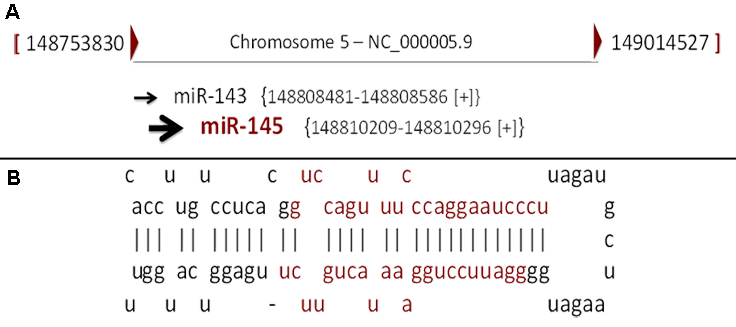
Figure 1: A) Genomic localization of miR-145 gene on chromosome 5q32. B) Stem-loop structure of miR-145 (Red: mature miR-145 sequence).
Description
miR-145 is located on chromosome 5 (5q32-33) within a 4.09 kb region (miRBase). The pri-microRNA structure of miR-145 has not been identified, yet it is suggested that it co-transcribed with miR-143. This gene has been implicated as both tumor and metastasis suppressor in multiple tumor types (Sachdeva and Mo, 2010a).
Transcription
miR-145 is transcribed by RNA pol-II into pri-miRNA sequence, which is first processed to pre-miRNA (~88 bp long) involving RNA cutting and exporting, and finally to mature miR-145. miR-145 is a p53-regulated gene. Several reports suggest that miR-145 can be induced transcriptionally by p53 in response to stress such as serum starvation or anticancer drugs (Sachdeva et al., 2009; Spizzo et al., 2010). Interestingly, another report showed a novel mechanism of posttranscriptional regulation of miR-145 that occurs via p53-mediated RNA processing (Suzuki et al., 2009). Recently, a study demonstrates that activated Ras can suppress miR-143/145 cluster through Ras-responsive element-binding protein (RREB1), which represses the miR-143/145 promoter (Kent et al., 2010).
Pseudogene
There is no pseudogene reported for this gene.
Proteins
Note
Non-coding RNA.
Implicated in
Entity name
Cancer
Note
Downregulation of miR-145 has been found in cancers of many tissue types including colon, breast, prostate, pancreas, etc. (Sachdeva et al., 2009; Bandres et al., 2006; Michael et al., 2003). For example, in situ hybridization detected accumulation of miR-145 in normal colon epithelia with no signal from adenocarcinomas cells. Loss of miR-145 in various tumors suggests its role as a tumor suppressor. In fact, miR-145 has been well documented as a tumor suppressor gene in multiple tumor types because of its anti-proliferative and pro-apoptotic effects. It is shown that miR-145 can negatively regulate multiple oncogenes such as MYC, Kras, IRS-1, ERK5, etc. involved in cell proliferation and survival (Sachdeva et al., 2009; Kent et al., 2010; Shi et al., 2007; Ibrahim et al., 2011).
Entity name
Metastasis
Note
Several reports suggest that miR-145 is a suppressor of metastasis. For example, mir-145 negatively regulates MUC1 and suppresses invasion and metastasis of the breast cancer cells (Sachdeva and Mo, 2010b). Similar findings in prostate cancer and in gliomas have further confirmed the role of miR-145 as a metastasis suppressor by targeting genes including FASCN1 and SOX2, respectively (Fang et al., 2011; Watahiki et al., 2011; Leite et al., 2011).
Entity name
Stem cells and differentiation
Note
A study has shown that miR-145 is induced during differentiation, and it directly silences the stem cell self renewal and pluripotency program by suppressing multiple pluripotent genes such as OCT4, SOX2 and KLF4 (Xu et al., 2009).
Entity name
Vascular smooth muscle cells
Note
The role of miR-145 in differentiation of vascular smooth muscle cell (VSMC) has been recently investigated. A report demonstrated that miR-145 is the most enriched microRNA in arteries and its expression is significantly downregulated in vascular walls with neointimal lesions (Chen et al., 2004). Similarly, another group, using transgenic mouse model with miR-145 promoter fused to β-galactosidase gene, found that miR-145 is cardiac-specific and smooth-muscle specific microRNA regulated by serum response factor, myocardin and Nkx2-5 (NK2 transcription factor related, locus 5) (Cordes et al., 2009). Further evidence from the miR-43/miR-145 KO rats suggests that this microRNA cluster is expressed mostly in the SMC compartment in vessels and SMC-containing organs and their loss induces an incomplete differentiation of VSMCs (Elia et al., 2009).
Entity name
Note
A comprehensive study using clinical samples combined with mouse models have found that deletion of chromosome 5q correlates with loss of two miRNAs that are abundant in hematopoietic stem/progenitor cells (HSPCs), miR-145 and miR-146a. In addition, they observed that miR-145 is highly expressed in primitive lin- (mouse) and CD34+ (human) bone marrow cells than committed cells and stable knockdown of miR-145 in these cells in mouse marrow results in 5-q syndrome (Starczynowski et al., 2010). Similar work from another group in patients with del (5q) have decreased expression of miR-145 and increased expression of Fli-1 (Kumar et al., 2011). They found that miR-145 functions through repression of Fli-1, a megakaryocyte and erythroid regulatory transcription factor and thus, cells lacking miR-145 have impaired megakaryocyte and erythroid differentiation.
Article Bibliography
| Pubmed ID | Last Year | Title | Authors |
|---|---|---|---|
| 16854228 | 2006 | Identification by Real-time PCR of 13 mature microRNAs differentially expressed in colorectal cancer and non-tumoral tissues. | Bandrés E et al |
| 14657504 | 2004 | MicroRNAs modulate hematopoietic lineage differentiation. | Chen CZ et al |
| 19578358 | 2009 | miR-145 and miR-143 regulate smooth muscle cell fate and plasticity. | Cordes KR et al |
| 16778182 | 2006 | Sequence variations of microRNAs in human cancer: alterations in predicted secondary structure do not affect processing. | Diederichs S et al |
| 19816508 | 2009 | The knockout of miR-143 and -145 alters smooth muscle cell maintenance and vascular homeostasis in mice: correlates with human disease. | Elia L et al |
| 21211035 | 2011 | The SOX2 response program in glioblastoma multiforme: an integrated ChIP-seq, expression microarray, and microRNA analysis. | Fang X et al |
| 21690566 | 2011 | MicroRNA replacement therapy for miR-145 and miR-33a is efficacious in a model of colon carcinoma. | Ibrahim AF et al |
| 21159816 | 2010 | Repression of the miR-143/145 cluster by oncogenic Ras initiates a tumor-promoting feed-forward pathway. | Kent OA et al |
| 21873545 | 2011 | Coordinate loss of a microRNA and protein-coding gene cooperate in the pathogenesis of 5q- syndrome. | Kumar MS et al |
| 21880514 | 2013 | MicroRNA expression profiles in the progression of prostate cancer--from high-grade prostate intraepithelial neoplasia to metastasis. | Leite KR et al |
| 14573789 | 2003 | Reduced accumulation of specific microRNAs in colorectal neoplasia. | Michael MZ et al |
| 19996288 | 2010 | MicroRNA-145 suppresses cell invasion and metastasis by directly targeting mucin 1. | Sachdeva M et al |
| 17827156 | 2007 | Micro RNA 145 targets the insulin receptor substrate-1 and inhibits the growth of colon cancer cells. | Shi B et al |
| 19730444 | 2010 | miR-145 participates with TP53 in a death-promoting regulatory loop and targets estrogen receptor-alpha in human breast cancer cells. | Spizzo R et al |
| 19898489 | 2010 | Identification of miR-145 and miR-146a as mediators of the 5q- syndrome phenotype. | Starczynowski DT et al |
| 19626115 | 2009 | Modulation of microRNA processing by p53. | Suzuki HI et al |
| 21980368 | 2011 | MicroRNAs associated with metastatic prostate cancer. | Watahiki A et al |
| 19409607 | 2009 | MicroRNA-145 regulates OCT4, SOX2, and KLF4 and represses pluripotency in human embryonic stem cells. | Xu N et al |
Other Information
Locus ID:
NCBI: 406937
MIM: 611795
HGNC: 31532
Ensembl: ENSG00000276365
miRBase:
Variants:
dbSNP: 406937
ClinVar: 406937
TCGA: ENSG00000276365
COSMIC: MIR145
RNA/Proteins
Expression (GTEx)
Pathways
| Pathway | Source | External ID |
|---|---|---|
| MicroRNAs in cancer | KEGG | hsa05206 |
| MicroRNAs in cancer | KEGG | ko05206 |
References
| Pubmed ID | Year | Title | Citations |
|---|---|---|---|
| 37264620 | 2024 | Over-expression of microRNA-145 Elevating Autophagy Activities via Downregulating FRS2 Expression. | 0 |
| 38211336 | 2024 | High microRNA-145 plasma levels are associated with decreased risk of future incident venous thromboembolism: the HUNT study. | 0 |
| 38287826 | 2024 | MiR-145 Alleviates Sepsis-Induced Inflammatory Responses and Organ Injury by Targeting ADAM17. | 0 |
| 38353742 | 2024 | Long noncoding RNA XIST inhibition promotes Leydig cell apoptosis by acting as a competing endogenous RNA for microRNA-145a-5p that targets SIRT1 in late-onset hypogonadism. | 0 |
| 38396844 | 2024 | Differential Expression of MicroRNA MiR-145 and MiR-155 Downstream Targets in Oral Cancers Exhibiting Limited Chemotherapy Resistance. | 1 |
| 38400818 | 2024 | CircCPA4 induces ASCT2 expression to promote tumor property of non-small cell lung cancer cells in a miR-145-5p-dependent manner. | 1 |
| 38834101 | 2024 | Circ_0008571 modulates the phenotype of vascular smooth muscle cells by targeting miR-145-5p in intracranial aneurysms. | 0 |
| 38965401 | 2024 | Loss of miR-145 promotes remyelination and functional recovery in a model of chronic central demyelination. | 0 |
| 37264620 | 2024 | Over-expression of microRNA-145 Elevating Autophagy Activities via Downregulating FRS2 Expression. | 0 |
| 38211336 | 2024 | High microRNA-145 plasma levels are associated with decreased risk of future incident venous thromboembolism: the HUNT study. | 0 |
| 38287826 | 2024 | MiR-145 Alleviates Sepsis-Induced Inflammatory Responses and Organ Injury by Targeting ADAM17. | 0 |
| 38353742 | 2024 | Long noncoding RNA XIST inhibition promotes Leydig cell apoptosis by acting as a competing endogenous RNA for microRNA-145a-5p that targets SIRT1 in late-onset hypogonadism. | 0 |
| 38396844 | 2024 | Differential Expression of MicroRNA MiR-145 and MiR-155 Downstream Targets in Oral Cancers Exhibiting Limited Chemotherapy Resistance. | 1 |
| 38400818 | 2024 | CircCPA4 induces ASCT2 expression to promote tumor property of non-small cell lung cancer cells in a miR-145-5p-dependent manner. | 1 |
| 38834101 | 2024 | Circ_0008571 modulates the phenotype of vascular smooth muscle cells by targeting miR-145-5p in intracranial aneurysms. | 0 |
Citation
Mohit Sachdeva ; Yin Yuan Mo
MIR145 (microRNA 145)
Atlas Genet Cytogenet Oncol Haematol. 2012-02-01
Online version: http://atlasgeneticsoncology.org/gene/50927/mir145-(microrna-145)
