MIR429 (microRNA 429)
2015-08-01 Yaguang Xi , Hong Chang AffiliationMitchell Cancer Institute, University of South Alabama, USA. [email protected]; [email protected]
Abstract
Review on MIR429, with data on RNA, and where it is implicated.
DNA/RNA
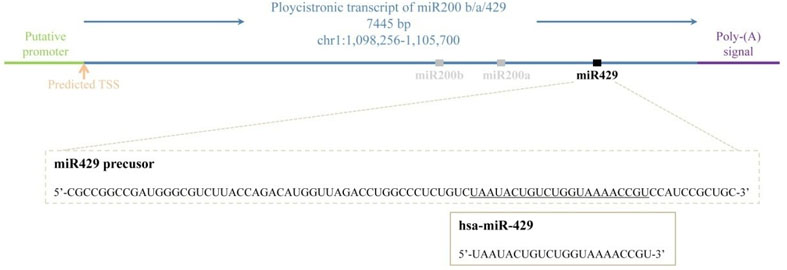
Description
microRNA 429 located in chromosome 1 and microRNA 429 was transcribed with microRNA 200b and microRNA 200a as a ploycistronic transcript. The putative transcription start site locates about 6129 bp upstream of the precursor of microRNA 429.
Transcription
MiR-429 precursor: 5-CGCCGGCCGAUGGGCGUCUUACCAGACAUGGUUAGACCUGGCCCUCUGUCUAAUACUGUCUGGUAAAACCGUCCAUCCGCUGC-3
Mature miR-429: 5-UAAUACUGUCUGGUAAAACCGU-3
Mature miR-429: 5-UAAUACUGUCUGGUAAAACCGU-3
Pseudogene
No pseudogene was found.
Proteins
Note
microRNAs are not translated into proteins.
Implicated in
Entity name
Tumor cell proliferation
Note
Abnormal expression of miR-200a was reported in various tumors, including human breast cancer, gastric carcinoma, endometrial adenocarcinoma, gliomas, and colorectal carcinoma. MiR-429 could inhibit cell growth and induce apoptosis by directly targeting ONECUT2 in colorectal carcinoma and targeting BCL2 in esophageal carcinoma (Sun, Shen et al. 2014). Also, MiR-429 could induce apoptosis and suppress invasion by targeting BCL2 and SP1 in esophageal carcinoma (Wang, Li et al. 2013). However, miR-429 was also showed its anti-apoptosis function in colorectal cancer by targeting SOX2 (Li, Du et al. 2013).
Entity name
Tumor cells invasion and cancer metastasis
Note
Members of miR-200 family showed vital roles in tumor cells invasion and cancer metastasis. As to miR-429, studies demonstrated it could repress tumor cell invasion and cancer metastasis by targeting ONECUT2 and SP1 in different tumors (Sun, Shen et al. 2014; Wang, Li et al. 2013).
Entity name
Repression of epithelial-mesenchymal transition (EMT)
Note
EMT is an important feature of tumor cells. Tumor cells underwent EMT showed more invasion and metastatic properties. Studies demonstrated members of miR-200 family could directly target ZEB1 and ZEB2 and could be regulated as a feedback loop during EMT. Ectopic over-expression of miR-429 induces mesenchymal-to-epithelial transition (MET) in metastasizing ovarian cancer cells (Chen, Wang et al. 2011). In colorectal carcinoma cells, miR-429 could regulate EMT-related markers such as ZEB2, Vimentin, SNAI2 (SLUG) and SNAI1 (SNAIL) by targeting ONECUT2 (Sun, Shen et al. 2014).
Entity name
Chemoresistance
Note
Cancer stem cells showed highly resistance to chemotherapy which make relapse of tumor. It was found that over-expression of miR-429 could increase drug sensitivity in metastasizing ovarian (Wang, Mezencev et al. 2014). However, it was reported that miR-429 was highly expressed in hepatocellular carcinoma tissues and enrichment of miR-429 in liver tumour-initiating cells with EPCAM expression would contributed to hepatocyte self-renewal, malignant proliferation, chemoresistance and tumorigenicity (Li, Tang et al. 2014).
Article Bibliography
| Pubmed ID | Last Year | Title | Authors |
|---|---|---|---|
| 21277012 | 2011 | Overexpression of miR-429 induces mesenchymal-to-epithelial transition (MET) in metastatic ovarian cancer cells. | Chen J et al |
| 23111103 | 2013 | MiR-429 is an independent prognostic factor in colorectal cancer and exerts its anti-apoptotic function by targeting SOX2. | Li J et al |
| 24572141 | 2015 | Epigenetic modification of MiR-429 promotes liver tumour-initiating cell properties by targeting Rb binding protein 4. | Li L et al |
| 24402783 | 2014 | MiR-429 inhibits cells growth and invasion and regulates EMT-related marker genes by targeting Onecut2 in colorectal carcinoma. | Sun Y et al |
| 24802724 | 2014 | Ectopic over-expression of miR-429 induces mesenchymal-to-epithelial transition (MET) and increased drug sensitivity in metastasizing ovarian cancer cells. | Wang L et al |
| 23999873 | 2013 | MiR-429 up-regulation induces apoptosis and suppresses invasion by targeting Bcl-2 and SP-1 in esophageal carcinoma. | Wang Y et al |
Other Information
Locus ID:
NCBI: 554210
MIM: 612094
HGNC: 13784
Ensembl: ENSG00000198976
miRBase:
Variants:
dbSNP: 554210
ClinVar: 554210
TCGA: ENSG00000198976
COSMIC: MIR429
RNA/Proteins
Expression (GTEx)
References
| Pubmed ID | Year | Title | Citations |
|---|---|---|---|
| 38159618 | 2024 | FRS2 regulated by miR-429 and miR-206 promotes angiogenesis in osteosarcoma. | 0 |
| 38914806 | 2024 | Circular RNA circLIFR suppresses papillary thyroid cancer progression by modulating the miR-429/TIMP2 axis. | 0 |
| 38159618 | 2024 | FRS2 regulated by miR-429 and miR-206 promotes angiogenesis in osteosarcoma. | 0 |
| 38914806 | 2024 | Circular RNA circLIFR suppresses papillary thyroid cancer progression by modulating the miR-429/TIMP2 axis. | 0 |
| 36104590 | 2023 | CircLIFR Inhibits Non-small Cell Lung Cancer Progression by Acting as a miR-429 Sponge to Enhance CELF2 Expression. | 3 |
| 37128782 | 2023 | Long noncoding RNA ZEB1-AS1 attenuates ferroptosis of gastric cancer cells through modulating miR-429/BGN axis. | 2 |
| 37775648 | 2023 | miR-429 inhibits the formation of an immunosuppressive microenvironment to counteract hepatocellular carcinoma immune escape by targeting PD-L1. | 0 |
| 36104590 | 2023 | CircLIFR Inhibits Non-small Cell Lung Cancer Progression by Acting as a miR-429 Sponge to Enhance CELF2 Expression. | 3 |
| 37128782 | 2023 | Long noncoding RNA ZEB1-AS1 attenuates ferroptosis of gastric cancer cells through modulating miR-429/BGN axis. | 2 |
| 37775648 | 2023 | miR-429 inhibits the formation of an immunosuppressive microenvironment to counteract hepatocellular carcinoma immune escape by targeting PD-L1. | 0 |
| 35203290 | 2022 | Angiogenesis Driven by the CEBPD-hsa-miR-429-VEGFA Signaling Axis Promotes Urothelial Carcinoma Progression. | 7 |
| 35856354 | 2022 | Evaluation of miR-429 as a novel serum biomarker for pancreatic ductal adenocarcinoma and analysis its tumor suppressor function and target genes. | 3 |
| 35872179 | 2022 | miR-429 negatively regulates the progression of hypoxia-induced retinal neovascularization by the HPSE-VEGF pathway. | 1 |
| 36219319 | 2022 | The miR-429 suppresses proliferation and migration in glioblastoma cells and induces cell-cycle arrest and apoptosis via modulating several target genes of ERBB signaling pathway. | 3 |
| 35203290 | 2022 | Angiogenesis Driven by the CEBPD-hsa-miR-429-VEGFA Signaling Axis Promotes Urothelial Carcinoma Progression. | 7 |
Citation
Yaguang Xi ; Hong Chang
MIR429 (microRNA 429)
Atlas Genet Cytogenet Oncol Haematol. 2015-08-01
Online version: http://atlasgeneticsoncology.org/gene/51154/mir429-(microrna-429)
