Identity
Abstract
HLTF is a transcription factor - The Helicase-Like Transcription Factor (HLTF\/SMARCA3) belongs to the family of SWI\/SNF proteins that use the energy of ATP hydrolysis to remodel chromatin in a variety of cellular processes. Several groups independently isolated HLTF through its capacity to selectively interact with a DNA cis-element in the promoter or enhancer of different genes involved in cardiac development during embryogenesis, cell cycle, collagen biogenesis, cell motility and angiogenesis.
DNA/RNA
Description
Transcription
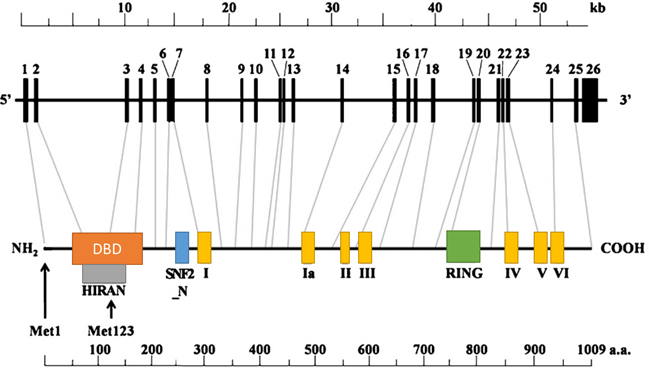
In the rabbit, the RUSH 1alpha and beta protein variants result from progesterone- or estrogen-dependent alternative splicing of the mRNA, respectively (Hayward-Lester et al., 1996).
In the mouse, a transcriptome analysis of the heart and brain revealed the expression of a full-lenght HLTF RNA isoform (exons 1-25) and a spliced isoform (exons 1-21 + intron 21) in a ratio 26 :1 (heart) and 5 :1 (brain) (Helmer et al., 2013 and 2013a).
Pseudogene
Proteins
Note
The alternative use of start codons Met1 and Met123 in the same reading frame generates HLTF proteins of 115kDa and 110kDa, respectively (Ding et al., 1996).
The rabbit orthologue of human HLTFMet123 is the RUSH-1alpha 113kDa protein; RUSH-1beta is a 95kDa truncated version that results from alternative splicing of a 57bp exon (Chilton et al., 2008).
In Hela cells two protein variants resulting from alternative splicing of exon 20 or intron 21 were observed: HLTF1ΔA (83kDa) and HLTF1ΔB (95kDa). These proteins have lost domains needed for DNA repair activity (Capouillez et al., 2009).
Description
Expression
During mouse embryogenesis, Zbu1 (mouse HLTF) transcripts are detected relatively late in foetal development and increase in neonatal stages, whereas the protein accumulates asynchronously in heart, skeletal muscle, and brain. In adult human tissues, alternatively spliced Zbu1 transcripts are ubiquitous with highest expression in the same tissues (Gong et al., 1997). Sandhu and colleagues built a Hltf -/- mouse by replacing Hltf with LacZ, in order to track Hltf expression during embryogenesis. They found that Hltf was specifically expressed in the heart at an early developmental stage (E8.5 to E9.5). Hltf exhibited a broader expression pattern at E10.5, with LacZ signals detected in somites, branchial arches, limb bud and brain. At later embryonic developmental stages, such as E16.5, Hltf showed wide and strong expression in many tissues, including heart, lung, liver, kidney, spleen and pancreas. This wide-spread expression of Hltf was also observed in adult mice. In both adult intestine and colon, Hltf expression was mainly detected in the crypts and in the intestinal epithelial cells (Sandhu et al., 2012).
Expression profile:
Find link to expression profile: HLTF (T1D database)
Transcription regulation:
In the uterus rabbit HLTF expression is repressed by estrogens and induced by progesterone (Hayward-Lester et al., 1996).
The rabbit HLTF (RUSH) promotor has no TATAA box and the transcription start site maps on an initiator/downstream element (Inr-DPE). Two Sp1/Sp3 binding sites in the proximal promoter repress basal transcription. These features are conserved in the human gene promoter. In addition the rabbit HLTF promoter is repressed by NF-Y and HLTF itself and activated by progesterone (Hewetson and Chilton, 2003). In response to progesterone the HLTF (RUSH 1alpha) protein binds to a distal site in the promoter of its own gene and is involved in DNA looping by interaction with Egr-1/c-Rel bound to one of the Sp1/Sp3 sites mentioned above. This interaction represses progesterone induction (Chilton and Hewetson, 2008).
Protein regulation:
Kim and colleagues showed that HLTF undergoes a negative regulation by CHFR, a E3 ubiquitin ligase. Both proteins interact in vitro and in vivo and as CHFR levels increase, HLTF levels decrease accordingly. Proteasome inhibitor (MG132) reverts this effect on HLTF stability, suggesting its degradation is mediated by ubiquitin-proteasome system. They also proved that HLTF half-life was shortened in presence of CHFR (Kim et al., 2010). Qing and colleagues showed that HLTF was positively regulated by USP7, a deubiquitination enzyme, which interacts with HLTF in vitro and in vivo and stabilizes it without any competition with CHFR (Qing et al., 2011).
Cancer:
Two lines of evidence have lead to the conclusion that HLTF was a tumor suppressor gene. A first set of publications showed aberrant hypermethylation of the HLTF promoter leading to its silencing in various cancer types. Then two publications demonstrated that the HLTF protein was involved in post replication DNA repair and that its inactivation leads to chromosome rearrangements.
The HLTF promotor is hypermethylated in 43% of primary colon cancer (Moinova et al., 2002) and is frequently methylated in adenomas and hepatocarcinomas. Kim et al. (2006) found that the HLTF inactivation by promoter hypermethylation was associated with the first stages of carcinogenesis. For a detailed analysis, see Dhont et al., 2015.
Localisation
In head and neck, and thyroid cancer progression a significant shift of HLTF expression from the cytoplasm toward the nuclear compartment was observed (Capouillez et al., 2008).
Function
HLTF was isolated independently (and given different names) by different groups based on its interaction with different genes (see table below).
| Name | Target gene | Reference |
| HIP116 (human) | HIV promoter; SV40 enhancers | Sheridan et al., 1995 |
| HLTF (human) | PAI-1 (SERPINE1) promoter | Ding et al., 1996 |
| P113 (mouse) | PAI-1 (SERPINE1) promoter | Zhang et al., 1996 |
| RUSH (rabbit) | Uteroglobin promoter | Hayward-Lester et al., 1996 |
| Zbu1 (mouse) | Myosin light chain enhancer | Gong et al., 1997 |
| HLTF (human) | B-globin locus control region | Mahajan and Weissman, 2002 |
The HLTFMet123 variant activates the SERPINE1 (PAI-1) promoter in synergy with Sp1 or Sp3. This synergy involves protein/protein and protein/DNA interactions (Ding et al., 1996; Ding et al., 1999).
Two different consensus sequences recognized by HLTF were discovered: (A/G)G(T/C)(G/T)G (Ding et al., 1996) and (C/A)C(T/A)TN(T/G) (Hayward-Lester et al., 1996). The latter one was used by Genomatix (MatInspector; Cartharius et al., 2005) to develop an algoritm to find putative HLTF binding sites.
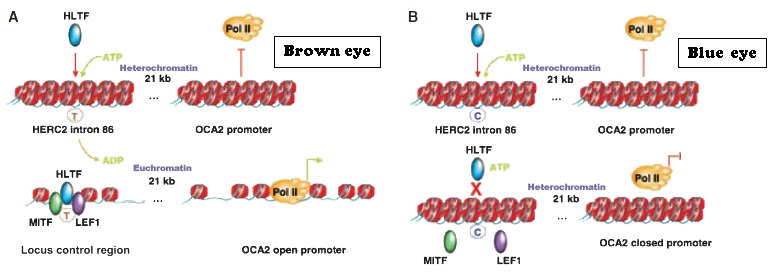
HLTF can activate gene transcription either alone or with different protein partners according to the cell type and the target gene (i.e., SP1/ SP3 for SERPINE1 (Ding et al., 1996 and 1999), NONO and SFPQ for PRL (Guillaumond et al., 2011), LEF1 and MITF for OCA2 (Visser et al., 2012)). It binds a promoter (i.e. SERPINE1 or PRL) or an enhancer (i.e., intron 86 of HERC2 for OCA2 expression) and involves a long distance chromatin looping (Visser et al., 2012) for PRL expression (Guillaumond et al., 2011) and its own downregulation mediated by Erg-1 and REL (Hewetson et al., 2008). See also Dhont et al., 2015.
Chromatin remodelling:
Similarly to other SNF/SWI proteins, HLTF could play a role in chromatin remodelling. It has the 7 helicase domains and presents a DNA-dependent ATPase activity (Sheridan et al., 1995; Hayward-Lester et al., 1996; MacKay et al., 2009).
E3 ubiquitin ligase activity:
The RING domain insures protein-protein interactions in E3 ubiquitin ligases. It allows specific targeting of the substrate proteins for transfer of ubiquitin by the associated E2 ubiquitin ligase. The HLTF RING domain is situated between helicase domains III and IV and is strongly conserved in evolution. HLTF and its homologue SHPRH are the functional orthologues of Rad5 in S. cerevisiae, which mediates the polyubiquitination of PCNA lysine 63 when damage is detected on the lagging DNA strand during replication (Unk et al., 2008; Motegi et al., 2008). The HLTF E3 ubiquitin ligase activity was confirmed with a range of E2 ubiquitin ligases (MacKay et al., 2009).
DNA repair:
The SNF2 domain is situated between the HLTF DBD and the first helicase domain. It is present in a large variety of proteins implicated in DNA repair, recombination, chromatin remodelling and transcription (Eisen et al., 1995; Linder et al., 2004). In addition, part of the HLTF DNA binding domain is conserved in SWI2/SNF2 proteins such as RAD5P: this domain was named HIRAN based on one of the HLTF alternatives names (HIP116) and the Rad5p N-terminal domain. HLTF is involved in post replication DNA repair (Unk et al., 2008; Motegi et al., 2008). HLTF can complement the ultraviolet (UV) sensitivity of rad5- yeast cells, thus strongly supporting a role in postreplication DNA repair (Unk et al., 2008). Hltf-deficient mouse embryonic fibroblasts show elevated chromosome breaks and fusions after methyl methane sulfonate treatment (Motegi et al., 2008). In addition the HLTF protein interacts with PAXIP1 (PTIP) and RPA70, both involved in DNA replication and repair (MacKay et al., 2009).
When DNA damaged, the replication fork stalls and leads to cell death. DNA damage tolerance pathways are activated through PCNA ubiquitination. RAD6- RAD18 and HLTF control this pathways. HLTF is preferentially recruited when DNA is damaged by UV and inhibits its counterpart SHPRH in that case. However, if DNA is damaged by methyl-methan sulfonate (MMS), HLTF degradation is triggered and SHPRH is activated (Lin et al., 2011). HLTF activates translesion synthesis by monoubiquinating PCNA and by recruiting the error-free DNA polymerase POLH ID: 303> (Polη). HLTF also activates template switching by polyubiquitinating PCNA. Its HIRAN domain is essential in the recognition of stalled DNA replication fork (a 3-hydroxyl group (3-OH) on the nascent leading strand, which mimics a site of two unpaired nucleotides) and its restart (Kile et al., 2015), in concert with it helicase domains (Blastyàk et al., 2010). Beside this role, HLTF exhibits an ATP hydrolysis-dependent protein remodeling activity at stalled replication fork: HLTF catalyzes the clearance of roadblocks in replication fork restart (Achar et al., 2011).
HLTF can also promote the intrusion of the newly synthesized strand, stalled by a damage, in the sister chromatid to bypass the lesion (Burkovics et al., 2013). Both RING and helicase domains are critical for this process (Blastyak et al., 2010). Studies on HLTF HIRAN domain revealed how HLTF recognizes a stalled replication fork and restarts it by fork regression (Hishiki et al., 2015; Ikegaya et al., 2015). Stalled replication forks contain a 3-hydroxyl group (3-OH) on the nascent leading strand, which mimics a site of two unpaired nucleotides ("lesion"). HLTF specifically recognizes this "lesion" by its HIRAN domain pocket in which (i) the two unpaired nucleotides are stuck between two tyrosines (Y72 and Y93) and (ii) the 3-OH single DNA (ssDNA) end binds to an aspartate (D94) (Kile et al., 2015; Tsutakawa et al., 2015). Fork reactivation is also promoted via concerted mediation of TP53, POLI (POLι), HLTF and ZRANB3 (Hampp et al., 2016).
Isoforms of RUSH (rabbit HLTF) interact with a RING-finger binding protein (RFBP), which is a splice variant of the Type IV P-type ATPase, ATP11B. This protein is a putative phospholipid pump, located in the inner nuclear membrane and the interaction with the HLTF RING domain is conserved in humans (Mansharamani et al., 2001; Hewetson et al., 2008).
Homology
RUSH-1-alpha and RUSH-1-beta (rabbit: 91% and 90% identity)
P113 (rat and mouse: 83% identity)
MGC131155 (Xenopus leavis: 63% identity)
RAD5B (Saccharomyces cerevisiae: 25, 7% identity)
Implicated in
Article Bibliography
| Pubmed ID | Last Year | Title | Authors |
|---|---|---|---|
| 25005870 | 2014 | Helicase-like transcription factor: a new marker of well-differentiated thyroid cancers. | Arcolia V et al |
| 21585432 | 2011 | Expression of the helicase-like transcription factor and its variants during carcinogenesis of the uterine cervix: implications for tumour progression. | Capouillez A et al |
| 20535496 | 2011 | Helicase-like transcription factor confers radiation resistance in cervical cancer through enhancing the DNA damage repair capacity. | Cho S et al |
| 26472339 | 2016 | The helicase-like transcription factor (HLTF) in cancer: loss of function or oncomorphic conversion of a tumor suppressor? | Dhont L et al |
| 21507896 | 2011 | Chromatin remodeling as a mechanism for circadian prolactin transcription: rhythmic NONO and SFPQ recruitment to HLTF. | Guillaumond F et al |
| 27407148 | 2016 | DNA damage tolerance pathway involving DNA polymerase ι and the tumor suppressor p53 regulates DNA replication fork progression. | Hampp S et al |
| 23826137 | 2013 | Role of helicase-like transcription factor (hltf) in the G2/m transition and apoptosis in brain. | Helmer RA et al |
| 24278285 | 2013 | Helicase-like transcription factor (Hltf) regulates G2/M transition, Wt1/Gata4/Hif-1a cardiac transcription networks, and collagen biogenesis. | Helmer RA et al |
| 25858588 | 2015 | Structure of a Novel DNA-binding Domain of Helicase-like Transcription Factor (HLTF) and Its Functional Implication in DNA Damage Tolerance. | Hishiki A et al |
| 26057792 | 2015 | Crystallographic study of a novel DNA-binding domain of human HLTF involved in the template-switching pathway to avoid the replication arrest caused by DNA damage. | Ikegaya Y et al |
| 26051180 | 2015 | HLTF's Ancient HIRAN Domain Binds 3' DNA Ends to Drive Replication Fork Reversal. | Kile AC et al |
| 21845734 | 2011 | USP7 regulates the stability and function of HLTF through deubiquitination. | Qing P et al |
| 22452792 | 2012 | Loss of HLTF function promotes intestinal carcinogenesis. | Sandhu S et al |
| 26091346 | 2015 | Bending Forks and Wagging Dogs--It's about the DNA 3' Tail. | Tsutakawa SE et al |
| 22234890 | 2012 | HERC2 rs12913832 modulates human pigmentation by attenuating chromatin-loop formation between a long-range enhancer and the OCA2 promoter. | Visser M et al |
| 25666710 | 2015 | MicroRNA-145 contributes to enhancing radiosensitivity of cervical cancer cells. | Ye C et al |
Other Information
Locus ID:
NCBI: 6596
MIM: 603257
HGNC: 11099
Ensembl: ENSG00000071794
Variants:
dbSNP: 6596
ClinVar: 6596
TCGA: ENSG00000071794
COSMIC: HLTF
RNA/Proteins
Expression (GTEx)
Protein levels (Protein atlas)
References
| Pubmed ID | Year | Title | Citations |
|---|---|---|---|
| 37487091 | 2023 | The helicase-like transcription factor redirects the autophagic flux and restricts human T cell leukemia virus type 1 infection. | 0 |
| 37487091 | 2023 | The helicase-like transcription factor redirects the autophagic flux and restricts human T cell leukemia virus type 1 infection. | 0 |
| 34010296 | 2021 | Helicase-like transcription factor-deletion from the tumor microenvironment in a cell line-derived xenograft model of colorectal cancer reprogrammed the human transcriptome-S-nitroso-proteome to promote inflammation and redirect metastasis. | 6 |
| 34010296 | 2021 | Helicase-like transcription factor-deletion from the tumor microenvironment in a cell line-derived xenograft model of colorectal cancer reprogrammed the human transcriptome-S-nitroso-proteome to promote inflammation and redirect metastasis. | 6 |
| 31973093 | 2020 | Helicase-Like Transcription Factor HLTF and E3 Ubiquitin Ligase SHPRH Confer DNA Damage Tolerance through Direct Interactions with Proliferating Cell Nuclear Antigen (PCNA). | 13 |
| 32192191 | 2020 | The Human RAD5 Homologs, HLTF and SHPRH, Have Separate Functions in DNA Damage Tolerance Dependent on The DNA Lesion Type. | 6 |
| 32442397 | 2020 | HLTF Promotes Fork Reversal, Limiting Replication Stress Resistance and Preventing Multiple Mechanisms of Unrestrained DNA Synthesis. | 90 |
| 32971328 | 2020 | Time for remodeling: SNF2-family DNA translocases in replication fork metabolism and human disease. | 15 |
| 31973093 | 2020 | Helicase-Like Transcription Factor HLTF and E3 Ubiquitin Ligase SHPRH Confer DNA Damage Tolerance through Direct Interactions with Proliferating Cell Nuclear Antigen (PCNA). | 13 |
| 32192191 | 2020 | The Human RAD5 Homologs, HLTF and SHPRH, Have Separate Functions in DNA Damage Tolerance Dependent on The DNA Lesion Type. | 6 |
| 32442397 | 2020 | HLTF Promotes Fork Reversal, Limiting Replication Stress Resistance and Preventing Multiple Mechanisms of Unrestrained DNA Synthesis. | 90 |
| 32971328 | 2020 | Time for remodeling: SNF2-family DNA translocases in replication fork metabolism and human disease. | 15 |
| 30696947 | 2019 | A germline HLTF mutation in familial MDS induces DNA damage accumulation through impaired PCNA polyubiquitination. | 6 |
| 31019079 | 2019 | HIV-1 Vpr counteracts HLTF-mediated restriction of HIV-1 infection in T cells. | 24 |
| 31350889 | 2019 | Rad5 dysregulation drives hyperactive recombination at replication forks resulting in cisplatin sensitivity and genome instability. | 9 |
Citation
Ludovic Dhont ; Alexandra Belayew
HLTF (helicase-like transcription factor)
Atlas Genet Cytogenet Oncol Haematol. 2016-11-01
Online version: http://atlasgeneticsoncology.org/gene/42332/hltf-(helicase-like-transcription-factor)
Historical Card
2010-01-01 HLTF (helicase-like transcription factor) by Jeni Dimitrova,Alexandra Belayew Affiliation
