NRF1 (nuclear respiratory factor 1)
2008-12-01 Deodutta Roy , Ranjan Tamuli AffiliationDepartment of Environmental, Occupational Health, Florida International University, 11200 SW 8th Street, Miami, FL 33199-0001, USA
DNA/RNA
Note
NRF-1 / a-PAL (nuclear respiratory factor-1/a-palindrome-binding protein) is a transcription factor. It belongs to the NRF1/Ewg family. The optimal NRF-1 binding site is (T/C)GCGCA(C/T)GCGC(A/G).
Description
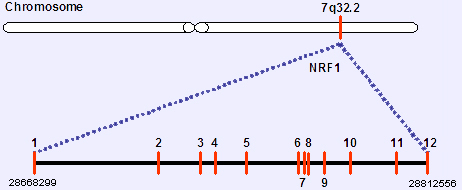
DNA size 144.26 kb; mRNA size 2578 bp 12 exons.
Proteins
Expression
It is widely expressed, and strongest expression is in skeletal muscle.
Localisation
Nucleus.
Function
NRF-1 was first discovered as an activator of the cytochrome c gene (Evans and Scarpulla, 1989). Now we know that this transcription factor activates the expression of several key genes regulating cell growth and development, nuclear genes required for respiration, heme biosynthesis, and mitochondrial DNA transcription and replication.
A genome-wide analysis has revealed that NRF-1 binding elements are present in genes involved in DNA replication, mitosis, and cytokinesis, suggesting that NRF-1 plays an important role in cell cycle regulation. Similarly, computation analysis of NRF-1 gene regulation by querying the TRANSFAC database revealed that the TGCGCATGCGCA motif of the consensus NRF1 binding site is present in genes encoding proteins regulating cell growth (CKS2, CDC6, CDC7, CDC25C, NPAT), replication (ORC6L, FEN1), and DNA repair (DNA polymerase alpha, MLH1, MSH2, PCNA, Prim2A, TOP1, ATM, XRCC2, GTSE, SMC4L1, KIF22, PP5C, cyclin B1, cyclin G2, RAD54B, PRC1, CBX5). NRF-1 and CREB elements significantly co-occur on promoters of cell cycle-regulated genes. NRF-1 also binds to the gene promoters of cysteine proteases (CAPNS1 and CASP2), chemokines (CXR5, CKLF), the putative breast adenocarcinoma marker BC2, BRCA2, BCCIP, tumor suppressors (putative tumor suppressor, 101F6 and tumor suppressor deleted in oral cancer-related 1). These NRF-1 target genes control cell adhesion, cell spreading, migration, proliferation, apoptosis, and tumor invasion. NRF-1 responds to redox signaling pathways through post-translational modifications and through its specific interaction with transcriptional co-activators.
A genome-wide analysis has revealed that NRF-1 binding elements are present in genes involved in DNA replication, mitosis, and cytokinesis, suggesting that NRF-1 plays an important role in cell cycle regulation. Similarly, computation analysis of NRF-1 gene regulation by querying the TRANSFAC database revealed that the TGCGCATGCGCA motif of the consensus NRF1 binding site is present in genes encoding proteins regulating cell growth (CKS2, CDC6, CDC7, CDC25C, NPAT), replication (ORC6L, FEN1), and DNA repair (DNA polymerase alpha, MLH1, MSH2, PCNA, Prim2A, TOP1, ATM, XRCC2, GTSE, SMC4L1, KIF22, PP5C, cyclin B1, cyclin G2, RAD54B, PRC1, CBX5). NRF-1 and CREB elements significantly co-occur on promoters of cell cycle-regulated genes. NRF-1 also binds to the gene promoters of cysteine proteases (CAPNS1 and CASP2), chemokines (CXR5, CKLF), the putative breast adenocarcinoma marker BC2, BRCA2, BCCIP, tumor suppressors (putative tumor suppressor, 101F6 and tumor suppressor deleted in oral cancer-related 1). These NRF-1 target genes control cell adhesion, cell spreading, migration, proliferation, apoptosis, and tumor invasion. NRF-1 responds to redox signaling pathways through post-translational modifications and through its specific interaction with transcriptional co-activators.
Homology
The percent Identity below represents identity of NRF-1 over an aligned region in UniGene.
M. musculus : 99.8 (Percentage Identity)
M. domestica : 99.8
E. caballus : 99.8
B. taurus : 99.8
C. lupus familiaris : 99.6
G. gallus : 99.6
D. rerio : 93.7
X. laevis : 92.9
D. melanogaster : 51.5
M. musculus : 99.8 (Percentage Identity)
M. domestica : 99.8
E. caballus : 99.8
B. taurus : 99.8
C. lupus familiaris : 99.6
G. gallus : 99.6
D. rerio : 93.7
X. laevis : 92.9
D. melanogaster : 51.5
Description
Post translational modifications: Phosphorylation enhances DNA binding. DNA binding 109-305 (197), region 1-78 (78) is required for dimerization, region 301-476 (176) required for transcriptional activation, motif 88-116 (29) is nuclear localization signal, compositional bias 41-66 (26) Asp/Glu-rich (acidic), compositional bias 80-86 (7).Isoform Long (identifier: Q16656-1)
This isoform has been chosen as the canonical sequence.
Isoform Short (identifier: Q16656-2)
The sequence of this isoform differs from the canonical sequence, amino acid residues from 256-321 are missing.
Isoforms:
Two isoforms have been identified.
This isoform has been chosen as the canonical sequence.
The sequence of this isoform differs from the canonical sequence, amino acid residues from 256-321 are missing.
Mutations
Note
Two novel single nucleotide polymorphisms (SNPs) in the NRF1 gene SNPs are found to be associated with type 2 diabetes in a Han Chinese population.
Implicated in
Entity name
Estrogen-dependent breast cancer
Note
NRF-1 is a redox sensitive transcription factor. Some of the same mitogenic pathways that are sensitive to oxidant levels and estrogen are also directly regulated by NRF-1. For example, the expression of CDC25C, which is required for progression of the cell cycle, is regulated by both E2 and reactive oxygen species ( ROS ) and its promoter contains NRF-1 binding motif. The expression of cyclin D1 is also regulated by both E2 and ROS. There are several estrogen-regulatable genes, which are also regulated by ROS. Cell cycle regulation by the cdks and cyclins is dependent upon cell adhesion mediated by integrins, which control expression of cell cycle genes via ROS. Many of the genes associated with high-risk breast tumors appear to participate in cell cycle regulation, including those encoding CDC2 and PRC1. As noted above, both genes are NRF-1 regulatable. Importantly, in human breast cancer cells, the expression of almost 15% of the genes significantly affected by E2 contain the NRF-1 binding element, and the NRF-1 binding signature is significantly enriched in the promoters of genes induced by estrogen treatment. We have recently shown that inhibitors of mitochondrial oxidant production prevent E2-induced expression of cell cycle genes containing NRF-1 binding sites (cyclin B1, PCNA, and PRC1), decrease E2-induced NRF-1 expression, and delay growth. These findings show that E2 stimulates NRF-1 expression and cell cycle progression of breast cancer cells through ROS, possibly by altering NRF-1 activity.
Entity name
Breast cancer
Disease
Motifs bound by ELK1, E2F, NRF1 and NFY positively correlate with malignant progression of breast cancer.
Entity name
Colorectal tumors
Note
NRF-1 is also the main transcription factor regulating the expression of human TOMM34 gene that encodes a cytosolic protein with chaperone-like activity. TOMM34 helps import some preproteins to the mitochondria by keeping them in an unfolded, import-compatible state. TOMM34 was found to be upregulated frequently in colorectal tumors, suggesting that it also has a role in the growth of cancer cells.
Entity name
Hepatoma and thyroid oncocytoma
Note
NRF-1 overexpression has been observed in hepatoma and thyroid oncocytoma.
Entity name
Diabetes Mellitus, Type 2
Note
Two novel single nucleotide polymorphisms (SNPs) in the NRF1 gene SNPs (-46127T>C and +98560A>G) are associated with type 2 diabetes in a Han Chinese population. NRF1 genetic polymorphisms may be a suspectibility factor for type 2 diabetes by conferring abnormalities in triglyceride metabolism.
Two common haplotypes of NRF1 gene are found to be associated with type 2 diabetes in the Korean population. A haplotype (H2) is associated with a decreased risk of type 2 diabetes and another haplotype (H4) is associated with an increased risk of type 2 diabetes.
Two common haplotypes of NRF1 gene are found to be associated with type 2 diabetes in the Korean population. A haplotype (H2) is associated with a decreased risk of type 2 diabetes and another haplotype (H4) is associated with an increased risk of type 2 diabetes.
Entity name
Endurance exercise capacity
Note
In young Chinese men of Han origin, two NRF1 genotypes have been found to be associated with the baseline and/or training response of human aerobic capacity. NRF1 is a critical component of the energy-sensing mechanism in mammalian cells, and translates physiological signals, including those induced by exercise, into increased capacity for mitochondrial biogenesis and oxidative phosphorylation.
Article Bibliography
| Pubmed ID | Last Year | Title | Authors |
|---|---|---|---|
| 11340167 | 2001 | Pgc-1-related coactivator, a novel, serum-inducible coactivator of nuclear respiratory factor 1-dependent transcription in mammalian cells. | Andersson U et al |
| 18234454 | 2008 | NRF-1, and AP-1 regulate the promoter of the human calpain small subunit 1 (CAPNS1) gene. | Asangani IA et al |
| 18364745 | 2008 | NRF-1 is the major transcription factor regulating the expression of the human TOMM34 gene. | Blesa JR et al |
| 8248256 | 1993 | Cloning of Nrf1, an NF-E2-related transcription factor, by genetic selection in yeast. | Chan JY et al |
| 16082529 | 2005 | Association between polymorphisms in the nuclear respiratory factor 1 gene and type 2 diabetes mellitus in the Korean population. | Cho YM et al |
| 18077450 | 2008 | Nuclear respiratory factor 1 regulates all ten nuclear-encoded subunits of cytochrome c oxidase in neurons. | Dhar SS et al |
| 12198131 | 2002 | Mitochondrial transcription factor A and its downstream targets are up-regulated in a rat hepatoma. | Dong X et al |
| 8034649 | 1994 | A key transcription factor for eukaryotic initiation factor-2 alpha is strongly homologous to developmental transcription factors and may link metabolic genes to cellular growth and development. | Efiok BJ et al |
| 2547796 | 1989 | Interaction of nuclear factors with multiple sites in the somatic cytochrome c promoter. Characterization of upstream NRF-1, ATF, and intron Sp1 recognition sequences. | Evans MJ et al |
| 15897899 | 2005 | Estrogen-induced G1/S transition of G0-arrested estrogen-dependent breast cancer cells is regulated by mitochondrial oxidant signaling. | Felty Q et al |
| 15865435 | 2005 | Estrogen-induced mitochondrial reactive oxygen species as signal-transducing messengers. | Felty Q et al |
| 7629110 | 1995 | Structure, expression, and chromosomal assignment of the human gene encoding nuclear respiratory factor 1. | Gopalakrishnan L et al |
| 9228045 | 1997 | Serine phosphorylation within a concise amino-terminal domain in nuclear respiratory factor 1 enhances DNA binding. | Gugneja S et al |
| 18184751 | 2008 | NRF-1 genotypes and endurance exercise capacity in young Chinese men. | He Z et al |
| 18071027 | 2008 | Genetic variation and association analyses of the nuclear respiratory factor 1 (nRF1) gene in Chinese patients with type 2 diabetes. | Liu Y et al |
| 18823535 | 2008 | Integrative bioinformatics analysis of transcriptional regulatory programs in breast cancer cells. | Niida A et al |
| 14550271 | 2003 | PGC-1-related coactivator and targets are upregulated in thyroid oncocytoma. | Savagner F et al |
| 8541844 | 1995 | The pre-mRNA of nuclear respiratory factor 1, a regulator of mitochondrial biogenesis, is alternatively spliced in human tissues and cell lines. | Spelbrink JN et al |
| 7558044 | 1995 | The gene (NFE2L1) for human NRF-1, an activator involved in nuclear-mitochondrial interactions, maps to 7q32. | Tiranti V et al |
| 16908542 | 2006 | PGC-1-related coactivator: immediate early expression and characterization of a CREB/NRF-1 binding domain associated with cytochrome c promoter occupancy and respiratory growth. | Vercauteren K et al |
| 8253388 | 1993 | NRF-1, an activator involved in nuclear-mitochondrial interactions, utilizes a new DNA-binding domain conserved in a family of developmental regulators. | Virbasius CA et al |
Other Information
Locus ID:
NCBI: 4899
MIM: 600879
HGNC: 7996
Ensembl: ENSG00000106459
Variants:
dbSNP: 4899
ClinVar: 4899
TCGA: ENSG00000106459
COSMIC: NRF1
RNA/Proteins
Expression (GTEx)
Pathways
Protein levels (Protein atlas)
References
| Pubmed ID | Year | Title | Citations |
|---|---|---|---|
| 37539637 | 2024 | NRF1 promotes primordial germ cell development, proliferation and survival. | 3 |
| 37668961 | 2024 | Inhibitor of DNA Binding Protein 3 (ID3) and Nuclear Respiratory Factor 1 (NRF1) Mediated Transcriptional Gene Signatures are Associated with the Severity of Cerebral Amyloid Angiopathy. | 1 |
| 38055835 | 2024 | Molecular mechanism of specific DNA sequence recognition by NRF1. | 0 |
| 37539637 | 2024 | NRF1 promotes primordial germ cell development, proliferation and survival. | 3 |
| 37668961 | 2024 | Inhibitor of DNA Binding Protein 3 (ID3) and Nuclear Respiratory Factor 1 (NRF1) Mediated Transcriptional Gene Signatures are Associated with the Severity of Cerebral Amyloid Angiopathy. | 1 |
| 38055835 | 2024 | Molecular mechanism of specific DNA sequence recognition by NRF1. | 0 |
| 36738378 | 2023 | Nuclear respiratory factor 1 promotes the progression of EBV-associated gastric cancer and maintains EBV latent infection. | 1 |
| 36960492 | 2023 | NRF1 Regulates the Epithelial Mesenchymal Transition of Breast Cancer by Modulating ROS Homeostasis. | 0 |
| 36974812 | 2023 | The Regulatory Role of Nuclear Respiratory Factor 1 in Bladder Cancer Cells. | 1 |
| 36989111 | 2023 | The N(6)-methyladenine DNA demethylase ALKBH1 promotes gastric carcinogenesis by disrupting NRF1 binding capacity. | 8 |
| 37084817 | 2023 | UBE4A catalyzes NRF1 ubiquitination and facilitates DDI2-mediated NRF1 cleavage. | 1 |
| 37402316 | 2023 | NRF1 knockdown alleviates lipopolysaccharide-induced pulmonary inflammatory injury by upregulating DKK3 and inhibiting the GSK-3β/β-catenin pathway. | 1 |
| 37875967 | 2023 | Nuclear respiratory factor 1 drives hepatocellular carcinoma progression by activating LPCAT1-ERK1/2-CREB axis. | 0 |
| 37962027 | 2023 | NRF1 Alleviated Oxidative Stress of Glioblastoma Cells by Regulating NOR1. | 0 |
| 36738378 | 2023 | Nuclear respiratory factor 1 promotes the progression of EBV-associated gastric cancer and maintains EBV latent infection. | 1 |
Citation
Deodutta Roy ; Ranjan Tamuli
NRF1 (nuclear respiratory factor 1)
Atlas Genet Cytogenet Oncol Haematol. 2008-12-01
Online version: http://atlasgeneticsoncology.org/gene/44233/nrf1-(nuclear-respiratory-factor-1)
