t(6;9)(p22;q34) DEK/NUP214 in Childhood
2016-11-01 Julie Damgaard Sandahl , Henrik Hasle Affiliation1.Department of Pediatrics, Aarhus University Hospital, Skejby, Palle Juul-Jensens Boulevard 99, DK-8200 Aarhus N, Denmark; [email protected], [email protected]
Abstract
Review on t(6;9)(p22;q34) DEK/NUP214 in Childhood, with data on clinics, and the genes involved.
Clinics and Pathology
Disease
Acute myeloid leukemias 1238 (AML) and myelodysplastic syndromes (MDS)
Phenotype stem cell origin
t(6;9)(p22;q34) is a rare subtype of pediatric AML earlier only described in small series and case reports (Gupta, et al 2010, Ishiyama, et al 2012, Slovak, et al 2006). Two large studies both published in 2014 described the clinical, morphologic, and genetic characteristics: the I-BFM-study including 62 children of which 54 was diagnosed as AML and 8 as MDS, and the COG study investigating 48 children all diagnosed as AML (Sandahl, et al 2014, Tarlock, et al 2014). This review is based upon the 110 children from these two series.
There are no pediatric studies of stem cell origin. AML in children with t(6;9) is associated with French-American-British (FAB) type M2 (44%) and FAB type M4 (25%) (Sandahl, et al 2014, Tarlock, et al 2014).
There are no pediatric studies of stem cell origin. AML in children with t(6;9) is associated with French-American-British (FAB) type M2 (44%) and FAB type M4 (25%) (Sandahl, et al 2014, Tarlock, et al 2014).
Epidemiology
The t(6;9)(p22;q34) was first described in a pediatric patient in 1982 (Kaneko, et al 1982). It is rare, found in only about 1% of all pediatric AML (Sandahl, et al 2014, Slovak, et al 2006, Tarlock, et al 2014) and associated with late onset with a median age 11 years and no patients below 2 years of age (Sandahl, et al 2014, Tarlock, et al 2014). There is an equal sex distribution with 53% males.
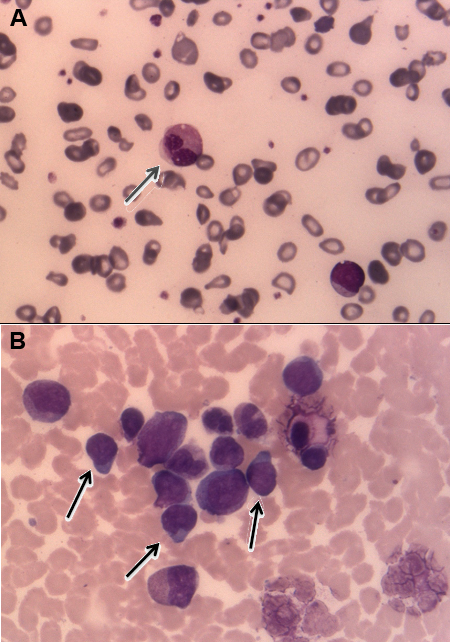
BM biopsies from pediatric t(6;9) AML illustrating morphologic characteristics A Pseudo-Pelger-Hüet anomaly tadpole blasts. Illustration from central review by Gitte Kerndrup (2013)
Cytology
Basophilia is common in adults with t(6;9). In the I-BFM study, peripheral blood smears from 11 children and bone marrow smears from 15 children with t(6;9)(p22;q34) were evaluable for central review (Sandahl, et al 2014). All had mild to moderate bilinear dysplasia. Basophils were present in five patients (33%), four of which had 2% basophils, one patient (6%) had 1% basophils, none had > 2%. From the remaining 47 AML patients, reports on basophils were available in 16 cases; four patients had 1-2% basophils in BM smears, one had 0.4%, and no basophils were reported in the remaining 11. No Auer rods were seen in this reviewed pediatric series. Pseudo-Pelger cells were found in all reviewed material. Furthermore, almost all had tadpole blasts and many have bilobar blasts, both characteristic of AML-M3. However no patients were classified as FAB M3.
Treatment
It has been suggested that Hematopoietic stem cell transplantation (HSCT) in first complete remission may improve outcome. In the I-BFM-study, the 5-year event-free survival was improved among patients treated the HSCT in CR1 compared with chemotherapy alone (68% vs. 18%; P
Prognosis
Complete remission rate is significantly lower compared with pediatric AML patients without t(6;9)(Tarlock, et al 2014), but reported CR rates varied between 67 and 93%. (Sandahl, et al 2014, Tarlock, et al 2014) Furthermore, t(6;9) was associated with high risk of relapse 57%-64%, low 5-year EFS of 32% and 5-year OS around 45%(Sandahl, et al 2014, Tarlock, et al 2014).
The outcome seems better among pediatric t(6,9) patients compared with adults (Slovak, et al 2006).(Ishiyama, et al 2012, Slovak, et al 2006).
Among t(6;9) patients FLT3-ITD had a non-significant negative influence on survival with a 5-year overall survival compared with non-FLT3-ITD (22% versus 62%; p=0.13) in the I-BFM study (Sandahl, et al 2014). The OS in the COG study was in contrast higher with FLT3-ITD than without (40% vs. 27%; p>0.9) which may be explained by FLT3-ITD being allocated to hematopoietic stem cell transplantation (HSCT) (Sandahl, et al 2014, Tarlock, et al 2014)
The outcome seems better among pediatric t(6,9) patients compared with adults (Slovak, et al 2006).(Ishiyama, et al 2012, Slovak, et al 2006).
Among t(6;9) patients FLT3-ITD had a non-significant negative influence on survival with a 5-year overall survival compared with non-FLT3-ITD (22% versus 62%; p=0.13) in the I-BFM study (Sandahl, et al 2014). The OS in the COG study was in contrast higher with FLT3-ITD than without (40% vs. 27%; p>0.9) which may be explained by FLT3-ITD being allocated to hematopoietic stem cell transplantation (HSCT) (Sandahl, et al 2014, Tarlock, et al 2014)
Note
The t(6;9) is often associated with FLT3-ITD reported in 42% to 69% (Sandahl, et al 2014, Slovak, et al 2006, Tarlock, et al 2014).
In the I-BFM study, the gene expression profile was analyzed in 297 pediatric AML patients including eight t(6;9) AML cases. The t(6,9) cases had a significant signature with high expression levels of HOXA and the HOXB (HOXB2, (HOXB3, (HOXB4, HOXB5, HOXB6, HOXB8, and HOXB9) genes described previously (Hollink, et al 2011) but also with high expression of HIST2H4A, PRDM2 (RIZ), SESN1, and EYA3 (Sandahl, et al 2014).
In the I-BFM study, the gene expression profile was analyzed in 297 pediatric AML patients including eight t(6;9) AML cases. The t(6,9) cases had a significant signature with high expression levels of HOXA and the HOXB (HOXB2, (HOXB3, (HOXB4, HOXB5, HOXB6, HOXB8, and HOXB9) genes described previously (Hollink, et al 2011) but also with high expression of HIST2H4A, PRDM2 (RIZ), SESN1, and EYA3 (Sandahl, et al 2014).
Cytogenetics
Cytogenetics morphological
The translocation is easily detected by conventional karyotyping, only 4/62 pediatric cases were discovered solely by FISH or PCR (Sandahl, et al 2014).
Additional anomalies
t(6;9)(p22;q34) often presents as the sole cytogenetic abnormality (81%). (Gupta, et al 2010). Additional abnormalities are described in 12-19%. (Sandahl, et al 2014) Recurrent aberrations in addition to t(6;9) have been described in 19% with loss of chromosome Y in three boys and trisomy 8 and trisomy 13 each present in three cases, either alone or combined (Sandahl, et al 2014).
Genes Involved and Proteins
Gene name
DEK (DEK proto-oncogene)
Location
6p22.3
Protein description
375 amino-acids; DEK contains acidic domains (Asp/Glu-rich), a SAF/SAP box, a nuclear localisation signal; and other DNA binding domains. Highly conserved nuclear factor; chromatin remodeling protein, essential for heterochromatin integrity; DEK localizes preferentially at sites proximal to the promoters of expressed genes; acts as a repressor of transcription by interfering with histone acetyl-transferases and as an activator of transcription by stimulating the binding of TFAP2A (the activator protein AP2-alpha) to its target DNA sequences; DEK introduces super-coils into circular DNA (in Oancea et al., 2010). DEK is a regulator of stem and progenitor cells and is upregulated in a number of neoplasms (breast cancer, chronic lymphocytic leukemia, small cell lung carcinoma, Merkel cell carcinoma, melanoma, glioblastoma, retinoblastoma, cervical, and bladder cancers) (review in Riveiro-Falkenbach and Soengas, 2010); CEBPA and DEK coordinately activate myeloid gene expression (Koleva et al., 2012); DEK is an estrogen receptor alpha (ESR1) target gene (Privette Vinnedge et al., 2012). DEK expression modulates ATM and DNA-dependent protein kinase signaling, and contributes to DNA repair (Kavanaugh et al., 2011).
Gene name
NUP214 (nucleoporin 214kDa)
Location
9q34.13
Note
The previous name of NUP214 was CAN.
Protein description
2090 amino acids; contains dimerization domains (2 leucine zippers) and FG repeats; forms homodimers; the C-terminus is essential; the N-terminus is involved in mRNA export (Köser et al., 2005). Nuclear membrane localisation (cytoplasmic face of nucleopore); component of the nuclear pore complex; involved in nucleo-cytoplasmic transport.
Result of the Chromosomal Anomaly
Description
5 DEK - 3 NUP214 on der(6); head to tail DEK/NUP214 fusion gene (SET/NUP214 exceptional); breakpoint clusters in a single intron of 8 kb (ICB9: intron containing breakpoint 9) in NUP214, and in a single intron (of 12 kb) as well (ICB6) in DEK.
Transcript
5.5 kb RNA; no NUP214-DEK reciprocal transcript on chromosome 9.
Detection protocole
RNA-PCR.
Description
165 kDa; N-term with almost the entire DEK protein fused to the C-terminal two-thirds of the NUP214 protein.
Expression localisation
Nuclear localisation.
Highly cited references
| Pubmed ID | Year | Title | Citations |
|---|---|---|---|
| 35682627 | 2022 | Molecular Classification and Overcoming Therapy Resistance for Acute Myeloid Leukemia with Adverse Genetic Factors. | 169 |
| 30669574 | 2019 | NUP214 in Leukemia: It's More than Transport. | 148 |
| 37172756 | 2023 | The impact of the chromatin binding DEK protein in hematopoiesis and acute myeloid leukemia. | 105 |
| 33439382 | 2021 | Acute Myeloid Leukemia in Children: Emerging Paradigms in Genetics and New Approaches to Therapy. | 101 |
| 27114368 | 2016 | Leukemia-Associated Nup214 Fusion Proteins Disturb the XPO1-Mediated Nuclear-Cytoplasmic Transport Pathway and Thereby the NF-κB Signaling Pathway. | 82 |
| 32934780 | 2020 | Targeted CRM1-inhibition perturbs leukemogenic NUP214 fusion proteins and exerts anti-cancer effects in leukemia cell lines with NUP214 rearrangements. | 72 |
| 33755722 | 2021 | Nuclear DEK preserves hematopoietic stem cells potential via NCoR1/HDAC3-Akt1/2-mTOR axis. | 59 |
| 32656741 | 2020 | Role of the DEK oncogene in the development of squamous cell carcinoma. | 55 |
| 25120641 | 2014 | NUP214 fusion genes in acute leukemia (Review). | 52 |
| 36288392 | 2022 | Understanding a high-risk acute myeloid leukemia by analyzing the interactome of its major driver mutation. | 50 |
| 25568664 | 2014 | STAT activation status differentiates leukemogenic from non-leukemogenic stem cells in AML and is suppressed by arsenic in t(6;9)-positive AML. | 46 |
| 24441146 | 2014 | t(6;9)(p22;q34)/DEK-NUP214-rearranged pediatric myeloid leukemia: an international study of 62 patients. | 42 |
| 35941390 | 2022 | Activation of signaling pathways in models of t(6;9)-acute myeloid leukemia. | 42 |
| 38571499 | 2024 | NUP214 fusion genes in acute leukemias: genetic characterization of rare cases. | 41 |
| 38145892 | 2024 | NUP214 Rearrangements in Leukemia Patients: A Case Series From a Single Institution. | 36 |
| 24073922 | 2013 | Forced expression of the DEK-NUP214 fusion protein promotes proliferation dependent on upregulation of mTOR. | 36 |
| 29109093 | 2017 | DEK-NUP214-Fusion Identified by RNA-Sequencing of an Acute Myeloid Leukemia with t(9;12)(q34;q15). | 34 |
| 34572762 | 2021 | Advances in the First Line Treatment of Pediatric Acute Myeloid Leukemia in the Polish Pediatric Leukemia and Lymphoma Study Group from 1983 to 2019. | 33 |
| 23091311 | 2012 | Rapid detection of prognostically significant fusion transcripts in acute leukemia using simplified multiplex reverse transcription polymerase chain reaction. | 28 |
| 27065320 | 2016 | Transformation of human CD34+ hematopoietic progenitor cells with DEK-NUP214 induces AML in an immunocompromised mouse model. | 27 |
| 29344131 | 2017 | A novel variant translocation (1;9)(p22;q34) resulting in a DEK/NUP214 fusion gene in a patient with acute myeloid leukemia: A case report. | 24 |
| 28318095 | 2017 | Clinicopathologic and molecular characterization of myeloid neoplasms with isolated t(6;9)(p23;q34). | 23 |
| 38951067 | 2024 | [Analysis of therapeutic effects of allogeneic hematopoietic stem cell transplantation in 12 patients with DEK-NUP214 fusion gene positive acute myeloid leukemia]. | 20 |
| 32269633 | 2020 | Imatinib therapy in acute myeloid leukemia with DEK-NUP214 and FIP1L1-PDGFRA rearrangement: A case report. | 19 |
| 31938438 | 2018 | Secondary mixed phenotype acute leukemia following chemotherapy for diffuse large B-cell lymphoma: a case report and review of the literature. | 19 |
| 38172329 | 2024 | Gene regulation in t(6;9) DEK::NUP214 Acute Myeloid Leukemia resembles that of FLT3-ITD/NPM1 Acute Myeloid Leukemia but with an altered HOX/MEIS axis. | 15 |
| 38899336 | 2024 | FLT3 inhibitors potentially improve response rates in acute myeloid leukemia harboring t(6;9)(DEK::NUP214): the Mayo Clinic experience. | 15 |
| 38503531 | 2023 | [Clinical observation on 16 cases of DEK-NUP214 fusion gene positive acute myeloid leukemia treated with allogeneic hematopoietic stem cell transplantation]. | 15 |
| 35845276 | 2021 | Volunteer unrelated donor cell-derived acute myeloid leukemia with RUNX1-RUNX1T1. | 15 |
| 35198371 | 2022 | Gilteritinib monotherapy as a transplant bridging option for high risk FLT3-mutated AML with t(6;9)(p23;q34.1);DEK-NUP214 in morphological but not cytogenetic or molecular remission following standard induction chemotherapy. | 8 |
| 38175403 | 2023 | Iron-laden blasts in refractory acute myeloid leukemia. | 2 |
| 25765544 | 2015 | The DEK oncoprotein and its emerging roles in gene regulation. | 0 |
| 24657637 | 2014 | Nucleoporins and nucleocytoplasmic transport in hematologic malignancies. | 0 |
| 34551474 | 2021 | [Prognostic significance of DEK-NUP214 fusion gene in patients with acute myeloid leukemia after allogeneic hematopoietic stem cell transplantation]. | 0 |
| 37643244 | 2023 | IL-33-ST2 signaling promotes stemness in subtypes of myeloid leukemia cells through the Wnt and Notch pathways. | 0 |
| 25605311 | 2015 | The kinetics of relapse in DEK-NUP214-positive acute myeloid leukemia patients. | 0 |
| 33558656 | 2021 | Myelodysplastic syndrome with t(6;9)(p22;q34.1)/DEK-NUP214 better classified as acute myeloid leukemia? A multicenter study of 107 cases. | 0 |
| 18181180 | 2008 | Identification of a novel and myeloid specific role of the leukemia-associated fusion protein DEK-NUP214 leading to increased protein synthesis. | 0 |
| 37011983 | 2023 | [Analysis of 7 cases of pediatric acute myeloid leukemia with DEK-NUP214 fusion gene]. | 0 |
| 32526729 | 2020 | Acute Myeloid Leukemia with t(6;9)(p23;q34.1); DEK-NUP214: The Pathogenesis and Potential. | 0 |
| 33676766 | 2021 | Diagnosis of rare subtypes of acute myeloid leukaemia and related neoplasms. | 0 |
| 19860179 | 2009 | [Classification of myeloid leukemias]. | 0 |
| 26517539 | 2015 | NUP214-RAC1 and RAC1-COL12A1 Fusion in Complex Variant Translocations Involving Chromosomes 6, 7 and 9 in an Acute Myeloid Leukemia Case with DEK-NUP214. | 0 |
| 32020596 | 2020 | Allogeneic stem cell transplantation in AML with t(6;9)(p23;q34);DEK-NUP214 shows a favourable outcome when performed in first complete remission. | 0 |
| 34979355 | 2022 | t(5;12)(q31;p13)/ETV6::ACSL6 and t(6;9)(p23;q34)/DEK::NUP214 concurrence in acute myeloid leukemia: an unusual association of two rare abnormalities. | 0 |
| 39361146 | 2024 | Clinical features and long-term outcomes of pediatric patients with de novo acute myeloid leukemia in China with or without specific gene abnormalities: a cohort study of patients treated with BCH-AML 2005. | 0 |
| 38964929 | 2024 | [High-risk acute myeloid leukemia with DEK-NUP214 rearrangement and eyelid infiltration: a case report]. | 0 |
| 28509585 | 2017 | Identification of a novel fusion TBL1XR1-PDGFRB in a patient with acute myeloid leukemia harboring the DEK-NUP214 fusion and clinical response to dasatinib. | 0 |
| 27734129 | 2017 | Identification of a potential topoisomerase II "hotspot" DNA region in the DEK gene in two t(6;9)-positive therapy-related myeloid neoplasms. | 0 |
| 26193901 | 2015 | Eosinophil chimerism in the differential diagnosis between DEK-NUP214-positive acute myeloid leukaemia relapse and chronic graft-versus-host disease. | 0 |
| 23630019 | 2013 | NUP98-NSD1 gene fusion and its related gene expression signature are strongly associated with a poor prognosis in pediatric acute myeloid leukemia. | 0 |
| 30442503 | 2018 | Measurable residual disease-guided treatment with azacitidine to prevent haematological relapse in patients with myelodysplastic syndrome and acute myeloid leukaemia (RELAZA2): an open-label, multicentre, phase 2 trial. | 0 |
Article Bibliography
| Pubmed ID | Last Year | Title | Authors |
|---|---|---|---|
| 21156248 | 2010 | The t(6;9)(p22;q34) in myeloid neoplasms: a retrospective study of 16 cases. | Gupta M et al |
| 21813447 | 2011 | NUP98/NSD1 characterizes a novel poor prognostic group in acute myeloid leukemia with a distinct HOX gene expression pattern. | Hollink IH et al |
| 22157737 | 2012 | Prognostic factors for acute myeloid leukemia patients with t(6;9)(p23;q34) who underwent an allogeneic hematopoietic stem cell transplant. | Ishiyama K et al |
| 6953984 | 1982 | Chromosome pattern in childhood acute nonlymphocytic leukemia (ANLL). | Kaneko Y et al |
| 24441146 | 2014 | t(6;9)(p22;q34)/DEK-NUP214-rearranged pediatric myeloid leukemia: an international study of 62 patients. | Sandahl JD et al |
| 16628187 | 2006 | A retrospective study of 69 patients with t(6;9)(p23;q34) AML emphasizes the need for a prospective, multicenter initiative for rare 'poor prognosis' myeloid malignancies. | Slovak ML et al |
| 24661089 | 2014 | Acute myeloid leukaemia (AML) with t(6;9)(p23;q34) is associated with poor outcome in childhood AML regardless of FLT3-ITD status: a report from the Children's Oncology Group. | Tarlock K et al |
Summary
Fusion gene
DEK/NUP214
Citation
Julie Damgaard Sandahl ; Henrik Hasle
t(6;9)(p22;q34) DEK/NUP214 in Childhood
Atlas Genet Cytogenet Oncol Haematol. 2016-11-01
Online version: http://atlasgeneticsoncology.org/haematological/1359/t(6
