t(9;13)(p12;q21) PAX5/DACH1
2014-01-01 Jean-Loup Huret Affiliation1.Genetics, Dept Medical Information, University of Poitiers, CHU Poitiers Hospital, F-86021 Poitiers, France
Clinics and Pathology
Disease
B-cell acute lymphoblastic leukemia (B-ALL)
Epidemiology
Only one case to date, a 5-year old boy with a CD10+ ALL (Nebral et al., 2009).
Prognosis
The patient was noted at an intermediate risk, reached complete remission, and was alive at 23 months+.
Genes Involved and Proteins
Gene name
PAX5 (paired box gene 5)
Location
9p13.2
Protein description
391 amino acids; from N-term to C-term, PAX5 contains: a paired domain (aa: 16-142); an octapeptide (aa: 179-186); a partial homeodomain (aa: 228-254); a transactivation domain (aa: 304-359); and an inhibitory domain (aa: 359-391). Lineage-specific transcription factor; recognizes the concensus recognition sequence GNCCANTGAAGCGTGAC, where N is any nucleotide. Involved in B-cell differentiation. Entry of common lymphoid progenitors into the B cell lineage depends on E2A, EBF1, and PAX5; activates B-cell specific genes and repress genes involved in other lineage commitments. Activates the surface cell receptor CD19 and repress FLT3. Pax5 physically interacts with the RAG1/RAG2 complex, and removes the inhibitory signal of the lysine-9-methylated histone H3, and induces V-to-DJ rearrangements. Genes repressed by PAX5 expression in early B cells are restored in their function in mature B cells and plasma cells, and PAX5 repressed (Fuxa et al., 2004; Johnson et al., 2004; Zhang et al., 2006; Cobaleda et al., 2007; Medvedovic et al., 2011).
Gene name
DACH1 (dachshund family transcription factor 1)
Location
13q21.33
Dna rna description
2 splice transcript variants.
Protein description
708 and 760 amino acids (aa). From N-term to C-term (for the 760 aa form), contains a Poly-Ala (aa 61-68), three Poly-Gly (aa 74-89; aa 92-103; aa 116-123), a Poly-Ser (aa 142-165), a Dachshund domain motif N (aa 191-277), an interaction region with SIX6 (14q23.1) and HDAC3 (5q31) (aa 191-386), two Poly-Ala (aa 327-335; aa 469-472), a Dachshund Domain motif C (aa 618-698), an interaction region with SIN3A (15q24.2) and SIN3B (19p13.11),(aa 629-708), and a Coiled coil domain (aa 632-720) (Swiss-Prot).
Protein description
DACH1 is a tumor suppressor. DACH1 downregulates EGFR (7p11.2), CCND1 (11q13), ESR1 (6q25.1) and AR (Xq12), and also TGFB1 (19q13.2), through interaction with SMAD4 (18q21.2) and NCOR1 (17p11.2). DACH1 coprecipitates the histone deacetylase proteins (HDAC1, HDAC2, and NCOR1). DACH1 transcriptionally represses JUN (1p32.1), and FOS (14q24.3), and DACH1 inhibits DNA synthesis and cellular proliferation (Wu et al., 2007). DACH1 is involved in the PAX-EYA-SIX-DACH regulatory pathway (eyeless (PAX6), sine oculis (SIX1, SIX2, SIX3, SIX4, SIX5, SIX6), eyes absent (EYA1, EYA2, EYA3, EYA4), and dachshund (DACH1-2)). CREBBP (16p13.3) is involved in this process.
Protein description
DACH1 is involved in the development of the neocortex and the hippocampus, is expressed by neural stem cells during early neurogenesis, and also in adult neurogenesis following brain ischemia (Honsa et al., 2013). DACH1 inhibits breast cancer cellular proliferation via cyclin D1 (Nan et al., 2009). DACH1 suppresses epithelial-mesenchymal transition via repression of cytoplasmic translational induction of SNAI2 (8q11.21) by inactivating YBX1 (1p34.2). DACH1 blockes YBX1-induced mammary tumor growth (Wu et al., 2014). DACH1 expression appears to be predictive of good prognosis in oestrogen receptor (ER) positive breast cancer (Powe et al., 2014). DACH1 inhibites prostate cancer cellular DNA synthesis and growth (Wu et al., 2009). DACH1, BMP7 (20q13.31), and MECOM (EVI1, 3q26.2) were up-regulated in advanced-stage ovarian cancers, and inhibited TGF-beta signaling in these cancers associated with TGFb resistance (Purcell et al., 2005). DACH1 is frequently methylated in hepatocellular carcinoma and DACH1 expression is regulated by promoter hypermethylation. Down-regulation of DACH1 is a novel mechanism for gaining resistance to the TGFB1 (19q13.2) antiproliferative signaling (Zhu et al., 2013). DACH1 is also frequently methylated in human colorectal cancer and methylation of DACH1 may serve as detective and prognostic marker in colorectal cancer (Yan et al., 2013). DACH1 regulates FGF2 (4q27)-mediated tumor-initiating activity of glioma cells and inhibits formation of tumor-initiating spheroids of glioma cells (Watanabe et al., 2011).
Result of the Chromosomal Anomaly
Description
Fusion of PAX5 exon 5 to DACH1 exon 5.
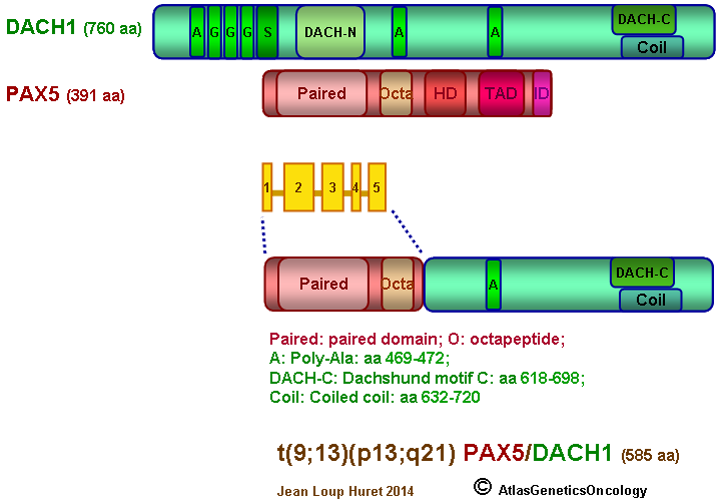
PAX5/DACH1 fusion protein.
Description
585 amino acids. The predicted fusion protein contains the DNA binding paired domain of PAX5 (the 201 N-term aa) and the DACHbox-C of DACH1 (the 384 C-term aa).
Highly cited references
| Pubmed ID | Year | Title | Citations |
|---|---|---|---|
| 24435167 | 2014 | Functional heterogeneity of PAX5 chimeras reveals insight for leukemia development. | 0 |
Article Bibliography
| Pubmed ID | Last Year | Title | Authors |
|---|---|---|---|
| 17440452 | 2007 | Pax5: the guardian of B cell identity and function. | Cobaleda C et al |
| 15004008 | 2004 | Pax5 induces V-to-DJ rearrangements and locus contraction of the immunoglobulin heavy-chain gene. | Fuxa M et al |
| 23458709 | 2013 | Focal cerebral ischemia induces the neurogenic potential of mouse Dach1-expressing cells in the dorsal part of the lateral ventricles. | Honsa P et al |
| 15258579 | 2004 | B cell-specific loss of histone 3 lysine 9 methylation in the V(H) locus depends on Pax5. | Johnson K et al |
| 21970955 | 2011 | Pax5: a master regulator of B cell development and leukemogenesis. | Medvedovic J et al |
| 19502783 | 2009 | Altered expression of DACH1 and cyclin D1 in endometrial cancer. | Nan F et al |
| 19020546 | 2009 | Incidence and diversity of PAX5 fusion genes in childhood acute lymphoblastic leukemia. | Nebral K et al |
| 19896866 | 2010 | The Dachshund gene in development and hormone-responsive tumorigenesis. | Popov VM et al |
| 24392136 | 2014 | DACH1: its role as a classifier of long term good prognosis in luminal breast cancer. | Powe DG et al |
| 16024294 | 2005 | Pax6-dependence of Six3, Eya1 and Dach1 expression during lens and nasal placode induction. | Purcell P et al |
| 21750150 | 2011 | Homozygously deleted gene DACH1 regulates tumor-initiating activity of glioma cells. | Watanabe A et al |
| 24335958 | 2014 | Cell fate factor DACH1 represses YB-1-mediated oncogenic transcription and translation. | Wu K et al |
| 19351840 | 2009 | The cell fate determination factor dachshund inhibits androgen receptor signaling and prostate cancer cellular growth. | Wu K et al |
| 17182846 | 2007 | Cell fate determination factor DACH1 inhibits c-Jun-induced contact-independent growth. | Wu K et al |
| 24149323 | 2013 | Epigenetic regulation of DACH1, a novel Wnt signaling component in colorectal cancer. | Yan W et al |
| 16680144 | 2006 | Transcription factor Pax5 (BSAP) transactivates the RAG-mediated V(H)-to-DJ(H) rearrangement of immunoglobulin genes. | Zhang Z et al |
| 23787902 | 2013 | Epigenetic silencing of DACH1 induces loss of transforming growth factor-β1 antiproliferative response in human hepatocellular carcinoma. | Zhu H et al |
Summary
Fusion gene
PAX5/DACH1 PAX5 (9p13.2) DACH1 (13q21.33) M t(9;13)(p12;q21)|PAX5/DACH1 PAX5 (9p13.2) DACH1 (13q21.33) TIC
Citation
Jean-Loup Huret
t(9;13)(p12;q21) PAX5/DACH1
Atlas Genet Cytogenet Oncol Haematol. 2014-01-01
Online version: http://atlasgeneticsoncology.org/haematological/1560/t(9
