SH3PXD2A (SH3 and PX domains 2A)
2015-08-01 Carman Man-Chung Li , Tyler Jacks AffiliationDavid H. Koch Institute for Integrative Cancer Research, Department of Biology, Massachusetts Institute of Technology, Cambridge, Massachusetts 02139, USA. [email protected]
Identity
Abstract
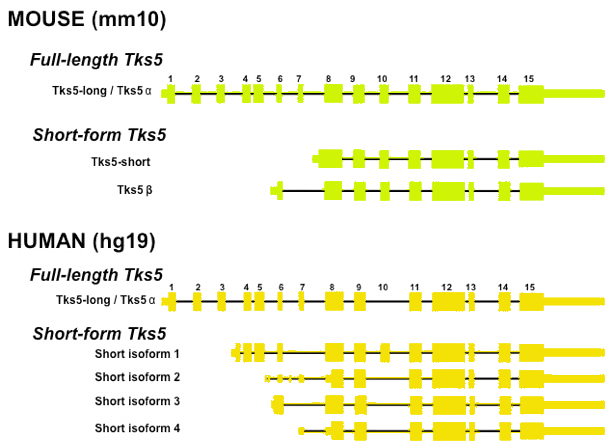
The TKS5 protein, encoded by the gene SH3PXD2A, is a scaffolding protein essential for the formation of podosomes and invadopodia in untransformed cells and cancer cells, respectively. Podosomes and invadopodia (which collectively are termed invadosomes) are actin-rich cellular protrusions capable of secreting proteolytic enzymes that can degrade the extracellular matrix. These structures are thought to regulate cellular migration and invasion, as well as adhesion and the release of growth factors. In the context of cancer, TKS5-dependent invadopodia activity has been shown to play important roles in tumor growth and metastasis in various cancer types. Multiple isoforms of TKS5 exist due to alternative mRNA splicing and promoter usage.
DNA/RNA
Description
Transcription
Proteins
Description
Expression
Localisation
Function
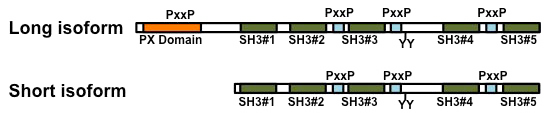
Full-length TKS5 functions as an adaptor for recruiting other proteins to the cell membrane for invadosome formation. The recruitment of TKS5 to the cell membrane depends on its PX domain and phosphorylation by Src (Abram et al., 2003). It has been proposed that phosphorylation of TKS5 releases its PX domain from intramolecular interaction and allows TKS5 to bind to cell membrane phosphatidylinositol lipids, such as phosphatidylinositol-3,4-bisphosphate (PI(3,4)P2) (Abram et al., 2003; Oikawa et al., 2008). At the cell membrane, TKS5 is thought to interact with multiple components of invadosomes either directly or indirectly, and thereby mediates invadosome formation and maturation (Sharma et al., 2013). These interacting partners includes adaptor proteins and actin regulatory proteins, such as NCK1, NCK2, GRB2, CTTN (Cortactin), WASL (N-WASP), ACTR2/ACTR3 (Arp2/3) complex, and ARHGAP35 (p190RhoGAP) (Crimaldi et al., 2009; Oikawa et al., 2008; Stylli et al., 2009).
TKS5 also interacts with NOXA1 and CYBA (p22phox), which are components of the NADPH oxidase complex, and thereby promotes reactive oxygen species (ROS) production by NOX enzymes at invadosomes (Diaz et al., 2009; Gianni et al., 2010; 2009). ROS have been shown to facilitate invadosome formation by maintaining or amplifying the phosphorylation of TKS5. As such, TKS5 is thought to promote invadosome formation via ROS in a positive feedback loop.
Finally, TKS5 has also been shown to interact with members of the ADAM family metalloproteases, specifically ADAM12, ADAM15, ADAM19 (Abram et al., 2003). It is believed that Tks5 recruits theses proteases to the invadosome foci for processing growth factors and regulating cell motility. For example, ADAM12 has been shown to promote ectodomain shedding of HBEGF (heparin-binding EGF-like growth factor) and enhance invadopodia formation in cancer cells (Diaz et al., 2013).
In the context of cancer, TKS5-dependent formation of invadopodia is thought to promote metastasis by mediating local tumor invasion and intravasation at the primary site, as well as extravasation and colonization at the distant site (Murphy and Courtneidge, 2011; Paz et al., 2014). In the context of normal development, TKS5-depedent podosomes are important for mediating cell migration during embryogenesis. Knockdown of Tks5 in zebrafish led to impaired dorsal-ventral migration of neural crest cells and defective craniofacial structures and pigmentation (Murphy et al., 2011). Similarly, genetic deletion of Tks5 in mice led to complete cleft of the secondary palate and neonatal death (Cejudo-Martin et al., 2014). In addition, study in Xenopus showed that Tks5-dependent podosomes are also required for the migration of neuronal growth cones (Santiago-Medina et al., 2015).
While most studies have focused on full-length TKS5, shorter isoforms of TKS5 that lack the PX domain have been reported (Lock et al, 1998; Li et al., 2013; Cejudo-Martin et al., 2014). There are few reports on the functions of these short isoforms. Experiments in mouse lung cancer cell lines showed that overexpression of a short isoform (Tks5-short) suppressed invadopodia function by disrupting the stability of invadopodia (Li et al., 2013). In addition, overexpression of a short-form equivalent protein, ΔPX-Tks5, in Xenopus neural crest cells inhibited invadosome functions and impaired motoneuron axon extension into the peripheral myotomal tissue in Xenopus embryos (Santiago-Medina et al., 2015). These data suggest that the short forms of TKS5 can function as negative regulators of invadosomes.
At the mRNA level, the transcription of full-length Tks5 has been shown to be synergistically inhibited by the developmental regulators NKX2-1, FOXA2, and CDX2 in lung adenocarcinoma (Li et al., 2015). Furthermore, TKS5 has been shown to be a target of the microRNA mir200-c (Sundararajan et al., 2015). In terms of protein stability and abundance, the full-length isoform of TKS5 is positively regulated by Src, while the short isoform (TKS5-beta) is negatively regulated by Src (Cejudo-Martin et al. 2014).
Homology
Implicated in
Article Bibliography
| Pubmed ID | Last Year | Title | Authors |
|---|---|---|---|
| 12615925 | 2003 | The adaptor protein fish associates with members of the ADAMs family and localizes to podosomes of Src-transformed cells. | Abram CL et al |
| 25826475 | 2015 | The invadopodia scaffold protein Tks5 is required for the growth of human breast cancer cells in vitro and in vivo. | Blouw B et al |
| 22021214 | 2011 | The podosome marker protein Tks5 regulates macrophage invasive behavior. | Burger KL et al |
| 24174371 | 2014 | Src-dependent Tks5 phosphorylation regulates invadopodia-associated invasion in prostate cancer cells. | Burger KL et al |
| 19144821 | 2009 | The novel adaptor protein Tks4 (SH3PXD2B) is required for functional podosome formation. | Buschman MD et al |
| 25259869 | 2014 | Genetic disruption of the sh3pxd2a gene reveals an essential role in mouse development and the existence of a novel isoform of tks5. | Cejudo-Martin P et al |
| 22260678 | 2012 | Cell migration and invasion in human disease: the Tks adaptor proteins. | Courtneidge SA et al |
| 19540230 | 2009 | Tks5 recruits AFAP-110, p190RhoGAP, and cortactin for podosome formation. | Crimaldi L et al |
| 23589494 | 2013 | Notch increases the shedding of HB-EGF by ADAM12 to potentiate invadopodia formation in hypoxia. | Díaz B et al |
| 19755709 | 2009 | Tks5-dependent, nox-mediated generation of reactive oxygen species is necessary for invadopodia formation. | Diaz B et al |
| 21397860 | 2011 | Twist1-induced invadopodia formation promotes tumor metastasis. | Eckert MA et al |
| 20943948 | 2010 | c-Src-mediated phosphorylation of NoxA1 and Tks4 induces the reactive oxygen species (ROS)-dependent formation of functional invadopodia in human colon cancer cells. | Gianni D et al |
| 22389406 | 2012 | N-WASP-mediated invadopodium formation is involved in intravasation and lung metastasis of mammary tumors. | Gligorijevic B et al |
| 17440933 | 2007 | Interaction between the ADAM12 and SH3MD1 genes may confer susceptibility to late-onset Alzheimer's disease. | Harold D et al |
| 25176655 | 2014 | Invadopodia are required for cancer cell extravasation and are a therapeutic target for metastasis. | Leong HS et al |
| 23873940 | 2013 | Differential Tks5 isoform expression contributes to metastatic invasion of lung adenocarcinoma. | Li CM et al |
| 26341558 | 2015 | Foxa2 and Cdx2 cooperate with Nkx2-1 to inhibit lung adenocarcinoma metastasis. | Li CM et al |
| 9687503 | 1998 | A new method for isolating tyrosine kinase substrates used to identify fish, an SH3 and PX domain-containing protein, and Src substrate. | Lock P et al |
| 15710903 | 2005 | Amyloid-beta neurotoxicity is mediated by FISH adapter protein and ADAM12 metalloprotease activity. | Malinin NL et al |
| 21697900 | 2011 | The 'ins' and 'outs' of podosomes and invadopodia: characteristics, formation and function. | Murphy DA et al |
| 21799874 | 2011 | A Src-Tks5 pathway is required for neural crest cell migration during embryonic development. | Murphy DA et al |
| 18606851 | 2008 | Sequential signals toward podosome formation in NIH-src cells. | Oikawa T et al |
| 22584907 | 2012 | Tks5-dependent formation of circumferential podosomes/invadopodia mediates cell-cell fusion. | Oikawa T et al |
| 24077283 | 2014 | Invading one step at a time: the role of invadopodia in tumor metastasis. | Paz H et al |
| 25564649 | 2015 | Regulation of ECM degradation and axon guidance by growth cone invadosomes. | Santiago-Medina M et al |
| 15710328 | 2005 | The adaptor protein Tks5/Fish is required for podosome formation and function, and for the protease-driven invasion of cancer cells. | Seals DF et al |
| 24206842 | 2013 | Tks5 and SHIP2 regulate invadopodium maturation, but not initiation, in breast carcinoma cells. | Sharma VP et al |
| 22249020 | 2012 | Prognostic significance of Tks5 expression in gliomas. | Stylli SS et al |
| 24993883 | 2014 | Expression of the adaptor protein Tks5 in human cancer: prognostic potential. | Stylli SS et al |
| 19596797 | 2009 | Nck adaptor proteins link Tks5 to invadopodia actin regulation and ECM degradation. | Stylli SS et al |
| 26334100 | 2015 | The ZEB1/miR-200c feedback loop regulates invasion via actin interacting proteins MYLK and TKS5. | Sundararajan V et al |
| 18982058 | 2008 | Dystroglycan, Tks5 and Src mediated assembly of podosomes in myoblasts. | Thompson O et al |
Other Information
Locus ID:
NCBI: 9644
HGNC: 23664
Ensembl: ENSG00000107957
Variants:
dbSNP: 9644
ClinVar: 9644
TCGA: ENSG00000107957
COSMIC: SH3PXD2A
RNA/Proteins
| Gene ID | Transcript ID | Uniprot |
|---|---|---|
| ENSG00000107957 | ENST00000355946 | Q5TCZ1 |
| ENSG00000107957 | ENST00000369774 | Q5TCZ1 |
| ENSG00000107957 | ENST00000420222 | H0Y507 |
Expression (GTEx)
Protein levels (Protein atlas)
References
| Pubmed ID | Year | Title | Citations |
|---|---|---|---|
| 38353696 | 2024 | A MAP1B-cortactin-Tks5 axis regulates TNBC invasion and tumorigenesis. | 1 |
| 38353696 | 2024 | A MAP1B-cortactin-Tks5 axis regulates TNBC invasion and tumorigenesis. | 1 |
| 37515639 | 2023 | Spontaneous malignant transformation of trigeminal schwannoma: consideration of responsible gene alterations for tumorigenesis-a case report. | 0 |
| 37515639 | 2023 | Spontaneous malignant transformation of trigeminal schwannoma: consideration of responsible gene alterations for tumorigenesis-a case report. | 0 |
| 33414172 | 2021 | Serine-Threonine Kinase TAO3-Mediated Trafficking of Endosomes Containing the Invadopodia Scaffold TKS5α Promotes Cancer Invasion and Tumor Growth. | 7 |
| 33994260 | 2021 | STAT3/SH3PXD2A-AS1/miR-125b/STAT3 positive feedback loop affects psoriasis pathogenesis via regulating human keratinocyte proliferation. | 8 |
| 34255789 | 2021 | The clinicopathologic significance of Tks5 expression of peritoneal mesothelial cells in gastric cancer patients. | 2 |
| 34769479 | 2021 | Tks5 Regulates Synaptic Podosome Formation and Stabilization of the Postsynaptic Machinery at the Neuromuscular Junction. | 0 |
| 33414172 | 2021 | Serine-Threonine Kinase TAO3-Mediated Trafficking of Endosomes Containing the Invadopodia Scaffold TKS5α Promotes Cancer Invasion and Tumor Growth. | 7 |
| 33994260 | 2021 | STAT3/SH3PXD2A-AS1/miR-125b/STAT3 positive feedback loop affects psoriasis pathogenesis via regulating human keratinocyte proliferation. | 8 |
| 34255789 | 2021 | The clinicopathologic significance of Tks5 expression of peritoneal mesothelial cells in gastric cancer patients. | 2 |
| 34769479 | 2021 | Tks5 Regulates Synaptic Podosome Formation and Stabilization of the Postsynaptic Machinery at the Neuromuscular Junction. | 0 |
| 31999741 | 2020 | Tks5 SH3 domains exhibit differential effects on invadopodia development. | 6 |
| 32673397 | 2020 | Intersection of TKS5 and FGD1/CDC42 signaling cascades directs the formation of invadopodia. | 15 |
| 33087629 | 2020 | Functional Role of the L396R Mutation of Tks5 Identified by an Exome-Wide Association Study in Atrial Fibrillation. | 1 |
Citation
Carman Man-Chung Li ; Tyler Jacks
SH3PXD2A (SH3 and PX domains 2A)
Atlas Genet Cytogenet Oncol Haematol. 2015-08-01
Online version: http://atlasgeneticsoncology.org/gene/45995
