ALDH1A1 (Aldehyde Dehydrogenase 1 family member A1)
2019-04-01 Sinem Tunçer , Rümeysa Çamlica , Idris Yilmaz AffiliationIdentity

Abstract
Aldehyde dehydrogenase 1A1 (ALDH1A1) is a member of the ALDH gene superfamily. Aldehyde dehydrogenases (ALDHs) are responsible for the metabolism of aldehydes (exogenous and endogenous) through NAD(P)+<\/sup>-dependent oxidation to their corresponding carboxylic acids or CoA esters. Different biological functions have been attributed to the different ALDH family members. The cytosolic enzyme ALDH1A1 is involved in the catalysis of retinol (vitamin A) metabolite retinaldehyde to retinoic acid (RA). RA acts as a ligand for the nuclear receptors retinoic receptor (RAR) and the retinoid X receptor (RXR) and therefore regulates the transcriptional activity of genes involved in multiple important processes including proliferation, differentiation, and apoptosis.
DNA/RNA
Note
| Gene Species | Gene Symbol | Identity (%) DNA |
| H.sapiens | ALDH1A1 | |
| vs. P.troglodytes | ALDH1A1 | 99,5 |
| vs. M.mulatta | ALDH1A1 | 97,9 |
| vs. C.lupus | ALDH1A1 | 88,4 |
| vs. B.taurus | ALDH1A1 | 90,2 |
| vs. M.musculus | Aldh1a1 | 84,6 |
| vs. R.norvegicus | Aldh1a1 | 83,9 |
| vs. G.gallus | ALDH1A1 | 79,4 |
| vs. X.tropicalis | aldh1a1 | 74,4 |
| vs. E.gossypii | AGOS_ADR417W | 54,1 |
| vs. A.thaliana | ALDH2C4 | 57,6 |
| vs. O.sativa | Os01g0591000 | 56 |
| vs. O.sativa | Os01g0591300 | 55,5 |
Table 1. Pairwise alignment of ALDH1A1 gene (in distance from human) (HomoloGene, NCBI).

Description
Transcription
| Name | Transcript ID | bp | CCDS | RefSeq |
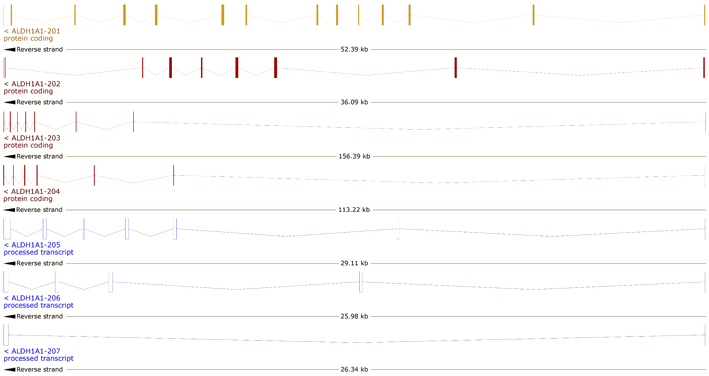
| ALDH1A1-201 | ENST00000297785.7 | 2107 | CCDS6644 | NM_000689 |
| ALDH1A1-202 | ENST00000376939.5 | 822 | - | - |
| ALDH1A1-203 | ENST00000419959.5 | 806 | - | - |
| ALDH1A1-204 | ENST00000446946.1 | 805 | - | - |
| ALDH1A1-205 | ENST00000482210.5 | 879 | - | - |
| ALDH1A1-206 | ENST00000493113.1 | 604 | - | - |
| ALDH1A1-207 | ENST00000493311.1 | 209 | - | - |
Table 2. Transcripts of human ALDH1A1 gene (Ensembl release 95-January 2019)
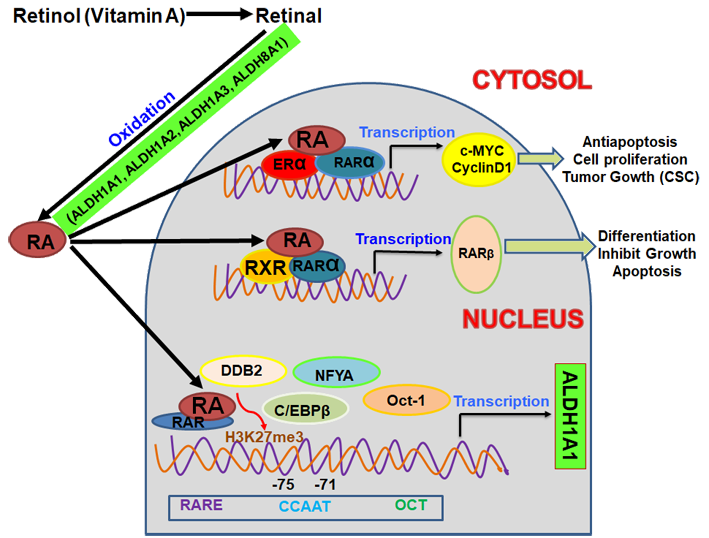
Studies in human K562 erythroleukemia and Hep3B hepatoma cells showed that the ALDH1A1 promoter contains a positive regulatory region (-91 to +53 bp to the transcription start site) with a CCAAT box as a major cisacting element (Alam et al., 2013). Among CCAAT-recognizing transcription factors, nuclear factor YA ( NFYA) was shown to be involved in ALDH1A1 transcription. Mamat et al. found that in cooperation with POU2F1 (Oct-1), alternatively spliced isoforms of NFYA plays an important role in ALDH1A1 expression in endometrial adenocarcinoma (Mamat et al., 2011). In mouse hepatoma cells, RARA transactivates the Aldh1a1 promoter by binding to the RARE region, located between -91 and -75 bp. Moreover, CEBPB has been demonstrated to transactivate the ALDH1A1 promoter by interacting with the CCAAT box that resides at -75 to -71 bp adjacent to the RARE (Alam et al., 2013).
Pseudogene
Proteins
Note
| Name | Transcript ID | bp | Protein | Charge | Isoelectric Point | Molecular Weight | CCDS | UniProt | RefSeq |
| ALDH1A1-201 | ENST00000297785.7 | 2107 | 501aa | 1,0 | 6,6811 | 54,861.84 g/mol | CCDS6644 | P00352 V9HW83 | NM_000689 NP_000680 |
| ALDH1A1-202 | ENST00000376939.5 | 822 | 230aa | -0,5 | 6,2427 | 25,314.22 g/mol | - | Q5SYQ9 | - |
| ALDH1A1-203 | ENST00000419959.5 | 806 | 238aa | -1,0 | 6.1061 | 26,097.05 g/mol | - | Q5SYQ8 | - |
| ALDH1A1-204 | ENST00000446946.1 | 805 | 203aa | -1,0 | 5,8174 | 22,654.11 g/mol | - | Q5SYQ7 | - |
Table 3. Protein products of human ALDH1A1 gene (Ensembl release 95-January 2019)
| Gene Species | Gene Symbol | Identity (%) Protein |
| H.sapiens | ALDH1A1 | |
| vs. P.troglodytes | ALDH1A1 | 100 |
| vs. M.mulatta | ALDH1A1 | 98,8 |
| vs. C.lupus | ALDH1A1 | 89 |
| vs. B.taurus | ALDH1A1 | 91,2 |
| vs. M.musculus | Aldh1a1 | 87 |
| vs. R.norvegicus | Aldh1a1 | 86,4 |
| vs. G.gallus | ALDH1A1 | 84,2 |
| vs. X.tropicalis | aldh1a1 | 78,2 |
| vs. E.gossypii | AGOS_ADR417W | 50,7 |
| vs. A.thaliana | ALDH2C4 | 52 |
| vs. O.sativa | Os01g0591000 | 53,8 |
| vs. O.sativa | Os01g0591300 | 51,8 |
Table 4. Pairwise alignment of ALDH1A1 protein sequences (in distance from human) (HomoloGene, NCBI)
Description
Expression
Localisation
Function
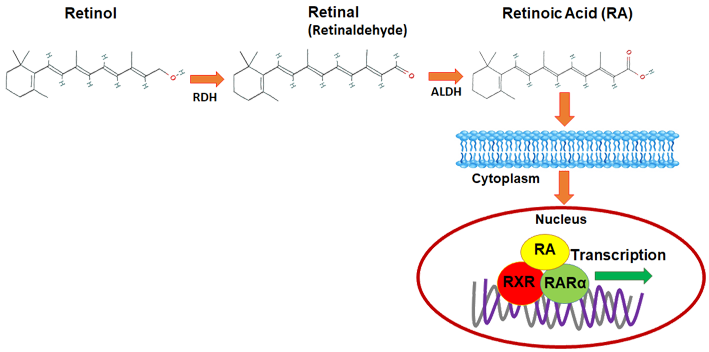
Aldehyde dehydrogenase (ALDH) enzyme family plays an important role in cellular signal transmission and protection by catalyzing the oxidation of aldehydes (Alam et al., 2013). ALDH1A1 mainly contributes to the biosynthesis of retinoic acid (RA) from vitamin A (Van Der Waals et al., 2018). Inside the cell, Retinol (vitamin A) is oxidized to retinal by retinal dehydrogenases. The retinal is then oxidized to RA in a reaction catalyzed with ALDH1A1, ALDH1A2, ALDH1A3, and ALDH8A1 (Tomita et al., 2016). The RA enters the cell nucleus and binds and activates RA receptors (RARs) or retinoid X receptors (RXRs) to regulate gene expression (Zhao et al., 2014).
ALDH1A1 also plays a role in acetaldehyde metabolism. Acetaldehyde is the first product of ethanol metabolism. Alcohol, taken with alcohol consumption, is converted to acetaldehyde by alcohol dehydrogenase (ADH), catalase and cytochrome P450 2E1. Then, acetaldehyde is metabolized to acetates by ALDH2 and ALDH1A1. Indeed, low ALDH1A1 activity is suggested to be related to alcohol sensitivity in some Caucasian populations ("Identification And Characterisation Of Alcohol-Induced Flushing In Caucasian Subjects", 2017). Moreover, decreased levels of ALDH1A1 were shown in RXRA-/-w/sup> mice, which were more susceptible to alcoholic liver injury (Gyamfi, 2006), while increased ALDH1A1 expression found in brains of alcohol-avoiding DBA/2 mice (Bhave et al., 2006).
ALDH1A1 is predominantly expressed by a subgroup of dopaminergic (DA) neurons in the midbrain (Maring et al., 1985). In DA neurons, ALDH1A1 mediates the oxidation of the cytotoxic dopamine intermediate, 3,4-dihydroxyphenylacetaldehyde (DOPAL), to the less reactive 3,4-dihydroxyphenylacetic acid (DOPAC), and thereby protects the DA neurons from toxicity (Pan et al., 2019). Very recently, ALDH1A1 was reported to mediate the synthesis of the inhibitory neurotransmitter gamma-aminobutyric acid (GABA) (Kim et al., 2015) in DA neurons, where co-release of dopamine and GABA regulates alcohol consumption and preference (Pan et al., 2019). In addition, as a metabolic product of ALDH1A1, RA is known to play a crucial role in neuronal patterning, differentiation, and survival (Pan et al., 2019).
In addition to its role in aldehyde metabolism, ALDH1A1 possesses esterase activity. Collard et al. proposed ALDH1A1 being the major if not the only enzyme responsible for the oxidation of 3-deoxyglucosone to 2-keto-3-deoxygluconate (Collard et al., 2007).
ALDHs are generally categorized as detoxification enzymes. ALDH1A1 was found to offer cellular protection against cytotoxic drugs and implicated in drug-resistance in chemotherapy (Tomita et al., 2016). ALDH1A1 activity has been reported to provide cellular protection against some oxazaphosphorine anticancer drugs, such as cyclophosphamide (CP) and ifosfamide, by detoxifying their major active aldehyde metabolites (Hilton, 1984; Wang et al., 2017).
ALDH1A1 also plays a vital role as a marker of stem cells and cancer stem cells. Experimental data indicate that ALDH1 activity, predominantly attributed to isotype ALDH1A1, is tissue and cancer type specific. On the other hand, although elevated ALDH1 activity and ALDH1A1 overexpression are associated with poor cancer prognosis, high ALDH1 and ALDH1A1 levels are not always correlated with highly malignant phenotypes and poor clinical outcome in a range of cancers (Tomita et al., 2016). It is suggested that ALDH1A1 can be a useful marker for cancer stem cells derived from tumors that normally do not express high levels of ALDH1A1, including breast, lung, esophagus, colon, and stomach (Tomita et al., 2016; Xing et al., 2014).
ALDH1A1 also plays a key role in the cellular defense against oxidative stress: ALDH activity is required to maintain sufficiently low Reactive Oxygen Species (ROS) level. Human ALDH1A1 was shown to efficiently oxidize lipid peroxidation-derived aldehydes, like 4-Hydroxynonenal (4-HNE), hexanal, and Malondialdehyde (MDA) (MANZER et al., 2003), and Aldh1a1 knock-out mouse models demonstrated that ALDH1A1 plays a crucial role in protecting the mouse eye lens and cornea by detoxifying lipid peroxidation-derived aldehydes and preventing cataract formation induced by oxidative stresses (Mice et al., 2008).
In addition to its catalytic functions, ALDH1A1 has also non-catalytic roles. Similar with other ALDHs, ALDH1A1 acts as corneal and lens crystallins in mammalian eye tissue and contributes to the transparent and refractive properties of the eye (Vasiliou et al., 2013), as well as protects the eye from tissue damage as mentioned earlier. Finally, since ALDH1A1 can bind thyroid hormone and its expression is induced by estrogens, it is suggested that the enzyme may be regulated by or involved in hormone signaling (Marchitti et al., 2008).
Mutations
Note
Consequences of indicated ALDH1A1 mutations are necessary to evaluate.
Implicated in
As an ALDH1A1 metabolite, RA has also an effect on adipogenesis. RA treatment of obese mice resulted in weight loss and increased insulin sensitivity in addition to increased expression of RAR and other genes (Berry and Noy, 2009). In comparison with other vitamin A metabolizing enzymes responsible in the production of RA, the major enzyme expressed during adipogenesis is ALDH1A1, and ALDH1A1 deficiency was shown to result in impaired adipogenesis (Harrison et al., 2011). Retinal, the substrate of ALDH1A1, is suggested to inhibit PPARG (peroxisome proliferator-activated receptor-gamma) a transcription factor known as the master regulator of adipogenesis. Ziouzenkova et al. showed that retinal is present in rodent fat, binds retinol-binding proteins (CRBP1, RBP4), inhibits adipogenesis and suppresses PPARG and RXR responses. In vivo, mice lacking the Aldh1a1 resisted diet-induced obesity and insulin resistance and showed increased energy dissipation. In ob/ob mice, administrating retinal or an Aldh1a1 inhibitor reduced fat and increased insulin sensitivity (Ziouzenkova et al., 2007).
Kim et al. showed that an evolutionarily conserved GABA synthesis pathway involves Aldh1a1. They found that repeated ethanol exposure reduces GABA co-release from the ventral tegmental area (VTA) dopamine neurons and downregulation of Aldh1a through gene targeting or RNA interference increases alcohol consumption in mice. These findings highlight the importance of Aldh1a1 and VTA GABA co-release in moderating alcohol consumption (Kim et al., 2015).
More recently, Cui et al. showed that in ovarian cancer, DNA damage-binding protein 2 (DDB2) suppresses non-cancer stem cell to cancer stem cell conversion by repressing ALDH1A1 transcription. Mechanistically, DDB2 binds to the ALDH1A1 gene promoter, enhances the enrichment of histone H3K27me3, and thereby competes with the transcription factor CEBPB for binding to this region, and eventually inhibits the promoter activity of the ALDH1A1 gene (Cui et al., 2018) (Figure 5).
Article Bibliography
| Pubmed ID | Last Year | Title | Authors |
|---|---|---|---|
| 24043631 | 2013 | MUC1-C oncoprotein activates ERK→C/EBPβ signaling and induction of aldehyde dehydrogenase 1A1 in breast cancer cells. | Alam M et al |
| 15526345 | 2004 | Proteome analysis of human substantia nigra in Parkinson's disease. | Basso M et al |
| 19364826 | 2009 | All-trans-retinoic acid represses obesity and insulin resistance by activating both peroxisome proliferation-activated receptor beta/delta and retinoic acid receptor. | Berry DC et al |
| 17010133 | 2006 | Gene array profiles of alcohol and aldehyde metabolizing enzymes in brains of C57BL/6 and DBA/2 mice. | Bhave SV et al |
| 25670168 | 2015 | Aldehyde Dehydrogenase Is Regulated by β-Catenin/TCF and Promotes Radioresistance in Prostate Cancer Progenitor Cells. | Cojoc M et al |
| 17175089 | 2007 | Identification of 3-deoxyglucosone dehydrogenase as aldehyde dehydrogenase 1A1 (retinaldehyde dehydrogenase 1). | Collard F et al |
| 28937653 | 2017 | Differential Functional Roles of ALDH1A1 and ALDH1A3 in Mediating Metastatic Behavior and Therapy Resistance of Human Breast Cancer Cells. | Croker AK et al |
| 29752431 | 2018 | DDB2 represses ovarian cancer cell dedifferentiation by suppressing ALDH1A1. | Cui T et al |
| 25881507 | 2015 | The role of LGR5 and ALDH1A1 in non-small cell lung cancer: Cancer progression and prognosis. | Gao F et al |
| 16829625 | 2006 | The role of retinoid X receptor alpha in regulating alcohol metabolism. | Gyamfi MA et al |
| 6488175 | 1984 | Role of aldehyde dehydrogenase in cyclophosphamide-resistant L1210 leukemia. | Hilton J et al |
| 25446856 | 2015 | Comparative and evolutionary studies of vertebrate ALDH1A-like genes and proteins. | Holmes RS et al |
| 21712190 | 2011 | Update on the aldehyde dehydrogenase gene (ALDH) superfamily. | Jackson B et al |
| 22878609 | 2012 | Expression analysis of aldehyde dehydrogenase 1A1 (ALDH1A1) in colon and rectal cancer in association with prognosis and response to chemotherapy. | Kahlert C et al |
| 26894647 | 2017 | Increased Expression of ALDH1A1 in Prostate Cancer is Correlated With Tumor Aggressiveness: A Tissue Microarray Study of Iranian Patients. | Kalantari E et al |
| 26430123 | 2015 | Aldehyde dehydrogenase 1a1 mediates a GABA synthesis pathway in midbrain dopaminergic neurons. | Kim JI et al |
| 20889728 | 2010 | Targeting aldehyde dehydrogenase cancer stem cells in ovarian cancer. | Landen CN Jr et al |
| 17567582 | 2007 | Multiple and additive functions of ALDH3A1 and ALDH1A1: cataract phenotype and ocular oxidative damage in Aldh3a1(-/-)/Aldh1a1(-/-) knock-out mice. | Lassen N et al |
| 27354812 | 2016 | The prognostic roles of ALDH1 isoenzymes in gastric cancer. | Li K et al |
| 20010854 | 2010 | ALDH1A1 is a marker for malignant prostate stem cells and predictor of prostate cancer patients' outcome. | Li T et al |
| 24938375 | 2014 | ALDH1A1 expression correlates with clinicopathologic features and poor prognosis of breast cancer patients: a systematic review and meta-analysis. | Liu Y et al |
| 22701763 | 2011 | Transcriptional Regulation of Aldehyde Dehydrogenase 1A1 Gene by Alternative Spliced Forms of Nuclear Factor Y in Tumorigenic Population of Endometrial Adenocarcinoma. | Mamat S et al |
| 21552008 | 2011 | Aldehyde dehydrogenase: its role as a cancer stem cell marker comes down to the specific isoform. | Marcato P et al |
| 18611112 | 2008 | Non-P450 aldehyde oxidizing enzymes: the aldehyde dehydrogenase superfamily. | Marchitti SA et al |
| 25240521 | 2014 | Immunohistochemical analysis of cancer stem cell markers in pancreatic adenocarcinoma patients after neoadjuvant chemoradiotherapy. | Mizukami T et al |
| 22079344 | 2012 | The enzymatic activity of human aldehyde dehydrogenases 1A2 and 2 (ALDH1A2 and ALDH2) is detected by Aldefluor, inhibited by diethylaminobenzaldehyde and has significant effects on cell proliferation and drug resistance. | Moreb JS et al |
| 25450233 | 2015 | Development of a high-throughput in vitro assay to identify selective inhibitors for human ALDH1A1. | Morgan CA et al |
| 25512087 | 2015 | N,N-diethylaminobenzaldehyde (DEAB) as a substrate and mechanism-based inhibitor for human ALDH isoenzymes. | Morgan CA et al |
| 30837649 | 2019 | ALDH1A1 regulates postsynaptic μ-opioid receptor expression in dorsal striatal projection neurons and mitigates dyskinesia through transsynaptic retinoic acid signaling. | Pan J et al |
| 12943535 | 2003 | Human aldehyde dehydrogenase 3A1 (ALDH3A1): biochemical characterization and immunohistochemical localization in the cornea. | Pappa A et al |
| 21436255 | 2011 | Concerted action of aldehyde dehydrogenases influences depot-specific fat formation. | Reichert B et al |
| 29850778 | 2018 | NGL viewer: web-based molecular graphics for large complexes. | Rose AS et al |
| 14506398 | 2003 | Evaluation of aldehyde dehydrogenase 1 promoter polymorphisms identified in human populations. | Spence JP et al |
| 26160842 | 2015 | ALDH1A1-overexpressing cells are differentiated cells but not cancer stem or progenitor cells in human hepatocellular carcinoma. | Tanaka K et al |
| 26783961 | 2016 | Aldehyde dehydrogenase 1A1 in stem cells and cancer. | Tomita H et al |
| 23159885 | 2013 | Aldehyde dehydrogenases: from eye crystallins to metabolic disease and cancer stem cells. | Vasiliou V et al |
| 28978015 | 2017 | Aldehyde dehydrogenase 1A1 increases NADH levels and promotes tumor growth via glutathione/dihydrolipoic acid-dependent NAD(+) reduction. | Wang B et al |
| 7986281 | 1994 | Identification and characterisation of alcohol-induced flushing in Caucasian subjects. | Ward RJ et al |
| 22384032 | 2012 | Neurodegeneration and motor dysfunction in mice lacking cytosolic and mitochondrial aldehyde dehydrogenases: implications for Parkinson's disease. | Wey MC et al |
| 24485040 | 2014 | High ALDH1A1 expression correlates with poor survival in papillary thyroid carcinoma. | Xing Y et al |
| 28792511 | 2017 | Aldehyde dehydrogenase 1 (ALDH1) isoform expression and potential clinical implications in hepatocellular carcinoma. | Yang CK et al |
| 28046028 | 2017 | Predictive Value of Stemness Factor Sox2 in Gastric Cancer Is Associated with Tumor Location and Stage. | Yang L et al |
| 29748529 | 2018 | Expression of Aldehyde Dehydrogenase 1A1 (ALDH1A1) as a Prognostic Biomarker in Colorectal Cancer Using Immunohistochemistry. | Yang W et al |
| 25230277 | 2014 | NEK2 mediates ALDH1A1-dependent drug resistance in multiple myeloma. | Yang Y et al |
| 25384215 | 2014 | NOTCH-induced aldehyde dehydrogenase 1A1 deacetylation promotes breast cancer stem cells. | Zhao D et al |
| 17529981 | 2007 | Retinaldehyde represses adipogenesis and diet-induced obesity. | Ziouzenkova O et al |
| 30308036 | 2018 | ALDH1A1 expression is associated with poor differentiation, 'right-sidedness' and poor survival in human colorectal cancer. | van der Waals LM et al |
Other Information
Locus ID:
NCBI: 216
MIM: 100640
HGNC: 402
Ensembl: ENSG00000165092
Variants:
dbSNP: 216
ClinVar: 216
TCGA: ENSG00000165092
COSMIC: ALDH1A1
RNA/Proteins
Expression (GTEx)
Pathways
Protein levels (Protein atlas)
PharmGKB
| Entity ID | Name | Type | Evidence | Association | PK | PD | PMIDs |
|---|---|---|---|---|---|---|---|
| PA166131270 | aldophosphamide | Chemical | VipGene | associated | |||
| PA166131319 | chloroacetaldehyde | Chemical | VipGene | associated | |||
| PA166157783 | rs6151031 | Variant | VipGene | associated | 17286337, 15597079 | ||
| PA443309 | Alcoholism | Disease | VipGene | associated | |||
| PA443560 | Breast Neoplasms | Disease | ClinicalAnnotation | associated | PD | 29938344 | |
| PA448073 | ethanol | Chemical | VipGene | associated | |||
| PA448803 | carboplatin | Chemical | ClinicalAnnotation | associated | PD | 18854779 | |
| PA449165 | cyclophosphamide | Chemical | ClinicalAnnotation, VipGene | associated | PD | 15237855, 10469894, 18854779, 29938344 | |
| PA449412 | doxorubicin | Chemical | ClinicalAnnotation | associated | PD | 29938344 | |
| PA451668 | thiotepa | Chemical | ClinicalAnnotation | associated | PD | 18854779 | |
| PA451884 | vitamin a | Chemical | VipGene | associated |
References
| Pubmed ID | Year | Title | Citations |
|---|---|---|---|
| 37249063 | 2024 | METTL3-mediated ALDH m(6)A methylation regulates the malignant behavior of BMI1(+) HNSCC stem cells. | 3 |
| 38169509 | 2024 | ALDH1A1 drives prostate cancer metastases and radioresistance by interplay with AR- and RAR-dependent transcription. | 1 |
| 38400679 | 2024 | Are embryonic stem cell markers and ALDH1A1 relevant in the context of breast cancer estrogen positivity? | 1 |
| 37249063 | 2024 | METTL3-mediated ALDH m(6)A methylation regulates the malignant behavior of BMI1(+) HNSCC stem cells. | 3 |
| 38169509 | 2024 | ALDH1A1 drives prostate cancer metastases and radioresistance by interplay with AR- and RAR-dependent transcription. | 1 |
| 38400679 | 2024 | Are embryonic stem cell markers and ALDH1A1 relevant in the context of breast cancer estrogen positivity? | 1 |
| 36768723 | 2023 | The Prognostic Value of Cancer Stem Cell Markers (CSCs) Expression-ALDH1A1, CD133, CD44-For Survival and Long-Term Follow-Up of Ovarian Cancer Patients. | 4 |
| 37298333 | 2023 | The Molecular Context of Oxidant Stress Response in Cancer Establishes ALDH1A1 as a Critical Target: What This Means for Acute Myeloid Leukemia. | 3 |
| 36768723 | 2023 | The Prognostic Value of Cancer Stem Cell Markers (CSCs) Expression-ALDH1A1, CD133, CD44-For Survival and Long-Term Follow-Up of Ovarian Cancer Patients. | 4 |
| 37298333 | 2023 | The Molecular Context of Oxidant Stress Response in Cancer Establishes ALDH1A1 as a Critical Target: What This Means for Acute Myeloid Leukemia. | 3 |
| 34897678 | 2022 | EHMT1 promotes tumor progression and maintains stemness by regulating ALDH1A1 expression in alveolar rhabdomyosarcoma. | 0 |
| 34974299 | 2022 | High aldehyde dehydrogenase 1 activity is related to radiation resistance due to activation of AKT signaling after insulin stimulation in prostate cancer. | 1 |
| 35090523 | 2022 | Co-expression of cancer stem cell markers, SALL4/ALDH1A1, is associated with tumor aggressiveness and poor survival in patients with serous ovarian carcinoma. | 8 |
| 35162954 | 2022 | Mesothelin Expression Is Not Associated with the Presence of Cancer Stem Cell Markers SOX2 and ALDH1 in Ovarian Cancer. | 0 |
| 35194895 | 2022 | ITGA7, CD133, ALDH1 are inter-correlated, and linked with poor differentiation, lymph node metastasis as well as worse survival in surgical cervical cancer. | 1 |
Citation
Sinem Tunçer ; Rümeysa Çamlica ; Idris Yilmaz
ALDH1A1 (Aldehyde Dehydrogenase 1 family member A1)
Atlas Genet Cytogenet Oncol Haematol. 2019-04-01
Online version: http://atlasgeneticsoncology.org/gene/53077/meetings/teaching-explorer/
