CRLF2 (Cytokine receptor like factor 2)
2019-02-01 Dafné Moreno-Lorenzana , Rocío Juárez-Velázquez , Daniel MartÍnez-Anaya , Patricia Péez-Vera AffiliationIdentity
HGNC
LOCATION
Xp22.33 and Yp11.2, negative strand. ENSG00000205755
IMAGE

LEGEND
A) Chromosomal location of CRLF2 gene. B) Mapping of CRLF2 gene and local order on genomic context of the chromosome X and Y.
IMAGE

LEGEND
Chromosomes obtained from MHH-CALL-4 cell line positive to IGH/CRLF2 translocation detected by fluorescence in situ hybridization (FISH). The der(Y) chromosome is lost in the cell line. Metaphase hybridized with CRLF2 break-apart probe (Cytocell Aquarius) with a normal chromosome X (green-red signal, yellow arrow), and der(14) (green signal, white arrow).
ALIAS
CRL2,TSLPR
FUSION GENES
Abstract
CRLF2 is a member of type I cytokine receptor family. CRLF2 forms a functional complex with IL-7 receptor α chain and thymic stromal lymphopoietin, this complex induces the activation of signal transducers and activators of transcription proteins. The overexpression of CRLF2 induced by genetic rearrangements has been described in acute lymphoblastic leukemia.
DNA/RNA
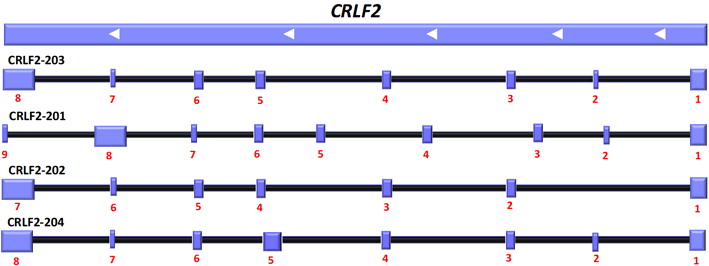
CRLF2 gene encodes four transcript variants: two with 8 exons, one with 9 exons, and one with 7 exons (exons are represented by violet boxes and introns by black line). ENSG00000205755, Entrez Gene ID: 64109
Description
CRLF2 gene is located in reverse strand of pseudo-autosomal region 1 (PAR1) in X and Y chromosomes. CRLF2 encompasses 22kb of DNA and give rise to four transcript variants with different lengths: 1.6, 1.5, 1.0 and 1.7 kb. ENSG00000205755
Transcription
CRLF2 gene encodes a member of type I cytokine receptor family and generate four transcript variants (Table 1). Three generate protein coding transcripts and one generates a non-sense mediated decay transcript.
According with gene expression array data CRLF2 is expressed, from highest to lowest, in: cervix > lung > bladder > small intestine > esophagus > stomach > skin > prostate > uterus > vagina > testes > colon > spleen > mammary gland > thyroid > whole blood.
It has been reported that in pathological conditions the transcription rate of CRLF2 is altered. CRLF2 overexpression (fold change > 2) is found in: microbial infection, immunodeficiency syndromes (X-linked hyper IgM syndrome), autoimmune diseases (arthritis), and cancer (esophagus dysplasia, papillary thyroid carcinoma and acute lymphoblastic leukemia). The CRLF2 subexpression (fold change < 2) has been reported only in cancer (myelodysplastic syndrome, non-small cell lung carcinoma, hepatobiliary carcinoma, colorectal carcinoma, pancreatic adenocarcinoma and breast carcinoma). ENSG00000205755; UniProt Q9HC73; neXtProt NX_Q9HC73
Table 1. Transcript variants and proteins
According with gene expression array data CRLF2 is expressed, from highest to lowest, in: cervix > lung > bladder > small intestine > esophagus > stomach > skin > prostate > uterus > vagina > testes > colon > spleen > mammary gland > thyroid > whole blood.
It has been reported that in pathological conditions the transcription rate of CRLF2 is altered. CRLF2 overexpression (fold change > 2) is found in: microbial infection, immunodeficiency syndromes (X-linked hyper IgM syndrome), autoimmune diseases (arthritis), and cancer (esophagus dysplasia, papillary thyroid carcinoma and acute lymphoblastic leukemia). The CRLF2 subexpression (fold change < 2) has been reported only in cancer (myelodysplastic syndrome, non-small cell lung carcinoma, hepatobiliary carcinoma, colorectal carcinoma, pancreatic adenocarcinoma and breast carcinoma). ENSG00000205755; UniProt Q9HC73; neXtProt NX_Q9HC73
Table 1. Transcript variants and proteins
| Name (RefSeq) | Exons | Coding Exons | Transcript Length | Protein Length | Type of transcript |
| CRLF2-203 (NM_022148) | 8 | 8 | 1, 639 bp | 371 residues | Protein coding |
| CRLF2-201 | 9 | 8 | 1, 545 bp | 371 residues | Protein coding |
| CRLF2-202 (NM_001012288) | 7 | 6 | 1, 013 bp | 259 residues | Protein coding |
| CRLF2-204 (NR_110830) | 8 | 5 | 1, 789 bp | 232 residues | Non-sense mediated decay |
Proteins

Isoform 1 is a single-pass type I membrane protein, have a length of 371 aa. Protein sequence includes four main regions: FN3 (Fibronectin type 3), encompassed from 109 to 207 aa; WSXWS motif, encompassed from 200 to 204 aa; Box 1 motif encompassed from 261 to 269 aa; Transmembrane region encompassed from 232 to 252 aa.
Isoform 2 is a secreted protein an only have FN3 region, encompassed from 7 to 76 aa.
Description
CRLF2 gene encodes a member of the type I cytokine receptor family. CRLF2 has three protein coding transcripts: CRLF2-201, CRLF2-202, CRLF2-203 and CRLF2-204.
CRLF2-203 and CRLF2-201 transcript variants generate the longer isoform of 371 amino acids (42 kDa), also called isoform 1.
Isoform 1 has the protein regions that characterize this family gene: FN3 (Fibronectin type 3) region, WSXWS motif, Box 1 motif, and transmembrane region. Post-translational modifications of CRLF2 protein include glycosylation at asparagine residues (Asn169, Asn55 and Asn47) and phosphorylation at isoleucine (Ile271) and tyrosine (Tyr74) residues.
The other isoform, called isoform 2, is encoded by the transcript variant CRLF2-202. This isoform is shorter, 259 amino acids (26.6 kDa), at N-terminus compared with isoform 1 because lacks an alternate exon which results in translation initiation at a downstream start codon. ENSG00000205755; UniProt Q9HC73, Q9HC73-2, Q4V300; neXtProt NX_Q9HC73
CRLF2-203 and CRLF2-201 transcript variants generate the longer isoform of 371 amino acids (42 kDa), also called isoform 1.
Isoform 1 has the protein regions that characterize this family gene: FN3 (Fibronectin type 3) region, WSXWS motif, Box 1 motif, and transmembrane region. Post-translational modifications of CRLF2 protein include glycosylation at asparagine residues (Asn169, Asn55 and Asn47) and phosphorylation at isoleucine (Ile271) and tyrosine (Tyr74) residues.
The other isoform, called isoform 2, is encoded by the transcript variant CRLF2-202. This isoform is shorter, 259 amino acids (26.6 kDa), at N-terminus compared with isoform 1 because lacks an alternate exon which results in translation initiation at a downstream start codon. ENSG00000205755; UniProt Q9HC73, Q9HC73-2, Q4V300; neXtProt NX_Q9HC73
Expression
CRLF2 protein is present in intestine, bone marrow, spleen, thymus, and is more abundant in dendritic cells. neXtProt NX_Q9HC73
Localisation
CRLF2 isoform 1 is a cell membrane protein and CRLF2 isoform 2 is a secreted protein.
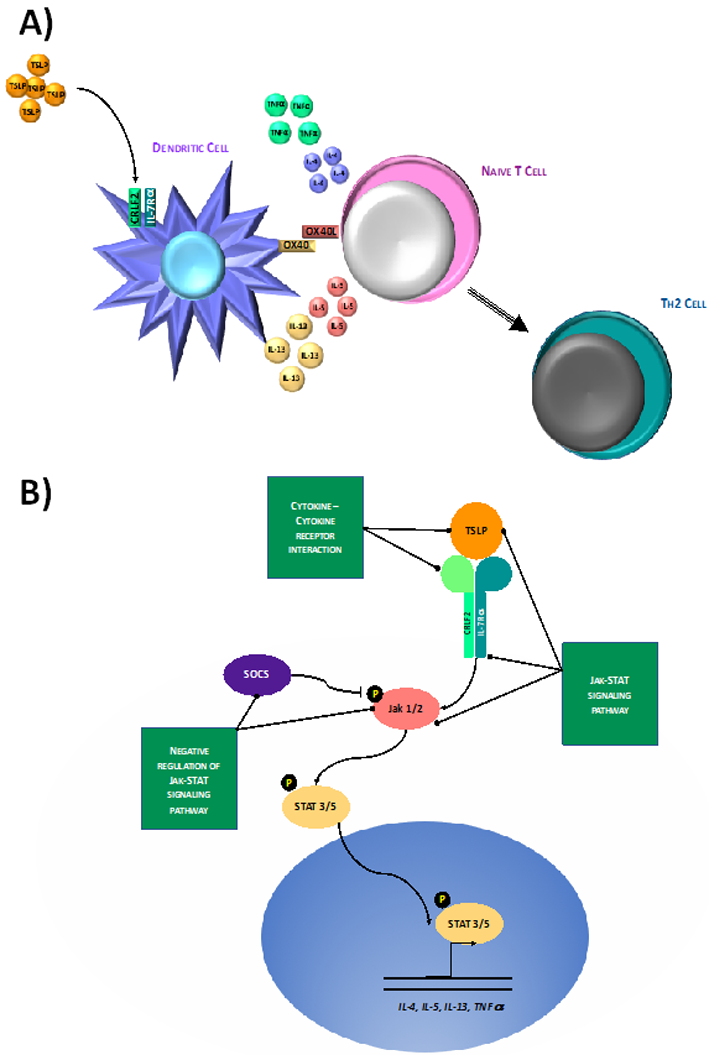
A) TSLP /CRLF2/ IL7R complex activation is implicated in Th2 differentiation. TSLP binds to CRLF2/IL-7Rα heterodimer in dendritic cells and promotes the expression of OX40 ligand ( TNFSF4 (CD252)) and IL13, IL5, IL4 and TNF to induce Th2 differentiation. B) TSLP/CRLF2/IL-7Rα complex activation in dendritic cells. Activation of CRLF2 was described by first time in dendritic cells. This scheme exemplifies the main nodes involved.
Function
CRLF2 forms a functional complex with IL-7Rα (IL-7 receptor α chain) and TSLP (thymic stromal lymphopoietin). Functional complex activation induces different signals depending on the type of cell and also exerts multiple functions. Heterocomplex is involved in a plethora of physiologic and pathologic immune functions, including: tolerance, allergy, autoimmune diseases and cancer. (Tsilingin et al., 2017).
CRLF2 is expressed mainly in dendritic cells and also hematopoietic cells including T cells, B cells, granulocytes, and mast cells. Heterocomplex main function is the differentiation to T helper type 2 (Th2) cells. CRLF2-activated dendritic cells express OX40 ligand and trigger naive CD4+ to differentiate into inflammatory Th2 cells and the expansion of allergen-specific Th2 memory cells (Lin et al., 2018).
According with phosphoproteome analysis in diverse cell types, after TSLP binds to the CRLF2/IL-7Rα heterocomplex, the phosphorylation of Janus kinase1 ( JAK1) and 2 ( JAK2) activates signal transducers and activators of transcription (STATs) proteins, including: STAT1, STAT3, STAT4, STAT5A, STAT5B and STAT6. Heterocomplex also activates other signaling molecules such as PI3K/AKT/MTOR pathway, SRC / TEC pathway, MAPK3 / MAPK1 (ERK1/2), NF-kB, MAPK8 / MAPK9 (JNK1 JNK2), and p38/MAPK activation (Zhong Jun et al., 2012; Zhong Jun et al., 2014).
In allergy or autoimmune disease has been described high expression of TSLP and overstimulation of TSLP/CRLF2/IL-7Rα complex. Tezepelumab is a human monoclonal antibody that blocks functional complex and is successfully used in asthma treatment (Van Rompaey et al., 2012).
The role of functional heterocomplex in cancer is still controversial, in certain neoplasia plays a pro-tumorigenic role, whereas in others, a protective role. For example, in cervix, breast, and pancreas cancer has been describe an increase of metastasis associated with an overstimulation of TSLP/CRLF2/IL-7Rα. On the other hand, in colon and skin carcinoma, functional heterocomplex has been associated with better prognostic. In addition to above, CRLF2 gene has genetic alterations that promote cell survival in cancer. The genetic rearrangements P2RY8/CRLF2 and IGH/CRLF2, generate CRLF2 overexpression, and the mutation Phe232Cys, encodes CRLF2 proteins capable of forming homodimers and self-activation, both described in acute lymphoblastic leukemia (Varricchi et al., 2018; Zhong Jun, 2014).
CRLF2 is expressed mainly in dendritic cells and also hematopoietic cells including T cells, B cells, granulocytes, and mast cells. Heterocomplex main function is the differentiation to T helper type 2 (Th2) cells. CRLF2-activated dendritic cells express OX40 ligand and trigger naive CD4+ to differentiate into inflammatory Th2 cells and the expansion of allergen-specific Th2 memory cells (Lin et al., 2018).
According with phosphoproteome analysis in diverse cell types, after TSLP binds to the CRLF2/IL-7Rα heterocomplex, the phosphorylation of Janus kinase1 ( JAK1) and 2 ( JAK2) activates signal transducers and activators of transcription (STATs) proteins, including: STAT1, STAT3, STAT4, STAT5A, STAT5B and STAT6. Heterocomplex also activates other signaling molecules such as PI3K/AKT/MTOR pathway, SRC / TEC pathway, MAPK3 / MAPK1 (ERK1/2), NF-kB, MAPK8 / MAPK9 (JNK1 JNK2), and p38/MAPK activation (Zhong Jun et al., 2012; Zhong Jun et al., 2014).
In allergy or autoimmune disease has been described high expression of TSLP and overstimulation of TSLP/CRLF2/IL-7Rα complex. Tezepelumab is a human monoclonal antibody that blocks functional complex and is successfully used in asthma treatment (Van Rompaey et al., 2012).
The role of functional heterocomplex in cancer is still controversial, in certain neoplasia plays a pro-tumorigenic role, whereas in others, a protective role. For example, in cervix, breast, and pancreas cancer has been describe an increase of metastasis associated with an overstimulation of TSLP/CRLF2/IL-7Rα. On the other hand, in colon and skin carcinoma, functional heterocomplex has been associated with better prognostic. In addition to above, CRLF2 gene has genetic alterations that promote cell survival in cancer. The genetic rearrangements P2RY8/CRLF2 and IGH/CRLF2, generate CRLF2 overexpression, and the mutation Phe232Cys, encodes CRLF2 proteins capable of forming homodimers and self-activation, both described in acute lymphoblastic leukemia (Varricchi et al., 2018; Zhong Jun, 2014).
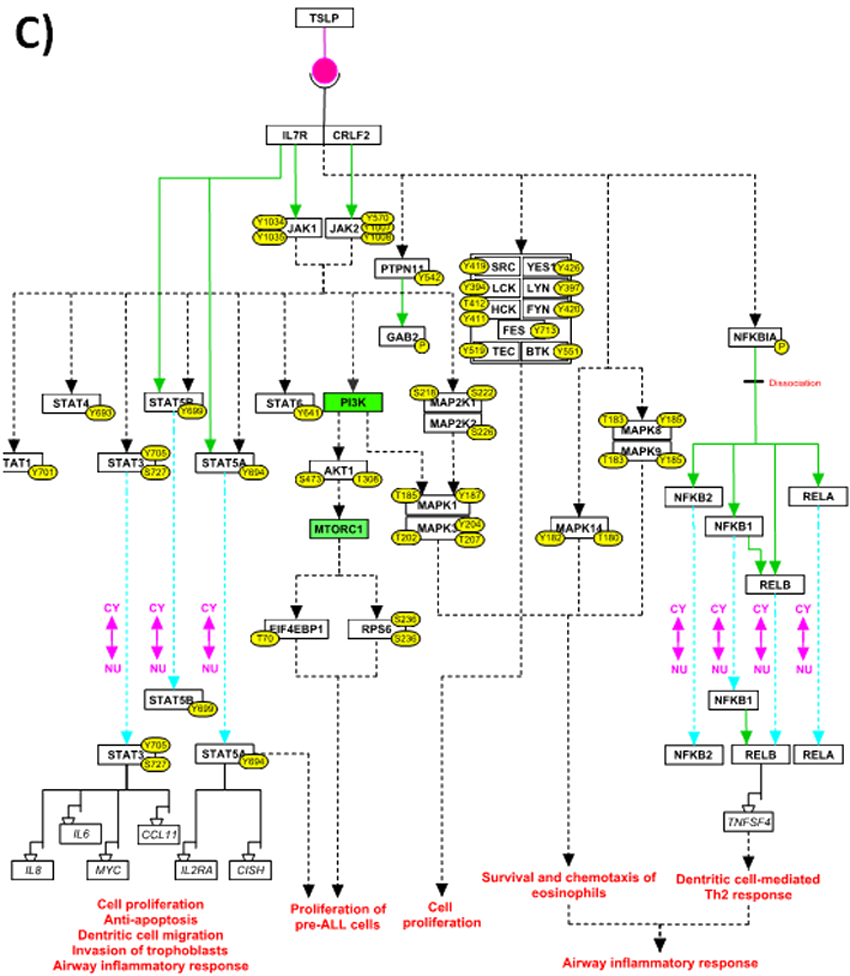
C) Phosphoproteomic analysis reveals multiple targets in TSLP/CRLF2/IL-7Rα pathway in different cell types. This scheme shows experimental curated data obtained from NetSlim.
Homology
Table 2. CRLF2 Orthologues
| Name | Organism |
| CRLF2 | P. troglodytes |
| CRLF2 (ENSCAFG00000011034) | C. lupus |
| LOC529792 (ENSBTAG00000020242) | B. taurus |
| Crlf2 (ENSMUSG00000033467) | M. musculus |
| Crlf2 (ENSRNOG00000049828) | R. novergicus |
| LOC418668 (ENSGALG00000016696) | G. gallus |
Mutations
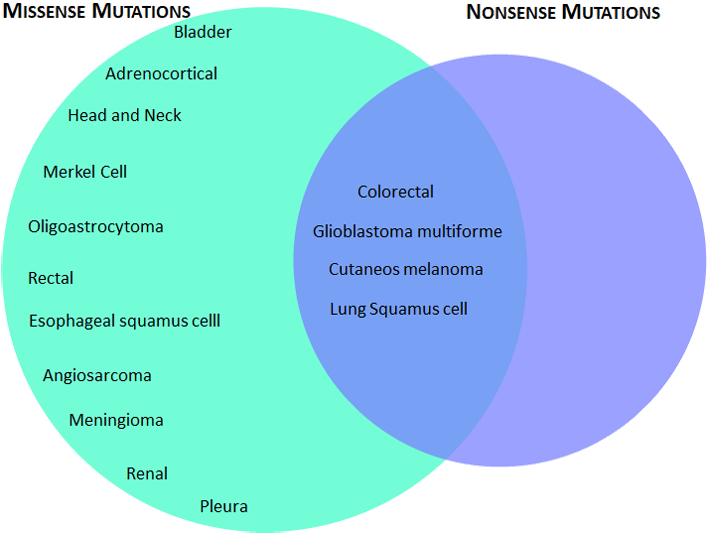
Mutations in CRLF2 have been identified in a wide range of cancer types. Most of them are missense mutations (green), nonsense mutations are also represented (violet).
Somatic
Table 3 CRLF2 mutations in cancer
Catalogue of Somatic Mutations in Cancer; cBioPortal for Cancer Genomics
| CDS Mutation | Cancer Type | Type of Mutation |
| c.315C>A | Bladder Carcinoma | Missense mutation |
| c.357C>A | Bladder Carcinoma | Missense mutation |
| c.193G>A | Bladder Carcinoma | Missense mutation |
| c.89T>A | Bladder Carcinoma | Missense mutation |
| c.33C>G | Diffuse Large B Cell Lymphoma | Missense mutation |
| c.415T>C | Diffuse Large B Cell Lymphoma | Missense mutation |
| c.349C>T | Osteosarcoma | Missense mutation |
| c.330T>C | Colon Carcinoma | Missense mutation |
| c.384G>A | Colon Carcinoma | Missense mutation |
| c.33C>G | Colon Carcinoma | Missense mutation |
| c.159G>A | Rectum Carcinoma | Missense mutation |
| c.474C>T | Adenocarcinoma | Missense mutation |
| c.372C>T | Adenocarcinoma | Missense mutation |
| c.411G>A | Adenocarcinoma | Missense mutation |
| c.603C>T | Adenocarcinoma | Missense mutation |
| c.405G>A | Adenocarcinoma | Missense mutation |
| c.669G>A | Adenocarcinoma | Missense mutation |
| c.642T>C | Adenocarcinoma | Missense mutation |
| c.642T>C | Endometrioid Carcinoma | Missense mutation |
| c.321C>T | Lung Carcinoma | Missense mutation |
| c.384G>A | Pleura Carcinoma | Missense mutation |
| c.456C>T | Melanoma | Missense mutation |
| c.411G>A | Melanoma | Missense mutation |
| c.468C>T | Melanoma | Missense mutation |
| c.123C>T | Melanoma | Missense mutation |
| c.630G>A | Melanoma | Missense mutation |
| c.534G>A | Melanoma | Missense mutation |
| c.438C>T | Melanoma | Missense mutation |
| c.383C>T | Merkel Cell Carcinoma | Missense mutation |
| c-.335G>T | Merkel Cell Carcinoma | Missense mutation |
| c.604G>A | Urinary Tract Carcinoma | Missense mutation |
| c.742C>A | Urinary Tract Carcinoma | Missense mutation |
| c.208C>A | Neuroblastoma | Missense mutation |
| c.139A>T | Glioma | Missense mutation |
| c.404C>T | Glioma | Missense mutation |
| c.365C>T | Glioma | Missense mutation |
| c.598C>A | Glioma | Missense mutation |
| c.404C>T | Glioma | Missense mutation |
| c.313C>T | Glioma | Missense mutation |
| c.74G>A | Glioma | Missense mutation |
| c.632G>A | Glioma | Missense mutation |
| c.445G>A | Meningioma | Missense mutation |
| c.660G>T | Breast Carcinoma | Missense mutation |
| c.734C>T | Breast Carcinoma | Missense mutation |
| c.526G>C | Breast Carcinoma | Missense mutation |
| c.297C>G | Cervix Carcinoma | Missense mutation |
| c.658G>C | Cervix Carcinoma | Missense mutation |
| c.566C>T | Endometrium Carcinoma | Missense mutation |
| c.536A>T | Endometrium Carcinoma | Missense mutation |
| c.643C>T | Endometrium Carcinoma | Missense mutation |
| c.7C>T | Endometrium Carcinoma | Missense mutation |
| c.496A>C | Endometrium Carcinoma | Missense mutation |
| c.373G>A | Endometrium Carcinoma | Missense mutation |
| c.346T>C | Endometrium Carcinoma | Missense mutation |
| c.495A>C | Endometrium Carcinoma | Missense mutation |
| c.248G>T | Kidney Carcinoma | Missense mutation |
| c.526G>A | Liver Carcinoma | Missense mutation |
| c.105C>G | Liver Carcinoma | Missense mutation |
| c.671C>T | Acute Myeloid Leukemia | Missense mutation |
| c.695T>G | B Cell Acute Lymphoblastic Leukemia | Missense mutation |
| c.2T>A | Mantle Cell Lymphoma | Missense mutation |
| c.340G>C | Marginal Zone Lymphoma | Missense mutation |
| c.228C>T | Head and Neck Carcinoma | Missense mutation |
| c.764G>A | Melanoma | No sense mutation |
| c.764G>A | Melanoma | No sense mutation |
| c.755G>A | Head and Neck Carcinoma | No sense mutation |
| c.755G>A | Melanoma | No sense mutation |
| c.451C>T | Melanoma | No sense mutation |
| c.628C>T | Pancreas | No sense mutation |
| c.137G>A | Colon Carcinoma | No sense mutation |
| c.620C>G | Intestinal Adenocarcinoma | No sense mutation |
| c.91C>T | Glioblastoma Multiforme | No sense mutation |
| c.73G>T | Adenocarcinoma | No sense mutation |
| c.54G>A | Head and Neck Carcinoma | No sense mutation |
| c.25G>T | Lung Carcinoma | No sense mutation |
Catalogue of Somatic Mutations in Cancer; cBioPortal for Cancer Genomics
Implicated in
Entity name
Hematological malignancies
Oncogenesis
The t(X;14)(p22;q32) or t(Y;14)(p11;q32) rearrange CRLF2 with immunoglobulin heavy chain gene forming IGH/CRLF2 rearrangement. With P2Y purinoceptor 8 gene ( P2RY8), located also in the pseudoautosomal (PAR1) region of X or Y chromosomes, CRLF2 forms a rearrangement through the interstitial deletions del(X)(p22p22) or del(Y)(p11p11). Both abnormalities are associated with B-precursor acute lymphoblastic leukemia (pre-B ALL) and Down syndrome pre-B ALL (Entrez Gene ID: 64109; Russell LJ et al., 2009).
It has been referred similar deletions in the PAR1 region involving the interleukin 3 receptor subunit alpha ( IL3RA) gene or the colony stimulating factor 2 receptor alpha subunit (CSF2RA) gene and CRLF2, indicating that the breakpoints are variable between patients. Interestingly, one patient has been reported with the CSF2RA/CRLF2 rearrangement and IGH/ EPOR (Yano M et al., 2015). These rearrangements produce the overexpression of CRLF2 by the juxtaposition of this gene within the gene promoter of P2RY8, AKAP17A (SFRS17A), or ASMT (Russell LJ et al., 2009). Biallelic deletions of the PAR1 region, including CSF2RA and CRLF2 genes, have been reported in mantle cell lymphoma (Nieländer I et al., 2008).
In addition, four fusions with CRLF2 have been also reported: 1) CHRFAM7A /CRLF2 with the cholinergic receptor, nicotinic, alpha 7, exons 5-10 and he family with sequence similarity 7A, exons A-E fusion gene (CHRNA7) located in 15q13 (Fusion gen ID: 7161); 2) CRLF2/ U2AF1 with the U2 small nuclear RNA auxiliary factor 1 gene (U2F1), associated with myelodysplastic syndrome, and located in 21q22.3 (Fusion gen ID: 8499); 3) GOLGA8A /CRLF2 with the golgin A8 family member A gene (GOLGA8A) in 15q14 (Fusion gen ID: 15056); 4) WDR27 /CRLF2 with the WD repeat domain 27 gene (WDR27) in 6q27 (Fusion gen ID: 41824).
It has been referred similar deletions in the PAR1 region involving the interleukin 3 receptor subunit alpha ( IL3RA) gene or the colony stimulating factor 2 receptor alpha subunit (CSF2RA) gene and CRLF2, indicating that the breakpoints are variable between patients. Interestingly, one patient has been reported with the CSF2RA/CRLF2 rearrangement and IGH/ EPOR (Yano M et al., 2015). These rearrangements produce the overexpression of CRLF2 by the juxtaposition of this gene within the gene promoter of P2RY8, AKAP17A (SFRS17A), or ASMT (Russell LJ et al., 2009). Biallelic deletions of the PAR1 region, including CSF2RA and CRLF2 genes, have been reported in mantle cell lymphoma (Nieländer I et al., 2008).
In addition, four fusions with CRLF2 have been also reported: 1) CHRFAM7A /CRLF2 with the cholinergic receptor, nicotinic, alpha 7, exons 5-10 and he family with sequence similarity 7A, exons A-E fusion gene (CHRNA7) located in 15q13 (Fusion gen ID: 7161); 2) CRLF2/ U2AF1 with the U2 small nuclear RNA auxiliary factor 1 gene (U2F1), associated with myelodysplastic syndrome, and located in 21q22.3 (Fusion gen ID: 8499); 3) GOLGA8A /CRLF2 with the golgin A8 family member A gene (GOLGA8A) in 15q14 (Fusion gen ID: 15056); 4) WDR27 /CRLF2 with the WD repeat domain 27 gene (WDR27) in 6q27 (Fusion gen ID: 41824).
Entity name
Pulmonary alveolar proteinosis
Note
A recessive pattern of another similar homozygous deletion, that disrupts CSF2RA, CRLF2, and IL3RA gene, was found in a boy with pulmonary alveolar proteinosis, an accumulation of surfactant in the alveoli. Surfactant is cleared by alveolar macrophages, and granulocyte-macrophage colony-stimulating factor (GM-CSF) and its signaling is necessary for this process. GM-CSF activates Jak-Stat pathway inducing phagocytic functions of alveolar macrophage and catabolize surfactant (Chiu CY et al., 2017).
Article Bibliography
| Pubmed ID | Last Year | Title | Authors |
|---|---|---|---|
| 28233860 | 2017 | Whole-Genome Sequencing of a Family with Hereditary Pulmonary Alveolar Proteinosis Identifies a Rare Structural Variant Involving CSF2RA/CRLF2/IL3RA Gene Disruption. | Chiu CY et al |
| 29670037 | 2018 | Expression and Regulation of Thymic Stromal Lymphopoietin and Thymic Stromal Lymphopoietin Receptor Heterocomplex in the Innate-Adaptive Immunity of Pediatric Asthma. | Lin SC et al |
| 18515880 | 2008 | Recurrent loss of the Y chromosome and homozygous deletions within the pseudoautosomal region 1: association with male predominance in mantle cell lymphoma. | Nieländer I et al |
| 19641190 | 2009 | Deregulated expression of cytokine receptor gene, CRLF2, is involved in lymphoid transformation in B-cell precursor acute lymphoblastic leukemia. | Russell LJ et al |
| 28275684 | 2017 | Thymic Stromal Lymphopoietin: To Cut a Long Story Short. | Tsilingiri K et al |
| 29222519 | 2017 | Virtual screening for inhibitors of the human TSLP:TSLPR interaction. | Van Rompaey D et al |
| 30057581 | 2018 | Thymic Stromal Lymphopoietin Isoforms, Inflammatory Disorders, and Cancer. | Varricchi G et al |
| 22345495 | 2012 | TSLP signaling network revealed by SILAC-based phosphoproteomics. | Zhong J et al |
| 24573880 | 2014 | TSLP signaling pathway map: a platform for analysis of TSLP-mediated signaling. | Zhong J et al |
Other Information
Locus ID:
NCBI: 64109
MIM: 400023
HGNC: 14281
Ensembl: ENSG00000205755
Variants:
dbSNP: 64109
ClinVar: 64109
TCGA: ENSG00000205755
COSMIC: CRLF2
RNA/Proteins
Expression (GTEx)
Pathways
References
| Pubmed ID | Year | Title | Citations |
|---|---|---|---|
| 36642937 | 2023 | The prognostic significance of CRLF2 expression at diagnosis in adult Ph-negative B-cell precursor acute lymphoblastic leukemia. | 0 |
| 37364323 | 2023 | TSLP/TSLPR promotes renal fibrosis by activating STAT3 in renal fibroblasts. | 0 |
| 36642937 | 2023 | The prognostic significance of CRLF2 expression at diagnosis in adult Ph-negative B-cell precursor acute lymphoblastic leukemia. | 0 |
| 37364323 | 2023 | TSLP/TSLPR promotes renal fibrosis by activating STAT3 in renal fibroblasts. | 0 |
| 34587248 | 2022 | Genome-wide CRISPR-Cas9 screen identifies rationally designed combination therapies for CRLF2-rearranged Ph-like ALL. | 7 |
| 34857887 | 2022 | HMGN1 plays a significant role in CRLF2 driven Down Syndrome leukemia and provides a potential therapeutic target in this high-risk cohort. | 10 |
| 34987014 | 2022 | Prognostic significance of CRLF2 overexpression and JAK2 mutation in Egyptian pediatric patients with B-precursor acute lymphoblastic leukemia. | 4 |
| 35253299 | 2022 | CRLF2 overexpression defines an immature-like subgroup which is rescued through restoration of the PRC2 function in T-cell precursor acute lymphoblastic leukemia. | 2 |
| 35306048 | 2022 | CRLF2 overexpression results in reduced B-cell differentiation and upregulated E2F signaling in the Dp16 mouse model of Down syndrome. | 3 |
| 35537330 | 2022 | High occurrence of CRLF2 abnormalities in Mexican children with B-cell acute lymphoblastic leukemia. | 4 |
| 34587248 | 2022 | Genome-wide CRISPR-Cas9 screen identifies rationally designed combination therapies for CRLF2-rearranged Ph-like ALL. | 7 |
| 34857887 | 2022 | HMGN1 plays a significant role in CRLF2 driven Down Syndrome leukemia and provides a potential therapeutic target in this high-risk cohort. | 10 |
| 34987014 | 2022 | Prognostic significance of CRLF2 overexpression and JAK2 mutation in Egyptian pediatric patients with B-precursor acute lymphoblastic leukemia. | 4 |
| 35253299 | 2022 | CRLF2 overexpression defines an immature-like subgroup which is rescued through restoration of the PRC2 function in T-cell precursor acute lymphoblastic leukemia. | 2 |
| 35306048 | 2022 | CRLF2 overexpression results in reduced B-cell differentiation and upregulated E2F signaling in the Dp16 mouse model of Down syndrome. | 3 |
Citation
Dafné Moreno-Lorenzana ; Rocío Juárez-Velázquez ; Daniel MartÍnez-Anaya ; Patricia Péez-Vera
CRLF2 (Cytokine receptor like factor 2)
Atlas Genet Cytogenet Oncol Haematol. 2019-02-01
Online version: http://atlasgeneticsoncology.org/gene/51262/crlf2
