MIR135A1 (microRNA 135a-1)
2014-02-01 Alfons Navarro , Marina Díaz-Beyá , Mariano Monzó AffiliationMolecular Oncology, Embryology Laboratory, Human Anatomy Unit, School of Medicine, University of Barcelona, Barcelona, Spain (AN, MM); Hematology Department, Hospital Clinic, IDIBAPS, Barcelona, Spain (MDB)
DNA/RNA
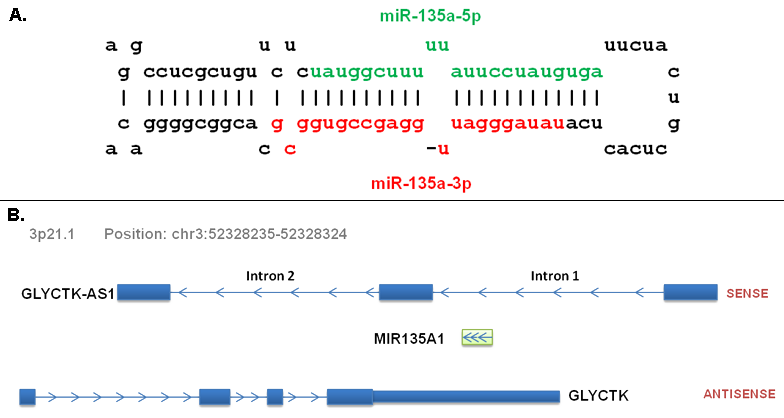
A. Stem-loop structure of hsa-mir-135a-1. B. Genomic location of MIR135A 1 and its host genes.
Description
The gene is located in the intron 1 of GLYCTK-AS1/RP11 gene (sense) and in the exon 4 of GLYCTK (antisense). The precursor length is 90 nt.
Transcription
Pseudogene
No reported pseudogenes.
Proteins
Note
MicroRNAs are not translated into amino acids.
Implicated in
Entity name
Cancer
Entity name
Colorectal cancer (CRC)
Note
Interestingly, treating CRC cell lines with mistletoe lecitin-I, degrades precursor of some microRNAs, including pre-mir-135a, thus dowregulating miR-135 and upregulating APC and increasing beta-catenin phosphorylation (Li et al., 2011).
Prognosis
Oncogenesis
Oncogene.
miRNA expression: Overexpression among colorectal adenome and carcinome in comparison with normal tissue. miR-135 family (miR-135a and miR-135b) overexpression during CRC progression (in patients) (Nagel et al., 2008). Consistently, a study comparing patient samples, healthy controls and cell lines showed overexpression in CRC samples (Zhou et al., 2012). Another study also showed overexpression associated with progression and metastasis (Vickers et al., 2012).
Targets: Adenomatous polyposis coli (APC) (Nagel et al., 2008). Metastasis suppressor 1 (MTSS1) (Zhou et al., 2012).
Function: miR-135a and miR-135b inhibits APC translation (independently of mutational status of APC) activating downstream Wnt pathway activity and induce beta-catenin signaling (Nagel et al., 2008). In CRC cell lines, miR-135a overexpression increased proliferation and promoted mobility and invasion in part by targeting MTSS1 (Zhou et al., 2012).
miRNA expression: Overexpression among colorectal adenome and carcinome in comparison with normal tissue. miR-135 family (miR-135a and miR-135b) overexpression during CRC progression (in patients) (Nagel et al., 2008). Consistently, a study comparing patient samples, healthy controls and cell lines showed overexpression in CRC samples (Zhou et al., 2012). Another study also showed overexpression associated with progression and metastasis (Vickers et al., 2012).
Targets: Adenomatous polyposis coli (APC) (Nagel et al., 2008). Metastasis suppressor 1 (MTSS1) (Zhou et al., 2012).
Function: miR-135a and miR-135b inhibits APC translation (independently of mutational status of APC) activating downstream Wnt pathway activity and induce beta-catenin signaling (Nagel et al., 2008). In CRC cell lines, miR-135a overexpression increased proliferation and promoted mobility and invasion in part by targeting MTSS1 (Zhou et al., 2012).
Entity name
Gastric cancer
Oncogenesis
Tumor suppressor (Wu H et al., 2012).
miRNA expression: Downregulation in gastric cancer patient samples in comparison with adjacent normal tissue.
Targets: JAK2 (Janus kinase 2)
Function: miR-135a overexpression produces downregulation of JAK2 levels reducing cell proliferation and colony formation. It also reduces p-STAT3 (phospho signal transducer and activator of transcription 3) activation and cyclin D1 and Bcl-x (BCL2-like1).
miRNA expression: Downregulation in gastric cancer patient samples in comparison with adjacent normal tissue.
Targets: JAK2 (Janus kinase 2)
Function: miR-135a overexpression produces downregulation of JAK2 levels reducing cell proliferation and colony formation. It also reduces p-STAT3 (phospho signal transducer and activator of transcription 3) activation and cyclin D1 and Bcl-x (BCL2-like1).
Entity name
Hepatocellular carcinoma (HCC)
Prognosis
In a cohort of 50 patients, overexpression of miR-135a identified a group of patients with worse OS end DFS among patients with PVTT.
Oncogenesis
Oncogene (Liu et al., 2012).
Function: miR-135a promotes invasion and metastasis in vitro and in mouse models of HCC. Reducing miR-135a leads to reduced PVTT. The transcription of miR-135a is regulated by FOXM1. Targets: MTSS
Function: miR-135a promotes invasion and metastasis in vitro and in mouse models of HCC. Reducing miR-135a leads to reduced PVTT. The transcription of miR-135a is regulated by FOXM1. Targets: MTSS
Entity name
Breast cancer
Oncogenesis
Oncogene (Chen et al., 2012).
miRNA expression: Overexpression in metastasic breast tumors in comparison with benign tumor patient samples. Upregulation in the highly invasive breast cancer cell line BT 549 in comparison with other breast cancer cell lines.
Targets: HOXA10 (homeobox A10).
Function: miR-135a promotes the migration and invasion of breast cancer cells at least in part through HOXA10.
miRNA expression: Overexpression in metastasic breast tumors in comparison with benign tumor patient samples. Upregulation in the highly invasive breast cancer cell line BT 549 in comparison with other breast cancer cell lines.
Targets: HOXA10 (homeobox A10).
Function: miR-135a promotes the migration and invasion of breast cancer cells at least in part through HOXA10.
Entity name
Malignant glioma
Oncogenesis
Tumor suppressor (Wu S et al., 2012).
miRNA expression: Downregulated in glioma in comparison with normal glia. miRNA-135a correlated negatively with the pathological grading of human glioma tissue samples.
Targets: STAT6 (signal transducer and activator of transcription 6), SMAD5 (SMAD family member 5), BMPR2 (bone morphogenetic protein receptor, type II).
Function: miR-135a selectively induces mitochondria-dependent apoptosis of malignant glioma by targeting various genes (STAT6, SMAD5, BMPR2). Interestingly it doesnt affect normal glia cells.
miRNA expression: Downregulated in glioma in comparison with normal glia. miRNA-135a correlated negatively with the pathological grading of human glioma tissue samples.
Targets: STAT6 (signal transducer and activator of transcription 6), SMAD5 (SMAD family member 5), BMPR2 (bone morphogenetic protein receptor, type II).
Function: miR-135a selectively induces mitochondria-dependent apoptosis of malignant glioma by targeting various genes (STAT6, SMAD5, BMPR2). Interestingly it doesnt affect normal glia cells.
Entity name
Lung cancer
Oncogenesis
Tumor suppressor (Cheng et al., 2013; Zhou et al., 2013).
miRNA expression: miR-135a/b downregulated in the cisplatin-resistant cell line A549R compared with the cisplatin-sensitive A549 cell line (Zhou, Qiu et al. 2013)
Targets: MCL1 (myeloid cell leukemia sequence 1) (Zhou et al., 2013), CD133 (Cheng et al., 2013).
Function: Overexpression of miR-135a/b reduced MCL1 and sensitized cell lines to cisplatin by modulation of apoptosis (Zhou et al., 2013). miR-135a/b suppressed CD133 only in CD133 with binding polymorphism rs2240688 CC or CA but not in genotype AA (Cheng et al., 2013).
miRNA expression: miR-135a/b downregulated in the cisplatin-resistant cell line A549R compared with the cisplatin-sensitive A549 cell line (Zhou, Qiu et al. 2013)
Targets: MCL1 (myeloid cell leukemia sequence 1) (Zhou et al., 2013), CD133 (Cheng et al., 2013).
Function: Overexpression of miR-135a/b reduced MCL1 and sensitized cell lines to cisplatin by modulation of apoptosis (Zhou et al., 2013). miR-135a/b suppressed CD133 only in CD133 with binding polymorphism rs2240688 CC or CA but not in genotype AA (Cheng et al., 2013).
Entity name
Classic Hodgkin lymphoma (cHL)
Prognosis
In a cohort of 89 cHL patients, low miR-135a was associated with a higher risk of relapse and worse disease free survival.
Oncogenesis
Tumor suppressor (Navarro et al., 2008; Navarro et al., 2009).
miRNA expression: Downregulated miR-135a in cHL patient lymph nodes in comparison with reactive non-tumor lymph nodes used as control.
Targets: JAK2.
Function: Overexpression of miR-135a increases apoptosis and decreases cellular growth in HL cell lines through regulation of JAK/STAT pathway and activation BcL-xL expression.
miRNA expression: Downregulated miR-135a in cHL patient lymph nodes in comparison with reactive non-tumor lymph nodes used as control.
Targets: JAK2.
Function: Overexpression of miR-135a increases apoptosis and decreases cellular growth in HL cell lines through regulation of JAK/STAT pathway and activation BcL-xL expression.
Entity name
Acute myeloid leukemia (AML)
Prognosis
In a cohort of 85 intermediate risk AML (IR-AML) patients (later extended to 238 IR-AML patients), low expression of miR-135a identified a group of patients with a higher risk of relapse - both in the entire cohort and also within the unfavourable molecular subgroup (FLT3-ITD or wild-type NPM and CEBPA) (Díaz-Beyá et al., 2014).
Oncogenesis
Tumor suppressor.
Entity name
Renal cell carcinoma
Oncogenesis
Tumor suppressor (Hidaka et al., 2012).
miRNA expression: Lower expression of miR-135a observed in 10 cancer tissue samples compared to 5 adjacent non-cancer tissue samples.
Function: Effect on cell proliferation, where the miR-135a overexpression reduces cell viavility.
miRNA expression: Lower expression of miR-135a observed in 10 cancer tissue samples compared to 5 adjacent non-cancer tissue samples.
Function: Effect on cell proliferation, where the miR-135a overexpression reduces cell viavility.
Entity name
Cervival cancer cell
Oncogenesis
Oncogene (Leung et al., 2014).
miRNA expression: miR-135a is overexpressed in cervical squamous cell carcinoma in comparison with cervical intraepithelial neoplasia (precancerous lesions).
Targets: SIAH1 (in cervical cancer cells and cervical epithelial cells).
Function: Overexpression of miR-135a induced increased colony formation, anchorage-independent growth, and proliferation, cell-invasion and migration in cervical cancer cell lines. The inhibition of miR-135a on SIAH1 led to upregulation of beta-catenin activity, indicating that miR-135a induces transformation and enhances tumor growth. The authors analyzed the miR-135a-induced malignant transformation activity in cell lines with or without human papiloma virus (HPV) proteins (E6 and E7) and concluded that these proteins are necessary for miR-135a oncogenic activity. Also in xenografts, miR-135a improved the growth of cancer cells and the tumorigenic activity of HPV cells.
miRNA expression: miR-135a is overexpressed in cervical squamous cell carcinoma in comparison with cervical intraepithelial neoplasia (precancerous lesions).
Targets: SIAH1 (in cervical cancer cells and cervical epithelial cells).
Function: Overexpression of miR-135a induced increased colony formation, anchorage-independent growth, and proliferation, cell-invasion and migration in cervical cancer cell lines. The inhibition of miR-135a on SIAH1 led to upregulation of beta-catenin activity, indicating that miR-135a induces transformation and enhances tumor growth. The authors analyzed the miR-135a-induced malignant transformation activity in cell lines with or without human papiloma virus (HPV) proteins (E6 and E7) and concluded that these proteins are necessary for miR-135a oncogenic activity. Also in xenografts, miR-135a improved the growth of cancer cells and the tumorigenic activity of HPV cells.
Entity name
Various tumor cell lines (HeLa cervical carcinoma, SW480 colon cancer, A375 melanoma, PANC-1 pancreatic tumor, and 293 epithelial kidney cells)
Note
FAK is overexpressed in many cancers.
Oncogenesis
Tumor suppressor (Golubovskaya et al., 2014).
Targets: FAK (focal adhesion kinase).
Function: miR-135a overexpression decreased FAK mRNA and protein levels, decreased cell invasion and increased sensitivity to doxorubicin, 5-fluorouacil and FAK inhibitor Y15.
Targets: FAK (focal adhesion kinase).
Function: miR-135a overexpression decreased FAK mRNA and protein levels, decreased cell invasion and increased sensitivity to doxorubicin, 5-fluorouacil and FAK inhibitor Y15.
Entity name
Various tumor cell lines
Oncogenesis
Oncogene (Holleman et al., 2011).
miRNA expression: miR-135a levels were significantly upregulated in paclitaxel-resistant ovarian, lung, uterine, breast and prostate tumor cells lines derived from A549, PC-14, MCF-7, PC-3, SKOV-3 and MES-SA.
Targets: APC.
Function: miR-135a upregulation in vitro and in vivo is associated with paclitaxel resistance. Anti-miR-135a treatment in paclitaxel-resistant lung cancer xenografts restored sensitivity to paclitaxel, in part through the direct inhibition of APC expression.
miRNA expression: miR-135a levels were significantly upregulated in paclitaxel-resistant ovarian, lung, uterine, breast and prostate tumor cells lines derived from A549, PC-14, MCF-7, PC-3, SKOV-3 and MES-SA.
Targets: APC.
Function: miR-135a upregulation in vitro and in vivo is associated with paclitaxel resistance. Anti-miR-135a treatment in paclitaxel-resistant lung cancer xenografts restored sensitivity to paclitaxel, in part through the direct inhibition of APC expression.
Entity name
Metabolism
Entity name
Diabetes
Note
miRNA expression: Overexpression in diabetic human and mouse skeletal muscle.
Targets: IRS2 (insulin receptor substrate 2).
Function: miR-135a inhibits IRS2, thus reducing glucose uptake into the cell. miR-135a overexpression attenuates insulin signaling and glucose uptake in skeletal muscle. In vivo, silencing miR-135a decreases hyperglicemia (Agarwal et al., 2013).
Targets: IRS2 (insulin receptor substrate 2).
Function: miR-135a inhibits IRS2, thus reducing glucose uptake into the cell. miR-135a overexpression attenuates insulin signaling and glucose uptake in skeletal muscle. In vivo, silencing miR-135a decreases hyperglicemia (Agarwal et al., 2013).
Entity name
Essential hypertension, renin-angiotensin-aldosteron system
Note
Entity name
Corticoid dependent stress response
Note
Targets: NR3C2 (mineral corticoid receptor, other alias MR)
Function: In a mouse model, downregulation of miR-135a and miR-124 in amygdale after two hours of stress stimulus. Stress reaction by activation of corticosteroid signaling through NR3C2R. miR-135a and miR-124 are thus important components of the stress signaling response in the brain (Mannironi et al., 2013).
Function: In a mouse model, downregulation of miR-135a and miR-124 in amygdale after two hours of stress stimulus. Stress reaction by activation of corticosteroid signaling through NR3C2R. miR-135a and miR-124 are thus important components of the stress signaling response in the brain (Mannironi et al., 2013).
Entity name
Development, congenital disease and others
Entity name
Cryptorchid testis
Note
miRNA expression: In rat models, low expression of miR-135a in undescended testis in comparison with that in contralateral normal testis. Higher miR-135a expression in the testes than in other organs. miR-135a is detected in spermatogonial stem cells.
Targets: FoxO1 (forehead box protein O1).
Functions: miR-135a contributes to spermatogonial stem cell maintenance through modulation of FoxO1 (Moritoki et al., 2014).
Targets: FoxO1 (forehead box protein O1).
Functions: miR-135a contributes to spermatogonial stem cell maintenance through modulation of FoxO1 (Moritoki et al., 2014).
Entity name
Endometriosis
Note
miRNA expression: Overexpressed in endometriosis in comparison with normal endometrial tissue (50 controls and 32 women with endometriosis).
Targets: HOXA10 (homeobox A10).
Function: miR135a expression in controls was increased during the proliferative phase, decreased at the time of ovulation, and increased during the luteal phase (Petracco et al., 2011).
Targets: HOXA10 (homeobox A10).
Function: miR135a expression in controls was increased during the proliferative phase, decreased at the time of ovulation, and increased during the luteal phase (Petracco et al., 2011).
Entity name
Osteogenesis
Note
miRNA expression: Very low levels in differentiated osteoblast, downregulated during BMP2-mediated osteogenic differentiation.
Targets: SMAD5.
Function: miR-135a suppresses osteogenesis and inhibits differentiation of osteoprogenitors and the osteogenic phenotype in pluripotent cells by attenuating SMAD5. BMP2 inhibits miR-135a expression and permits osteoblast differentiation (Li et al., 2008).
Targets: SMAD5.
Function: miR-135a suppresses osteogenesis and inhibits differentiation of osteoprogenitors and the osteogenic phenotype in pluripotent cells by attenuating SMAD5. BMP2 inhibits miR-135a expression and permits osteoblast differentiation (Li et al., 2008).
Entity name
Muscle differentiation (myogenesis) and Duchenne muscular dystrophy (DMD)
Note
miRNA expression: miR-135a is upregulated during myogenic differentiation. Overexpression of miR-135a is observed when the myoblasts are differentiated in human samples, cell lines and mouse model (Greco et al., 2009). miR-135a is part of the DMD miRNA signature (Greco et al., 2009) and is overexpressed in Duchenne muscle (Cesana et al., 2011).
Targets: MEF2C (myocyte enhancer factor 2C) (Cesana et al., 2011).
Function: Critical in myogenesis by targeting MEF2C. miR-135a inhibits MEF2C, leading to inhibition of muscle genes. LincRNA MD1 sponges miR-135a, allowing transcription of muscle genes. LincRNA MD1 is reduced in Duchenne muscle cells, so miR-135a is overexpressed and MEFC2 is downregulated (Cesana et al., 2011).
Targets: MEF2C (myocyte enhancer factor 2C) (Cesana et al., 2011).
Function: Critical in myogenesis by targeting MEF2C. miR-135a inhibits MEF2C, leading to inhibition of muscle genes. LincRNA MD1 sponges miR-135a, allowing transcription of muscle genes. LincRNA MD1 is reduced in Duchenne muscle cells, so miR-135a is overexpressed and MEFC2 is downregulated (Cesana et al., 2011).
Entity name
Preimplantation embryo development
Note
miRNA expression: Overexpressed in mouse zygote and decreased thereafter, indicating that it is a zygote-specific miRNA.
Targets: SIAH1A (E3 ubiquitin ligase seven in absentia homolog 1A).
Function: miR-135a modulates the first cell cleavage through regulation of Siah1a. When miR-135a is inhibited, first cell cleavage is suppressed. mir-135a regulates proteosomal degradation (Pang et al., 2011).
Targets: SIAH1A (E3 ubiquitin ligase seven in absentia homolog 1A).
Function: miR-135a modulates the first cell cleavage through regulation of Siah1a. When miR-135a is inhibited, first cell cleavage is suppressed. mir-135a regulates proteosomal degradation (Pang et al., 2011).
Entity name
Mouse embryonic stem cells
Note
Entity name
Bovine blastocyst development
Note
miRNA expression: miR-135a is part of a downregulated miRNA signature in more mature stage (Goossens et al., 2013).
Entity name
Megakaryocytopoiesis
Note
miRNA expression: A comparison between differentiated megakaryocytes with AML megakaryocytic cell lines found miR-135a higher in AML samples (Garzon et al., 2006).
Entity name
Hypoxia
Note
miRNA expression: Downregulation of miR-135a (and miR199a-5p) in response to hypoxia.
Targets: FLAP (5-lipoxygenase activating protein) (Gonsalves and Kalra, 2010).
Targets: FLAP (5-lipoxygenase activating protein) (Gonsalves and Kalra, 2010).
Article Bibliography
| Pubmed ID | Last Year | Title | Authors |
|---|---|---|---|
| 23579070 | 2013 | miR-135a targets IRS2 and regulates insulin signaling and glucose uptake in the diabetic gastrocnemius skeletal muscle. | Agarwal P et al |
| 22000014 | 2011 | A long noncoding RNA controls muscle differentiation by functioning as a competing endogenous RNA. | Cesana M et al |
| 22439757 | 2012 | miRNA-135a promotes breast cancer cell migration and invasion by targeting HOXA10. | Chen Y et al |
| 23715500 | 2013 | A microRNA-135a/b binding polymorphism in CD133 confers decreased risk and favorable prognosis of lung cancer in Chinese by reducing CD133 expression. | Cheng M et al |
| 24072101 | 2014 | MicroRNA expression at diagnosis adds relevant prognostic information to molecular categorization in patients with intermediate-risk cytogenetic acute myeloid leukemia. | Díaz-Beyá M et al |
| 16549775 | 2006 | MicroRNA fingerprints during human megakaryocytopoiesis. | Garzon R et al |
| 23438844 | 2014 | MiR-138 and MiR-135 directly target focal adhesion kinase, inhibit cell invasion, and increase sensitivity to chemotherapy in cancer cells. | Golubovskaya VM et al |
| 20194722 | 2010 | Hypoxia-mediated expression of 5-lipoxygenase-activating protein involves HIF-1alpha and NF-kappaB and microRNAs 135a and 199a-5p. | Gonsalves CS et al |
| 23398486 | 2013 | Regulatory microRNA network identification in bovine blastocyst development. | Goossens K et al |
| 19528256 | 2009 | Common micro-RNA signature in skeletal muscle damage and regeneration induced by Duchenne muscular dystrophy and acute ischemia. | Greco S et al |
| 22294552 | 2012 | Tumor suppressive microRNA-1285 regulates novel molecular targets: aberrant expression and functional significance in renal cell carcinoma. | Hidaka H et al |
| 21552288 | 2011 | miR-135a contributes to paclitaxel resistance in tumor cells both in vitro and in vivo. | Holleman A et al |
| 24503442 | 2014 | miR-135a leads to cervical cancer cell transformation through regulation of β-catenin via a SIAH1-dependent ubiquitin proteosomal pathway. | Leung CO et al |
| 20955366 | 2011 | Down-regulation of some miRNAs by degrading their precursors contributes to anti-cancer effect of mistletoe lectin-I. | Li LN et al |
| 18784367 | 2008 | A microRNA signature for a BMP2-induced osteoblast lineage commitment program. | Li Z et al |
| 21888875 | 2012 | MicroRNA-135a contributes to the development of portal vein tumor thrombus by promoting metastasis in hepatocellular carcinoma. | Liu S et al |
| 21793975 | 2012 | Genetic alterations in microRNAs in medulloblastomas. | Lv SQ et al |
| 24023867 | 2013 | Acute stress alters amygdala microRNA miR-135a and miR-124 expression: inferences for corticosteroid dependent stress response. | Mannironi C et al |
| 24184258 | 2014 | Expression profiling of microRNA in cryptorchid testes: miR-135a contributes to the maintenance of spermatogonial stem cells by regulating FoxO1. | Moritoki Y et al |
| 18632633 | 2008 | Regulation of the adenomatous polyposis coli gene by the miR-135 family in colorectal cancer. | Nagel R et al |
| 19666866 | 2009 | Regulation of JAK2 by miR-135a: prognostic impact in classic Hodgkin lymphoma. | Navarro A et al |
| 18089852 | 2008 | MicroRNA expression profiling in classic Hodgkin lymphoma. | Navarro A et al |
| 22132158 | 2011 | miR-135A regulates preimplantation embryo development through down-regulation of E3 Ubiquitin Ligase Seven In Absentia Homolog 1A (SIAH1A) expression. | Pang RT et al |
| 21956427 | 2011 | MicroRNA 135 regulates HOXA10 expression in endometriosis. | Petracco R et al |
| 20634564 | 2010 | miRNAs regulate SIRT1 expression during mouse embryonic stem cell differentiation and in adult mouse tissues. | Saunders LR et al |
| 19944075 | 2010 | MicroRNAs miR-124 and miR-135a are potential regulators of the mineralocorticoid receptor gene (NR3C2) expression. | Sõber S et al |
| 22120473 | 2012 | Stage-dependent differential expression of microRNAs in colorectal cancer: potential role as markers of metastatic disease. | Vickers MM et al |
| 22310976 | 2012 | MiR-135a targets JAK2 and inhibits gastric cancer cell proliferation. | Wu H et al |
| 22139076 | 2012 | MiR-135a functions as a selective killer of malignant glioma. | Wu S et al |
| 23640248 | 2013 | miR-135a/b modulate cisplatin resistance of human lung cancer cell line by targeting MCL1. | Zhou L et al |
| 23017832 | 2012 | MiR-135a promotes growth and invasion of colorectal cancer via metastasis suppressor 1 in vitro. | Zhou W et al |
Other Information
Locus ID:
NCBI: 406925
HGNC: 31520
Ensembl: ENSG00000207926
miRBase:
Variants:
dbSNP: 406925
ClinVar: 406925
TCGA: ENSG00000207926
COSMIC: MIR135A1
RNA/Proteins
Expression (GTEx)
Pathways
| Pathway | Source | External ID |
|---|---|---|
| MicroRNAs in cancer | KEGG | hsa05206 |
| MicroRNAs in cancer | KEGG | ko05206 |
References
| Pubmed ID | Year | Title | Citations |
|---|---|---|---|
| 36538242 | 2023 | CircSTK39 suppresses the proliferation and invasion of bladder cancer by regulating the miR-135a-5p/NR3C2-mediated epithelial-mesenchymal transition signaling pathway. | 2 |
| 36869643 | 2023 | Epigenetic and genetic inactivation of tumor suppressor miR-135a in non-small-cell lung cancer. | 1 |
| 37080266 | 2023 | Circular RNA ciRS-7 affects the propagation of Cryptosporidium parvum in HCT-8 cells via regulating miR-135a-5p/stat1 axis. | 0 |
| 37667545 | 2023 | Placenta-derived exosomal miR-135a-5p promotes gestational diabetes mellitus pathogenesis by activating PI3K/AKT signalling pathway via SIRT1. | 4 |
| 36538242 | 2023 | CircSTK39 suppresses the proliferation and invasion of bladder cancer by regulating the miR-135a-5p/NR3C2-mediated epithelial-mesenchymal transition signaling pathway. | 2 |
| 36869643 | 2023 | Epigenetic and genetic inactivation of tumor suppressor miR-135a in non-small-cell lung cancer. | 1 |
| 37080266 | 2023 | Circular RNA ciRS-7 affects the propagation of Cryptosporidium parvum in HCT-8 cells via regulating miR-135a-5p/stat1 axis. | 0 |
| 37667545 | 2023 | Placenta-derived exosomal miR-135a-5p promotes gestational diabetes mellitus pathogenesis by activating PI3K/AKT signalling pathway via SIRT1. | 4 |
| 35121826 | 2022 | MicroRNA-135 inhibits initiation of epithelial-mesenchymal transition in breast cancer by targeting ZNF217 and promoting m6A modification of NANOG. | 11 |
| 35124585 | 2022 | Single nucleotide polymorphisms in binding site of miRNA-135a and targeted gene IRS2 are correlated with multiple clinical features of PCOS: A study in Chinese women. | 0 |
| 35818205 | 2022 | Mir 135a inhibits tumor cell proliferation by regulating the expression of notch pathway in hepatoblastoma. | 1 |
| 36009038 | 2022 | Hsa-mir-135a Shows Potential as A Putative Diagnostic Biomarker in Saliva and Plasma for Endometriosis. | 2 |
| 36177782 | 2022 | Study of the role of microRNAs 16 and 135a in patients with lifelong premature ejaculation receiving fluoxetine daily for 3 months: A prospective case control study. | 2 |
| 36228497 | 2022 | MiR-135a-5p suppresses breast cancer cell proliferation, migration, and invasion by regulating BAG3. | 5 |
| 35121826 | 2022 | MicroRNA-135 inhibits initiation of epithelial-mesenchymal transition in breast cancer by targeting ZNF217 and promoting m6A modification of NANOG. | 11 |
Citation
Alfons Navarro ; Marina Díaz-Beyá ; Mariano Monzó
MIR135A1 (microRNA 135a-1)
Atlas Genet Cytogenet Oncol Haematol. 2014-02-01
Online version: http://atlasgeneticsoncology.org/gene/50328/mir135a1-(microrna-135a-1)
