NUSAP1 (nucleolar and spindle associated protein 1)
2020-05-01 Michela Damizia , Patrizia Lavia AffiliationIdentity

Abstract
NUSAP1 (Nucleolar and Spindle Associated Protein 1) is a cell-cycle dependent protein highly expressed during mitosis. It has microtubule-binding and DNA-binding activity, which underlies its best-characterised function as a regulator of the mitotic apparatus in dividing cells. Deregulated abundance of NUSAP1 is associated with misassembly or misfunction of the mitotic spindle during mitosis, originating genetic instability in daughter cells. Roles in cell migration, invasion and metastases are also reported, as well as functional interactions with pro-oncogenic pathways. NUSAP1 is overexpressed in several cancer types and is regarded as a novel prognostic biomarker. Experimental down-regulation of NUSAP1 abundance often inhibited cell proliferation in several cancer contexts. NUSAP1 is also proposed as a therapeutic target, with the potential to improve the outcome of treatments in combination therapy for certain cancer types.
DNA/RNA
Description
Transcription
Proteins
Note
Biological overview: NUSAP1 (Nuclear and Spindle Associated Protein) is a cell-cycle dependent protein and is the only product of the NUSAP1 gene, which is selectively expressed in proliferating cells (Raemaekers et al., 2003). Both the mRNA and protein abundance peak in the G2 and M phases of the cell cycle and sharply decrease at mitotic exit.
NUSAP1 is a microtubule-associated protein (MAP) and has microtubule-bundling and stabilizing activity in vitro. This underlies its main function as a regulator of the mitotic apparatus in dividing cells (Raemaekers et al., 2003; Ribbeck et al., 2006). At mitotic onset, NUSAP1 localises to the spindle microtubules in the region that comes in contact with chromosomes, and stabilises their interaction, thus contributing to regulate chromosome segregation to daughter cells.
Deregulated abundance of NUSAP1 is associated with misassembly or misfunction of the mitotic spindle and contributes to generate genetic instability in daughter cells through faulty mitosis. NUSAP1 also has roles in invasion (Gordon et al., 2017) and in functional interactions with pro-oncogenic pathways. High levels of NUSAP1 are often associated with poor prognosis.

Description
- a helix-extension-helix domain (aa 10-44), containing a potential SAP motif - the latter, named after three proteins that share it, i.e. SAF-A/B, Acinus and PIAS, is found in various nuclear proteins involved in transcription, DNA repair, and RNA processing. The SAP motif, which is essential for DNA binding in the SAF-A/B protein, is also thought to act as the DNA-binding motif in many nuclear proteins (https://www.ebi.ac.uk/interpro/entry/InterPro/IPR003034/), and is reported to confer DNA-interacting capacity to the NH2 terminal (N-ter) region of NUSAP1 (Verbakel et al., 2011),
- a bipartite nuclear localisation signal, NLS (aa 194-211) that can interact with KPNA1 and KPNB1 (importin-alpha and -beta),
- the microtubule-binding domain with a minimal essential core located between residues 243-367,
- a KEN box (aa 383-390), required for protein degradation (Li et al., 2007),
- a highly charged domain with a predicted helical structure, called the charged helical domain (ChHD; aa 410-433), in the COOH terminal (C-ter) region,
- the C-ter region containing the MCAK-binding domain (MCBD), (aa 433-441), responsible for direct binding to KIF2C (or MCAK, mitotic centromere-associated kinesin) and implicated in control of the depolymerisation activity of MCAK at the kinetochore region and, thus, for regulating the stabilisation of kinetochore-microtubules attachments during prometaphase and metaphase (Li et al., 2016).
Phosphorylation sites for various cell cycle kinases, including AURKB (Aurora-B) (Hussain et al., 2008; Ozlu et al., 2010), AURKA (Aurora-A) (Sardon et al., 2010), CDK1 (Chou et al., 2011) and ATM (Xie et al., 2011) have been experimentally identified.
Expression
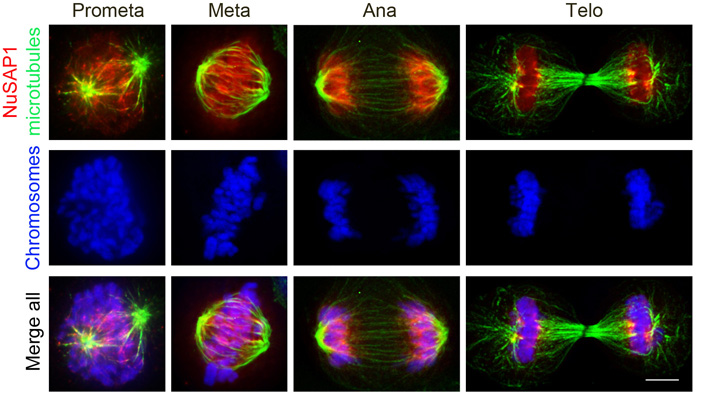
Localisation
Function
a) Cell cycle progression
NUSAP1 is essential to proper cell cycle progression. Indeed, NUSAP1 depletion following RNA interference delays entry into mitosis and arrests cycling cells at the G2/M transition. Under this condition, dramatic mitotic defects are depicted by IF, e.g. abnormal spindles in prometaphase and altered chromosome condensation. Mitotic cells that still proceeded towards chromosome segregation with disorganised spindles underwent abnormal anaphase and defective cytokinesis (Raemaekers et al., 2003). On the other hand, NUSAP1 overexpression also leads to mitotic arrest (Li et al., 2007) due to the formation of thick microtubule bundles that impair the dynamic activity of the spindle. These results indicate the critical importance of regulated levels of NUSAP1 protein to ensure proper cell division.
b) Regulation of microtubule activity
- NUSAP1 binds and stabilises microtubules
Microtubule sedimentation assays separate polymerised microtubules from free dimers of alpha/beta tubulin, and they are used to study microtubule-associated proteins (MAPs). In these assays, NUSAP1 binds directly to polymerised microtubules (Raemaekers et al., 2003). NUSAP1 can effectively cross-link microtubules into asters and thick fibers, an essential step in assembly of the mitotic apparatus. Moreover, NUSAP1 binding protects microtubules against depolymerisation and helps guiding the microtubules towards the chromosomal DNA, an essential step prior to chromosome segregation (Ribbeck et al., 2006).
- Importins and the GTPase RAN regulate the activity of NUSAP1 on microtubules
NUSAP1 interacts with nuclear import receptors: importin alpha, which recognises the NLS; Importin beta and IPO7 (Importin 7) (the actual import vectors for NUSAP1), in both biochemical experiments (Ribbeck et al., 2006) and in intact cells (Di Francesco et al., 2018). In interphase, this interaction mediates NUSAP1 import in nuclei.
In vitro assays indicate that NUSAP1 functions are differentially affected by Importin beta and importin 7. Indeed, the presence of Importin beta alone impaired NUSAP1 function in the production of aster-like microtubule structures, while not affecting the production of long tubulin fibers; on the contrary, Importin 7 alone prevented NUSAP1 activity in generating long fibers and only aster structures were produced. RANGTP addition reversed the inhibitory effect exerted by either importin on NUSAP1 functions on microtubules, suggesting that the release of free NUSAP1 from Importin beta and -7 interactions is RANGTP-dependent (Ribbeck et al., 2006).
- Phosphorylation of NUSAP1 regulates its functions
NUSAP1 is phosphorylated by the major cell cycle-dependent kinase, CDK1, at threonine 300 and 338 in the microtubule-binding domain. In in vitro microtubule sedimentation assays, phosphorylated NUSAP1 (ph-NUSAP1) fails to bind microtubules, suggesting that CDK1-mediated phosphorylation negatively regulates NUSAP1 interaction with microtubules. During the cell cycle, ph-NUSAP1 is detectable in nucleoli in prophase; later, after nuclear envelope breakdown, it diffuses in the cytosol and around condensed chromosomes; finally, the signal disappears during progression from anaphase to telophase, (Chou et al., 2011).
NUSAP1 can also be phosphorylated by Aurora kinases. Aurora-A was shown to be able to phosphorylate NUSAP1 at Serine 240; although the functional significance of this phosphorylation remains unclear, it may have roles during microtubule assembly (Sardon et al., 2010). NUSAP1 was also identified in a proteomic screening for Aurora-B substrates; this phosphorylation putatively involves several serines or threonines in the N-ter region and is proposed to regulate NUSAP1 activity at the spindle midzone at cytokinesis (Ozlu et al., 2010).
c) Spindle formation and dynamics
- NUSAP1 regulates spindle formation
Xenopus egg extract provide an informative model system to study spindle assembly and function. They derive from unfertilised eggs arrested in metaphase II of meiosis and contain all maternal factors which only need be organised and activated at fertilisation. Immunodepletion experiments show that NUSAP1 is essential for spindle formation. Indeed, in NUSAP1-depleted extracts, abnormal spindles formed, which showed a low microtubule density and a distorted bipolar organisation (Ribbeck et al., 2006). Instead, excess NUSAP1 blocked the onset of spindle formation. When NUSAP1 was added after the spindle had already started to form, the microtubules became strongly bundled into prominent fibers, resulting in a distorted configuration. Thus, the amount of NUSAP1 regulates the balance of microtubules in the spindle (Ribbeck et al., 2006).
-NUSAP1 regulates spindle dynamics
NUSAP1 interacts with MCAK, a kinesin with microtubule-depolymerizing activity, required to correct any misattachments between microtubules and kinetochores occurring during spindle formation. Li and colleagues demonstrated that NUSAP1 regulates the depolymerizing activity of MCAK, assigning to NUSAP1 a novel role in microtubule dynamics (Li et al., 2016). It has also been discovered that NUSAP1 also contributes to orchestrate the alignment and orientation of chromosomes in the metaphase plate by regulating the activity of Kid, a chromokinesin that guides the anti-poleward movements of chromosomes: thanks to its ability to use and hydrolyze ATP, Kid generates a force along the spindle defined the ejection force. NUSAP1 binds Kid and facilitates its association with microtubules, thus governing the pole ejection force generated by Kid (Li et al., 2016).
- NUSAP1 interacts with the nucleoporin and E3 SUMO ligase RANBP2
Mass spectrometry-based analysis of NUSAP1 interacting partners revealed a novel interaction with RANBP2, a nucleoporin endowed with SUMO E3 ligase activity, and its partners, the RANGTP hydrolysis-activating enzyme RANGAP1 and the SUMO conjugating enzyme UBE2I (Ubc9) (Mills et al., 2017). Proximity ligation assays (PLA) localised the interaction on microtubules (Mills et al., 2017).
In summary, NUSAP1 controls the mitotic apparatus in several ways: it regulates microtubule stability both directly, via its own microtubule-bundling activity, and indirectly, by regulating the MCAK microtubule-depolymerizing enzyme; it also regulates Kid-generated pole ejection forces in the spindle. These functions converge to regulate proper chromosome segregation during mitosis.
d) DNA-binding activity
NUSAP1 can also interact with the DNA via the SAP domain in the N-ter region (Verbakel et al., 2011). In vitro, the SAP domain preferentially binds double-stranded DNA. During mitosis, wild-type but not SAP-deleted NUSAP1 (NuSAPΔSAP) localises not only to chromosome proximal microtubules, but also to chromosome arms, indicating that the SAP domain mediates the association of NUSAP1 with chromatin in early mitosis. In interphase nuclei, both WT and NuSAPΔSAP are found in nucleoli, but only wild-type NUSAP1 also assumes its canonical localisation to the periphery of the nucleoplasm, where active chromatin domains reside; possible roles of NUSAP1 in transcription or in the DNA damage response have therefore been suggested, as found for other SAP domain-containing proteins (Aravidin and Koonin 2000).
Homology
Mutations
Note
CD74 (5q32) / NUSAP1 (15q15.1)
NUSAP1 (15q15.1) / RRNAD1 (1q23.1) (Klijn et al., 2015)
NUSAP1 (15q15.1) / ZNF445 (3p21.31) (Wang et al., 2015)
OIP5 (15q15.1) / NUSAP1 (15q15.1) (Yoshihara et al., 2015)
Expected fusion products by conceptual translation of open reading frames generated by translocations:
ITPKA/NUSAP1 fusion, from translocation t(15;15)(q15;q15) (Gao et al., 2018)
MGA /NUSAP1 fusion, from translocation t(15;15)(q15;q15) (Gao et al., 2018)
Decipher database
The region of chromosome 15 containing, among others, the NUSAP1 locus is involved in sporadic cases of deletions or duplications associated with complex phenotypes; of those, the most selective for NUSAP1 are:
heterozygous deletion 15:41285354-45826511 (removing 4,5 Mbp), associated with facial and intellectual disabilities;
heterozygous deletion 15:41285354-45826511 (removing 6,9 Mbp), associated with microcephaly, intellectual disabilities and other traits.
Overall, these phenotypes are consistent with the notion that mutation or deletion of mitotic genes, when occurring early in development, often cause failed development of the central nervous system (Lang and Gershon, 2018; Degrassi et al., 2019).
Implicated in
Zhang et al. (2018) further identified NUSAP1 in a screening for Invasive Breast Cancer (IBC)-related genes, in which NUSAP1 was found to have higher expression compared to normal tissues. Similar results were obtained from the MCF7 breast cancer cell line. In functional assays, downregulation of NUSAP1 led to reduced proliferation in MCF7 cells, associated with downregulation of both the mitotic kinase CDK1 and the mitotic spindle-stabilizing factor DLGAP5 (HURP), both required for mitotic progression. Cell migration and invasion also decreased in NUSAP1-interfered compared with untreated BC cells. The development of innovative cancer therapies based on the gene expression profile is key to overcome chemotherapy resistance in IBC. Remarkably, in that respect, NUSAP1-interfered MCF7 cells show increased susceptibility to Epirubicine (E-ADM) treatment, enhancing E-ADM-induced apoptosis (Zhang et al., 2018). Thus, combination therapies including NUSAP1 targeting and traditional compounds, e.g. Epirubicine, might be envisaged in IBC treatment.
NUSAP1 upregulation is associated with CTNNB1 (beta-catenin) translocation into the nucleus, which enhances the transcriptional activity of TCF4 (a member of TCF/LEF transcription factors) on target genes. Actually, NUSAP1 overexpression enhances RANBP2 mediated-SUMOylation of TCF4. RANBP2 knockdown, like NUSAP1 knockdown, inhibits Wnt/beta-catenin signaling and TCF transcriptional activity (Li et al., 2019). CC treatment with XAV-939, an inhibitor of the Wnt/beta-catenin pathway, abrogated NUSAP1-dependent cancer stem cell metastasis. Based on these data, NUSAP1 is thought to promote CC metastatic progression via activation of beta-catenin signaling and downstream transcriptional programmes. The authors suggest that the Wnt/beta-catenin inhibitor XAV-939 might improve the outcome of canonical drugs in NUSAP1-overexpressing CC patients.
The role of NUSAP1 in CRC was investigated by post-transcriptional silencing: NUSAP1 knockdown was found to inhibit cell proliferation, migration, invasion, as well as the epithelial-to-mesenchymal transition (EMT), while promoting apoptosis compared to non-interfered cells. Expression of the DNA methyl-transferase ( DNMT1) gene, encoding the major enzyme required for both de novo and maintenance cytosine methylation in 5-CG-3 dinucleotides in genomic DNA, was also inhibited in NUSAP1-silenced cells; given the master role of DNMT1 in establishing the epigenetic landscape of the cells, that finding might account for the global effects observed in NUSAP1-silenced cells; how NUSAP1 might influence DNMT1 expression remains however still unclear (Han et al., 2018). These results suggest that NUSAP1 may be a good candidate target for CRC treatment.
Glioma samples of various grades also show upregulation of both NUSAP1 transcript and NUSAP1 protein compared to normal tissues (Zhu et al., 2018; Qian et al., 2018). NUSAP1 protein abundance increases with the degree of malignancy and pathological grade of glioma, and patients with high NUSAP1 expression exhibited significantly reduced OS, compared to those with low NUSAP1. Furthermore, in vitro experiments showed that loss of NUSAP1 impairs the proliferation capacity of glioma cells, inducing cell cycle arrest with a G2/M genomic content (Zhu et al., 2018; Qian et al., 2018) and apoptosis. NUSAP1 is also involved in glioma cells migration (Zhu et al., 2018). Qian et al. also demonstrated that, in a xenograft mouse model of GBM (IV degree of glioma), the tumour volume was smaller in NUSAP1-silenced compared with control animals, indicating a role of NUSAP1 in glioma progression in vivo (Qian et al., 2018). On these grounds, high levels of NUSAP1 might be viewed as a new prognostic factor in human Glioblastoma Multiforme (GBM).
Article Bibliography
| Pubmed ID | Last Year | Title | Authors |
|---|---|---|---|
| 10694879 | 2000 | SAP - a putative DNA-binding motif involved in chromosomal organization. | Aravind L et al |
| 26485712 | 2015 | High Levels of Nucleolar Spindle-Associated Protein and Reduced Levels of BRCA1 Expression Predict Poor Prognosis in Triple-Negative Breast Cancer. | Chen L et al |
| 22101338 | 2011 | Phosphorylation of NuSAP by Cdk1 regulates its interaction with microtubules in mitosis. | Chou HY et al |
| 31878213 | 2019 | The Mitotic Apparatus and Kinetochores in Microcephaly and Neurodevelopmental Diseases. | Degrassi F et al |
| 29382863 | 2018 | Visualization of human karyopherin beta-1/importin beta-1 interactions with protein partners in mitotic cells by co-immunoprecipitation and proximity ligation assays. | Di Francesco L et al |
| 29617662 | 2018 | Driver Fusions and Their Implications in the Development and Treatment of Human Cancers. | Gao Q et al |
| 32099387 | 2020 | Nucleolar and Spindle Associated Protein 1 (NUSAP1) Promotes Bladder Cancer Progression Through the TGF-β Signaling Pathway. | Gao S et al |
| 28404898 | 2017 | NUSAP1 promotes invasion and metastasis of prostate cancer. | Gordon CA et al |
| 22349817 | 2013 | Increased expression of NuSAP in recurrent prostate cancer is mediated by E2F1. | Gulzar ZG et al |
| 29608915 | 2018 | NUSAP1 gene silencing inhibits cell proliferation, migration and invasion through inhibiting DNMT1 gene expression in human colorectal cancer. | Han G et al |
| 19596847 | 2009 | The nucleolar RNA methyltransferase Misu (NSun2) is required for mitotic spindle stability. | Hussain S et al |
| 25485619 | 2015 | A comprehensive transcriptional portrait of human cancer cell lines. | Klijn C et al |
| 16170025 | 2005 | Modulation of cell cycle and gene expression in pancreatic tumor cell lines by methionine deprivation (methionine stress): implications to the therapy of pancreatic adenocarcinoma. | Kokkinakis DM et al |
| 29577351 | 2018 | A New Way to Treat Brain Tumors: Targeting Proteins Coded by Microcephaly Genes?: Brain tumors and microcephaly arise from opposing derangements regulating progenitor growth. Drivers of microcephaly could be attractive brain tumor targets. | Lang PY et al |
| 26839278 | 2016 | NuSAP governs chromosome oscillation by facilitating the Kid-generated polar ejection force. | Li C et al |
| 26733216 | 2016 | NuSAP modulates the dynamics of kinetochore microtubules by attenuating MCAK depolymerisation activity. | Li C et al |
| 30678687 | 2019 | Nucleolar and spindle associated protein 1 promotes metastasis of cervical carcinoma cells by activating Wnt/β-catenin signaling. | Li H et al |
| 17618083 | 2007 | NuSAP is degraded by APC/C-Cdh1 and its overexpression results in mitotic arrest dependent of its microtubules' affinity. | Li L et al |
| 29853313 | 2018 | High NUSAP1 expression predicts poor prognosis in colon cancer. | Liu Z et al |
| 28900032 | 2017 | Nucleolar and spindle-associated protein 1 (NUSAP1) interacts with a SUMO E3 ligase complex during chromosome segregation. | Mills CA et al |
| 26554377 | 2015 | Down-Regulation of Nucleolar and Spindle-Associated Protein 1 (NUSAP1) Expression Suppresses Tumor and Cell Proliferation and Enhances Anti-Tumor Effect of Paclitaxel in Oral Squamous Cell Carcinoma. | Okamoto A et al |
| 19786723 | 2010 | Binding partner switching on microtubules and aurora-B in the mitosis to cytokinesis transition. | Ozlü N et al |
| 29995176 | 2018 | Prognostic value of NUSAP1 in progression and expansion of glioblastoma multiforme. | Qian Z et al |
| 12963707 | 2003 | NuSAP, a novel microtubule-associated protein involved in mitotic spindle organization. | Raemaekers T et al |
| 16571672 | 2006 | NuSAP, a mitotic RanGTP target that stabilizes and cross-links microtubules. | Ribbeck K et al |
| 30165047 | 2018 | microRNA 193a-5p Regulates Levels of Nucleolar- and Spindle-Associated Protein 1 to Suppress Hepatocarcinogenesis. | Roy S et al |
| 21072059 | 2010 | Uncovering new substrates for Aurora A kinase. | Sardon T et al |
| 21782797 | 2011 | SAP-like domain in nucleolar spindle associated protein mediates mitotic chromosome loading as well as interphase chromatin interaction. | Verbakel W et al |
| 26215638 | 2015 | FusionCancer: a database of cancer fusion genes derived from RNA-seq data. | Wang Y et al |
| 28899410 | 2017 | Nucleolar and spindle associated protein 1 promotes the aggressiveness of astrocytoma by activating the Hedgehog signaling pathway. | Wu X et al |
| 21130744 | 2011 | ATM-mediated NuSAP phosphorylation induces mitotic arrest. | Xie P et al |
| 30476929 | 2018 | Nucleolar and Spindle Associated Protein 1 (NUSAP1) Inhibits Cell Proliferation and Enhances Susceptibility to Epirubicin In Invasive Breast Cancer Cells by Regulating Cyclin D Kinase (CDK1) and DLGAP5 Expression. | Zhang X et al |
| 29336114 | 2018 | Nucleolar and spindle-associated protein 1 is a tumor grade correlated prognosis marker for glioma patients. | Zhu T et al |
Other Information
Locus ID:
NCBI: 51203
MIM: 612818
HGNC: 18538
Ensembl: ENSG00000137804
Variants:
dbSNP: 51203
ClinVar: 51203
TCGA: ENSG00000137804
COSMIC: NUSAP1
RNA/Proteins
Expression (GTEx)
Protein levels (Protein atlas)
References
| Pubmed ID | Year | Title | Citations |
|---|---|---|---|
| 38117947 | 2024 | NuSAP regulates microtubule flux and Kif2A localization to ensure accurate chromosome congression. | 0 |
| 38229038 | 2024 | NUSAP1 promotes pancreatic ductal adenocarcinoma progression by drives the epithelial-mesenchymal transition and reduces AMPK phosphorylation. | 2 |
| 38117947 | 2024 | NuSAP regulates microtubule flux and Kif2A localization to ensure accurate chromosome congression. | 0 |
| 38229038 | 2024 | NUSAP1 promotes pancreatic ductal adenocarcinoma progression by drives the epithelial-mesenchymal transition and reduces AMPK phosphorylation. | 2 |
| 37005340 | 2023 | A recurrent de novo variant in NUSAP1 escapes nonsense-mediated decay and leads to microcephaly, epilepsy, and developmental delay. | 3 |
| 37047232 | 2023 | NUSAP1 Binds ILF2 to Modulate R-Loop Accumulation and DNA Damage in Prostate Cancer. | 4 |
| 37200136 | 2023 | NUSAP1 regulates basal cell carcinoma migration, invasion and DNA damage through activation of the Hedgehog signaling pathway. | 0 |
| 37005340 | 2023 | A recurrent de novo variant in NUSAP1 escapes nonsense-mediated decay and leads to microcephaly, epilepsy, and developmental delay. | 3 |
| 37047232 | 2023 | NUSAP1 Binds ILF2 to Modulate R-Loop Accumulation and DNA Damage in Prostate Cancer. | 4 |
| 37200136 | 2023 | NUSAP1 regulates basal cell carcinoma migration, invasion and DNA damage through activation of the Hedgehog signaling pathway. | 0 |
| 35487972 | 2022 | Increased NUSAP1 expression is associated with lymph node metastasis and survival prognosis in bladder urothelial carcinoma. | 1 |
| 35532155 | 2022 | Knockdown of NUSAP1 inhibits cell proliferation and invasion through downregulation of TOP2A in human glioblastoma. | 3 |
| 35695609 | 2022 | Prognostic Value of NUSAP1 and Its Correlation with Immune Infiltrates in Human Breast Cancer. | 3 |
| 35710427 | 2022 | Evaluate the diagnostic and prognostic value of NUSAP1 in papillary thyroid carcinoma and identify the relationship with genes, proteins, and immune factors. | 5 |
| 35739489 | 2022 | Identification and clinical validation of NUSAP1 as a novel prognostic biomarker in ovarian cancer. | 4 |
Citation
Michela Damizia ; Patrizia Lavia
NUSAP1 (nucleolar and spindle associated protein 1)
Atlas Genet Cytogenet Oncol Haematol. 2020-05-01
Online version: http://atlasgeneticsoncology.org/gene/51490/nusap1-(nucleolar-and-spindle-associated-protein-1)
