CSNK2A2 (casein kinase 2 alpha 2)
2020-11-01 Nazanin Abazari, MSc , Alessandro Beghini, PhD AffiliationUniversity of Milan, Department of Health Sciences, Milan Italy [email protected]; [email protected]
Identity

Abstract
CSNK2A2 gene, 16q21, has a role in regulating the phosphorylation and circulation of old proteasomes by encoding the catalytic α subunit of casein kinase 2 (CK2α). Casein kinase 2 is a serine\/threonine protein kinase that phosphorylates acidic proteins. It can regulate Wnt signalling by phosphorylating CTNNB1 and the transcription factor LEF1 and for this reason, it is involved in some cellular key processes such as cell cycle progression, inhibition of apoptosis, DNA damage repair, differentiation and transcription but also viral infection. CSNK2A2 is a cancer-related gene and its upregulation has been detected is many cancers such as glioblastoma multiforme, colorectal cancer, breast cancer and ovarian cancer, and also in some diseases such as diabetes, theileriasis in cattle and distal muscular dystrophy with anterior tibial onset in mice are associated with CSNK2A2.
DNA/RNA
Description
Transcription
CSNK2A2-202 ENST00000562367.1: mRNA 687 bp, No protein
CSNK2A2-203 ENST00000563307.1: mRNA 4978 bp, protein 152 aa
CSNK2A2-204 ENST00000565188.1: mRNA 547 bp, protein 135 aa
CSNK2A2-205 ENST00000566813.5: mRNA 1569 bp, No protein
CSNK2A2-206 ENST00000567730.6: mRNA 947 bp, protein 230 aa (www.ensembl.org).
Pseudogene
Proteins
Description
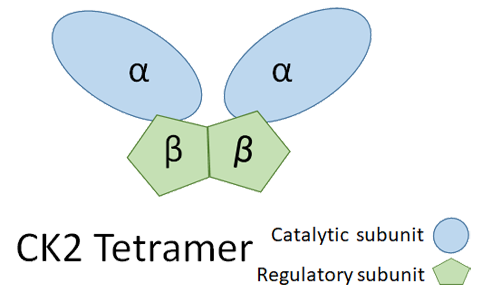
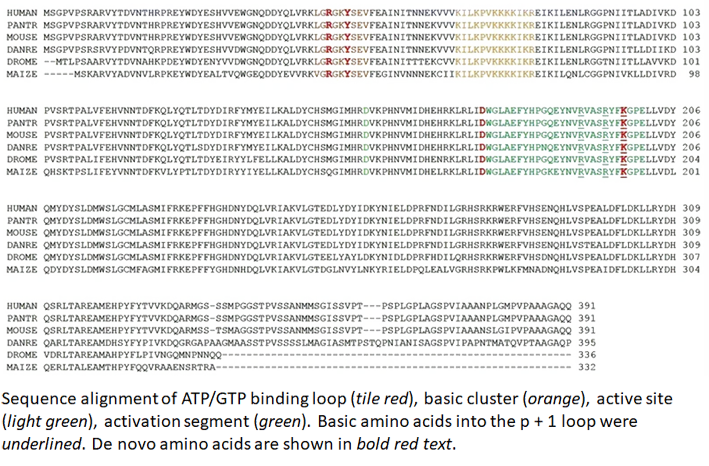
The crystal structure of a fully active form (Tetramer) of human CK2 consisting of two C-terminally truncated (Alpha) catalytic and two regulatory (Beta) subunits (Protein Data Bank code: 1JWH). This protein is composed of 350 amino acids, with Molecular mass of 41213 Da. For two α subunits, α being 42 kDa and α being 38 kDa, and two β subunits, each weighing in at 28 kDa. The β subunits form homodimers which are building blocks to generate heterotetramers with the catalytic subunits (α or α) in which these two catalytic subunits in the holoenzyme make no contacts with each other (Niefind, Guerra et al. 2001). CK2 proteins can function as monomeric kinases or within a tetrameric complex of two CK2 kinase units and two units of the regulatory protein CK2b. ((Ortega, Seidner et al. 2014).
Quaternary structure is generally characterized by tight regulation. The enzyme acts independently of classical activating second messengers. (Ackermann, Neidhart et al. 2005). Unlike most other proteins, CK2 shows the rare ability dual-co-substrate specificity to use either ATP or GTP as phosphoryl donor. (Niefind et al., 1999).
CSNK2A2 encodes alpha prime polypeptide (the catalytic subunit of the protein kinase enzyme). The α subunits do not require the β regulatory subunits to function, this allows dimers to form of the catalytic domains independent of β subunit transcription. Catalytic subunit of kinase complex phosphorylates a large number of substrates containing acidic residues C-terminal to the phosphorylated serine or threonine such as casein (Pinna 2002). In mouse transgenic models CK2α is an oncogene and CK2α overexpression in mammary gland and lymphoid compartment leads to tumor formation (Seldin 1995).
CSNK2A2 protein also has interactions with other proteins such as CSNK2B, CSNK2A1, ENSG00000263020, JUN , TP53, SUPT16H, SSRP1, DVL3, DVL1, NFKBIA. https://www.sinobiological.com/resource/ck2-alpha-csnk2a1/proteins
Expression
A significant increase in expression of eight Wnt signaling pathway proteins including CSNK2A2, was detected in glioblastoma multiforme (GBM) (Shevchenko, Arnotskaya et al. 2020).
Experimental studies suggest that irregular expression of the alpha CK2 subunit transmits a oncogenic potential in the cells such that in cooperation with certain oncogenes it causes a profound increase in tumor phenotype. (Tawfic, Yu et al. 2001).
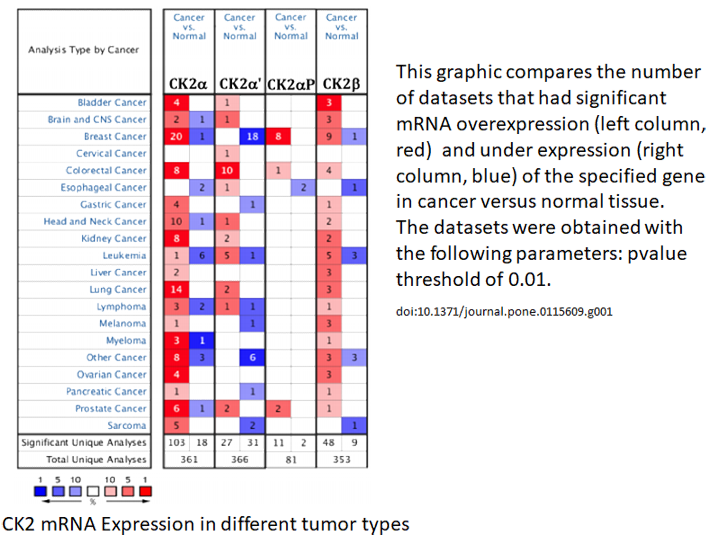
In addition, increased CSNK2A2 expression has been observed in breast cancer tissue and breast cancer cell lines, colon cancer progression as well as villous colon adenomas (Romieu-Mourez, Landesman-Bollag et al. 2001, Nibbe, Markowitz et al. 2009, Nguyen, Albers et al. 2010, Wang, Chang et al. 2016). Moreover, data on transcript expression of the specified gene (CK2) in cancer versus normal tissue revealed widespread upregulation in the expression of CK2 genes in primary tumor tissues (Ortega, Seidner et al. 2014).
Localisation
Function
During mitosis CK2s anti-apoptotic function is in the continuation of the cell cycle; from G1 to S phase and G2 to M phase checkpoints, it functions as a component of the TP53-dependent spindle assembly checkpoint (SAC) that maintains cyclin-B- CDK1 activity and G2 arrest in response to spindle damage.
Comparison the induced expression of catalytically inactive CK2a in human osteosarcoma U2-OS cells suggested that CK2α may have unique functions associated with the control of proliferation or viability.
CSNK2A2 is also required for TP53-mediated apoptosis, phosphorylating Ser-392 of TP53 following UV irradiation.
CSNK2A2 also regulates transcription by direct phosphorylation of RNA polymerases I, II, III and IV. Also phosphorylates and regulates numerous transcription factors including NF-kappa-B, STAT1, CREB1, IRF1, IRF2, ATF1, SRF, MAX, JUN, FOS, MYC and MYB. Phosphorylates HSP90AA1 (Hsp90) and its co-chaperones FKBP4 and CDC37, which is essential for chaperone function.
It acts as an ectokinase that phosphorylates several extracellular proteins. During viral infection, phosphorylates various proteins involved in the viral life cycles of EBV, HSV, HBV, HCV, HIV, CMV and HPV (Keller, Zeng et al. 2001, Sayed, Pelech et al. 2001, Shin, Lee et al. 2005).
The Wnt pathway connection:
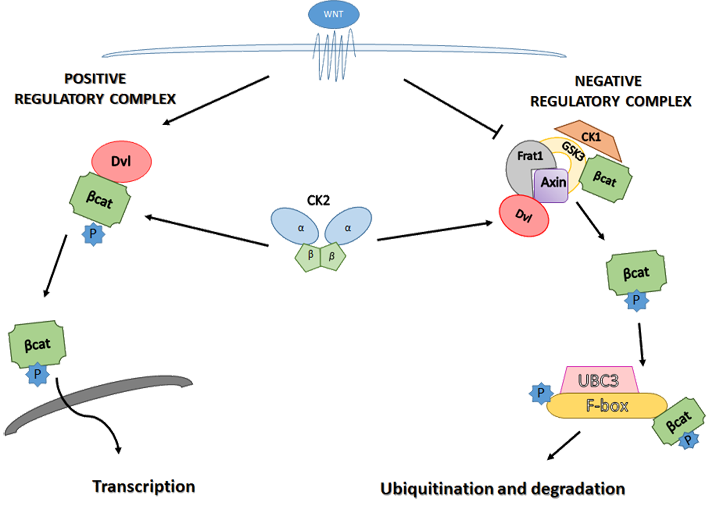
CSNK2A2 acts as a multi-site regulator of the Wnt pathway, and it is well known for phosphorylating CTNNB1 (β-catenin ) and the transcription factor LEF1.
Wnt signaling is initiated by binding of the secreted Wnt ligand to the members of the Frizzled receptor family. The level of β-catenin in the cytosol, is a key element in the Wnt pathway which triggers the activation of Wnt responsive genes. In the absence of Wnt stimulation, β-catenin is degraded by the proteasome (which depends upon β-catenin phosphorylation in a multi-protein complex by a hierarchical mechanism involving both CSNK1A1 (CK1) and GSK3). This phosphorylation is crucial for binding of β-catenin to the F-box protein βTrCP, which imparts specficity on the ubiquitination apparatus.
Wnt signaling inhibits GSK3 and prevents the ubiquitination and degradation of β-catenin, which leads to the accumulation of β-catenin in the cytosol and the activation of Wnt responsive genes, some of which are proto-oncogenes.
It is hypothesized that CK2 has dual role in the Wnt signaling pathway. First it can directly phosphorylate β-catenin and prevents its degradation by counteracting the effect of GSK3 phosphorylation within the negative regulatory complex (Son et al., 2000). Inhibition of CK2 decreases β-catenin level and blocks proliferation of Wnt-transfected cells. Suggesting that β-catenin phosphorylated by CK2 escapes ubiquitination and degradation, leading to an increased level of β-catenin available to activate Wnt-responsive genes.
On the other hand, CK2, by phosphorylating CDC34 (the E2 ubiquitin-conjugating enzyme UBC3), promotes its binding to the proteasome receptor β-TrCP, ultimately assisting the degradation of β-catenin (Semplici et al., 2002).
The apoptosis pathway connection:
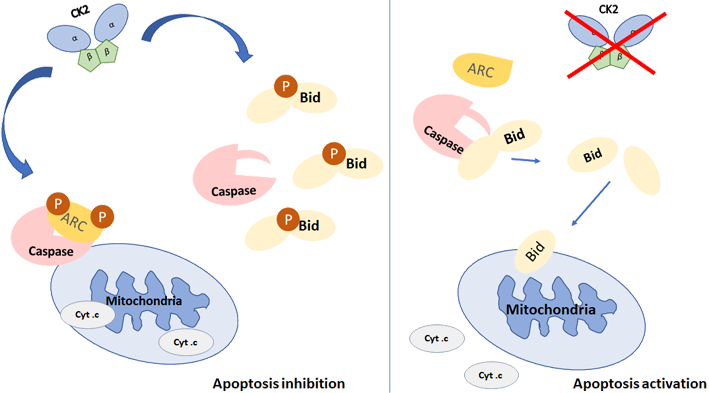
Under survival conditions, CK2 phosphorylates proteins such as ARC and BID. When ARC is phosphorylated, it is targeted to mitochondria, where it inhibits CASP8 (caspase 8). Bid is resistant to cleavage by caspase 8, when it is phosphorylated by CK2. Under apoptotic conditions, CK2 phosphorylation sites on proteins such as BID and ARC are not phosphorylated, indeed ARC is not targeted to mitochondria and does not inhibit caspase 8. In the absence of phosphorylation, Bid is susceptible to cleavage by caspase 8.
The subsequent translocation of BID to the mitochondria is followed by release of cytochrome C that leads to the amplification of caspase activation (proteins, including MAX and HS1, become susceptible to caspase-mediated cleavage when they are not phosphorylated by CK2) (Litchfield 2003).
CSNK2A2 can also negatively regulate apoptosis by phosphorylating the caspases ( CASP9 and CASP2) and the apoptotic regulator NOL3. This phosphorylation, protects CASP9 from cleavage and activation by CASP8, so can inhibits the CASP2 dimerization and CASP8 activation.
Homology
Mutations
Note
Somatic
Implicated in
CSNK2A2 is affiliated with the members of the shelterin complex involved in chromosome-end protection, telomere regulation, and maintenance. Interestingly, the telomeric repeat binding factor 1 ( TERF1) serves as a substrate for CSNK2A2, which phosphorylates and initiates its binding to telomeres. Partial knock-down of CSNK2A2 resulted in removal of TERF1 from telomeres and degradation of TERF1.
CSNK2A2 also influences Wnt signaling via beta-catenin phosphorylation and the PI3-K signaling pathway via the phosphorylation of Akt (Saxena, Bjonnes et al. 2014).
Article Bibliography
| Pubmed ID | Last Year | Title | Authors |
|---|---|---|---|
| 16335532 | 2005 | The catalytic subunit alpha' gene of human protein kinase CK2 (CSNK2A2): genomic organization, promoter identification and determination of Ets1 as a key regulator. | Ackermann K et al |
| 11239457 | 2001 | A DNA damage-induced p53 serine 392 kinase complex contains CK2, hSpt16, and SSRP1. | Keller DM et al |
| 25837326 | 2015 | Preclinical evaluation of cyclin dependent kinase 11 and casein kinase 2 survival kinases as RNA interference targets for triple negative breast cancer therapy. | Kren BT et al |
| 12396231 | 2003 | Protein kinase CK2: structure, regulation and role in cellular decisions of life and death. | Litchfield DW et al |
| 28355289 | 2017 | Increased expression of protein kinase CK2α correlates with poor patient prognosis in epithelial ovarian cancer. | Ma Z et al |
| 20514431 | 2010 | Differentiation of tubular and villous adenomas based on Wnt pathway-related gene expression profiles. | Nguyen AV et al |
| 19098285 | 2009 | Discovery and scoring of protein interaction subnetworks discriminative of late stage human colon cancer. | Nibbe RK et al |
| 11574463 | 2001 | Crystal structure of human protein kinase CK2: insights into basic properties of the CK2 holoenzyme. | Niefind K et al |
| 25541719 | 2014 | Mining CK2 in cancer. | Ortega CE et al |
| 12244125 | 2002 | Protein kinase CK2: a challenge to canons. | Pinna LA et al |
| 11325857 | 2001 | Roles of IKK kinases and protein kinase CK2 in activation of nuclear factor-kappaB in breast cancer. | Romieu-Mourez R et al |
| 24795349 | 2014 | Genome-wide association study identifies variants in casein kinase II (CSNK2A2) to be associated with leukocyte telomere length in a Punjabi Sikh diabetic cohort. | Saxena R et al |
| 11704824 | 2001 | Protein kinase CK2 is involved in G2 arrest and apoptosis following spindle damage in epithelial cells. | Sayed M et al |
| 8573310 | 1995 | New models of lymphoma in transgenic mice. | Seldin DC et al |
| 32448607 | 2020 | Proteins of Wnt signaling pathway in cancer stem cells of human glioblastoma. | Shevchenko V et al |
| 16193064 | 2005 | Caspase-2 primes cancer cells for TRAIL-mediated apoptosis by processing procaspase-8. | Shin S et al |
| 11332713 | 2001 | Protein kinase CK2 signal in neoplasia. | Tawfic S et al |
| 26873729 | 2016 | High Expression of miR-532-5p, a Tumor Suppressor, Leads to Better Prognosis in Ovarian Cancer Both In Vivo and In Vitro. | Wang F et al |
Other Information
Locus ID:
NCBI: 1459
MIM: 115442
HGNC: 2459
Ensembl: ENSG00000070770
Variants:
dbSNP: 1459
ClinVar: 1459
TCGA: ENSG00000070770
COSMIC: CSNK2A2
RNA/Proteins
| Gene ID | Transcript ID | Uniprot |
|---|---|---|
| ENSG00000070770 | ENST00000262506 | P19784 |
| ENSG00000070770 | ENST00000563307 | H3BV19 |
| ENSG00000070770 | ENST00000565188 | H3BNI9 |
| ENSG00000070770 | ENST00000567730 | H3BSA1 |
Expression (GTEx)
Pathways
References
| Pubmed ID | Year | Title | Citations |
|---|---|---|---|
| 37907238 | 2024 | Cell cycle-dependent gene networks for cell proliferation activated by nuclear CK2α complexes. | 0 |
| 37907238 | 2024 | Cell cycle-dependent gene networks for cell proliferation activated by nuclear CK2α complexes. | 0 |
| 34548224 | 2023 | CK2α causes stemness and chemotherapy resistance in liver cancer through the Hedgehog signaling pathway. | 2 |
| 37247928 | 2023 | Casein Kinase 2α Augments Oxaliplatin Resistance in Colorectal Cancer Cells by Increasing ABCE1 Expression. | 0 |
| 37268061 | 2023 | CSNK2A2 promotes hepatocellular carcinoma progression through activation of NF-κB pathway. | 1 |
| 38132153 | 2023 | Protein Kinase CK2α', More than a Backup of CK2α. | 0 |
| 34548224 | 2023 | CK2α causes stemness and chemotherapy resistance in liver cancer through the Hedgehog signaling pathway. | 2 |
| 37247928 | 2023 | Casein Kinase 2α Augments Oxaliplatin Resistance in Colorectal Cancer Cells by Increasing ABCE1 Expression. | 0 |
| 37268061 | 2023 | CSNK2A2 promotes hepatocellular carcinoma progression through activation of NF-κB pathway. | 1 |
| 38132153 | 2023 | Protein Kinase CK2α', More than a Backup of CK2α. | 0 |
| 33944995 | 2021 | Okur-Chung neurodevelopmental syndrome-linked CK2α variants have reduced kinase activity. | 9 |
| 33944995 | 2021 | Okur-Chung neurodevelopmental syndrome-linked CK2α variants have reduced kinase activity. | 9 |
| 29243286 | 2018 | Conformational dynamics of human protein kinase CK2α and its effect on function and inhibition. | 7 |
| 30061228 | 2018 | Effect of Simultaneous Inhibition of Protein Kinase CK2 and Thymidylate Synthase in Leukemia and Breast Cancer Cells. | 6 |
| 29243286 | 2018 | Conformational dynamics of human protein kinase CK2α and its effect on function and inhibition. | 7 |
Citation
Nazanin Abazari, MSc ; Alessandro Beghini, PhD
CSNK2A2 (casein kinase 2 alpha 2)
Atlas Genet Cytogenet Oncol Haematol. 2020-11-01
Online version: http://atlasgeneticsoncology.org/gene/40171/csnk2a2-(casein-kinase-2-alpha-2)
