PLA2G2A (phospholipase A2, group IIA (platelets, synovial fluid))
2010-05-01 Robert T Cormier AffiliationDepartment of Biochemistry, Molecular Biology, University of Minnesota Medical School, Duluth, Minnesota, USA
Identity
DNA/RNA
Description
PLA2G2A was first identified following the isolation and sequencing of proteins from the synovial fluid of human rheumatoid arthritis. A cDNA library prepared from peritoneal exudate cells identified a full-length PLA2G2A 0.8 kb transcript and cDNA of 435 nucleotides that encodes for a polypeptide of 144 amino acids with a molecular mass of 16 kD (~14 kD in the mature peptide). The protein was found to demonstrate features of the type II class of PLA2s, including conserved catalytic residues and a Ca2+-binding loop.
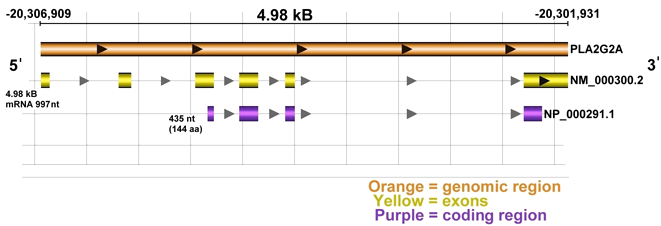
Structure: The PLA2G2A gene is 4.98 kb in length, with 6 total exons and 4 protein coding exons.
Transcription
atgaagaccctcctactgttggcagtgatcatgatctttggcctactgcaggcccatggg
aatttggtgaatttccacagaatgatcaagttgacgacaggaaaggaagccgcactcagt
tatggcttctacggctgccactgtggcgtgggtggcagaggatcccccaaggatgcaacg
gatcgctgctgtgtcactcatgactgttgctacaaacgtctggagaaacgtggatgtggc
accaaatttctgagctacaagtttagcaactcggggagcagaatcacctgtgcaaaacag
gactcctgcagaagtcaactgtgtgagtgtgataaggctgctgccacctgttttgctaga
aacaagacgacctacaataaaaagtaccagtactattccaataaacactgcagagggagc
acccctcgttgctga
The PLA2G2A gene produces multiple transcripts arising from splice variants and alternative promoter usage. There are believed to be at least seven splice variants produced by usage of the predominant promoter. The gene contains 6 exons with 4 exons containing protein coding regions. Variants are produced that have different 5 UTRs. The longest and predominant transcript is NM_000300 with a processed length of 970 nt and a mRNA of 997 nt. This produces a mature mRNA (NP_000291.1) of 435 nt that encodes for a polypeptide of 144 amino acids. The different splice variants either encode for the same polypeptide or encode for no protein product.
The PLA2G2A promoter contains TATA and CAAT boxes and elements with consensus sequences for binding of transcription factors such as AP-1, C/EBPs, CREB, NF-kB, STAT, LXR/RXR heterodimers, NFATs and PPARgamma. Although the promoter does not contain a typical CpG island there are CpG target sites at -82 and -111 and Sp1 binding may be inhibited by promoter hypermethylation. CpG sites also exist in the -1340 to -900 promoter region and in gastric cancer cell lines that did not express PLA2G2A these sites were hypermethylated, leading to PLA2G2A silencing. PLA2G2A has also been reported to be silenced by promoter hypermethylation in prostate cancer cells and Jurkat leukemia cells. PLA2G2A is a direct target of Wnt/beta catenin signaling, with multiple TCF/LEF transcription factor binding sites in the -1340 to -920 promoter region.
Trans acting regulators of PLA2G2A transcription include: Sp1, NF-kB p65, Jak/STAT, Rho-kinase, and C/EBP-beta. Expression of musashi-1, a putative stem cell marker, suppresses PLA2G2A expression in cell culture at the mRNA level. Notch1 activates PLA2G2A within intestinal epithelial cells and forced expression of Nicd1 in human CRC cells resulted in increased PLA2G2A expression.
Proteins
Description
MKTLLLLAVIMIFGLLQAHGNLVNFHRMIKLTTGKEAAL
SYGFYGCHCGVGGRGSPKDATDRCCVTHDCCYKRLE
KRGCGTKFLSYKFSNSGSRITCAKQDSCRSQLCECDK
AAATCFARNKTTYNKKYQYYSNKHCRGSTPRC
The protein has a 20 amino acid signal sequence and a 124 amino acid mature peptide with a molecular mass of ~14 kD. PLA2G2A has protein domains typical of Type II PLA2s that include a highly conserved catalytic region (DXCCXXHD) and a Ca2+-binding loop (XCGXGG). PLA2G2A also shares with other PLA2s the characteristic seven cysteine disulfide bridges that are important for regulation and protein stability.
Expression
Many human cells can secrete PLA2G2A, including: mesangial cells, smooth muscle cells, endothelial cells, mast cells, neutrophils, macrophages, hepatic cells, platelets, Paneth cells, lacrimal cells, human tears, prostate cells, seminal plasma, chondrocytes, synoviocytes, and astrocytes.
PLA2G2A is constitutively expressed in: spleen, thymus, tonsil, bone marrow, intestine (Paneth cells), liver (Kupfer cells), neutrophils, macrophages, mast cells, and Platelets. In these last 4 cell types PLA2G2A is stored in granules and secreted following cell activation. PLA2G2A is induced by inflammatory cytokines such as IL-6, TNF-alpha and IL-8 in smooth muscle cells and hepatocytes, which may be the main source of PLA2G2A in systemic inflammatory conditions.
Function
Phospholipase Catalytic activity. One important feature that discriminates PLA2G2A from other group II PLA2 family members is its highly cationic nature. PLA2G2A is highly basic with a pI of 9.4 and a net charge of +19; the positive charge is distributed over the surface of the protein and this permits the protein to bind anionic phospholipids, to bind tightly to anionic heparanoids such as heparin and heparan sulphate proteoglycans (HPSGs), and to form supra molecular aggregates, and in general PLA2G2A prefers substrates in aggregates (e.g., micelles). Thus, a large proportion of PLA2G2A protein will stick to cell surface molecules, as has been observed for recombinant PLA2 transfected into HEK293 cells. When bound to glycerophosphatidylinositol-anchored HSPGs such as glypicans, PLA2G2A is transferred to punctate compartments containing caveolin.
Substrate hydrolysis by PLA2G2A proceeds through activation and orientation of a water molecule by hydrogen bonding to the active site histidine. Adjacent to this histidine there is a conserved aspartate residue, which, together with the Ca2+-binding loop, acts as a ligand cage for Ca2+. The enzymatic reaction requires mM concentrations of Ca2+ and optimal substrate hydrolysis occurs at pH 7-9. PLA2G2A hydrolyzes the ester bond at the sn-2 position of glycerophospholipids with no strict fatty acid selectivity.
Enzymatically, the cationic nature of the PLA2G2A protein causes it to be much more effective in hydrolyzing fatty acids from negatively charged lipid membranes containing anionic phospholipids like phosphatidylserine (PS) than in releasing fatty acids from uncharged lipid membranes. The outer leaflets of unperturbed mammalian cells are characterized by neutral lipid composition enriched in phosphatidylcholines, sphingomyelin and cholesterol, thus unperturbed cells are poor substrates for extracellular PLA2G2A and thereby prevent indiscriminate hydrolysis of healthy cells. Consistent with this idea, healthy mammalian cells are highly resistant to exogenous PLA2G2A, requiring very high concentration of the protein to elicit arachidonic acid release. Perturbation of cell membranes by phospholipid scramblase that alters membrane symmetry increases PLA2G2A activity and arachidonic acid release. While PLA2G2A does not exhibit a strict selectivity for the types of fatty acids that are being released, arachidonic acid is certainly one of its major hydrolytic products. Arachidonic acid can be processed by cyclooxygenases (COXs) and lipoxygenases (LOXs) to form eicosanoids including prostaglandins and leukotrienes.
PLA2G2A activity is increased by association with the sulfated polysaccharides including heparanoids. In particular, arginine and lysine residues on the surface of PLA2G2A facilitates the binding of PLA2G2A to heparin and heparan sulfate proteoglycans. Under certain conditions sphingomyelin inhibits PLA2G2A enzyme activity. The high packing density of lipid bilayers rich in sphingomyelin hinders the penetration of PLA2G2A into the bilayer. Cholesterol counteracts the effect of sphingomyelin-based inhibition and enhances PLA2G2A hydrolysis. Ceramides also increase PLA2G2A activity and alter fatty acid specificity. Finally, the presence of oxidized phospholipids in vesicles facilitates PLA2G2A enzyme activity.
Arachidonic acid metabolism. While PLA2G2A is clearly implicated in arachidonic acid release its relative importance in this activity in specific cells and tissues is still under investigation. cPLA2alpha/IVA-PLA2 is considered to be the primary enzyme responsible for arachidonic acid release in many cells. In some cells IVA and PLA2G2A cooperate in arachidonic acid release and PGE2 production (e.g., as shown in rat gastric cells). In other cells PLA2G2A activity is dependent on the activity of cPLA2s. The reason that PLA2G2A is believed to be less of a key factor in arachidonic acid release is that PLA2G2A prefers to act on anionic phospholipids such as phosphatidyl glycerol, phosphatidyl ethanolamine and phosphatidyl serine in marked preference to charge neutral phospatidylcholine (PA>PE PS>PC). But the outer leaflet of mammalian cells (and in general the extracellular environment) is normally zwitterionic (containing unperturbed phosphatidyl choline bilayers), making these cells refractory to hydrolysis; traumatized, necrotic and apoptotic cells are more susceptible to hydrolysis by PLA2G2A, one reason that PLA2G2A has been proposed to play a role in apoptotic processes. PLA2G2A added exogenously is poorly capable of releasing arachidonic acid because PLA2G2A binds poorly to zwitterioninc phospatidylcholine on the outer leaflets of resting cells. PLA2G2A may release arachidonic acid from the membrane microdomains where cell activation-induced membrane rearrangements including altered phospholipid symmetry, phospholipid oxidation, altered membrane fluidity, and possible sphingomyelin turnover.
PLA2G2A is involved in Inflammation, an overview: PLA2G2A is induced during an inflammatory response by pro-inflammatory endotoxins and cytokines via both autocrine and paracrine processes and is involved in the acute phase of the immune responses. These stimuli can result from the action of microbial pathogens, chemical irritants, allergens and physical stress factors.PLA2G2A is an acute phase reactant and is found significantly increased in plasma in diseases that involve systemic inflammation such as sepsis, rheumatoid arthritis and cardiovascular diseases. For example, serum PLA2G2A concentrations can increase up to 1000 x fold in trauma and infection. Secreted PLA2G2A assists in the biosynthesis of lipid mediators in inflammatory cells such as mast cells, macrophages, neutrophils and eosinophils. Anti-inflammatory glucacorticoids are a potent suppressor of the induced expression of PLA2G2A. However, in certain contexts the actions of PLA2G2A may be anti-inflammatory. It plays a role in the removal of cell debris and micro particles resulting from tissue trauma and downstream lipid mediators such as prostaglandins may prevent chronic inflammation in tissues such as the gastrointestinal tract.
PLA2G2A, a pro-inflammatory factor. Since the identification of PLA2G2A from synovial fluid of patients with rheumatoid arthritis, high levels of PLA2G2A have been detected in many inflammatory, autoimmune, and allergic disease like acute pancreatitis, septic shock, adult respiratory distress syndrome, Crohns disease, ulcerative colitis, bronchial asthma, and allergic rhinitis. Serum levels of PLA2G2A can serve as an index of disease activity in rheumatoid arthritis. Moreover, expression of PLA2G2A by inflammatory cells is induced by pro-inflammatory stimuli like LPS, TNF-alpha, IL-1beta, IL-6, and IFN-gamma, and strongly repressed by anti-inflammatory glucocorticoids, indicating that expression of PLA2G2A is strongly associated with, and regulated by inflammatory responses. The enzymatic activity of PLA2 enzymes results in the generation of bioactive molecules such as lysophospholipids and free fatty acids, of which the release of arachidonic acid is of particular interest because it is the first and rate-limiting step in the generation of eicosanoids. Free arachidonic acid is metabolized by COXs and LOXs into various prostaglandins and leukotrienes, respectively, bioactive molecules that have a wide range of effects, including modulation of inflammatory responses. Although cPLA2 enzymes have been implicated in the release of arachidonic acid specifically for eicosanoid generation, there is functional coupling between sPLA2s and cPLA2. PLA2G2A and sPLA2-V have been demonstrated to enhance eicosanoid generation, e.g., by stimulating expression of inducible COX-2 in conjunction with other stimuli. COX-2 (also known as prostaglandin H synthase-2) converts arachidonic acid to PGH2, the immediate substrate for a variety of prostaglandin and thromboxane synthases. In the GI tract, COX-2 is best known for its promotion of inflammation, proliferation of cancer cells and resistance to apoptosis. Although the mechanisms through which sPLA2s stimulate COX-2 induction have not been completely resolved, sPLA2-mediated generation of lysophosphatidylcholine (lyso-PC) may play a role in this process. In addition, lyso-PC has been demonstrated to be a chemoattractant for monocytes, suggesting that sPLA2s mediate the influx of inflammatory cells during inflammation. In rodents, Pla2g2a and several other sPLA2s can also function as ligands for PLA2-binding proteins like the M-type PLA2 receptor PLA2R1. This receptor is expressed by various inflammatory cells like neutrophils and macrophages. Stimulation of the PLA2R1 by sPLA2s induces activation of signal transduction pathways involving p38 MAPK, ERK1/ERK2, phosphatidylinositol 3-kinase (PI3K) and Akt, and results in the induction of iNOS and the production of various cytokines that mediate inflammatory responses against bacterial infections.
PLA2G2A is implicated in the development of inflammatory bowel disease (IBD) in both humans and rodents. In humans, its mRNA and protein expression is upregulated in both ulcerative colitis and Crohns Disease, with an increase in expression detected in the colonic mucosa, in the intestinal submucosa in mast cells and macrophages, and in the serum of IBD patients. In rodents, inhibitors of Pla2g2a protect rats from TNBS-induced colitis; mouse Pla2g2a is upregulated in the colonic mucosa following treatment with azoxymethane and dextran sulfate sodium (DSS) and PLA2G2A is a candidate for a quantitative trait locus (QTL) for experimental IBD. All together, these data indicate that PLA2G2A modulates inflammatory responses by attracting inflammatory cells and by stimulating the production of various mediators of inflammation, both through its enzymatic and its receptor-mediated actions.
PLA2G2A, a potential anti-inflammatory factor. There is direct and indirect evidence that PLA2G2A may also act in an anti-inflammatory manner. Inbred strains of mice are naturally mutant or wildtype for the Pla2g2a allele. Several studies of gastric inflammation employing mice that expressed a wildtype allele of Pla2g2a, either as an endogenous copy or a transgene, clearly demonstrated that Pla2g2a+ mice were resistant to bacterially-induced gastric inflammation in comparison with C57BL/6 mice that expressed a mutant copy of Pla2g2a. In the DSS model of experimental IBD, C57BL/6 and Balb/c mice (Pla2g2a wildtype) were treated with DSS and it was observed that the C57BL/6 mice progressed to chronic inflammation while the Balb/c mice significantly upregulated production of PGE2, down-regulated expression of a great number of inflammatory cytokines and rapidly resolved the DSS-induced inflammation. This study indicated that PGE2 was protective against chronic inflammation, rather than a promoter of inflammation. Several other studies support this conclusion. DSS treatment of knockout mice that lack the EP4 PGE2 receptor caused a more severe colitis, greater mucosal damage, and enhanced proliferation of inflammatory CD4+ T cells when compared with EP4 wildtype mice. In rats, rectal injection of PGE2 following treatment with DSS caused the inhibition of tissue damage and the down-regulation of inflammatory cytokines. This finding was in agreement with the low levels of PGE2 observed upon enterocolitis relapse in the Lewis rat strain that is susceptible to relapse. PGE2 can also suppress Th1 cytokine production (IL-12, IFN-gamma) in intestinal macrophages, thereby helping to maintain resident macrophages in an anti-inflammatory mode. Indeed, COX-2 may have anti-inflammatory properties, and a number of studies suggest that inhibition of COX-2 and PGE2 can actually exacerbate IBD in mice. For example, in the IL-10 knockout model of colitis and inflammatory colon cancer, treatment of IL-10 knockout mice with the COX-2 selective inhibitors celecoxib and rofecoxib greatly increased the incidence of colitis. Thus, the specific context is a major determinant of whether a molecule acts in an inflammatory or anti-inflammatory fashion and this may be true for PGE2.
Normal bacterial flora play a key role in the development of colonic inflammation and inflammation-dependent and independent intestinal cancer, so it is quite likely that bactericidal factors such as PLA2G2A that are active in the intestinal crypt lumen may play an important role in management of gut flora, especially in the context of mucosal damage. Eicosanoids that are produced downstream of PLA2G2A are involved in both the initiation and resolution stages of inflammation and wound repair. This biphasic response involves multiple interacting factors that include PGE2, PGD2, PGJ2, plus the level of immune cell activation. This was demonstrated in a carrageenin-induced pleurisy model in rats where PLA2G2A was maximally produced in the resolution stage where it was associated with production of PGD2 and PGI2. PLA2G2A has been associated with upregulation of lipoxin A4, a suppressor of leukocyte function that reduces inflammation and leukocyte infiltration, and platelet activating factor (PAF), a molecule that enhances macrophage phagocytosis of apoptotic cells. Recent studies of sepsis also call into question a pro-inflammatory role for PLA2G2A. In human clinical trials, PLA2G2A inhibition produced a negative survival trend in sepsis patients. Sepsis has traditionally been treated as an inflammatory disease, but very recent work indicates that elevated levels of inflammatory cytokines actually improve clinical outcome. Consistent with this observation studies in rodent models of peritonitis showed that blockage of TNF-alpha resulted in a reduction in animal survival. Similarly, combination therapy against TNF-alpha and the IL-1 receptor was fatal in a rodent model of sepsis, an effect that was also observed in a clinical trial of TNF-alpha antagonists. Thus, the increased levels of PLA2G2A observed in some inflammatory conditions may result in enhanced destruction of invasive flora, and this may help resolve both the infection and inflammation. Consistent with this idea is the significant clinical improvement of sepsis patients treated with statins, a molecule that induces both PLA2G2A and pro-inflammatory cytokines. These data suggest that PLA2G2A can promote the resolution of inflammatory responses, thereby contributing to the prevention of chronic inflammation.
PLA2G2A has potent bactericidal activity. The management of normal enteric and infectious bacterial flora by PLA2G2A in prevention of inflammatory disease in both mice and humans is well-documented. PLA2G2A is stored in secretory granules of platelets, neutrophils, mast cells, gastric cells, goblet cells and Paneth cells, and is also expressed by macrophages. These types of cells have a common function in the defense against microbacteria. PLA2G2A is particularly active against Gram+ bacterial cells where it demonstrates a preference for the inner cell membrane. The positively charged residues on the surface of the PLA2G2A protein allow it to penetrate through the negatively charged cell wall of Gram-positive bacteria, where its enzymatic activity is responsible for membrane phospholipid degradation and ultimately bacterial killing. Overexpression of human PLA2G2A in transgenic mice resulted in decreased mortality in experimental Staphylococcus aureus infection and improved clearance of bacteria from organs and body fluids, and provided protection against Bacillus anthracis infection. Hence, enzymatic activity of PLA2G2A forms a first line of defense against Gram-positive bacteria such as Bacillus, Listeria, Staphylococcus, Streptococcus, Enterococcus, and Clostridium.
Gram-negative bacteria are coated with LPS. PLA2G2A exhibits only weak direct bactericidal activity against Gram-negative bacteria like Escherichia coli. Nevertheless, upon experimental E. coli infection, mice transgenic for wildtype Pla2g2a showed lower rates of mortality and less bacterial growth in tissues than their Pla2g2a-deficient C57BL/6 littermates, indicating that PLA2G2A does play a role in defense against Gram-negative bacteria. In humans, chronic gastritis caused by the Gram-negative bacterium Helicobacter pylori is a strong risk factor for gastric cancer where H. pylori has been shown to activate beta catenin. Human PLA2G2A is bactericidal against H. pylori in vitro but H. pyloris effect is modeled in vivo in the stomach of mice via the use of the related species H. felis. Infection of C57BL/6 mice with H. felis causes severe gastritis that eventually results in neoplastic development. A key early event in this gastritis is the breakdown of the epithelial phospholipid barrier. In several H. felis studies, comparison of inbred mouse strains that expressed either a wildtype or mutant allele of Pla2g2a indicated that expression of wildtype Pla2g2a provided resistance to both inflammation and neoplastic development. The protective role of PLA2G2A was further demonstrated by another study in which the expression of a human transgene in C57BL/6 mice prevented infection with H. felis. In another study, Balb/c mice that expressed a wildtype Pla2g2a gene were shown to sharply upregulate Pla2g2a in the stomach upon challenge with H. felis, resulting in rapid resolution of the inflammation. These effects of Pla2g2a on Gram-negative pathogens are probably due to receptor-mediated activity rather than to direct bactericidal activity. Knockout mice that lack the M-type PLA2 receptor Pla2r1 were demonstrated to be more resistant to LPS-induced endotoxic shock than their wild-type littermates. Hence, Pla2g2a and the PLA2R1 receptor are likely involved in the innate immune response against Gram-negative bacteria. Finally, in another study, C57BL/6-ApcMin/+ mice (Pla2g2a-negative) developed three-fold more colon tumors after infection with the naturally occurring Gram-negative bacterium Citrobacter rodentium. This study confirmed the oncogenic role of bacterial flora in colon carcinogenesis and emphasized the action of bactericidal agents such as Pla2g2a in management of gut flora to protect against tumorigenesis.
Catalytic-independent activity by PLA2G2A. Some biological effects of PLA2G2A are independent of its catalytic functions: catalytically inactive mutants can enhance COX-2 expression in connective tissue mast cells and catalytically inactive mutants can induce secretion of beta-glucuronidase, IL-6 and IL-8 from human eosinophils. Signaling mediated by binding to ανβ3 and α4β3 integrins stimulates proliferation of monocytes.
In rodents Pla2g2a binds to the 180 kDa M-type receptor, a cell surface protein that may be involved in important physiological functions that are mediated by the binding of PLA2s and other ligands. The M-type receptor is expressed in the colon, thus these receptors may have some importance in Pla2g2as functions in intestinal tumorigenesis. Accordingly, there are reports that some functions of PLA2G2A do not rely on its hydrolytic activity, and that even arachidonic acid release can result solely from binding of PLA2G2A to its M-type cell surface receptor. Catalytically-inactive PLA2G2A mutants which were unable to cause the release of arachidonic acid from cytokine-primed mast cells still retained the ability to enhance COX-2 expression. Furthermore, the ability of PLA2G2A to enhance EGFR activation in A431 cells is located in a separate amino terminal domain from the distal phospholipase domain, although it is notable that other sPLA2s can inhibit EGF induced receptor activation in A431 cells. Other reported PLA2G2A activities that are likely to be independent of its enzymatic activity are the induction of iNOS in murine macrophages and the release of cytokines from human monocytes, lung macrophages and eosinophils.
PLA2G2A, arachidonic acid, and apoptosis. PLA2G2A has a preference for negatively charged lipid membranes containing anionic lipids like phosphatidylserine, due to its cationic nature. The outer leaflets of lipid bilayers in unperturbed cells have a neutral lipid composition enriched in phosphatidylcholines, sphingomyelin, and cholesterol, and form a poor substrate for PLA2G2A. However, cells that are undergoing apoptosis lose their membrane asymmetry, resulting in exposure of anionic lipids to the outer leaflet, thereby increasing the affinity for PLA2G2A binding. Moreover, perturbed cell membranes are also found in cancer cells. Apoptosis of transformed cancer cells is an important defense mechanism against neoplastic development, and PLA2 enzymes both promote and prevent apoptosis in different cell types under different pathological conditions. Addition of phospholipid scramblase, an enzyme that alters membrane symmetry, to HEK293 cells, caused an increase in PLA2G2A activity, resulting in an increase in arachidonic acid release and a slowing in cellular proliferation. Arachidonic acid produced by PLA2G2A enzymatic activity promotes apoptosis in colon cancer cells and in many other types of normal and cancer cells. Exogenous arachidonic acid is cytotoxic to HCT-116 colon cancer cells and causes an increase in the expression of pro-apoptotic genes such as caspase-3 and c-Jun and a decrease in the expression of genes that promote cancer cell survival. In another study, exogenous arachidonic acid caused a dramatic increase in rates of apoptosis in HCT-116 and SW480 colon cancer cells, a phenotype that was associated with the activation of neutral sphingomyelinase resulting in the greatly enhanced production of ceramide. Sphingomyelinases and their sphingolipid products confer resistance to colon cancer, including the suppression of tumorigenesis in ApcMin/+ mice. Sphingomyelin in the outer leaflet of healthy cells is not a substrate for PLA2G2A and inhibits its activity. It is possible that sphingomyelinase may stimulate PLA2G2A by the removal of inhibitory sphingomyelins. It has been reported that TNF-alpha induces sphingomyelinase hydrolysis, resulting in PLA2G2A activation and arachidonic acid release. Cytosolic PLA2s resistance to AOM-induced colon tumors was associated with a sharp increase in ceramide production in cPLA2 wildtype mice versus knockout mice. A similar mechanism may contribute to PLA2G2As mode of action as has been shown with other sPLA2s. Interestingly, factors that promote release of arachidonic acid from cells, such as Vitamin D3 and other nuclear receptor agonists promote apoptosis despite the concurrent increase in lipoxygenases. PLA2G2A also induces apoptosis in a wide range of non-colonic cells including neurons, astrocytes, fibroblasts, murine macrophages and NK and cytotoxic T cells. Finally, while PGE2 is generally considered as a pro-cell-survival factor, it does induce apoptosis in certain cell types such as brain glial cells where PGE2 activates BAX.
PLA2G2A receptors. In mice and rabbits PLA2G2A binds to a 180 kDa M-type high affinity receptor but no receptor has been identified in humans. Binding to this receptor in mice induces Pla2g2a internalization. Human PLA2G2A has been shown to bind to integrins (such as ανβ3 and α4β3), and to heparan sulfate proteoglycans such as glypican 1 and decorin.
Inducers and downstream effectors of sPLA2-IIA. Factors that stimulate PLA2G2A include bacterial lipopolysaccarides (LPS), interleukin (IL)-1beta, IL-6, IL-8, tumor necrosis factor (TNF)-alpha, interferon (IFN)-gamma, phorbol esters, and cyclic AMP (cAMP) elevating agents. The PLA2G2A promoter has TATA and CAAT boxes and binding sites for AP-1, C/EBPs, CREB, NF-kappaB, STAT, PPAR-gamma, LXR/RXR heterodimers and NFATs. In some contexts PLA2G2A activation is dependent upon prior activation by cPLA2 and 12-LOX/15-LOX. Factors that inhibit PLA2G2A include TGF-beta, IL-10, epidermal growth factor (EGF), basic fibroblast growth factor (bFGF), platelet derived growth factor (PDGF) and insulin growth factor (IGF). Some of the molecules and pathways that act downstream of PLA2G2A include ERK1/2, inducible nitric oxide synthase (iNOS) in RAW264.7 macrophages, EGF, based on its ability to increase activation of EGF receptor (EGFR) in A431 cells, MUC16 in human conjunctive epithelium, and in human microvascular cells PLA2G2A induces NF-kappaB, intercellular adhesion molecule (ICAM)-1, IL-8, epithelial derived neutrophil activating peptide (ENA)-78/CXCL5 and growth regulated protein Gro-alpha/CXCL1.
Homology
Mutations
Somatic
Implicated in
Article Bibliography
| Pubmed ID | Last Year | Title | Authors |
|---|---|---|---|
| 16397236 | 2006 | Topological and functional discovery in a gene coexpression meta-network of gastric cancer. | Aggarwal A et al |
| 11080684 | 2000 | Transcriptional regulation of inflammatory secreted phospholipases A(2). | Andreani M et al |
| 11706041 | 2002 | The antibacterial properties of secreted phospholipases A2: a major physiological role for the group IIA enzyme that depends on the very high pI of the enzyme to allow penetration of the bacterial cell wall. | Beers SA et al |
| 17091473 | 2007 | Expression of secretory phospholipase A2 in colon tumor cells potentiates tumor growth. | Belinsky GS et al |
| 10946311 | 2000 | Type IIA secretory phospholipase A2 up-regulates cyclooxygenase-2 and amplifies cytokine-mediated prostaglandin production in human rheumatoid synoviocytes. | Bidgood MJ et al |
| 19818633 | 2010 | Catalytic and non-catalytic functions of human IIA phospholipase A2. | Birts CN et al |
| 11080678 | 2000 | The antibacterial properties of secreted phospholipases A(2). | Buckland AG et al |
| 10918573 | 2000 | The Mom1AKR intestinal tumor resistance region consists of Pla2g2a and a locus distal to D4Mit64. | Cormier RT et al |
| 16609916 | 2006 | Apoptosis-inducing factor of a cytotoxic T cell line: involvement of a secretory phospholipase A2. | Costa-Junior HM et al |
| 8175726 | 1994 | Diversity of group types, regulation, and function of phospholipase A2. | Dennis EA et al |
| 9684289 | 1998 | The intestinal epithelium and its neoplasms: genetic, cellular and tissue interactions. | Dove WF et al |
| 19759415 | 2009 | Pla2g2a attenuates colon tumorigenesis in azoxymethane-treated C57BL/6 mice; expression studies reveal Pla2g2a target genes and pathways. | Fijneman RJ et al |
| 18519687 | 2008 | Inhibition of gastric cancer invasion and metastasis by PLA2G2A, a novel beta-catenin/TCF target gene. | Ganesan K et al |
| 11751475 | 2001 | Expression of group IIa secretory phospholipase A2 increases with prostate tumor grade. | Graff JR et al |
| 12876405 | 2003 | Secretory phospholipases A2 as multivalent mediators of inflammatory and allergic disorders. | Granata F et al |
| 11238650 | 2001 | Bactericidal properties of group IIA and group V phospholipases A2. | Grönroos JO et al |
| 10463466 | 1999 | Phospholipase A2 in serum and colonic mucosa in ulcerative colitis. | Haapamäki MM et al |
| 9407054 | 1997 | Resistance to endotoxic shock in phospholipase A2 receptor-deficient mice. | Hanasaki K et al |
| 7860744 | 1995 | Bactericidal properties of murine intestinal phospholipase A2. | Harwig SS et al |
| 15887152 | 2005 | Helicobacter pylori and gastric cancer: a new paradigm for inflammation-associated epithelial cancers. | Houghton J et al |
| 16519749 | 2006 | Antibacterial effects of human group IIA and group XIIA phospholipase A2 against Helicobacter pylori in vitro. | Huhtinen HT et al |
| 11839587 | 2002 | Expression of group IIA secretory phospholipase A2 is elevated in prostatic intraepithelial neoplasia and adenocarcinoma. | Jiang J et al |
| 2239445 | 1990 | Localization and evolution of two human phospholipase A2 genes and two related genetic elements. | Johnson LK et al |
| 10229680 | 1999 | Enhancing activity and phospholipase A2 activity: two independent activities present in the enhancing factor molecule. | Kadam S et al |
| 9458096 | 1998 | Overexpression of the nonpancreatic secretory group II PLA2 messenger RNA and protein in colorectal adenomas from familial adenomatous polyposis patients. | Kennedy BP et al |
| 15208663 | 2004 | Different gene expression profiles between microsatellite instability-high and microsatellite stable colorectal carcinomas. | Kim H et al |
| 12381872 | 2002 | Comparison of the activities of wild type and mutant enhancing factor/mouse secretory phospholipase A2 proteins. | Kirtane BM et al |
| 10667329 | 1999 | Role of type IIA secretory phospholipase A2 in arachidonic acid metabolism. | Kuwata H et al |
| 12664557 | 2002 | Type IIA secretory PLA2-mediated delayed PGE2 biosynthesis is regulated by the products of the cytosolic PLA2. | Kuwata H et al |
| 10603372 | 2000 | Resistance of transgenic mice expressing human group II phospholipase A2 to Escherichia coli infection. | Laine VJ et al |
| 16564042 | 2006 | Secretory phospholipase A2 induces apoptosis through TNF-alpha and cytochrome c-mediated caspase cascade in murine macrophage RAW 264.7 cells. | Lee C et al |
| 16461407 | 2006 | Domain-induced activation of human phospholipase A2 type IIA: local versus global lipid composition. | Leidy C et al |
| 12456890 | 2002 | Phospholipase A2 group IIA expression in gastric adenocarcinoma is associated with prolonged survival and less frequent metastasis. | Leung SY et al |
| 8823686 | 1996 | Secretory phospholipase A2 as an index of disease activity in rheumatoid arthritis. Prospective double blind study of 212 patients. | Lin MK et al |
| 16007193 | 2005 | Diversity in secreted PLA2-IIA activity among inbred mouse strains that are resistant or susceptible to Apc Min/+ tumorigenesis. | Markova M et al |
| 16188494 | 2005 | Diverse cellular localizations of secretory phospholipase A2 enzymes in several human tissues. | Masuda S et al |
| 17088072 | 2006 | Local production of chemokines and prostaglandin E2 in the acute, chronic and recovery phase of murine experimental colitis. | Melgar S et al |
| 18953428 | 2008 | Involvement of epigenetic mechanisms in the regulation of secreted phospholipase A2 expressions in Jurkat leukemia cells. | Menschikowski M et al |
| 8250944 | 1993 | Enhancing factor, a Paneth cell specific protein from mouse small intestines: predicted amino acid sequence from RT-PCR amplified cDNA and its expression. | Mulherkar R et al |
| 15305013 | 2004 | Secretory phospholipase A2. | Murakami M et al |
| 15305017 | 2004 | Hot topics in phospholipase A2 field. | Murakami M et al |
| 9272153 | 1997 | Loss of the PLA2G2A gene in a sporadic colorectal tumor of a patient with a PLA2G2A germline mutation and absence of PLA2G2A germline alterations in patients with FAP. | Nimmrich I et al |
| 11506189 | 2001 | Helicobacter infection and phospholipase A2 enzymes: effect of Helicobacter felis-infection on the expression and activity of sPLA2 enzymes in mouse stomach. | Ottlecz A et al |
| 16272335 | 2005 | In vivo protective role of human group IIa phospholipase A2 against experimental anthrax. | Piris-Gimenez A et al |
| 16103116 | 2005 | Evidence for the regulatory role of the N-terminal helix of secretory phospholipase A(2) from studies on native and chimeric proteins. | Qin S et al |
| 9153207 | 1997 | Analysis of the secretory phospholipase A2 that mediates prostaglandin production in mast cells. | Reddy ST et al |
| 16973413 | 2006 | The phospholipase A2 superfamily and its group numbering system. | Schaloske RH et al |
| 2925608 | 1989 | Cloning and recombinant expression of phospholipase A2 present in rheumatoid arthritic synovial fluid. | Seilhamer JJ et al |
| 15466184 | 2004 | Oncogenic action of secreted phospholipase A2 in prostate cancer. | Sved P et al |
| 8838795 | 1996 | Low-molecular-weight, calcium-dependent phospholipase A2 genes are linked and map to homologous chromosome regions in mouse and human. | Tischfield JA et al |
| 16952481 | 2006 | Activation of human inflammatory cells by secreted phospholipases A2. | Triggiani M et al |
| 9516388 | 1998 | Mice lacking secretory phospholipase A2 show altered apoptosis and differentiation with Helicobacter felis infection. | Wang TC et al |
| 8550843 | 1996 | The potent anti-Staphylococcus aureus activity of a sterile rabbit inflammatory fluid is due to a 14-kD phospholipase A2. | Weinrauch Y et al |
| 12591965 | 2003 | COX-2, inflammatory secreted PLA2, and cytoplasmic PLA2 protein expression in small bowel adenocarcinomas compared with colorectal adenocarcinomas. | Wendum D et al |
| 15778124 | 2005 | A potent and selective inhibitor of group IIa secretory phospholipase A2 protects rats from TNBS-induced colitis. | Woodruff TM et al |
| 16368710 | 2006 | Tagging-SNP haplotype analysis of the secretory PLA2IIa gene PLA2G2A shows strong association with serum levels of sPLA2IIa: results from the UDACS study. | Wootton PT et al |
| 18794118 | 2008 | Interaction of Muc2 and Apc on Wnt signaling and in intestinal tumorigenesis: potential role of chronic inflammation. | Yang K et al |
| 11749963 | 2001 | Delayed oxidant-induced cell death involves activation of phospholipase A2. | Zhao M et al |
| 16705022 | 2006 | Cd14, Gbp1, and Pla2g2a: three major candidate genes for experimental IBD identified by combining QTL and microarray analyses. | de Buhr MF et al |
Other Information
Locus ID:
NCBI: 5320
MIM: 172411
HGNC: 9031
Ensembl: ENSG00000188257
Variants:
dbSNP: 5320
ClinVar: 5320
TCGA: ENSG00000188257
COSMIC: PLA2G2A
RNA/Proteins
Expression (GTEx)
Pathways
Protein levels (Protein atlas)
PharmGKB
| Entity ID | Name | Type | Evidence | Association | PK | PD | PMIDs |
|---|---|---|---|---|---|---|---|
| PA33384 | PLCB1 | Gene | Pathway | associated | 20938371 | ||
| PA33393 | PLCG2 | Gene | Pathway | associated | 20938371 |
References
| Pubmed ID | Year | Title | Citations |
|---|---|---|---|
| 36385678 | 2023 | Interplay between C1-inhibitor and group IIA secreted phospholipase A(2) impairs their respective function. | 0 |
| 36982611 | 2023 | Secretory Phospholipase A2 and Interleukin-6 Levels as Predictive Markers of the Severity and Outcome of Patients with COVID-19 Infections. | 2 |
| 37087406 | 2023 | [Diagnostic value of lipoprotein-associated phospholipase A2 in OPBR combined with gallbladder cholesterol deposition]. | 0 |
| 37673297 | 2023 | Identification and immunological characterization of PLA2G2A and cell death-associated molecular clusters in idiopathic pulmonary fibrosis. | 0 |
| 36385678 | 2023 | Interplay between C1-inhibitor and group IIA secreted phospholipase A(2) impairs their respective function. | 0 |
| 36982611 | 2023 | Secretory Phospholipase A2 and Interleukin-6 Levels as Predictive Markers of the Severity and Outcome of Patients with COVID-19 Infections. | 2 |
| 37087406 | 2023 | [Diagnostic value of lipoprotein-associated phospholipase A2 in OPBR combined with gallbladder cholesterol deposition]. | 0 |
| 37673297 | 2023 | Identification and immunological characterization of PLA2G2A and cell death-associated molecular clusters in idiopathic pulmonary fibrosis. | 0 |
| 35241529 | 2022 | Secretory Phospholipase A2 Digital Expression Analysis in Colon Adenocarcinoma. | 0 |
| 36233022 | 2022 | PLA2G2A Phospholipase Promotes Fatty Acid Synthesis and Energy Metabolism in Pancreatic Cancer Cells with K-ras Mutation. | 5 |
| 35241529 | 2022 | Secretory Phospholipase A2 Digital Expression Analysis in Colon Adenocarcinoma. | 0 |
| 36233022 | 2022 | PLA2G2A Phospholipase Promotes Fatty Acid Synthesis and Energy Metabolism in Pancreatic Cancer Cells with K-ras Mutation. | 5 |
| 32217848 | 2021 | Expression of Secretory Phospholipase A2 Group IIa in Breast Cancer and Correlation to Prognosis in a Cohort of Advanced Breast Cancer Patients. | 4 |
| 33734490 | 2021 | A novel prognosis prediction model, including cytotoxic T lymphocyte-associated antigen-4, ischemia-modified albumin, lipoprotein-associated phospholipase A2, glial fibrillary acidic protein, and homocysteine, for ischemic stroke in the Chinese hypertensive population. | 5 |
| 34175441 | 2021 | Role of human group IIA secreted phospholipase A2 in malaria pathophysiology: Insights from a transgenic mouse model. | 1 |
Citation
Robert T Cormier
PLA2G2A (phospholipase A2, group IIA (platelets, synovial fluid))
Atlas Genet Cytogenet Oncol Haematol. 2010-05-01
Online version: http://atlasgeneticsoncology.org/gene/41730/pla2g2a
