RASSF6 (Ras association (RalGDS/AF-6) domain family member 6)
2010-04-01 Luke B Hesson , Farida Latif AffiliationDNA/RNA
Description
Proteins
Expression
Expression of the RASSF6 gene is lost or downregulated in a variety of solid tumours by unknown mechanisms, whereas in childhood leukaemias RASSF6 is inactivated by CpG island promoter region DNA methylation (see below).
Function
In Drosophila, dRASSF represents the orthologue of mammalian RASSF1-6. dRASSF protein competes with Salvador (the Drosophila orthologue of the mammalian WW45 protein) for binding to Hippo (the Drosophila orthologue of the mammalian MST kinases). The dRASSF-Hippo and Salvador-Hippo interactions appear mutually exclusive and control Hippo function in very different ways. Both Salvador or dRASSF are stabilised following binding to Hippo, however, probing of immunoprecipitates of Salvador or dRASSF with a phospho-specific antibody that recognises active Hippo demonstrates that Hippo is present in Drosophila cells in two pools; an active form associated with Salvador and an inactive form associated with dRASSF (Polesello et al., 2006). Furthermore, RNAi-mediated dRASSF depletion led to a marked increase in Hippo activation following Staurosporine (STS) treatment, a potent activator of Hippo in Drosophila cells and MSTs in mammalian cells. Thus, in Drosophila dRASSF restricts the activation of Hippo, which may account for the smaller size of dRASSF mutant flies (Polesello et al., 2006).
Regulation of apoptosis by mammalian RASSF6
Several studies have demonstrated that overexpression of RASSF6 induces apoptosis and inhibits the growth of a variety of tumour cell lines (Ikeda et al., 2007; Allen et al., 2007; Ikeda et al., 2009). In HeLa cells RASSF6-induced apoptosis occurred through both caspase-dependent and caspase-independent pathways, since overexpression of RASSF6 results in cleavage and activation of caspase-3 but apoptosis was not abrogated by z-VAD-FMK, an inhibitor of caspase-1, caspase-3, caspase-4 and caspase-7 activation (Ikeda et al., 2007). RASSF6 also induced Bax activation and cytochrome C release as well as the release of apoptosis-inducing factor (AIF) and endonuclease G (endoG) from the mitochondria. Following release from the mitochondria AIF and endoG may result in DNA fragmentation even in the absence of caspase activation. Early evidence has suggested that the molecular mechanisms of RASSF6-induced apoptosis are likely to be complex and multi-layered. Currently, three signalling routes are implicated in RASSF6-induced apoptosis (see below), though at present it is unclear whether these routes act autonomously or as part of an extensive apoptotic network.
RASSF6 is an effector molecule of K-Ras-mediated apoptosis
RASSF6 interacts with K-Ras in a GTP-dependent manner via its Ras-association domain and the effector domain of K-Ras. Therefore, RASSF6 exhibits the basic properties of a Ras effector protein. These data are in contradiction to another report in which RASSF6 did not interact with K-Ras, H-Ras, N-Ras, M-Ras or TC21 under the same conditions that RASSF5 binds to these Ras proteins (Ikeda et al., 2007). Apart from a strict context-dependency of these interactions The reasons for this discrepancy is unclear but may be related to a strict context-dependency of the interaction or to the requirement of Ras farnesylation as shown by Allen et al., (2007). Of particular note however, is the observation that RASSF6 acts synergistically with activated K-Ras to induce cell death in 293-T cells (Allen et al., 2007). Taken together these data suggests RASSF6 does indeed function within a K-Ras-regulated pathway, most likely through direct interaction, to determine cell fate.
RASSF6 negatively regulates the proapoptotic protein MST2
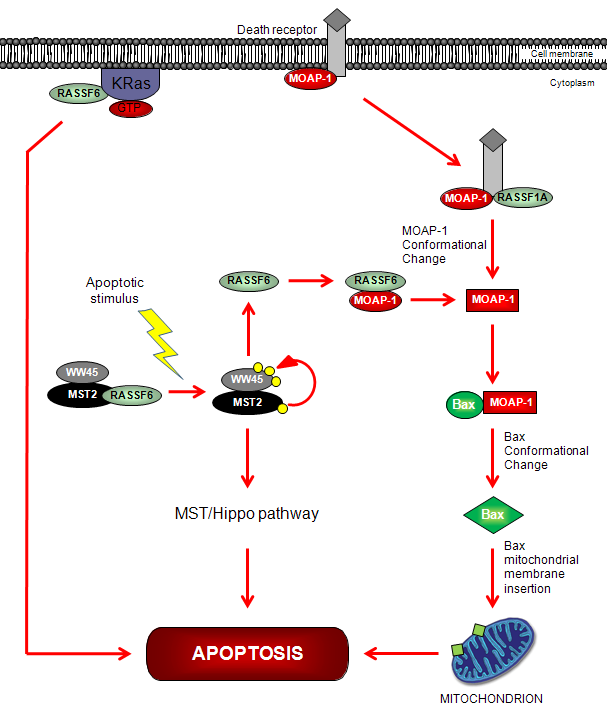
RASSF6 interacts with MST2 via the Sav/RASSF/Hpo (SARAH) domains within both proteins (Ikeda et al., 2009). It seems clear from many studies that several (if not all) classical RASSF proteins interact with the MST1 and MST2 kinases and that this interaction is at least partly involved in RASSF-induced apoptosis (van der Weyden and Adams, 2007). Ikeda et al., (2009) showed that the SARAH domain of MST2 can bind both WW45 (the mammalian orthologue of the Drosophila protein Salvador) and RASSF6 to form a trimeric complex. However, RASSF6 and WW45 do not interact. This differs somewhat with the regulation of the Hippo pathway in Drosophila, in which the Salvador/Hippo and dRASSF/Hippo complexes are mutually exclusive (see above). RASSF6 inhibits MST2 kinase activity, however activation of MST2 releases RASSF6 in a manner dependent on WW45. Previous studies have demonstrated that MST2 can extensively phosphorylate WW45 (Callus et al., 2006). Ikeda et al., (2009) demonstrated that activation of MST2 by the phosphatase inhibitor okadaic acid (OA) reduced the co-immunoprecipitation of RASSF6 with MST2, whilst the association of MST2 and WW45 remained unchanged. Taken together this suggests that the activation of MST2 and subsequent phosphorylation of WW45 results in the release of RASSF6 from the WW45/MST2/RASSF6 complex. The release of RASSF6 was shown to be WW45-dependent since RASSF6 remained in complex with MST2 following OA treatment of cells in which WW45 had been depleted by RNAi. Furthermore, the release of RASSF6 appears to be necessary for RASSF6-mediated apoptosis. However, apoptosis was vastly reduced in cells transfected with both MST2 and RASSF6. This block of RASSF6-induced apoptosis was dependent on the SARAH domain of MST2 but not the kinase activity of MST2 suggesting that MST2 blocks RASSF6-mediated apoptosis by physical interaction. Interestingly co-expression of RASSF6, MST2 and WW45 resulted in potent cell death. This effect was dependent on the SARAH domain of WW45 suggesting that physical interaction of WW45 with MST2 was necessary to reinstate RASSF6-induced apoptosis by allowing the release of RASSF6. Inhibition of MST2 kinase activity by RASSF6 also results in the inhibition of NDR1 and LATS2 phosphorylation (Ikeda et al., 2009). NDR1 and LATS2 are known MST2 substrates that form part of the MST/Hippo tumour suppressor pathway (see Hergovich and Hemmings, 2009 and Harvey and Tapon, 2007 for a more thorough review of the regulation of apoptosis through the MST/Hippo pathway). Thus release of RASSF6 from the MST2-WW45 complex allows RASSF6-mediated and MST2-mediated apoptosis (figure 3). The induction of apoptosis through these separate pathways may explain the caspase-dependent and caspase-independent nature of RASSF6-mediated apoptosis, since full activation of MSTs is thought to require caspase cleavage.
MOAP-1 is involved in RASSF6-mediated apoptosis
The MOAP-1 protein may also be a RASSF6 effector molecule. To date, two independent studies have demonstrated that RASSF6 also interacts with MOAP-1 (Allen et al., 2007; Ikeda et al., 2009). Though this interaction has not been demonstrated formally at the endogenous level, co-expression of the two proteins clearly demonstrates that MOAP-1 is a likely mediator of RASSF6-induced apoptosis in a manner independent of the MST/Hippo tumour suppressor pathway. MOAP-1 regulates the extrinsic pathway of apoptosis by acting downstream of death receptors such as the tumour necrosis factor a receptor 1 (TNF-R1) and TNFa apoptosis-inducing related ligand receptor 1 (TRAIL-R1). A role for MOAP-1 in regulating RASSF1A-induced apoptosis has previously been demonstrated. Following ligand binding the C-terminal region of MOAP-1 associates with the death domain of TNF-R1. Subsequently, the TNF-R1/MOAP-1 receptor complex is internalised and recruits RASSF1A through the N-terminal cysteine-rich (C1) domain within RASSF1A (Baksh et al., 2005; Vos et al., 2006; Foley et al., 2008). Under static conditions MOAP-1 is held in an inactive conformation, however binding to RASSF1A results in a conformational change that allows MOAP-1 to interact with Bax. This in turn induces a conformational change within Bax that is required for its insertion into the mitochondrial membrane and for the release of inner mitochondrial membrane proteins that can induce apoptosis. Interestingly, activated K-Ras, RASSF1A and MOAP-1 synergise to induce Bax activation and apoptosis (Vos et al., 2006) indicating that cell death induced by the RASSF1A/MOAP-1 interaction may be regulated by both K-Ras and death receptors.
The acidic sequence Glu-Glu-Glu-Glu [312EEEE] in the SARAH domain of RASSF1A that binds to MOAP-1 (Baksh et al., 2005) is also partially conserved in the RASSF6 SARAH domain [EEEK]. However, this is unlikely to be the sole site of interaction since RASSF6 lacking the N-terminal region, the Ras-association domain, or the SARAH domain also interacted with MOAP-1 (Ikeda et al., 2009). Depletion of MOAP-1 partially suppresses RASSF6-mediated apoptosis and co-expression of MST2 vastly reduces the co-immunoprecipitation of RASSF6 and MOAP-1; an effect that is abrogated by the expression of WW45. Taken together these data suggest that the MST2/WW45 complex binds RASSF6 and prevents its interaction with MOAP-1. The MST-Hippo pathway and the MOAP-1 pathway represent distinct RASSF6-regulated apoptotic pathways that are triggered by the activation of MST2 (figure 3).
Homology
Mutations
Note
Implicated in
Article Bibliography
| Pubmed ID | Last Year | Title | Authors |
|---|---|---|---|
| 17404571 | 2007 | RASSF6 is a novel member of the RASSF family of tumor suppressors. | Allen NP et al |
| 15949439 | 2005 | The tumor suppressor RASSF1A and MAP-1 link death receptor signaling to Bax conformational change and cell death. | Baksh S et al |
| 15256003 | 2004 | Activation of cytokines and NF-kappa B in corneal epithelial cells infected by respiratory syncytial virus: potential relevance in ocular inflammation and respiratory infection. | Bitko V et al |
| 16930133 | 2006 | Association of mammalian sterile twenty kinases, Mst1 and Mst2, with hSalvador via C-terminal coiled-coil domains, leads to its stabilization and phosphorylation. | Callus BA et al |
| 17252232 | 2007 | Expression microarray analysis of papillary thyroid carcinoma and benign thyroid tissue: emphasis on the follicular variant and potential markers of malignancy. | Finn SP et al |
| 18474619 | 2008 | Dynamics of RASSF1A/MOAP-1 association with death receptors. | Foley CJ et al |
| 17318211 | 2007 | The Salvador-Warts-Hippo pathway - an emerging tumour-suppressor network. | Harvey K et al |
| 19484742 | 2009 | Mammalian NDR/LATS protein kinases in hippo tumor suppressor signaling. | Hergovich A et al |
| 17325427 | 2007 | The role of RASSF1A methylation in cancer. | Hesson LB et al |
| 19570220 | 2009 | The novel RASSF6 and RASSF10 candidate tumour suppressor genes are frequently epigenetically inactivated in childhood leukaemias. | Hesson LB et al |
| 14605870 | 2004 | Haplotype mapping of the bronchiolitis susceptibility locus near IL8. | Hull J et al |
| 17367779 | 2007 | Ras-association domain family protein 6 induces apoptosis via both caspase-dependent and caspase-independent pathways. | Ikeda M et al |
| 19797269 | 2009 | Hippo pathway-dependent and -independent roles of RASSF6. | Ikeda M et al |
| 19744316 | 2009 | Identification of Achaete-scute complex-like 1 (ASCL1) target genes and evaluation of DKK1 and TPH1 expression in pancreatic endocrine tumours. | Johansson TA et al |
| 17174922 | 2006 | The Drosophila RASSF homolog antagonizes the hippo pathway. | Polesello C et al |
| 18540961 | 2008 | B-cell-activating factor inhibits CD20-mediated and B-cell receptor-mediated apoptosis in human B cells. | Saito Y et al |
| 16860701 | 2006 | Bronchiolitis. | Smyth RL et al |
| 16344548 | 2006 | The RASSF1A tumor suppressor activates Bax via MOAP-1. | Vos MD et al |
| 16221973 | 2005 | Two major branches of anti-cadmium defense in the mouse: MTF-1/metallothioneins and glutathione. | Wimmer U et al |
| 18534021 | 2008 | Transformation of MCF-10A cells by random mutagenesis with frameshift mutagen ICR191: a model for identifying candidate breast-tumor suppressors. | Zientek-Targosz H et al |
| 17692468 | 2007 | The Ras-association domain family (RASSF) members and their role in human tumourigenesis. | van der Weyden L et al |
Other Information
Locus ID:
NCBI: 166824
MIM: 612620
HGNC: 20796
Ensembl: ENSG00000169435
Variants:
dbSNP: 166824
ClinVar: 166824
TCGA: ENSG00000169435
COSMIC: RASSF6
RNA/Proteins
| Gene ID | Transcript ID | Uniprot |
|---|---|---|
| ENSG00000169435 | ENST00000307439 | Q6ZTQ3 |
| ENSG00000169435 | ENST00000335049 | Q6ZTQ3 |
| ENSG00000169435 | ENST00000342081 | Q6ZTQ3 |
| ENSG00000169435 | ENST00000395777 | Q6ZTQ3 |
Expression (GTEx)
Pathways
Protein levels (Protein atlas)
References
| Pubmed ID | Year | Title | Citations |
|---|---|---|---|
| 34898277 | 2022 | DNA Damage Triggers the Nuclear Accumulation of RASSF6 Tumor Suppressor Protein via CDK9 and BAF53 To Regulate p53 Target Gene Transcription. | 0 |
| 34898277 | 2022 | DNA Damage Triggers the Nuclear Accumulation of RASSF6 Tumor Suppressor Protein via CDK9 and BAF53 To Regulate p53 Target Gene Transcription. | 0 |
| 33416181 | 2021 | lncRNA TUSC7 inhibits osteosarcoma progression through the miR‑181a/RASSF6 axis. | 0 |
| 34151476 | 2021 | Down-regulation of circITCH promotes osteosarcoma development and resistance to doxorubicin via the miR-524/RASSF6 axis. | 10 |
| 35048636 | 2021 | Kindlin-3 and RASSF6 are probable biomarkers for predicting metastasis in cutaneous melanoma. | 0 |
| 33416181 | 2021 | lncRNA TUSC7 inhibits osteosarcoma progression through the miR‑181a/RASSF6 axis. | 0 |
| 34151476 | 2021 | Down-regulation of circITCH promotes osteosarcoma development and resistance to doxorubicin via the miR-524/RASSF6 axis. | 10 |
| 35048636 | 2021 | Kindlin-3 and RASSF6 are probable biomarkers for predicting metastasis in cutaneous melanoma. | 0 |
| 31273789 | 2020 | MiR-496 promotes migration and epithelial-mesenchymal transition by targeting RASSF6 in colorectal cancer. | 19 |
| 31273789 | 2020 | MiR-496 promotes migration and epithelial-mesenchymal transition by targeting RASSF6 in colorectal cancer. | 19 |
| 31486880 | 2019 | Residual methylation of tumor suppressor gene promoters, RASSF6 and RASSF10, as novel biomarkers for minimal residual disease detection in adult acute lymphoblastic leukemia. | 4 |
| 31812473 | 2019 | RASSF6-TRIM16 axis promotes cell proliferation, migration and invasion in esophageal squamous cell carcinoma. | 6 |
| 31486880 | 2019 | Residual methylation of tumor suppressor gene promoters, RASSF6 and RASSF10, as novel biomarkers for minimal residual disease detection in adult acute lymphoblastic leukemia. | 4 |
| 31812473 | 2019 | RASSF6-TRIM16 axis promotes cell proliferation, migration and invasion in esophageal squamous cell carcinoma. | 6 |
| 29891515 | 2018 | The RASSF6 Tumor Suppressor Protein Regulates Apoptosis and Cell Cycle Progression via Retinoblastoma Protein. | 7 |
Citation
Luke B Hesson ; Farida Latif
RASSF6 (Ras association (RalGDS/AF-6) domain family member 6)
Atlas Genet Cytogenet Oncol Haematol. 2010-04-01
Online version: http://atlasgeneticsoncology.org/gene/43462/rassf6-(ras-association-(ralgds-af-6)-domain-family-member-6)
