BIRC7 (baculoviral IAP repeat containing 7)
2019-09-01 Dhiego Botelho Rigato , Paola Cristina Branco , Catarina Sofia Mateus Reis Silva , Joao Agostinho Machado-Neto, PhD , Letícia Veras Costa-Lotufo , Paula Christine Jimenez AffiliationAbstract
BIRC7, also known as livin, is a member of the Inhibitor of Apoptosis Protein (IAP) family and is linked to the prevention of cell death induced by apoptosis, by directly or indirectly preventing caspase activity. In general, as most IAPs, BIRC7 expression is not detectable in normal differentiated adult tissues, with the exception of placenta, spleen, lymph nodes and developing embryonic tissues. On the other hand, BIRC7 overexpression has been reported in a variety of tumor types, in which it is associated to malignancy and chemoresistance. Currently, there are some unanswered questions about BIRC7, including its interaction with caspases, a potential paradoxical role in the apoptotic process, and specific functions\/affinities of the BIRC7α and BIRC7β splice variants. Moreover, several studies have demonstrated the value of BIRC7 as a therapeutic target in a number of cancer types. This review mainly focuses on the role of BIRC7 in cancer cell biology and its clinical significance, demonstrating aspects of its DNA\/RNA and protein, as well as its relevance in cancer diagnosis and prognosis.
DNA/RNA
Description
Proteins
Description
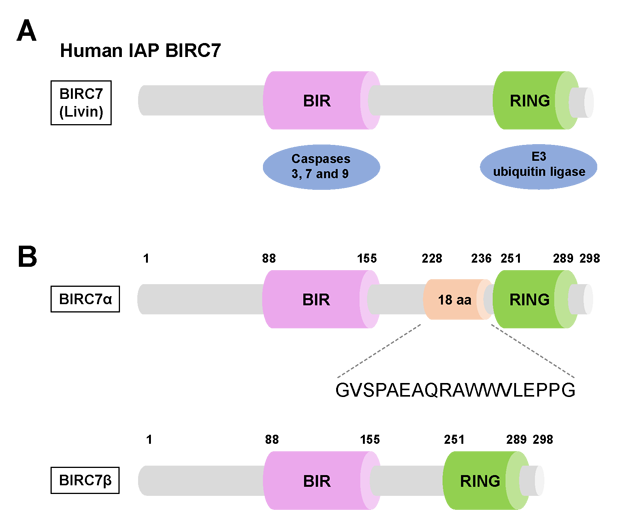
BIRC7 is a 39 kDa member of the IAP family, structured with a single BIR domain, added with a RING domain on the C-terminus portion, as firstly described by Vucic and colleagues in the year 2000 (Figure 1). Its BIR domain is globularly assembled, with four α-helixes and a three-strand anti-parallel β-sheet (Hinds et al., 1999). In turn, the RING-type zinc-finger domain, alike in other RING-bearing IAPs, has ubiquitin-ligase (E3) activity and, thus, is associated with the ubiquitination functionality; however further studies have demonstrated additional and yet unclear roles in addressing apoptotic activity (Ma et al., 2006).
A distinctive feature of this protein is that, unlike any other IAP, following a strong apoptotic incitement, BIRC7 is cleaved by CASP3 and CASP7 (caspases-3 and -7) at Asp52 to give a truncated form, which, paradoxically, promotes cell death (Nachmias et al., 2003). By such trait, rather than merely an apoptosis inhibitor, BIRC7 may actually be allowed to a broader title, one of a cell death regulator. Furthermore, through alternative splicing of the mRNA, BIRC7 has two splice variants, BIRC7α and BIRC7β, which have different subcellular distribution and distinct anti-apoptosis properties. Still, the BIR and RING domains are identical in both isoforms, and their only structural difference is assumed by the 18 amino acids present between these domains in the α isoform, allowing the formation of an α-helix linker (Ashhab et al., 2001; Li et al., 2013a).
For BIRC7, there are currently a number of unanswered questions concerning the protein interaction with caspases, the paradoxical activities it can undertake during apoptosis and, also, on specific functions and affinities of the α and β variants. Still, taken the range of activities and regulatory motifs of the protein, BIRC7 has been regarded as an interesting target for cancer therapy. As this IAP displays such unique pro- and anti-apoptotic properties, a treatment strategy could involve the promotion of BIRC7 cleavage, directing accumulation of the truncated protein, in an attempt to tip the scale towards the pro-apoptotic effect, to counteract apoptosis resistance promoted by IAPs and other disrupted signaling pathways present in cancer cells (Wang et al., 2008). Other therapeutic opportunities include targeting BIRC7 at the transcriptional level using antisense oligonucleotides, thus, reducing the expression levels of the protein. Interestingly, antisense IAP therapy is also under clinical testing for XIAP and BIRC5, with promising candidates (Xia et al., 2002; Hu et al., 2003).
Expression
Gastric, prostate, bladder, breast, renal and liver carcinomas, along with neuroblastoma, leukemia, and lymphomas, as well as non-small cell lung, cervical, liver and pancreatic cancers have all been related to BIRC7 upregulation (Gazzaniga et al., 2003; Tanabe et al., 2004; Hariu et al., 2005; Kim et al., 2005; Wagener et al., 2007; Augello et al., 2009; Yuan et al., 2009; Wang et al., 2010; El-Mesallamy et al., 2011; Lazar et al., 2012). In neuroblastoma, bladder and gastric cancers, higher levels of BIRC7 expression could be pondered as a risk factor, once isoform α, but not β, was predominant in bladder cancerous tissue but neither isoform occurred in the healthy tissue (Gazzaniga et al., 2003). In gastric cancer, nearly half of the assessed patients expressed both isoforms in their tumorous tissue, however benign gastric lesions showed no detectable BIRC7 expression (Wang et al., 2010).
Moreover, Ashhab and colleagues (2001) assessed mRNA transcripts of BIRC7α and BIRC7β in a panel of human tumor cell lines and upregulation of both isoforms was detected in melanoma, colon, and prostate carcinoma cells. Nevertheless, when measured in normal fetal and adult tissues, different expression levels for each isoform suggests a specific pattern of splicing and expression related to histology. Notable levels of BIRC7β were found mainly in fetal kidney, spleen, and heart, whereas no BIRC7α was detected in fetal tissues. Adult tissues, such as heart, placenta, lung, spleen and ovary showed upregulation of both isoforms, while only the α isoform was detected in brain, skeletal muscle and lymphocytes (Ashhab et al., 2001).
Localisation
Point mutations to the RING domain resulted in proper peri-nuclear distribution and further Golgi localization, but abrogated the pro-apoptotic effect of t-livin. However, RING-mutated full-length BIRC7 was found in both nucleus and cytoplasm, suggesting that RING domain, opposite to what was observed for the truncated forms, may affect the sub-cellular localization of full-length BIRC7 (Nachmias et al., 2007a). Moreover, while the occurrence of intact full-length BIRC7 in the cytoplasm directly correlates with resistance to apoptosis, the presence of t-livin in the nucleus is associated with increased cellular apoptosis.
Function
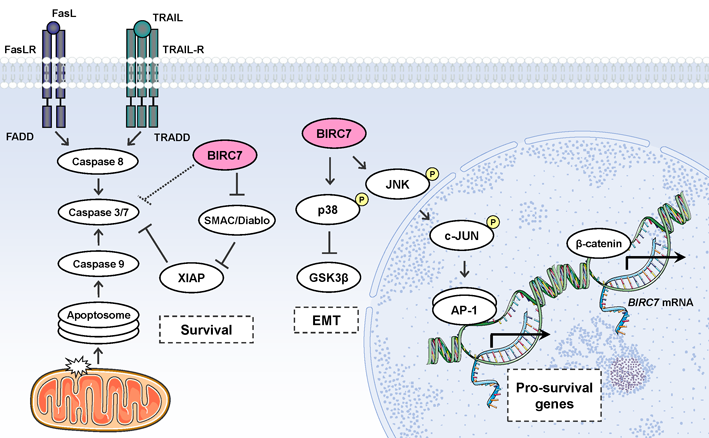
BIRC7 has prompted apoptosis blockage induced by a number of death receptors, such as FAS, TNFRSF1A (TNFR1), TNFRSF10A (DR4) and TNFRSF10B (DR5) (Vucic et al., 2000), and has been associated to other proteins that are within the apoptotic pathway, thus inducing further indirect caspase inhibition. Similar to XIAP, the ability of BIRC7 to activate MAPK8 (JNK1), a protective pathway against apoptosis induced by TNF (TNF-&alpha); and interleukin, was verified by the MAP3K7 / TAB1 (TAK1/TAB1) signaling cascade (Sanna et al., 2002; Chen et al., 2010). Moreover, BIRC7 may play a role in the WNT/ CTNNB1 (Wnt/β-catenin) signaling pathway, a key component of gene activation with outcomes on tumor development through the activity of TCF (T-cell factor) transcription factors (Uematsu et al., 2003). Indeed, Yuan and collaborators (2007) confirmed BIRC7 to be a target of the β-catenin/TCF complex, suggesting their transcriptional regulation by upon BIRC7 (Yuan et al., 2007). Recent studies have also demonstrated a role for BIRC7 in regulating the epithelial-mesenchymal transition in colorectal cancer cells, favoring metastasis by the activation of the p38/ GSK3B pathway (Han et al., 2017).
BIRC7 overexpression has been also associated with tumor aggressiveness, chemoresistance and reduced sensitivity to radiation, while silencing of BIRC7 has been shown to lessen such features, both in vitro and in vivo. When SMMC-7721 cells were transfected with BIRC7 siRNA, mRNA and protein levels of both splice variants, BIRC7α and β, were greatly downregulated. Moreover, transfected cells displayed G1-arrest and a diminished S-phase cell count, reduced invasiveness, and re-established a response to apoptotic stimuli (Liu et al., 2010). BIRC7-silenced SCG-7901 cells, in turn, regained sensitivity to cytotoxic chemotherapy drugs, such as 5-fluorouracil (5-FU) and cisplatin (Wang et al., 2010). In xenograft models, HCT116 tumors treated with BIRC7 siRNA presented reduced volume in a dose-dependent fashion, while mice maintained healthy body weight and no signs of toxicity (Oh et al., 2011). Animal models were also used to demonstrate the differential effects of BIRC7 isoforms in tumorigenesis. BIRC7α was shown to promote tumor progression, whereas those expressing BIRC7β inhibited tumor growth due to high degrees of cleavage, mediated by natural killer (NK) cells activity, of this variant into t-livin, which has a pro-apoptotic effect. Nevertheless, the expression of a mutated BIRC7β with lowered inclination to undergo cleavage restored a positive effect of tumor growth (Abd-Elrahman et al., 2009). In turn, it was also established that, while BIRC7α enhanced killing by NK cells, the β variant took on a modest protective effect against apoptosis induced by NK cells, however, in Jurkat cells, this action occurred alongside a concurrent inhibitory trigger, and not self-sufficiently. Nevertheless, when both isoforms were detected in melanoma cells, a low killing rate was observed (Nachimas et al., 2007b).
The paradoxical pro-apoptotic effects of BIRC7, although baring intact BIR domains, are exerted by the truncated forms of both variants; still, t-livin β was found to give a stronger, however less stable, pro-apoptotic effect than t-livin α. t-Livin occurs around the cell nucleus, although not sturdily bound to that, and accumulates in the Golgi apparatus. Resorting to mutagenesis and co-localization studies, Nachmias and colleagues further demonstrated that an intact RING domain and merely the first N-terminal glycine (G53) residue were sufficiently responsible for t-livins localization to Golgi apparatus and also for its pro-apoptotic function, while deletion of either of these regions resulted in restoration of anti-apoptotic effect (Nachimas et al., 2007a). Additionally, t-livin has also been termed a flexible inducer of cell death once Shiloach and colleagues (2014) recognized its capacity of inciting necrosis, like in 293T cells, or apoptosis, like in A549 and MelA1, and such distinction may be possibly linked to TP53 status. Moreover, once the BIR domain was deleted from t-livin, the prior necrotic effect observed in 293T cells was replaced by an apoptotic effect, regardless of its inactive TP53. Both effects, apoptosis and necrosis, were linked to activation of JNK pathway. However, once the BIR domain was deleted from t-livin, 293T cells failed to express JNK, suggesting a role for BIR in activation of this pathway. In MelA1 cells, when these were treated with a pan-caspase inhibitor, t-livin-induced cell death was only partially abrogated, implying an aptitude of t-livin to induce cell death in situations where the apoptotic process is compromised (Shiloach et al., 2014).
Homology
Table 1. Comparative identity of human BIRC7 with other species
| % Identity for: Homo sapiens BIRC7 | Symbol | Protein | DNA |
| vs. X. tropicalis | birc7 | 55.4 | 58.2 |
| vs. D. rerio | birc7 | 60.3 | 62.7 |
| vs. G. gallus | BIRC7 | 55.4 | 58.2 |
| vs. D. rerio | birc7 | 59.1 | 65.0 |
| vs. G. gallus | BIRC7 | 60.3 | 62.7 |
| vs. X. tropicalis | birc7 | 59.1 | 65.0 |
(Source: http://www.ncbi.nlm.nih.gov/homologene)
Mutations
Somatic
Implicated in
Clinicopathological studies revealed that the expression levels of BIRC7 in breast cancer tissues (62%) are higher than that of adjacent (35%) and normal breast tissues (25%). Still, the expression of BIRC7 in breast cancer is not closely related to age, menopause status, histological grade, ESR1 (estrogen receptor), or PGR (progesterone receptor) status. However, expression of BIRC7 is higher in breast cancers classified under histological grade III when compared to grades I and II (88.9% vs. 46.9%). Similarly, the positive expression rate of BIRC7 in TNM in breast cancer stages III and IV (87.5%) was higher than in other stages (50%). In breast cancer cells, BIRC7 gene silencing induced G0/G1 cell cycle arrest. BIRC7 was highly expressed in high-invasive breast cancer cells and promoted breast cancer cell migration and invasion via the activation of AKT signaling and induction of epithelial-mesenchymal transition (EMT) in vitro and in vivo (Li et al., 2012).
EMT is a key step in tumor progression via the induction of a highly invasive phenotype, and its molecular mechanisms have been extensively studied. The loss of epithelial markers such as CDH1 (E-cadherin), and the gain of mesenchymal markers such as CDH2 (N-cadherin) and VIM (vimentin) are the hallmarks of EMT. Overexpression of BIRC7 resulted in a similar loss of epithelial markers and a gain of mesenchymal markers, suggesting that BIRC7 was actively involved in the EMT process in breast cancer cells. These results suggested that BIRC7 participates of EMT by altering expression and activation of proteins involved in metastasis (Li et al., 2013b).
Together, these findings indicate that BIRC7 promoted the progression and metastasis of breast cancer through the regulation of EMT by activating the p38/GSK3β pathway. A deeper understanding of the role of BIRC7-induced EMT in breast cancer may provide effective targets for therapy, especially in triple-negative breast cancer (Han et al., 2017, Etti et al., 2017).
In neuroblastomas, 80% of cases presented high BIRC7 expression. Experimental findings indicate that BIRC7 may play a role in drug-resistance in neuroblastoma, particularly in aggressive and MYCN amplified tumors. These data strongly support that therapeutic targeting of BIRC7 to block its antiapoptotic effect could be an interesting strategy for the treatment of this disease (Dasgupta et al., 2010).
In glioblastoma multiforme, the tumor hypoxia-induced BIRC7 expression may represent a pathway for resistance to radio- and chemotherapeutics, since experimental studies showed that siRNA directed against BIRC7 inhibited tumor growth (Hsieh et al., 2014; Yuan et al., 2011).
In primary tumors, BIRC7 expression was significantly increased compared with adjacent or distant normal mucosa, in which expression was independently related to survival outcomes in patients with rectal cancer (Ding et al., 2013). In addition, BIRC7 was related to pathological grade, extent of invasion and amount of lymph node metastasis, contributing to poor prognosis of mid-distal rectal cancer following surgery (Su et al., 2017).
Overexpression of BIRC7 induced proliferation, migration, and invasion of cancer colorectal cells, which was reverted by BIRC7 depletion. Moreover, this overexpression promoted EMT, as evidenced by a decrease in E-cadherin expression and an increase in mesenchymal markers, including vimentin, SNAI2 (SLUG), and SNAI1 (SNAIL) (Ge et al., 2016). Additionally, knockdown of BIRC7 promoted cell cycle arrest by decreasing CCND1 36 and CCND3 (cyclins D1 and D3), CDK4 and CDK6, and by inducing CDKN1B (p27) expression. Moreover, MAPK signaling cascades were significantly blocked by knockdown of BIRC7 (Myung et al, 2013), while BIRC7 silencing using siRNA also decreased cell proliferation and clonogenicity and increased apoptosis rates (Zou et al., 2014).
In colorectal cancer cell lines, BIRC7 expression was attributed to cisplatin resistance. BIRC7 mRNA levels was upregulated after cisplatin treatment in a dose- dependent manner. By contrast, knockdown of BIRC7 by siRNA rendered colon cancer cells more sensitive to cisplatin, reinforcing its involvement in chemoresistance (Ding et al., 2013). BIRC7 knockdown also improved the sensitivity of colorectal cells to 5-FU (Liu et al., 2018). Colorectal cancer chemoresistance in HCT-8/V due to overexpression of this protein has also been attributed in response to vincristine (VCR), etoposide (VP-16), and 5-FU (Wang et al., 2010).
Furthermore, Ou et al. (2014) demonstrated that BIRC7 depletion inhibited cell proliferation and invasion and induced apoptosis - showed by decreased expression of p38 MAPK, VEGF, and MMP2 and increased expression of caspase 3 in vitro. This feature also induced cell cycle arrest, with a decrease of cyclin D1 and CDK4 and CDK6, and an increase in expression of CDKN1A (p21) and CDKN1B (p27) (Chung et al., 2013). Comparably, in vivo assessments proved tumor size had decreased after treatment with siRNA (Oh et al., 2011) or shRNA (Ou et al., 2014) targeting BIRC7.
Clinical studies indicated that tissues from advanced stages of RCC have greater expression of BIRC7 (Wang et al., 2016). Functional studies strongly suggested that BIRC7 is a bridge for apoptosis and autophagy. Silencing of BIRC7 induced apoptosis and autophagic cell death while also increasing sensitivity to cisplatin in RCC cells (Wang et al., 2016).
In patients with nasopharyngeal carcinoma (NPC), high expression levels of BIRC7 occurred in 65.1% of cases, suggesting BIRC7 to be implicated in progression of such disease. Thus, this may be a useful prognostic biomarker for NPC (Kuang et al., 2017, Liu et al., 2016). Nevertheless, observational studies have shown that the efficacy of radiotherapy is greater in patients who did not express BIRC7 compared to those with BIRC7 overexpression, indicating that BIRC7 may be associated with a poor prognosis for NPC and LHSCC (Kuang et al., 2017, Liu et al., 2016).
Additionally, levels of BIRC7 expression in acute lymphoblastic leukemia (ALL) were also shown to be elevated. Such feature may be attributed to the different mutations that occurred in the two types of leukemia that further lead to leukemogenesis (Ibrahim et al., 2014; Choi et al., 2019).
Overexpression of BIRC7 protein in newly diagnosed children with acute leukemia suggested an important role for this protein in carcinogenesis and progression of such disease (Lv et al., 2015). Yang et al. (2010) also suggested that the expression of BIRC7α and BIRC7β may be associated with genesis and development of acute leukemia in childhood, and that this could be used as a molecular marker of childhood acute leukemia. In addition, BIRC7 can be used as a new target for leukemia treatment, as RNAi technology effectively inhibited expression of BIRC7 (Yang et al., 2010; Yan et al., 2011; Ibrahim et al., 2014).
BIRC7 inhibition, by shRNA, promoted apoptosis in hepatocellular carcinoma cell line HepG2, which was even more evident with a combinatory strategy using the co-transfection with a shRNA targeting BIRC5 (Xu et al., 2014). Additionally, another study demonstrated that inhibition of BIRC7 using shRNA increased chemosensitivity of HepG2 cells (Liu et al., 2015).
Similar results were obtained in other hepatocellular carcinoma cell line, SMMC-7721, using BIRC7 siRNA. Inhibition of BIRC7 sensitized cells to pro-apoptotic stimuli associated with caspase 3 activation and, moreover, promoted cell growth inhibition specifically by mitotic arrest. In addition, BIRC7 depletion reduced the invasive capacity of hepatocellular carcinoma cells, demonstrating that BIRC7 is not only involved in resistance to apoptosis, but also in cell proliferation and invasiveness (Liu et al., 2010).
BIRC7 not only provided resistance to hepatocellular carcinoma cells, but also significantly contributed to cell proliferation and invasion (Liu, 2010). In addition, clinical studies showed that overexpression of BIRC7α isoform correlates with a high risk of relapse in liver cancer (Liu, 2007; Liu, 2010).
Inhibition of BIRC7 gene expression was associated with a strong increase in apoptotic response in the presence of pro-apoptotic agents, indicating that BIRC7 depletion led to sensitization to apoptotic stimuli (Mazumder, 2008; Liu, 2010). Moreover, negative regulation of BIRC7 expression induced cell cycle arrest at the G0/G1 phase, indicating that BIRC7 modulation may be a potential targeted approach for the treatment of liver cancer (Wang, 2008; Liu, 2010)
Functional studies showed that silencing of BIRC7 increased the efficiency of chemotherapy or radiotherapy in pulmonary adenocarcinomas. In addition, this protein is portrayed as a potential predictive biomarker for the prognosis of lung adenocarcinoma besides a promising strategy for drug-resistant lung adenocarcinoma (Yang et al., 2014; Wu et al., 2016; Liang et al., 2017).
BIRC7 plays a critical role in the pathogenesis of lymphomas and was detected in 40% of cases Hodgkins lymphoma and 48% in cases of Burkitts lymphoma, indicating that BIRC7 could be a potential marker and therapeutic target for these diseases (Abd-Elrahamn et al., 2009; Kalungi et al., 2012).
BIRC7 showed low occurrence in nevi (15%), however an increased expression in melanoma (47.6 - 70.7%), in which these levels came up to 95% in metastatic melanoma, suggesting this protein to be involved in melanoma progression (Hartman & Czyz, 2013). In this scenario, high BIRC7 levels were associated with a poor prognosis in melanoma (Lazar et al., 2012). Still, silencing of BIRC7 induced apoptosis, by activation of caspase 3, and cell cycle arrest at the G0/G1 phase, thus inhibiting proliferation of LiBr melanoma cells (Wang et al., 2007).DISEASE
As BIRC7 has rarely been found in osteochondroma tissues, this feature may be indicative of a specificity of such protein to osteosarcomas. In invasive osteosarcomas metastatic tissues, BIRC7 was notoriously elevated, suggesting that the higher levels of this protein conferred anti-apoptotic effects and endurance of these tumor cells (Li et al, 2012). In this context, BIRC7 may serve as a promising therapeutic target for the treatment of osteosarcomas. Furthermore, expression of BIRC7 was related to a poor prognosis of osteosarcoma and its detection may play an important role in evaluation of this type of cancer (Li et al, 2012; Li et al, 2014; Sun et al., 2018).
In PANC-1 cells, pharmacological studies have shown oxymatrine-induced apoptosis to be related to downregulation of BIRC7 and upregulation of the BAX / BCL2 ratio (Lopes et al., 2007, Liu et al., 2011).
In prostate carcinoma tissues, BIRC7 overexpression was associated with high-grade clinical stages of the disease and metastasis. This protein plays an important role in initiation of prostate cancer and promotes cell proliferation by regulating the G1/S cell cycle transition. BIRC7 has been related with invasion of cancer cells in the surrounding prostate tissue by affecting NF-KB signaling pathway and expressions of FN1 and CXCR4, resulting in inhibition of PTK2 (FAK) and SRC, and of ITGA5 and ITGB3 (integrins a5 and b3) (Ye et al, 2011; Chen et al., 2012)
Article Bibliography
| Pubmed ID | Last Year | Title | Authors |
|---|---|---|---|
| 19549891 | 2009 | The inhibitor of apoptosis protein Livin (ML-IAP) plays a dual role in tumorigenicity. | Abd-Elrahman I et al |
| 972280 | 1976 | Clinical evaluation of tobramycin in respiratory and systemic infections in immunodepressed and normal patients. | Altucci P et al |
| 9556606 | 1998 | Induction of apoptosis and inhibition of cell proliferation by survivin gene targeting. | Ambrosini G et al |
| 11322947 | 2001 | Two splicing variants of a new inhibitor of apoptosis gene with different biological properties and tissue distribution pattern. | Ashhab Y et al |
| 19397802 | 2009 | Inhibitors of apoptosis proteins (IAPs) expression and their prognostic significance in hepatocellular carcinoma. | Augello C et al |
| 14608905 | 2003 | The B-cell transcription factors BSAP, Oct-2, and BOB.1 and the pan-B-cell markers CD20, CD22, and CD79a are useful in the differential diagnosis of classic Hodgkin lymphoma. | Browne P et al |
| 25542341 | 2015 | IAPs: Modular regulators of cell signalling. | Budhidarmo R et al |
| 22271494 | 2012 | Livin regulates prostate cancer cell invasion by impacting the NF-κB signaling pathway and the expression of FN and CXCR4. | Chen F et al |
| 21192816 | 2010 | iASPP is over-expressed in human non-small cell lung cancer and regulates the proliferation of lung cancer cells through a p53 associated pathway. | Chen J et al |
| 18837095 | 2008 | Expression of livin and vascular endothelial growth factor in different clinical stages of human esophageal carcinoma. | Chen L et al |
| 19269012 | 2009 | Caspases and inhibitor of apoptosis proteins in cutaneous and mucosal melanoma: expression profile and clinicopathologic significance. | Chen N et al |
| 22938441 | 2012 | Relationship between PTEN and Livin expression and malignancy of renal cell carcinomas. | Cheng T et al |
| 16990595 | 2007 | Expression of Livin, an antiapoptotic protein, is an independent favorable prognostic factor in childhood acute lymphoblastic leukemia. | Choi J et al |
| 24008725 | 2013 | Expression and prognostic significance of Livin in gastric cancer. | Chung CY et al |
| 20177953 | 2010 | Isolation of peptides blocking the function of anti-apoptotic Livin protein. | Crnković-Mertens I et al |
| 18591623 | 2008 | Molecular characterization of acute myeloid leukemia. | Döhner K et al |
| 20691667 | 2010 | Expression and functional role of inhibitor-of-apoptosis protein livin (BIRC7) in neuroblastoma. | Dasgupta A et al |
| 23188704 | 2013 | Upregulation of the antiapoptotic factor Livin contributes to cisplatin resistance in colon cancer cells. | Ding ZY et al |
| 24295240 | 2013 | Livin expression is an independent factor in rectal cancer patients with or without preoperative radiotherapy. | Ding ZY et al |
| 21700335 | 2011 | Expression of inhibitor of apoptosis protein (IAP) livin/BIRC7 in acute leukemia in adults: correlation with prognostic factors and outcome. | El-Mesallamy HO et al |
| 28771532 | 2017 | The molecular mechanism of the anticancer effect of Artonin E in MDA-MB 231 triple negative breast cancer cells. | Etti IC et al |
| 28983346 | 2015 | Utility of SOX2 and Livin Co-Expression in the Prognosis of Bladder Cancer With Bilharzial and Non-Bilharzial Bladder Status. | Gayyed MF et al |
| 12488298 | 2003 | Expression and prognostic significance of LIVIN, SURVIVIN and other apoptosis-related genes in the progression of superficial bladder cancer. | Gazzaniga P et al |
| 27013894 | 2016 | Overexpression of Livin promotes migration and invasion of colorectal cancer cells by induction of epithelial-mesenchymal transition via NF-κB activation. | Ge Y et al |
| 25117814 | 2014 | Fascin is involved in the chemotherapeutic resistance of breast cancer cells predominantly via the PI3K/Akt pathway. | Ghebeh H et al |
| 16189155 | 2005 | Melanoma inhibitor of apoptosis protein is expressed differentially in melanoma and melanocytic naevus, but similarly in primary and metastatic melanomas. | Gong J et al |
| 17253596 | 2007 | Expression patterns of inhibitor of apoptosis proteins in malignant pleural mesothelioma. | Gordon GJ et al |
| 26708654 | 2016 | Effects of RNA interference-mediated knockdown of livin and survivin using monomethoxypolyethylene glycol-chitosan nanoparticles in MG-63 osteosarcoma cells. | Guan HP et al |
| 24223461 | 2013 | Expression and clinical significance of livin protein in hepatocellular carcinoma. | Guo H et al |
| 20651737 | 2010 | IAPs: from caspase inhibitors to modulators of NF-kappaB, inflammation and cancer. | Gyrd-Hansen M et al |
| 29039608 | 2017 | Livin promotes the progression and metastasis of breast cancer through the regulation of epithelial‑mesenchymal transition via the p38/GSK3β pathway. | Han Y et al |
| 10647931 | 2000 | The hallmarks of cancer. | Hanahan D et al |
| 15709165 | 2005 | Aberrant expression and potency as a cancer immunotherapy target of inhibitor of apoptosis protein family, Livin/ML-IAP in lung cancer. | Hariu H et al |
| 23340174 | 2013 | Anti-apoptotic proteins on guard of melanoma cell survival. | Hartman ML et al |
| 10404221 | 1999 | Solution structure of a baculoviral inhibitor of apoptosis (IAP) repeat. | Hinds MG et al |
| 25370472 | 2015 | Livin contributes to tumor hypoxia-induced resistance to cytotoxic therapies in glioblastoma multiforme. | Hsieh CH et al |
| 12855663 | 2003 | Antisense oligonucleotides targeting XIAP induce apoptosis and enhance chemotherapeutic activity against human lung cancer cells in vitro and in vivo. | Hu Y et al |
| 24696218 | 2014 | Expression and prognostic significance of livin/BIRC7 in childhood acute lymphoblastic leukemia. | Ibrahim L et al |
| 23030305 | 2013 | Expression of apoptosis associated proteins Survivin, Livin and Thrombospondin-1 in Burkitt lymphoma. | Kalungi S et al |
| 11024045 | 2001 | Livin, a novel inhibitor of apoptosis protein family member. | Kasof GM et al |
| 18515985 | 2008 | Expression of splicing variants of the inhibitor of apoptosis livin in testicular germ cell tumors. | Kempkensteffen C et al |
| 16328668 | 2005 | Expression of inhibitor-of-apoptosis protein (IAP) livin by neuroblastoma cells: correlation with prognostic factors and outcome. | Kim DK et al |
| 27175933 | 2016 | Livin enhances tumorigenesis by regulating the mitogen-activated protein kinase signaling pathway in human hypopharyngeal squamous cell carcinoma. | Kim SA et al |
| 28617432 | 2017 | BST2 confers cisplatin resistance via NF-κB signaling in nasopharyngeal cancer. | Kuang CM et al |
| 22441029 | 2012 | The clinical effect of the inhibitor of apopotosis protein livin in melanoma. | Lazar I et al |
| 25242075 | 2014 | Relationship between expression of Livin and the biological behavior of human oral squamous cell carcinoma. | Lee DH et al |
| 25374170 | 2014 | Research progress on the livin gene and osteosarcomas. | Li CJ et al |
| 23524337 | 2013 | Livin promotes progression of breast cancer through induction of epithelial-mesenchymal transition and activation of AKT signaling. | Li F et al |
| 23632777 | 2013 | RNA interference-mediated knockdown of Livin suppresses cell proliferation and invasion and enhances the chemosensitivity to cisplatin in human osteosarcoma cells. | Li X et al |
| 22266186 | 2012 | Impairment of p53 acetylation by EWS-Fli1 chimeric protein in Ewing family tumors. | Li Y et al |
| 24161202 | 2013 | CpG oligodeoxynucleotides enhance chemosensitivity of 5-fluorouracil in HepG2 human hepatoma cells via downregulation of the antiapoptotic factors survivin and livin. | Liang SR et al |
| 28765921 | 2017 | miR-198-induced upregulation of Livin may be associated with the prognosis and contribute to the oncogenesis of lung adenocarcinoma. | Liang Y et al |
| 22932199 | 2012 | Expression of CD44v6 and Livin in gastric cancer tissue. | Liang YZ et al |
| 21714853 | 2011 | Oxymatrine induces human pancreatic cancer PANC-1 cells apoptosis via regulating expression of Bcl-2 and IAP families, and releasing of cytochrome c. | Ling Q et al |
| 27373721 | 2016 | Prognostic significance of Livin expression in nasopharyngeal carcinoma after radiotherapy. | Liu AH et al |
| 17218055 | 2007 | Livin/ML-IAP as a new target for cancer treatment. | Liu B et al |
| 26722271 | 2015 | The effects of Livin shRNA on the response to cisplatin in HepG2 cells. | Liu F et al |
| 21472331 | 2010 | Inhibition of tumorigenesis and invasion of hepatocellular carcinoma by siRNA-mediated silencing of the livin gene. | Liu H et al |
| 29740490 | 2018 | Silencing Livin improved the sensitivity of colon cancer cells to 5-fluorouracil by regulating crosstalk between apoptosis and autophagy. | Liu S et al |
| 22766624 | 2012 | Expression and role of the inhibitor of apoptosis protein livin in chemotherapy sensitivity of ovarian carcinoma. | Liu X et al |
| 26622485 | 2015 | Effect of siRNA-Livin on drug resistance to chemotherapy in glioma U251 cells and CD133(+) stem cells. | Liu Y et al |
| 17311258 | 2007 | Expression of the IAP protein family is dysregulated in pancreatic cancer cells and is important for resistance to chemotherapy. | Lopes RB et al |
| 20888210 | 2010 | To fight or die - inhibitor of apoptosis proteins at the crossroad of innate immunity and death. | Lopez J et al |
| 26636528 | 2015 | In vitro application of RNA interference to silence livin gene expression to induce apoptosis in leukemia cells. | Lv J et al |
| 16729033 | 2006 | Livin promotes Smac/DIABLO degradation by ubiquitin-proteasome pathway. | Ma L et al |
| 9990949 | 1989 | Magnetic and structural properties of amorphous CoTi soft ferromagnetic thin films. II. Structural properties. | Machizaud F et al |
| 18175808 | 2008 | Caspase-3 activation is a critical determinant of genotoxic stress-induced apoptosis. | Mazumder S et al |
| 24023847 | 2013 | Expression of Livin in colorectal cancer and its relationship to tumor cell behavior and prognosis. | Myung DS et al |
| 18034418 | 2007 | Manipulation of NK cytotoxicity by the IAP family member Livin. | Nachmias B et al |
| 27904848 | 2016 | Silencing the livin gene enhances the cytotoxic effects of anticancer drugs on colon cancer cells. | Oh BY et al |
| 21633662 | 2011 | siRNA targeting Livin decreases tumor in a xenograft model for colon cancer. | Oh BY et al |
| 24220265 | 2014 | Knockdown of Livin inhibits growth and invasion of gastric cancer cells through blockade of the MAPK pathway in vitro and in vivo. | Ou JM et al |
| 25328816 | 2013 | Inhibitor of Apoptosis Proteins: Promising Targets for Cancer Therapy. | Owens TW et al |
| 21340093 | 2011 | Apoptotic cell signaling in cancer progression and therapy. | Plati J et al |
| 12048196 | 2002 | ILPIP, a novel anti-apoptotic protein that enhances XIAP-mediated activation of JNK1 and protection against apoptosis. | Sanna MG et al |
| 24960127 | 2014 | tLivin displays flexibility by promoting alternative cell death mechanisms. | Shiloach T et al |
| 20574922 | 2010 | DHA alters expression of target proteins of cancer therapy in chemotherapy resistant SW620 colon cancer cells. | Slagsvold JE et al |
| 29344221 | 2017 | Livin serves as a prognostic marker for mid-distal rectal cancer and a target of mid-distal rectal cancer treatment. | Su QB et al |
| 30214613 | 2018 | Expression of Livin and PlGF in human osteosarcoma is associated with tumor progression and clinical outcome. | Sun K et al |
| 12131697 | 2002 | Intraportal infusion therapy as a novel approach to adult ABO-incompatible liver transplantation. | Tanabe M et al |
| 24767895 | 2014 | Livin, a novel marker in lymphoma type distinction. | Tanhaei AP et al |
| 12907630 | 2003 | Wnt pathway activation in mesothelioma: evidence of Dishevelled overexpression and transcriptional activity of beta-catenin. | Uematsu K et al |
| 11801603 | 2002 | SMAC negatively regulates the anti-apoptotic activity of melanoma inhibitor of apoptosis (ML-IAP). | Vucic D et al |
| 15485396 | 2005 | Engineering ML-IAP to produce an extraordinarily potent caspase 9 inhibitor: implications for Smac-dependent anti-apoptotic activity of ML-IAP. | Vucic D et al |
| 11084335 | 2000 | ML-IAP, a novel inhibitor of apoptosis that is preferentially expressed in human melanomas. | Vucic D et al |
| 17968430 | 2007 | Expression of inhibitor of apoptosis protein Livin in renal cell carcinoma and non-tumorous adult kidney. | Wagener N et al |
| 18031611 | 2007 | Silencing livin gene by siRNA leads to apoptosis induction, cell cycle arrest, and proliferation inhibition in malignant melanoma LiBr cells. | Wang H et al |
| 28459204 | 2017 | Single-chain antibody-delivered Livin siRNA inhibits human malignant melanoma growth in vitro and in vivo. | Wang H et al |
| 18340356 | 2008 | Silencing Livin gene expression to inhibit proliferation and enhance chemosensitivity in tumor cells. | Wang R et al |
| 20171199 | 2010 | Livin gene plays a role in drug resistance of colon cancer cells. | Wang X et al |
| 25339450 | 2014 | Expression of the apoptosis inhibitor livin in colorectal adenoma-carcinoma sequence: correlations with pathology and outcome. | Wang Y et al |
| 27677286 | 2016 | Silencing Livin induces apoptotic and autophagic cell death, increasing chemotherapeutic sensitivity to cisplatin of renal carcinoma cells. | Wang Z et al |
| 26553359 | 2016 | miR-198 targets SHMT1 to inhibit cell proliferation and enhance cell apoptosis in lung adenocarcinoma. | Wu S et al |
| 21934342 | 2011 | Significant elevation of survivin and livin expression in human colorectal cancer: inverse correlation between expression and overall survival. | Xi RC et al |
| 12479365 | 2002 | Induction of apoptosis in mesothelioma cells by antisurvivin oligonucleotides. | Xia C et al |
| 24175843 | 2013 | Impact of Co-transfection with Livin and survivin shRNA expression vectors on biological behavior of HepG2 cells. | Xu W et al |
| 23343959 | 2013 | Expression and prognostic significance of livin, caspase-3, and ki-67 in the progression of human ampullary carcinoma. | Xue D et al |
| 21617971 | 2011 | Research progress on Livin protein: an inhibitor of apoptosis. | Yan B et al |
| 24357456 | 2014 | MicroRNA-198 inhibits proliferation and induces apoptosis of lung cancer cells via targeting FGFR1. | Yang J et al |
| 20109966 | 2010 | Expression and prognostic significance of the apoptotic genes BCL2L13, Livin, and CASP8AP2 in childhood acute lymphoblastic leukemia. | Yang YL et al |
| 20607788 | 2011 | Livin-α promotes cell proliferation by regulating G1-S cell cycle transition in prostate cancer. | Ye L et al |
| 28440463 | 2017 | Livin enhances chemoresistance in head and neck squamous cell carcinoma. | Yoon TM et al |
| 19821098 | 2009 | Effects of Livin gene RNA interference on apoptosis of cervical cancer HeLa cells and enhanced sensitivity to cisplatin. | Yu L et al |
| 22086237 | 2012 | siRNA directed against Livin inhibits tumor growth and induces apoptosis in human glioma cells. | Yuan B et al |
| 18827979 | 2009 | The effects on cell growth and chemosensitivity by livin RNAi in non-small cell lung cancer. | Yuan D et al |
| 30588872 | 2018 | Expression of antiapoptotic proteins livin and survivin in pediatric AML patients, as prognostic markers. | Zareifar S et al |
| 23324287 | 2013 | Effect of topotecan on retinocytoma cell apoptosis and expression of Livin and PTEN. | Zhang M et al |
| 24938471 | 2014 | Effect of RNAi-mediated silencing of Livin gene on biological properties of colon cancer cell line LoVo. | Zou AM et al |
Other Information
Locus ID:
NCBI: 79444
MIM: 605737
HGNC: 13702
Ensembl: ENSG00000101197
Variants:
dbSNP: 79444
ClinVar: 79444
TCGA: ENSG00000101197
COSMIC: BIRC7
RNA/Proteins
| Gene ID | Transcript ID | Uniprot |
|---|---|---|
| ENSG00000101197 | ENST00000217169 | Q96CA5 |
| ENSG00000101197 | ENST00000342412 | Q96CA5 |
| ENSG00000101197 | ENST00000395306 | A8MTF4 |
Expression (GTEx)
Pathways
References
| Pubmed ID | Year | Title | Citations |
|---|---|---|---|
| 38332512 | 2024 | Livin is protective in UVB-induced skin photodamage by regulating keratinocyte activation and inflammatory responses. | 1 |
| 38332513 | 2024 | Livin expression promotes keratinocyte release of inflammatory mediators in psoriasis. | 1 |
| 38332512 | 2024 | Livin is protective in UVB-induced skin photodamage by regulating keratinocyte activation and inflammatory responses. | 1 |
| 38332513 | 2024 | Livin expression promotes keratinocyte release of inflammatory mediators in psoriasis. | 1 |
| 37773704 | 2023 | Dendritic cells infected with recombinant adenoviral vector encoding mouse fibroblast activation protein-α and human livin α exert an antitumor effect against Lewis lung carcinoma in mice. | 1 |
| 37773704 | 2023 | Dendritic cells infected with recombinant adenoviral vector encoding mouse fibroblast activation protein-α and human livin α exert an antitumor effect against Lewis lung carcinoma in mice. | 1 |
| 35931997 | 2022 | The clinicopathological and prognostic significances of IGF-1R and Livin expression in patients with colorectal cancer. | 1 |
| 35931997 | 2022 | The clinicopathological and prognostic significances of IGF-1R and Livin expression in patients with colorectal cancer. | 1 |
| 33649820 | 2021 | Inhibitor of apoptosis protein Livin promotes tumor progression and chemoradioresistance in human anaplastic thyroid cancer. | 4 |
| 33649820 | 2021 | Inhibitor of apoptosis protein Livin promotes tumor progression and chemoradioresistance in human anaplastic thyroid cancer. | 4 |
| 32119704 | 2020 | Inhibition of livin overcomes radioresistance in nasopharyngeal carcinoma cells. | 4 |
| 32124942 | 2020 | A novel role for Livin in the response to ultraviolet B radiation and pterygium development. | 2 |
| 32359099 | 2020 | Oncostatin M upregulates Livin to promote keratinocyte proliferation and survival via ERK and STAT3 signalling pathways. | 8 |
| 32395888 | 2020 | Methylation-mediated miR-214 regulates proliferation and drug sensitivity of renal cell carcinoma cells through targeting LIVIN. | 7 |
| 32724797 | 2020 | Huaier Granule Combined with Tegafur Gimeracil Oteracil Potassium Promotes Stage IIb Gastric Cancer Prognosis and Induces Gastric Cancer Cell Apoptosis by Regulating Livin. | 7 |
Citation
Dhiego Botelho Rigato ; Paola Cristina Branco ; Catarina Sofia Mateus Reis Silva ; Joao Agostinho Machado-Neto, PhD ; Letícia Veras Costa-Lotufo ; Paula Christine Jimenez
BIRC7 (baculoviral IAP repeat containing 7)
Atlas Genet Cytogenet Oncol Haematol. 2019-09-01
Online version: http://atlasgeneticsoncology.org/gene/799/birc7-(baculoviral-iap-repeat-containing-7)%5C
