Colon: Colorectal adenocarcinoma
2012-12-01 Viktor H Koelzer , Heather Dawson , Inti Zlobec , Alessandro Lugli Affiliation1.Clinical Pathology Division, Translational Research Unit, Institute of Pathology, University of Bern, Murtenstrasse 31, CH-3010 Bern, Switzerland
2.Department of Molecular Biology, Genetics, Middle East Technical University, Ankara 06531 Turkey (NS); Department of Biological Sciences, Middle East Technical University, Ankara 06531, Turkey (SB)
3.Clinical Pathology Division, Translational Research Unit, Institute of Pathology, University of Bern, Murtenstrasse 31, CH-3010 Bern, Switzerland
4.INSERM U434, Laboratoire de Genetique des Tumeurs, CEPH, Paris
Summary
Cos histo
Orphanet
Omim
Nci
Mesh
Classification
Classification
Molecular pathway
- Chromosome instability (CIN)
-- 85% of all CRCs
-- Somatic inactivation of APC, p53;
- Microsatellite instability (MSI)
-- 15% of all CRCs
-- Hypermethylation or somatic inactivation of DNA repair enzymes;
Etiology
- Sporadic CRC
-- 84% microsatellite stable (MSS) CRC
-- 10% microsatellite instable (MSI) CRC;
- Hereditary CRC
-- 1% Familial Adenomatous Polyposis (FAP) (MSS CRC)
-- 5% Hereditary Non-Polyposis Colorectal Cancer (HNPCC) (MSI CRC).
In the last years, downstream molecules of different pathways such as KRAS and BRAF are included in proposals for a more differentiated molecular classification of CRC.
The CpG Methylator Phenotype (CIMP) status also seems to play an important role in the pathogenesis of CRC.
Clinics and Pathology
Etiology
- Diet (high caloric food, meat consumption)
- Obesity
- Sedentary lifestyle
- Smoking
- Alcohol consumption
- Inflammatory Bowel Disease (IBD)
-- Cohns disease
-- Ulcerative colitis.
Epidemiology
- In 2008, 1.23 million new CRC cases occurred worldwide (9.7% of all new cancers).
- CRC is the 4th most frequent cancer in men and 3rd in women.
- Higher rates occur in industrialized, high-resource countries (40-60 per 100000).
- Incidence increases with age.
- Rates of colon cancer are about 20% higher and rectal cancer about 50% higher in men than in women.
- Worldwide mortality rate is about 50% of the incidence rate.
Clinics
- Melena
- Abdominal pain
- Anemia due to chronic low-grade bleeding
- Weight loss
- Fever
- Malaise.
Pathology
The different histological subtypes include:
- Adenocarcinoma
-- Mucinous adenocarcinoma
-- Signet ring cell carcinoma
-- Medullary carcinoma
-- Serrated adenocarcinoma
-- Cribriform comedo-type adenocarcinoma
-- Micropapillary adenocarcinoma
- Adenosquamous carcinoma
- Spindle cell carcinoma
- Squamous cell carcinoma
- Undifferentiated carcinoma.
The gold standard for staging is the TNM classification proposed by the UICC/AJCC.
Important parameters included in the TNM classification are:
- T : Primary Tumor
- N: Regional Lymph Nodes
- M: Distant Metastasis
- G: Histopathological grading
- L: Lymphatic invasion
- V: Venous invasion
- Pn: Perineural invasion.
Molecular features in Pathology that can be important in the daily diagnostic practice are:
- Microsatellite status: Determined by immunohistochemistry and/or PCR
- KRAS status: Determined by PCR
- BRAF status: Determined by PCR.
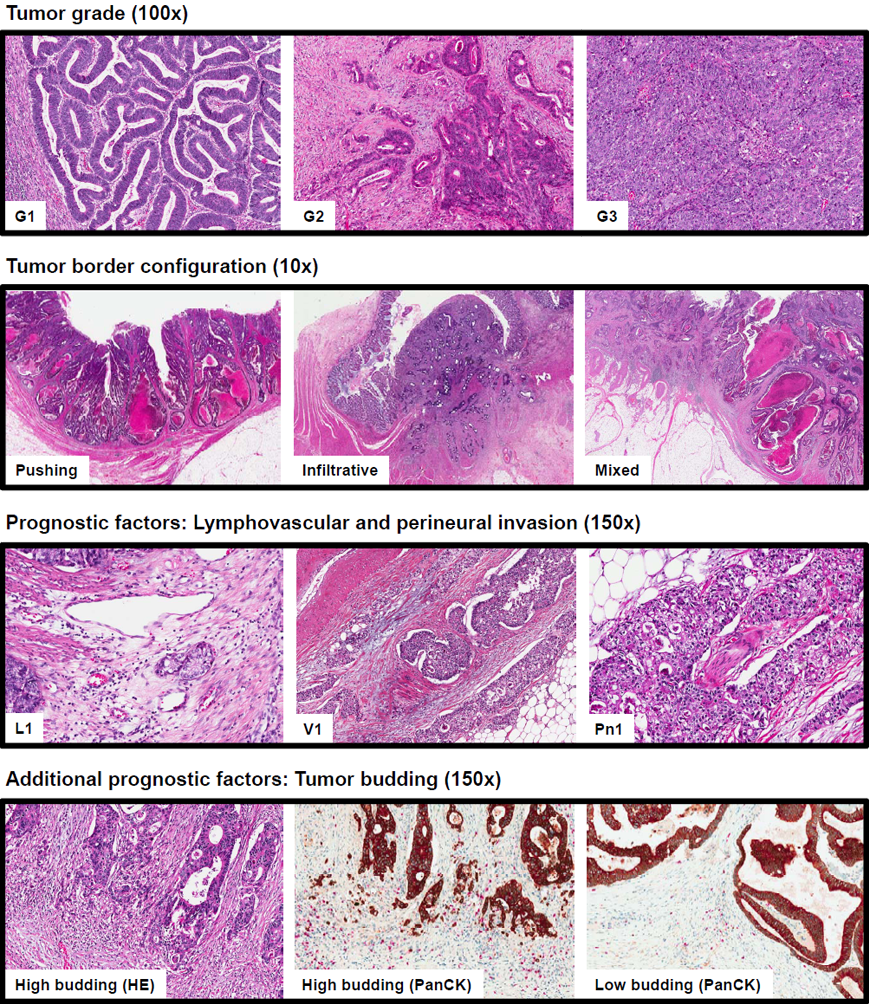
Treatment
Adjuvant therapy:
- Colon Cancer: Chemotherapy
- Rectal Cancer: Chemo- and radiotherapy
- Anti-EGFR therapy: dependent on the KRAS mutational status.
Prognosis
Additional prognostic factors can be:
- Tumor border configuration
- Tumor budding
- Tumor regression grade
- Bowel perforation
- Intra- and peritumoral inflammation
- Circumferential resection margin
- Microsatellite status
- BRAF
- EGFR
- VEGF
- Loss of heterozygosity
- CEA level
- miRNA
- CIMP status.
Cytogenetics
Cytogenetics morphological
Aneuploid tumors showing numerous allelic losses; Aneuploidy, loss and rearrangements of chromosome 1p (about 70%), 5q (55%, loss of APC), 15q, 18q (65%, loss of DCC), 17p (80%, TP53), and 17q (30%); and abnormalities in 7q (25%) and 8p (55%). Reciprocal translocation t(5;10)(q22;q25), inv(5)(q22q31.3).
Diploid tumours without frequent allelic losses.
Genes Involved and Proteins
Note
Gene name
Location
Dna rna description
Protein description
Germinal mutations
The full penetrance of Lynch syndrome requires the biallelic "double hit" inactivation of the responsible MMR gene (see also MSH2, MSH6 and PMS2) for tumor development.
Somatic mutations
Gene name
Location
Dna rna description
Protein description
Germinal mutations
Somatic mutations
Gene name
Location
Dna rna description
Protein description
Germinal mutations
Somatic mutations
Gene name
Location
Dna rna description
Protein description
Germinal mutations
Somatic mutations
Gene name
Location
Dna rna description
Protein description
Germinal mutations
Somatic mutations
Gene name
Location
Dna rna description
Protein description
Germinal mutations
Somatic mutations
Gene name
Location
Dna rna description
Protein description
Germinal mutations
Note
Gene name
Location
Dna rna description
Protein description
Germinal mutations
Somatic mutations
Gene name
Location
Dna rna description
Protein description
Somatic mutations
Gene name
Location
Dna rna description
Protein description
Somatic mutations
Gene name
Location
Dna rna description
Protein description
Somatic mutations
Gene name
Location
Dna rna description
Protein description
Somatic mutations
Gene name
Location
Dna rna description
Protein description
Germinal mutations
Somatic mutations
Gene name
Location
Dna rna description
Protein description
Somatic mutations
Gene name
Location
Dna rna description
Protein description
Germinal mutations
Somatic mutations
Gene name
Location
Dna rna description
Protein description
Somatic mutations
Gene name
Location
Dna rna description
Protein description
Germinal mutations
Somatic mutations
Gene name
Location
Dna rna description
Protein description
Somatic mutations
Note
Gene name
Location
Dna rna description
Protein description
Germinal mutations
Somatic mutations
Gene name
Location
Dna rna description
Protein description
Somatic mutations
Gene name
Location
Dna rna description
Protein description
Somatic mutations
Gene name
Location
Dna rna description
Protein description
Somatic mutations
Gene name
Location
Dna rna description
Protein description
Germinal mutations
Somatic mutations
Gene name
Location
Dna rna description
Protein description
Somatic mutations
Gene name
Location
Dna rna description
Protein description
Somatic mutations
Note
Gene name
Location
Dna rna description
Protein description
Somatic mutations
Gene name
Location
Dna rna description
Protein description
Somatic mutations
Gene name
Location
Dna rna description
Protein description
Somatic mutations
Gene name
Location
Dna rna description
Protein description
Somatic mutations
Gene name
Location
Dna rna description
Protein description
Germinal mutations
Somatic mutations
Note
Gene name
Location
Dna rna description
Protein description
Somatic mutations
Gene name
Location
Dna rna description
Protein description
Somatic mutations
Gene name
Location
Dna rna description
Protein description
Germinal mutations
Further, germinal mutations in PTEN are associated with rare hereditary syndromes including Bannayan-Riley-Ruvalcaba Syndrome, Proteus syndrome and Proteus-like syndrome.
Somatic mutations
Note
Gene name
Location
Dna rna description
Protein description
Germinal mutations
Somatic mutations
Note
Gene name
Location
Dna rna description
Protein description
Somatic mutations
Gene name
Location
Dna rna description
Protein description
Germinal mutations
Somatic mutations
Gene name
Location
Dna rna description
Protein description
Germinal mutations
Gene name
Location
Dna rna description
Protein description
Germinal mutations
Gene name
Location
Dna rna description
Protein description
Germinal mutations
To be Noted
Note
The RER- are polyploid, with LOH (5q, 17p, 18q), mutations in p53, and more often left-sided, they have a worse prognosis.
Article Bibliography
| Pubmed ID | Last Year | Title | Authors |
|---|---|---|---|
| 15132997 | 2004 | Interactions between Sox9 and beta-catenin control chondrocyte differentiation. | Akiyama H et al |
| 11818965 | 2002 | Inherited variants of MYH associated with somatic G:C-->T:A mutations in colorectal tumors. | Al-Tassan N et al |
| 22102590 | 2012 | Reorganizing the protein space at the Universal Protein Resource (UniProt). | |
| 21282377 | 2011 | FBXW7 influences murine intestinal homeostasis and cancer, targeting Notch, Jun, and DEK for degradation. | Babaei-Jadidi R et al |
| 21892161 | 2011 | Genomic sequencing of colorectal adenocarcinomas identifies a recurrent VTI1A-TCF7L2 fusion. | Bass AJ et al |
| 8145827 | 1994 | Mutation in the DNA mismatch repair gene homologue hMLH1 is associated with hereditary non-polyposis colon cancer. | Bronner CE et al |
| 16525031 | 2006 | Mapping of hereditary mixed polyposis syndrome (HMPS) to chromosome 10q23 by genomewide high-density single nucleotide polymorphism (SNP) scan and identification of BMPR1A loss of function. | Cao X et al |
| 19957330 | 2010 | Loss of imprinting and marked gene elevation are 2 forms of aberrant IGF2 expression in colorectal cancer. | Cheng YW et al |
| 8188295 | 1994 | The DCC gene: structural analysis and mutations in colorectal carcinomas. | Cho KR et al |
| 1355210 | 1992 | Molecular analysis of APC mutations in familial adenomatous polyposis and sporadic colon carcinomas. | Cottrell S et al |
| 19289081 | 2009 | Nuclear export of Smad2 and Smad3 by RanBP3 facilitates termination of TGF-beta signaling. | Dai F et al |
| 20619739 | 2010 | Effects of KRAS, BRAF, NRAS, and PIK3CA mutations on the efficacy of cetuximab plus chemotherapy in chemotherapy-refractory metastatic colorectal cancer: a retrospective consortium analysis. | De Roock W et al |
| 10213492 | 1999 | Dominant negative effect of the APC1309 mutation: a possible explanation for genotype-phenotype correlations in familial adenomatous polyposis. | Dihlmann S et al |
| 15931596 | 2005 | Germline susceptibility to colorectal cancer due to base-excision repair gene defects. | Farrington SM et al |
| 2188735 | 1990 | A genetic model for colorectal tumorigenesis. | Fearon ER et al |
| 23139211 | 2013 | SMAD2, SMAD3 and SMAD4 mutations in colorectal cancer. | Fleming NI et al |
| 19854944 | 2010 | The NCBI BioSystems database. | Geer LY et al |
| 20924129 | 2010 | MSH6 and MUTYH deficiency is a frequent event in early-onset colorectal cancer. | Giráldez MD et al |
| 9927040 | 1999 | Mutational inactivation of transforming growth factor beta receptor type II in microsatellite stable colon cancers. | Grady WM et al |
| 1553789 | 1992 | Detection of a rare point mutation in Ki-ras of a human bladder cancer xenograft by polymerase chain reaction and direct sequencing. | Grimmond SM et al |
| 9769952 | 1997 | [p53 and colorectal cancer]. | Hamelin R et al |
| 16185824 | 2005 | Non-traditional roles for the Adenomatous Polyposis Coli (APC) tumor suppressor protein. | Hanson CA et al |
| 8988175 | 1997 | Localization of a susceptibility locus for Peutz-Jeghers syndrome to 19p using comparative genomic hybridization and targeted linkage analysis. | Hemminki A et al |
| 16472587 | 2006 | Heterozygous mutations in PMS2 cause hereditary nonpolyposis colorectal carcinoma (Lynch syndrome). | Hendriks YM et al |
| 9545410 | 1998 | A gene for familial juvenile polyposis maps to chromosome 18q21.1. | Howe JR et al |
| 9582123 | 1998 | Mutations in the SMAD4/DPC4 gene in juvenile polyposis. | Howe JR et al |
| 11245474 | 2001 | MSH6 and MSH3 are rarely involved in genetic predisposition to nonpolypotic colon cancer. | Huang J et al |
| 17492758 | 2007 | Genomic and functional evidence for an ARID1A tumor suppressor role. | Huang J et al |
| 17942460 | 2008 | Carcinogenesis and microsatellite instability: the interrelationship between genetics and epigenetics. | Imai K et al |
| 9425897 | 1998 | Peutz-Jeghers syndrome is caused by mutations in a novel serine threonine kinase. | Jenne DE et al |
| 22009941 | 2012 | Somatic mutations in the chromatin remodeling gene ARID1A occur in several tumor types. | Jones S et al |
| 1678319 | 1991 | Identification of deletion mutations and three new genes at the familial polyposis locus. | Joslyn G et al |
| 14988818 | 2004 | Loss of activin receptor type 2 protein expression in microsatellite unstable colon cancers. | Jung B et al |
| 20011542 | 2009 | Activin signaling in microsatellite stable colon cancers is disrupted by a combination of genetic and epigenetic mechanisms. | Jung B et al |
| 22157284 | 2011 | Inherited colorectal cancer syndromes. | Kastrinos F et al |
| 1319835 | 1992 | Genetic changes of both p53 alleles associated with the conversion from colorectal adenoma to early carcinoma in familial adenomatous polyposis and non-familial adenomatous polyposis patients. | Kikuchi-Yanoshita R et al |
| 9616081 | 1998 | Landscaping the cancer terrain. | Kinzler KW et al |
| 23152409 | 2012 | Dissecting the impact of Frizzled receptors in Wnt/β-catenin signaling of human mesenchymal stem cells. | Kolben T et al |
| 17203173 | 2007 | Conditional nuclear localization of hMLH3 suggests a minor activity in mismatch repair and supports its role as a low-risk gene in HNPCC. | Korhonen MK et al |
| 15042511 | 2004 | Mutations in AXIN2 cause familial tooth agenesis and predispose to colorectal cancer. | Lammi L et al |
| 1614522 | 1992 | Cancer. p53, guardian of the genome. | Lane DP et al |
| 9872311 | 1998 | Genetic instabilities in human cancers. | Lengauer C et al |
| 22357840 | 2012 | Prognostic role of PIK3CA mutation in colorectal cancer: cohort study and literature review. | Liao X et al |
| 11148689 | 2001 | Different mechanisms in the tumorigenesis of proximal and distal colon cancers. | Lindblom A et al |
| 8574961 | 1996 | Analysis of mismatch repair genes in hereditary non-polyposis colorectal cancer patients. | Liu B et al |
| 11017067 | 2000 | Mutations in AXIN2 cause colorectal cancer with defective mismatch repair by activating beta-catenin/TCF signalling. | Liu W et al |
| 8625067 | 1995 | Attenuated familial adenomatous polyposis (AFAP). A phenotypically and genotypically distinctive variant of FAP. | Lynch HT et al |
| 10822375 | 2000 | Somatic mutation of hPMS2 as a possible cause of sporadic human colon cancer with microsatellite instability. | Ma AH et al |
| 9796814 | 1998 | The DCC gene product induces apoptosis by a mechanism requiring receptor proteolysis. | Mehlen P et al |
| 19420964 | 2009 | Somatic mutations of the CDC4 (FBXW7) gene in hereditary colorectal tumors. | Miyaki M et al |
| 1338904 | 1992 | Somatic mutations of the APC gene in colorectal tumors: mutation cluster region in the APC gene. | Miyoshi Y et al |
| 20388775 | 2010 | Somatic hypermethylation of MSH2 is a frequent event in Lynch Syndrome colorectal cancers. | Nagasaka T et al |
| 19134005 | 2009 | Inverse correlation of the up-regulation of FZD10 expression and the activation of beta-catenin in synchronous colorectal tumors. | Nagayama S et al |
| 14724591 | 2004 | PTEN mutations are common in sporadic microsatellite stable colorectal cancer. | Nassif NT et al |
| 8072530 | 1994 | Mutations of two PMS homologues in hereditary nonpolyposis colon cancer. | Nicolaides NC et al |
| 15294875 | 2004 | Distinct patterns of KRAS mutations in colorectal carcinomas according to germline mismatch repair defects and hMLH1 methylation status. | Oliveira C et al |
| 9342373 | 1997 | Alternative genetic pathways in colorectal carcinogenesis. | Olschwang S et al |
| 7604266 | 1995 | Mutations of GTBP in genetically unstable cells. | Papadopoulos N et al |
| 20500843 | 2010 | Constitutively decreased TGFBR1 allelic expression is a common finding in colorectal cancer and is associated with three TGFBR1 SNPs. | Pasche B et al |
| 18651794 | 2008 | WikiPathways: pathway editing for the people. | Pico AR et al |
| 14871813 | 2004 | Loss of MSH3 protein expression is frequent in MLH1-deficient colorectal cancer and is associated with disease progression. | Plaschke J et al |
| 1528264 | 1992 | APC mutations occur early during colorectal tumorigenesis. | Powell SM et al |
| 3041218 | 1987 | Mutational activation of the K-ras oncogene. A possible pathogenetic factor in adenocarcinoma of the lung. | Rodenhuis S et al |
| 1699228 | 1990 | p53 mutations in colorectal cancer. | Rodrigues NR et al |
| 20696052 | 2010 | Mutations in the WTX-gene are found in some high-grade microsatellite instable (MSI-H) colorectal cancers. | Scheel SK et al |
| 9399838 | 1998 | A database of germline p53 mutations in cancer-prone families. | Sedlacek Z et al |
| 17143297 | 2006 | Colorectal cancer and genetic alterations in the Wnt pathway. | Segditsas S et al |
| 18602922 | 2008 | The clinical phenotype of Lynch syndrome due to germ-line PMS2 mutations. | Senter L et al |
| 21949851 | 2011 | TGFBR2 and BAX mononucleotide tract mutations, microsatellite instability, and prognosis in 1072 colorectal cancers. | Shima K et al |
| 12606733 | 2003 | Multiple colorectal adenomas, classic adenomatous polyposis, and germ-line mutations in MYH. | Sieber OM et al |
| 12093899 | 2002 | Mutations in APC, Kirsten-ras, and p53--alternative genetic pathways to colorectal cancer. | Smith G et al |
| 11248065 | 2001 | ACVR1B (ALK4, activin receptor type 1B) gene mutations in pancreatic carcinoma. | Su GH et al |
| 9503010 | 1998 | Characterization of the MADH2/Smad2 gene, a human Mad homolog responsible for the transforming growth factor-beta and activin signal transduction pathway. | Takenoshita S et al |
| 22252256 | 2012 | Lifetime cancer risks in individuals with germline PTEN mutations. | Tan MH et al |
| 8673134 | 1996 | Evaluation of candidate tumour suppressor genes on chromosome 18 in colorectal cancers. | Thiagalingam S et al |
| 8484122 | 1993 | Microsatellite instability in cancer of the proximal colon. | Thibodeau SN et al |
| 15286780 | 2004 | Cancer genes and the pathways they control. | Vogelstein B et al |
| 16401470 | 2006 | Prevalence of early onset colorectal cancer in 397 patients with classic Li-Fraumeni syndrome. | Wong P et al |
| 15887124 | 2005 | Familial mutations in PMS2 can cause autosomal dominant hereditary nonpolyposis colorectal cancer. | Worthley DL et al |
| 10693791 | 2000 | Conversion of diploidy to haploidy. | Yan H et al |
| 16798748 | 2006 | Adenomatous polyposis coli (APC) differentially regulates beta-catenin phosphorylation and ubiquitination in colon cancer cells. | Yang J et al |
| 21157497 | 2011 | Concurrent genetic alterations in DNA polymerase proofreading and mismatch repair in human colorectal cancer. | Yoshida R et al |
| 17056636 | 2007 | Expansion of the genotypic and phenotypic spectrum in patients with KRAS germline mutations. | Zenker M et al |
| 11854177 | 2002 | Distinct PTEN mutational spectra in hereditary non-polyposis colon cancer syndrome-related endometrial carcinomas compared to sporadic microsatellite unstable tumors. | Zhou XP et al |
| 11815870 | 2002 | Chromosome rearrangement with no apparent gene mutation in familial adenomatous polyposis and hepatocellular neoplasia. | de Chadarévian JP et al |
| 21205875 | 2011 | High cancer risk and increased mortality in patients with Peutz-Jeghers syndrome. | van Lier MG et al |
| 7669739 | 1995 | Molecular, cytogenetic, and phenotypic studies of a constitutional reciprocal translocation t(5;10)(q22;q25) responsible for familial adenomatous polyposis in a Dutch pedigree. | van der Luijt RB et al |
Citation
Viktor H Koelzer ; Heather Dawson ; Inti Zlobec ; Alessandro Lugli
Colon: Colorectal adenocarcinoma
Atlas Genet Cytogenet Oncol Haematol. 2012-12-01
Online version: http://atlasgeneticsoncology.org/solid-tumor/5006/colon-colorectal-adenocarcinoma
Historical Card
2007-05-01 Colon: Colorectal adenocarcinoma by Nilufer Sayar,Sreeparna Banerjee Affiliation
1998-04-01 Colon: Colorectal adenocarcinoma by Richard Hamelin Affiliation
