Identity
Abstract
Thrombospondins are encoded in vertebrates by a family of 5 THBS genes. THBS1 is infrequently mutated in most cancers, but its expression is positively regulated by several tumor suppressor genes and negatively regulated by activated oncogenes and promoter hypermethylation. Consequently, loss of thrombospondin-1 expression is frequently lost during oncogenesis and is correlated with a poor prognosis for some cancers. Thrombospondin-1 is a secreted protein that acts in the tumor microenvironment to inhibit angiogenesis, regulate antitumor immunity, stimulate tumor cell migration, and regulate the activities of extracellular proteases and growth factors. Differential effects of thrombospondin-1 on the sensitivity of normal versus malignant cells to ischemic and genotoxic stress also regulate the responses to tumors to therapeutic radiation and chemotherapy.
DNA/RNA

Description
Transcription
Pseudogene
Proteins
Description
Expression
Localisation
Function
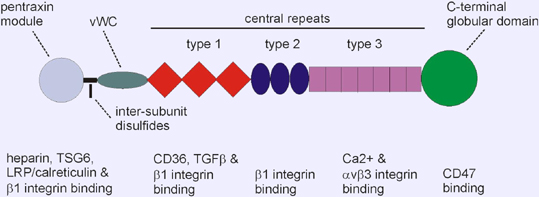
THBS1 in a context-dependent and cell-specific manner stimulates or inhibits cell adhesion, proliferation, motility, and survival. THBS1 is a potent inhibitor of angiogenesis, but N-terminal proteolytic and recombinant parts of THBS1 have clear pro-angiogenic activities mediated by beta-1 integrins. In the immune system, THBS1 is a potent inhibitor of T cell and dendritic cell activation and mediates clearance of apoptotic cells by phagocytes (Soto-Pantoja et al., 2015). In the CNS, THBS1 secreted by astrocytes promotes synaptogenesis (Risher and Eroglu, 2012).
Based on studies of Thbs1 null mice, platelet THBS1 is not essential for platelet aggregation, but THBS1 null mice have impaired excisional but improved ischemic wound repair, increased retinal angiogenesis, and are hyper-responsive to several inflammatory stimuli (Soto-Pantoja et al., 2015). time stimulates pathologic production of reactive oxygen species (ROS) by targeting NOX1. Mitochondria from CD47 null mice produce less ROS. Inhibition of H2S signaling contributes to the inhibition of T cell activation by THBS1 mediated through the CD47 receptor (Miller et al., 2015).
THBS1 through interacting with CD47, plays a broader role in primary non-cancer and cancer tissue survival of genotoxic damage caused by ionizing radiation and chemotherapy (Soto-Pantoja et al., 2015; Feliz-Mosquea et al., 2018). Animals lacking either THBS1 or CD47 tolerated high-dose regional radiation with minimal soft-tissue injury or loss of bone marrow (Isenberg et al., 2008). Suppressing THBS1-CD47 signaling renders non-cancer cells and tissues resistant to radiation- and chemotherapy-mediated injury by promoting protective autophagy and enhancing anabolic metabolic repair pathways (Soto-Pantoja et al., 2012; Miller et al., 2015). Blocking the THBS1-CD47 axis also enhanced survival to lethal whole-body radiation (Soto-Pantoja et al., 2013). Conversely, interruption of THBS1-CD47 signaling increases radiation- and chemotherapy-mediated killing of cancers (Maxhimer et al., 2009; Feliz-Mosquea et al., 2018). This latter effect is mediated through activation of T and NK cell killing of tumors (Soto-Pantoja et al., 2014; Nath et al., 2019).
THBS1 is also a proximate inhibitor of stem cell self-renewal (Kaur et al., 2013). Acting via its cell surface receptor CD47, THBS1 limits the expression of important self-renewal transcription factors including POU5F1 (Oct3/4), SOX2, KLF4, and MYC in nonmalignant cells (Kaur et al., 2013). However, the ability of THBS1 to limit stem cell self-renewal is lost in cancer cells where MYC is amplified or dysregulated, and loss of CD47 expression or function consequently can suppress cancer stem cells (Kaur et al., 2013; Lee et al., 2014; Kaur and Roberts, 2016).
Homology
Mutations

Germinal
Somatic
Epigenetics
Implicated in
Carriers of the CC genotype exhibited a decreased risk of developing gastric cancer compared to the carriers of the CT and TT genotypes [adjusted OR, 0.56; 95% confidence interval (CI), 0.39-0.79; P=0.001] (Hong et al., 2015). The CC genotype of rs1478605 was negatively associated with gastric cancer lymph node metastasis (OR, 0.41; 95% CI, 0.23-0.71; P=0.001) and was associated with a reduced risk of lymph node metastasis in male patients (OR, 0.27; 95% CI, 0.14-0.52; PC, rs1478604 A>G
Significant association was found between the homozygous CC variant of THBS1 (rs2292305 T>C) and development of highly differentiated gastric carcinoma (Lin et al., 2012). The rs1478604 A>G variant was associated with invasion and lymph node metastasis in gastric cancer. Based on logistic regression and stratification analysis, rs1478604 A>G was more strongly associated with lymph node metastasis in highly differentiated gastric cancer.
Compared with the CT/TT genotypes, the CC genotype was associated with a significantly increased risk of bladder cancer (adjusted odds ratio [OR] 1.43, 95% CI 1.01-2.04) (Gu et al., 2014).
Conversely, transgenic mice overexpressing THBS1 in skin or mammary tissue were resistant to chemical or oncogene-driven carcinogenesis (Streit et al., 1999; Rodriguez-Manzaneque et al., 2001). In addition to inhibiting the angiogenic switch required for tumor growth and hematologic metastasis, over-expression of THBS1 in tumor cells was associated with increased M1 polarization of tumor-associated macrophages in xenograft tumors, and THBS1 treatment increased superoxide production and killing of tumor cells by macrophages in vitro (Martin-Manos et al., 2008).
The THBS1 missense mutation (Asp362Asn) alters a residue in the first type 1 repeat of THBS1 (Maloney et al., 2012). The Asp362Asn THBS1 mutant had less than half of the ability of wild-type THBS1 to activate latent TGFB1. Mutant 362Asn THBS1 also lost the ability to inhibit growth of pulmonary arterial smooth muscle cells and was over three-fold less effective at inhibiting endothelial cell growth.
The mutation was found in two unrelated probands from 60 familial pulmonary arterial hypertension (PAH) kindreds but not in any healthy or chronic disease control cohorts. Several affected family members carried a mutation in BMPR2, which is known to be associated with PAH risk, and one family member with the THBS1 mutation but lacking the BMPR2 mutation was not diagnosed with PAH. Therefore, the THBS1 mutation alone may not be sufficient to cause PAH, and THBS1 was proposed to be a modifier gene for familial PAH. The frequency of other common THBS1 polymorphisms did not differ between PAH and control cohorts.
THBS1 intronic mutation (IVS8+255 G/A)
THBS1 intronic mutation (IVS8+255 G/A) was identified in a proband with familial pulmonary hypertension (Maloney et al., 2012). This mutation decreased and/or eliminated local binding of the transcription factors SP1 and MAZ in aortic smooth muscle cells. The mutation was confirmed to not alter splicing of THBS1 mRNA but is predicted to alter gene expression.
The mutation was found in multiple members of the single proband family with nine members diagnosed with PAH but absent in healthy and chronic disease control cohorts. Some of the affected family members were known to have BMPR2 mutations that are associated with PAH risk, and two family members with the THBS1 mutation but lacking the BMPR2 mutation were not diagnosed with PAH. Therefore, THBS1 was proposed to be a modifier gene. Because only one family was reported to date, the relative risk associated with this mutation remains to be determined.
Increased risk for developing chronic inflammation in patients undergoing refractive eye surgery or receiving corneal allografts.
The THBS1 S700N variant is a significant risk factor for familial premature myocardial infarction in both homozygous and heterozygous carriers of the variant allele (Topol et al., 2001; Zwicker et al., 2006; Stenina et al., 2004). Paternal and neonatal THBS1 A2210G was also associated with small gestational age. Maternal THBS1 A2210G was associated with reduced maternal birth weight adjusted for gestational age at delivery (P = 0.03) (Andraweera et al., 2011).
The THBS1 SNPs rs1478604 (minor allele frequencies (MAF) 0.291) and rs1478605 (MAF 0.286) were negatively associated [OR 0.45 (95% CI 0.19, 1.08; p=0.069) and OR 0.33 (95% CI 0.12, 0.88; p=0.017, respectively)] with tricuspid regurgitant velocity (TRV) ≥2.5 in sickle cell disease patients (Jacob et al., 2017). Elevated TRV is a marker of pulmonary dysfunction. Of note, rs1478605 and rs1478604 are proximal to the THBS1 transcription start site and may alter THBS1 expression in patients with sickle cell disease.
Article Bibliography
| Pubmed ID | Last Year | Title | Authors |
|---|---|---|---|
| 21875984 | 2011 | The thrombospondins. | Adams JC et al |
| 10842357 | 2000 | The thrombospondin type 1 repeat (TSR) superfamily: diverse proteins with related roles in neuronal development. | Adams JC et al |
| 21883885 | 2011 | A functional variant in the thrombospondin-1 gene and the risk of small for gestational age infants. | Andraweera PH et al |
| 19734141 | 2009 | A disintegrin-like and metalloprotease (reprolysin-type) with thrombospondin type 1 motif (ADAMTS) superfamily: functions and mechanisms. | Apte SS et al |
| 15777239 | 2005 | Novel integrin antagonists derived from thrombospondins. | Calzada MJ et al |
| 18499674 | 2008 | Influences of the N700S thrombospondin-1 polymorphism on protein structure and stability. | Carlson CB et al |
| 28760845 | 2017 | MicroRNA-98 interferes with thrombospondin 1 expression in peripheral B cells of patients with asthma. | Chen L et al |
| 24679443 | 2014 | Polymorphism in THBS1 gene is associated with post-refractive surgery chronic ocular surface inflammation. | Contreras-Ruiz L et al |
| 9657149 | 1998 | Thrombospondin-1 is a major activator of TGF-beta1 in vivo. | Crawford SE et al |
| 18515748 | 2008 | Aryl hydrocarbon receptor is activated by glucose and regulates the thrombospondin-1 gene promoter in endothelial cells. | Dabir P et al |
| 29228113 | 2018 | Fibroblast growth factor-2 and transforming growth factor-beta1 oppositely regulate miR-221 that targets thrombospondin-1 in bovine luteal endothelial cells. | Farberov S et al |
| 15838828 | 2005 | Human breast tumors override the antiangiogenic effect of stromal thrombospondin-1 in vivo. | Fontana A et al |
| 2930192 | 1989 | Structural study of the sugar chains of human platelet thrombospondin. | Furukawa K et al |
| 17409099 | 2007 | Activating transcription factor-1-mediated hepatocyte growth factor-induced down-regulation of thrombospondin-1 expression leads to thyroid cancer cell invasion. | Ghoneim C et al |
| 12660028 | 2003 | CpG island methylation of tumor-related genes in three primary central nervous system lymphomas in immunocompetent patients. | Gonzalez-Gomez P et al |
| 25150583 | 2014 | Effects of TSP-1-696 C/T polymorphism on bladder cancer susceptibility and clinicopathologic features. | Gu J et al |
| 18336597 | 2008 | Hypermethylation of the thrombospondin-1 gene is associated with poor prognosis in penile squamous cell carcinoma. | Guerrero D et al |
| 15456750 | 2004 | A polymorphism in thrombospondin-1 associated with familial premature coronary artery disease alters Ca2+ binding. | Hannah BL et al |
| 11067851 | 2001 | C-mannosylation and O-fucosylation of the thrombospondin type 1 module. | Hofsteenge J et al |
| 26075074 | 2015 | Association of THBS1 rs1478605 T>C in 5'-untranslated regions with the development and progression of gastric cancer. | Hong BB et al |
| 22207555 | 2012 | Thrombospondin-1 expression in breast cancer: prognostic significance and association with p53 alterations, tumour angiogenesis and extracellular matrix components. | Ioachim E et al |
| 19194382 | 2009 | Regulation of nitric oxide signalling by thrombospondin 1: implications for anti-angiogenic therapies. | Isenberg JS et al |
| 22383169 | 2012 | The miR-17-92 cluster and its target THBS1 are differentially expressed in angiosarcomas dependent on MYC amplification. | Italiano A et al |
| 28033687 | 2017 | Thrombospondin-1 gene polymorphism is associated with estimated pulmonary artery pressure in patients with sickle cell anemia. | Jacob SA et al |
| 10871348 | 2000 | Activation of the myc oncoprotein leads to increased turnover of thrombospondin-1 mRNA. | Janz A et al |
| 27163531 | 2016 | Divergent modulation of normal and neoplastic stem cells by thrombospondin-1 and CD47 signaling. | Kaur S et al |
| 23591719 | 2013 | Thrombospondin-1 signaling through CD47 inhibits self-renewal by regulating c-Myc and other stem cell transcription factors. | Kaur S et al |
| 11696456 | 2001 | Thrombospondin-1 gene expression affects survival and tumor spectrum of p53-deficient mice. | Lawler J et al |
| 9486968 | 1998 | Thrombospondin-1 is required for normal murine pulmonary homeostasis and its absence causes pneumonia. | Lawler J et al |
| 24523067 | 2014 | Blockade of CD47-mediated cathepsin S/protease-activated receptor 2 signaling provides a therapeutic target for hepatocellular carcinoma. | Lee TK et al |
| 27535533 | 2016 | Analysis of protein-coding genetic variation in 60,706 humans. | Lek M et al |
| 10359534 | 1999 | Methylation and silencing of the Thrombospondin-1 promoter in human cancer. | Li Q et al |
| 22011138 | 2012 | Polymorphism of THBS1 rs1478604 A>G in 5-untranslated region is associated with lymph node metastasis of gastric cancer in a Southeast Chinese population. | Lin XD et al |
| 15519514 | 2004 | Thrombospondin-1 expression in relation to p53 status and VEGF expression in human breast cancers. | Linderholm B et al |
| 15730804 | 2004 | [Correlation of thrombospondin-1 G1678A polymorphism to stroke: a study in Chinese population]. | Liu XN et al |
| 26461935 | 2015 | Thrombospondin-1 in a Murine Model of Colorectal Carcinogenesis. | Lopez-Dee ZP et al |
| 11410779 | 2001 | Expression of thrombospondin-1 inversely correlated with tumor vascularity and hematogenous metastasis in colon cancer. | Maeda K et al |
| 22198906 | 2012 | Loss-of-function thrombospondin-1 mutations in familial pulmonary hypertension. | Maloney JP et al |
| 30532588 | 2018 | IL-8 and thrombospondin-1 as prognostic markers in patients with metastatic colorectal cancer receiving bevacizumab. | Marisi G et al |
| 18757424 | 2008 | Thrombospondin 1 promotes tumor macrophage recruitment and enhances tumor cell cytotoxicity of differentiated U937 cells. | Martin-Manso G et al |
| 20161613 | 2009 | Radioprotection in normal tissue and delayed tumor growth by blockade of CD47 signaling. | Maxhimer JB et al |
| 29442415 | 2018 | Thrombin-reduced miR-27b attenuates platelet angiogenic activities in vitro via enhancing platelet synthesis of anti-angiogenic thrombospondin-1. | Miao X et al |
| 23499828 | 2013 | Thrombospondin-1 is a CD47-dependent endogenous inhibitor of hydrogen sulfide signaling in T cell activation. | Miller TW et al |
| 30118999 | 2018 | Apigenin Inhibits UVB-Induced Skin Carcinogenesis: The Role of Thrombospondin-1 as an Anti-Inflammatory Factor. | Mirzoeva S et al |
| 12553016 | 2002 | Expression and role of thrombospondin-1 in colorectal cancer. | Miyanaga K et al |
| 23749112 | 2013 | Thrombospondin-1 in urological cancer: pathological role, clinical significance, and therapeutic prospects. | Miyata Y et al |
| 29288716 | 2018 | Thrombospondin-1 regulation of latent TGF-β activation: A therapeutic target for fibrotic disease. | Murphy-Ullrich JE et al |
| 21107877 | 2011 | Expression of thrombospondin-1 and Ski are prognostic factors in advanced gastric cancer. | Nakao T et al |
| 31362997 | 2019 | Natural Killer Cell Recruitment and Activation Are Regulated by CD47 Expression in the Tumor Microenvironment. | Nath PR et al |
| 30892078 | 2019 | Vascular TSP1-CD47 signaling promotes sickle cell-associated arterial vasculopathy and pulmonary hypertension in mice. | Novelli EM et al |
| 15217952 | 2004 | Clinical significance of thrombospondin 1 expression in hepatocellular carcinoma. | Poon RT et al |
| 29415890 | 2018 | Thrombospondin-1 protects against pathogen-induced lung injury by limiting extracellular matrix proteolysis. | Qu Y et al |
| 24476925 | 2014 | Current understanding of the thrombospondin-1 interactome. | Resovi A et al |
| 12461058 | 2002 | Thrombospondin 1 protein expression relates to good prognostic indices in ductal carcinoma in situ of the breast. | Rice AJ et al |
| 11606713 | 2001 | Thrombospondin-1 suppresses spontaneous tumor growth and inhibits activation of matrix metalloproteinase-9 and mobilization of vascular endothelial growth factor. | Rodriguez-Manzaneque JC et al |
| 24418252 | 2014 | Thrombospondin-1 and CD47 regulation of cardiac, pulmonary and vascular responses in health and disease. | Rogers NM et al |
| 27422280 | 2016 | Osteopontin and thrombospondin-1 play opposite roles in promoting tumor aggressiveness of primary resected non-small cell lung cancer. | Rouanne M et al |
| 7798257 | 1994 | Overlapping Egr-1 and Sp1 sites function in the regulation of transcription of the mouse thrombospondin 1 gene. | Shingu T et al |
| 27239962 | 2016 | Dietary fat overcomes the protective activity of thrombospondin-1 signaling in the Apc(Min/+) model of colon cancer. | Soto-Pantoja DR et al |
| 15094117 | 2004 | Coronary artery disease and the thrombospondin single nucleotide polymorphisms. | Stenina OI et al |
| 10433937 | 1999 | Overexpression of thrombospondin-1 decreases angiogenesis and inhibits the growth of human cutaneous squamous cell carcinomas. | Streit M et al |
| 22028325 | 2011 | p53-responsive miR-194 inhibits thrombospondin-1 and promotes angiogenesis in colon cancers. | Sundaram P et al |
| 27404020 | 2016 | Role of thrombospondin-1 expression in colorectal liver metastasis and its molecular mechanism. | Teraoku H et al |
| 11723011 | 2001 | Single nucleotide polymorphisms in multiple novel thrombospondin genes may be associated with familial premature myocardial infarction. | Topol EJ et al |
| 12498716 | 2002 | Id1 regulates angiogenesis through transcriptional repression of thrombospondin-1. | Volpert OV et al |
| 25624796 | 2012 | Thrombospondins and synaptogenesis. | Wang B et al |
| 15184388 | 2004 | Glucose up-regulates thrombospondin 1 gene transcription and transforming growth factor-beta activity through antagonism of cGMP-dependent protein kinase repression via upstream stimulatory factor 2. | Wang S et al |
| 24618326 | 2014 | Thrombospondin-1 polymorphisms influence risk of corneal allograft rejection. | Winton HL et al |
| 2341158 | 1990 | Structure and chromosomal localization of the human thrombospondin gene. | Wolf FW et al |
| 30991448 | 2019 | HDAC6 Suppresses Let-7i-5p to Elicit TSP1/CD47-Mediated Anti-Tumorigenesis and Phagocytosis of Hepatocellular Carcinoma. | Yang HD et al |
| 14559817 | 2003 | Methylation-associated silencing of the thrombospondin-1 gene in human neuroblastoma. | Yang QW et al |
| 16684956 | 2006 | The thrombospondin-1 N700S polymorphism is associated with early myocardial infarction without altering von Willebrand factor multimer size. | Zwicker JI et al |
| 22439850 | 2012 | The R-spondin protein family. | de Lau WB et al |
| 21501375 | 2011 | MicroRNA-18 and microRNA-19 regulate CTGF and TSP-1 expression in age-related heart failure. | van Almen GC et al |
Other Information
Locus ID:
NCBI: 7057
MIM: 188060
HGNC: 11785
Ensembl: ENSG00000137801
Variants:
dbSNP: 7057
ClinVar: 7057
TCGA: ENSG00000137801
COSMIC: THBS1
RNA/Proteins
| Gene ID | Transcript ID | Uniprot |
|---|---|---|
| ENSG00000137801 | ENST00000260356 | P07996 |
| ENSG00000137801 | ENST00000397591 | A8MZG1 |
Expression (GTEx)
Pathways
Protein levels (Protein atlas)
References
| Pubmed ID | Year | Title | Citations |
|---|---|---|---|
| 37507331 | 2024 | Thrombospondin-1 in vascular development, vascular function, and vascular disease. | 3 |
| 37822187 | 2024 | Relationship between elevated circulating thrombospondin-1 levels and vascular complications in diabetes mellitus. | 1 |
| 37863116 | 2024 | Pericardial Adipose Tissue Thrombospondin-1 Associates With Antiangiogenesis in Ischemic Heart Disease. | 0 |
| 38006767 | 2024 | A-296G variant of THBS1 gene (rs1478605) is associated with a lower frequency of stroke in a Brazilian population with sickle cell anemia. | 0 |
| 38013141 | 2024 | LncRNA MIR217HG aggravates pressure-overload induced cardiac remodeling by activating miR-138/THBS1 pathway. | 0 |
| 38091840 | 2024 | Thrombospondin-1 promotes liver fibrosis by enhancing TGF-β action in hepatic stellate cells. | 0 |
| 38163319 | 2024 | Thrombospondin-1 is an endogenous substrate of cereblon responsible for immunomodulatory drug-induced thromboembolism. | 0 |
| 38217383 | 2024 | Thrombospondin-1 associated with carotid intima-media thickness among individuals with hypertension. | 0 |
| 38339060 | 2024 | THBS1 and THBS2 Enhance the In Vitro Proliferation, Adhesion, Migration and Invasion of Intrahepatic Cholangiocarcinoma Cells. | 0 |
| 38350444 | 2024 | THBS1(+) myeloid cells expand in SLD hepatocellular carcinoma and contribute to immunosuppression and unfavorable prognosis through TREM1. | 0 |
| 38569496 | 2024 | Thrombospondin-1 Regulates Trophoblast Necroptosis via NEDD4-Mediated Ubiquitination of TAK1 in Preeclampsia. | 1 |
| 38572579 | 2024 | hsa_circ_0007919 promotes pancreatic cancer metastasis by modulating Sp1-mediated THBS1 transcription. | 0 |
| 38581244 | 2024 | CircTHBS1 promotes trophoblast cell migration and invasion and inhibits trophoblast apoptosis by regulating miR-136-3p/IGF2R axis. | 0 |
| 38705811 | 2024 | The role of THBS1 and PDGFD in the immune microenvironment of Helicobacter pylori-associated gastric cancer. | 0 |
| 37507331 | 2024 | Thrombospondin-1 in vascular development, vascular function, and vascular disease. | 3 |
Citation
Jeffrey S. Isenberg ; David D. Roberts
THBS1 (thrombospondin-1)
Atlas Genet Cytogenet Oncol Haematol. 2019-10-01
Online version: http://atlasgeneticsoncology.org/gene/42548/thbs1
Historical Card
2005-05-01 THBS1 (thrombospondin-1) by David D Roberts Affiliation
