PRKAA1 (protein kinase AMP-activated catalytic subunit alpha 1)
2018-07-01 Esin Gülce Seza , Ismail Güderer , Çagdas Ermis , Sreeparna Banerjee AffiliationDepartment of Biology, Middle East Technical University, 06800 Ankara, Turkey; [email protected]
Abstract
Protein kinase AMP-activated catalytic subunit alpha 1 (PRKAA1), also known as AMPK α1, is an energy sensor that plays a key role in the regulation of cellular energy metabolism. AMPK α1 is the catalytic subunit of the heterotrimeric AMPK protein with a length of 548 amino acids. A key switch to activate this protein is an alteration in the AMP\/ATP ratio. The protein is dysregulated in several human diseases including diabetes and metabolic syndrome, cardiovascular diseases, neurodegenerative diseases and many cancer types (Steinberg and Kemp, 2009). Two isoforms of AMPK exist including AMPK α1 and AMPK α2; however, discrimination between these isoforms for their involvement in certain diseases is currently not possible.
DNA/RNA
Note
Description
Transcription
Pseudogene
Proteins
Description
There are several known AMPK kinases (AMPKKs). STK11 (LKB1), complexed with STRADA and CAB39 (MO25), is the major upstream regulator of the AMPK, which phosphorylates the AMP bound protein (Shackelford and Shaw, 2009). Ca2+/calmodulin-dependent protein kinase kinase β ( CAMKK2 or CaMKKβ) is also known to be an upstream kinase of AMPK (Sundararaman et al., 2016). TGF-beta-activated kinase-1 ( MAP3K7 or TAK1) may also phosphorylate AMPK α or at least play a role in its activation as loss of TAK1 leads to impaired AMPK activation (Xie et al., 2006).
The AMPK α1 protein consists of several domains (Figure 1). The N-terminal kinase domain carries out the serine/threonine kinase function. The C-terminus regulatory domain contains an α-RIM sensor loop and a β-subunit interaction domain (Crute et al., 1998). A UBA-like auto-inhibitory domain (AID) is present between the α-RIM sensor loop and the kinase domain. AID is required for allosteric regulation via AMP. Absence of this inhibitory region renders the protein independent of AMP but still requires phosphorylation of the activation loop (Crute et al., 1998).

Expression
Localisation
Function
- Cellular Metabolism
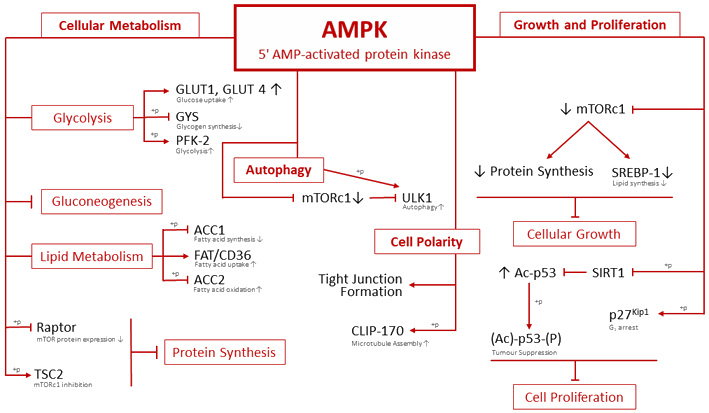
AMPK is activated when there is energy stress in the cell manifested by an increase in the AMP/ATP ratio. In response to this stress, AMPK activates catabolic pathways while inhibiting anabolic pathways.- Glycolysis
One of the key catabolic pathways for energy generation, glycolysis, is upregulated through AMPK signalling. In order increase glucose uptake to the cell, AMPK activates (induces translocation, short term response) and increases protein expression (longer term response) of SLC2A1 (GLUT1) and SLC2A4 (GLUT4) (Fryer et al., 2002). Also, 6-phosphofructo-2-kinase ( PFKFB3 or PFK-2) gets phosphorylated and activated by AMPK which enhances glycolysis (Marsin et al., 2000). Glycogen synthesis (anabolic pathway) is inhibited by the phosphorylation of glycogen synthase. - Gluconeogenesis
Anabolic pathways such as gluconeogenesis that enhance glucose levels are inhibited by repression of transcripts that encode for gluconeogenesis enzymes. CRTC2, coactivator of the cyclic AMP response element-binding protein CREB, gets phosphorylated and inhibited (excluded from the nucleus) by AMPK. This leads to disruption of CREB-CRTC2 complex and inhibition of CREB-dependent gluconeogenesis (Lee et al., 2010). Transcription of mRNAs encoding glucose-6-phosphatase and phosphoenolpyruvate carboxykinase are inhibited via this mechanism. Also, class IIA histones, which can activate the FOXO family of transcription factors via HDAC3 recruitment, gets phosphorylated and excluded from the nucleus. This decrease in activity of FOXO family of transcription factors leads to reduced expression of gluconeogenesis genes (Mihaylova et al., 2011). - Lipid Metabolism
In AMPK activated cells, fatty acid uptake is increased by translocation of fatty acid translocase, CD36 (FAT), to the cellular membrane (Bonen et al., 2007). Meanwhile, acetyl-CoA carboxylase ( ACACA ACC1), which catalyses the rate-limiting step of fatty acid synthesis (Hofbauer et al., 2014), gets phosphorylated and this phosphorylation inhibits the enzymatic activity of ACC1. Along with CD36 (FAT) translocation to the membrane, ACACB (ACC2) is also inhibited which leads to increased fatty acid uptake into mitochondria due to decreased amounts of malonyl-CoA in the cell (Merrill et al., 1997). - Protein Synthesis
Synthesis of proteins is an enormous energy consuming process for the cells. MTOR, in its active form, promotes cell proliferation and protein synthesis. Activated AMPK inhibits mTOR via phosphorylation of upstream regulator TSC2 (Huang and Manning, 2008) and its subunit RPTOR (Raptor) (Gwinn et al., 2008). Also, eukaryotic elongation factor 2 ( EEF2) is required for the elongation of translation in eukaryotes. EEF2 kinase gets activated by AMPK which inhibits EEF2 via phosphorylation, resulting in inhibition of protein synthesis (Horman et al., 2002).
- Glycolysis
- Autophagy
Excess or dysfunctional organelles get "eaten up" by the cell over time, this process is called autophagy and it can give cells the advantage of recycling important nutrients, especially during starvation. It is known that mTORc1 inhibits autophagy via inhibition of ULK1 (Chan, 2009), and AMPK downregulates mTORc1 via phosphorylation of TSC2 and Raptor. This was thought to be the main mechanism by which AMPK activates autophagy. Recently, it was found that initiator of autophagy, the ULK1 protein kinase, directly interacts with AMPK, and gets phosphorylated and activated by AMPK (Roach, 2011). - Cell Growth and Proliferation
AMPK can act as a metabolic checkpoint via inhibition of cellular growth when energy status in the cell is compromised (Mihaylova and Shaw, 2011). Processes of cellular growth and proliferation require many events to take place in the cell such as protein and lipid synthesis. As mentioned above, AMPK can decrease the synthesis of proteins and subsequently cell proliferation through the inhibition of mTORc1.
mTORc1 also controls lipid biosynthesis via a transcription factor named as sterol regulatory element-binding protein-1, SREBF1 (SREBP-1) (Laplante and Sabatini, 2009). SREBP-1 targets lipogenic genes such as ACC (Brown et al., 2007); fatty acid synthase, FASN (Jung et al., 2012); and stearoyl-CoA desaturase 1, SCD (Mauvoisin et al., 2007). mTORc1 inhibition by AMPK along with the previously mentioned inhibition of ACC1 leads to decreased lipid synthesis in the cell.
Other than metabolic effects, AMPK also activates checkpoint regulators such as TP53 via inactivation of SIRT1 (Sirtuin 1) (Lee et al., 2012) and phosphorylation at Ser-15 (Jones et al., 2005), as well as CDKN1B (cyclin-dependent kinase inhibitor p27(Kip1)) via phosphorylation at Thr198 (Liang et al., 2007). - Cell Polarity
LKB1-null and AMPK-null Drosophila models show lethal phenotypes with severe defects in cell polarity and mitosis (Lee at al., 2007). AMPK activation was reported to rescue LKB1-null phenotype while non-muscle myosin regulatory light chain (MRLC) phopshomimetic mutants rescued AMPK-null models (Lee at al., 2007). However, another study reported that in mammalian MDCK cells, AMPK activation did not change phosphorylation of MRLC, rather AFDN (afadin) was identified as AMPK substrate for phosphorylation (Zhang et al., 2011). Activation via AMPK leads to deposition of junction components in the cellular membrane.
The microtubule plus-end-tracking protein CLIP1 (CLIP-170) is activated via phosphorylation by AMPK. CLIP-170 phosphorylation is required for microtubule dynamics and the regulation of directional cell migration (Nakano et al., 2010). The same study reported that inhibition of AMPK leads to accumulation of CLIP-170 at microtubule tips and slower tubulin polymerization (Nakano et al., 2010). Thus, AMPK also controls microtubule dynamics through CLIP-170 phosphorylation.
Homology
Homologs of Human PRKAA1 (AMPK α1)
| Gene Name | Organism | NCBI RefSeq | Protein | Length (aa) |
| PRKAA1 | H. sapiens | NP_996790.3 | 5-AMP-activated protein kinase catalytic subunit alpha-1 | 574 |
| PRKAA1 | P. troglodytes | XP_009447514.1 | 5-AMP-activated protein kinase catalytic subunit alpha-1 | 574 |
| PRKAA1 | M. mulatta | XP_001086410.2 | 5-AMP-activated protein kinase catalytic subunit alpha-1 | 559 |
| PRKAA1 | C. lupus | XP_022273603.1 | 5-AMP-activated protein kinase catalytic subunit alpha-1 | 573 |
| PRKAA1 | B. taurus | NP_001103272 | 5-AMP-activated protein kinase catalytic subunit alpha-1 | 458 |
| Prkaa1 | M. musculus | NP_001013385.3 | 5-AMP-activated protein kinase catalytic subunit alpha-1 | 559 |
| Prkaa1 | R. norvegicus | NP_062015.2 | 5-AMP-activated protein kinase catalytic subunit alpha-1 | 559 |
| PRKAA1 | G. gallus | NP_001034692.1 | 5-AMP-activated protein kinase catalytic subunit alpha-1 | 560 |
| prkaa1 | X. tropicalis | NP_001120434.1 | 5-AMP-activated protein kinase catalytic subunit alpha-1 | 551 |
| prkaa1 | D. rerio | NP_001103756.1 | 5-AMP-activated protein kinase catalytic subunit alpha-1 | 573 |
| KIN10 | A. thaliana | NP_001118546.1 | SNF1 kinase homolog 10 | 512 |
| KIN11 | A. thaliana | NP_974374.1 | SNF1 kinase homolog 11 | 512 |
| Os05g0530500 | O. sativa | XP_015639849.1 | SNF1-related protein kinase catalytic subunit alpha KIN10 | 505 |
Implicated in
5- ATIC (Aminoimidazole-4-carboxamide ribonucleotide (AICAR)), is an AMPK agonist that enhances phosphorylation of AMPK- α1 at Thr-172 and its downstream target ACC at Ser-79. Prostate cancer cell lines infected with lentiviral shRNA against AMPK- α1 were shown to almost block AICAR-induced AMPK phosphorylation. AICAR-induced cytotoxicity in prostate cancer cells was slightly more potent than other AMPK activators such as A-769662 and Compound 13. It has been suggested that AICAR-induced cytotoxicity was not dependent of AMPK activation but might play a pro-survival role in prostate cancer cells (Guo et al., 2016).
Another study suggests that Icaritin (a flavonoid with anti-tumorigenic activity) was reported to induce AMPK signaling in colorectal cancer (CRC) and it also activates autophagy. AMPK-α1 knockdown (shRNA or siRNA mediated) inhibited icaritin-activated autophagy but increased cell death in CRC both in vitro and in vivo (Zhou et al., 2017).
Article Bibliography
| Pubmed ID | Last Year | Title | Authors |
|---|---|---|---|
| 19245655 | 2009 | The regulation and function of mammalian AMPK-related kinases. | Bright NJ et al |
| 17950100 | 2007 | The mammalian target of rapamycin regulates lipid metabolism in primary cultures of rat hepatocytes. | Brown NF et al |
| 24726383 | 2014 | AMPK at the nexus of energetics and aging. | Burkewitz K et al |
| 19690328 | 2009 | mTORC1 phosphorylates the ULK1-mAtg13-FIP200 autophagy regulatory complex. | Chan EY et al |
| 25018645 | 2014 | AMPK activation: a therapeutic target for type 2 diabetes? | Coughlan KA et al |
| 9857077 | 1998 | Functional domains of the alpha1 catalytic subunit of the AMP-activated protein kinase. | Crute BE et al |
| 29491475 | 2018 | A Functional Signature Ontology (FUSION) screen detects an AMPK inhibitor with selective toxicity toward human colon tumor cells. | Das B et al |
| 23274086 | 2013 | AMPK is a negative regulator of the Warburg effect and suppresses tumor growth in vivo. | Faubert B et al |
| 11903059 | 2002 | Characterization of the role of the AMP-activated protein kinase in the stimulation of glucose transport in skeletal muscle cells. | Fryer LG et al |
| 27103440 | 2016 | AICAR induces AMPK-independent programmed necrosis in prostate cancer cells. | Guo F et al |
| 18439900 | 2008 | AMPK phosphorylation of raptor mediates a metabolic checkpoint. | Gwinn DM et al |
| 21937710 | 2011 | AMP-activated protein kinase: an energy sensor that regulates all aspects of cell function. | Hardie DG et al |
| 24960695 | 2014 | Regulation of gene expression through a transcriptional repressor that senses acyl-chain length in membrane phospholipids. | Hofbauer HF et al |
| 12194824 | 2002 | Activation of AMP-activated protein kinase leads to the phosphorylation of elongation factor 2 and an inhibition of protein synthesis. | Horman S et al |
| 18466115 | 2008 | The TSC1-TSC2 complex: a molecular switchboard controlling cell growth. | Huang J et al |
| 15866171 | 2005 | AMP-activated protein kinase induces a p53-dependent metabolic checkpoint. | Jones RG et al |
| 21768291 | 2011 | Nuclear translocation of AMPK-alpha1 potentiates striatal neurodegeneration in Huntington's disease. | Ju TC et al |
| 22786746 | 2012 | Reduced expression of FASN through SREBP-1 down-regulation is responsible for hypoxic cell death in HepG2 cells. | Jung SY et al |
| 19948145 | 2009 | An emerging role of mTOR in lipid biosynthesis. | Laplante M et al |
| 22728651 | 2012 | AMPK promotes p53 acetylation via phosphorylation and inactivation of SIRT1 in liver cancer cells. | Lee CW et al |
| 17486097 | 2007 | Energy-dependent regulation of cell structure by AMP-activated protein kinase. | Lee JH et al |
| 20688914 | 2010 | AMPK-dependent repression of hepatic gluconeogenesis via disruption of CREB.CRTC2 complex by orphan nuclear receptor small heterodimer partner. | Lee JM et al |
| 28540163 | 2017 | Dissecting the role of AMP-activated protein kinase in human diseases. | Li J et al |
| 17237771 | 2007 | The energy sensing LKB1-AMPK pathway regulates p27(kip1) phosphorylation mediating the decision to enter autophagy or apoptosis. | Liang J et al |
| 14976552 | 2004 | LKB1 is a master kinase that activates 13 kinases of the AMPK subfamily, including MARK/PAR-1. | Lizcano JM et al |
| 11069105 | 2000 | Phosphorylation and activation of heart PFK-2 by AMPK has a role in the stimulation of glycolysis during ischaemia. | Marsin AS et al |
| 18481202 | 2007 | Role of the PI3-kinase/mTor pathway in the regulation of the stearoyl CoA desaturase (SCD1) gene expression by insulin in liver. | Mauvoisin D et al |
| 9435525 | 1997 | AICA riboside increases AMP-activated protein kinase, fatty acid oxidation, and glucose uptake in rat muscle. | Merrill GF et al |
| 21892142 | 2011 | The AMPK signalling pathway coordinates cell growth, autophagy and metabolism. | Mihaylova MM et al |
| 20495555 | 2010 | AMPK controls the speed of microtubule polymerization and directional cell migration through CLIP-170 phosphorylation. | Nakano A et al |
| 22333580 | 2012 | Subunit composition of AMPK trimers present in the cytokinetic apparatus: Implications for drug target identification. | Pinter K et al |
| 21628530 | 2011 | AMPK -> ULK1 -> autophagy. | Roach PJ et al |
| 17908557 | 2007 | Glucose restriction extends Caenorhabditis elegans life span by inducing mitochondrial respiration and increasing oxidative stress. | Schulz TJ et al |
| 20054491 | 2009 | Overexpression of AMPKalpha1 Ameliorates Fatty Liver in Hyperlipidemic Diabetic Rats. | Seo E et al |
| 8557660 | 1996 | Mammalian AMP-activated protein kinase subfamily. | Stapleton D et al |
| 19584320 | 2009 | AMPK in Health and Disease. | Steinberg GR et al |
| 28835570 | 2017 | AMP-activated protein kinase: a therapeutic target in intestinal diseases. | Sun X et al |
| 17085580 | 2006 | A pivotal role for endogenous TGF-beta-activated kinase-1 in the LKB1/AMP-activated protein kinase energy-sensor pathway. | Xie M et al |
| 24186207 | 2014 | Androgens regulate prostate cancer cell growth via an AMPK-PGC-1α-mediated metabolic switch. | Tennakoon JB et al |
| 19273578 | 2009 | AMP-activated protein kinase response to contractions and treatment with the AMPK activator AICAR in young adult and old skeletal muscle. | Thomson DM et al |
| 27226623 | 2016 | Calcium-Oxidant Signaling Network Regulates AMP-activated Protein Kinase (AMPK) Activation upon Matrix Deprivation. | Sundararaman A et al |
| 24762438 | 2014 | The tumor suppressor folliculin regulates AMPK-dependent metabolic transformation. | Yan M et al |
| 21383016 | 2011 | AMP-activated protein kinase (AMPK) activation and glycogen synthase kinase-3β (GSK-3β) inhibition induce Ca2+-independent deposition of tight junction components at the plasma membrane. | Zhang L et al |
| 28103582 | 2017 | AMPK-autophagy inhibition sensitizes icaritin-induced anti-colorectal cancer cell activity. | Zhou C et al |
Other Information
Locus ID:
NCBI: 5562
MIM: 602739
HGNC: 9376
Ensembl: ENSG00000132356
Variants:
dbSNP: 5562
ClinVar: 5562
TCGA: ENSG00000132356
COSMIC: PRKAA1
RNA/Proteins
| Gene ID | Transcript ID | Uniprot |
|---|---|---|
| ENSG00000132356 | ENST00000296800 | Q96E92 |
| ENSG00000132356 | ENST00000354209 | Q13131 |
| ENSG00000132356 | ENST00000397128 | Q13131 |
Expression (GTEx)
Pathways
Protein levels (Protein atlas)
PharmGKB
| Entity ID | Name | Type | Evidence | Association | PK | PD | PMIDs |
|---|---|---|---|---|---|---|---|
| PA134983031 | GPAM | Gene | Pathway | associated | 22722338 | ||
| PA142672073 | CRTC2 | Gene | Pathway | associated | 22722338 | ||
| PA189 | HMGCR | Gene | Pathway | associated | 22722338 | ||
| PA24421 | ACACA | Gene | Pathway | associated | 22722338 | ||
| PA24422 | ACACB | Gene | Pathway | associated | 22722338 | ||
| PA30861 | MLYCD | Gene | Pathway | associated | 22722338 | ||
| PA335 | SREBF1 | Gene | Pathway | associated | 22722338 | ||
| PA35879 | SLC2A4 | Gene | Pathway | associated | 22722338 | ||
| PA36198 | STK11 | Gene | Pathway | associated | 22722338 | ||
| PA37353 | MLXIPL | Gene | Pathway | associated | 22722338 | ||
| PA37935 | SIRT1 | Gene | Pathway | associated | 22722338 | ||
| PA450395 | metformin | Chemical | Pathway | associated | 22722338 | ||
| PA61 | ATM | Gene | Pathway | associated | 22722338 |
References
| Pubmed ID | Year | Title | Citations |
|---|---|---|---|
| 37773574 | 2024 | Gene expression of protein kinase AMP-activated catalytic subunit alpha 1 (PRKAA1), solute carrier family 2 member 1 (SLC2A1) and mechanistic target of rapamycin (MTOR) in metformin-treated type 2 diabetes patients with COVID-19: impact on inflammation markers. | 2 |
| 38166485 | 2024 | Nuclear DNA damage-triggered ATM-dependent AMPK activation regulates the mitochondrial radiation response. | 0 |
| 38211651 | 2024 | AMPKα1-mediated ZDHHC8 phosphorylation promotes the palmitoylation of SLC7A11 to facilitate ferroptosis resistance in glioblastoma. | 3 |
| 38229038 | 2024 | NUSAP1 promotes pancreatic ductal adenocarcinoma progression by drives the epithelial-mesenchymal transition and reduces AMPK phosphorylation. | 2 |
| 38642501 | 2024 | SLC7A11-ROS/αKG-AMPK axis regulates liver inflammation through mitophagy and impairs liver fibrosis and NASH progression. | 2 |
| 37773574 | 2024 | Gene expression of protein kinase AMP-activated catalytic subunit alpha 1 (PRKAA1), solute carrier family 2 member 1 (SLC2A1) and mechanistic target of rapamycin (MTOR) in metformin-treated type 2 diabetes patients with COVID-19: impact on inflammation markers. | 2 |
| 38166485 | 2024 | Nuclear DNA damage-triggered ATM-dependent AMPK activation regulates the mitochondrial radiation response. | 0 |
| 38211651 | 2024 | AMPKα1-mediated ZDHHC8 phosphorylation promotes the palmitoylation of SLC7A11 to facilitate ferroptosis resistance in glioblastoma. | 3 |
| 38229038 | 2024 | NUSAP1 promotes pancreatic ductal adenocarcinoma progression by drives the epithelial-mesenchymal transition and reduces AMPK phosphorylation. | 2 |
| 38642501 | 2024 | SLC7A11-ROS/αKG-AMPK axis regulates liver inflammation through mitophagy and impairs liver fibrosis and NASH progression. | 2 |
| 35680515 | 2023 | Impacts of altered exercise volume, intensity, and duration on the activation of AMPK and CaMKII and increases in PGC-1α mRNA. | 4 |
| 36468539 | 2023 | AMP-activated protein kinase is a key regulator of obesity-associated factors. | 0 |
| 37080995 | 2023 | RBM4 dictates ESCC cell fate switch from cellular senescence to glutamine-addiction survival through inhibiting LKB1-AMPK-axis. | 6 |
| 37224650 | 2023 | Nesfatin-1, a novel energy-regulating peptide, alleviates pulmonary fibrosis by blocking TGF-β1/Smad pathway in an AMPKα-dependent manner. | 0 |
| 37365150 | 2023 | Sex and age differences in AMPK phosphorylation, mitochondrial homeostasis, and inflammation in hearts from inflammatory cardiomyopathy patients. | 7 |
Citation
Esin Gülce Seza ; Ismail Güderer ; Çagdas Ermis ; Sreeparna Banerjee
PRKAA1 (protein kinase AMP-activated catalytic subunit alpha 1)
Atlas Genet Cytogenet Oncol Haematol. 2018-07-01
Online version: http://atlasgeneticsoncology.org/gene/43428/cancer-prone-explorer/
