CCR1 (chemokine (C-C motif) receptor 1)
2010-04-01 Qiang Gao , Jia Fan AffiliationLiver Cancer Institute, Zhong Shan Hospital, Shanghai Medical School, Fudan University, Shanghai, P R China
DNA/RNA
Note
CCR1, a member of the beta chemokine receptor family, is a seven transmembrane protein similar to G protein-coupled receptors. CCR1 is the first human CC chemokine receptor to be identified at the cDNA level. It has a functional viral homolog, US28, which is a human cytomegalovirus.The ligands of this receptor include macrophage inflammatory protein 1 alpha (MIP-1 alpha), regulated on activation normal T expressed and secreted protein (RANTES), monocyte chemoattractant protein 3 (MCP-3), and myeloid progenitor inhibitory factor-1 (MPIF-1). This gene and other chemokine receptor genes, including CCR2, CCRL2, CCR3, CCR5 and CCXCR1, form a gene cluster on chromosome 3p.

Description
Sequence length: 6633 bp; coding sequence: CDS 72-1139. 2 exons; number of SNPs: 97.
Transcription
2690 bp mRNA, no alternative splicing.
Pseudogene
No pseudogenes have been reported for CCR1.
Proteins
Note
Chemokine receptors are cytokine receptors found on the surface of certain cells, which interact with a type of cytokine called a chemokine. They each have a 7 transmembrane structure and couple to G-protein for signal transduction within a cell, making them members of a large protein family of G protein-coupled receptors. Following interaction with their specific chemokine ligands, chemokine receptors trigger a flux in intracellular calcium (Ca2+) ions (calcium signaling). This causes cell responses, including the onset of a process known as chemotaxis that traffics the cell to a desired location within the organism. Chemokine receptors share many common structural features; they are composed of about 350 amino acids that are divided into a short and acidic N-terminal end, seven helical transmembrane domains with three intracellular and three extracellular hydrophilic loops, and an intracellular C-terminus containing serine and threonine residues that act as phosphorylation sites during receptor regulation. The first two extracellular loops of chemokine receptors are linked together by disulfide bonding between two conserved cysteine residues. The N-terminal end of a chemokine receptor binds to chemokine(s) and is important for ligand specificity. G-proteins couple to the C-terminal end, which is important for receptor signaling following ligand binding.
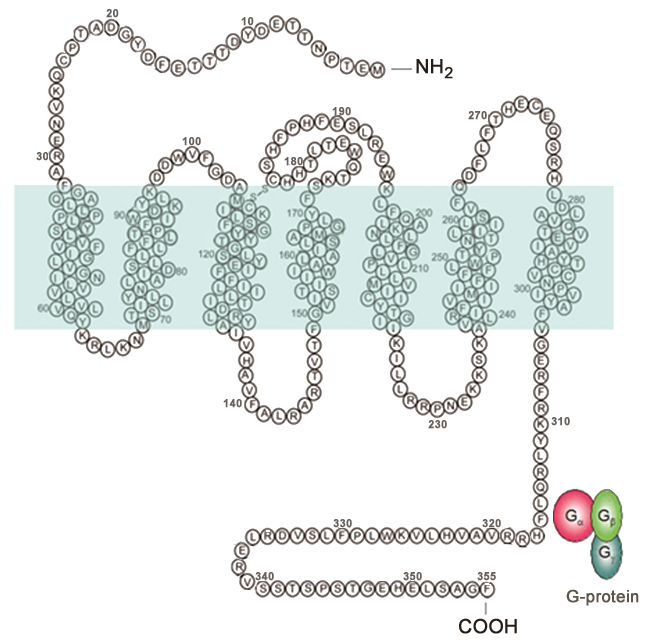
Predicted structure and amino acid sequence of CCR1. The typical serpentine structure is depicted with three extracellular (top) and three intracellular (bottom) loops and seven transmembrane domains. The shaded horizontal band represents the cell membrane. Amino acids are listed with a single letter code.
Description
355 amino acids; 41173 Da.
Expression
Monocyte/macrophages; T cells; platelets; tonsil B lymphocytes; blood derived mast cells, dendritic cells, basophils and eosinophils; bone marrow stromal cells; microvascular endothelial cells; vascular smooth muscle cells.
Localisation
Cell membrane; multi-pass membrane protein.
Function
Receptor for a C-C type chemokine. Binds to CCL3 (MIP-1-alpha), CCL5 (RANTES), CCL7 (MCP-3), CCL9 (MIP-1-gamma), CCL14 (HCC-1), CCL15 (MIP-1-delta), CCL16 (HCC-4) and CCL23 (MIP-3), and, less efficiently, to MIP-1-beta or MCP-1 and subsequently transduces a signal by increasing the intracellular calcium ions level. The major function of CCR1 is to regulate leukocyte trafficking in hematopoiesis and in innate and adaptive immunity. Other functions include angiogenic activity, ischemia/reperfusion injury, immune-cell differentiation, phagocyte activation, and affecting stem cell proliferation.
Implicated in
Entity name
Hematolymphoid neoplasia
Prognosis
CCR1 expression correlates with overall survival in the non-germinal center subtype of diffuse large B-cell lymphoma. In follicular lymphoma, high levels of CCR1 are associated with a shorter survival interval, and CCR1 is a marker of an immune switch between macrophages and a T cell-dominant response.
Oncogenesis
CCR1 is expressed in intraepithelial B cells of human tonsil and granulocytic/monocytic cells in the bone marrow. Immunohistochemical analysis of 944 cases of hematolymphoid neoplasia identified CCR1 expression in a subset of B- and T-cell lymphomas, plasma cell myeloma, acute myeloid leukemia, and classical Hodgkin lymphoma. In 13 patients with chronic lymphocytic leukemia (CLL), 9 with hairy cell leukemia (HCL), 5 with mantle cell lymphoma (MCL), 5 with marginal zone B-cell lymphoma (MZL), 6 with small lymphocytic lymphoma (SLL), and 5 with follicular cell lymphoma (FCL), flow cytometry analysis demonstrated that CCR1 was expressed in 70% of patients with CLL and 40% of those with HCL but was lacking in patients with MCL, MZL, SLL, and circulating normal B cells.
Circulating CD3+ T cells derived from healthy individuals and acute myelogenous leukemia patients with therapy-induced cytopenia after conventional chemotherapy or allogeneic stem cell transplantation showed no qualitative differences in CCR1 expression, that is, low expression for all the three groups.
Circulating CD3+ T cells derived from healthy individuals and acute myelogenous leukemia patients with therapy-induced cytopenia after conventional chemotherapy or allogeneic stem cell transplantation showed no qualitative differences in CCR1 expression, that is, low expression for all the three groups.
Entity name
Prognosis
In 80 multiple myeloma (MM) patients with bone marrow samples, patients with active disease showed a significantly lower expression of CCR1, CCR2, as well as CXCR4 than patients with non-active disease. This chemokine receptor expression profile correlated with serum beta2-microglobulin, C-reactive protein and hemoglobin. Multivariate analysis identified the chemokine receptor expression profile as an independent prognostic factor.
Oncogenesis
Human MM cells express at least three different chemokine receptors that are functionally involved in MM cell migration, i.e. CCR1, CCR2 and CXCR4, some also CCR6 and CXCR3. cDNA arrays identified CCR1 and CCR2 are overexpressed in myeloma cells compared to autologous B-lymphoblastoid cell lines. The expression of CCR1 and the migration to their ligands, RANTES and MIP-1alpha, respectively, were demonstrated in MM cell lines and primary MM cells.
Osteoclasts (OCL) secrete high levels of CCL3 and MM cells the express CCR1, the interaction between which plays a key role in the pathogenesis of MM-related osteolytic bone disease. Through CCL3-CCR1 axis OCL cells promote OCL formation and, in turn, OCL enhance MM cell proliferation.
In murine models of MM, MIP-1alpha, an OCL stimulatory factor produced by primary MM cells, increases bone destruction and tumor burden, by interacting with chemokine receptors CCR1 and CCR5 that widely expressed in human OCL precursors, myeloma cell lines, and purified marrow plasma cells from MM patients. Neutralizing antibodies to CCR1 or CCR5 inhibited MIP-1alpha-induced OCL formation. Furthermore, MCP-3, which binds CCR1 but not CCR5, and the CCR1-specific antagonist, BX471, markedly inhibited OCL formation stimulated with MIP-1alpha. Anti-CCR1, anti-CCR5, or BX471 also inhibited the upregulation of beta1 integrin myeloma cells induced by MIP-1alpha, as well as the adherence of myeloma cells to stromal cells and IL-6 production by stromal cells in response to myeloma cells.
The oncogene c-maf is translocated in approximately 5%-10% of MM. By gene expression profiling, three c-maf target genes, cyclin D2, integrin beta7 and CCR1, were identified.
Osteoclasts (OCL) secrete high levels of CCL3 and MM cells the express CCR1, the interaction between which plays a key role in the pathogenesis of MM-related osteolytic bone disease. Through CCL3-CCR1 axis OCL cells promote OCL formation and, in turn, OCL enhance MM cell proliferation.
In murine models of MM, MIP-1alpha, an OCL stimulatory factor produced by primary MM cells, increases bone destruction and tumor burden, by interacting with chemokine receptors CCR1 and CCR5 that widely expressed in human OCL precursors, myeloma cell lines, and purified marrow plasma cells from MM patients. Neutralizing antibodies to CCR1 or CCR5 inhibited MIP-1alpha-induced OCL formation. Furthermore, MCP-3, which binds CCR1 but not CCR5, and the CCR1-specific antagonist, BX471, markedly inhibited OCL formation stimulated with MIP-1alpha. Anti-CCR1, anti-CCR5, or BX471 also inhibited the upregulation of beta1 integrin myeloma cells induced by MIP-1alpha, as well as the adherence of myeloma cells to stromal cells and IL-6 production by stromal cells in response to myeloma cells.
The oncogene c-maf is translocated in approximately 5%-10% of MM. By gene expression profiling, three c-maf target genes, cyclin D2, integrin beta7 and CCR1, were identified.
Entity name
Hepatocellular carcinoma
Oncogenesis
Hepatic myofibroblast LI90 cells express and secrete MCP-1/CCL2. Through its receptors CCR1 and CCR2 as well, LI90 induces human hepatocellular carcinoma (HCC) Huh7 cell migration and invasion, which are strongly inhibited by heparin, beta-D-xyloside and anti-syndecan-1 and -4 antibodies. RANTES/CCL5 strongly stimulates the migration and the invasion of Huh7 cells by stimulating the tyrosine phosphorylation of focal adhesion kinase as well as activating matrix metalloproteinase-9, and to a lesser extent that of Hep3B cells. The RANTES-induced migration and invasion of Huh7 cells are also strongly inhibited by anti-CCR1 antibodies and heparin, as well as by beta-d-xyloside treatment of the cells, suggesting that CCR1 and glycosaminoglycans are involved in these events. We found that the miRNA-mediated knockdown expression of CCR1 significantly inhibited the invasive ability of and reduced the secretion of MMP-2 in hepatocellular carcinoma HCCLM3 cells, but only had a minor effect on the cellular proliferation. CCR1 expression was also detected on primary HCC cells and to a lesser degree, on endothelial cells in HCC tissues but not in normal liver tissues. Similarly, CCL3 expression was detected in HCC cells, endothelial cells, and to a lesser degree, fibroblast-like cells in HCC tissue, whereas only occasional vascular endothelial cells and inflammatory cells in normal liver tissues were weakly positive for CCL3. IL-1 enhances the local production of CCL3, which interact with CCR1 expressed on HCC cells, in an autocrine and/or paracrine manner. In a murine HCC model, injected tumor cells were transfected with HSV-thymidine kinase gene and then treated with ganciclovir (GCV). GCV treatment induced massive tumor cell apoptosis accompanied with intratumoral CCR1+CCR5+ dendritic cell infiltration. Tumor-infiltrating T cells and macrophages expressed CCL3, suggesting CCR1-CCL3 play a crucial role in the regulation of intratumoral dendritic cell accumulation and the subsequent establishment of tumor immunity following induction of tumor apoptosis by suicide genes. CCL3 and CCR1 are also expressed in 2 different models of HCC, i.e., N-nitrosodiethylamine (DEN)-induced HCC and HCC induced by hepatitis B virus. After DEN treatment, tumor foci number and sizes were remarkably reduced in CCR1- and CCL3-deficient mice, comparing with wild-type (WT) mice. Also, tumor angiogenesis markedly diminished, intratumoral Kupffer cells number reduced, MMP9 gene expression attenuated and MMP9+ cell numbers decreased in CCL3- and CCR1-deficient mice, as compared with WT mice. These observations suggest the contribution of the CCR1-CCL3 axis to HCC progression.
Entity name
Colorectal cancer
Prognosis
The expression of CCR1 is higher in colorectal carcinoma than normal tissues, and correlates with lymph node metastasis, deep invasion, poor differentiation and advanced Dukes stage.
Oncogenesis
Inactivation of TGF-beta family signaling within colon cancer increases CCL9 and promotes recruitment of the matrix metalloproteinase-expressing stromal cells that carry CCR1. Lack of CCR1 prevents the accumulation of MMP-expressing cells at the invasive front and suppresses tumor invasion. In a murine model of invasive colorectal cancer in which TGF-beta family signaling is blocked, CD34+ CCR1+ immature myeloid cell is recruited from the bone marrow to the tumor invasive front where expression of CCL9 is increased. These immature myeloid cells express MMP9, MMP2 and CCR1 and migrate toward the ligand CCL9. Lack of CCR1 prevents accumulation of CD34+ immature myeloid cell at the invasive front and suppresses tumor invasion.
Entity name
Non-small cell lung cancer
Oncogenesis
CCR1 expression correlated with the aggressive phenotype of the non-small cell lung cancer (NSCLC) cells. CCR1 knockdown significantly suppressed the invasiveness of NSCLC cells and significantly reduced the expression of matrix metalloproteinase-9, but had only a minor effect on cell proliferation.
Entity name
Oral squamous cell carcinoma
Oncogenesis
Expression of CCL3 and CCR1 is significant higher in oral squamous cell carcinoma compared with the normal controls. The percentages of CCL3+ and CCR1+ cells were observed to be similar in parenchyma and stroma in cases without lymph node metastasis when compared with lymph node metastasis positive cases.
Entity name
Ovarian cancer
Oncogenesis
mRNA for CCR1, -2a, -2b, -3, -4, -5, and -8 was detected in cells from human ovarian cancer ascites. Further, flowcytometry showed CD14+ macrophages within ascites consistently expressed CCR1, -2, and -5, and >60% of all T cells expressed CCR1. Although ovarian cancer ascitic and blood monocyte/macrophages express CCR1, they failed to migrate in response to the RANTES. Compared with that of normal blood, cell surface expression level for CCR1 was higher in ascites. In a monocytic cell line in vitro, CCR1 mRNA expression was increased 5-fold by hypoxia. In 25 patients with ovarian cancer, CCR1 was detected in samples from 75% of patients, where CCR1 localised to macrophages and lymphocytes, and there was a correlation between numbers of CD8+ cells and CCR1+ cells.
Entity name
Prostate cancer
Oncogenesis
Androgen receptor negative human prostate cancer cell line DU-145 cells selectively expressed CXCR4 and CCR1 at high levels compared with DU-145/AR cells that express androgen receptor. DU-145 showed vigorous migratory responses to CXCL12 and CCL3. In contrast, neither CXCL12 nor CCL3 affected the migration of DU-145/AR cells.
Entity name
Breast cancer
Oncogenesis
The expression of CCR5 was higher than that of CCR1 in the peripheral blood mononuclear cells (PBMC) of healthy women, while the PBMC of the breast cancer patients showed overexpression of CCR1 and downregulation of CCR5. The differential effects of MIP-1alpha and MIP-1beta on the PBMC of healthy women and breast cancer patients correlated with the expression levels of CCR1 and CCR5 in these monocytes. In murine model of breast cancer, CCL5 (RANTES) was produced by the tumor cells, and its receptors, CCR1 and CCR5, were expressed by the infiltrating leukocytes. In mice treatment with Met-CCL5, an antagonist of CCR1 and CCR5, the volume and weight of tumors were significantly decreased compared with control-treated tumors. The total cell number obtained after collagenase digestion was decreased in Met-CCL5-treated tumors as was the proportion of infiltrating macrophages. Furthermore, chemokine antagonist treatment increased stromal development and necrosis.
Entity name
Glioma
Oncogenesis
Co-cultured human glioma U87 cells induced an activated phenotype in HUVECs. These tumour-activated endothelial cells coordinately expressed matching pairs of receptors/ligands were found to be, including CCR1-RANTES axis.
Entity name
Oncogenesis
The activities of phospholipase C (PLC), protein kinase C delta (PKCdelta) and NF-kappaB were enhanced by Lkn-1 (CCL15) stimulation on CCR1+ human osteogenic sarcoma cells. Inhibitors of G protein, PLC, PKCdelta and NF-kappaB inhibited the chemotactic activity of Lkn-1 on CCR1+ osteogenic sarcoma cells indicating that Lkn-1-induced chemotaxis involving these signaling pathways.
Article Bibliography
| Pubmed ID | Last Year | Title | Authors |
|---|---|---|---|
| 16969502 | 2006 | Androgen receptor negatively influences the expression of chemokine receptors (CXCR4, CCR1) and ligand-mediated migration in prostate cancer DU-145. | Akashi T et al |
| 20154287 | 2010 | C-C chemokine receptor 1 expression in human hematolymphoid neoplasia. | Anderson MW et al |
| 18174380 | 2008 | Clinical quantitation of immune signature in follicular lymphoma by RT-PCR-based gene expression profiling. | Byers RJ et al |
| 18022698 | 2008 | Chemo-angiogenic profile of bovine urinary bladder tumors distinguishes urothelial carcinomas from hemangiosarcomas. | Carvalho T et al |
| 19642141 | 2010 | Monocyte chemoattractant protein-1 (MCP-1)/CCL2 secreted by hepatic myofibroblasts promotes migration and invasion of human hepatoma cells. | Dagouassat M et al |
| 11468178 | 2001 | Identifying intercellular signaling genes expressed in malignant plasma cells by using complementary DNA arrays. | De Vos J et al |
| 9647242 | 1998 | Reduced tumorigenicity and augmented leukocyte infiltration after monocyte chemotactic protein-3 (MCP-3) gene transfer: perivascular accumulation of dendritic cells in peritumoral tissue and neutrophil recruitment within the tumor. | Fioretti F et al |
| 17926037 | 2008 | Migration deficit in monocyte-macrophages in human ovarian cancer. | Freedman RS et al |
| 11369623 | 2001 | Macrophage inflammatory protein-1alpha is an osteoclastogenic factor in myeloma that is independent of receptor activator of nuclear factor kappaB ligand. | Han JH et al |
| 14998494 | 2004 | Overexpression of c-maf is a frequent oncogenic event in multiple myeloma that promotes proliferation and pathological interactions with bone marrow stroma. | Hurt EM et al |
| 18644849 | 2008 | Tumor cell apoptosis induces tumor-specific immunity in a CC chemokine receptor 1- and 5-dependent manner in mice. | Iida N et al |
| 17974948 | 2007 | Keeping out the bad guys: gateway to cellular target therapy. | Kitamura T et al |
| 15001559 | 2004 | Human LZIP binds to CCR1 and differentially affects the chemotactic activities of CCR1-dependent chemokines. | Ko J et al |
| 11943214 | 2002 | Leukotactin-1/CCL15-induced chemotaxis signaling through CCR1 in HOS cells. | Ko J et al |
| 12651617 | 2003 | Potential interaction between CCR1 and its ligand, CCL3, induced by endogenously produced interleukin-1 in human hepatomas. | Lu P et al |
| 19664396 | 2009 | [Correlations of chemokine receptor CCR1 expression with metastasis of lymph nodes in colorectal carcinoma tissues]. | Ma JA et al |
| 17086356 | 2006 | Role of CCR1 and CCR5 in homing and growth of multiple myeloma and in the development of osteolytic lesions: a study in the 5TMM model. | Menu E et al |
| 16518599 | 2006 | Macrophage inflammatory protein (MIP)1alpha and MIP1beta differentially regulate release of inflammatory cytokines and generation of tumoricidal monocytes in malignancy. | Nath A et al |
| 15730850 | 2005 | MIP-1alpha utilizes both CCR1 and CCR5 to induce osteoclast formation and increase adhesion of myeloma cells to marrow stromal cells. | Oba Y et al |
| 19055860 | 2008 | Circulating T cells derived from acute leukemia patients with severe therapy-induced cytopenia express a wide range of chemokine receptors. | Olsnes AM et al |
| 15894378 | 2005 | The clinical potential of chemokine receptor antagonists. | Ribeiro S et al |
| 14678997 | 2003 | A chemokine receptor antagonist inhibits experimental breast tumor growth. | Robinson SC et al |
| 11556842 | 2001 | Analysis of CC chemokine and chemokine receptor expression in solid ovarian tumours. | Scotton C et al |
| 17914560 | 2007 | Dual role of CCL3/CCR1 in oral squamous cell carcinoma: implications in tumor metastasis and local host defense. | Silva TA et al |
| 18025279 | 2007 | Glycosaminoglycans and their synthetic mimetics inhibit RANTES-induced migration and invasion of human hepatoma cells. | Sutton A et al |
| 15001469 | 2004 | Homeostatic chemokines drive migration of malignant B cells in patients with non-Hodgkin lymphomas. | Trentin L et al |
| 11544332 | 2001 | Urokinase plasminogen activator and plasmin efficiently convert hemofiltrate CC chemokine 1 into its active. | Vakili J et al |
| 17715391 | 2007 | MLN3897, a novel CCR1 inhibitor, impairs osteoclastogenesis and inhibits the interaction of multiple myeloma cells and osteoclasts. | Vallet S et al |
| 16461304 | 2006 | Clinical significance of chemokine receptor (CCR1, CCR2 and CXCR4) expression in human myeloma cells: the association with disease activity and survival. | Vande Broek I et al |
| 10737895 | 2000 | CKbeta-8 [CCL23], a novel CC chemokine, is chemotactic for human osteoclast precursors and is expressed in bone tissues. | Votta BJ et al |
| 18972130 | 2009 | CCR1 knockdown suppresses human non-small cell lung cancer cell invasion. | Wang CL et al |
| 17336272 | 2007 | Downregulation of CCR1 inhibits human hepatocellular carcinoma cell invasion. | Wu X et al |
| 16284949 | 2006 | Essential contribution of a chemokine, CCL3, and its receptor, CCR1, to hepatocellular carcinoma progression. | Yang X et al |
| 20236357 | 2010 | Chemokine CCL3 facilitates the migration of hepatoma cells by changing the concentration intracellular Ca. | Yuan Y et al |
Other Information
Locus ID:
NCBI: 1230
MIM: 601159
HGNC: 1602
Ensembl: ENSG00000163823
Variants:
dbSNP: 1230
ClinVar: 1230
TCGA: ENSG00000163823
COSMIC: CCR1
RNA/Proteins
| Gene ID | Transcript ID | Uniprot |
|---|---|---|
| ENSG00000163823 | ENST00000296140 | P32246 |
| ENSG00000163823 | ENST00000296140 | Q5U003 |
Expression (GTEx)
Pathways
References
| Pubmed ID | Year | Title | Citations |
|---|---|---|---|
| 37903056 | 2023 | CCR1 mediates Müller cell activation and photoreceptor cell death in macular and retinal degeneration. | 0 |
| 38274805 | 2023 | Characterizing ligand-receptor interactions and unveiling the pro-tumorigenic role of CCL16-CCR1 axis in the microenvironment of hepatocellular carcinoma. | 1 |
| 37903056 | 2023 | CCR1 mediates Müller cell activation and photoreceptor cell death in macular and retinal degeneration. | 0 |
| 38274805 | 2023 | Characterizing ligand-receptor interactions and unveiling the pro-tumorigenic role of CCL16-CCR1 axis in the microenvironment of hepatocellular carcinoma. | 1 |
| 35287505 | 2022 | Identification of ITGAX and CCR1 as potential biomarkers of atherosclerosis via Gene Set Enrichment Analysis. | 4 |
| 35408790 | 2022 | Expression of the Chemokine Receptor CCR1 in Burkitt Lymphoma Cell Lines Is Linked to the CD10-Negative Cell Phenotype and Co-Expression of the EBV Latent Genes EBNA2, LMP1, and LMP2. | 1 |
| 35809272 | 2022 | The rs13075270 and rs13092160 polymorphisms of CCR1 and CCR3 genes on oral aphthous-like lesions in PFAPA syndrome. | 0 |
| 36317881 | 2022 | Activation of the Chemokine Receptor CCR1 and Preferential Recruitment of Gαi Suppress RSV Replication: Implications for Developing Novel Respiratory Syncytial Virus Treatment Strategies. | 0 |
| 35287505 | 2022 | Identification of ITGAX and CCR1 as potential biomarkers of atherosclerosis via Gene Set Enrichment Analysis. | 4 |
| 35408790 | 2022 | Expression of the Chemokine Receptor CCR1 in Burkitt Lymphoma Cell Lines Is Linked to the CD10-Negative Cell Phenotype and Co-Expression of the EBV Latent Genes EBNA2, LMP1, and LMP2. | 1 |
| 35809272 | 2022 | The rs13075270 and rs13092160 polymorphisms of CCR1 and CCR3 genes on oral aphthous-like lesions in PFAPA syndrome. | 0 |
| 36317881 | 2022 | Activation of the Chemokine Receptor CCR1 and Preferential Recruitment of Gαi Suppress RSV Replication: Implications for Developing Novel Respiratory Syncytial Virus Treatment Strategies. | 0 |
| 33147936 | 2021 | Expression of the chemokine receptor CCR1 promotes the dissemination of multiple myeloma plasma cells in vivo. | 10 |
| 33361824 | 2021 | Hypertension delays viral clearance and exacerbates airway hyperinflammation in patients with COVID-19. | 98 |
| 33147936 | 2021 | Expression of the chemokine receptor CCR1 promotes the dissemination of multiple myeloma plasma cells in vivo. | 10 |
Citation
Qiang Gao ; Jia Fan
CCR1 (chemokine (C-C motif) receptor 1)
Atlas Genet Cytogenet Oncol Haematol. 2010-04-01
Online version: http://atlasgeneticsoncology.org/gene/44379/ccr1-(chemokine-(c-c-motif)-receptor-1)
