EP300 (E1A binding protein p300)
2014-11-01 Gloria Negri , Cristina Gervasini AffiliationDepartment of Health Science, Medical Genetics, Universita degli Studi di Milano, Milano, Italy
Identity
DNA/RNA

Description
Transcription
Pseudogene
Proteins
Description
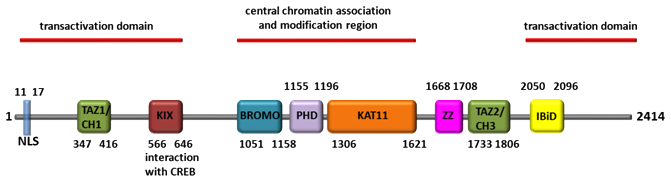
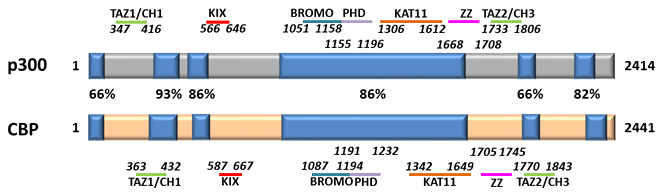
p300 shares a modular organization consisting in several conserved domains including a central chromatin association and modification region which includes the bromodomain/PHD finger module and the KAT11 domain (Rack et al., 2014) which is flanked by four transactivation domains (TADs): i) the CH1 that encompasses the TAZ1 domain, ii) the KIX domain, iii) another CH3 containing the TAZ2 domain and a ZZ domain, and iv) the IBiD (Bedford et al., 2012; Wang et al., 2013).
The Bromodomain mediates p300 binding to acetylated histones, nucleosomes and transcriptional factors and could therefore play a role in tethering p300 to specific chromosomal sites (Kalkhoven et al., 2004; Rack et al., 2014) moreover, the associated PHD finger is an integral part of the enzymatic core of the protein influencing its ability to recognize and acetylate both itself as well as histones and non-histone substrates (Kalkhoven et al., 2004; Wang et al., 2013; Rack et al., 2014). The KAT11 catalytic domain can acetylate p300 itself and a variety of histonic and non-histonic proteins and the CH rich regions are able to bind zinc and are involved in protein-protein interaction (Valor et al., 2013; Wang et al., 2013).
p300 has also multiple specific interaction domains for different transcriptional factors such as the KIX domain that mediates CREB-p300 interaction and CREB phosphorylation at serine 133 residue but also for the Retinoic Acid Receptor-related orphan receptor A (RORA) and for ALX1 at the N-term end of the protein and for Interferons at C-term end.
Expression
Localisation
Function
1) Acetylation of histones tails: p300 can enable transcription through the catalytic activity of its KAT domain which is able to acetylate promoter nucleosomal histones resulting in chromatin remodelling and relaxation and in increased accessibility of the DNA to other essential regulators (Kalhoven et al., 2004; Wang et al., 2013). Thanks to its ability in modifying chromatin structure by histone acetylation, p300 can be defined as "writer" of the epigenetic code (Berdasco et al., 2013).
2) Acetylation of other target proteins: p300 can also acetylate other kinds of proteins, such as transcriptional factors, modulating their activity positively or negatively, or coactivators.
Acetylation of non-histone substrates can result in either positive or negative effects on transcription by affecting protein-protein interactions (activator of thyroid and retinoid receptors ACTR), protein-DNA interactions (the high mobility group protein HMGI), nuclear retention (the hepatocyte nuclear factor HNF4) or protein half-life (E2F).
For example some acetylated p300 targets regulate the expression of histone methyltransferase leading to chromatin condensation and gene silencing.
3) RNA Polymerase II stabilization: p300 functions as a "bridge" linking the DNA-bound transcription factors (activators) to the basal transcription machinery through direct interaction with TFIID, including TATA-binding protein (TBP) and 13 TBP-associated factors (TAFs) and TFIIB promoting the pre-initiation complex (PIC) assembly (Wang et al., 2013).
p300 has also some more indirect chromatin-related roles:
4) DNA replication and repair: p300 interacts with various replication and repair proteins, including proliferating cell nuclear antigen (PCNA), the Recq4 helicase, Flap endonuclease 1 (Fen1), DNA polymerase b and thymine DNA glycosylase, with the latter three also serving as acetylation substrates.
5) Cell cycle regulation: p300 associates with the complex formed between cyclin E and cyclin-dependent kinase 2 (cdk2) regulating proper progression of the cell cycle.
6) p53 activity regulation: p300 is involved in p53 degradation, which depends on the murine double minute 2 protein (MDM2). Degradation and ubiquitination of p53 is dependent on MDM2, and a ternary complex between these two proteins and p300 regulates the turnover of p53 itself in cycling cells. Furthermore, the CH-1 region of p300 displays polyubiquitin ligase activity towards p53, and could therefore play a key role in controlling p53 levels.
7) Nuclear import: p300 can acetylate two proteins involved in regulating nuclear import, the importin-α1 isoform Rch1 and importin-α7, and could therefore play a role in this process.
Because of its ability of interacting with more than 400 partner proteins, p300 can be considered a "hub" (Bedford et al., 2014). Its interactome includes pro-proliferative proteins and oncoproteins: c-Myc, c-Myb, CREB, c-Jun and c-Fos; transforming viral proteins: E1A, and E6; as well as tumor suppressors and pro-apoptotic proteins: Forkhead box class O (FoxO) transcription factors FoxO1, FoxO3a, and FoxO4, signal transducers and activators of transcription (STAT) 1 and STAT 2, Hypoxia-inducible factor 1α (HIF-1α), breast cancer 1 (BRCA1), SMA/MAD homology (Smad) proteins, the Runt-related transcription factor (RUNX), E2 Transcription Factor (E2F), and E-proteins (Wang et al., 2013).
Homology
Mutations
Germinal
Somatic
Epigenetics
Implicated in
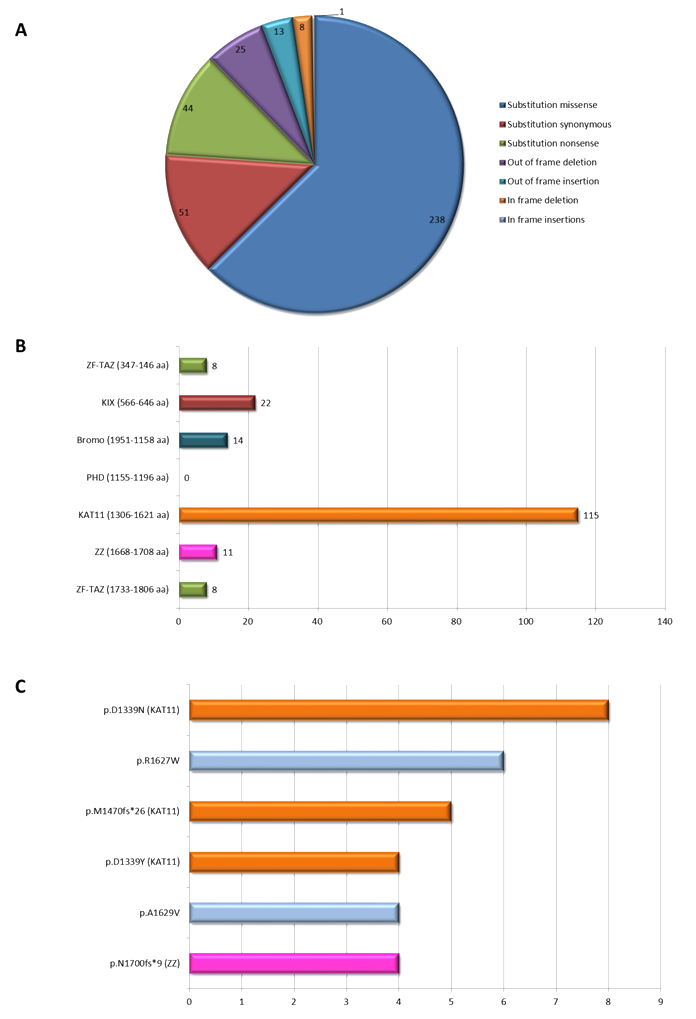
With about ~400 unique somatic alterations reported, point mutations appear to be the most represented kind of EP300,mutations: in particular, missense mutations account for >60% of all mutations, followed by synonymous (~13%) and nonsense (~11%) mutations. In detail, transitions justify about 70% of all substitutions. Out of frame insertion/deletions (ins/del) represent together 38% and in frame ins/del about 4%.
Mutations are widespread across the gene with a great concentration in the large KAT11 domain, which clusters about 26% of all alterations. Few recurrent mutations are reported: the most frequently mutated amino acid residue is the aspartic acid at position 1339 in the KAT11 domain which is replaced by either asparagine (eight samples) or tyrosine (four samples).
CNVs are described too. In particular, losses are reported in 31 samples including breast, endometrium, ovary, large intestine and lung cancer, while gains seem to be rarer being described in 11 samples including breast, hematopoietic and lymphoid, and lung cancer.
Alterations in EP300 gene expression are recorded too: in particular over expression was described in 94 samples, while under expression in 104 samples, both in cancers derived from breast, endometrium, ovary, CNV, haematopoietic and lymphoid organs, kidney, large intestine and lung.
Only three cases of MLL1-EP300 fusion genes have been described, all in therapy-related leukemia patients following chemoterapy with topoisomerase II inhibitors. The first patient was initially diagnosed as having non-Hodgkin lymphoma and, after conventional chemotherapy, he developed secondary AML which was cytogenetically characterized as t(11;22)(q23;q13) producing a chimeric MLL1-EP300 gene in which the exon 9 of MLL1 was juxtaposed to EP300 exon 15 (Ida et al., 1997). The second case is a girl who developed AML after chemotherapy for neuroblastoma. She presented a complex karyotype 46,XX,t(1;22;11)(q44;q13;q23),t(10;17)(q22,q21) with the fusion of MLL1 exon 8 to EP300 exon 15 and also a less expressed clone in which exon 7 of MLL1 is fused with exon 15 of EP300, which was considered to be generated by alternative splicing (Ohnishi et al., 2008). The third patient presented AML with myelodysplasia-related changes evolving after chemotherapy in acute myelomonocytic leukaemia (AMML). Leukemic cells were cytologically characterised as 46;XY,t(11;22)(q23;q13)[15]/47,idem,+8[2] including the fusion of exon 10, or exon 11 resulting from alternative splicing, of MLL1 with exon 13 of EP300 (Duhoux et al., 2011).
All chimeric proteins retain almost the same part of both MLL1, including the AT-hook, the DNA methyltransferase and the transcriptional repression domains and p300, i.e. the bromodomain, the catalytic KAT and TADs
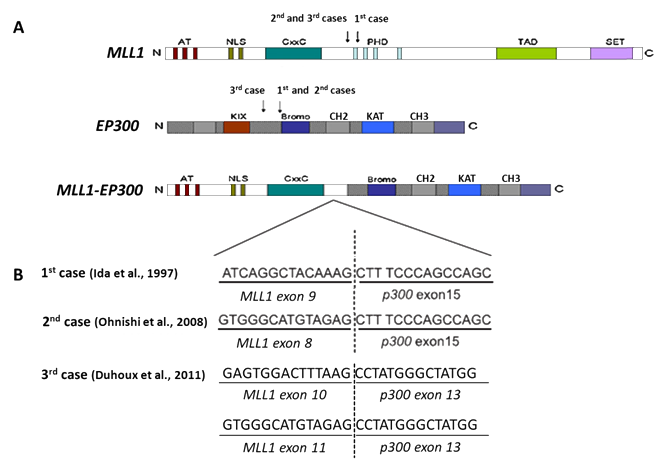
The translocation t(11;22)(q23;q13) involving MLL1-EP300 is characteristic of therapy related leukemias where it is likely driven by topoisomerase II inhibitors, rather than of de novo leukaemias.
The gene underlies chromosomal translocation with different partners, generating fusion genes, such as MOZ-TIF2, MOZ-CBP and MOZ-EP300 in acute myeloid leukemia (AML). All MOZ fusion partner genes are involved in histone modification and transcriptional regulation (Katsumoto et al., 2008).
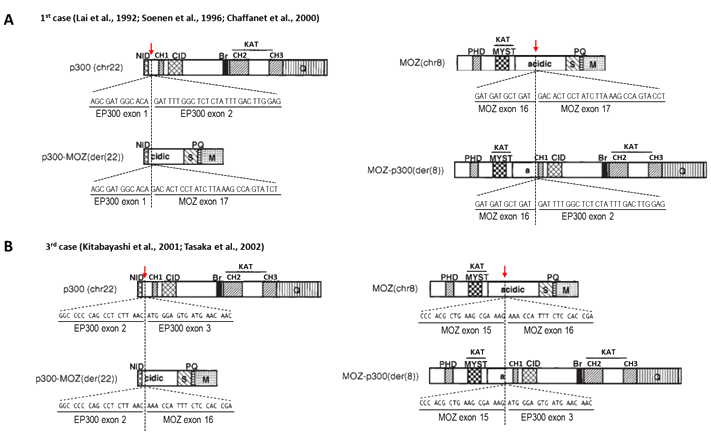
To date, only three cases of t(8;22)(p11;q13) involving MOZ and EP300 have been reported and investigated at DNA and RNA levels in two of them (Lai et al., 1992; Soenen et al., 1996; Chaffanet et al., 2000; Kitabayashi et al., 2001; Tasaka et al., 2002).
In Chaffanet et al., and in Kitabayashi et al., MOZ-EP300 fusion genes result from the hybrid junction between exon 16 and exon 15 of MOZ with exons 2 and 3 of EP300, respectively.
In both cases, the MOZ breakpoints are located in or around its acidic domain resulting in the retention of its N-terminal region and the replacement of the C-terminal end with the p300 fusion partner. The N-terminal region of MOZ contains a H15 (histone H1/H5) domain related to nuclear localization, a PHD (plant homeobox-like domain) zinc finger involved in binding to methylated histones, a basic domain and a Myst-type KAT domain. The KAT domain contains C2HC zinc finger and helix-turn-helix motifs that bind to nucleosomes and DNA. Because of the early truncation of EP300 , almost all its functional domains are conserved, including the KAT, the bromodomain and the CH1-3, resulting in a fusion protein with both MOZ and p300 KAT domains.
In the reciprocal fusion genes, EP300-MOZ, exon 1 or 2 of EP300 are juxtaposed to exons 17 and 16 of MOZ, respectively. In both cases, the N-terminal region including only the nuclear receptor interaction domain (NID) of p300 and the C-terminal of MOZ encompassing its serine, proline-glutammine and methionine-rich regions are conserved (Chaffanet et al., 2000; Kitabayashi et al., 2001).
Article Bibliography
| Pubmed ID | Last Year | Title | Authors |
|---|---|---|---|
| 25111821 | 2014 | Somatic alterations and dysregulation of epigenetic modifiers in cancers. | Aumann S et al |
| 17220215 | 2007 | Genetic heterogeneity in Rubinstein-Taybi syndrome: delineation of the phenotype of the first patients carrying mutations in EP300. | Bartholdi D et al |
| 20014264 | 2010 | Two patients with EP300 mutations and facial dysmorphism different from the classic Rubinstein-Taybi syndrome. | Bartsch O et al |
| 22511639 | 2012 | Is histone acetylation the most important physiological function for CBP and p300? | Bedford DC et al |
| 23370504 | 2013 | Genetic syndromes caused by mutations in epigenetic genes. | Berdasco M et al |
| 10824998 | 2000 | MOZ is fused to p300 in an acute monocytic leukemia with t(8;22). | Chaffanet M et al |
| 11559745 | 2001 | p300/CBP proteins: HATs for transcriptional bridges and scaffolds. | Chan HM et al |
| 20980053 | 2011 | Novel variant form of t(11;22)(q23;q13)/MLL-EP300 fusion transcript in the evolution of an acute myeloid leukemia with myelodysplasia-related changes. | Duhoux FP et al |
| 7587135 | 1994 | The adenovirus E1A-associated 300-kD protein exhibits properties of a transcriptional coactivator and belongs to an evolutionarily conserved family. | Eckner R et al |
| 19353645 | 2009 | Further case of Rubinstein-Taybi syndrome due to a deletion in EP300. | Foley P et al |
| 16868563 | 2006 | Rubinstein-Taybi syndrome. | Hennekam RC et al |
| 9389684 | 1997 | Adenoviral E1A-associated protein p300 is involved in acute myeloid leukemia with t(11;22)(q23;q13). | Ida K et al |
| 15313412 | 2004 | CBP and p300: HATs for different occasions. | Kalkhoven E et al |
| 18754862 | 2008 | Roles of the histone acetyltransferase monocytic leukemia zinc finger protein in normal and malignant hematopoiesis. | Katsumoto T et al |
| 11243405 | 2001 | Fusion of MOZ and p300 histone acetyltransferases in acute monocytic leukemia with a t(8;22)(p11;q13) chromosome translocation. | Kitabayashi I et al |
| 1606561 | 1992 | Acute monocytic leukemia with (8;22)(p11;q13) translocation. Involvement of 8p11 as in classical t(8;16)(p11;p13). | Lai JL et al |
| 19262598 | 2009 | New insights to the MLL recombinome of acute leukemias. | Meyer C et al |
| 24476420 | 2015 | Clinical and molecular characterization of Rubinstein-Taybi syndrome patients carrying distinct novel mutations of the EP300 gene. | Negri G et al |
| 18778367 | 2008 | A complex t(1;22;11)(q44;q13;q23) translocation causing MLL-p300 fusion gene in therapy-related acute myeloid leukemia. | Ohnishi H et al |
| 22941188 | 2012 | Integrative genome analyses identify key somatic driver mutations of small-cell lung cancer. | Peifer M et al |
| 25158095 | 2014 | The PHD finger of p300 influences its ability to acetylate histone and non-histone targets. | Rack JGM et al |
| 15706485 | 2005 | Genetic heterogeneity in Rubinstein-Taybi syndrome: mutations in both the CBP and EP300 genes cause disease. | Roelfsema JH et al |
| 24622842 | 2014 | Driver mutations of cancer epigenomes. | Roy DM et al |
| 2586363 | 1989 | Keloids and neoplasms in the Rubinstein-Taybi syndrome. | Siraganian PA et al |
| 8721686 | 1996 | Identification of a YAC spanning the translocation breakpoint t(8;22) associated with acute monocytic leukemia. | Soenen V et al |
| 12010682 | 2002 | Secondary acute monocytic leukemia with a translocation t(8;22)(p11;q13). | Tasaka T et al |
| 20717166 | 2011 | Exon deletions of the EP300 and CREBBP genes in two children with Rubinstein-Taybi syndrome detected by aCGH. | Tsai AC et al |
| 23448461 | 2013 | Lysine acetyltransferases CBP and p300 as therapeutic targets in cognitive and neurodegenerative disorders. | Valor LM et al |
| 23307074 | 2013 | Transcriptional/epigenetic regulator CBP/p300 in tumorigenesis: structural and functional versatility in target recognition. | Wang F et al |
| 2521301 | 1989 | Cellular targets for transformation by the adenovirus E1A proteins. | Whyte P et al |
| 17299436 | 2007 | Confirmation of EP300 gene mutations as a rare cause of Rubinstein-Taybi syndrome. | Zimmermann N et al |
| 11004107 | 2000 | Ocular features in Rubinstein-Taybi syndrome: investigation of 24 patients and review of the literature. | van Genderen MM et al |
| 25132000 | 2014 | Keloids in Rubinstein-Taybi syndrome: a clinical study. | van de Kar AL et al |
Other Information
Locus ID:
NCBI: 2033
MIM: 602700
HGNC: 3373
Ensembl: ENSG00000100393
Variants:
dbSNP: 2033
ClinVar: 2033
TCGA: ENSG00000100393
COSMIC: EP300
RNA/Proteins
| Gene ID | Transcript ID | Uniprot |
|---|---|---|
| ENSG00000100393 | ENST00000263253 | Q09472 |
| ENSG00000100393 | ENST00000634690 | A0A0U1RR87 |
Expression (GTEx)
Pathways
Protein levels (Protein atlas)
References
| Pubmed ID | Year | Title | Citations |
|---|---|---|---|
| 38096616 | 2024 | NDUFA8 is transcriptionally regulated by EP300/H3K27ac and promotes mitochondrial respiration to support proliferation and inhibit apoptosis in cervical cancer. | 1 |
| 38244240 | 2024 | EP300 improves endothelial injury and mitochondrial dysfunction in coronary artery disease by regulating histone acetylation of SOCS1 promoter via inhibiting JAK/STAT pathway. | 0 |
| 38256128 | 2024 | Acetyltransferase P300 Regulates Glucose Metabolic Reprogramming through Catalyzing Succinylation in Lung Cancer. | 0 |
| 38316196 | 2024 | P300 in schizophrenia: Then and now. | 0 |
| 38378770 | 2024 | Upregulation of p300 in paclitaxel-resistant TNBC: implications for cell proliferation via the PCK1/AMPK axis. | 0 |
| 38566191 | 2024 | EP300-ZNF384 transactivates IL3RA to promote the progression of B-cell acute lymphoblastic leukemia. | 0 |
| 38636368 | 2024 | P300 reduces TUBB4B expression to facilitate the biological process of migration and invasion of non-small cell lung cancer cells. | 0 |
| 38691868 | 2024 | EP300 through upregulating the expression of vimentin to promote the progression of chordoma. | 0 |
| 38096616 | 2024 | NDUFA8 is transcriptionally regulated by EP300/H3K27ac and promotes mitochondrial respiration to support proliferation and inhibit apoptosis in cervical cancer. | 1 |
| 38244240 | 2024 | EP300 improves endothelial injury and mitochondrial dysfunction in coronary artery disease by regulating histone acetylation of SOCS1 promoter via inhibiting JAK/STAT pathway. | 0 |
| 38256128 | 2024 | Acetyltransferase P300 Regulates Glucose Metabolic Reprogramming through Catalyzing Succinylation in Lung Cancer. | 0 |
| 38316196 | 2024 | P300 in schizophrenia: Then and now. | 0 |
| 38378770 | 2024 | Upregulation of p300 in paclitaxel-resistant TNBC: implications for cell proliferation via the PCK1/AMPK axis. | 0 |
| 38566191 | 2024 | EP300-ZNF384 transactivates IL3RA to promote the progression of B-cell acute lymphoblastic leukemia. | 0 |
| 38636368 | 2024 | P300 reduces TUBB4B expression to facilitate the biological process of migration and invasion of non-small cell lung cancer cells. | 0 |
Citation
Gloria Negri ; Cristina Gervasini
EP300 (E1A binding protein p300)
Atlas Genet Cytogenet Oncol Haematol. 2014-11-01
Online version: http://atlasgeneticsoncology.org/gene/97
Historical Card
2000-01-01 EP300 (E1A binding protein p300) by Jean-Loup Huret Affiliation
