Identity
HGNC
LOCATION
3p21.31
LOCUSID
ALIAS
ARH12,ARHA,EDFAOB,RHO12,RHOH12
FUSION GENES
Abstract
Review on RHOA, with data on DNA\/RNA, on the protein encoded and where the gene is implicated.
DNA/RNA
Description
The RhoA gene can be found on chromosome 3 at location: 49371585-49424530. This gene includes 5 exons.
Transcription
This gene has 6 transcripts (splice variants): 2031 bp (variant a); 961 bp (variant b); 889 bp (variant c); 633 bp (variant d); 539 bp (variant e); 388 bp (variant f).
Proteins
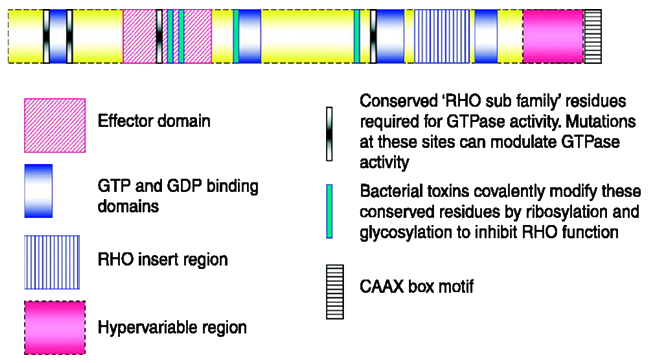
Schematic representation of the domains of RhoA. The available functional and structural data show that RHO-GTP-binding proteins are made-up of an effector domain, four separate guanosine phosphate binding regions that span the length of the core structure, a hypervariable region and a CAAX box motif (Lartey and López Bernal, 2009).
Description
The RhoA protein encodes five alternative isoforms: variant a (193 amino acids), variant b (187 amino acids), variant c (90 amino acids), variant d (129 amino acids) and variant e (86 amino acids).
- RhoA structure:
The available functional and structural data show that RHO-GTP-binding proteins are made-up of an effector domain, four separate guanosine phosphate binding regions that span the length of the core structure, a hypervariable region and a CAAX box motif (C: Cys; A: aliphatic residue; X: any residue). The effector domain (residues 26-45) changes conformation between the GTP bound and GDP bound states. All RHO proteins have conserved residues at Gly14, Thr19, Phe30 and Gln93 which are involved in binding, stabilization or regulation of GTP hydrolysis. The N-terminus region also contains switch 1 (residues 27-40) and switch 2 (residues 59-78) regions which change conformation between GTP- and GDP-bound states and may facilitate changes in effector region required for binding to downstream targets. RhoA protein is target for several bacterial toxins, which modify key conserved amino acids involved in their regulation. These include Clostridium botulinum exoenzyme C3 transferase, which modifies Asn41, and Toxin B, which acts on Thr37. The hypervariable region made-up of residues 173-189 is the region of most diversity between individual RHO family members. It may contain sites for palmitoylation and a polybasic region which can determine membrane association. The C-terminus of RhoA is essential for correct localization of the protein. RhoA is post-translationally modified by prenylation of a conserved C-terminal cysteine followed by methylation and proteolytic removal of the last three amino acids. The prenyl group (geranylgeranyl) anchors the GTPase into membranes and this modification is essential for its stability, cell growth, transformation, and cytoskeletal organization.
- RhoA activity regulation:
Rho GTPases can be activated by intrinsic or extrinsic cues, setting off a signaling cascade (Etienne-Manneville and Hall, 2002). Rho GTPases behave as molecular switches that fluctuate between inactive and active states, two conformations that depend on the binding of either GDP or GTP to the GTPases, respectively (Bustelo et al., 2007). Two types of regulatory proteins control this cycling: guanine nucleotide-exchange factors (GEFs), which activate Rho GTPases by catalyzing the exchange of GDP for GTP (Rossman et al., 2005), and GTPase-activating proteins (GAPs), which inactivate the GTPases by enhancing intrinsic GTP hydrolysis activity (Bos et al., 2007). There are over 80 GEFs and 70 GAPs for Rho GTPases, whose activity is tightly regulated and can be highly specific. RhoA can be sequestered in the cytoplasm by guanine nucleotide-dissociation inhibitors (GDIs), which bind prenylated GDP-bound Rho proteins (Garcia-Mata et al., 2011), allowing translocation of Rho GTPases between membranes and cytosol.
- RhoA effectors binding:
To date, at least 21 proteins have been identified which directly interact with RhoA (ROCK1, ROCK2, PRKcA, PKN1, PKN2, RTKN1, RTKN2, RHPN1, RHPN2, KTN1, CIT, DIAPH1, KCNA2, ITRP1, PLD, MYBPH, PIP5K, FAK, BORG, MBS, GDIA). Some of these have been shown to contribute to specific responses downstream of RhoA. Similarly to GEFs and GAPs, effectors bind to Rho both through the Switch 1 and 2 regions, but the amino acids involved in interaction with each target differ.
- RhoA structure:
The available functional and structural data show that RHO-GTP-binding proteins are made-up of an effector domain, four separate guanosine phosphate binding regions that span the length of the core structure, a hypervariable region and a CAAX box motif (C: Cys; A: aliphatic residue; X: any residue). The effector domain (residues 26-45) changes conformation between the GTP bound and GDP bound states. All RHO proteins have conserved residues at Gly14, Thr19, Phe30 and Gln93 which are involved in binding, stabilization or regulation of GTP hydrolysis. The N-terminus region also contains switch 1 (residues 27-40) and switch 2 (residues 59-78) regions which change conformation between GTP- and GDP-bound states and may facilitate changes in effector region required for binding to downstream targets. RhoA protein is target for several bacterial toxins, which modify key conserved amino acids involved in their regulation. These include Clostridium botulinum exoenzyme C3 transferase, which modifies Asn41, and Toxin B, which acts on Thr37. The hypervariable region made-up of residues 173-189 is the region of most diversity between individual RHO family members. It may contain sites for palmitoylation and a polybasic region which can determine membrane association. The C-terminus of RhoA is essential for correct localization of the protein. RhoA is post-translationally modified by prenylation of a conserved C-terminal cysteine followed by methylation and proteolytic removal of the last three amino acids. The prenyl group (geranylgeranyl) anchors the GTPase into membranes and this modification is essential for its stability, cell growth, transformation, and cytoskeletal organization.
- RhoA activity regulation:
Rho GTPases can be activated by intrinsic or extrinsic cues, setting off a signaling cascade (Etienne-Manneville and Hall, 2002). Rho GTPases behave as molecular switches that fluctuate between inactive and active states, two conformations that depend on the binding of either GDP or GTP to the GTPases, respectively (Bustelo et al., 2007). Two types of regulatory proteins control this cycling: guanine nucleotide-exchange factors (GEFs), which activate Rho GTPases by catalyzing the exchange of GDP for GTP (Rossman et al., 2005), and GTPase-activating proteins (GAPs), which inactivate the GTPases by enhancing intrinsic GTP hydrolysis activity (Bos et al., 2007). There are over 80 GEFs and 70 GAPs for Rho GTPases, whose activity is tightly regulated and can be highly specific. RhoA can be sequestered in the cytoplasm by guanine nucleotide-dissociation inhibitors (GDIs), which bind prenylated GDP-bound Rho proteins (Garcia-Mata et al., 2011), allowing translocation of Rho GTPases between membranes and cytosol.
- RhoA effectors binding:
To date, at least 21 proteins have been identified which directly interact with RhoA (ROCK1, ROCK2, PRKcA, PKN1, PKN2, RTKN1, RTKN2, RHPN1, RHPN2, KTN1, CIT, DIAPH1, KCNA2, ITRP1, PLD, MYBPH, PIP5K, FAK, BORG, MBS, GDIA). Some of these have been shown to contribute to specific responses downstream of RhoA. Similarly to GEFs and GAPs, effectors bind to Rho both through the Switch 1 and 2 regions, but the amino acids involved in interaction with each target differ.
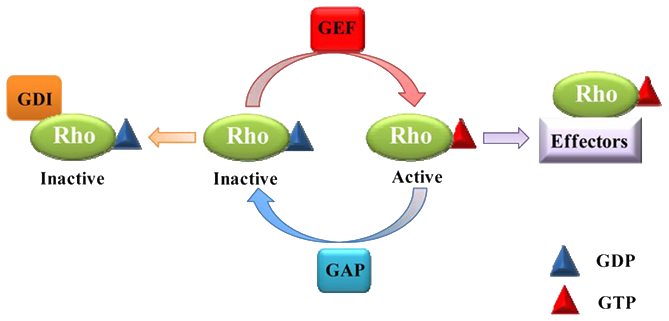
RhoA activity regulation. Rho GTPase activity is controlled by guanine nucleotide exchange factor (GEF), GTPase-activating protein (GAP) and guanine nucleotide dissociation inhibitor (GDI). GEF activates Rho GTPases by facilitating the release of GDP and the binding of GTP. GAP inactivates Rho GTPases by promoting hydrolysis of the bound GTP molecules, resulting in their quick change from the GTP-bound form to the GDP-bound form. GDI binds to C-terminal prenyl groups on some Rho proteins, maintaining them in the inactive state. Active Rho GTPases act on their downstream effector proteins, stimulating a variety of cellular processes (Chi et al., 2013).
Expression
RhoA protein is expressed in all tissues tested. RhoA expression in normal human tissues, embryonic tissues and stem cells.
Localisation
RhoA localizes predominantly in the plasmatic membrane and cytoplasm. Also, it localizes to cell-cell contacts and cell projections.
Function
RhoA is a protein involved in multiple cellular processes.
- Role in actin organization:
RhoA protein plays a central role in regulating cell shape, polarity and locomotion through their effects on actin polymerization, actomyosin contractility, cell adhesion, and microtubule dynamics. RhoA is believed to act primarily at the rear of migrating cells to promote detachment.
RhoA directly stimulates actin polymerization through activiation of diaphanous-related formins (DRFs, also known as Dia proteins). These stimulate addition of actin monomers to the fast-growing end of actin filaments. DRFs act together with ROCKs to mediate Rho-induced stress fiber formation. ROCK-mediated phosphorylation of LIMK and consequent inhibition of cofilin also contributes to the increase in actin filaments in response to Rho. In addition, ROCKs induce actomyosin-based contractility and phosphorylate several proteins involved in regulating myosins and other actin-binding proteins. Actomyosin contractility is important in migrating cells for detachment of the rear. Microtubules are essential for determining cell polarity as well as for vesicular locomotion and intracellular transport. The concerted action of ROCK and Dia is essential for the regulation of cell polarity and organization of microtubules. ROCK phosphorylates TAU and MAP2, proteins that regulate microtubule stability.
RhoA plays a key role in regulating the integrity of cell-extracellular matrix and cell-cell adhesions, the latter including both adherens junctions and tight junctions. Loss of cell-cell junctions is required form the migration of epithelial cells and may be regulated reciprocally by ROCKs and DRFs. Also, RhoA is localized to developing axons and growth cones, and this localization is mediated by an axonal targeting element located in the RhoA 3 untranslated region (UTR). Local RhoA translations regulates the neuronal cytoskeleton and identify a new mechanism for the regulation of RhoA signaling (Wu et al., 2005). On the other hand, increasing expression of the transcription repressor, GCF2, can silence RhoA expression, leading to actin cytoskeleton disorganization (Shen et al., 2012).
- Role in cell migration:
The inhibition of RhoA signaling by blocking the interaction with its downstream effectors Rho-associated kinase (ROCK) and mDia is required for both vaccinia morphogenesis and virus-induced cell motility (Valderrama et al., 2006).
- Role in cell protrusion:
RhoA activates focal adhesion kinase (FAK) signaling. RhoA has a role in the initial events of protrusion, whereas Rac1 and Cdc42 activate pathways implicated in reinforcement and stabilization of newly expanded protrusions (Machacek et al., 2009).
- Role in exocytosis:
RhoA is involved in Ca2+-dependent exocytosis at least partly through the reorganization of actin filaments (Komuro et al., 1996). This type of exocytosis is regulated by G12/G13 alpha through a Rho/Rho-associated kinase-dependent pathway (Yamaguchi et al., 2000).
- Role in endocytosis:
RhoA helps direct endocytosis in a variety of cell types (Lamaze et al., 1996; Khandelwal et al., 2010; Yu et al., 2010). RhoA is essential for clathrin- and caveolar- independent endocytosis (Sabharanjak et al., 2002). Treatment with the PI3K inhibitor (LY294002) or the FAK inhibitor (PF573228) suppresses compensatory endocytosis by inhibiting the activation of RhoA and then reducing the recruitment of ROCK (Khandelwal et al., 2010).
- Role in cytokinesis:
Cytokinesis requires actomyosin-based contraction. Inhibition of ROCK or citron kinase causes defects in cytokinesis resulting in multinucleate cells. Diaphanous-related formins (DRFs) are also implicated in this process, the DRF mDia1 localizes to the cleavage furrow during cytokinesis. DRFs could contribute to cytokinesis by stimulating local actin polymerization and/or by coordinating microtubules with actin filaments at the site of the contractile ring. RhoA signaling is controlled by the central spindle, a set of microtubule bundles that forms between the separating chromosomes. Thus, inactivation of Rac by centralspindlin functions in parallel with RhoA activation to drive contractile ring constriction during cytokinesis (Canman et al., 2008).
- Role in cell cycle regulation:
RhoA plays a pivotal role in G1 cell cycle progression, primarily through regulation of both cyclin D1 expression, and the levels of the cyclin-dependent kinase inhibitors p21 and p27. Multiple pathways seem to link Rho proteins to the control of cyclin D1 levels. Many of these involve the activation of protein kinases, leading to the subsequent modulation of transcription factor activity. RhoA suppresses p21 levels in multiple normal and transformed cell lines. This effect appears to occur through a transcriptional mechanism but is independent of p53, a major transcriptional regulator of p21. RhoA plays an important role in determining the levels of p27 through a pathway involving its effector, the Rho-associated kinases. RhoA facilitates entry into S phase by degradation of the cyclin-dependent kinase inhibitor p27kip1 (Hirai et al., 1997).
- Role in development:
RhoA protein is required for processes involving cell migration in development including: neurite outgrowth, dorsal closure, bone formation, and myogenesis. Rho-loss of function is embryonically lethal in mouse development by E7. This is attributed to failure in gastrulation and an inability of cells to migrate.
- Role in transcriptional control:
The relationship between many of the cellular functions mediated by RhoA with transcriptional regulation has been described. RhoA modulates the activity of SRF, NF-kappaB, c/EBPb, Stat3, Stat5, FHL-2, PAX6, GATA-4, E2F, estrogen receptor alpha, estrogen receptor beta, CREB, and transcription factors that depend on the JNK and p38 MAP kinase pathways. Substrates to these kinases include c-Jun, ELK, PEA3, ATF2, MEF2A, Max and CHOP/GADD153.
- Role in cell proliferation:
RhoA plays cell type-specific roles in the regulation of cell proliferation. RhoA plays critical roles in both early and late stages of B-cell development (Zhang et al., 2012).
- Role in actin organization:
RhoA protein plays a central role in regulating cell shape, polarity and locomotion through their effects on actin polymerization, actomyosin contractility, cell adhesion, and microtubule dynamics. RhoA is believed to act primarily at the rear of migrating cells to promote detachment.
RhoA directly stimulates actin polymerization through activiation of diaphanous-related formins (DRFs, also known as Dia proteins). These stimulate addition of actin monomers to the fast-growing end of actin filaments. DRFs act together with ROCKs to mediate Rho-induced stress fiber formation. ROCK-mediated phosphorylation of LIMK and consequent inhibition of cofilin also contributes to the increase in actin filaments in response to Rho. In addition, ROCKs induce actomyosin-based contractility and phosphorylate several proteins involved in regulating myosins and other actin-binding proteins. Actomyosin contractility is important in migrating cells for detachment of the rear. Microtubules are essential for determining cell polarity as well as for vesicular locomotion and intracellular transport. The concerted action of ROCK and Dia is essential for the regulation of cell polarity and organization of microtubules. ROCK phosphorylates TAU and MAP2, proteins that regulate microtubule stability.
RhoA plays a key role in regulating the integrity of cell-extracellular matrix and cell-cell adhesions, the latter including both adherens junctions and tight junctions. Loss of cell-cell junctions is required form the migration of epithelial cells and may be regulated reciprocally by ROCKs and DRFs. Also, RhoA is localized to developing axons and growth cones, and this localization is mediated by an axonal targeting element located in the RhoA 3 untranslated region (UTR). Local RhoA translations regulates the neuronal cytoskeleton and identify a new mechanism for the regulation of RhoA signaling (Wu et al., 2005). On the other hand, increasing expression of the transcription repressor, GCF2, can silence RhoA expression, leading to actin cytoskeleton disorganization (Shen et al., 2012).
- Role in cell migration:
The inhibition of RhoA signaling by blocking the interaction with its downstream effectors Rho-associated kinase (ROCK) and mDia is required for both vaccinia morphogenesis and virus-induced cell motility (Valderrama et al., 2006).
- Role in cell protrusion:
RhoA activates focal adhesion kinase (FAK) signaling. RhoA has a role in the initial events of protrusion, whereas Rac1 and Cdc42 activate pathways implicated in reinforcement and stabilization of newly expanded protrusions (Machacek et al., 2009).
- Role in exocytosis:
RhoA is involved in Ca2+-dependent exocytosis at least partly through the reorganization of actin filaments (Komuro et al., 1996). This type of exocytosis is regulated by G12/G13 alpha through a Rho/Rho-associated kinase-dependent pathway (Yamaguchi et al., 2000).
- Role in endocytosis:
RhoA helps direct endocytosis in a variety of cell types (Lamaze et al., 1996; Khandelwal et al., 2010; Yu et al., 2010). RhoA is essential for clathrin- and caveolar- independent endocytosis (Sabharanjak et al., 2002). Treatment with the PI3K inhibitor (LY294002) or the FAK inhibitor (PF573228) suppresses compensatory endocytosis by inhibiting the activation of RhoA and then reducing the recruitment of ROCK (Khandelwal et al., 2010).
- Role in cytokinesis:
Cytokinesis requires actomyosin-based contraction. Inhibition of ROCK or citron kinase causes defects in cytokinesis resulting in multinucleate cells. Diaphanous-related formins (DRFs) are also implicated in this process, the DRF mDia1 localizes to the cleavage furrow during cytokinesis. DRFs could contribute to cytokinesis by stimulating local actin polymerization and/or by coordinating microtubules with actin filaments at the site of the contractile ring. RhoA signaling is controlled by the central spindle, a set of microtubule bundles that forms between the separating chromosomes. Thus, inactivation of Rac by centralspindlin functions in parallel with RhoA activation to drive contractile ring constriction during cytokinesis (Canman et al., 2008).
- Role in cell cycle regulation:
RhoA plays a pivotal role in G1 cell cycle progression, primarily through regulation of both cyclin D1 expression, and the levels of the cyclin-dependent kinase inhibitors p21 and p27. Multiple pathways seem to link Rho proteins to the control of cyclin D1 levels. Many of these involve the activation of protein kinases, leading to the subsequent modulation of transcription factor activity. RhoA suppresses p21 levels in multiple normal and transformed cell lines. This effect appears to occur through a transcriptional mechanism but is independent of p53, a major transcriptional regulator of p21. RhoA plays an important role in determining the levels of p27 through a pathway involving its effector, the Rho-associated kinases. RhoA facilitates entry into S phase by degradation of the cyclin-dependent kinase inhibitor p27kip1 (Hirai et al., 1997).
- Role in development:
RhoA protein is required for processes involving cell migration in development including: neurite outgrowth, dorsal closure, bone formation, and myogenesis. Rho-loss of function is embryonically lethal in mouse development by E7. This is attributed to failure in gastrulation and an inability of cells to migrate.
- Role in transcriptional control:
The relationship between many of the cellular functions mediated by RhoA with transcriptional regulation has been described. RhoA modulates the activity of SRF, NF-kappaB, c/EBPb, Stat3, Stat5, FHL-2, PAX6, GATA-4, E2F, estrogen receptor alpha, estrogen receptor beta, CREB, and transcription factors that depend on the JNK and p38 MAP kinase pathways. Substrates to these kinases include c-Jun, ELK, PEA3, ATF2, MEF2A, Max and CHOP/GADD153.
- Role in cell proliferation:
RhoA plays cell type-specific roles in the regulation of cell proliferation. RhoA plays critical roles in both early and late stages of B-cell development (Zhang et al., 2012).
Mutations
Note
48 mutations have been described in the RhoA gene, according to the Catalogue of Somatic Mutations in Cancer (COSMIC) database.
De novo mutations have been described in patients with Burkitt lymphoma: R5Q and I23R (Richter et al., 2012; Rohde et al., 2014); peripheral T-cell lymphoma: G17V, affecting the GTP-binding domain (Manso et al., 2014; Palomero et al., 2014; Sakata-Yanagimoto et al., 2014; Yoo et al., 2014); head and neck carcinoma: E40Q and Y42I, affecting the effector domain (Lawrence et al., 2014); diffuse-type gastric carcinoma: R5Q, Y42I and G17V (Kakiuchi et al., 2014).
De novo mutations have been described in patients with Burkitt lymphoma: R5Q and I23R (Richter et al., 2012; Rohde et al., 2014); peripheral T-cell lymphoma: G17V, affecting the GTP-binding domain (Manso et al., 2014; Palomero et al., 2014; Sakata-Yanagimoto et al., 2014; Yoo et al., 2014); head and neck carcinoma: E40Q and Y42I, affecting the effector domain (Lawrence et al., 2014); diffuse-type gastric carcinoma: R5Q, Y42I and G17V (Kakiuchi et al., 2014).
Implicated in
Entity name
Breast carcinoma
Oncogenesis
RhoA protein levels were significantly increased in breast cancer compared with the corresponding normal tissue. Of particular note, protein levels of RhoA were barely detectable in normal mammary tissue, but were highly expressed in all breast tumors tested. Interestingly, RhoA protein levels correlated with increasing breast tumor grade. Moreover, decreased metastasis-free survival was predicted by RhoA and ROCK1 co-overexpression in breast cell lines and cancer tissues (Gilkes et al., 2014). On the other hand, blocking RhoA activity with the RhoA pathway specific inhibitor H-1152, or a RhoA specific siRNA, resulted in inhibition of invasive behavior in a triple-negative breast cancer cell line (Fagan-Solis et al., 2013).
Entity name
Ovarian carcinoma
Oncogenesis
Expression of RhoA is significantly increased in advanced ovarian carcinomas and also in the peritoneal disseminated lesions (Horiuchi et al., 2008). The expression of the protein is further upregulated in tumors of stages III/IV when compared to those of stages I/II. Analysis of matched pairs of primary and metastatic lesions showed that expression of both RhoA mRNA was significantly higher in metastatic lesions of peritoneal dissemination than in the respective primary tumors.
Entity name
Testicular cancer
Oncogenesis
RhoA is involved in testicular germinal epithelial carcinogenesis and progression in testicular germ cell tumors (GCT) (Kamai et al., 2001). Protein expression of RhoA and its two major downstream effectors ROCK1 and ROCK2, was significantly higher in tumor tissue than in nontumor tissue from 57 patients with GCT. The expression was greater in tumors of higher stages than lower stages, thus RhoA correlates with tumor stage and aggressiveness.
Entity name
Pelvic/ureteric cancer
Oncogenesis
Both mRNA and protein level of RhoA are elevated in pelvic/ureteric cancer with an increase in lymph node metastasis. The expression levels of RhoA were related to poorly differentiated grade and muscle invasion and associated with a shorter disease-free and overall survival. These findings suggest that RhoA is involved in the invasion and metastasis of upper urinary tract cancer, indicating that RhoA may be a useful prognostic factor in this disease.
Entity name
Bladder cancer
Oncogenesis
A similar deregulation of RhoA is observed in bladder cancer. In this sense, RhoA and ROCK protein levels are elevated in tumors, again with higher expression in less differentiated tumors and metastatic lymph nodes compared to normal bladder. Interestingly, the levels of expression of RhoA and ROCK correlated positively with one another suggesting that the GTPase and its effector synergize to promote tumor progression.
Entity name
Lung tumors
Oncogenesis
Of the two major forms of lung cancer, small cell lung carcinoma (SCLC) and non-small cell lung carcinoma (NSCLC), the former has a greater metastatic potential. The expression and activation of RhoA is greater in SCLC than NSCLC cell lines. It has been observed that RhoA repress the expression of nitric oxide synthase-2 (NOS-2) in a lung cancer-derived cell line. Since NOS-2 activity is related to reduced proliferation, RhoA could be eliminating this antiproliferative signal in lung carcinogenesis. In addition, inhibition of RhoA by C3 exoenzyme or through ADP-ribosylation leads to an increase in cadherin-based adhesion and loss of motility of SCLC. RhoA overexpression and delta-catenin positive expression are consistently found in NSCLC, but not in normal lung tissue (Zhang et al., 2014).
Entity name
Oesophageal squamous cell carcinoma (ESCC)
Oncogenesis
RhoA and RhoC proteins promote both cell proliferation and cell invasion of human ESCC cell lines in vitro and in vivo (Faried et al., 2006). There were significant correlations among RhoA overexpression and tumor-node-metastasis (TNM) clinical classification, lymphatic invasion, and blood-vessel invasion. The five-year survival rates for ESCC patients with RhoA overexpression were significantly lower than those in patients with RhoA under-expression. The expression of RhoA protein appeared to be correlated with tumour progression of ESCC. Patients with RhoA overexpression tended to have poor prognosis compared with patients with RhoA under-expression.
Entity name
Gastric cancer
Oncogenesis
RhoA was found frequently overexpressed in gastric cancer tissues compared with normal tissues, suggesting that RhoA may play a critical role in the carcinogenesis of this type of cancer. The interference of RhoA expression and/or activity could significantly inhibit the proliferation and tumorigenicity of gastric cancer cells and enhance the chemosensitivity to therapeutic agents such as Adriamycin and 5-fluorouracil. Inhibition of RhoA/ROCK signaling pathway promotes the apoptosis of gastric cancer cells (Xu et al., 2012). Recently, recurrent gain-of-function mutations of RhoA have been described in diffuse-type gastric carcinoma (Kakiuchi et al., 2014).
Entity name
Hepatocellular carcinoma (HCC)
Oncogenesis
Invasiveness of HCC is facilitated by the Rho/Rho-kinase pathway and likely to be relevant to tumor progression. The Rho/Rho-kinase may be useful as a prognostic indicator and in the development of novel therapeutic strategies. The high expression of RhoA protein in HCC plays an important role in intrahepatic recurrence of patients who underwent a hepatectomy for HCC, and RhoA is a useful marker for predicting early recurrence in an early-stage HCC (Fukui et al., 2006). Overexpression of RhoA is associated with poor prognosis in HCC (Li et al., 2006; Hu et al., 2013).
Entity name
Pancreatic tumor
Oncogenesis
Although overexpression of RhoA has not been detected in any pancreatic tumor tissue to date, it might nevertheless also be involved in pancreatic tumors. The progression of pancreatic tumors is partially controlled by the balance between Tiam1-Rac1 and RhoA (Guo et al., 2013). Use of two 3-hydroxy 3methylgultaryl coenzyme A (HMG-CoA) reductase inhibitors, fluvastatin and lovastatin inhibit human pancreatic cancer cell invasion and metastasis in a Rho-dependent manner. These inhibitors prevent the synthesis of cholesterol precursors necessary for proper membrane translocation of Rho protein. Also, BART plays a role in inhibiting cell invasion by regulating the activity of RhoA in pancreatic cancer cells (Taniuchi et al., 2011).
Entity name
Colorectal cancer
Oncogenesis
A high proportion of colon cancers overexpress RhoA and several aspects of colon tumor biology have been related to Rho GTPases. Leptin receptor and leptin-induced migration of colonic epithelial cancer cells is dependent on RhoA, since inhibition of the activity of the GTPase through introduction of dominant negative mutants completely abolishes the invasive capacity of the tumor cells. On the other hand, GCF2 plays an important role in colorectal cancer metastasis by regulating RhoA-induced cell adhesion, migration, and invasion (Ariake et al., 2012).
Entity name
Head and neck squamous cell carcinoma
Oncogenesis
RhoA, Rac2, and other proteins involved in initiating cell motility are promising clinical molecular markers for head and neck squamous cell cancer (Abraham et al., 2001). Mutations have affecting the effector domain (ED) have been described: these include five E40Q mutations and a single Y42I mutation, which alter the seventh and ninth amino acids, respectively, of the ED (Lawrence et al., 2014).
Entity name
Peripheral T-cell lymphoma (PTCL)
Oncogenesis
New studies identify recurrent dominant-negative mutation of the RhoA GTPase gene in these lymphomas. In T-cell lines, expression of the G17V mutant reduced the formation of stress fibers in fibroblast, increased cell proliferation and cell migration. It has an important role in the pathogenesis of angioimmunoblastic t-cell lymphoma (AITL) and other subtypes of PTCL (Manso et al., 2014; Palomero et al., 2014; Sakata-Yanagimoto et al., 2014; Yoo et al., 2014).
Entity name
Oncogenesis
Entity name
Pediatric Burkitt lymphoma
Oncogenesis
The mutation R5Q is detection in patients with pediatric Burkitt lymphoma. RhoA mutant induced inactivate the RhoA protein. Thus, deregulation of RhoA by mutation is a recurrent event in Burkitt lymphomagenesis in children (Rohde et al., 2014).
Entity name
Chronic myeloid leukemia (CML)
Oncogenesis
Higher expression of RhoA in CML could be responsible for increased proliferation of polymorphonuclear leukocytes (PMNL) cells (Molli et al., 2012).
Entity name
Prostate cancer
Oncogenesis
LPA stimulates RhoA and increased PC-3 prostate cancer cell invasion activity through an NF-kappaB-dependent pathway (Hwang et al., 2006). Inhibition of RhoA activity induced senescence-like arrest in a human prostate carcinoma cell line (Park et al., 2007).
Entity name
Oncogenesis
Lipophilic statins induced membrane RhoA relocalization to the cytosol and inhibited RhoA activity, which resulted in decreased phospho-p42/p44- mitogen-activated protein kinases (MAPKs) and Bcl-2 levels. Constitutively active RhoA rescued phospho-p42/p44-MAPKs and Bcl-2 and abolished statin-induced apoptosis (Fromigué et al., 2006).
Entity name
Glioblastoma
Oncogenesis
Decreased RhoA activity occurred in correlation with increased glioma cell migration (Fortin Ensign et al., 2013).
Entity name
Cervical cancer
Oncogenesis
Overexpression of RhoA promotes the proliferation and migration of cervical cancer cells (Liu et al., 2014).
Entity name
Squamous cell carcinoma of tongue (TSCC)
Oncogenesis
RhoA plays a significant role in TSCC progression by regulating cell migration and invasion through Wnt/β-catenin signaling pathway and cell proliferation through cell cycle regulation, respectively (Yan et al., 2014).
Entity name
Neurological disorders
Oncogenesis
RhoA protein was lower in the Alzheimers disease (AD) brain hippocampus, reflecting loss of the membrane bound. Altered subcellular targeting of RhoA is related to neurodegeneration (Huesa et al., 2010). In addition, an upregulation of RhoA immunoreactivity occurs in the brains of patients with intractable epilepsy (Yuan et al., 2010). Also, the Down syndrome critical region protein TTC3 inhibits neuronal differentiation via RhoA and Citron kinase (Berto et al., 2007).
Entity name
Diabetic nephropathy
Oncogenesis
High glucose activates RhoA/Rho-kinase in mesangial cells (MC), leading to downstream AP-1 activation and fibronectin induction. Inhibition of this pathway in vivo prevents the pathologic changes of diabetic nephropathy, supporting a potential role for inhibitors of RhoA/Rho in the treatment of diabetic renal disease (Peng et al., 2008).
Entity name
Pregnancy
Oncogenesis
In the early stage pregnancy, up-regulation of RhoA induced by low oxygen conditions may play an important role in regulation of HIF-1α expression in trophoblast cells (Hayashi et al., 2005).
Entity name
Pulmonary hypertension (PH)
Oncogenesis
RhoA and Rho kinase activities are increased in PH (Guilluy et al., 2009). Inhibition of this pathway is involved in the beneficial effect of sildenafil on PH (Guilluy et al., 2005).
Entity name
Hypertension
Oncogenesis
RhoA signaling through Arhgef1 is central to the development of angiotensin II-dependent hypertension and identify Arhgef1 as a potential target for the treatment of hypertension (Guilluy et al., 2010).
Article Bibliography
| Pubmed ID | Last Year | Title | Authors |
|---|---|---|---|
| 11568556 | 2001 | Motility-related proteins as markers for head and neck squamous cell cancer. | Abraham MT et al |
| 22750095 | 2012 | GCF2/LRRFIP1 promotes colorectal cancer metastasis and liver invasion through integrin-dependent RhoA activation. | Ariake K et al |
| 11053255 | 2000 | Leptin promotes invasiveness of kidney and colonic epithelial cells via phosphoinositide 3-kinase-, rho-, and rac-dependent signaling pathways. | Attoub S et al |
| 15588766 | 2004 | Rho GTPases in human cancer: an unresolved link to upstream and downstream transcriptional regulation. | Benitah SA et al |
| 17488780 | 2007 | The Down syndrome critical region protein TTC3 inhibits neuronal differentiation via RhoA and Citron kinase. | Berto G et al |
| 10816416 | 2000 | Rho GTPases and their effector proteins. | Bishop AL et al |
| 17540168 | 2007 | GEFs and GAPs: critical elements in the control of small G proteins. | Bos JL et al |
| 17373658 | 2007 | GTP-binding proteins of the Rho/Rac family: regulation, effectors and functions in vivo. | Bustelo XR et al |
| 19056985 | 2008 | Inhibition of Rac by the GAP activity of centralspindlin is essential for cytokinesis. | Canman JC et al |
| 23538840 | 2013 | Roles of rho GTPases in intracellular transport and cellular transformation. | Chi X et al |
| 11641777 | 2001 | Ras and RhoA suppress whereas RhoB enhances cytokine-induced transcription of nitric oxide synthase-2 in human normal liver AKN-1 cells and lung cancer A-549 cells. | Delarue FL et al |
| 12478284 | 2002 | Rho GTPases in cell biology. | Etienne-Manneville S et al |
| 23255405 | 2013 | The RhoA pathway mediates MMP-2 and MMP-9-independent invasive behavior in a triple-negative breast cancer cell line. | Fagan-Solis KD et al |
| 16750623 | 2006 | RhoA and RhoC proteins promote both cell proliferation and cell invasion of human oesophageal squamous cell carcinoma cell lines in vitro and in vivo. | Faried A et al |
| 15837049 | 2005 | Correlation between RhoA overexpression and tumour progression in esophageal squamous cell carcinoma. | Faried A et al |
| 24109588 | 2013 | Implications of Rho GTPase Signaling in Glioma Cell Invasion and Tumor Progression. | Fortin Ensign SP et al |
| 12237774 | 2002 | Rho GTPases in human breast tumours: expression and mutation analyses and correlation with clinical parameters. | Fritz G et al |
| 10328216 | 1999 | Rho GTPases are over-expressed in human tumors. | Fritz G et al |
| 16470222 | 2006 | RhoA GTPase inactivation by statins induces osteosarcoma cell apoptosis by inhibiting p42/p44-MAPKs-Bcl-2 signaling independently of BMP-2 and cell differentiation. | Fromigué O et al |
| 16810502 | 2006 | Expression and prognostic role of RhoA GTPases in hepatocellular carcinoma. | Fukui K et al |
| 21779026 | 2011 | The 'invisible hand': regulation of RHO GTPases by RHOGDIs. | Garcia-Mata R et al |
| 10498656 | 1999 | Cell motility mediated by rho and Rho-associated protein kinase plays a critical role in intrahepatic metastasis of human hepatocellular carcinoma. | Genda T et al |
| 24324133 | 2014 | Hypoxia-inducible factors mediate coordinated RhoA-ROCK1 expression and signaling in breast cancer cells. | Gilkes DM et al |
| 15892119 | 2005 | Rho GTPase expression in tumourigenesis: evidence for a significant link. | Gómez del Pulgar T et al |
| 20098430 | 2010 | The Rho exchange factor Arhgef1 mediates the effects of angiotensin II on vascular tone and blood pressure. | Guilluy C et al |
| 19299501 | 2009 | RhoA and Rho kinase activation in human pulmonary hypertension: role of 5-HT signaling. | Guilluy C et al |
| 16205723 | 2005 | Inhibition of RhoA/Rho kinase pathway is involved in the beneficial effect of sildenafil on pulmonary hypertension. | Guilluy C et al |
| 23322732 | 2013 | Balanced Tiam1-rac1 and RhoA drives proliferation and invasion of pancreatic cancer cells. | Guo X et al |
| 15598682 | 2005 | Hypoxia up-regulates hypoxia-inducible factor-1alpha expression through RhoA activation in trophoblast cells. | Hayashi M et al |
| 8995216 | 1997 | Geranylgeranylated rho small GTPase(s) are essential for the degradation of p27Kip1 and facilitate the progression from G1 to S phase in growth-stimulated rat FRTL-5 cells. | Hirai A et al |
| 19038009 | 2008 | Overexpression of RhoA enhances peritoneal dissemination: RhoA suppression with Lovastatin may be useful for ovarian cancer. | Horiuchi A et al |
| 23842948 | 2013 | Loss of p57 expression and RhoA overexpression are associated with poor survival of patients with hepatocellular carcinoma. | Hu T et al |
| 20061625 | 2010 | Altered distribution of RhoA in Alzheimer's disease and AbetaPP overexpressing mice. | Huesa G et al |
| 16402387 | 2006 | Lysophosphatidic acid stimulates PC-3 prostate cancer cell Matrigel invasion through activation of RhoA and NF-kappaB activity. | Hwang YS et al |
| 24816255 | 2014 | Recurrent gain-of-function mutations of RHOA in diffuse-type gastric carcinoma. | Kakiuchi M et al |
| 11167647 | 2001 | Overexpression of RhoA mRNA is associated with advanced stage in testicular germ cell tumour. | Kamai T et al |
| 12581011 | 2003 | RhoA is associated with invasion and lymph node metastasis in upper urinary tract cancer. | Kamai T et al |
| 15269155 | 2004 | Overexpression of RhoA, Rac1, and Cdc42 GTPases is associated with progression in testicular cancer. | Kamai T et al |
| 20461056 | 2010 | Compensatory endocytosis in bladder umbrella cells occurs through an integrin-regulated and RhoA- and dynamin-dependent pathway. | Khandelwal P et al |
| 12883706 | 2003 | Rho regulates the hepatocyte growth factor/scatter factor-stimulated cell motility of human oral squamous cell carcinoma cells. | Kitajo H et al |
| 9077452 | 1996 | Involvement of Rho and Rac small G proteins and Rho GDI in Ca2+-dependent exocytosis from PC12 cells. | Komuro R et al |
| 11832446 | 2002 | 3-hydroxy-3-methylglutaryl-coenzyme a reductase inhibitors reduce human pancreatic cancer cell invasion and metastasis. | Kusama T et al |
| 8700210 | 1996 | Regulation of receptor-mediated endocytosis by Rho and Rac. | Lamaze C et al |
| 19589855 | 2009 | RHO protein regulation of contraction in the human uterus. | Lartey J et al |
| 24390350 | 2014 | Discovery and saturation analysis of cancer genes across 21 tumour types. | Lawrence MS et al |
| 23828571 | 2013 | RhoA modulates functional and physical interaction between ROCK1 and Erk1/2 in selenite-induced apoptosis of leukaemia cells. | Li F et al |
| 16806792 | 2006 | Overexpression of RhoA is associated with poor prognosis in hepatocellular carcinoma. | Li XR et al |
| 25104222 | 2014 | Overexpression of RhoA promotes the proliferation and migration of cervical cancer cells. | Liu X et al |
| 19693013 | 2009 | Coordination of Rho GTPase activities during cell protrusion. | Machacek M et al |
| 24786457 | 2014 | The RHOA G17V gene mutation occurs frequently in peripheral T-cell lymphoma and is associated with a characteristic molecular signature. | Manso R et al |
| 22443473 | 2012 | RhoA: a therapeutic target for chronic myeloid leukemia. | Molli PR et al |
| 24413734 | 2014 | Recurrent mutations in epigenetic regulators, RHOA and FYN kinase in peripheral T cell lymphomas. | Palomero T et al |
| 17658517 | 2007 | Inhibitory role of RhoA on senescence-like growth arrest by a mechanism involving modulation of phosphatase activity. | Park C et al |
| 18356410 | 2008 | RhoA/Rho-kinase contribute to the pathogenesis of diabetic renal disease. | Peng F et al |
| 23143595 | 2012 | Recurrent mutation of the ID3 gene in Burkitt lymphoma identified by integrated genome, exome and transcriptome sequencing. | Richter J et al |
| 14657486 | 2003 | Cell migration: integrating signals from front to back. | Ridley AJ et al |
| 25044415 | 2014 | Recurrent RHOA mutations in pediatric Burkitt lymphoma treated according to the NHL-BFM protocols. | Rohde M et al |
| 15688002 | 2005 | GEF means go: turning on RHO GTPases with guanine nucleotide-exchange factors. | Rossman KL et al |
| 11970892 | 2002 | GPI-anchored proteins are delivered to recycling endosomes via a distinct cdc42-regulated, clathrin-independent pinocytic pathway. | Sabharanjak S et al |
| 24413737 | 2014 | Somatic RHOA mutation in angioimmunoblastic T cell lymphoma. | Sakata-Yanagimoto M et al |
| 22571463 | 2012 | The transcription factor GCF2 is an upstream repressor of the small GTPAse RhoA, regulating membrane protein trafficking, sensitivity to doxorubicin, and resistance to cisplatin. | Shen DW et al |
| 21833473 | 2011 | BART inhibits pancreatic cancer cell invasion by inhibiting ARL2-mediated RhoA inactivation. | Taniuchi K et al |
| 16424340 | 2006 | Vaccinia virus-induced cell motility requires F11L-mediated inhibition of RhoA signaling. | Valderrama F et al |
| 12579323 | 2003 | The small GTPase RhoA has greater expression in small cell lung carcinoma than in non-small cell lung carcinoma and contributes to their unique morphologies. | Varker KA et al |
| 15020670 | 2004 | Rho-family GTPases: it's not only Rac and Rho (and I like it). | Wennerberg K et al |
| 16107849 | 2005 | Local translation of RhoA regulates growth cone collapse. | Wu KY et al |
| 22584506 | 2012 | Inhibition of RhoA/ROCK signaling pathway promotes the apoptosis of gastric cancer cells. | Xu XT et al |
| 10899946 | 2000 | Galpha(12) and galpha(13) inhibit Ca(2+)-dependent exocytosis through Rho/Rho-associated kinase-dependent pathway. | Yamaguchi Y et al |
| 25001480 | 2014 | Silencing RhoA inhibits migration and invasion through Wnt/β-catenin pathway and growth through cell cycle regulation in human tongue cancer. | Yan G et al |
| 24584070 | 2014 | A recurrent inactivating mutation in RHOA GTPase in angioimmunoblastic T cell lymphoma. | Yoo HY et al |
| 20478062 | 2010 | Endocytic pathways mediating oligomeric Abeta42 neurotoxicity. | Yu C et al |
| 20140537 | 2010 | Altered expression of the small guanosine triphosphatase RhoA in human temporal lobe epilepsy. | Yuan J et al |
| 25120748 | 2014 | Co-expression of delta-catenin and RhoA is significantly associated with a malignant lung cancer phenotype. | Zhang D et al |
| 22438996 | 2012 | RhoA of the Rho family small GTPases is essential for B lymphocyte development. | Zhang S et al |
Other Information
Locus ID:
NCBI: 387
MIM: 165390
HGNC: 667
Ensembl: ENSG00000067560
Variants:
dbSNP: 387
ClinVar: 387
TCGA: ENSG00000067560
COSMIC: RHOA
RNA/Proteins
Expression (GTEx)
Pathways
Protein levels (Protein atlas)
PharmGKB
| Entity ID | Name | Type | Evidence | Association | PK | PD | PMIDs |
|---|---|---|---|---|---|---|---|
| PA444516 | Hypercholesterolemia | Disease | ClinicalAnnotation | associated | PD | 23166513 | |
| PA451089 | pravastatin | Chemical | ClinicalAnnotation | associated | PD | 23166513 | |
| PA451363 | simvastatin | Chemical | ClinicalAnnotation | associated | PD | 23166513 |
References
| Pubmed ID | Year | Title | Citations |
|---|---|---|---|
| 37801199 | 2024 | LAMB3 Promotes Myofibrogenesis and Cytoskeletal Reorganization in Endometrial Stromal Cells via the RhoA/ROCK1/MYL9 Pathway. | 0 |
| 38141763 | 2024 | The Snail signaling branch downstream of the TGF-β/Smad3 pathway mediates Rho activation and subsequent stress fiber formation. | 3 |
| 38341081 | 2024 | Inhibition of RhoGEF/RhoA alleviates regorafenib resistance and cancer stemness via Hippo signaling pathway in hepatocellular carcinoma. | 0 |
| 38578740 | 2024 | Hydrostatic pressure mediates epithelial-mesenchymal transition of cholangiocytes through RhoA/ROCK and TGF-β/smad pathways. | 0 |
| 38835115 | 2024 | Genetic disruption of ATAT1 causes RhoA downregulation through abnormal truncation of C/EBPβ. | 0 |
| 37801199 | 2024 | LAMB3 Promotes Myofibrogenesis and Cytoskeletal Reorganization in Endometrial Stromal Cells via the RhoA/ROCK1/MYL9 Pathway. | 0 |
| 38141763 | 2024 | The Snail signaling branch downstream of the TGF-β/Smad3 pathway mediates Rho activation and subsequent stress fiber formation. | 3 |
| 38341081 | 2024 | Inhibition of RhoGEF/RhoA alleviates regorafenib resistance and cancer stemness via Hippo signaling pathway in hepatocellular carcinoma. | 0 |
| 38578740 | 2024 | Hydrostatic pressure mediates epithelial-mesenchymal transition of cholangiocytes through RhoA/ROCK and TGF-β/smad pathways. | 0 |
| 38835115 | 2024 | Genetic disruption of ATAT1 causes RhoA downregulation through abnormal truncation of C/EBPβ. | 0 |
| 36201460 | 2023 | RHOA, a small G-protein, signals to mitophagy through regulation of PINK1 protein stability and protects cardiomyocytes against ischemia. | 0 |
| 36523161 | 2023 | Fidgetin-like 2 depletion enhances cell migration by regulating GEF-H1, RhoA, and FAK. | 2 |
| 36529281 | 2023 | A lncRNA MALAT1 is a positive regulator of RhoA protein expression in bronchial smooth muscle cells. | 1 |
| 36617975 | 2023 | RhoA G17E/Vav1 Signaling Induces Cancer Invasion via Matrix Metalloproteinase-9 in Gastric Cancer. | 2 |
| 36631535 | 2023 | ZNF185 prevents stress fiber formation through the inhibition of RhoA in endothelial cells. | 0 |
Citation
Rebeca Manso
RHOA (ras homolog gene family, member A)
Atlas Genet Cytogenet Oncol Haematol. 2014-09-01
Online version: http://atlasgeneticsoncology.org/gene/42107/rhoa
Historical Card
2007-01-01 RHOA (ras homolog gene family, member A) by Teresa Gómez del Pulgar,Juan Carlos Lacal Affiliation
Translational Oncology Unit, CSIC-UAM-La Paz, Madrid, Spain
