AFDN (afadin, adherens junction formation factor)
2018-12-01 Jean Loup Huret , Philippe Dessen Affiliation[email protected] (JLH); UMR 1170 INSERM, Gustave Roussy, 114 rue Edouard Vaillant, 94805 Villejuif 94805, France (PHD)
Identity

Abstract
Afadin, the protein coded by AFDN (6q27), also known as AF6 or MLLT4, is a cytoskeletal and junction-associated protein that links nectins, transmembrane proteins, to the F-actin (actin cytoskeleton) in a type of cell-cell junctions: the adherens junctions (AJs). Afadin plays an important role in AJs integrity and apical-basal polarity. There is growing evidence of its role in carcinogenesis.
DNA/RNA
Description
Transcription
AFDN at chr6:167826991-167972020 - (NM_001207008) afadin isoform 1: 7,459 bp
AFDN at chr6:167826991-167965113 - (NM_001040000) afadin isoform 2: 7,629 bp
AFDN at chr6:167827635-167972020 - (NM_001291964) afadin isoform 4: 7,750 bp PSEUDOGENE
Proteins
Description
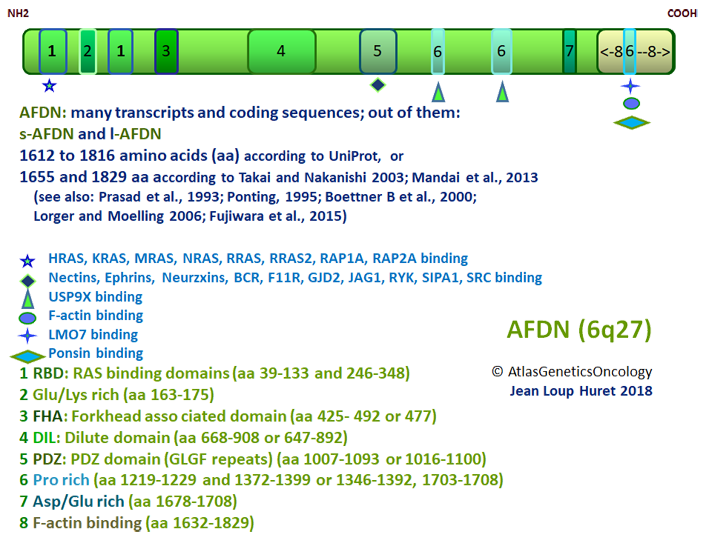
From N-term to C-term, afadin possess two Ras-association (RA) domains, a forkhead-associated (FHA) domain, a DIL domain (responsible for actin stress fiber formation (Saito et al., 2015)), a PDZ domain (responsible for binding the cytoplasmic C-terminus of nectins; where TJP1 (ZO-1) also binds (Kuriyama et al., 1996)), three proline-rich (PR) domains, one of which interacts with USP9X (FAM): (aa 1130-1612) (Hock et al., 199; Taya et al., 1998), and an F-actin-binding domain (see Figure 2).
PDZ domain (PDZ): GLGF (glycine-leucine-glycine-phenylalanine): IITVTLKKQNGMGLSIVAAKGAGQDKLGIYVKSVVKGGAADVDGRLAAGDQLLSVDGRSLVGLSQERAAELMTRTSSVVTLEVAKQG (Prasad et al., 1993).
Phosphorylation sites: KERQRLFSQG (aa 1792-1801 according to UniProt). There is an AKT phosphorylation site at Ser1718 in l-Afadin (large variant, see below). Phosphorylation of l-Afadin by AKT at Ser1718 promotes nuclear localization, which enhances migration and perturbs cell to cell adhesion (Ellol et al. 2014).
Afadin has many splice variants, in particular two of them: the larger l-afadin and the smaller s-afadin. s-Afadin lacks the F-actin-binding domain and the third proline-rich domain. These variants are made of 1612 to 1816 amino acids (aa) according to UniProt, or 1655 and 1829 aa according to others (see Figure 2).
l-Afadin links nectins to actin filaments (F-actin). Through its PDZ domain, l-Afadin binds to the nectin conserved motif of four amino acid residues (Glu/Ala-X-Tyr-Val) (except for nectin-4), and F-actin through its F-actin-binding domain. Afadin binds nectins ( NECTIN1, NECTIN2, NECTIN3, NECTIN4), but not nectin-like molecules (Necls: CADM1, CADM2, CADM3, CADM4, PVR) (Review in Ogita and Takai, 2006).
Afadin forms homodimer.
The 3 main isoforms produced by alternative splicing are:
Canonic sequence (Isoform 4, identifier: P55196-4). 1,824 amino acids; 206,804 Da.
s-afadin (Isoform 1, identifier: P55196-2); 1,612 aa; 182,000 Da. Compared to the canonical sequence, are missing aa: 139, 393-407, 1605-1628, 1629-1824.
l-afadin (Isoform 2, identifier: P55196-1); 1,816 aa; 205,605 Da. Compared to the canonical sequence, are missing aa: 139, 393-407, 1048-1048, 1747-1824.
Expression
Localisation
Function
Adherens junctions: two types of cell adhesion molecules (CAMs), cadherins and nectins, interact with actin filaments (F-actin). They interact through their cytoplasmic domain to form adherens junctions.
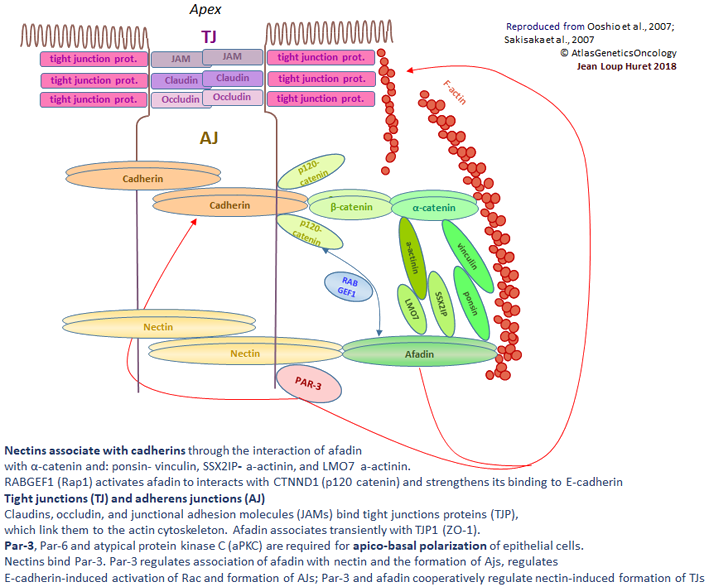
Cadherins and nectins: In epithelial cells, β-catenin ( CTNNB1) directly binds to cadherins and links it to the actin cytoskeleton through &alpha-catenin (CTNNA1, CTNNA2, CTNNA3), while nectins are linked to the actin cytoskeleton through afadin (Tachibana et al., 2000; Ogita and Takai, 2006) (see Figure 4).
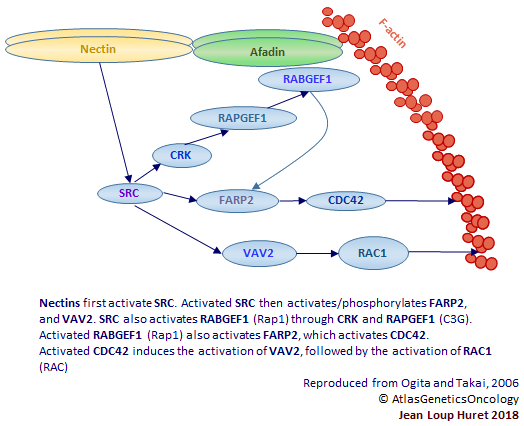
Nectins first activate SRC. Activated SRC then activates/phosphorylates FARP2, and VAV2. SRC also activates RABGEF1 (also known as Rap1) through CRK and RAPGEF1 (C3G).
Activated RABGEF1 (Rap1) also activates FARP2, which activates CDC42 40012. Activated CDC42 induces the activation of VAV2, followed by the activation of RAC1 (RAC) (see Figure 3).
Activated RABGEF1 (Rap1) is essential for down-regulation of Rho signaling and actin stress fiber dissolution (Birukova et al., 2013).
Some of the downstream effectors for VAV2 and RAC1 are actin filaments (F-actin)-binding proteins.
Nectins associate with cadherins through the interaction of afadin with &alpha-catenin and: a ponsin ( SORBS1) - vinculin (VCL) unit, an SSX2IP (ADIP) - a-actinin ( ACTN1, ACTN2 and ACTN3) unit, and a LMO7 - a-actinin unit (see Figure 4). RABGEF1 (Rap1) activates afadin to interacts with CTNND1 (p120 catenin) and strengthens its binding to E-cadherin ( CDH1), which results in reduced E-cadherin endocytosis (Bégay-Müller et al., 2002; Kooistra et al. 2007; Sakisaka et al., 2007 ; Birukova et al., 2013; Takeichi 2014)
Tight junctions/role of ZO-1 Afadin also associates transiently with tight junction protein TJP1 (ZO-1). ZO-1 is a member of F-actin-binding ZO proteins, which bind CAMs of tight junctions (TJs) such as claudins, occludin ( OCLN), and junctional adhesion molecules (JAMs) and link them to the actin cytoskeleton (Sakisaka et al., 2007) (see Figure 4). Occludin, EPHA2, a transmembrane tyrosine kinase receptor, and afadin also cooperate in tight junction organization (Perez White et al., 2017). Afadin is therefore a peripheral component of tight junctions in epithelial cells. The binding of claudins to tight junction proteins (or zonula occludens ZOs) and afadin and other proteins constitutes a step in cellular signal transduction (Zhang et al., 2018).
Apico-basal polarization/role of Par-3: PARD3 (Par-3), Par-6 and atypical protein kinase C (PRKCI) are required for apico-basal polarization of epithelial cells. Nectin-1 and nectin-3, but not nectin-2, bind the PDZ domain of Par-3 (Rakotomamonjy et al., 2017)
1- Par-3 regulates association of afadin with trans-interacting nectin and the formation of AJs;
2- Par-3 regulates E-cadherin-induced activation of Rac and formation of AJs;
3- Par-3 and afadin cooperatively regulate nectin-induced formation of TJs (Sakisaka et al 2007)
Migration Afadin is localized at cell-cell contact sites in mesangial cells. Afadin forms a complex with CTNNB1 (β-catenin) in cultured mesangial cells and Afadin regulates migratory polarity (Tsurumi et al., 2016). Afadin is required for the maintenance of the radial glial scaffold for neuronal migration during cortical development (Yamamoto et al., 2015b).
Mitotic spindle orientation Afadin is required for mitotic spindle orientation and correct epithelial morphogenesis (Carminati et al., 2016). Afadin orients the mitotic spindle and is required for lumen continuity in developing renal tubules by orienting the mitotic spindle during cell division (Gao et al., 2017). Afadin controls cell polarization and mitotic spindle orientation in developing cortical radial glia (Rakotomamonjy et al., 2017).
Actin polymerization/profilin profilin plays an important role in actin polymerization. Profilin 1 and Profilin 2 (PFN1 and PFN2) are afadin-binding protein (Boettner B et al., 2000)
MAPK cascade Afadin interacts with HRAS, KRAS, and NRAS GTPases and the Ras-related RAP1A leading to MAPK activation (Yamamoto et al., 1997). MRAS, whose GTP/GDP cycle is sensitive to the Ras GEFs, SOS1 42355, and RASGRF1 43453 (GRF1) and to RASA1 (p120 RASGAP) interacts with Afadin (Quilliam et al. 1999). RRAS, RRAS2 also interact with Afadin (Linnemann et al., 1999). Afadin also acts downstream of EGFR-Ras and provides a link from EGFR to cytoskeletal elements in the cell motility process (Gaengel and Mlodzik 2003).
Ubiquitination Afadin is a substrate of the USP9X deubiquitinating enzyme. USP9X can release ubiquitin from Afadin (Taya et al., 1998).
Ephrin receptors Eph receptor tyrosine kinases are membrane-bound proteins implicated in cell migration and intercellular communication during embryonic development, regulating cell pattern formation during organogenesis. EPHA7, EPHB2, EPHB3, and EPHB6 interact with Afadin. Afadin is phosphorylated specifically by EPHB3 and EPHB2 (Hock et al., 1998)
Homology
Implicated in
Down regulation of afadin appears to drive to carcinogenesis in a number of cancer types.
The nuclear localization of L-Afadin, regulated by phosphorylation at Ser1718 by the Akt pathway, is clinically relevant for breast cancer progression (Ellol et al. 2014).
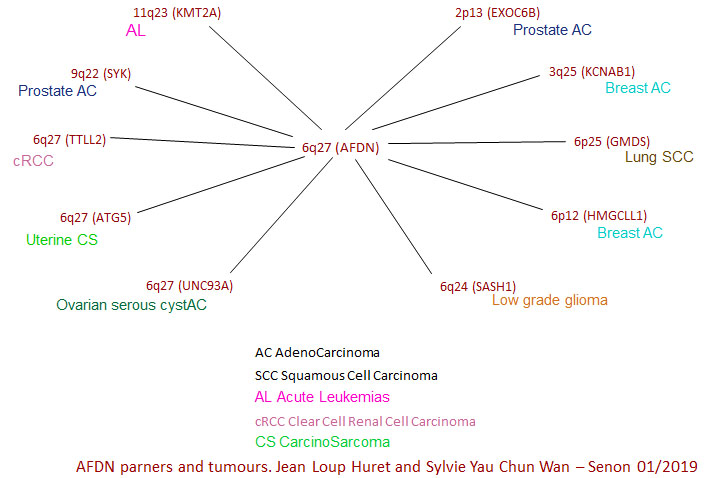
The fusion gene AFDN/ HMGCLL1 has also been found in breast adenocarcinoma (Hu et al. 2018).
The fusion gene ATG5/AFDN has been found in uterine carcinosarcoma (Hu et al. 2018).
AFDN antisense RNA 1 ( AFDN-AS1) is significantly downregulated in gastric cancer and a predictor of a poor prognosis (Lai et al., 2017).
Breakpoints
Article Bibliography
| Pubmed ID | Last Year | Title | Authors |
|---|---|---|---|
| 12067721 | 2002 | The LIM domain protein Lmo2 binds to AF6, a translocation partner of the MLL oncogene. | Bégay-Müller V et al |
| 10922060 | 2000 | The junctional multidomain protein AF-6 is a binding partner of the Rap1A GTPase and associates with the actin cytoskeletal regulator profilin. | Boettner B et al |
| 17013812 | 2007 | AF6/s-afadin is a dual residency protein and localizes to a novel subnuclear compartment. | Buchert M et al |
| 26751642 | 2016 | Concomitant binding of Afadin to LGN and F-actin directs planar spindle orientation. | Carminati M et al |
| 23361907 | 2013 | Leukemic transformation by the MLL-AF6 fusion oncogene requires the H3K79 methyltransferase Dot1l. | Deshpande AJ et al |
| 24269953 | 2014 | The adherens junction protein afadin is an AKT substrate that regulates breast cancer cell migration. | Elloul S et al |
| 21478912 | 2011 | Loss of AF6/afadin, a marker of poor outcome in breast cancer, induces cell migration, invasiveness and tumor growth. | Fournier G et al |
| 25534554 | 2015 | Crystal structure of afadin PDZ domain-nectin-3 complex shows the structural plasticity of the ligand-binding site. | Fujiwara Y et al |
| 14507782 | 2003 | Egfr signaling regulates ommatidial rotation and cell motility in the Drosophila eye via MAPK/Pnt signaling and the Ras effector Canoe/AF6. | Gaengel K et al |
| 28860115 | 2017 | Afadin orients cell division to position the tubule lumen in developing renal tubules. | Gao L et al |
| 9707552 | 1998 | PDZ-domain-mediated interaction of the Eph-related receptor tyrosine kinase EphB3 and the ras-binding protein AF6 depends on the kinase activity of the receptor. | Hock B et al |
| 29099951 | 2018 | TumorFusions: an integrative resource for cancer-associated transcript fusions. | Hu X et al |
| 9349501 | 1997 | Chimeric MLL products with a Ras binding cytoplasmic protein AF6 involved in t(6;11) (q27;q23) leukemia localize in the nucleus. | Joh T et al |
| 17182900 | 2007 | Rap1: a key regulator in cell-cell junction formation. | Kooistra MR et al |
| 8557659 | 1996 | Identification of AF-6 and canoe as putative targets for Ras. | Kuriyama M et al |
| 28927028 | 2017 | Decreased expression of the long non-coding RNA MLLT4 antisense RNA 1 is a potential biomarker and an indicator of a poor prognosis for gastric cancer. | Lai Y et al |
| 16819513 | 2007 | Correlated break at PARK2/FRA6E and loss of AF-6/Afadin protein expression are associated with poor outcome in breast cancer. | Letessier A et al |
| 22211808 | 2012 | The effector and scaffolding proteins AF6 and MUPP1 interact with connexin36 and localize at gap junctions that form electrical synapses in rodent brain. | Li X et al |
| 10224125 | 1999 | Thermodynamic and kinetic characterization of the interaction between the Ras binding domain of AF6 and members of the Ras subfamily. | Linnemann T et al |
| 16882694 | 2006 | Regulation of epithelial wound closure and intercellular adhesion by interaction of AF6 with actin cytoskeleton. | Lorger M et al |
| 24695851 | 2014 | MLL-AF6 fusion oncogene sequesters AF6 into the nucleus to trigger RAS activation in myeloid leukemia. | Manara E et al |
| 23481206 | 2013 | Afadin/AF-6 and canoe: roles in cell adhesion and beyond. | Mandai K et al |
| 30473688 | 2018 | Afadin Downregulation by Helicobacter pylori Induces Epithelial to Mesenchymal Transition in Gastric Cells. | Marques MS et al |
| 4269953 | 1973 | Newer antibiotics. | Neu HC et al |
| 29692408 | 2018 | The basic helix-loop-helix transcription factor SHARP1 is an oncogenic driver in MLL-AF6 acute myelogenous leukemia. | Numata A et al |
| 16754328 | 2006 | Nectins and nectin-like molecules: roles in cell adhesion, polarization, movement, and proliferation. | Ogita H et al |
| 27815408 | 2017 | EphA2 proteomics in human keratinocytes reveals a novel association with afadin and epidermal tight junctions. | Perez White BE et al |
| 7667878 | 1995 | AF-6/cno: neither a kinesin nor a myosin, but a bit of both. | Ponting CP et al |
| 8242616 | 1993 | Cloning of the ALL-1 fusion partner, the AF-6 gene, involved in acute myeloid leukemias with the t(6;11) chromosome translocation. | Prasad R et al |
| 10446149 | 1999 | M-Ras/R-Ras3, a transforming ras protein regulated by Sos1, GRF1, and p120 Ras GTPase-activating protein, interacts with the putative Ras effector AF6. | Quilliam LA et al |
| 28482867 | 2017 | Afadin controls cell polarization and mitotic spindle orientation in developing cortical radial glia. | Rakotomamonjy J et al |
| 25712270 | 2015 | Afadin regulates RhoA/Rho-associated protein kinase signaling to control formation of actin stress fibers in kidney podocytes. | Saito K et al |
| 17942295 | 2007 | The roles of nectins in cell adhesions: cooperation with other cell adhesion molecules and growth factor receptors. | Sakisaka T et al |
| 30268521 | 2018 | Cyto-nuclear shuttling of afadin is required for rapid estradiol-mediated modifications of histone H3. | Sellers KJ et al |
| 24373847 | 2014 | Disrupted interaction between CFTR and AF-6/afadin aggravates malignant phenotypes of colon cancer. | Sun TT et al |
| 10974003 | 2000 | Two cell adhesion molecules, nectin and cadherin, interact through their cytoplasmic domain-associated proteins. | Tachibana K et al |
| 24824068 | 2014 | Dynamic contacts: rearranging adherens junctions to drive epithelial remodelling. | Takeichi M et al |
| 9722616 | 1998 | The Ras target AF-6 is a substrate of the fam deubiquitinating enzyme. | Taya S et al |
| 26568295 | 2016 | Afadin is localized at cell-cell contact sites in mesangial cells and regulates migratory polarity. | Tsurumi H et al |
| 24567331 | 2014 | Coordinated nuclear and synaptic shuttling of afadin promotes spine plasticity and histone modifications. | VanLeeuwen JE et al |
| 26013125 | 2015 | Loss of polarity protein AF6 promotes pancreatic cancer metastasis by inducing Snail expression. | Xu Y et al |
| 25988834 | 2015 | Impairment of radial glial scaffold-dependent neuronal migration and formation of double cortex by genetic ablation of afadin. | Yamamoto H et al |
| 9348294 | 1997 | The Ras target AF-6 interacts with ZO-1 and serves as a peripheral component of tight junctions in epithelial cells. | Yamamoto T et al |
| 25500544 | 2015 | The landscape and therapeutic relevance of cancer-associated transcript fusions. | Yoshihara K et al |
| 30349422 | 2018 | CLDN2 inhibits the metastasis of osteosarcoma cells via down-regulating the afadin/ERK signaling pathway. | Zhang X et al |
Other Information
Locus ID:
NCBI: 4301
MIM: 159559
HGNC: 7137
Ensembl: ENSG00000130396
Variants:
dbSNP: 4301
ClinVar: 4301
TCGA: ENSG00000130396
COSMIC: AFDN
RNA/Proteins
Expression (GTEx)
Pathways
Protein levels (Protein atlas)
References
| Pubmed ID | Year | Title | Citations |
|---|---|---|---|
| 36384317 | 2024 | Damaging Mutations in AFDN Contribute to Risk of Nonsyndromic Cleft Lip With or Without Cleft Palate. | 2 |
| 36384317 | 2024 | Damaging Mutations in AFDN Contribute to Risk of Nonsyndromic Cleft Lip With or Without Cleft Palate. | 2 |
| 33165933 | 2021 | Afadin (AF6) in cancer progression: A multidomain scaffold protein with complex and contradictory roles. | 9 |
| 34493720 | 2021 | Proximity proteomics identifies PAK4 as a component of Afadin-Nectin junctions. | 6 |
| 34650294 | 2021 | [Clinical characteristics and prognosis of MLL-AF6 positive patients with acute myeloid leukemia]. | 1 |
| 33165933 | 2021 | Afadin (AF6) in cancer progression: A multidomain scaffold protein with complex and contradictory roles. | 9 |
| 34493720 | 2021 | Proximity proteomics identifies PAK4 as a component of Afadin-Nectin junctions. | 6 |
| 34650294 | 2021 | [Clinical characteristics and prognosis of MLL-AF6 positive patients with acute myeloid leukemia]. | 1 |
| 30692208 | 2019 | Afadin cooperates with Claudin-2 to promote breast cancer metastasis. | 31 |
| 30924770 | 2019 | The homophilic receptor PTPRK selectively dephosphorylates multiple junctional regulators to promote cell-cell adhesion. | 20 |
| 31264358 | 2019 | Afadin is a scaffold protein repressing insulin action via HDAC6 in adipose tissue. | 11 |
| 30692208 | 2019 | Afadin cooperates with Claudin-2 to promote breast cancer metastasis. | 31 |
| 30924770 | 2019 | The homophilic receptor PTPRK selectively dephosphorylates multiple junctional regulators to promote cell-cell adhesion. | 20 |
| 31264358 | 2019 | Afadin is a scaffold protein repressing insulin action via HDAC6 in adipose tissue. | 11 |
| 29159771 | 2018 | CLDN6 enhances chemoresistance to ADM via AF-6/ERKs pathway in TNBC cell line MDAMB231. | 17 |
Citation
Jean Loup Huret ; Philippe Dessen
AFDN (afadin, adherens junction formation factor)
Atlas Genet Cytogenet Oncol Haematol. 2018-12-01
Online version: http://atlasgeneticsoncology.org/gene/6/teaching-explorer/gene-fusions/submit-meetings/humanGenome
Historical Card
1997-12-01 AFDN (afadin, adherens junction formation factor) by Jean-Loup Huret Affiliation
