FGFR1 (Fibroblast Growth Factor Receptor 1)
2008-12-01 Jean-Loup Huret AffiliationGenetics, Dept Medical Information, University of Poitiers, CHU Poitiers Hospital, F-86021 Poitiers, France
Identity


DNA/RNA
Description
Transcription
Proteins
Description
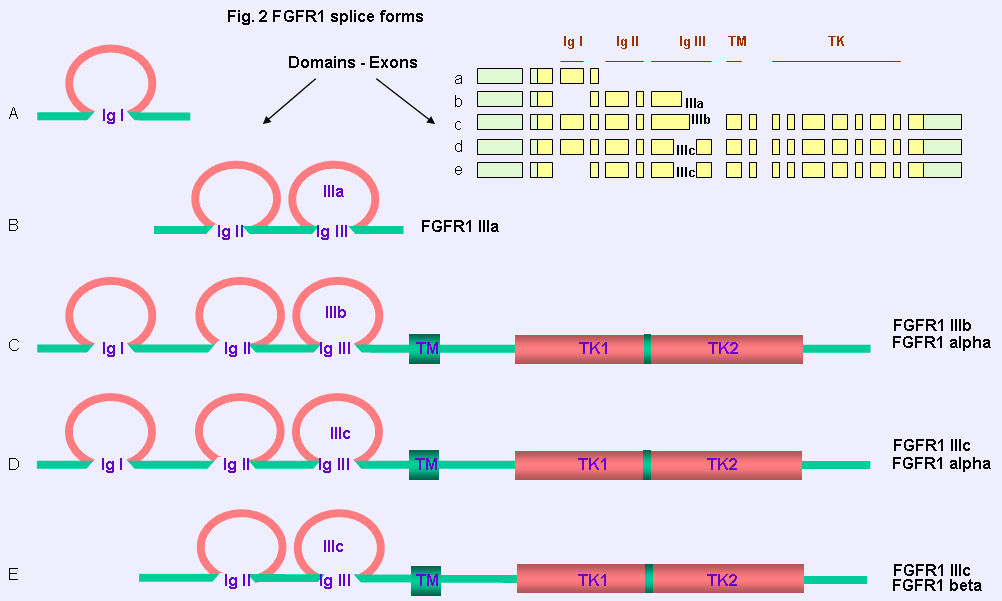
FGFR1 splice variants - Isoforms
FGFR1 IIIb (Fig 2C) is expressed in epithelial lineages, FGFR1 IIIc (Fig 2D and E; compare the exons with form IIIb) in mesenchymal lineages. FGFR1 IIIc is also preferentially expressed in cell lines.
Whereas FGFR1 IIIc was found expressed in nearly all tissues examined, FGFR1 IIIa was found expresssed in brain, muscle and skin, and FGFR IIIb in skin, brain, kidney, muscle and placenta (Johnson and Williams, 1993). Changes in FGFR isoform expression seem to regulate tumorigenesis and malignant transformation (Liu et al., 2007).
Targeted disruption of FGFR1 IIIc provoked mouse embryo lethality due to a defect in cell migration through the primitive streack, whereas FGFR1 IIIb deficient mouse embryo showed no obvious defect (reviewed in Eswarakumar et al., 2005).
Almost all tissues contain both forms of FGFR1. The first Ig domain may be deleted without ligand binding consequence. However, its splicing is tissue-dependant: the FGFR1 with 3 Ig like domains (FGFR1alpha) is predominant during mouse embryogenesis, while the form with only 2 Ig like domains (FGFR1beta) is equally expressed after birth in most tissues. FGFR1beta exhibits a 10-fold higher affinity for FGF1 and FGF2 than FGFR1alpha.
Only FGFR1alpha has been found in the nucleus.
Aberrant splicing of the alpha-exon has been associated with pancreatic cancer, breast cancer, and glioblastoma (Bruno et al., 2004).
Receptor specificity
TABLE I : FGFs and targets FGFRs (from Zang et al., 2006)
| FGF subfamilies | FGF | FGFR |
| FGF1 (secreted or intracellular) | FGF1 FGF2 | all FGFRs FGFR 1c, 3c > 2c, 1b, 4Δ |
| FGF4 (secreted) | FGF4, FGF5, FGF6 | FGFR 1c, 2c > 3c, 4Δ |
| FGF7 (secreted) | FGF3, FGF7, FGF10, FGF22 | FGFR 2b > 1b |
| FGF8 (secreted) | FGF8, FGF17, FGF18 | FGFR 3c > 4Δ, > 2c > 1c > 3b |
| FGF9 (secreted) | FGF9, FGF16, FGF20 | FGFR 3c > 2c > 1c, 3b > 4Δ |
| FGF19 (secreted) | FGF19, FGF21, FGF23 | FGFR 1c, 2c, 3c, 4Δ (weak) |
| FGF11 (intracellular) | FGF11, FGF12, FGF13, FGF14 | Not known |
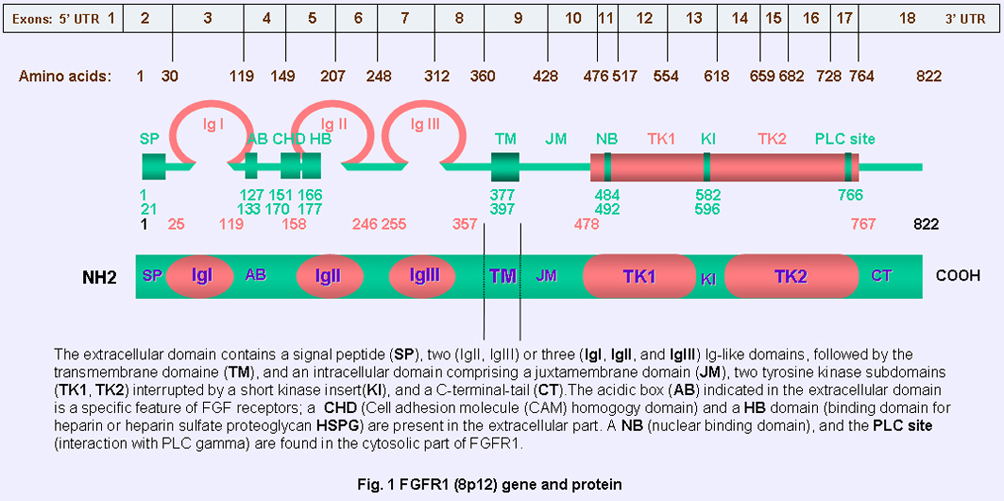
FGFR1 possesses a CHD (Cell adhesion molecule (CAM) homology domain).
Cell adhesion molecules L1CAM (Xq28; L1 cell adhesion molecule), NCAM1 and NCAM2 (11q23 and 21q21; neural cell adhesion molecules) and the members of the vast cadherin family are transmembrane receptors that maintain adhesion between epithelial cells. FGF1 and FGF2 induce the internalization of surface FGFR1 and surface CDH1 (16q22; alias E-cadherin) in an endosome before nuclear import into the nucleus (Bryant et al., 2005). CDH11 (16q21; cadherin 11) and FGFR1 can interact directly through their extracellular domains. The neuronal cell adhesion molecule L1CAM also interacts directly with FGFR1. L1CAM promotes axonal outgrowth through an interaction with FGFR1. The extracellular domain of L1CAM binds to the combined second and third Ig-like domains of FGFR1. Activation of FGFR1 is both necessary and sufficient to account for the ability of CAMs to stimulate axonal growth. PLC gamma (see below) is the downstream effector of this response (Doherty and Walsh, 1996; Saffell et al., 1997; Boscher and Mege, 2008; Kulahin et al., 2008).
Expression
Localisation
Function
There are 22 FGF, from FGF1 to FGF23, with no FGF number 15 (see Ornitz and Itoh, 2001). The first family of FGFs consists of FGF1 and FGF2; they can either be secreted or remain intracellular (they possess a nuclear localization signal). The second and third families comprise FGF3-10 and 16-23 and are secreted; the last family (FGF11-14) remain intracellular, they do not bind FGFRs; they are called FHFs (FGF homologous factors).
FGFs bind FGFRs to regulate cell growth, migration and differentiation during embryogenesis, and homeostasis later in life. They act both in mesenchymal and epithelial cells. The ligand-receptor complex, in association with heparin or heparan sulfate proteoglycan (FGF and FGFR both have heparan-binding sites), induces receptor dimerization.
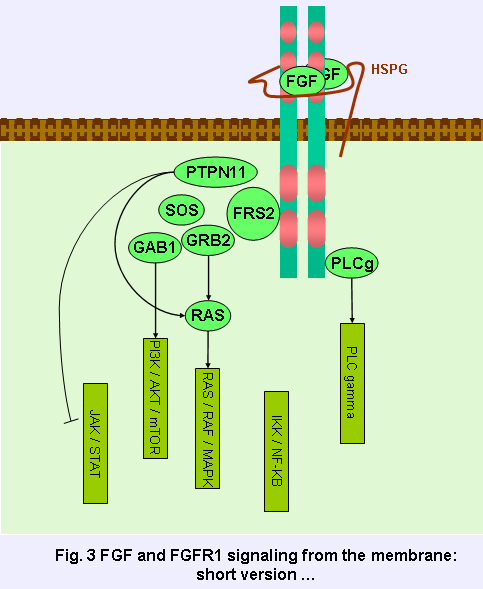
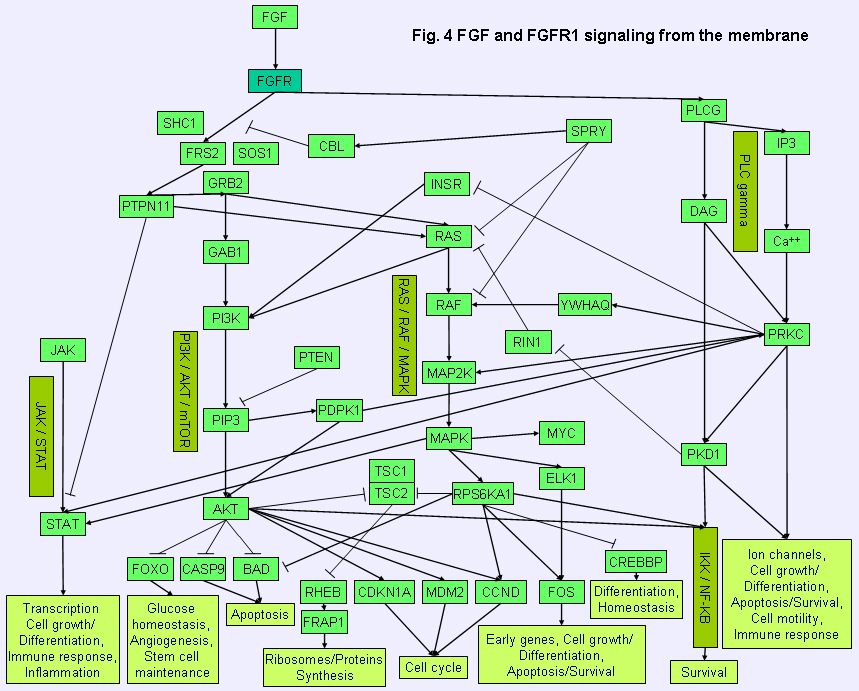
The FGFR1 signaling is achieved by receptor conformational changes upon ligand binding, leading to dimerization and subsequent activation by autophosphorylation of TK intracellular domains. It then activates the MAP (mitogen-activated protein) kinase pathway, necessary for cell cycle progression. However, FGFR1 dimerization leads to the activation of a number of other signaling molecules including the PI3K/AKT/mTOR pathway, the phospholipase Cgamma (PLCgamma ) pathway, the JAK-STAT pathway , and, more indirectly, the IKK/NF-KB pathway (Fig 3). All these pathways interact with other, as is summarized Figure 4.
These functions depend on: 1- the expression of one or multiple FGF and FGF receptors, 2- the various and numerous splicings of the FGFR mRNA, 3- the cell and tissue involved (review in Naski and Ornitz,1998; Ornitz and Itoh, 2001).
FGF-FGFR binding
Surface cell heparin or heparan sulfate proteoglycans (HSPG) interact with FGF to induce growth factor polymerization, binding to FGFR and subsequent dimerization of FGFRs. It is essential for the dimerization and activation of the FGF-FGFR complex. Recent studies showed that KAL1 (Xp22; Kallmann syndrome 1 sequence) acts as an FGFR1-specific modulator and coligand that physically interacts with the FGFR1-FGF-heparin sulfate proteoglycan complex and amplifies the resulting downstream signaling responses (Gonzalez-Martinez et al., 2004).
Note: KAL1, like FGFR1, is involved in Kallmann syndrome (see below).
Proteins which contain either a Src homology (SH2) domain, or a phosphotyrosine binding (PTB) domain can be phosphorylated/activated by the dimerized/activated receptor (herein FGFR1).
FRS2, GRB2 and partners
FRS2 (fibroblast growth factor receptor substrate 2) contains a PTB domain. Activation of the FGF-FGFR complex allows FRS2 to be phosphorylated, and then bind to GRB2 (growth factor receptor-bound protein 2) and PTPN11 (protein tyrosine phosphatase, non-receptor type, 11, alias SHP2).
FGFRs (as well as other receptor tyrosine kinases), and also SHC1 (SHC (src homology 2 domain containing) transforming protein 1), PTPN11 and GAB1 (GRB2-associated binding protein 1) can bind GRB2 (Athauda and Bottaro, 2007). Phosphorylation of SHC1 and GAB1 induces binding to GRB2 and SOS1 (son of sevenless homolog 1) (Nelson et al., 2008) resulting in a multi-protein complex (Fig 3). GRB2 is constituvely associated with SOS.
RAS/RAF/MAPK pathway
GRB2-SOS stimulates the exchange of GTP to GDP on RAS (RAS viral oncogene homolog). RAS induces a phosphorylation cascade towards the nucleus, involving RAF (v-raf murine sarcoma viral oncogene homolog), MAP2K1 (mitogen-activated protein kinase kinase 1, alias MAPKK or MEK), MAPK (mitogen-activated protein kinase, alias ERK), ELK1 (ELK1, member of ETS oncogene family) and RPS6KA1 (ribosomal protein S6 kinase, 90kDa, polypeptide 1), towards cell cycle processes, differentiation, and homeostasis.
PTPN11 positively regulates the RAS/RAF/MAPK pathway (Athauda and Bottaro, 2007). PRKC, a member of the PLC gamma pathway, phosphorylates a number of substrates, including MAP2K and YWHAQ (alias: 14-3-3) (Nelson et al., 2008). PKD1, another PLC gamma pathway member, upregulates the RAS/RAF/MAPK pathway by phosphorylating RIN1 (ras and rab interactor 1) and blocking its interaction with RAS.
PI3K/AKT/mTOR pathway
The complex FRS2-GRB2-GAB1 enables tyrosine phosphorylation of GAB1. GAB1, then, activates the PI3K/AKT/mTOR pathway, involving PI3K (phosphoinositide-3-kinase, catalytic, alpha, beta, delta, gamma polypeptide), PIP3 (Phosphatidylinositol (3,4,5)-trisphosphate (PtdIns(3,4,5)P3)), and AKT (v-akt murine thymoma viral oncogene homologs 1, 2, 3, alias: PKB). AKT has a great number of targets (Fig 4), FRAP1 (alias mTOR) in particular. It has a role in glucose homeostasis, ribosomes and proteines syntheses, angiogenesis, stem cell maintenance, differentiation, survival, apoptosis, and cell cycle (Altomare and Testa, 2007).
PLC gamma pathway
PLCG induces the pathway involving DAG (diacylglycerol) and IP3 (inositol 1,4,5-trisphosphate) by lipid hydrolysis of PtdIns(4,5)P2, a rise of intracellular Ca++ concentration, PRKC (protein kinase C), and PKD1 (protein kinase D) through phosphorylation towards ion channels regulations, and various processes such as cell growth and differentiation, apoptosis and survival, cell motility and immune response. To be noted that PDPK1, regulated by PI3K from the PI3K/AKT/mTOR pathway, phosphorylates PRKC (Dempsey et al., 2000; Wang, 2006; Kheifets and Mochly-Rosen, 2007).
JAK/STAT pathway
PTPN11, once activated in the FRS2/PTPN11/GRB2/GAB1/SOS complex, provokes STAT (signal transducer and activator of transcription) dephosphorylation (review on JAK-STAT in Schindler et al., 2007). PRKC (member of the PLC gamma pathway) regulates STATs (Malavez et al., 2008). The JAK/STAT pathway regulates transcription, cell growth and differentiation, inflammation and immune response.
IKK/NF-KB pathway
PKD1 activates the NF-KB pathway.
AKT, a member of the PI3K/AKT/mTOR pathway, activates CHUK (10q24, alias IKKA). (Altomare and Testa, 2007). RPS6KA1, a member of the RAS/RAF/MAPK pathway, inactivates NFKBIA (14q13) (Roux, 2008). PRKC regulates NFKB (Malavez et al., 2008). The IKK/NFKB pathway regulates survival processes.
SPRY and CBL inhibition
SPRY (sprouty homolog (Drosophila)) competes with PTPN11 and FRS2 for binding to the GRB2-SOS complex, and inhibits the RAS/RAF/MAPK pathway. On the other hand, SPRY prevents CBL-mediated ubiquitylation, endocytosis and degradation of FGFR (Guy et al., 2003; Mason et al., 2006; Dikic and Schmidt, 2007).
Note: SPRY, like FGFR1, is involved in nonsyndromic cleft lip and palate (see below).
Nuclear FGFR1
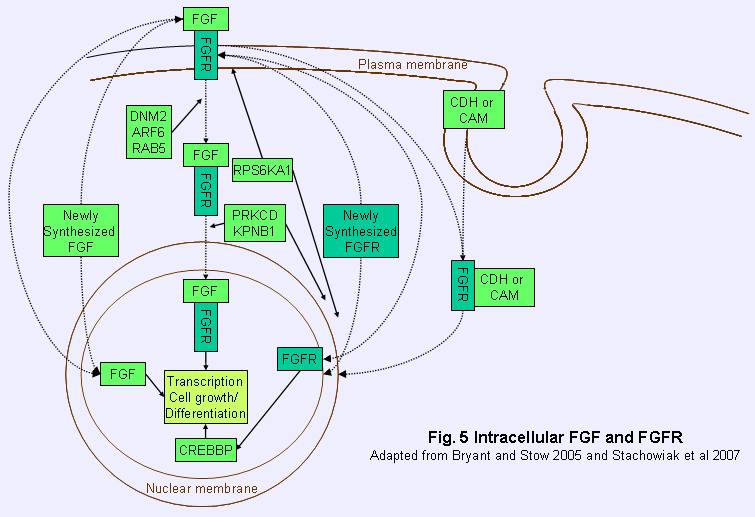
FGFs may: 1- be secreted (FGF 3-10, 16-23) out of the cell, bind on surface receptors (FGFRs) of other cells and activate signaling cascades as above described; 2- remain intra cellular (FGF 11-14); or 3- both (FGF1, FGF2). Intracytoplasmic FGFs can translocate to the nucleus and act as nuclear signaling molecules.
All the same, FGFRs can be found inserted in the cytoplasmic membrane, but also in the cytosol, and in the nuclear compartment (Fig 5).
FGFR1 (and also FGFR2 and 3 but not FGFR4) contains an atypical transmembrane domain (TM), with a probable beta-sheet conformation, instead of the more membrane-stable alpha-helical conformation of other single TM tyrosine kinase receptors (Myers et al., 2003).
ARF6 (14q21; ADP-ribosylation factor 6) and DNM2 (19p13; dynamin 2) facilitate surface FGFR1 internalization, RAB5 (RAB5; member RAS) facilitates the trafic into the endosome. RPS6KA1 would also favor FGFR1 release from the membrane to the cytosol and also prior to nuclear import. KPNB1 (17q21; importin beta) would facilitate FGFR1 nuclear import. VHL (3p25; von Hippel-Lindau tumor suppressor) is recruited to FGFR1-containing endosomal vesicles and exhibits a functional relationship with RAB5A and DNM2 in FGFR1 internalization. In cooperation with CREBBP, Nuclear FGFR1 (nFGFR1) up-regulates gene transcription of FGF2, CCND1 (11q13; cyclin D1), JUN (1p32; jun oncogene), NEFL (8p21; neurofilament, light polypeptide), TH (11p15; tyrosine hydroxylase) (Groth and Lardelli, 2002; Bryant and Stow, 2005; Hsu et al., 2006; Stachowiak et al., 2007).
Homology
Implicated in
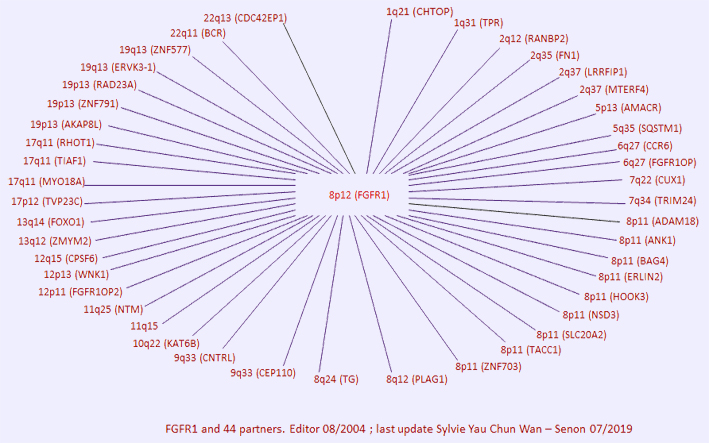
The translocation is the sole anomaly in half of the cases; additional anomalies are: duplication of one of the derivative chromosomes: 15% (strangely the der(partner) and the der(8) are equally found); 7/del(7q): 10%; +21: 10%; +8: 5%.

Finally, a S125L mutation was found in one of 25 cases of breast cancer (Stephens et al., 2005).
A hypomethylation of a CpG island upstream to FGFR1 exon 1 was identified in the primary RMS tumors (Goldstein et al., 2007).
Two mutations in FGFR1 were found (N546K and R576W), and no amplification, in a study of 19 glioblastomas (Rand et al., 2005).
A subgroup of pleomorphic salivary gland adenomas showed a ring chromosome 8: r(8)(p12q12) with amplification of a hybrid gene 5-FGFR1 3-PLAG1, and also multiple copies of an intact PLAG1 (8q12; pleiomorphic adenoma gene 1) (Persson et al., 2008).
A single somatic mutation in FGFR1 (P252T) was observed in a bronchoalveolar cancer from a study of 26 primary lung neoplasms (Davies et al., 2005).
Patients with tumors that showed high expression of VEGF and FGF2 had significantly shorter survival (Kuwahara et al., 2003). Pancreatic adenocarcinomas overexpresses fibroblast growth factor ligands (FGF-1 and FGF-2) and FGFR1beta in about 90% of the time. Overexpression of FGFR1alpha inhibits pancreatic adenocarcinoma cells (Vickers et al., 2002). FGFR1-IIIc enhances and FGFR1-IIIb inhibits pancreatic cancer cell growth. Expression of FGFR1-IIIb inhibited the transformed phenotype of human pancreatic cancer cells. This was associated with a reduced p44/42 MAPK phosphorylation and an enhanced activity of JNK (10q11; JUN N-terminal kinase, alias MAPK8) and p38. The antiproliferative effects of FGFR1-IIIb were confirmed in a xenograft model. IIIc enhanced and IIIb inhibited basal cell proliferation in pancreatic cancer and non-cancer cells. Expression of FGFR1-IIIc in nonmalignant pancreatic ductal cells resulted in cellular transformation and in vivo tumor formation, whereas inhibition of FGFR1-IIIc resulted in a reversion of the malignant phenotype in pancreatic cancer cells. FGFR1-IIIc promotes pancreatic ductal adenocarcinomas cell growth through phosphorylation of FRS2, PLCG, and activation of the RAS/RAF/MAPK pathway (Kornmann et al., 2002; Liu et al., 2007). FGFR1-IIIb and FGFR1-IIIc are coexpressed in pancreatic cancer and these isoforms are differentially regulated by growth factors FGFs, IGF1R (15q26; insulin-like growth factor 1 receptor) and EGF (4q25; epidermal growth factor), and by CCND1 (11q13; cyclin D1) (Chen et al., 2008).
FGFR1 may function as a negative regulator of long bone development rather than increasing skull bone growth.
FGFR1 expression is positively regulated by thyroid hormone T3 in osteoblasts.
FGFR1 is important for early limb bud development and distal skeletal patterning. It is expressed in limb bud mesenchyme that gives rise to mesenchymal condensations and eventually to the chondrogenic and osteogenic lineage. Inactivation of FGFR1 in osteo-chondro-progenitor cells delayed osteoblast differentiation; conversely, inactivation of FGFR1 in differentiated osteoblasts accelerated differentiation. It appears that FGFR1 expression in osteoblasts is necessary to maintain the balance between bone formation and remodeling (Jacob et al., 2006).
Pfeiffer syndrome is due to an activating mutation of FGFR1.
Pfeiffer syndrome is due to mutations in FGFR1 or in FGFR2. A unique mutation in FGFR1 is known to provoke Pfeiffer syndrome: P252R, where a proline is replaced by an arginine in the IgII-III linker region (see figure I) (Muenke et al., 1994; Schell et al., 1995; Rossi et al., 2003; Ibrahimi et al., 2004). Pfeiffer syndrome with a mutation in FGFR2 exhibits the heavier form, those with a mutation in FGFR1 exhibits the milder form (type I) of the disease. It is an activating mutation, which enhance the affinity of FGF9, causing inappropriate dimerization of FGFR1 and signal transduction (Ibrahimi et al., 2004).
Note: Jackson-Weiss syndrome is caused by mutations in codons 342, 344, or 359, or deletion at codon 319 in FGFR2 gene. No case of Jackson-Weiss syndrome is due to a mutation in FGFR1, altough this is sometimes found written in databases.
Mutations within FGFR1 are within the IgIII (also called D3) domain, the linker region and the initial transmembrane domain: N330I, Y374C, C381R (White et al., 2005; Farrow et al., 2006), They appear to be activating mutations, causing inappropriate dimerization of FGFR1.
Mutations were found so far in MSX1 (4p16; msh homeobox 1), FOXE1 (9q22; forkhead box E1 (thyroid transcription factor 2)), GLI2 (2q14; GLI-Kruppel family member GLI2), MSX2 (5q35; msh homeobox 2), SKI (1p36; v-ski sarcoma viral oncogene homolog (avian)), SPRY2 and, recently in FGF family members, namely: FGFR1, FGFR2, FGFR3, and FGF8. The mutations found in FGFR1 were I300T, M369I, E467K, and R609X. These loss-of-function mutations map to the IgIII-TM linker, the TM-TK linker, and to the TK domain. Penetrance appears to be incomplete (Kress et al., 2000; Riley et al., 2007).
Kallmann syndrome is found in 10/100 000 males and 2/100 000 females. There is X-linked cases, autosomal dominant cases, and autosomal recessive transmissions. Kallmann syndrome is genetically heterogeneous, and may be due to mutations in KAL1 (Xp22.3; also called anosmin-1,causing the X-linked form of KS), FGFR1 (also called KAL2 for Kallmann 2, often associated with cleft palate and dental agenesis), PROK2 (3p13; prokineticin 2), and PROKR2 (20p12; prokineticin receptor 2). However, only 25% of Kallmann syndrome cases are due to mutations in these four genes. To be noted is that KAL1 has recently be found to acts as an FGFR1-specific modulator and coligand that physically interacts with the FGFR1-FGF-heparin sulfate proteoglycan complex (specifically through FGFR1 IIIc), and amplifies the FGF/FGFR1 downstream signaling responses in olfactory neuroblasts (Gonzalez-Martinez et al., 2004).
Mutations or interstitial deletions in FGFR1 are found in 10% of individuals with Kallmann syndrome. Mutations within FGFR1 are variable: G48S, N77K, R78C, G97D, Y99C, 303-304insCC, C101F, V102I, S107X, D129A, A167S, C178S, D224H, G237S, G237D, L245P, R250W (2 cases), R254Q, G270D, V273M (2 cases), E274G, C277Y, P283R, 936G->A, E324X, S332C, Y339C, A343V, S346C, c.1081G>C (splice site), R365fsX41, P366 liter, S439fs, A520T, I538V, V607M, Y613fsX42, K618fsX654, H621R, R622X, R622G, R622Q, 1970-1971delCA, c.1977+1G>A (splice site), R661X, W666R, Q680X, G687R, IV15+1G->A, G703S, G703R, M719R, P722S (2 cases), S685F, I693F, P722H and N724K double mutation, Y730X, P745S, P772S, V795I, R822C; However, the N77K and R822C changes were also found in healthy control individuals. The above noted mutations are dispersed in variable sites of FGFR1 (Ig domains, Ig-Ig linkers, IgIII-TM linker, TK domains, C-term); they appear to be dominant loss-of-function mutations.
FGFR1 mutations also account for some of the mixed pedigrees, extending to hypogonadotropic hypogonadism and normal olfaction or, conversely, to isolated anosmia, or even asymptomatic carriers at times (Dode et al., 2003; Sato et al., 2004; Sato et al., 2005; Albuisson et al., 2005; Karges and de Roux, 2005; Pitteloud, Acierno et al., 2006; Pitteloud, Meysing, et al., 2006; Zenaty et al., 2006; Trarbach et al., 2008; Dode et al., 2007).
Conversely, decreased FGFR1 mRNA was found in the hippocampus in rats with social defeat experience (Turner, Calvo et al., 2008). Reduced density of dopamine neurons was found in transgenic mice expressing a dominant negative FGFR1 mutant; the mice presented similar structural and biochemical changes in dopamine neurons as what is found in shizophrenia patients (Klejbor et al., 2006).
Caution must be taken when comparing the results, since, methodology, histology and anatomic regions of the cells under study, and diagnoses of the population studied may not be comparable from one study to another.
Rats with an increased locomotor response to a novel environment exhibited increased FGFR1 mRNA in the hippocampus compared to other rats. Cocaine injections decreased FGFR1 mRNA in the hippocampus and increased FGFR1 mRNA in the prefrontal cortex. In rats with an increased locomotor response, cocaine decreased gene expression in the hippocampus and did not affect it in the prefrontal cortex, while, in other rats, cocaine did not affect gene expression in the hippocampus and increased gene expression in the prefrontal cortex (Turner, Flagel et al., 2008).
Breakpoints
Article Bibliography
| Pubmed ID | Last Year | Title | Authors |
|---|---|---|---|
| 18068632 | 2007 | Inducible FGFR-1 activation leads to irreversible prostate adenocarcinoma and an epithelial-to-mesenchymal transition. | Acevedo VD et al |
| 15605412 | 2005 | Kallmann syndrome: 14 novel mutations in KAL1 and FGFR1 (KAL2). | Albuisson J et al |
| 15609342 | 2005 | 8p11 myeloproliferative syndrome with a novel t(7;8) translocation leading to fusion of the FGFR1 and TIF1 genes. | Belloni E et al |
| 11517011 | 2001 | Fibroblast growth factor receptor 1 (FGFR1) is over-expressed in benign prostatic hyperplasia whereas FGFR2-IIIc and FGFR3 are not. | Boget S et al |
| 18302981 | 2008 | Cadherin-11 interacts with the FGF receptor and induces neurite outgrowth through associated downstream signalling. | Boscher C et al |
| 15333583 | 2004 | Correction of aberrant FGFR1 alternative RNA splicing through targeting of intronic regulatory elements. | Bruno IG et al |
| 16138907 | 2005 | Nuclear translocation of cell-surface receptors: lessons from fibroblast growth factor. | Bryant DM et al |
| 15509650 | 2005 | Regulation of endocytosis, nuclear translocation, and signaling of fibroblast growth factor receptor 1 by E-cadherin. | Bryant DM et al |
| 9484786 | 1998 | t(6;8), t(8;9) and t(8;13) translocations associated with stem cell myeloproliferative disorders have close or identical breakpoints in chromosome region 8p11-12. | Chaffanet M et al |
| 11242034 | 2001 | Mammalian MAP kinase signalling cascades. | Chang L et al |
| 18665077 | 2008 | Exon III splicing of fibroblast growth factor receptor 1 is modulated by growth factors and cyclin D1. | Chen G et al |
| 17803937 | 2007 | A molecular brake in the kinase hinge region regulates the activity of receptor tyrosine kinases. | Chen H et al |
| 11703922 | 2001 | FGF signaling regulates mesoderm cell fate specification and morphogenetic movement at the primitive streak. | Ciruna B et al |
| 9226454 | 1997 | Chimeric analysis of fibroblast growth factor receptor-1 (Fgfr1) function: a role for FGFR1 in morphogenetic movement through the primitive streak. | Ciruna BG et al |
| 12128225 | 2002 | FGFR1-IIIb is a putative marker of pancreatic progenitor cells. | Cras-Méneur C et al |
| 17552943 | 2007 | Syndromic craniosynostosis: from history to hydrogen bonds. | Cunningham ML et al |
| 16140923 | 2005 | Somatic mutations of the protein kinase gene family in human lung cancer. | Davies H et al |
| 11739186 | 2001 | The t(8;22) in chronic myeloid leukemia fuses BCR to FGFR1: transforming activity and specific inhibition of FGFR1 fusion proteins. | Demiroglu A et al |
| 10956616 | 2000 | Protein kinase C isozymes and the regulation of diverse cell responses. | Dempsey EC et al |
| 17137506 | 2006 | FGFR1 and WT1 are markers of human prostate cancer progression. | Devilard E et al |
| 17553592 | 2007 | Malfunctions within the Cbl interactome uncouple receptor tyrosine kinases from destructive transport. | Dikic I et al |
| 17154279 | 2007 | Novel FGFR1 sequence variants in Kallmann syndrome, and genetic evidence that the FGFR1c isoform is required in olfactory bulb and palate morphogenesis. | Dodé C et al |
| 12627230 | 2003 | Loss-of-function mutations in FGFR1 cause autosomal dominant Kallmann syndrome. | Dodé C et al |
| 8954625 | 1996 | CAM-FGF Receptor Interactions: A Model for Axonal Growth. | Doherty P et al |
| 14614009 | 2003 | Gene amplifications associated with the development of hormone-resistant prostate cancer. | Edwards J et al |
| 17397528 | 2007 | FGFR1 amplification in breast carcinomas: a chromogenic in situ hybridisation analysis. | Elbauomy Elsheikh S et al |
| 15863030 | 2005 | Cellular signaling by fibroblast growth factor receptors. | Eswarakumar VP et al |
| 17321332 | 2007 | Combined translocation with ZNF198-FGFR1 gene fusion and deletion of potential tumor suppressors in a myeloproliferative disorder. | Etienne A et al |
| 16470795 | 2006 | Extended mutational analyses of FGFR1 in osteoglophonic dysplasia. | Farrow EG et al |
| 9393762 | 1997 | Fibroblast growth factor receptor 2 limits and receptor 1 accelerates tumorigenicity of prostate epithelial cells. | Feng S et al |
| 18042549 | 2008 | Prostaglandin E2 regulates angiogenesis via activation of fibroblast growth factor receptor-1. | Finetti F et al |
| 11746971 | 2001 | Fusion of the BCR and the fibroblast growth factor receptor-1 (FGFR1) genes as a result of t(8;22)(p11;q11) in a myeloproliferative disorder: the first fusion gene involving BCR but not ABL. | Fioretos T et al |
| 16807070 | 2007 | Recurrent FGFR1 amplification and high FGFR1 protein expression in oral squamous cell carcinoma (OSCC). | Freier K et al |
| 16954433 | 2006 | Concomitant down-regulation of SPRY1 and SPRY2 in prostate carcinoma. | Fritzsche S et al |
| 16507368 | 2006 | Autophosphorylation of FGFR1 kinase is mediated by a sequential and precisely ordered reaction. | Furdui CM et al |
| 9973481 | 1999 | IL-2, but not IL-4 and other cytokines, induces phosphorylation of a 98-kDa protein associated with SHP-2, phosphatidylinositol 3'-kinase, and Grb2. | Gadina M et al |
| 15897872 | 2005 | A 1 Mb minimal amplicon at 8p11-12 in breast cancer identifies new candidate oncogenes. | Garcia MJ et al |
| 16861106 | 2006 | Hippocampal FGF-2 and FGFR1 mRNA expression in major depression, schizophrenia and bipolar disorder. | Gaughran F et al |
| 16380503 | 2005 | Comprehensive profiling of 8p11-12 amplification in breast cancer. | Gelsi-Boyer V et al |
| 10353739 | 1999 | Alterations in expression of basic fibroblast growth factor (FGF) 2 and its receptor FGFR-1 in human prostate cancer. | Giri D et al |
| 17696196 | 2007 | FGFR1 over-expression in primary rhabdomyosarcoma tumors is associated with hypomethylation of a 5' CpG island and abnormal expression of the AKT1, NOG, and BMP4 genes. | Goldstein M et al |
| 15548653 | 2004 | Anosmin-1 modulates fibroblast growth factor receptor 1 signaling in human gonadotropin-releasing hormone olfactory neuroblasts through a heparan sulfate-dependent mechanism. | González-Martínez D et al |
| 10887150 | 2000 | CBP/p300 in cell growth, transformation, and development. | Goodman RH et al |
| 18452557 | 2008 | Regulation of growth factor signaling by FRS2 family docking/scaffold adaptor proteins. | Gotoh N et al |
| 15034873 | 2004 | Identification of a novel gene, FGFR1OP2, fused to FGFR1 in 8p11 myeloproliferative syndrome. | Grand EK et al |
| 2325100 | 1990 | Osteoglophonic dysplasia. | Greenberg F et al |
| 12141425 | 2002 | The structure and function of vertebrate fibroblast growth factor receptor 1. | Groth C et al |
| 10688839 | 2000 | FGFR1 is fused to the centrosome-associated protein CEP110 in the 8p12 stem cell myeloproliferative disorder with t(8;9)(p12;q33). | Guasch G et al |
| 12393597 | 2003 | Endogenous retroviral sequence is fused to FGFR1 kinase in the 8p12 stem-cell myeloproliferative disorder with t(8;19)(p12;q13.3). | Guasch G et al |
| 12829736 | 2003 | Sprouty: how does the branch manager work? | Guy GR et al |
| 18205209 | 2008 | The t(1;9)(p34;q34) and t(8;12)(p11;q15) fuse pre-mRNA processing proteins SFPQ (PSF) and CPSF6 to ABL and FGFR1. | Hidalgo-Curtis C et al |
| 16505488 | 2006 | Endocytic function of von Hippel-Lindau tumor suppressor protein regulates surface localization of fibroblast growth factor receptor 1 and cell motility. | Hsu T et al |
| 16452204 | 2006 | Ectopic activity of fibroblast growth factor receptor 1 in hepatocytes accelerates hepatocarcinogenesis by driving proliferation and vascular endothelial growth factor-induced angiogenesis. | Huang X et al |
| 14613973 | 2004 | Proline to arginine mutations in FGF receptors 1 and 3 result in Pfeiffer and Muenke craniosynostosis syndromes through enhancement of FGF binding affinity. | Ibrahimi OA et al |
| 12147242 | 2002 | Gene amplification profiling of esophageal squamous cell carcinomas by DNA array CGH. | Ishizuka T et al |
| 2162671 | 1990 | The complete amino acid sequence of the shorter form of human basic fibroblast growth factor receptor deduced from its cDNA. | Itoh N et al |
| 16815385 | 2006 | Fibroblast growth factor receptor 1 signaling in the osteo-chondrogenic cell lineage regulates sequential steps of osteoblast maturation. | Jacob AL et al |
| 15558020 | 2005 | Reciprocal relationship in gene expression between FGFR1 and FGFR3: implication for tumorigenesis. | Jang JH et al |
| 10728679 | 2000 | Fibroblast growth factor receptor-1 alpha-exon exclusion and polypyrimidine tract-binding protein in glioblastoma multiforme tumors. | Jin W et al |
| 8417497 | 1993 | Structural and functional diversity in the FGF receptor multigene family. | Johnson DE et al |
| 15313412 | 2004 | CBP and p300: HATs for different occasions. | Kalkhoven E et al |
| 15722618 | 2005 | Molecular genetics of isolated hypogonadotropic hypogonadism and Kallmann syndrome. | Karges B et al |
| 17580120 | 2007 | Insight into intra- and inter-molecular interactions of PKC: design of specific modulators of kinase function. | Kheifets V et al |
| 11267671 | 2001 | A novel fibroblast growth factor receptor-5 preferentially expressed in the pancreas(1). | Kim I et al |
| 16524369 | 2006 | Fibroblast growth factor receptor signaling affects development and function of dopamine neurons - inhibition results in a schizophrenia-like syndrome in transgenic mice. | Klejbor I et al |
| 17545628 | 2007 | Epigenetically controlled fibroblast growth factor receptor 2 signaling imposes on the RAS/BRAF/mitogen-activated protein kinase pathway to modulate thyroid cancer progression. | Kondo T et al |
| 12105858 | 2002 | IIIc isoform of fibroblast growth factor receptor 1 is overexpressed in human pancreatic cancer and enhances tumorigenicity of hamster ductal cells. | Kornmann M et al |
| 11173846 | 2000 | An unusual FGFR1 mutation (fibroblast growth factor receptor 1 mutation) in a girl with non-syndromic trigonocephaly. | Kress W et al |
| 18222703 | 2008 | Fibronectin type III (FN3) modules of the neuronal cell adhesion molecule L1 interact directly with the fibroblast growth factor (FGF) receptor. | Kulahin N et al |
| 12717266 | 2003 | Expressions of angiogenic factors in pancreatic ductal carcinoma: a correlative study with clinicopathologic parameters and patient survival. | Kuwahara K et al |
| 15256439 | 2004 | The expression of Sprouty1, an inhibitor of fibroblast growth factor signal transduction, is decreased in human prostate cancer. | Kwabi-Addo B et al |
| 2544996 | 1989 | Purification and complementary DNA cloning of a receptor for basic fibroblast growth factor. | Lee PL et al |
| 19029025 | 2009 | Activation of the FGF2/FGFR1 autocrine loop for cell proliferation and survival in uveal melanoma cells. | Lefèvre G et al |
| 17956267 | 2007 | Functional PKC in vivo analysis using deficient mouse models. | Leitges M et al |
| 17040570 | 2006 | Frequency, prognostic impact, and subtype association of 8p12, 8q24, 11q13, 12p13, 17q12, and 20q13 amplifications in breast cancers. | Letessier A et al |
| 9285567 | 1997 | Keratinocyte growth factor expression in hormone insensitive prostate cancer. | Leung HY et al |
| 17363592 | 2007 | Identification of a fibroblast growth factor receptor 1 splice variant that inhibits pancreatic cancer cell growth. | Liu Z et al |
| 7657392 | 1995 | Expression of 2 variant forms of fibroblast growth factor receptor 1 in human breast. | Luqmani YA et al |
| 12696066 | 2003 | Genetic alterations in primary cutaneous CD30+ anaplastic large cell lymphoma. | Mao X et al |
| 16337795 | 2006 | Sprouty proteins: multifaceted negative-feedback regulators of receptor tyrosine kinase signaling. | Mason JM et al |
| 18068633 | 2007 | Enhanced paracrine FGF10 expression promotes formation of multifocal prostate adenocarcinoma and an increase in epithelial androgen receptor. | Memarzadeh S et al |
| 18096225 | 2008 | Common features of myeloproliferative disorders with t(8;9)(p12;q33) and CEP110-FGFR1 fusion: report of a new case and review of the literature. | Mozziconacci MJ et al |
| 7874169 | 1994 | A common mutation in the fibroblast growth factor receptor 1 gene in Pfeiffer syndrome. | Muenke M et al |
| 11122115 | 2000 | The 8p12 myeloproliferative disorder. t(8;19)(p12;q13.3): a novel translocation involving the FGFR1 gene. | Mugneret F et al |
| 17312100 | 2007 | The JAK-STAT signaling pathway: input and output integration. | Murray PJ et al |
| 12647309 | 2003 | Nuclear trafficking of FGFR1: a role for the transmembrane domain. | Myers JM et al |
| 9021547 | 1997 | Immunohistochemical localization of fibroblast growth factor-1 (FGF-1), FGF-2 and fibroblast growth factor receptor-1 (FGFR-1) in pleomorphic adenoma of the salivary glands. | Myoken Y et al |
| 12111699 | 2002 | Down-regulation of (IIIb) and (IIIc) isoforms of fibroblast growth factor receptor 2 (FGFR2) is associated with malignant progression in human prostate. | Naimi B et al |
| 9683641 | 1998 | FGF signaling in skeletal development. | Naski MC et al |
| 18402935 | 2008 | Insulin, PKC signaling pathways and synaptic remodeling during memory storage and neuronal repair. | Nelson TJ et al |
| 15562827 | 2004 | The mTOR/S6K signalling pathway: the role of the TSC1/2 tumour suppressor complex and the proto-oncogene Rheb. | Nobukini T et al |
| 7547227 | 1995 | Expression of basic fibroblast growth factor and its receptor in human pancreatic carcinomas. | Ohta T et al |
| 11276432 | 2001 | Fibroblast growth factors. | Ornitz DM et al |
| 15863035 | 2005 | FGF signaling in the developing endochondral skeleton. | Ornitz DM et al |
| 18295660 | 2008 | 8p11 myeloproliferative syndrome preceded by t(8;9)(p11;q33), CEP110/FGFR1 fusion transcript: morphologic, molecular, and cytogenetic characterization of myeloid neoplasms associated with eosinophilia and FGFR1 abnormality. | Park TS et al |
| 11294822 | 2001 | Mitogen-activated protein (MAP) kinase pathways: regulation and physiological functions. | Pearson G et al |
| 16764984 | 2006 | Mutations in fibroblast growth factor receptor 1 cause Kallmann syndrome with a wide spectrum of reproductive phenotypes. | Pitteloud N et al |
| 15380937 | 2004 | PKC-interacting proteins: from function to pharmacology. | Poole AW et al |
| 9949182 | 1999 | The t(6;8)(q27;p11) translocation in a stem cell myeloproliferative disorder fuses a novel gene, FOP, to fibroblast growth factor receptor 1. | Popovici C et al |
| 16186508 | 2005 | Sequence survey of receptor tyrosine kinases reveals mutations in glioblastomas. | Rand V et al |
| 17121884 | 2006 | FGFR1 emerges as a potential therapeutic target for lobular breast carcinomas. | Reis-Filho JS et al |
| 9716603 | 1998 | Consistent fusion of ZNF198 to the fibroblast growth factor receptor-1 in the t(8;13)(p11;q12) myeloproliferative syndrome. | Reiter A et al |
| 18615682 | 2008 | Chronic myeloproliferative disorder with t(8;22)(p11;q11) can mime clonal cytogenetic evolution of authentic chronic myelogeneous leukemia. | Richebourg S et al |
| 17360555 | 2007 | Impaired FGF signaling contributes to cleft lip and palate. | Riley BM et al |
| 14564217 | 2003 | The appearance of the feet in Pfeiffer syndrome caused by FGFR1 P252R mutation. | Rossi M et al |
| 11919389 | 2002 | Sequential transformation of t(8;13)-related disease: a case report. | Roy S et al |
| 9052794 | 1997 | Expression of a dominant negative FGF receptor inhibits axonal growth and FGF receptor phosphorylation stimulated by CAMs. | Saffell JL et al |
| 17607666 | 2007 | Selective over-expression of fibroblast growth factor receptors 1 and 4 in clinical prostate cancer. | Sahadevan K et al |
| 18394876 | 2008 | FoxO transcription factors in the maintenance of cellular homeostasis during aging. | Salih DA et al |
| 15845591 | 2005 | Gonadotrophin therapy in Kallmann syndrome caused by heterozygous mutations of the gene for fibroblast growth factor receptor 1: report of three families: case report. | Sato N et al |
| 15001591 | 2004 | Clinical assessment and mutation analysis of Kallmann syndrome 1 (KAL1) and fibroblast growth factor receptor 1 (FGFR1, or KAL2) in five families and 18 sporadic patients. | Sato N et al |
| 7795583 | 1995 | Mutations in FGFR1 and FGFR2 cause familial and sporadic Pfeiffer syndrome. | Schell U et al |
| 17502367 | 2007 | JAK-STAT signaling: from interferons to cytokines. | Schindler C et al |
| 7601337 | 1995 | The MAPK signaling cascade. | Seger R et al |
| 15561781 | 2004 | Exogenous fibroblast growth factors maintain viability, promote proliferation, and suppress GADD45alpha and GAS6 transcript content of prostate cancer cells genetically modified to lack endogenous FGF-2. | Shain SA et al |
| 9625444 | 1998 | Expression of fibroblast growth factor-2 and fibroblast growth factor receptor-1 in thyroid diseases: difference between neoplasms and hyperplastic lesions. | Shingu K et al |
| 11389083 | 2001 | High-throughput tissue microarray analysis of 3p25 (RAF1) and 8p12 (FGFR1) copy number alterations in urinary bladder cancer. | Simon R et al |
| 8958322 | 1996 | Osteoglophonic dysplasia: review and further delineation of the syndrome. | Sklower Brooks S et al |
| 9499416 | 1998 | The t(8;13)(p11;q11-12) rearrangement associated with an atypical myeloproliferative disorder fuses the fibroblast growth factor receptor 1 gene to a novel gene RAMP. | Smedley D et al |
| 11550283 | 2001 | Identification of four new translocations involving FGFR1 in myeloid disorders. | Sohal J et al |
| 15564323 | 2005 | Fibroblast growth factor receptors as molecular targets in thyroid carcinoma. | St Bernard R et al |
| 18021009 | 2007 | Integrative nuclear signaling in cell development--a role for FGF receptor-1. | Stachowiak MK et al |
| 18337767 | 2008 | Contributions of the Raf/MEK/ERK, PI3K/PTEN/Akt/mTOR and Jak/STAT pathways to leukemia. | Steelman LS et al |
| 15908952 | 2005 | A screen of the complete protein kinase gene family identifies diverse patterns of somatic mutations in human breast cancer. | Stephens P et al |
| 17518610 | 2007 | Chemical dimerization of fibroblast growth factor receptor-1 induces myoblast proliferation, increases intracardiac graft size, and reduces ventricular dilation in infarcted hearts. | Stevens KR et al |
| 17273733 | 2007 | Co-expression of aFGF and FGFR-1 is predictive of a poor prognosis in patients with esophageal squamous cell carcinoma. | Sugiura K et al |
| 12189386 | 2002 | Epithelial-mesenchymal transitions in tumour progression. | Thiery JP et al |
| 9543164 | 1998 | Fibroblast growth factors 1 and 2 and fibroblast growth factor receptor 1 are elevated in thyroid hyperplasia. | Thompson SD et al |
| 18068248 | 2008 | Gene expression profiling of major depression and suicide in the prefrontal cortex of postmortem brains. | Tochigi M et al |
| 16882753 | 2006 | Novel fibroblast growth factor receptor 1 mutations in patients with congenital hypogonadotropic hypogonadism with and without anosmia. | Trarbach EB et al |
| 18061349 | 2008 | The fibroblast growth factor system is downregulated following social defeat. | Turner CA et al |
| 18824081 | 2008 | Cocaine interacts with the novelty-seeking trait to modulate FGFR1 gene expression in the rat. | Turner CA et al |
| 10086345 | 1999 | Differential expression assay of chromosome arm 8p genes identifies Frizzled-related (FRP1/FRZB) and Fibroblast Growth Factor Receptor 1 (FGFR1) as candidate breast cancer genes. | Ugolini F et al |
| 12080186 | 2002 | Noninvasive dynamic fluorescence imaging of human melanomas reveals that targeted inhibition of bFGF or FGFR-1 in melanoma cells blocks tumor growth by apoptosis. | Valesky M et al |
| 12127120 | 2002 | Ligand activation of alternatively spliced fibroblast growth factor receptor-1 modulates pancreatic adenocarcinoma cell malignancy. | Vickers SM et al |
| 15570299 | 2004 | Clinical variability of patients with the t(6;8)(q27;p12) and FGFR1OP-FGFR1 fusion: two further cases. | Vizmanos JL et al |
| 9274456 | 1997 | Prognostic value of basic fibroblast growth factor and its receptor (FGFR-1) in patients with non-small cell lung carcinomas. | Volm M et al |
| 15800673 | 2005 | The t(8;17)(p11;q23) in the 8p11 myeloproliferative syndrome fuses MYO18A to FGFR1. | Walz C et al |
| 14673947 | 2004 | Chronic activity of ectopic type 1 fibroblast growth factor receptor tyrosine kinase in prostate epithelium results in hyperplasia accompanied by intraepithelial neoplasia. | Wang F et al |
| 16678913 | 2006 | PKD at the crossroads of DAG and PKC signaling. | Wang QJ et al |
| 9154000 | 1997 | FGFR activation in skeletal disorders: too much of a good thing. | Webster MK et al |
| 12011115 | 2002 | Inducible dimerization of FGFR1: development of a mouse model to analyze progressive transformation of the mammary gland. | Welm BE et al |
| 1722683 | 1991 | cDNA cloning and expression of a human FGF receptor which binds acidic and basic FGF. | Wennström S et al |
| 15625620 | 2005 | Mutations that cause osteoglophonic dysplasia define novel roles for FGFR1 in bone elongation. | White KE et al |
| 11502737 | 2001 | Control of myoblast proliferation with a synthetic ligand. | Whitney ML et al |
| 17297442 | 2007 | Conditional activation of FGFR1 in the prostate epithelium induces angiogenesis with concomitant differential regulation of Ang-1 and Ang-2. | Winter SF et al |
| 16301332 | 2005 | Pleiotropic effects of FGFR1 on cell proliferation, survival, and migration in a 3D mammary epithelial cell model. | Xian W et al |
| 9425908 | 1998 | FGFR1 is fused with a novel zinc-finger gene, ZNF198, in the t(8;13) leukaemia/lymphoma syndrome. | Xiao S et al |
| 8290551 | 1994 | Differential expression of two fibroblast growth factor-receptor genes is associated with malignant progression in human astrocytomas. | Yamaguchi F et al |
| 18794879 | 2008 | PTEN: a new guardian of the genome. | Yin Y et al |
| 16757108 | 2006 | Paediatric phenotype of Kallmann syndrome due to mutations of fibroblast growth factor receptor 1 (FGFR1). | Zenaty D et al |
| 18226189 | 2008 | Activator protein 1 (Fos/Jun) functions in inflammatory bone and skin disease. | Zenz R et al |
| 16631103 | 2006 | Alternatively spliced FGFR-1 isoforms differentially modulate endothelial cell activation of c-YES. | Zhang P et al |
| 16597617 | 2006 | Receptor specificity of the fibroblast growth factor family. The complete mammalian FGF family. | Zhang X et al |
Other Information
Locus ID:
NCBI: 2260
MIM: 136350
HGNC: 3688
Ensembl: ENSG00000077782
Variants:
dbSNP: 2260
ClinVar: 2260
TCGA: ENSG00000077782
COSMIC: FGFR1
RNA/Proteins
Expression (GTEx)
Pathways
Protein levels (Protein atlas)
PharmGKB
| Entity ID | Name | Type | Evidence | Association | PK | PD | PMIDs |
|---|---|---|---|---|---|---|---|
| PA164924492 | brivanib | Chemical | Pathway | associated | 20124951 | ||
| PA26880 | CRK | Gene | Pathway | associated | 20124951 | ||
| PA28115 | FGF2 | Gene | Pathway | associated | 20124951 | ||
| PA29444 | HRAS | Gene | Pathway | associated | 28362716 | ||
| PA30196 | KRAS | Gene | Pathway | associated | 28362716 | ||
| PA31768 | NRAS | Gene | Pathway | associated | 28362716 | ||
| PA33304 | PIK3C2A | Gene | Pathway | associated | 20124951 | ||
| PA33305 | PIK3C2B | Gene | Pathway | associated | 20124951 | ||
| PA7000 | sorafenib | Chemical | Pathway | associated | 28362716 |
References
| Pubmed ID | Year | Title | Citations |
|---|---|---|---|
| 37855739 | 2024 | Acute leukemia with cytogenetically cryptic FGFR1 rearrangement and lineage switch during therapy: A case report and literature review. | 3 |
| 37994108 | 2024 | Expression of fibroblast growth factor receptor 1 correlates inversely with the efficacy of single-agent fibroblast growth factor receptor-specific inhibitors in pancreatic cancer. | 2 |
| 38227553 | 2024 | Clinical manifestations and spermatogenesis outcomes in Chinese patients with congenital hypogonadotropic hypogonadism caused by inherited or de novo FGFR1 mutations. | 0 |
| 38272512 | 2024 | Additional mutation in PROKR2 and phenotypic differences in a Kallmann syndrome/normosmic congenital hypogonadotropic hypogonadism family carrying FGFR1 missense mutation. | 0 |
| 38387284 | 2024 | Fibroblast growth factor receptor 1 inhibition suppresses pancreatic cancer chemoresistance and chemotherapy-driven aggressiveness. | 1 |
| 38388383 | 2024 | Clinicopathological analysis of rosette-forming glioneuronal tumors. | 0 |
| 38654040 | 2024 | RAPID resistance to BET inhibitors is mediated by FGFR1 in glioblastoma. | 0 |
| 38679587 | 2024 | Prenatal identification of a pathogenic maternal FGFR1 variant in two consecutive pregnancies with fetal forebrain malformations. | 0 |
| 37855739 | 2024 | Acute leukemia with cytogenetically cryptic FGFR1 rearrangement and lineage switch during therapy: A case report and literature review. | 3 |
| 37994108 | 2024 | Expression of fibroblast growth factor receptor 1 correlates inversely with the efficacy of single-agent fibroblast growth factor receptor-specific inhibitors in pancreatic cancer. | 2 |
| 38227553 | 2024 | Clinical manifestations and spermatogenesis outcomes in Chinese patients with congenital hypogonadotropic hypogonadism caused by inherited or de novo FGFR1 mutations. | 0 |
| 38272512 | 2024 | Additional mutation in PROKR2 and phenotypic differences in a Kallmann syndrome/normosmic congenital hypogonadotropic hypogonadism family carrying FGFR1 missense mutation. | 0 |
| 38387284 | 2024 | Fibroblast growth factor receptor 1 inhibition suppresses pancreatic cancer chemoresistance and chemotherapy-driven aggressiveness. | 1 |
| 38388383 | 2024 | Clinicopathological analysis of rosette-forming glioneuronal tumors. | 0 |
| 38654040 | 2024 | RAPID resistance to BET inhibitors is mediated by FGFR1 in glioblastoma. | 0 |
Citation
Jean-Loup Huret
FGFR1 (Fibroblast Growth Factor Receptor 1)
Atlas Genet Cytogenet Oncol Haematol. 2008-12-01
Online version: http://atlasgeneticsoncology.org/gene/113/fgfr1
Historical Card
2000-12-01 FGFR1 (Fibroblast Growth Factor Receptor 1) by Marie-Josèphe Pébusque Affiliation
1998-03-01 FGFR1 (Fibroblast Growth Factor Receptor 1) by Jean-Loup Huret Affiliation
