MIR133B (microRNA 133b)
2013-06-01 Hiroyuki Tsuchiya , Li Wang AffiliationDepartments of Medicine, Oncological Sciences, Huntsman Cancer Institute, University of Utah School of Medicine, Salt Lake City, Utah, USA
DNA/RNA
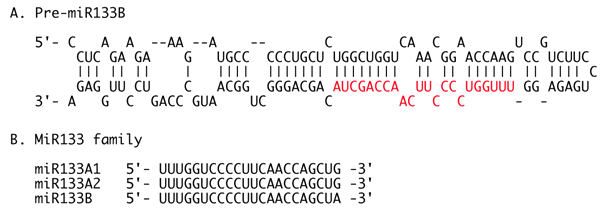
A. Homo sapiens stem-loop structure of pre-miR133B. Red characters indicate mature miR133B sequence. B. The human miR133 family members.
Description
Transcription
MiR133B is specifically modestly expressed in the substantia nigra pars compacta as well as in GABAergic neurons of cortex and cerebellum. The beginning and the end of the pri-miR133B sequence are unknown.
Pre-miR133B
miRBase accession number: MI0000822.
Length: 119 nucleotides.
Sequence:
5-CCTCAGAAGAAAGATGCCCCCTGCTCTGGCTGGTCAAACGGAACCAAGTCCGTCTTCCTGAGAGGTTTGGTCCCCTTCAACCAGCTACAGCAGGGCTGGCAATGCCCAGTCCTTGGAGA-3
Mature miR133B
miRBase accession number: MIMAT0000770.
Length: 22 nucleotides.
Sequence:
5-TTTGGTCCCCTTCAACCAGCTA-3
Pre-miR133B
miRBase accession number: MI0000822.
Length: 119 nucleotides.
Sequence:
5-CCTCAGAAGAAAGATGCCCCCTGCTCTGGCTGGTCAAACGGAACCAAGTCCGTCTTCCTGAGAGGTTTGGTCCCCTTCAACCAGCTACAGCAGGGCTGGCAATGCCCAGTCCTTGGAGA-3
Mature miR133B
miRBase accession number: MIMAT0000770.
Length: 22 nucleotides.
Sequence:
5-TTTGGTCCCCTTCAACCAGCTA-3
Pseudogene
Pseudogenes were not reported.
Proteins
Note
MicroRNAs are not translated into aminoacids.
Implicated in
Entity name
Bladder cancer
Note
Prognosis
Dyrskjøt et al. identified several miRNAs with prognostic potential for predicting bladder tumor progression (e.g., miR-129, miR-133b, and miR-518c*) (Dyrskjøt et al., 2009). miR-133a and miR-133b were found to inhibit cell proliferation, migration and invasion in T24 and EJ cells. The first evidence was provided that miR-133a and miR-133b may directly target the epidermal growth factor receptor in bladder cancer (Zhou et al., 2012).
Entity name
Cervical carcinoma
Note
Oncogenesis
miR-133b enhances cell proliferation and colony formation by targeting mammalian sterile 20-like kinase 2 (MST2), cell division control protein 42 homolog (CDC42) and ras homolog gene family member A (RHOA), which subsequently results in activation of the tumorigenic protein kinase B alpha (AKT1) and mitogen-activated protein kinase (ERK1 and ERK2, here abbreviated as ERK) signaling pathways. Upregulation of miR-133b in cervical carcinoma cells strongly promotes both in vivo tumorigenesis and independent metastasis to the mouse lung (Qin et al., 2012).
Entity name
Colorectal cancer
Note
Downregulation of miR-133b expression was significant in human colorectal cancer tissues compared with adjacent normal tissues. Ectopic expression of miR-133b potently affected colorectal cancer cell proliferation and apoptosis in vitro and in vivo by direct targeting of the receptor tyrosine kinase MET (Hu et al., 2010). Overexpression of miR-145, miR-1, miR-146a, miR-576-5p, miR-126*, HS287, miR-28-5p, miR-143, miR-199b-5p, miR-199a-5p, miR-10b, miR-22, miR-133b, miR-145*, miR-199a, miR-133a, miR-125b and downregulation of miR-31 and HS170 were observed in brain-metastatic colorectal carcinomas (Li et al., 2012).
Prognosis
High expression of miR-185 and low expression of miR-133b were correlated with poor survival (p=0.001 and 0.028, respectively) and metastasis (p=0.007 and 0.036, respectively) in colorectal cancer. (Akçakaya et al., 2011).
Entity name
Gastric cancer
Note
The most highly expressed miRNAs in non-tumorous tissues were miR-133b as well as miR-768-3p, miR-139-5p, miR-378, miR-31, miR-195, miR-497, compared to in gastric cancer tissues (Guo et al., 2009). miR-133b was downregulated in high-grade gastrointestinal stromal tumors. Fascin-1 mRNA was upregulated in accordance with miR-133b downregulation in high-grade gastrointestinal stromal tumors; this result was consistent with a previous report showing that fascin-1 might be a direct target of miR-133b (Yamamoto et al., 2013). miR-133b targets FGFR1 and inhibits gastric cancer cell growth (Wen et al., 2013).
Entity name
Lung cancer
Prognosis
MiR-133B had the lowest expression of miRNA in lung tumor tissue compared to adjacent uninvolved tissue. Selective over-expression of miR-133B in adenocarcinoma (H2009) cell lines resulted in reduced expression of MCL-1 and BCL2L2. MiR-133B directly targets the 3UTRs of both MCL-1 and BCL2L2. Lastly, over-expression of miR-133B induced apoptosis following gemcitabine exposure in these tumor cells (Crawford et al., 2009). miR-133b can inhibit cell growth of NSCLC through targeting EGFR and regulating its downstream signaling pathway (Liu et al., 2012).
Oncogenesis
Serum miR-206 and miR-133b were significantly up-regulated in the early stage of 4-(methylnitrosamino)-1-(3-pyridyl)-1-butanone-induced lung carcinogenesis. miR-206 and miR-133b exhibited low-expression in lung cancer tissues (Wu et al., 2013).
Entity name
Note
Entity name
Prostate cancer
Note
miR-133a and miR-133b are expressed at the detection limit in two hormone-insensitive prostate cancer cell lines, PC3 and DU145. Ectopic expression of miR-133 inhibited cell proliferation, migration and invasion in these cells, possibly by targeting EGFR (Tao et al., 2012). A significant lower expression of miR-1, miR-133b and miR-378* was observed in osteosarcomas with respect to control, and also in 31 high-grade osteosarcomas than in 25 low-grade and in metastatic versus non-metastatic patients. The expression of miR-1 and miR-133b may control cell proliferation and cell cycle through MET protein expression modulation (Novello et al., 2013).
Oncogenesis
Entity name
Squamous cell carcinoma
Note
MiR133B expression was downregulated in laser microdissected cells of tongue squamous cell carcinoma (Wong et al., 2008b). MiR-133b as well as miR-145, miR-30a-3p, and miR-133a are downregulated in esophageal squamous cell carcinoma (Kano et al., 2010).
Oncogenesis
Tongue squamous cell carcinoma cell lines transfected with miR133a and miR-133b precursors displayed reduction in proliferation rate possibly through the downregulation of pyruvate kinase type M2 (Wong et al., 2008a). Gain-of-function analysis revealed that 3 transfectants (miR-145, miR-133a and miR-133b) inhibit cell proliferation and cell invasion in esophageal squamous cell carcinoma cells (Kano et al., 2010). miR-133b, was downregulated in esophageal squamous cell carcinoma tissue compared with the adjacent normal tissue. Bioinformatics analyses identified that miR-133b was found to be involved in invasion and metastasis of esophageal squamous cell carcinoma (Fu et al., 2013).
Entity name
Muscular development
Note
miR-133b as well as miR-1, miR-133a, and miR-206 levels were found increased during late stages of human foetal muscle development. Increases in the expression levels of these miRNAs were proportional to the capacity of myoblasts to form myotubes. Changes in miRNA levels during human foetal development were accompanied by endogenous alterations in their known targets and also in their inducer, MyoD. Ectopic MyoD expression caused an induction of muscle cell differentiation in vitro, accompanied by an increase in the levels of miR-1, miR-133a, miR-133b and miR-206 (Koutsoulidou et al., 2011).
Entity name
Myocardial hypertrophy and heart failure.
Note
MiR133B expression was downregulated in the heart obtained from idiopathic cardiomyopathy and ischemic patients (Sucharov et al., 2008).
Disease
Down-regulation of miR-133b induced an increase in cardiomyocyte size while over-expression of miR-133b dramatically reduced the cell size, suggesting that miR-133b may be a global regulator of cardiomyocyte hypertrophy (Sucharov et al., 2008). Xiao et al. quantified the muscle-specific microRNA subtypes miR-133a and miR-133b, which can posttranscriptionally regulate and repress KvLQT1 protein expression without affecting mRNA expression (Xiao L et al., 2008). miR-1, miR-133a, miR-133b, and miR-208b were independently associated with high-sensitivity troponin T levels (all P
Article Bibliography
| Pubmed ID | Last Year | Title | Authors |
|---|---|---|---|
| 21573504 | 2011 | miR-185 and miR-133b deregulation is associated with overall survival and metastasis in colorectal cancer. | Akçakaya P et al |
| 19654003 | 2009 | MicroRNA 133B targets pro-survival molecules MCL-1 and BCL2L2 in lung cancer. | Crawford M et al |
| 19487295 | 2009 | Genomic profiling of microRNAs in bladder cancer: miR-129 is associated with poor outcome and promotes cell death in vitro. | Dyrskjøt L et al |
| 23516093 | 2013 | Altered miRNA expression is associated with differentiation, invasion, and metastasis of esophageal squamous cell carcinoma (ESCC) in patients from Huaian, China. | Fu HL et al |
| 19175831 | 2009 | Differential expression of microRNA species in human gastric cancer versus non-tumorous tissues. | Guo J et al |
| 20505319 | 2010 | miR-133b regulates the MET proto-oncogene and inhibits the growth of colorectal cancer cells in vitro and in vivo. | Hu G et al |
| 19378336 | 2009 | Identification of novel microRNA targets based on microRNA signatures in bladder cancer. | Ichimi T et al |
| 21351259 | 2010 | miR-145, miR-133a and miR-133b: Tumor-suppressive miRNAs target FSCN1 in esophageal squamous cell carcinoma. | Kano M et al |
| 21645416 | 2011 | Expression of miR-1, miR-133a, miR-133b and miR-206 increases during development of human skeletal muscle. | Koutsoulidou A et al |
| 22740910 | 2012 | microRNA expression profiles in human colorectal cancers with brain metastases. | Li Z et al |
| 22883469 | 2012 | MicroRNA-133b inhibits the growth of non-small-cell lung cancer by targeting the epidermal growth factor receptor. | Liu L et al |
| 23451058 | 2013 | Identification of novel AR-targeted microRNAs mediating androgen signalling through critical pathways to regulate cell viability in prostate cancer. | Mo W et al |
| 23133552 | 2012 | Modulation of the osteosarcoma expression phenotype by microRNAs. | Namløs HM et al |
| 23229283 | 2013 | miRNA expression profile in human osteosarcoma: role of miR-1 and miR-133b in proliferation and cell cycle control. | Novello C et al |
| 22532850 | 2012 | MiR-133b targets antiapoptotic genes and enhances death receptor-induced apoptosis. | Patron JP et al |
| 22179829 | 2012 | MicroRNA-133b is a key promoter of cervical carcinoma development through the activation of the ERK and AKT1 pathways. | Qin W et al |
| 18582896 | 2008 | miRNA expression in the failing human heart: functional correlates. | Sucharov C et al |
| 22407299 | 2012 | microRNA-133 inhibits cell proliferation, migration and invasion in prostate cancer cells by targeting the epidermal growth factor receptor. | Tao J et al |
| 23296701 | 2013 | miR-133b acts as a tumor suppressor and negatively regulates FGFR1 in gastric cancer. | Wen D et al |
| 21806992 | 2011 | Diagnostic and prognostic impact of six circulating microRNAs in acute coronary syndrome. | Widera C et al |
| 18451220 | 2008 | Mature miR-184 as Potential Oncogenic microRNA of Squamous Cell Carcinoma of Tongue. | Wong TS et al |
| 23337359 | 2013 | Alteration of serum miR-206 and miR-133b is associated with lung carcinogenesis induced by 4-(methylnitrosamino)-1-(3-pyridyl)-1-butanone. | Wu J et al |
| 18711016 | 2008 | Feedback remodeling of cardiac potassium current expression: a novel potential mechanism for control of repolarization reserve. | Xiao L et al |
| 23196799 | 2013 | Fascin-1 overexpression and miR-133b downregulation in the progression of gastrointestinal stromal tumor. | Yamamoto H et al |
| 23206218 | 2013 | MicroRNA-133 inhibits cell proliferation, migration and invasion by targeting epidermal growth factor receptor and its downstream effector proteins in bladder cancer. | Zhou Y et al |
Other Information
Locus ID:
NCBI: 442890
MIM: 610946
HGNC: 31759
Ensembl: ENSG00000199080
miRBase:
Variants:
dbSNP: 442890
ClinVar: 442890
TCGA: ENSG00000199080
COSMIC: MIR133B
RNA/Proteins
Expression (GTEx)
Pathways
| Pathway | Source | External ID |
|---|---|---|
| MicroRNAs in cancer | KEGG | hsa05206 |
| MicroRNAs in cancer | KEGG | ko05206 |
References
| Pubmed ID | Year | Title | Citations |
|---|---|---|---|
| 36717039 | 2023 | Exosomal lncRNA NEAT1 induces paclitaxel resistance in breast cancer cells and promotes cell migration by targeting miR-133b. | 7 |
| 38069061 | 2023 | BAP31-Mediated miR-206/133b Cluster Promotes Transendothelial Migration and Metastasis of Colorectal Cancer. | 2 |
| 36717039 | 2023 | Exosomal lncRNA NEAT1 induces paclitaxel resistance in breast cancer cells and promotes cell migration by targeting miR-133b. | 7 |
| 38069061 | 2023 | BAP31-Mediated miR-206/133b Cluster Promotes Transendothelial Migration and Metastasis of Colorectal Cancer. | 2 |
| 34115259 | 2022 | MiR-133a is a potential target for arterial calcification in patients with end-stage renal disease. | 3 |
| 35015112 | 2022 | Eight weeks of combined exercise training do not alter circulating microRNAs-29a, -133a, -133b, and -155 in young, healthy men. | 1 |
| 35048795 | 2022 | The miR-133b/brefeldin A-inhibited guanine nucleotide-exchange protein 1 (ARFGEF1) axis represses proliferation, invasion, and migration in cervical cancer cells. | 4 |
| 35545336 | 2022 | MiR-133b regulates the proliferation, colony formation, and invasion of bladder cancer cells via inhibiting SOX4. | 0 |
| 35638462 | 2022 | SQLE facilitates the pancreatic cancer progression via the lncRNA-TTN-AS1/miR-133b/SQLE axis. | 6 |
| 35861544 | 2022 | CircRNA circ_0005273 contributes to the cisplatin resistance of cervical cancer cells by sponging miR-133b. | 1 |
| 36181243 | 2022 | The long non-sacoding RNA TMEM147-AS1/miR-133b/ZNF587 axis regulates the Warburg effect and promotes prostatic carcinoma invasion and proliferation. | 3 |
| 36198257 | 2022 | Downregulation of Circ_0088196 Contributes to the Development of Trophoblastic Cells through miR-133b Sponging Function to Affect the AHNAK Expression. | 1 |
| 34115259 | 2022 | MiR-133a is a potential target for arterial calcification in patients with end-stage renal disease. | 3 |
| 35015112 | 2022 | Eight weeks of combined exercise training do not alter circulating microRNAs-29a, -133a, -133b, and -155 in young, healthy men. | 1 |
| 35048795 | 2022 | The miR-133b/brefeldin A-inhibited guanine nucleotide-exchange protein 1 (ARFGEF1) axis represses proliferation, invasion, and migration in cervical cancer cells. | 4 |
Citation
Hiroyuki Tsuchiya ; Li Wang
MIR133B (microRNA 133b)
Atlas Genet Cytogenet Oncol Haematol. 2013-06-01
Online version: http://atlasgeneticsoncology.org/gene/52086/mir133b-(microrna-133b)
