RET (REarranged during Transfection)
2020-06-01 Jean Loup Huret , Sylvie Yau Chun Wan-Senon AffiliationIdentity
Abstract
Review on RET gene and protein, a membrane tyrosine kinase receptor involved in various cancers, including papillary thyroid carcinoma, lung cancer, breast cancer, colorectal cancer, salivary glands cancer, skin melanomas\/spitz tumors and soft tissue sarcomas, but also in inherited diseases, including multiple endocrine neoplasia type 2, familial medullary thyroid carcinoma, familial pheochromocytoma predisposition, Hirschsprung disease, congenital central hypoventilation syndrome and renal hypodysplasia\/aplasia 1.
DNA/RNA
Transcription
Proteins
Description
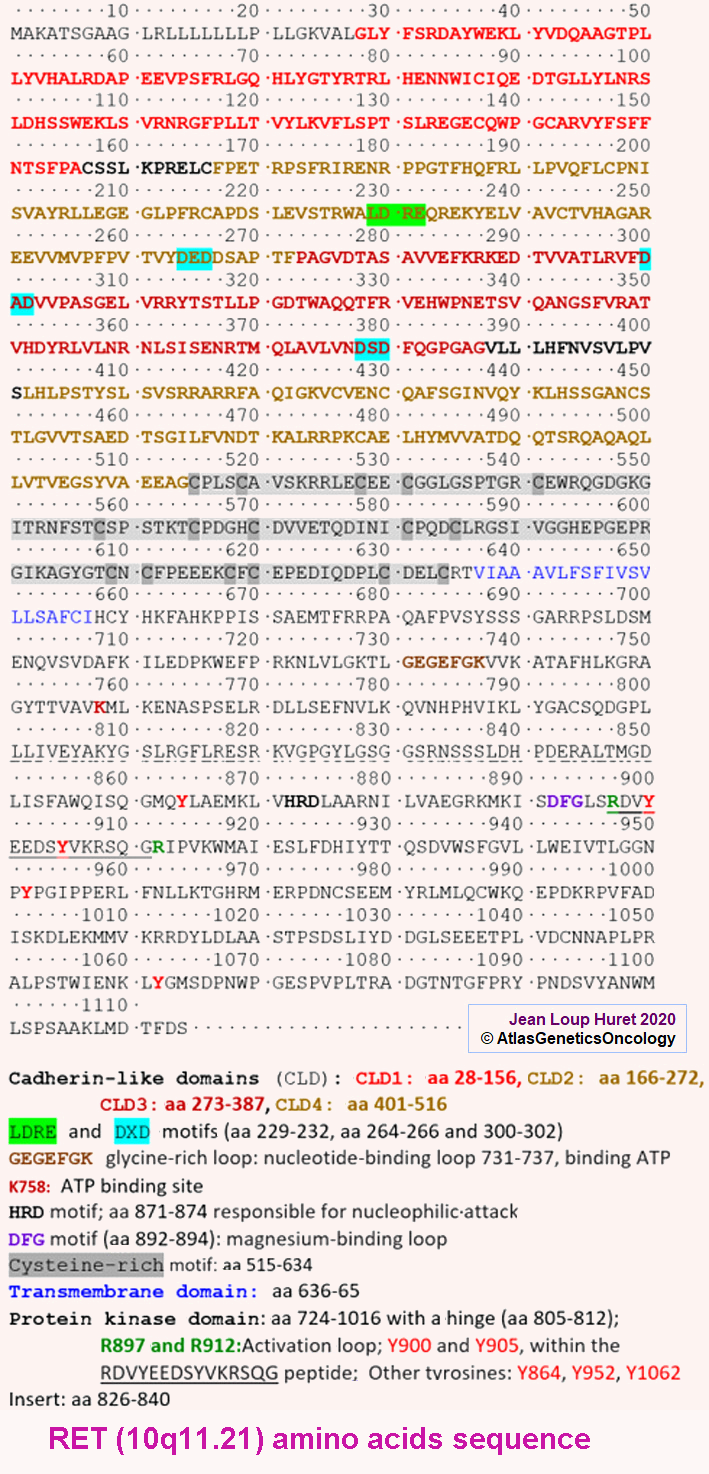
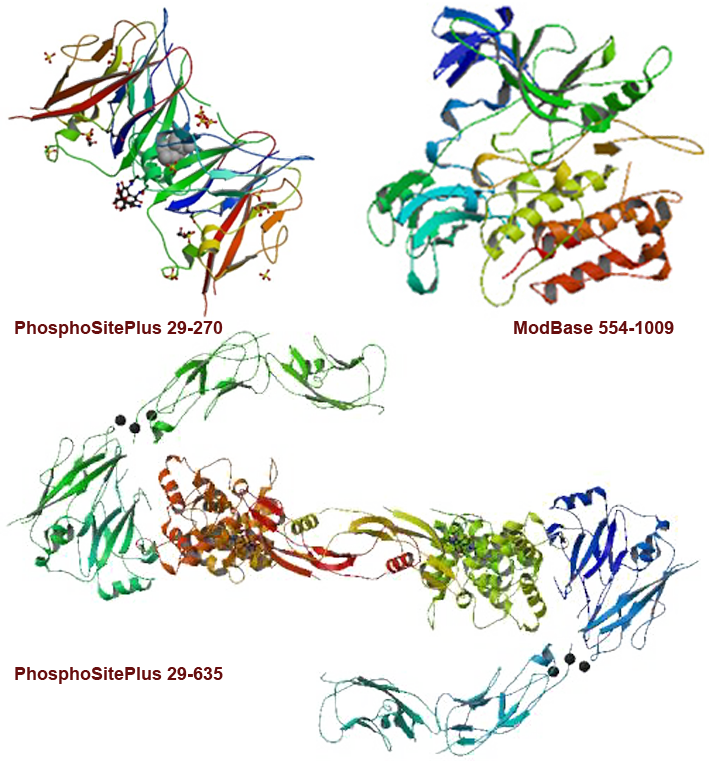
RET is composed of an extracellular region (amino acids (aa) 29-635, coded by exons 1-10, and part of exon 11), a transmembrane region (aa 636-657, coded by part of exon 11), and a cytoplasmic region (aa 658-1114 or 1072, coded by part of exon 11, and exon 12-19 or 12-20) (Figures 1 and 2).
RET has a Signal peptide (aa 1-28). RET contains a region of RET previously reported as having similarity to cadherins and named "cadherin domain" in databases (aa 168-272, coded by part of exon 3 and part of exon 4) and a bipartite protein kinase domain separated by a hinge (aa 805-812); (aa 724-1016, coded by part of exon 12, exons 13-18, and part of exon 19).
However, a detailed study shows that there are four cadherin-like domains (CLD): CLD1: aa 28-156 (exon 2 and part of exon 3), CLD2 aa 166-272 (part exon 3 and part of exon 4), CLD3 aa 273-387 (part exon 4, exon 5 and part of exon 6), CLD4: aa 401-516 (part exon 6, exon 7 and beginning of exon 8), with spacer sequences between CLD1 and CLD2 and between CLD3 and CLD4 (Anders et al., 2001).
There is a cysteine-rich domain (CRD, aa 515-634, coded by exons 8, 9, 10 and beginning of exon-11), and a calcium-binding sites (CA domain, aa 229-380, coded by part of exon 4, exon 5 and part of exon 6). The cysteine- rich domain is important for receptor dimerization. The cadherin domain adopts a β -sandwich fold, and calcium-binding sites are formed in between adjacent cadherin domains by the LDRE motif (aa 229-232) of CLD2 and the DXD motifs of CLD3 (aa 264-266 and 300-302). Ca2+ binding is required for the interaction of RET with GDNF.
Tyrosines: Tyrosine kinases usually have one or two tyrosines in the activation loop, in the case of RET there are two, Y900 and Y905, within the RDVYEEDSYVKRSQG peptide, both of which can be phosphorylated. Activation loop: Y905 is required for the transforming activity and signaling of RET-MEN2A mutations. The transforming activity of RET-MEN2B implicates Y864 or Y952. Y1062 is a multidocking site that interacts with a number of transduction molecules including SHC1, GRB2, FRS2, DOK4 / DOK5, IRS1 / IRS2, and PDLIM7. (Anders et al., 2001; Kouvaraki et al., 2005).
Other sites:
- GEGEFGK glycine-rich loop: nucleotide-binding loop 731-737, binding ATP
- K758: ATP binding site.
- DFG 892-894 motif: magnesium-binding loop
- R897 and R912: activation loop.
- HRD motif (aa 871-874) is responsible for nucleophilic attack (kinases lacking the HRD arginine are not phosphorylated in the activation loop). Activation loop phosphorylation can counteract the positive charge of the arginine in the catalytic loop by the HRD motif.
- Leucine rich: aa 11-22.
Other remarkable sites according to Prosite:
- Protein kinase C phosphorylation sites: aa 65 (phosphoserine), 75 (phosphothreonine), 110 (S), 131 (S), 159 (S), 173 (S), 224 (S), 295 (T), 328 (T), 413 (S), 492 (T), 522 (S), 538 (T), 561 (S), 675 (T), 811 (S), 819 (S)
- cAMP- and cGMP-dependent protein kinase phosphorylation sites: 315 (T), 696 (S)
- Casein kinase II phosphorylation sites: 104 (S), 131 (S), 261 (T), 350 (T), 363 (S), 456 (T), 457 (T), 564 (T), 670 (S), 729 (T), 765 (S), 836 (S), 847 (T), 922 (S), 930 (T), 1022 (T), 1034 (S), 1055 (T), 1078 (T)
- Tyrosine kinase phosphorylation site 2: 1089-1096: RypnDsvY
- N-myristoylation sites (role in membrane targeting): 28, 74, 275, 446, 453, 506, 514, 535, 550, 588, 601, 607, 810, 828, 830, 831, 1082
- N-glycosylation sites: 98, 151, 199, 336, 343, 361, 367, 377, 394, 448, 468, 554, 834, 975, 1092
- Amidation site XGRK (protects from proteolysis): 884-887.

Expression
Localisation
Function
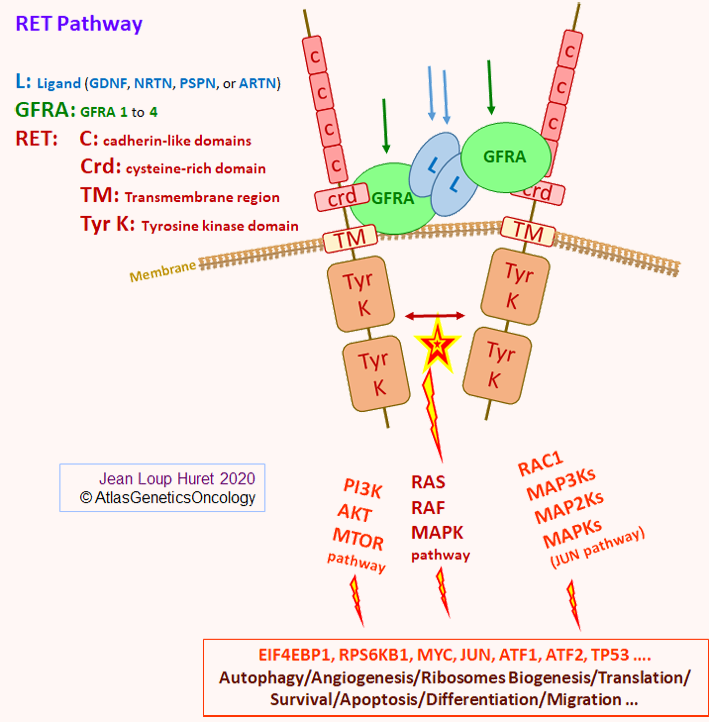
Co-receptors: the four RET ligands GDNF, NRTN, PSPN, and ARTN interact preferentially with GFRA1, GFRA2, GFRA3, and GFRA4, respectively. The ligand (e.g. NRTN) forms a homodimer with a cystine knot at its center and requires its co-receptor (e.g. GFRA2) to activate RET. The NRTN-GFRA2 complex is composed of a dimer of dimers with the NRTN homodimer at the center and two GFRA2 monomers attached (see figure 4). GFRAs are located in lipid rafts of the plasma membrane, and RET is recruited. GFRAs can come from the same cell as RET, or from a different cell. When the co-receptor is produced by the same cell as RET, it is termed cis signaling. When the co-receptor is produced by another cell, it is termed trans signaling. Cis and trans activation of RET can occur (Reactome).
RET binding: the NRTN-GFRA2 complex binds two copies of the RET extra cellular domain ("RET-ecd") (--> RET dimerization), thereby forming a heterohexamer. RET-ecd consists of four cadherin-like domains (RET-CLD1-4) and a cysteine-rich domain (RET-crd). RET-CLD2 and RET-CLD3 coordinate calcium ions that are critical for RET folding.
Signaling: RET dimerization results in tyrosine autophosphorylation on specific tyrosine residues. (e.g. GDNF-GFRA1-activated RET is autophosphorylated at tyrosine-sites, Y981, Y1015, Y1062, and Y1096 (Note: Y1096 in found only in RET51 isoform)). RET activates various signaling pathways, mainly through Y1062, such as PI3K/AKT/MTOR, RAS/RAF/MAPK, and JUN pathways to activate transcription factors, including EIF4EBP1, RPS6KB1, MYC, JUN, ATF1, ATF2, TP53) (Kouvaraki et al., 2005; Goodman et al., 2014; Bigalke et al., 2019).
The frequently mutated C634 in patients with MEN2A is part of the RET-crd, in which wild-type RET forms a disulfide bond with C630. The C634R mutation causes ligand-independent dimerization of RET (Goodman et al., 2014; Bigalke et al., 2019).
Phosphatases: Protein tyrosine phosphorylation is regulated by opposite activities of protein tyrosine kinases (PTKs) and phosphatases (PTPs). GDNF and GRB2 form a complex with the protein tyrosine phosphatase PTPRA. PTPRA dephosphorylates RET and inhibits the RET-RAS/RAF/MAPK signaling pathway. PTPRA also regulates the RET mutant found in MEN2A, whereas the MEN2B mutant is insensitive to PTPRA (Yadav et al., 2020). Other phosphatases are also known to balance the phosphorylation and oncogenic activity of RET: PTPRF, PTPN6 and PTPN11.
Feedback loop: ATF4 overexpression induces cell death. ATF4 promotes RET degradation and inhibits RET signaling pathways. In a feedback loop, RET represses expression of the ATF4 target proapoptotic genes PMAIP1 (known as NOXA) and BBC3 (PUMA) through phosphorylation-dependent degradation of ATF4 (Bagheri-Yarmand et al. 2015; Bagheri-Yarmand et al. 2017).
Mutations
Note
RET role in the tumor microenvironment: The tumor microenvironment (TME) consists of extracellular matrix, mesenchymal cells (i.e., fibroblasts, pericytes, adipocytes and other stromal cells), immune-inflammatory cells, blood and lymphatic vessels particularly in the perineural environment. Activation of the RET pathway has been found to be responsible for high expression and activation of cancer-associated fibroblasts-related proinflammatory proteins including cytokines, chemokines and their receptors (e.g. CCL2, CXCR4, CXCL8 (also called IL8), CXCL12, CCL20, CSF1, CSF2RA (GM-CSF), CSF3 (G-CSF), IL1B, SPP1). Cancer-associated fibroblasts promote tumorigenesis and metastasis, tumor angiogenesis and recruitment of immune-inflammatory cells (reviews in Castellone and Melillo 2018; Mulligan 2019).
Germinal
MEN2A/ MEN2B/ FMTC: 199 variants are described in MEN2 database (https://arup.utah.edu/database/MEN2/MEN2_display.php), of which 82 are said pathogenic. Mutations are dispersed through exons 7 to 16, many of them occurring in exons 10 or 11, in the cysteine rich domain: C609, C611, C618, C620 (exon 10), C630, D631, C634, T636, K666, D707 (exon 11). Other mutations are E505 (exon 7), C515, C531, G533, G548 (exon 8), E768, L790, Q781 (exon 13), V804 (exon 14), A883, S891, S904 (exon 15), M918, R912 (exon 16). The more common disease phenotype-specific mutations found in MEN2 are: E768D, L790F, Y791F, S891A, V804M/L (FMTC) and A883F, M918T (MEN2B). M918T catalytic domain mutants enhances autophosphorylation kinetics. M918T is a well characterized MEN2 mutation, and it correlates with the most aggressive and consistent disease phenotype (i.e. MEN2B) (Plaza-Menacho, 2017).
Somatic
According to the review by Subbiah and Cote, 2020, the frequencies of somatic RET translocations/fusion genes and mutations associated with oncogenesis are the following: medullary thyroid cancer: 60-90%, papillary thyroid cancer: 10-20%, urothelial carcinoma: 16.7%, basal cell carcinoma: 12.5%, meningioma: 5.6%, non-small cell lung carcinoma: 1-2%, ovarian epithelial carcinoma: 1.9%, esophageal carcinoma: 1.4%, colorectal carcinoma: 0.7%, gastric adenocarcinoma: 0.7% , melanoma: 0.7%, and breast carcinoma: 0.2%,
in a series of 32,989 advanced cancers RET alterations included 143 in-frame fusions found in 141 patients and 33 single-nucleotide variants (SNV) resulting in an amino acid substitution found in 29 patients. RET fusions were most prevalent among patients with non-small cell lung carcinoma (NSCLC), thyroid cancer, or colorectal cancer. Seven different fusion partners (KIF5B, CCDC6, NCOA4, TRIM24, TRIM33, ERC1, APAF1) were observed. The most common fusion partner was KIF5B, which was only observed in NSCLC (n = 75) (Rich et al., 2019).
Copy number variations according to Genomic Data Commons Data Portal are: CNV gains in: sarcomas (11% of cases, rounded numbers), ovarian serous cystadenocarcinoma (10%), lung squamous cell carcinoma (8%), bladder urothelial carcinoma (7%), breast carcinoma (6%), lung adenocarcinoma (6%), esophageal carcinoma (6%), cholangiocarcinoma (6%), uterine carcinosarcoma (5%), adrenocortical carcinoma (4%), head and neck squamous cell carcinoma (4%), gastric adenocarcinoma (3%), hepatocellular carcinoma (3%), glioblastoma multiforme (3%), uterine endometrial carcinoma (2%), cervical carcinoma (2%), skin cutaneous melanoma (2%), colorectal adenocarcinoma (1-2%), pancreatic adenocarcinoma (1 %); CNV losses in: ovarian serous cystadenocarcinoma (9%), sarcomas (6%), uterine carcinosarcoma (5 %), bladder urothelial carcinoma (5%), mesothelioma (4%), esophageal carcinoma (3%), prostate adenocarcinoma (3%), breast carcinoma (3%), adrenocortical carcinoma (2%), uterine endometrial carcinoma (2%), head and neck squamous cell carcinoma (2%),cervical carcinoma (2%), gastric adenocarcinoma (2%), lung adenocarcinoma (1%), colon adenocarcinoma (1%), hepatocellular carcinoma (1%), lung squamous cell carcinoma (1%).
Kohno et al, 2020 reviewed the mutations and fusion genes involving RET in various cancers detected in two large studies (Project Genie and TCGA PanCancer Atlas Studies):
Mutations: medullary thyroid carcinoma: 55% of cases presented a mutation in RET; breast carcinoma: 8%; of cases parathyroid carcinoma: 6 %; pheochromocytoma: 3.4 - 4.0%; T-cell lymphoblastic leukemia: 3%; lung carcinoma (neuroendocrine): 3%; upper tract urothelial carcinoma: 0,4%; uterine endometrioid carcinoma (serous/papillary serous): 0,3%.
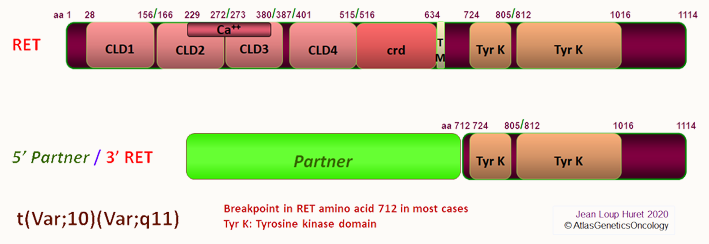
Translocations/fusion genes: RET translocations/fusion genes result in hybrid genes and proteins (Figure 5) with constitutive dimerization and activation of RET pathways. RET translocations/fusion genes were found in: papillary thyroid carcinoma, where 1.4 - 4.4% of cases presented a gene fusion implicating RET; poorly differentiated thyroid carcinoma: 3% of cases; pleomorphic lung carcinoma: 2.5%; thyroid carcinoma (hurthle cell): 2%; anaplastic thyroid carcinoma: 1%; lung adenocarcinoma: 0.2 - 0.6%; poorly differentiated non-small cell lung carcinoma: 0.5%; colon adenocarcinoma 0.26%; gastric adenocarcinoma 0.2%; serous ovarian carcinoma: 0,17%; non-small cell lung carcinoma: 0,16%.
TABLE 1: RET and 73 translocations/fusion partners
| RET Partner Gene | Chrom. | Location: band (bp) | Translocation / fusion gene | Disease |
| TRIM33 | 1 | 1p13.2 (114392777) | t(1;10)(p13;q11) TRIM33/RET | Lung: non-small cell lung carcinoma |
| Thyroid: papillary thyroid carcinoma | ||||
| RASAL2 | 1q25.2 (178093729) | t(1;10)(q25;q11) RASAL2/RET | Soft tissue sarcoma | |
| EML4 | 2 | 2p21 (42169338)) | t(2;10)(p21;q11) EML4/RET | Lung: non-small cell lung carcinoma |
| EML6 | 2p16.1 (54725012 | t(2;10)(p16;q11) EML6/RET | Lung: non-small cell lung carcinoma | |
| TFG | 3 | 3q12.2 (100709331) | t(3;10)(q12;q11) TFG/RET | Soft tissues: spindle cell tumors |
| TBL1XR1 | 3q26.32 (177019355) | t(3;10)(q26;q11) TBL1XR1/RET | Thyroid: papillary thyroid carcinoma | |
| EPHA5 | 4 | 4q13.1 (65319563) | t(4;10)(q13;q11) APHA5/RET | Lung: non-small cell lung carcinoma |
| SQSTM1 | 5 | 5q35.3 (179820842) | t(5;10)(q35;q11) SQSTM1/RET | Thyroid: papillary thyroid carcinoma |
| KIF13A | 6 | 6p22.3 (17763693) | t(6;10)(p22;q11) KIF13A/RET | Lung: adenocarcinoma |
| TRIM27 | 6p22.1 (28903002) | t(6;10)(p22;q11) TRIM27/RET | Salivary glands: intraductal carcinoma | |
| Thyroid: papillary thyroid carcinoma | ||||
| Neuro-endocrine tumor: multiple endocrine neoplasia | ||||
| TBC1D32 | 6q22.31 (121079494) | t(6;10)(q22;q11) TBC1D32/RET | Lung: adenocarcinoma | |
| PTPRK | 6q22.33 (127968779) | t(6;10)(q22;q11) PTPRK/RET | Lung: non-small cell lung carcinoma | |
| FGFR1OP | 6q27 (166,999,317) | t(6;10)(q27;q11) FGFR1OP/RET | Chronic myeloproliferative neoplasm | |
| CLIP2 | 7 | 7q11.23 (74289475) | t(7;10)(q11;q11) CLIP2/RET | Soft tissues: spindle mesenchymal neoplasm |
| CUX1 | 7q22.1 (101817602) | t(7;10)(q22,q11) CUX1/RET | Lung: non-small cell lung carcinoma | |
| TRIM24 | 7q33 (138460334) | t(7;10)(q33;q11) TRIM24/RET | Lung: non-small cell lung carcinoma | |
| Thyroid: papillary thyroid carcinoma | ||||
| TAS2R38 | 7q34 (141972631) | t(7;10)(q34;q11) TAS2R38/RET | Thyroid: papillary thyroid carcinoma | |
| PCM1 | 8 | 8p22 (17922857) | t(8;10)(p22;q11) PCM1/RET | Lung: non-small cell lung carcinoma |
| Thyroid: papillary thyroid carcinoma | ||||
| RBPMS | 8p12 (30384501) | t(8;10)(p12;q11) RBPMS/RET | Lung: non-small cell lung carcinoma | |
| HOOK3 | 8p11.21 (42896890) | t(8;10)(p11;q11) HOOK3/RET | Thyroid: papillary thyroid carcinoma | |
| FKBP15 | 9 | 9q32 (113165520) | t(9;10)(q32;q11) FKBP15/RET | Thyroid: papillary thyroid carcinoma |
| PRKCQ | 10 | 10p15.1 (6427143) | t(10;10)(p15;q11) PRKCQ/RET | Lung: non-small cell lung carcinoma |
| TAF3 | 10p14 (7818504) | t(10;10)(p14;q11) TAF3/RET | Thyroid: papillary thyroid carcinoma | |
| CCDC3 | 10p13 (12896625) | t(10;10)(p13;q11) CCDC3/RET | Lung: non-small cell lung carcinoma | |
| PRPF18 | 10p13 (13586939) | t(10;10)(p13;q11) PRPF18/RET | Lung: non-small cell lung carcinoma | |
| FRMD4A | 10p13 (13643706) | t(10;10)(p13;q11) FRMD4A/RET | Lung: non-small cell lung carcinoma | |
| KIAA1217 | 10p12.2 (24208791) | t(10;10)(p12;q11) KIAA1217/RET | Lung: adenocarcinoma | |
| Soft tissues: spindle mesenchymal neoplasm | ||||
| ANKRD26 | 10p12.1 (27004116) | t(10;10)(p12,q11) ANKRD26/RET | Thyroid: papillary thyroid carcinoma | |
| ACBD5 | 10p12.1 (27195214) | t(10;10)(p12;q11) ACBD5/RET | Thyroid: papillary thyroid carcinoma | |
| WAC | 10p12.1 (28533492) | t(10;10)(p12;q11) WAC/RET | Lung: non-small cell lung carcinoma | |
| ARHGAP12 | 10p11.22 (31805398) | t(10;10)(p11;q11) ARHGAP12/RET | Lung: non-small cell lung carcinoma | |
| KIF5B | 10p11.22 (32009010 ) | t(10;10)(p11;q11) KIF5B/RET | Lung: non-small cell lung carcinoma | |
| Skin: melanomas/Spitz tumors | ||||
| Thyroid: papillary thyroid carcinoma | ||||
| PARD3 | 10p11.22 (34109560) | t(10;10)(p11;q11) PARD3/RET | Lung: non-small cell lung carcinoma | |
| CCNYL2 | 10q11.21 (42408174) | CCNYL2/RET (10q11) | Lung: non-small cell lung carcinoma | |
| RASGEF1A | 10q11.21 (43194533) | RASGEF1A/RET (10q11) | Breast cancer | |
| RASSF4 | 10q11.21 (44959771) | RASSF4/RET (10q11) | Lung: non-small cell lung carcinoma | |
| NCOA4 | 10q11.23 (46005088) | NCOA4/RET (10q11) | Breast cancer | |
| Colorectal cancer | ||||
| Lung: adenocarcinoma | ||||
| Ovary: Germ cell tumours | ||||
| Salivary glands: intraductal carcinoma | ||||
| Soft tissues: spindle cell tumors | ||||
| Thyroid: papillary thyroid carcinoma | ||||
| PRKG1 | 10q11.23 (51074474) | PRKG1/RET (10q11) | Lung: non-small cell lung carcinoma | |
| ANK3 | 10q21.2 (60026298) | t(10;10)(q11;q21) ANK3/RET | Thyroid: papillary thyroid carcinoma | |
| SLC16A9 | 10q21.2 (59650764) | t(10;10))(q11;q21) SLC16A9/RET | Thyroid: papillary thyroid carcinoma | |
| CCDC6 | 10q21.2 (59788748) | t(10;10)(q11;q21) CCDC6/RET | Colorectal cancer | |
| Lung: non-small cell lung carcinoma | ||||
| Thyroid: papillary thyroid carcinoma | ||||
| CTNNA3 | 10q21.3 (65912518) | t(10;10)(q11;q21) CTNNA3/RET | Lung: non-small cell lung carcinoma | |
| SIRT1 | 10q21.3 (67884669) | t(10;10)(q11;q21) SIRT1/RET | Lung: non-small cell lung carcinoma | |
| RUFY2 | 10q21.3 (68343518) | t(10;10)(q11;q21) RUFY2/RET | Lung: non-small cell lung carcinoma | |
| Thyroid: papillary thyroid carcinoma | ||||
| DYDC1 | 10q23.1 (80336106) | t(10;10)(q11;q23) DYDC1/RET | Lung: non-small cell lung carcinoma | |
| SORBS1 | 10q24 (110005804) | t(10;10)(q11;q24) SORBS1/RET | Lung: non-small cell lung carcinoma | |
| ADD3 | 10q25.1 (114161608) | t(10;10)(q11;q25) ADD3/RET | Lung: non-small cell lung carcinoma | |
| CCDC186 | 10q25.3 (114294824) | t(10;10)(q11;q25) CCDC186/RET | Lung: non-small cell lung carcinoma | |
| AFAP1L2 | 10q25.3 (126905409) | t(10;10)(q11;q25) AFAP1L2/RET | Thyroid: papillary thyroid carcinoma | |
| DOCK1 | 10q26.2 (126905409) | t(10;10)(q11;q26) DOCK1/RET | Lung: non-small cell lung carcinoma | |
| CLRN3 | 10q26.2 (127877841) | t(10;10)(q11;q26) CLRN3/RET | Thyroid: papillary thyroid carcinoma | |
| PPFIBP2 | 11 | 11p15.4 (7513765) | t(10;11)(q11;p15) PPFIBP2/RET | Thyroid: papillary thyroid carcinoma |
| PICALM | 11q14.2 (85957171) | t(10;11)(q11;q14) PICALM/RET | Lung: non-small cell lung carcinoma | |
| ETV6 | 12 | 12p13.2 (11649854) | t(10;12)(q11;p13) ETV6/RET | Salivary glands: mammary analog secretory carcinoma |
| ERC1 | 12q13.33 (991208 ) | t(10;12)(q11;q13) ERC1/RET | Breast cancer | |
| Lung: non-small cell lung carcinoma | ||||
| Thyroid: papillary thyroid carcinoma | ||||
| ANKS1B | 12q23.1 (98743974) | t(10;12)(q11;q23) ANKS1B/RET | Lung: non-small cell lung carcinoma | |
| CLIP1 | 12q24.31 (122271434) | t(10;12)(q11;q24) CLIP1/RET | Lung: non-small cell lung carcinoma | |
| TSSK4 | 14 | 14q12 (24205720) | t(10;14)(q11;q12) TSSK4/RET | Lung: non-small cell lung carcinoma |
| KTN1 | 14q22.3 (55580207) | t(10;14)(q11;q22) KTN1/RET | Thyroid: papillary thyroid carcinoma | |
| CCDC88C | 14q32.11 (91271323) | t(10;14)(q11;q32) CCDC88C/RET | Lung: non-small cell lung carcinoma | |
| GOLGA5 | 14q32.12 (92794231) | t(10;14)(q11;q32) GOLGA5/RET | Skin: melanomas/Spitz tumors | |
| Thyroid: papillary thyroid carcinoma | ||||
| MYO5C | 15 | 15q21.2 (52192318) | t(10;15)(q11;q21) MYO5C/RET | Lung: non-small cell lung carcinoma |
| AKAP13 | 15q25.3 (85380616) | t(10;15)(q11;q25) AKAP13/RET | Thyroid: papillary thyroid carcinoma | |
| MYH10 | 17 | 17p13.1 (8474205) | t(10;17)(q11;p13) MYH10/RET | Soft tissues: Infantile myofibromatosis |
| Soft tissues: spindle mesenchymal neoplasm | ||||
| MYH13 | 17p13.1 (10300866) | t(10;17)(q11;p13) MYH13/RET | Thyroid: papillary thyroid carcinoma | |
| MPRIP | 17p11.2 (17042760) | t(10;17)(q11;p11) MPRIP/RET | Lung: non-small cell lung carcinoma | |
| PRKAR1A | 17q24.2 (68512379) | t(10;17)(q11;q24) PRKAR1A/RET | Lung: non-small cell lung carcinoma | |
| Neuro-endocrine tumor | ||||
| RELCH (KIAA1468) | 18 | 18q21.33 (62187291) | t(10;18)(q11;q21) KIAA1468/RET | Lung: adenocarcinoma |
| Lung: non-small cell lung carcinoma | ||||
| Thyroid: papillary thyroid carcinoma | ||||
| LSM14A | 19 | 19q13.11 (34172447) | t(10;19)(q11;q13) LSM14A/RET | Lung: adenocarcinoma |
| RRBP1 | 20 | 20p12.1 (17613678) | t(10;20)(q11;p12) RRBP1/RET | Colorectal cancer |
| BCR | 22 | 22q11.23 (23180365) | t(10;22)(q11;q11) BCR/RET | Chronic myeloproliferative neoplasm |
| SPECC1L | 22q11.23 (24270817) | t(10;22)(q11;q11) SPECC1L/RET | Thyroid: papillary thyroid carcinoma | |
| TIMP3 | 22q12.3 (32800816) | t(10;22)(q11 ;q12) TIMP3/RET | Soft tissues: Inflammatory myofibroblastic tumor |
Implicated in
RET mutations in pheochromocytoma are mainly found in exons 10, 11, 13 and 16. Carriers of codon 634 germline mutations present with much younger mean age of onset, and have a higher risk of developing pheochromocytomas.
Expression and penetrance of a RET mutation is variable and sex dependent (penetrance is 70% in males and 50% in females). More than 80 mutations have been identified, in particular: S32L, Y36C, L40P, P64L, L72P, R77C, G93S, L123F, A143G, C197Y, R231H, D264K, R287K, D300K, D300N, F329FfsX24, R330Q, R330N, R360W, P399L, R418X, D469N, R475Q, C611G, C620Y, all in the extracellular region (Anders et al., 2001; Butler Tjaden et al., 2013; Plaza-Menacho, 2017; Lorente-Ros et al., in press).
RET translocations/fusion genes have been described in 20-40% of patients with papillary thyroid carcinoma, with higher frequency in radiation-exposed patients and mutations in RET have been reported in 40-70% of patients with medullary thyroid carcinoma (Kato et al., 2017)
Medullary thyroid cancer: Amplification: 30% of medullary thyroid carcinomas harbour RET gene amplification with no alterations in chromosome 10 or a polysomy of chromosome 10, in variable percentage of cells, suggesting cell heterogeneity. RET copy number alterations can be considered a poor prognostic factor potentiating the poor prognostic role of RET mutation (Ciampi et al., 2012). Mutations: The far most frequent mutation in medullary thyroid cancer is M918T. Other mutations are: D631_L633delinsE, D631_L633delinsA, E632_L633del, C634R (cBioPortal). ATF4 promotes RET degradation. Low ATF4 expression correlates with poor overall survival of patients with MTC (Bagheri-Yarmand et al. 2017).
Papillary thyroid cancer: The most common rearrangements are translocation/fusion gene t(10;10)(q11;q21) CCDC6/RET and fusion gene NCOA4/RET, accounting for about 90%. Translocations/fusion genes in papillary thyroid cancer: t(1;10)(p13;q11) TRIM33/RET, t(3;10)(q26;q11) TBL1XR1/RET, t(5;10)(q35;q11) SQSTM1/RET, t(6;10)(p22;q11) TRIM27/RET, t(7;10)(q33;q11) TRIM24/RET, t(7;10)(q34;q11) TAS2R38/RET, t(8;10)(p22;q11) PCM1/RET, t(8;10)(p11;q11) HOOK3/RET, t(9;10)(q32;q11) FKBP15/RET, t(10;10)(p14;q11) TAF3/RET, t(10;10)(p12,q11) ANKRD26/RET, t(10;10)(p12;q11) ACBD5/RET, t(10;10)(p11;q11) KIF5B/RET, t(10;11)(q11;p15) PPFIBP2/RET, NCOA4/RET (10q11), t(10;10)(q11;q21) ANK3/RET, t(10;10))(q11;q21) SLC16A9/RET, t(10;10)(q11;q21) CCDC6/RET, t(10;10)(q11;q21) RUFY2/RET, t(10;10)(q11;q25) AFAP1L2/RET, t(10;10)(q11;q26) CLRN3/RET, t(10;12)(q11;q13) ERC1/RET, t(10;14)(q11;q22) KTN1/RET, t(10;14)(q11;q32) GOLGA5/RET, t(10;15)(q11;q25) AKAP13/RET, t(10;17)(q11;p13) MYH13/RET, t(10;18)(q11;q21) RELCH/RET, t(10;22)(q11;q11) SPECC1L/RET (PMID 8634704, 10337992, 10439047, 10741739, 10850414, 10980597, 11156407, 16946010, 17639057, 25175022, 25204415, 25417114, 25500544, 25546157, 27683183, 28351223, 28911147, 30466862, 31425920, 31715421 and data from Atlas Band 10q11 ).
Poorly differentiated thyroid cancer: mutation A1105V was found, and also translocations/fusion genes t(3;10)(q12;q11)TFG/RET, t(3;10)(q26;q11) PDCD10/RET and t(10;10)(q11;q21) CCDC6/RET.
RET translocations/fusion genes have been reported in 1% to 2% of patients with non-small cell lung cancer. Most cases of RET fusion-positive NSCLCs are adenocarcinoma, although Cai et al., 2013 screening 392 patients with NSCLC found 6 patients (1.5%) with a KIF5B/RET fusion: 4 had adenocarcinoma, 1 had a malignant neuroendocrine tumor, and 1 had squamous cell carcinoma. However, a meta-analysis of 165 patients with RET-rearranged NSCLC from 29 centers across Europe, Asia, and the United States was conducted. Median age was 61 years (range, 29 to 89 years). The majority of patients were never smokers (63%) with lung adenocarcinomas (98%); squamous cell (1%) and advanced disease (91%). The most frequent rearrangement was KIF5B/RET (72%); CCDC6/RET was found in 19 patients (23%), NCOA4/RET in two patients (2%), EPHA5/RET in one patient (1%), and PICALM/RET in one patient (1%) (Gautschi et al., 2017). In a study screening 1139 lung adenocarcinoma patients, ALK fusions were detected in 5.1% of cases, RET fusions in 1.3%, and ROS1 fusions in 1%. No significant difference in survival was observed between fusion-positive and fusion-negative patients (Pan el al., 2014). RET mutations in small-cell (neuroendocrine) lung cancer is extremely rare (Rudin et al., 2014).
A study on non-small-cell lung cancer showed RET amplification in 3%, low RET gene copy number gain in 8%, and RET over expression in 8% of cases (Platt et al., 2015).
RET translocations/fusion genes in NSCLC: t(1;10)(p13;q11) TRIM33/RET, t(2;10)(p21;q11) EML4/RET, t(2;10)(p16;q11) EML6/RET, t(4;10)(q13;q11) APHA5/RET, t(6;10)(p22;q11) KIF13A/RET, t(6;10)(q22;q11) TBC1D32/RET, t(6;10)(q22;q11) PTPRK/RET, t(7;10)(q22,q11) CUX1/RET, t(7;10)(q33;q11) TRIM24/RET, t(8;10)(p22;q11) PCM1/RET, t(8;10)(p12;q11) RBPMS/RET, t(10;10)(p13;q11) CCDC3/RET, t(10;10)(p13;q11) PRPF18/RET, t(10;10)(p13;q11) FRMD4A/RET, t(10;10)(p12;q11) KIAA1217/RET, t(10;10)(p12;q11) WAC/RET, t(10;10)(p11;q11) PRKCQ/RET, t(10;10)(p11;q11) ARHGAP12/RET, t(10;10)(p11;q11), KIF5B/RET, t(10;10)(p11;q11) PARD3/RET, CCNYL2/RET (10q11), RASSF4/RET (10q11), NCOA4/RET (10q11), PRKG1/RET (10q11), t(10;10)(q11;q21) CCDC6/RET, t(10;10)(q11;q21) CTNNA3/RET, t(10;10)(q11;q21) SIRT1/RET, t(10;10)(q11;q21) RUFY2/RET, t(10;10)(q11;q23) DYDC1/RET, t(10;10)(q11;q24) SORBS1/RET, t(10;10)(q11;q25) ADD3/RET, t(10;10)(q11;q25) CCDC186/RET, t(10;10)(q11;q26) DOCK1/RET, t(10;11)(q11;q14) PICALM/RET, t(10;12)(q11;q13) ERC1/RET, t(10;12)(q11;q23) ANKS1B/RET, t(10;12)(q11;q24) CLIP1/RET, t(10;14)(q11;q12) TSSK4/RET, t(10;14)(q11;q32) CCDC88C/RET, t(10;15)(q11;q21) MYO5C/RET, t(10;17)(q11;p11) MPRIP/RET, t(10;17)(q11;q24) PRKAR1A/RET, t(10;18)(q11;q21) KIAA1468/RET, t(10;19)(q11;q13) LSM14A/RET (PMID 22327623, 23150706, 23533264, 27150058, 28115111, 28851076, 29571998, 29935851, 30429449, 30579554, 32127187, 32216946, Ignatius Ou and Zhu, in press, and data from Atlas Band 10q11).
mutations in lung adenocarcinoma: L56M, E61K, T75K, R77C, R77L, H103N, L109I, X113_splice, K124*, E164K, P181H, E251Q, D290N, R297L, T350N, H352P, R355M, Q371K, V374M, L375Q, S406R, X421_splice, E428G, G453W, D460V, A479S, M484T, R494M, A496G, G506W, A510S, A513E, C541F, P560H, P566T, D567Y, X587_splice, G588D, G593R, C611S, V648I, F719L, P720L, V739F, V755L, V757M, M759I, N763K, P766Q, L790*, G798V, A807P, R817H, D839N, M848V, Q860P, S891*, E901K, S932N, E978Q, E1006*, M1009K, R1013K, D1031Y, L1048Pfs*11, E1072K, dispersed through all the RET length.
mutations in lung squamous cell carcinoma, according to cBioPortal: R33Kfs*29, A59S, R114S, R114H, E235Q, M255I, W324C, E366*, S462L, E530*, T564N, G691Vfs*40, A756G, E775Sfs*5, F776S, G825C, W856L, W917R, A919S, V934=, W942S, P951S, E979Q, R1013T, V1095.
RET mutations: P117T, S148del, F195L, R330Q, R368C, A479T, P537Qfs*101, S518C, A604D, C611Y, I625M, C634R/G, F663Lfs*12, V778I, A793Pfs*76, G828A, D842H, L846I, I852M, M868I, M918T, P951Lfs*12, X934_splice L963V, E991*, L1101V, dispersed through all the RET length (cBioPortal); and translocations/fusion genes: t(10;12)(q11;q13) ERC1/RET, NCOA4/RET (10q11), RASGEF1A/RET (10q11) (Stransky et al., 2014; Paratala et al., 208; Rich et al., 2019).
Aberrant methylation of RET is found in colon adenomas and adenocarcinomas, and is associated with decreased RET expression, potentially leading to inhibition of RET-induced apoptosis of colon cancer cells (Li et al., 2019).
Glioblastoma multiforme : Mutations N113=, R133H, R133C, R171K, D219N, E289A, S339*, N361I, N437I, G546R, R635H, A682V, D892N.
Neuroblastoma (Peripheral neuroblastic tumours of the sympathetic nervous system, mainly found in infants and young children): RET was found to be highly expressed (Li et al., 2019).
Mutations in squamous cell carcinoma : X25_splice, W85*, E107K, R114H, T120S, D547G, P599S, S705F, G736E, Y826F, Y826*, E843K, R844W, P957L.
Mutations in skin melanoma are the following: X25_splice, A55V, E62K, R67C, W85*, T92I, G141S, P155S, E208D, P259Q, X290_splice, G308V, E309K, P320S, D322N, W324L, E337K, A342V, E366Q, N367S, S379*, R417C, A472V, E480K, L481R, D627N, V685I, S696*, D698N, W717*, G736R, A741T, F744Y, H745N, G823ED839N, P841S, L851I, R873W, R897P, K907N, R912Q, S936F, M970I, D1000N, G1032D, E1036Q, P1049S, E1058K, D1093N, L1108* (cBioPortal).
Translocations in melanomas/ Spitz tumors were: t(10;10)(p11;q11) KIF5B/RET and t(10;14)(q11;q32) GOLGA5/RET (Wiesner et al., 2014).
Breakpoints
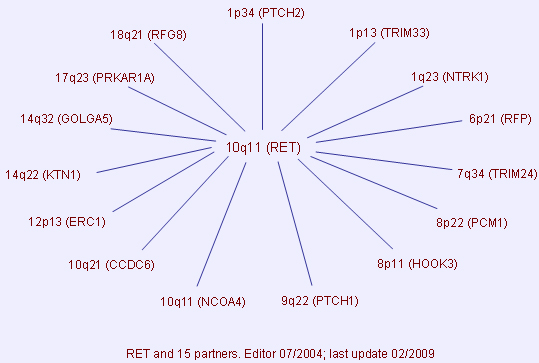
Note
TABLE 2: Breakpoints according to Cosmic
| Hybrid Gene | Partner Gene | Last Exon | Breakpoint | RET | RET First Exon | Breakpoint | Tissue |
| TRIM33/RET | 5 TRIM33 | 16 | 1_2976 | 3 RET | 12 | 2369_5659 | Thyroid (0.7%) |
| TRIM27/RET | 5 TRIM27 | 3 | 1_1104+6742 | 3 RET | 12 | 2369-1668_5659 | Thyroid (1.4%) |
| TRIM24/RET | 5 TRIM24 | 9 | 1_1745 | 3 RET | 12 | 2369_5659 | Thyroid (0.7%) |
| PCM1/RET | 5 PCM1 | 29 | 1_5266 | 3 RET | 12 | 2369_5659 | Thyroid (1.8%) |
| HOOK3/RET | 5 HOOK3 | 11 | 1_1322 | 3 RET | 12 | 2369_5659 | Thyroid (1.8%) |
| KIF5B/RET | 5 KIF5B | 15 | 1_2183 | 3 RET | 12 | 2369_5659 | |
| 5 KIF5B | 16 | 1_2372 | 3 RET | 12 | 2369_5659 | Skin 2.6%; Lung (1.5%) | |
| NCOA4/RET | 5 NCOA4 | 8 | 1_907 | 3 RET | 12 | 2369_5659 | Thyroid (8%), Lung, Soft tissue |
| CCDC6/RET | 5 CCDC6 | 1 | 1_535 | 3 RET | 12 | 2369_5659 | Thyroid (12.7%;) Lung 50.5% |
| ERC1/RET | 5 ERC1 | 11 | 1_2338 | 3 RET | 12 | 2369_5659 | Thyroid (1%) |
| KTN1/RET | 5 KTN1 | 29 | 1_2960 | 3 RET | 12 | 2369_5659 | Thyroid (1.4%) |
| GOLGA5/RET | 5 GOLGA5 | 7 | 1_1747 | 3 RET | 12 | 2369_5659 | Skin (2.6%); Thyroid (0.8%) |
| PRKAR1A/RET | 5 PRKAR1A | 7 | 1_825 | 3 RET | 12 | 2369_5659 | Thyroid (2.7%) |
| RELCH/RET | 5 RELCH | 10 | 1_1852 | 3 RET | 12 | 2369_5659 | Lung (0.2%) |
1p13 TRIM33/RET PMID 10439047, 11786418, 14668719
6p22 TRIM27/RET PMID 12787916, 14668719
7q33 TRIM24/RET PMID 10439047, 11786418, 14668719
8p22 PCM1/RET PMID 10980597, 14668719
8p11 HOOK3/RET PMID 14668719, 17639057
10p11 KIF5B/RET PMID 22194472, 22327622, 22327623, 22327624, 22797671, 23150706, 23418494, 23891510, 24133367, 24158231, 24346091, 24445538, 24469108, 24481316, 24700479, 24722163, 24727320, 24810493, 25348872
10q11 NCOA4/RET PMID 8180971, 8187085, 8290261, 8545102, 8806699, 8806700, 9001272, 9466701, 9482114, 9516913, 9528832, 9669285, 9935226, 10083732, 10675479, 10720057, 10773666, 10946873, 1111778111117782, 11443191, 11747322, 11786418, 11788677, 11927965, 12057919, 12720532, ,, 14668719, 15737050, 15788648, 15876154, 16015630, 16595592, 16784981, 17464312, 17727338, 17786355, 18226854, 18393128, 18757433, 19495791, 19958951, 20012784, 20099311, 20447069, 20564403, 20703476, 20712653, 20840674, 20924280, 21048359, 21173509, 21219595, 21411555, 21498916, 22481925, 22682753, 22745248, 22895275, 22961909, 23150706, 23436219, 23806056, 23966419, 24277231, 24417340, 24503805, 24613930, 24915144, 25111330, 26971368
10q21 CCDC6/RET PMID 2406025, 8545102, 8634704, 9001272, 9466701, 9508203, 9516913, 9528832, 9669285, 9935226, 10083732, 10675479, 10720057, 10773666, 10931090, 10946873, 10951397, 11117781, 11117782, 11443191, 11493988, 11747322, 11786418, 11788677, 11927965, 12057919, 12720532, 14668719, 15737050, 15788648, 15876154, 16015630, 16595592, 16784981, 17464312, 17727338, 17786355, 18226854, 18393128, 18757433, 19055826, 19495791, 19958951, 20012784, 20099311, 20447069, 20564403, 20703476, 20712653, 20840674, 20924280, 21048359, 21173509, 21219595, 21411555, 21498916, 22327623,22481925,22682753, 22745248, 22895275, 22961909, 23150706, 23436219, 23806056, 23966419, 24133367, 24158231, 24277231, 24327398, 24346091, 24417340, 24469108, 24503805, 24613930, 24700479, 24727320, 24810493, 24915144, 25111330, 25348872, 26187428, 26971368, 27588476
12q13 ERC1/RET PMID 10337992, 14668719, 15876154
14q22 KTN1/RET PMID 10850414, 11786418, 14668719, 18757433
14q32 GOLGA5/RET PMID 9443391, 10675479, 10773666, 11786418, 14668719, 24445538
17q24 PRKAR1A/RET PMID 7519046, 7678053, 8545102, 9466701, 9516913, 9528832, 9669285, 9935226, 10083732, 10675479, 10720057, 10773666, 10946873, 11117781, 11117782, 11747322, 11786418, 11788677, 14668719, 15876154, 18393128, 20447069, 22481925, 24277231
18q21 RELCH/RET PMID 24727320
Article Bibliography
| Pubmed ID | Last Year | Title | Authors |
|---|---|---|---|
| 30310176 | 2019 | Aberrant receptor tyrosine kinase signaling in lipofibromatosis: a clinicopathological and molecular genetic study of 20 cases. | Al-Ibraheemi A et al |
| 12640453 | 2003 | Polyalanine expansion and frameshift mutations of the paired-like homeobox gene PHOX2B in congenital central hypoventilation syndrome. | Amiel J et al |
| 11445581 | 2001 | Molecular modeling of the extracellular domain of the RET receptor tyrosine kinase reveals multiple cadherin-like domains and a calcium-binding site. | Anders J et al |
| 27935748 | 2017 | ATF4 Targets RET for Degradation and Is a Candidate Tumor Suppressor Gene in Medullary Thyroid Cancer. | Bagheri-Yarmand R et al |
| 22513837 | 2012 | RET fusion genes are associated with chronic myelomonocytic leukemia and enhance monocytic differentiation. | Ballerini P et al |
| 28490466 | 2017 | RET Signaling in Prostate Cancer. | Ban K et al |
| 22189301 | 2012 | The RET G691S polymorphism is a germline variant in desmoplastic malignant melanoma. | Barr J et al |
| 31392261 | 2019 | Cryo-EM structure of the activated RET signaling complex reveals the importance of its cysteine-rich domain. | Bigalke JM et al |
| 8826440 | 1996 | Congenital central hypoventilation syndrome: mutation analysis of the receptor tyrosine kinase RET. | Bolk S et al |
| 24315414 | 2014 | Functional characterization of a novel FGFR1OP-RET rearrangement in hematopoietic malignancies. | Bossi D et al |
| 23528997 | 2013 | The developmental etiology and pathogenesis of Hirschsprung disease. | Butler Tjaden NE et al |
| 23378251 | 2013 | KIF5B-RET fusions in Chinese patients with non-small cell lung cancer. | Cai W et al |
| 24548782 | 2014 | The prognostic role of intragenic copy number breakpoints and identification of novel fusion genes in paediatric high grade glioma. | Carvalho D et al |
| 28931560 | 2018 | RET-mediated modulation of tumor microenvironment and immune response in multiple endocrine neoplasia type 2 (MEN2). | Castellone MD et al |
| 22312249 | 2012 | Molecular basis of medullary thyroid carcinoma: the role of RET polymorphisms. | Ceolin L et al |
| 31917155 | 2020 | Uterine inflammatory myofibroblastic tumors in pregnant women with and without involvement of the placenta: a study of 6 cases with identification of a novel TIMP3-RET fusion. | Cheek EH et al |
| 31605946 | 2019 | Genetic Landscape of Somatic Mutations in a Large Cohort of Sporadic Medullary Thyroid Carcinomas Studied by Next-Generation Targeted Sequencing. | Ciampi R et al |
| 31994201 | 2020 | Recurrent RET gene fusions in paediatric spindle mesenchymal neoplasms. | Davis JL et al |
| 24022366 | 2014 | To bud or not to bud: the RET perspective in CAKUT. | Davis TK et al |
| 29617662 | 2018 | Driver Fusions and Their Implications in the Development and Treatment of Human Cancers. | Gao Q et al |
| 9858145 | 1998 | Differential expression of the RET gene in human acute myeloid leukemia. | Gattei V et al |
| 23868506 | 2013 | Ret inhibition decreases growth and metastatic potential of estrogen receptor positive breast cancer cells. | Gattelli A et al |
| 28447912 | 2017 | Targeting RET in Patients With RET-Rearranged Lung Cancers: Results From the Global, Multicenter RET Registry. | Gautschi O et al |
| 25242331 | 2014 | RET recognition of GDNF-GFRα1 ligand by a composite binding site promotes membrane-proximal self-association. | Goodman KM et al |
| 32293499 | 2020 | Oncogenic and drug-sensitive RET mutations in human epithelial ovarian cancer. | Guan L et al |
| 30130630 | 2019 | Novel gene fusions in secretory carcinoma of the salivary glands: enlarging the ETV6 family. | Guilmette J et al |
| 26686064 | 2016 | Vandetanib as a potential new treatment for estrogen receptor-negative breast cancers. | Hatem R et al |
| 29413423 | 2018 | Genomic Landscape of Pheochromocytoma and Paraganglioma. | Jochmanova I et al |
| 2588107 | 1989 | Difficulties of parathyroidectomy after previous thyroidectomy. | Kadowaki MH et al |
| 27683183 | 2017 | RET Aberrations in Diverse Cancers: Next-Generation Sequencing of 4,871 Patients. | Kato S et al |
| 28512242 | 2017 | A Systematic Analysis of Oncogenic Gene Fusions in Primary Colon Cancer. | Kloosterman WP et al |
| 31711124 | 2020 | REToma: a cancer subtype with a shared driver oncogene. | Kohno T et al |
| 16029119 | 2005 | RET proto-oncogene: a review and update of genotype-phenotype correlations in hereditary medullary thyroid cancer and associated endocrine tumors. | Kouvaraki MA et al |
| 24699901 | 2014 | RET gene mutations (genotype and phenotype) of multiple endocrine neoplasia type 2 and familial medullary thyroid carcinoma. | Krampitz GW et al |
| 26078337 | 2015 | Identification and characterization of RET fusions in advanced colorectal cancer. | Le Rolle AF et al |
| 31715421 | 2019 | RET fusions in solid tumors. | Li AY et al |
| 22327622 | 2012 | Identification of new ALK and RET gene fusions from colorectal and lung cancer biopsies. | Lipson D et al |
| 31411754 | 2020 | Novel TFG-RET fusion in a spindle cell tumour with S100 and CD34 coexpresssion. | Loong S et al |
| 31983649 | 2020 | [New mutations associated with Hirschsprung disease]. | Lorente-Ros M et al |
| 29665843 | 2018 | Next-generation sequencing analysis of receptor-type tyrosine kinase genes in surgically resected colon cancer: identification of gain-of-function mutations in the RET proto-oncogene. | Mendes Oliveira D et al |
| 30938880 | 2019 | S100 and CD34 positive spindle cell tumor with prominent perivascular hyalinization and a novel NCOA4-RET fusion. | Michal M et al |
| 30666215 | 2018 | GDNF and the RET Receptor in Cancer: New Insights and Therapeutic Potential. | Mulligan LM et al |
| 17270245 | 2007 | RET oncogene amplification in thyroid cancer: correlations with radiation-associated and high-grade malignancy. | Nakashima M et al |
| 19561646 | 2009 | Functional RET G691S polymorphism in cutaneous malignant melanoma. | Narita N et al |
| 31058838 | 2019 | Rearranged During Transfection Fusions in Non-Small Cell Lung Cancer. | O'Leary C et al |
| 24629636 | 2014 | ALK, ROS1 and RET fusions in 1139 lung adenocarcinomas: a comprehensive study of common and fusion pattern-specific clinicopathologic, histologic and cytologic features. | Pan Y et al |
| 30446652 | 2018 | RET rearrangements are actionable alterations in breast cancer. | Paratala BS et al |
| 29538669 | 2018 | RET fusions in a small subset of advanced colorectal cancers at risk of being neglected. | Pietrantonio F et al |
| 29175871 | 2018 | Structure and function of RET in multiple endocrine neoplasia type 2. | Plaza-Menacho I et al |
| 31300450 | 2019 | Analysis of Cell-Free DNA from 32,989 Advanced Cancers Reveals Novel Co-occurring Activating RET Alterations and Oncogenic Signaling Pathway Aberrations. | Rich TA et al |
| 28028925 | 2017 | A case of advanced infantile myofibromatosis harboring a novel MYH10-RET fusion. | Rosenzweig M et al |
| 25122419 | 2014 | RET mutations in neuroendocrine tumors: including small-cell lung cancer. | Rudin CM et al |
| 32326537 | 2020 | RET Gene Fusions in Malignancies of the Thyroid and Other Tissues. | Santoro M et al |
| 25330015 | 2014 | Association of RET genetic polymorphisms and haplotypes with papillary thyroid carcinoma in the Portuguese population: a case-control study. | Santos M et al |
| 16357163 | 2005 | The G691S RET polymorphism increases glial cell line-derived neurotrophic factor-induced pancreatic cancer cell invasion by amplifying mitogen-activated protein kinase signaling. | Sawai H et al |
| 31162284 | 2019 | NCOA4-RET and TRIM27-RET Are Characteristic Gene Fusions in Salivary Intraductal Carcinoma, Including Invasive and Metastatic Tumors: Is "Intraductal" Correct? | Skálová A et al |
| 29076873 | 2018 | Molecular Profiling of Mammary Analog Secretory Carcinoma Revealed a Subset of Tumors Harboring a Novel ETV6-RET Translocation: Report of 10 Cases. | Skalova A et al |
| 25204415 | 2014 | The landscape of kinase fusions in cancer. | Stransky N et al |
| 32094155 | 2020 | Advances in Targeting RET-Dependent Cancers. | Subbiah V et al |
| 32461304 | 2020 | Targeting RET Kinase in Neuroendocrine Prostate Cancer. | VanDeusen HR et al |
| 24445538 | 2014 | Kinase fusions are frequent in Spitz tumours and spitzoid melanomas. | Wiesner T et al |
| 32062451 | 2020 | PTPRA Phosphatase Regulates GDNF-Dependent RET Signaling and Inhibits the RET Mutant MEN2A Oncogenic Potential. | Yadav L et al |
| 32220490 | 2020 | RASAL2-RET: a novel RET rearrangement in a patient with high-grade sarcoma of the chest. | Zhou Y et al |
Other Information
Locus ID:
NCBI: 5979
MIM: 164761
HGNC: 9967
Ensembl: ENSG00000165731
Variants:
dbSNP: 5979
ClinVar: 5979
TCGA: ENSG00000165731
COSMIC: RET
RNA/Proteins
Expression (GTEx)
Pathways
Protein levels (Protein atlas)
PharmGKB
| Entity ID | Name | Type | Evidence | Association | PK | PD | PMIDs |
|---|---|---|---|---|---|---|---|
| PA162372840 | sunitinib | Chemical | MultilinkAnnotation | associated | 19248971 | ||
| PA165906891 | cabozantinib | Chemical | LabelAnnotation | associated | |||
| PA166118341 | vandetanib | Chemical | LabelAnnotation, Literature, MultilinkAnnotation | associated | 24433361 | ||
| PA29444 | HRAS | Gene | Pathway | associated | 28362716 | ||
| PA30196 | KRAS | Gene | Pathway | associated | 28362716 | ||
| PA31768 | NRAS | Gene | Pathway | associated | 28362716 | ||
| PA31817 | NTRK1 | Gene | DataAnnotation | associated | |||
| PA445857 | Thyroid Neoplasms | Disease | Literature, MultilinkAnnotation | associated | 23788249 | ||
| PA446649 | Carcinoma, Medullary | Disease | DataAnnotation | associated | |||
| PA446772 | Multiple Endocrine Neoplasia Type 2a | Disease | DataAnnotation | associated | |||
| PA7000 | sorafenib | Chemical | Pathway | associated | 28362716 |
References
| Pubmed ID | Year | Title | Citations |
|---|---|---|---|
| 37921725 | 2024 | Impact of the overexpression of the tyrosine kinase receptor RET in the hematopoietic potential of induced pluripotent stem cells (iPSCs). | 1 |
| 37995867 | 2024 | RET Signaling Persists in the Adult Intestine and Stimulates Motility by Limiting PYY Release From Enteroendocrine Cells. | 0 |
| 38061115 | 2024 | Comprehensive molecular analysis identifies RET alterations association with response of ICIs in multi-immunotherapy cohorts. | 1 |
| 38465999 | 2024 | Accelerated MEN2A in homozygous RET carriers in the context of consanguinity. | 0 |
| 38493096 | 2024 | Aberrant SOX10 and RET expressions in patients with Hirschsprung disease. | 0 |
| 38576288 | 2024 | Correlation Between the Clinicopathological Features of Papillary Thyroid Carcinoma Complicated with Hashimoto's Thyroiditis, BRAF V600E Gene Mutation, and RET Gene Rearrangement. | 0 |
| 38598020 | 2024 | BRAF and RET polymorphism association with thyroid cancer risk, a preliminary study from Khyber Pakhtunkhwa population. | 0 |
| 38623803 | 2024 | Non-syndromic Hirschsprung's disease as a result of a RET gene variant. | 0 |
| 38734621 | 2024 | Next-generation sequencing identified that RET variation associates with lymph node metastasis and the immune microenvironment in thyroid papillary carcinoma. | 0 |
| 38805286 | 2024 | CCDC6-RET fusion protein regulates Ras/MAPK signaling through the fusion- GRB2-SHC1 signal niche. | 0 |
| 37921725 | 2024 | Impact of the overexpression of the tyrosine kinase receptor RET in the hematopoietic potential of induced pluripotent stem cells (iPSCs). | 1 |
| 37995867 | 2024 | RET Signaling Persists in the Adult Intestine and Stimulates Motility by Limiting PYY Release From Enteroendocrine Cells. | 0 |
| 38061115 | 2024 | Comprehensive molecular analysis identifies RET alterations association with response of ICIs in multi-immunotherapy cohorts. | 1 |
| 38465999 | 2024 | Accelerated MEN2A in homozygous RET carriers in the context of consanguinity. | 0 |
| 38493096 | 2024 | Aberrant SOX10 and RET expressions in patients with Hirschsprung disease. | 0 |
Citation
Jean Loup Huret ; Sylvie Yau Chun Wan-Senon
RET (REarranged during Transfection)
Atlas Genet Cytogenet Oncol Haematol. 2020-06-01
Online version: http://atlasgeneticsoncology.org/gene/76/ret
Historical Card
2003-10-01 RET (REarranged during Transfection) by Patricia Niccoli-Sire Affiliation
