SKI (SKI proto-oncogene)
2021-02-01 Miriam Frech , Andreas Neubauer AffiliationClinic for Hematology, Oncology, Immunology and Center for Tumor Biology and Immunology, Philipps University Marburg, Germany \\\/ [email protected], [email protected]
Abstract
SKI gene is located on chromosome 1 (1p36.33-p36.32) and encodes a predominantly nuclear co-regulator of several transcription factors. SKI is also a proto-oncogene. SKI was initially found as the viral protein v-Ski of the Sloan-Kettering viruses, which are able to transform avian cells in vitro. SKI is a well described inhibitor of TGFβ signalling and is further involved in essential cellular mechanisms like proliferation and differentiation. As an oncogene SKI is further overexpressed in various tumours promoting transformation and tumour progression, but in some tumours SKI is also described as a tumour suppressor.
DNA/RNA
Description
Transcription
Proteins
Note
Description
Expression
Localisation
Function
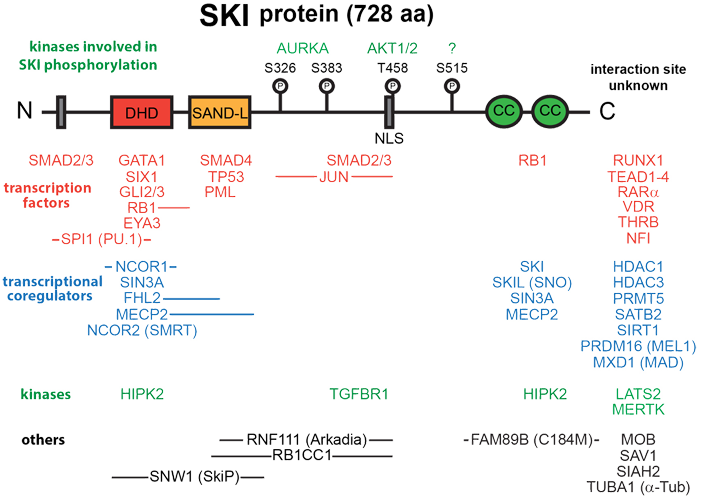
SKI interacts with several PU.1 different factors (s. Figure 2) and functions as a co-regulator. SKI was reported to inhibit i.a. GATA1 (Ueki et al., 2004), SPI1 (PU.1) (Ueki et al., 2008), TP53, together with SIRT1 or via MDM2 sumoylation, (Inoue et al., 2011, Ding et al., 2012) and RUNX1 (Feld et al., 2018). It also acts as a co-activator for factors like nuclear factor I (NFI) (Tarapore et al., 1997) or MYOD1, SIX1 and EYA3 during myogenesis (Kobayashi et al., 2007, Zhang & Stavnezer, 2009).
As in mature tissues, also during murine embryonic development low levels of SKI are expressed in most tissues. Highest expression levels can be found in brain and lung (Lyons et al., 1994, Namciu et al., 1995). SKI is crucial for the neuronal development, myogenesis and limb formation. In murine models, SKI downregulation causes aberrant neural tube closure leading to exencephaly, aberrant craniofacial, ocular, skeletal and muscle development (Berk et al., 1997, McGannon et al., 2006, Shinagawa and Ishii, 2003, Colmenares et al., 2002). SKI is further involved in the myelination of Schwann cells (Atanasoski et al., 2004). Even though SKI is relevant for myogenesis, it was reported that ectopic expression of SKI causes hypertrophy of fast skeletal muscle fibers (Lana et al., 1996, Leferovich et al., 1995, Sutrave et al., 1990, 2000). In humans SKI also may be relevant for neuronal and craniofacial development, since patients with the 1p36 deletion syndrome show similar symptoms like mice with a Ski deletion including developmental delay, orofacial clefting and congenital heart defects (Colmenares et al., 2002, Jordan et al., 2015). Moreover, SKI plays a role in hematopoietic differentiation (Namciu et al., 1994, Pearson-White et al., 1995, Dahl et al., 1998, Ueki et al., 2004, 2008, Singbrandt et al., 2014 Zhang et al., 2017). SKI is overexpressed in memory B cells (MBCs) and induces cell proliferation and differentiation (Bhattacharya et al., 2007, Laidlaw et al., 2020). Moreover, SKI is higher expressed in actively maintained quiescent tumour-infiltrating CD8+ T cells from liver tumours compared to natural quiescent T cells from the peripheral blood (Zhang et al., 2009). SKI is upregulated via T cell integrin leukocyte function-associated antigen-1(LFA-1) interacting with ICAM1 in T cells. Consequentially, SKI contributes to the inhibition of the TGFβ-mediated T cell quiescent state (Verma et al., 2012). In a mouse model, Ski inhibits CD103 (Itgae) expression in CD8+ T cells via histone hypoacetylation. This mechanism is dependent on SMAD4. The suppression of CD103+CD8+ T cell generation further leads to a higher susceptibility to secondary viral infections (Wu et al., 2020). In T cells, SKI and SMAD inhibit IL21 -induced differentiation into T helper 17 cells (Th17) via suppressing retinoic acid receptor-related orphan receptor γt (RORγt) expression (Zhang et al., 2017, 2019). SKI affects fibroblastic proliferation and development (Jinnin et al., 2007, Liu et al., 2008, Cunnington et al., 2011) and induces chondrocytic differentiation via inhibition of TGFβ signalling (Kim et al., 2012). The expression of SKI alters under many pathological conditions including demyelination or peripheral nerve damage (Atanasoski et al., 2004), wound healing (Liu et al., 2006, 2010, Li et al., 2011), liver regeneration (Macias-Silva et al., 2002), skeletal muscle regeneration (Soeta et al., 2001) and obstructive nephropathy (Fukasawa et al., 2006).
Homology
Mutations
Note
In patients with Shprintzen-Goldberg syndrome (SGS) mutations in exon 1 of SKI are responsible for ~90 % of the cases. The mutations can be found in the SMAD interaction domain and DHD domain resulting in the substitution or deletion of amino acids and leading to the induction of TGFβ signalling (Doyle et al., 2012, Carmignac et al., 2012, Au et al., 2014, Schepers et al., 2015, Polinska et al., 2016, Saito et al., 2017). However, it was proposed that during embryogenesis SKI mutations in the SMAD interaction domain or DHD domain effect TGFβ signalling differently, since a patient carrying a mutation in the SKI DHD domain developed lipomeningomyelocele, tethered cord and spina bifida but no SGS characteristics like intellectual disability, craniofacial or cardiovascular abnormalities (Zhang et al., 2019). Also, another mutation in the SKI DHD domain affecting the amino acid Thr180 was reported to be associated with marfanoid syndrome with thoracic aortic aneurysm but no intellectual disability (Arnaud et al., 2020).
A small deletion (576 kb) of 1p36.33-p36.32 encompassing SKI was found in a patient with limb malformations, congenital heart disease (CHD), epilepsy and mild development delay (Zhu et al., 2013).
In a paediatric case of de novo acute myeloid leukaemia with del(5q) a SKI out-of-frame fusion transcript with PRDM16, PRDM16(exon 1)/SKI(exon 2) t(1;1)(p36;p36) PRDM16/SKI, was identified together with another translocation, RUNX1(exon 6)/ USP42 (exon 3) t(7;21)(p22;q22) RUNX1/USP42 (Masetti et al., 2014).
| SKI mutation | AA change | domain | White et al. (2008) | Doyle et al. (2012) | Carmignac et al. (2012) | Au et al. (2014) | Schepers et al. (2014) | Poninska et al. (2016) | Saito et al. (2017) | Zhang et al. (2019) | Arnaud et al. (2020) | Total | |
| c.59C>G | p.Thr20Arg | SMAD | 1 | 1 | |||||||||
| c.59C>A | p.Thr20Lys | SMAD | 1 | 1 | |||||||||
| c.62T>G | p.Leu21Arg | SMAD | 1 | 1 | |||||||||
| c.82T>A | p.Ser28Thr | SMAD | 1 | 1 | |||||||||
| c.92C>T | p.Ser31Leu | SMAD | 1 | 1 | 2 | ||||||||
| c.94C>G | p.Leu32Val | SMAD | 2* | 3* | 1 | 5 | * | ||||||
| c.95T>C | p.Leu32Pro | SMAD | 1 | 1 | |||||||||
| c.100G>A | p.Gly34Ser | SMAD | 1 | 1 | 1 | 3 | |||||||
| c.100G>T | p.Gly34Cys | SMAD | 1 | 1 | 2 | ||||||||
| c.101G>A | p.Gly34Asp | SMAD | 1 | 1 | 2 | ||||||||
| c.101G>T | p.Gly34Val | SMAD | 1 | 1 | 2 | ||||||||
| c.101G>C | p.Gly34Ala | SMAD | 1 | 1 | |||||||||
| c.103C>T | p.Pro35Ser | SMAD | 1 | 1 | 1 | 2 | 5 | ||||||
| c.104C>A | p.Pro35Gln | SMAD | 1 | 1 | |||||||||
| c.185C>G | p.Ala62Gly | SMAD | 3 | 3 | |||||||||
| c.280_291del | p.Ser94_Ser97del | DHD | 1 | 1 | |||||||||
| c.283_291del | p.Asp95_Ser97del | DHD | 1 | 1 | 2 | ||||||||
| c.289_300del | p.Ser97_Arg100del | DHD | 1 | 1 | |||||||||
| c.336C>G | p.Cys112Trp | DHD | 1 | 1 | |||||||||
| c.347G>A | p.Gly116Glu | DHD | 1 | 1 | 2 | ||||||||
| c.349G>C | p.Gly117Arg | DHD | 1 | 1 | |||||||||
| c.539C>T | p.Thr180Met | DHD | 5 | 5 | |||||||||
| c.539C>A | p.Thr180Lys | DHD | 2 | 2 | |||||||||
| c.539C>G | p.Thr180Arg | DHD | 2 | 2 | |||||||||
| 3 | 8 | 9 | 2 | 10 | 1 | 1 | 1 | 9 | 48 |
*one common patient
Table1. Overview of the published SKI mutations leading to AA changes or deletions (adapted from Schepers et al., 2015, Arnaud et al., 2020).
Implicated in
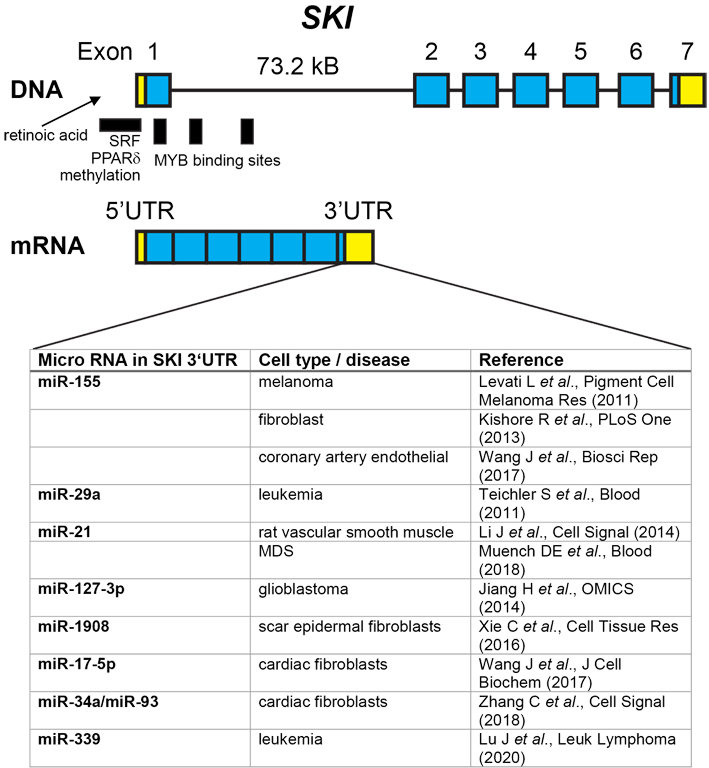
Compared with CD34-positive stem cells of healthy donors, SKI is overexpressed in different acute myeloid leukaemia (AML) subgroups (Ritter et al., 2006). Overexpression of SKI in-7/del7q AML patients is due to deletion of the SKI-targeting MIR29A, encoded on chromosome 7q (Ritter et al., 2006, Teichler et al., 2011). Recently it was published that the oncogenic long non-coding RNA LINC00467 is upregulated and contributes to the AML phenotype. Downregulation of LINC00467 induces MIR339 expression and inhibition of the MIR337 target SKI (Lu et al., 2020). In AML, SKI expression is further dependent on the oncogenic haematopoietic transcription factor MYB and contributes to its inhibitory activity in myeloid differentiation (Frech et al., 2018). In avian bone marrow, Ski increases stem cell-ness of primary multipotential progenitor cells, what may be relevant for leukemogenesis (Beug et al., 1995). In a mouse model exogenous expression of Ski in hematopoietic stem and progenitor cells induces a stem cell gene expression signature and causes the development of a myeloproliferative disorder in vivo. Here, SKI-positive myeloid progenitor cells seem to depend on HGF signalling (cf. Kishore et al., 2013) but not on the inhibition of TGFβ signalling (Singbrant et al., 2014). SKI as part of the co-repressor complex was reported to interact with the nuclear body protein PML and may be involved in PML/RARα-inducedacute promyelocytic leukaemia (APL) (Khan et al., 2001). SKI contributes to the development of erythroleukemia via interacting with the erythroid transcription factor GATA1. SKI promotes erythroblastic proliferation and blocks GATA1 DNA binding ability, causing an erythroid differentiation block (Larsen et al., 1992, Ueki et al., 2004, Fagnan et al., 2020). A regulatory mechanism of SKI with the histone methyltransferase nuclear receptor SET domain protein 1 ( NSD1) may also play a role in erythroleukemia (Leonards et al., 2020). SKI may further contribute to leukemogenesis via blocking activity of the important hematopoietic transcription factor PU.1 by recruiting an HDAC3 -containing co-repressor complex to its target genes (Ueki et al., 2008). In AML, SKI inhibits the signalling pathway of the important retinoic acid receptor α (RARα) crucial for myeloid differentiation via interacting with the HDAC-recruiting NCOR co-repressor complex. The differentiation block can partially be released with the HDAC inhibitor valproic acid (Dahl et al., 1998, Ritter et al., 2006). SKI also seems to block RARα signalling and the response to all-trans retinoic acid (ATRA) treatment in AML patients, also treated with chemotherapy, in vivo (Teichler et al., 2008). Feld et al. (2018) further analysed the SKI-dependent cistrome and transcriptome in AML cells and showed that SKI blocks myeloid differentiation and acts as a co-repressor for the haematopoietic transcription factor RUNX1.
Article Bibliography
| Reference Number | Pubmed ID | Last Year | Title | Authors |
|---|---|---|---|---|
| 1 | 10575014 | 1999 | c-Ski acts as a transcriptional co-repressor in transforming growth factor-beta signaling through interaction with smads. | Akiyoshi S et al |
| 2 | 31980905 | 2020 | A new mutational hotspot in the SKI gene in the context of MFS/TAA molecular diagnosis. | Arnaud P et al |
| 3 | 15312649 | 2004 | The protooncogene Ski controls Schwann cell proliferation and myelination. | Atanasoski S et al |
| 4 | 24357594 | 2014 | De novo exon 1 missense mutations of SKI and Shprintzen-Goldberg syndrome: two new cases and a clinical review. | Au PY et al |
| 5 | 16333029 | 2005 | Effect of Smad7 expression on metastasis of mouse mammary carcinoma JygMC(A) cells. | Azuma H et al |
| 6 | 15047811 | 2004 | NFI-Ski interactions mediate transforming growth factor beta modulation of human papillomavirus type 16 early gene expression. | Baldwin A et al |
| 7 | 19875456 | 2009 | The phosphatidylinositol 3-kinase/Akt pathway regulates transforming growth factor-{beta} signaling by destabilizing ski and inducing Smad7. | Band AM et al |
| 8 | 9284043 | 1997 | Mice lacking the ski proto-oncogene have defects in neurulation, craniofacial, patterning, and skeletal muscle development. | Berk M et al |
| 9 | 7624132 | 1995 | In vitro growth of factor-dependent multipotential hematopoietic cells is induced by the nuclear oncoprotein v-Ski. | Beug H et al |
| 10 | 17982071 | 2007 | Transcriptional profiling of antigen-dependent murine B cell differentiation and memory formation. | Bhattacharya D et al |
| 11 | 21647564 | 2012 | c-Ski in health and disease. | Bonnon C et al |
| 12 | 18782659 | 2009 | Clinical significance of the expression of c-Ski and SnoN, possible mediators in TGF-beta resistance, in primary cutaneous melanoma. | Boone B et al |
| 13 | 19096149 | 2009 | TGF-beta repressors SnoN and Ski are implicated in human colorectal carcinogenesis. | Bravou V et al |
| 14 | 15153332 | 2004 | Amplification of SKI is a prognostic marker in early colorectal cancer. | Buess M et al |
| 15 | 23103230 | 2012 | In-frame mutations in exon 1 of SKI cause dominant Shprintzen-Goldberg syndrome. | Carmignac V et al |
| 16 | 19845874 | 2009 | SKI knockdown inhibits human melanoma tumor growth in vivo. | Chen D et al |
| 17 | 14583455 | 2003 | SKI activates Wnt/beta-catenin signaling in human melanoma. | Chen D et al |
| 18 | 23809940 | 2013 | Ski protein levels increase during in vitro progression of HPV16-immortalized human keratinocytes and in cervical cancer. | Chen Y et al |
| 19 | 11731796 | 2002 | Loss of the SKI proto-oncogene in individuals affected with 1p36 deletion syndrome is predicted by strain-dependent defects in Ski-/- mice. | Colmenares C et al |
| 20 | 20943957 | 2011 | Antifibrotic properties of c-Ski and its regulation of cardiac myofibroblast phenotype and contractility. | Cunnington RH et al |
| 21 | 9736711 | 1998 | Transformation of hematopoietic cells by the Ski oncoprotein involves repression of retinoic acid receptor signaling. | Dahl R et al |
| 22 | 12435627 | 2002 | Ski is involved in transcriptional regulation by the repressor and full-length forms of Gli3. | Dai P et al |
| 23 | 22411991 | 2012 | Overexpression of SKI oncoprotein leads to p53 degradation through regulation of MDM2 protein sumoylation. | Ding B et al |
| 24 | 23023332 | 2012 | Mutations in the TGF-β repressor SKI cause Shprintzen-Goldberg syndrome with aortic aneurysm. | Doyle AJ et al |
| 25 | 32350520 | 2020 | Human erythroleukemia genetics and transcriptomes identify master transcription factors as functional disease drivers. | Fagnan A et al |
| 26 | 29471413 | 2018 | Combined cistrome and transcriptome analysis of SKI in AML cells identifies SKI as a co-repressor for RUNX1. | Feld C et al |
| 27 | 20959473 | 2010 | The oncoprotein c-ski functions as a direct antagonist of the transforming growth factor-{beta} type I receptor. | Ferrand N et al |
| 28 | 29854289 | 2018 | MYB induces the expression of the oncogenic corepressor SKI in acute myeloid leukemia. | Frech M et al |
| 29 | 16625151 | 2006 | Ubiquitin-dependent degradation of SnoN and Ski is increased in renal fibrosis induced by obstructive injury. | Fukasawa H et al |
| 30 | 14712482 | 2004 | Increased expression of c-Ski as a co-repressor in transforming growth factor-beta signaling correlates with progression of esophageal squamous cell carcinoma. | Fukuchi M et al |
| 31 | 8471834 | 1993 | Expression of the c-ski proto-oncogene in human melanoma cell lines. | Fumagalli S et al |
| 32 | 12874272 | 2003 | Requirement of the co-repressor homeodomain-interacting protein kinase 2 for ski-mediated inhibition of bone morphogenetic protein-induced transcriptional activation. | Harada J et al |
| 33 | 17592292 | 2007 | Ski promotes tumor growth through abrogation of transforming growth factor-beta signaling in pancreatic cancer. | Heider TR et al |
| 34 | 12687501 | 2003 | Physical map of 1p36, placement of breakpoints in monosomy 1p36, and clinical characterization of the syndrome. | Heilstedt HA et al |
| 35 | 7929440 | 1994 | A carboxyl-terminal region of the ski oncoprotein mediates homodimerization as well as heterodimerization with the related protein SnoN. | Heyman HC et al |
| 36 | 21149449 | 2011 | Suppression of p53 activity through the cooperative action of Ski and histone deacetylase SIRT1. | Inoue Y et al |
| 37 | 18695043 | 2008 | Expression and localization of Ski determine cell type-specific TGFbeta signaling effects on the cell cycle. | Jacob C et al |
| 38 | 21211030 | 2011 | Efficient TGF-β/SMAD signaling in human melanoma cells associated with high c-SKI/SnoN expression. | Javelaud D et al |
| 39 | 24517116 | 2014 | Next generation sequencing analysis of miRNAs: MiR-127-3p inhibits glioblastoma proliferation and activates TGF-β signaling by targeting SKI. | Jiang H et al |
| 40 | 17469184 | 2007 | Involvement of the constitutive complex formation of c-Ski/SnoN with Smads in the impaired negative feedback regulation of transforming growth factor beta signaling in scleroderma fibroblasts. | Jinnin M et al |
| 41 | 26345236 | 2015 | 1p36 deletion syndrome: an update. | Jordan VK et al |
| 42 | 11430826 | 2001 | Role of PML and PML-RARalpha in Mad-mediated transcriptional repression. | Khan MM et al |
| 43 | 22461172 | 2012 | Ski inhibits TGF-β/phospho-Smad3 signaling and accelerates hypertrophic differentiation in chondrocytes. | Kim KO et al |
| 44 | 23560074 | 2013 | Bone marrow progenitor cell therapy-mediated paracrine regulation of cardiac miRNA-155 modulates fibrotic response in diabetic hearts. | Kishore R et al |
| 45 | 19594546 | 2009 | c-Ski overexpression promotes tumor growth and angiogenesis through inhibition of transforming growth factor-beta signaling in diffuse-type gastric carcinoma. | Kiyono K et al |
| 46 | 17352741 | 2007 | c-Ski activates MyoD in the nucleus of myoblastic cells through suppression of histone deacetylases. | Kobayashi N et al |
| 47 | 15806158 | 2005 | Distinct molecular phenotype of malignant CD34(+) hematopoietic stem and progenitor cells in chronic myelogenous leukemia. | Kronenwett R et al |
| 48 | 32601467 | 2020 | The transcription factor Hhex cooperates with the corepressor Tle3 to promote memory B cell development. | Laidlaw BJ et al |
| 49 | 8770548 | 1996 | Selective expression of a ski transgene affects IIb fast muscles and skeletal structure. | Lana DP et al |
| 50 | 30488595 | 2018 | Ski drives an acute increase in MMP-9 gene expression and release in primary cardiac myofibroblasts. | Landry N et al |
| 51 | 1408132 | 1992 | The v-ski oncogene cooperates with the v-sea oncogene in erythroid transformation by blocking erythroid differentiation. | Larsen J et al |
| 52 | 18451154 | 2008 | Transforming growth factor-beta suppresses the ability of Ski to inhibit tumor metastasis by inducing its degradation. | Le Scolan E et al |
| 53 | 7823166 | 1995 | Regulation of c-ski transgene expression in developing and mature mice. | Leferovich JM et al |
| 54 | 32533074 | 2020 | Nuclear interacting SET domain protein 1 inactivation impairs GATA1-regulated erythroid differentiation and causes erythroleukemia. | Leonards K et al |
| 55 | 21466664 | 2011 | MicroRNA-155 targets the SKI gene in human melanoma cell lines. | Levati L et al |
| 56 | 23052247 | 2012 | Upregulation of ski in fibroblast is implicated in the peroxisome proliferator--activated receptor δ-mediated wound healing. | Li J et al |
| 57 | 24388835 | 2014 | MiR-21 inhibits c-Ski signaling to promote the proliferation of rat vascular smooth muscle cells. | Li J et al |
| 58 | 21341267 | 2011 | Ski, a modulator of wound healing and scar formation in the rat skin and rabbit ear. | Li P et al |
| 59 | 33188772 | 2021 | Ski: Double roles in cancers. | Liao HY et al |
| 60 | 29570207 | 2019 | Silencing of c-Ski augments TGF-b1-induced epithelial-mesenchymal transition in cardiomyocyte H9C2 cells. | Ling J et al |
| 61 | 17725545 | 2008 | The essential role for c-Ski in mediating TGF-beta1-induced bi-directional effects on skin fibroblast proliferation through a feedback loop. | Liu X et al |
| 62 | 16630105 | 2006 | Expression and possible mechanism of c-ski, a novel tissue repair-related gene during normal and radiation-impaired wound healing. | Liu X et al |
| 63 | 33054480 | 2021 | Long noncoding RNA LINC00467 facilitates the progression of acute myeloid leukemia by targeting the miR-339/SKI pathway. | Lu J et al |
| 64 | 10485843 | 1999 | The Ski oncoprotein interacts with the Smad proteins to repress TGFbeta signaling. | Luo K et al |
| 65 | 7894074 | 1994 | Protooncogene c-ski is expressed in both proliferating and postmitotic neuronal populations. | Lyons GE et al |
| 66 | 12023281 | 2002 | Up-regulated transcriptional repressors SnoN and Ski bind Smad proteins to antagonize transforming growth factor-beta signals during liver regeneration. | Macias-Silva M et al |
| 67 | 28115165 | 2017 | Repression of Smad3 by Stat3 and c-Ski/SnoN induces gefitinib resistance in lung adenocarcinoma. | Makino Y et al |
| 68 | 15806149 | 2005 | The Ski oncoprotein is upregulated and localized at the centrosomes and mitotic spindle during mitosis. | Marcelain K et al |
| 69 | 24673627 | 2014 | Whole transcriptome sequencing of a paediatric case of de novo acute myeloid leukaemia with del(5q) reveals RUNX1-USP42 and PRDM16-SKI fusion transcripts. | Masetti R et al |
| 70 | 17003410 | 2006 | Ocular abnormalities in mice lacking the Ski proto-oncogene. | McGannon P et al |
| 71 | 12793438 | 2003 | Repression of TGF-beta signaling by the oncogenic protein SKI in human melanomas: consequences for proliferation, survival, and metastasis. | Medrano EE et al |
| 72 | 23441061 | 2013 | Expression of Ski can act as a negative feedback mechanism on retinoic acid signaling. | Melling MA et al |
| 73 | 29928183 | 2018 | Identification of a New Candidate Locus for Ebstein Anomaly in 1p36.2. | Miranda-Fernández MC et al |
| 74 | 21600873 | 2011 | Identification of Ski as a target for Aurora A kinase. | Mosquera J et al |
| 75 | 30249787 | 2018 | SKI controls MDS-associated chronic TGF-β signaling, aberrant splicing, and stem cell fitness. | Muench DE et al |
| 76 | 19959502 | 2010 | Context-dependent regulation of the expression of c-Ski protein by Arkadia in human cancer cells. | Nagano Y et al |
| 77 | 17510063 | 2007 | Arkadia induces degradation of SnoN and c-Ski to enhance transforming growth factor-beta signaling. | Nagano Y et al |
| 78 | 17054724 | 2006 | Nuclear and cytoplasmic c-Ski differently modulate cellular functions. | Nagata M et al |
| 79 | 20624875 | 2010 | Identification of a phosphorylation site in c-Ski as serine 515. | Nagata M et al |
| 80 | 21107877 | 2011 | Expression of thrombospondin-1 and Ski are prognostic factors in advanced gastric cancer. | Nakao T et al |
| 81 | 8152801 | 1994 | Induction of the c-ski proto-oncogene by phorbol ester correlates with induction of megakaryocyte differentiation. | Namciu S et al |
| 82 | 8573720 | 1995 | Enhanced expression of mouse c-ski accompanies terminal skeletal muscle differentiation in vivo and in vitro. | Namciu S et al |
| 83 | 10049357 | 1999 | Ski is a component of the histone deacetylase complex required for transcriptional repression by Mad and thyroid hormone receptor. | Nomura T et al |
| 84 | 19643254 | 2009 | Differential expression of SKI oncogene protein in hemangiomas. | O TM et al |
| 85 | 7662963 | 1995 | The ski/sno protooncogene family in hematopoietic development. | Pearson-White S et al |
| 86 | 33023028 | 2020 | The Oncoprotein SKI Acts as A Suppressor of NK Cell-Mediated Immunosurveillance in PDAC. | Ponath V et al |
| 87 | 27146836 | 2016 | Next-generation sequencing for diagnosis of thoracic aortic aneurysms and dissections: diagnostic yield, novel mutations and genotype phenotype correlations. | Poninska JK et al |
| 88 | 25670202 | 2015 | Ski regulates Hippo and TAZ signaling to suppress breast cancer progression. | Rashidian J et al |
| 89 | 11719430 | 2001 | Cytoplasmic localization of the oncogenic protein Ski in human cutaneous melanomas in vivo: functional implications for transforming growth factor beta signaling. | Reed JA et al |
| 90 | 16424870 | 2006 | Inhibition of retinoic acid receptor signaling by Ski in acute myeloid leukemia. | Ritter M et al |
| 91 | 26138431 | 2016 | The Ski Protein is Involved in the Transformation Pathway of Aurora Kinase A. | Rivas S et al |
| 92 | 20635359 | 2010 | Refinement of causative genes in monosomy 1p36 through clinical and molecular cytogenetic characterization of small interstitial deletions. | Rosenfeld JA et al |
| 93 | 16845326 | 2006 | Influence of melanoma inhibitory activity on transforming growth factor-beta signaling in malignant melanoma. | Rothhammer T et al |
| 94 | 28857439 | 2017 | Shprintzen-Goldberg syndrome associated with first cervical vertebra defects. | Saito T et al |
| 95 | 10092127 | 1999 | Gains, losses, and amplifications of genomic materials in primary gastric cancers analyzed by comparative genomic hybridization. | Sakakura C et al |
| 96 | 24736733 | 2015 | The SMAD-binding domain of SKI: a hotspot for de novo mutations causing Shprintzen-Goldberg syndrome. | Schepers D et al |
| 97 | 22194822 | 2011 | A two-gene signature, SKI and SLAMF1, predicts time-to-treatment in previously untreated patients with chronic lymphocytic leukemia. | Schweighofer CD et al |
| 98 | 12782652 | 2003 | Generation of Ski-knockdown mice by expressing a long double-strand RNA from an RNA polymerase II promoter. | Shinagawa T et al |
| 99 | 24415629 | 2014 | The SKI proto-oncogene enhances the in vivo repopulation of hematopoietic stem cells and causes myeloproliferative disease. | Singbrant S et al |
| 100 | 11284965 | 2001 | Possible role for the c-ski gene in the proliferation of myogenic cells in regenerating skeletal muscles of rats. | Soeta C et al |
| 101 | 27734340 | 2016 | Ski modulate the characteristics of pancreatic cancer stem cells via regulating sonic hedgehog signaling pathway. | Song L et al |
| 102 | 2188109 | 1990 | Characterization of chicken c-ski oncogene products expressed by retrovirus vectors. | Sutrave P et al |
| 103 | 10607904 | 2000 | The induction of skeletal muscle hypertrophy by a ski transgene is promoter-dependent. | Sutrave P et al |
| 104 | 30972853 | 2019 | c-Ski accelerates renal cancer progression by attenuating transforming growth factor β signaling. | Taguchi L et al |
| 105 | 19049980 | 2009 | SKI and MEL1 cooperate to inhibit transforming growth factor-beta signal in gastric cancer cells. | Takahata M et al |
| 106 | 14699069 | 2004 | Interaction with Smad4 is indispensable for suppression of BMP signaling by c-Ski. | Takeda M et al |
| 107 | 9380514 | 1997 | DNA binding and transcriptional activation by the Ski oncoprotein mediated by interaction with NFI. | Tarapore P et al |
| 108 | 29892481 | 2018 | Transcriptional cofactors Ski and SnoN are major regulators of the TGF-β/Smad signaling pathway in health and disease. | Tecalco-Cruz AC et al |
| 109 | 18508800 | 2008 | Expression of the nuclear oncogene Ski in patients with acute myeloid leukemia treated with all-trans retinoic acid. | Teichler S et al |
| 110 | 22229264 | 2012 | Differential effect of the expression of TGF-β pathway inhibitors, Smad-7 and Ski, on invasive breast carcinomas: relation to biologic behavior. | Theohari I et al |
| 111 | 12716897 | 2003 | Signal-dependent N-CoR requirement for repression by the Ski oncoprotein. | Ueki N et al |
| 112 | 17621263 | 2008 | Ski can negatively regulates macrophage differentiation through its interaction with PU.1. | Ueki N et al |
| 113 | 22707713 | 2012 | Leukocyte function-associated antigen-1/intercellular adhesion molecule-1 interaction induces a novel genetic signature resulting in T-cells refractory to transforming growth factor-β signaling. | Verma NK et al |
| 114 | 18261624 | 2008 | Ski/SnoN expression in the sequence metaplasia-dysplasia-adenocarcinoma of Barrett's esophagus. | Villanacci V et al |
| 115 | 22843506 | 2012 | Differential role of Sloan-Kettering Institute (Ski) protein in Nodal and transforming growth factor-beta (TGF-β)-induced Smad signaling in prostate cancer cells. | Vo BT et al |
| 116 | 28214335 | 2017 | The Role of c-SKI in Regulation of TGFβ-Induced Human Cardiac Fibroblast Proliferation and ECM Protein Expression. | Wang J et al |
| 117 | 28607031 | 2017 | The mechanism of TGF-β/miR-155/c-Ski regulates endothelial-mesenchymal transition in human coronary artery endothelial cells. | Wang J et al |
| 118 | 24011664 | 2013 | c-Ski activates cancer-associated fibroblasts to regulate breast cancer cell invasion. | Wang L et al |
| 119 | 19546161 | 2009 | Dual role of Ski in pancreatic cancer cells: tumor-promoting versus metastasis-suppressive function. | Wang P et al |
| 120 | 11121043 | 2000 | Ski represses bone morphogenic protein signaling in Xenopus and mammalian cells. | Wang W et al |
| 121 | 19112531 | 2008 | Identification of STRA6 and SKI sequence variants in patients with anophthalmia/microphthalmia. | White T et al |
| 122 | 15130471 | 2004 | Crystal structure of the dachshund homology domain of human SKI. | Wilson JJ et al |
| 123 | 32612153 | 2021 | The SKI proto-oncogene restrains the resident CD103(+)CD8(+) T cell response in viral clearance. | Wu B et al |
| 124 | 27256397 | 2016 | MiR-1908 promotes scar formation post-burn wound healing by suppressing Ski-mediated inflammation and fibroblast proliferation. | Xie C et al |
| 125 | 28398634 | 2017 | Ski regulates Smads and TAZ signaling to suppress lung cancer progression. | Xie M et al |
| 126 | 25955797 | 2015 | Ski prevents TGF-β-induced EMT and cell invasion by repressing SMAD-dependent signaling in non-small cell lung cancer. | Yang H et al |
| 127 | 24454898 | 2014 | Identification of critical regions and candidate genes for cardiovascular malformations and cardiomyopathy associated with deletions of chromosome 1p36. | Zaveri HP et al |
| 128 | 27039037 | 2016 | Chronic expression of Ski induces apoptosis and represses autophagy in cardiac myofibroblasts. | Zeglinski MR et al |
| 129 | 29551367 | 2018 | MiR-34a/miR-93 target c-Ski to modulate the proliferaton of rat cardiac fibroblasts and extracellular matrix deposition in vivo and in vitro. | Zhang C et al |
| 130 | 19008232 | 2009 | Ski regulates muscle terminal differentiation by transcriptional activation of Myog in a complex with Six1 and Eya3. | Zhang H et al |
| 131 | 30896889 | 2019 | Overexpression of c-Ski promotes cell proliferation, invasion and migration of gastric cancer associated fibroblasts. | Zhang H et al |
| 132 | 30883014 | 2019 | A de novo mutation in DHD domain of SKI causing spina bifida with no craniofacial malformation or intellectual disability. | Zhang L et al |
| 133 | 29072299 | 2017 | Reversing SKI-SMAD4-mediated suppression is essential for T(H)17 cell differentiation. | Zhang S et al |
| 134 | 31398665 | 2019 | SKI and SMAD4 are essential for IL-21-induced Th17 differentiation. | Zhang S et al |
| 135 | 15699019 | 2005 | Identification of direct serum-response factor gene targets during Me2SO-induced P19 cardiac cell differentiation. | Zhang SX et al |
| 136 | 18778280 | 2009 | Genomic expression analysis by single-cell mRNA differential display of quiescent CD8 T cells from tumour-infiltrating lymphocytes obtained from in vivo liver tumours. | Zhang W et al |
| 137 | 31746363 | 2020 | Knockdown of Ski decreases osteosarcoma cell proliferation and migration by suppressing the PI3K/Akt signaling pathway. | Zhao X et al |
| 138 | 23892090 | 2013 | 576 kb deletion in 1p36.33-p36.32 containing SKI is associated with limb malformation, congenital heart disease and epilepsy. | Zhu X et al |
Other Information
Locus ID:
NCBI: 6497
MIM: 164780
HGNC: 10896
Ensembl: ENSG00000157933
Variants:
dbSNP: 6497
ClinVar: 6497
TCGA: ENSG00000157933
COSMIC: SKI
RNA/Proteins
| Gene ID | Transcript ID | Uniprot |
|---|---|---|
| ENSG00000157933 | ENST00000378536 | P12755 |
Expression (GTEx)
Pathways
Protein levels (Protein atlas)
References
| Pubmed ID | Year | Title | Citations |
|---|---|---|---|
| 37697026 | 2024 | Nucleotide substitutions at the p.Gly117 and p.Thr180 mutational hot-spots of SKI alter molecular dynamics and may affect cell cycle. | 0 |
| 37697026 | 2024 | Nucleotide substitutions at the p.Gly117 and p.Thr180 mutational hot-spots of SKI alter molecular dynamics and may affect cell cycle. | 0 |
| 37129290 | 2023 | Triplications of chromosome 1p36.3, including the genes GABRD and SKI, are associated with a developmental disorder and a facial gestalt. | 0 |
| 37129290 | 2023 | Triplications of chromosome 1p36.3, including the genes GABRD and SKI, are associated with a developmental disorder and a facial gestalt. | 0 |
| 33416497 | 2021 | Mutations in SKI in Shprintzen-Goldberg syndrome lead to attenuated TGF-β responses through SKI stabilization. | 11 |
| 33416497 | 2021 | Mutations in SKI in Shprintzen-Goldberg syndrome lead to attenuated TGF-β responses through SKI stabilization. | 11 |
| 31746363 | 2020 | Knockdown of Ski decreases osteosarcoma cell proliferation and migration by suppressing the PI3K/Akt signaling pathway. | 8 |
| 31980905 | 2020 | A new mutational hotspot in the SKI gene in the context of MFS/TAA molecular diagnosis. | 1 |
| 31746363 | 2020 | Knockdown of Ski decreases osteosarcoma cell proliferation and migration by suppressing the PI3K/Akt signaling pathway. | 8 |
| 31980905 | 2020 | A new mutational hotspot in the SKI gene in the context of MFS/TAA molecular diagnosis. | 1 |
| 29570207 | 2019 | Silencing of c-Ski augments TGF-b1-induced epithelial-mesenchymal transition in cardiomyocyte H9C2 cells. | 3 |
| 29734252 | 2019 | Are Ski and SnoN Involved in the Tumorigenesis of Oral Squamous Cell Carcinoma Through Smad4? | 1 |
| 30642396 | 2019 | Whole-genome methylation profiling of the retinal pigment epithelium of individuals with age-related macular degeneration reveals differential methylation of the SKI, GTF2H4, and TNXB genes. | 24 |
| 30896889 | 2019 | Overexpression of c-Ski promotes cell proliferation, invasion and migration of gastric cancer associated fibroblasts. | 1 |
| 30972853 | 2019 | c-Ski accelerates renal cancer progression by attenuating transforming growth factor β signaling. | 13 |
Citation
Miriam Frech ; Andreas Neubauer
SKI (SKI proto-oncogene)
Atlas Genet Cytogenet Oncol Haematol. 2021-02-01
Online version: http://atlasgeneticsoncology.org/gene/42303/chromosome-explorer/meetings/
