XIAP (X-linked inhibitor of apoptosis)
2020-03-01 Catarina Sofia Mateus Reis Silva , Gabriel Henrique Barbosa , Paola Cristina Branco , Paula Christine Jimenez , Joao Agostinho Machado-Neto, PhD , Letícia Veras Costa-Lotufo AffiliationIdentity
Abstract
X-linked inhibitor of apoptosis (XIAP), also referred to as BIRC4 or IAP3, is one of the most studied members among the proteins known as Inhibitors of Apoptosis Proteins (IAPs). This protein family portrays its main role by preventing apoptotic cell death through direct or indirect inhibition of caspase activity. All members of the IAPs carry at least one BIR domain in their structure, which are generally responsible for caspase interaction. XIAP has three BIR domains, enabling interaction with both initiation and effector caspases. Moreover, it is also structured with a RING finger domain, which functions as a ubiquitin ligase (E3), and one UBA domain, for binding to ubiquitin, further rendering XIAP a central role in the ubiquitination process and, thus, implicating such IAP in multiple signaling pathways, including cell death, autophagy, immunity, inflammation, cell cycle, and cell migration. XIAP overexpression is found in a variety of cancer types and is frequently associated with chemoresistance and increased risk of relapse. Furthermore, there are many evidences that XIAP inhibition may sensitize tumor cells to chemotherapy agents, which make this protein a potential target in cancer.
DNA/RNA
Description
Proteins
Description
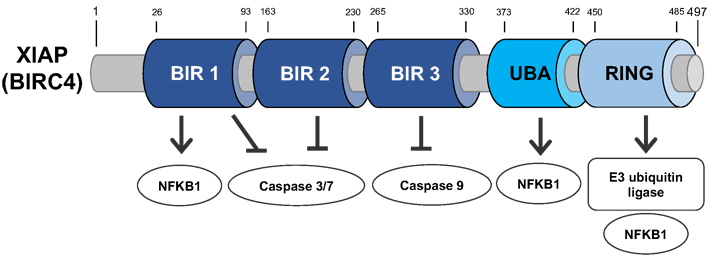
XIAP presents three BIR domains located at the N-terminus region as demonstrated in Figure 1. Despite similarities shared among BIR domains, their functions may vary according to the IAP member. BIR1 interacts with proteins that modulate NFKB1 (NFκB) signaling (Lu et al., 2007). BIR2 and the linker region between BIR1 and BIR2 domain are necessary for inhibition of effector CASP3 and CASP7 (caspases-3 and -7) (Suzuki et al., 2001). BIR3 domain is responsible for inhibiting CASP9 (caspase-9), thus, preventing the intrinsic apoptosis pathway (Lukacs et al., 2013). By contrast, diablo IAP-binding mitochondrial protein binds to both BIR2 and BIR3 domains, thus inhibiting their function, increasing the activation of CASP3, CASP7 and CASP9 (caspases-3, -7 and -9), and promoting apoptosis (Suzuki et al., 2001, Obexer and Ausserlechner, 2014).
At its C-terminus region, XIAP carries a RING zinc finger domain. Although a BIR domain occurs among all IAPs, the RING domain, in turn, is found only in XIAP, BIRC2 and BIRC3. For XIAP, the RING domain involves an E3 ligase effect, indicating an important activity on protein ubiquitin process (Nakatani et al., 2013). Additionally, the RING domain was shown to be involved in NFKB1 signaling and MYC proto-oncogene stability, contributing to cancer progression (Jiang et al., 2019), and also on the migratory and invasive potential of cancer cells (Liu et al., 2012).
Expression
Given that the main function of XIAP is to impair both intrinsic and extrinsic apoptosis pathways, this finding is of particular interest in oncology research, as mechanisms to avoid cell death are one of the main factors that contribute to the formation of solid tumor masses. Not coincidentally, upregulating XIAP expression is one of the means by which tumor cells may accomplish such resistance. Therefore, XIAP expression levels may directly determine the sensitivity of tumor cells to apoptosis (Eckelman et al., 2006; Yang et al., 2018).
XIAP was found to be overexpressed in a variety of cancer types and is frequently associated with chemoresistance and increased risk of recurrence, being, generally, a predictive marker of poor prognosis of the disease (Srinivasula & Ashwell., 2008; Obexer & Ausserlechner, 2014). In this matter, Gao and colleagues (2019) conducted a systematic review and metanalysis to determine the prognostic value of XIAP in patients with different tumor types. The analysis included 40 articles and more than 6,500 patients and concluded that the majority of the studies correlated high XIAP expression levels to an unfavorable prognostic factor for clinical outcomes in cancer patients (Gao et al., 2019). However, some discrepancies have been noted, as higher XIAP levels was also correlated to longer overall survival in non-small cell lung cancer patients (Ferreira et al., 2001b). Additionally, XIAP expression did not show any prognostic significance in cervical carcinoma (Liu et al., 2001) nor was that able to predict the response to chemotherapy in patients with advanced NSCLC (Ferreira et al., 2001a) .
An extensive study was conducted by Hussain and colleagues (2017) to assess the expression of XIAP in over 1000 Middle Eastern breast cancer cases by immunohistochemistry, and found this IAP to be overexpressed in 29.5% of the cases with an association to tumor size, extra nodal extension, triple negative breast cancer and poorly differentiated breast cancer subtype (Hussain et al., 2017). Expression and clinical significance of XIAP in a wide variety of cancer was further assessed and demonstrated in ovarian, lung, colorectal, thyroid, prostate, cervical, melanoma, salivary gland, pancreatic, cervical cancers, kidney, liver, neuroblastoma, oral, among others. Some of these will be further discussed herein.
XIAP expression was shown to be regulated at multiple levels, including transcriptional, post-transcriptional and translationally regulation. Transcriptional activation of XIAP may be controlled via NFkB pathway and ATP7A (ATPase copper transporting alpha) (Karin & Lin, 2002; Dai et al., 2005; Evans et al., 2018). XIAP protein but not its mRNA was found to be highly increased in childhood acute lymphoblastic leukemia compared to control bone marrow mononuclear cells, and no correlation between protein levels and mRNA was seen either, indicating post-transcriptional regulation (Hundsdoerfer et al., 2010). XIAP expression may also be regulated by an alternative translation initiation by a 162-nucleotide internal ribosome entry site (IRES) located in the 5 untranslated region of XIAP mRNA (Holcik et al., 1999; Holcik & Korneluk, 2000).
In addition, different expression levels in normal cells of the same lineage in different organs indicates that IAP expression is also influenced by cell type and organ-dependent regulatory mechanisms (Vischioni et al., 2006). Moreover, Yan and colleagues (2004) demonstrated a tumor stage-dependent increase of both XIAP mRNA and protein expression in renal cell carcinoma (Yan et al., 2004).
At a protein level, XIAP activity may also be negatively regulated by the interaction with specific endogenous inhibitors, i.e. DIABLO (diablo IAP-binding mitochondrial protein), HTRA2 and XAF1 (XIAP-associated factor-1) (Srinivasula & Ashwell., 2008; Desplanques et al., 2009; Ye et al., 2019; Abbas & Larisch, 2020), or stabilized by other IAPs and proteins to enhance its activity (Dohi et al., 2004; Rajalingam et al., 2006). XIAP also forms a complex with SIVA1 and NR2C2 (TAK1), which inhibits XIAP/TAK1/ TAB1 -mediated NFκB activation, activates JNK activity and modulates apoptosis responses (Resch et al., 2009).
Localisation
Germ and Sertoli cells displayed XIAP in both cytoplasm and nucleoli (Vischioni et al., 2006). Fluorescence staining of hNOKs (human normal oral keratinocytes) revealed XIAP to be localized mainly in the cytoplasm and perinuclear areas, whereas in Tca8113 cell line (squamous cell carcinoma of the human tongue) high levels of this IAP were found both in the cytoplasm and the nucleus (Gao et al., 2006). In gastric cancer tissue samples, XIAP expression was detected exclusively in the cytoplasm (Dizdar et al., 2017).
XIAP displayed different patterns of localization in pancreas: acinar exocrine cells showed stronger staining in a granular supranuclear position (alike in glands of the small intestine and in the bronchial epithelium); while ductal cells presented XIAP diffused in the cytoplasm (Vischioni et al., 2006). A granular pattern in the cytoplasm had already been described in NSCLC cells, mainly in adenocarcinoma sections (Ferreira et al., 2001a; Ferreira et al., 2001b).
XIAP membrane localization was described in endometrial glands, more prominently in brush border or basolateral type. The interaction of XIAP with bone morphogenetic protein (BMP) type I receptors via its RING-finger domain also suggests a possible localization in the plasma membrane (Yamaguchi et al., 1999; Vischioni et al., 2006).
Function
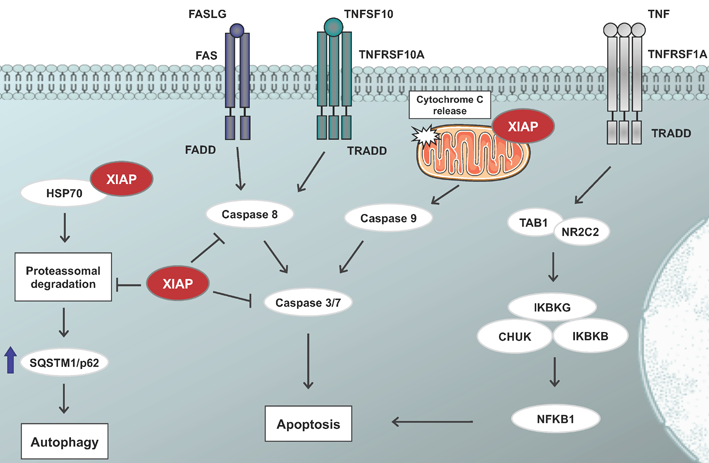
Another important mechanism for caspase inhibition by XIAP involves the E3 ligase activity of the RING domain, which is correlated with ubiquitination of XIAP-bound caspases. Thus, it can be concluded that XIAP interferes with extrinsic as well as intrinsic death pathways (Pistritto et al., 2016). Such ubiquitination activity may be associated with XIAP itself, XIAP-interacting proteins involved in apoptosis, and other different targets involved in apoptosis (Galban and Duckett, 2010). XIAP has also been correlated to suppression of autophagy, once depletion of this IAP resulted in increased expression of SQSTM1 (p62), a feature induced, in fact, by prevention of the ubiquitin-proteasomal degradation of SQSTM1 mediated by E3 ligase activity of XIAP (Huang et al., 2019).
Another study evidenced that XIAP also localizes to the mitochondria, deregulating its functions, especially concerning cytochrome c release, suggesting that XIAP may enhance mitochondrial membrane permeabilization and control cytochrome c release (Chaudhary et al., 2016). Furthermore, the tumor suppressor protein SEPTIN4, expressed in the outer mitochondrial membrane, promotes cell death through the antagonism of XIAP, leading XIAP to execute ubiquitination and degradation of BCL2 and, consequently, apoptosis (Edison et al., 2017), reinforcing the role the mitochondria plays in XIAP homeostasis.
Recently, it was demonstrated that XIAP physically interacts with HSP70 and, interestingly, that the use of HSP70 inhibitors promotes down-regulation of XIAP in both cancer cell lines and xenograft tumors (Cesa et al., 2017) .
In normal development, XIAP levels and function were studied using XIAP-deficient mice. Histopathological analysis revealed no differences compared to wild-type mice and, moreover, no defects in induction of caspase-dependent or -independent apoptosis were observed. However, other IAPs proteins were found to be upregulated, including BIRC2 and BIRC3, which suggests the existence of a compensatory mechanism (Harlin et al., 2001). Still, in cancer, high XIAP levels have been correlated with a poor prognosis (Cossu et al., 2019).
Homology
Table 1. Comparative identity of human XIAP with other species
| % Identity for: Homo sapiens BIRC7 | Symbol | Protein | DNA |
| vs. P. troglodytes | XIAP | 98.4 | 98.9 |
| vs. C. lupus | XIAP | 87.4 | 91.1 |
| vs. B. taurus | XIAP | 87.7 | 91.8 |
| vs. M. musculus | Xiap | 89.5 | 90.1 |
| vs. R. norvegicus | Xiap | 89.9 | 89.8 |
| vs. G. gallus | XIAP | 59.2 | 66.7 |
| vs. X. tropicalis | xiap | 53.0 | 61.7 |
| vs. D. rerio | xiap | 51.1 | 55.6 |
| vs. A. gambiae | AgaP_AGAP012677 | 43.0 | 52.1 |
(Source: http://www.ncbi.nlm.nih.gov/homologene)
Mutations
Somatic
Implicated in
Additionally, higher XIAP mRNA levels were found on CD133+ compared to CD133- adult glioblastoma primary cultured cells (LIU et al., 2006). Higher levels of XIAP were also seen in DAOY and D283MED cells compared to normal human astrocytes and immortalized fibroblasts. Moreover, expression of XIAP inversely correlated with that of CDKN1A (p21), suggesting IAPs may be involved in cell cycle control by CDKN1A suppression (CHEN et al., 2018).
Treatment with IAP inhibitors LCL161 or LBW242 alone or in combination with conventional chemotherapeutic agents, i.e. vincristine or cisplatin, as well as RNAi-mediated knockdown of XIAP, arrested the cell cycle at the G2/M phase through downregulation of CCNB1 - CDK1 and CCNA2 -CDK1/ CDK2 complexes in DAOY and D283MED cells (Chen et al., 2018). These IAP inhibitors combined with chemotherapy also enhanced the antiproliferative effect on MB cell line through autophagy induction and CASP3/CASP7-activated apoptosis (Chen et al., 2016).
Treatment with IAP inhibitors LCL161 or LBW242 alone or in combination with conventional chemotherapeutic agents, i.e. vincristine or cisplatin, as well as RNAi-mediated knockdown of XIAP, arrested the cell cycle at the G2/M phase through downregulation of CCNB1-CDK1 and CCNA2-CDK1/CDK2 complexes in DAOY and D283MED cells (Chen et al., 2018). These IAP inhibitors combined with chemotherapy also enhanced the antiproliferative effect on MB cell line through autophagy induction and CASP3/CASP7-activated apoptosis (Chen et al., 2016).
In U87MG glioblastoma cells, treatment with isolinderalactone, a sesquiterpene found in the roots of L. aggregata, resulted in a significant dose-dependent reduction of XIAP, BIRC5 and BCL2 levels, and apoptosis induction (Hwang et al., 2019). Crude extracts of medicinal herbs (crude alkaloid extract of R. stricta and crude flavonoid extract of Z. officinale) decreased mRNA expression levels of XIAP, BIRC5 and CCND1, while expression of CDNK1A and PMAIP1 were upregulated in U251MG cell line (Elkady et al., 2014).
XIAP and MYC expression were significantly decreased in 51A and SU-2 cell lines after treatment with HDAC6 inhibitor, resulting in decreased CHEK1 activity through proteasomal degradation, leading to radio-sensitivity and reduced DNA damage repair capacity of glioma stem cells, a group of stem-like cells hardly to be completely removed, thus conferring resistance to radio and chemotherapy in glioblastoma (Yang et al, 2017).
In a study with inflammatory breast cancer (IBC) was noticed that XIAP was also overexpressed in IBC patient tumors and high-grade breast cancers, corroborating XIAP overexpression in breast cancer (Evans et al., 2018). Additionally, high XIAP expression was associated with reduced CASP3 activation and apoptosis rates in breast cancer tumors compared to benign breast lesions. In immunoreactivity studies using breast cancer samples, high XIAP expression was found, but it did not correlate with age, tumor size, grade, status of lymph node, expression of ESR1 (estrogen receptor) and PGR (progesterone receptor). In addition, XIAP expression was found in 80% of patients with triple-negative invasive ductal breast cancer and it was related with primary tumor size and reduced disease-free survival and overall survival (Zohny; Zamzami; El-Shinawi, 2018).
The crude extract of the Chinese herb Antrodia camphorata induced apoptosis in HeLa and C-33A cells, showing a decrease in the expression of XIAP among other anti-apoptotic proteins (Yang et al., 2013). Xanthohumol, a prenylated chalcone isolated from Humulus lupus, also downregulated expression of anti-apoptotic proteins such as XIAP in Ca Ski cervical cancer cell line, inhibiting proliferation (Yong et al., 2015).
The diablo IAP-binding mitochondrial protein mimetic BV6, reduced cellular levels of XIAP, re-sensitizing BAX-deficient HCT-116, wildtype HCT-116, HCT-8 and DLD1 cells grown under hypoxic conditions to TNFSF10 and/or FASLG (CD95L) -induced cell death (Knoll et al., 2016). In addition, XIAP-deficient HCT-116 cells showed significant less TRAIL resistance under hypoxia compared to HCT-116 wild type cells (Knoll et a., 2016). BV6 also substantially increased 3D radiation response of HCT-15, HT-29 and SW480 cells upon BIRC2 and XIAP degradation, resulting in enhanced irradiation-induced apoptosis and DNA double-strand break repair hampering (Hehlgans et al., 2015). Agreeing with this, combinatorial treatments with TNFSF10 and Smac mimetics or XIAP-targeting drugs were reported to overcome hypoxia-induced TNFSF10 resistance, demonstrating that a reasonable alternative was to target XIAP as well as TNFSF10 in order to obtain stronger responses (Knoll et al., 2016).
Upregulation of XIAP might also be responsible for the acquired resistance to oxaliplatin, as established oxaliplatin-resistant SW480 and HT29 cells were shown to express significantly higher levels of XIAP and lower levels of MIR122 compared to wild types. A recovery of miR-122 expression was able to sensitize these colorectal cancer cells to oxaliplatin-mediated apoptosis through inhibition of XIAP expression. Thus, XIAP may offer a good strategy for reducing oxaliplatin resistance in colorectal cancer (Hua et al., 2018).
Transcriptomic analysis revealed that propionibacterial supernatant or its metabolites (propionate and acetate) increased pro-apoptotic gene expression (TNFSF10) and reduced anti-apoptotic gene expression of CFLAR and XIAP when administered in combination with TNFSF10 in HT-29 cells (Cousin et al., 2016).
In HT29 cells, mithramycin A selectively downregulated XIAP through inhibition of SP1 binding to its promoter. Suppression of XIAP transcription, by siRNA, enhanced TNFSF10-induced apoptosis even though its overexpression significantly attenuated apoptosis induced by MithA plus TNFSF10, indicating a critical role for XIAP in the recovery of TRAIL sensitivity in various cancer cells (Lee et al., 2006). Impaired CASP3 maturation by XIAP was also identified as one of the underlying mechanisms relating XIAP to TNFSF10 resistance in HCT-116 PIK3CA -mutant cells, as TNFSF10 sensitivity was efficiently restored after XIAP or proteasome inhibition, indicating that targeting XIAP or the proteasome in cells with PIK3CA mutations, which are found in 10-20% of colorectal tumors, may represent a good therapeutic strategy concerning TNFSF10 (Ehrenschwender et al., 2014).
COLO 205 and HCT-116 cells transfected with shRNA targeting AKAP4 (A-kinase anchor protein 4) resulted in XIAP downregulation among other anti-apoptotic molecules, while pro-apoptotic molecules were upregulated (Jagadish et al., 2015). TGFB1 / PRKACB (PKA) / PP2A signaling deactivated AKT phosphorylation leading to downregulation of XIAP and BIRC5 in FET cell line (Chowdhury et al., 2011 A; Chowdhury et al., 2011 B). Bufalin, a steroid-related molecule, in association with 5-fluorouracil reduced the expression of XIAP and other IAPs, while elevated the expression of pro-apoptotic proteins (Dai et al., 2018).
Moreover, MK-2206, an allosteric kinase inhibitor of AKT, dephosphorylated EZR (ezrin) at the T567 site and led to disruption of AKT-EZR-XIAP cell survival signaling (Agarwal et al., 2014). Phosphorylation of EZR at the T567 site was regulated by the IGF1R signaling pathway, and such activation enhanced cell survival in colorectal cancer cells by modulating XIAP and BIRC5 in both orthotopically implanted GEO tumors, as well as, human patient specimens (Leiphrakpam et al., 2014). SATB2 (special AT-rich binding protein-2) overexpression resulted in upregulation of XIAP and CCND1 in CRL-1831 cells (Yu et al., 2017). Silencing PIK3CA (PI3K p110α), by siRNA, also resulted in alterations in the expression of XIAP in KRAS/PIK3CA-mutant HCT-116 (Fernandes et al., 2016).
Placet et al. (2018) suggested that P2RY6 receptor could be targeted to block XIAP activity in colorectal cancer. P2RY6 stimulation with its selective agonist MRS2693 induced XIAP phosphorylation on Ser87 residue, concomitant to phosphorylation of AKT Thr3008 residue, and it was correlated to XIAP increase and maintenance over time. These findings suggested that P2Y6R antagonists could be used to block XIAP activity and enhance the therapeutic effect of drugs such as 5-fluorouracil (Placet et al., 2018).
Treatment of five ESCC cell lines with TNF combined to cycloheximide (CHX) induced significant apoptosis and decreased expression of XIAP and BIRC2. This effect was not seen when cells were treated with either TNF or CHX alone, but XIAP or BIRC2 siRNA transfected cells underwent apoptosis when TNF was administered alone, a result that was further increased by double knockdown, suggesting XIAP along with BIRC2 might play an essential role in apoptosis-resistance of ESCC cells (Hikami et al., 2017).
Esophageal cancer cells treated with siRNA targeting XIAP in combination to radiotherapy presented decreased cell survival rate and colony forming efficiency. Besides, nude mice treated with siRNA had a decrease in tumor weight and volume compared to control group, indicating that XIAP gene silencing could be an allied in radiotherapy strategies for esophageal cancer (Wen et al., 2017). Treatment with siRNA targeting XAIP also enhanced chemosensitivity of ESCC cells, as seen in a study that combined this strategy with paclitaxel, cisplatin, 5-fluorouracil and etoposide (Zhang et al., 2007).
XIAP and BIRC5 levels were evaluated in 201 patients who underwent total or subtotal gastrectomy and extended (D2) lymphadenectomy. High levels of both IAPs were seen in gastric cancer tissue specimens when compared with normal mucosa and were correlated with an intestinal-type and well-differentiated gastric cancer, as also to low UICC stages. High levels of XIAP was detected in lymph node metastasis compared to corresponding primary tumors, which supports the hypothesis that it also plays an important role in metastatic tumors. XIAP overexpression was identified as an independent negative prognostic marker in diffuse and mixed type of gastric cancer. Tissue microarray revealed XIAP was present only in the cytoplasm, whereas BIRC5 was found in both the nucleus and the cytoplasm. The authors also identified a positive correlation between cytoplasmic BIRC5 and XIAP expression (Dizdar et al., 2017).
XIAP was downregulated after treatment with cycloheximide (CHX) and the effect was enhanced when combined CHX to TNF, resulting in induced apoptosis that may occur by accelerated proteasome-mediated degradation of XIAP and other IAP family members in addition to inhibition of NFKB1-dependent synthesis of anti-apoptotic molecules (Kitagawa et al., 2015).
Treatment with L-asparaginase in human gastric adenocarcinoma cells (AGS) significantly down-regulated anti-apoptotic genes i.e. XIAP, BID, MCL1, and death receptors TNF and TRADD, while pro-apoptosis genes i.e. BAK1, BAX, BIK, APAF1, CASP3, CASP7, and CASP9 were upregulated. Further analysis confirmed intrinsic apoptosis pathway activation (Sindhu et al., 2018). Treatment with H72, a synthetic brominated chalcone derivative, reduced protein levels of XIAP, BCL2L1, and BIRC5, while increased levels of BCL2L11 BIM, TNFRSF10A (DR4), and TNFRSF10B (DR5), with no changes in BAX levels in MGC803 cells (Zhang et al., 2016).
Furthermore, scutellarein, a flavone glycoside obtained by hydrolysis of scutellarin found in herbs from Scutellaria genus, induced apoptosis and inhibited cell proliferation via down regulation of MDM2, which activates the tumor suppressor protein TP53, leading to down regulation of XIAP, BIRC2 and BIRC3 in a dose-dependent manner in AGS and SNU-484 gastric cancer cells (Gowda Saralamma et al., 2017). CDK7 selective inhibition by BS-181, a pyrimidine-derived compound, induced apoptosis due to a significant decrease in XIAP and CCND1 expression in BGC823 cells (Wang et al., 2016).
A double knockdown of both XIAP and BIRC5 expression by siRNA resulted in a notable increase in apoptosis rates and suppression of cell proliferation compared to cells submitted to a single knockdown of either BIRC5 or XIAP (Li et al., 2018).
XIAP levels were inversely correlated to expression of MIR509-3p in tissue specimens collected from patients with gastric cancer, which was a clinically significant miRNA detected in higher abundancy in patients with favorable survival states, both in The Cancer Genome Atlas and in an independent cohort (Pan et al., 2016). Paired tissues revealed significant downregulation of miR-509-3p in tumor tissues, and such downregulation was strongly correlated to poor outcomes (Sun et al., 2017).
XIAP expression was found in 17 out of 60 samples accessed, which was associated with cisplatin resistance and poor clinical outcome in advanced HNSCC patients. Chemotherapy with cisplatin induced XIAP expression. In HNSCC cells, cisplatin sensibility was significantly increased after inhibition of XIAP by siRNA. Along with alcohol consumption and lymph node metastasis, XIAP was found to be an independent prognostic marker of advanced HNSCC patients (Yang et al., 2012). Moreover, Yang and other colleagues (2018) reported that patients with HNSCC co-expressing high levels of XIAP and BIRC2 had shorter overall and disease-free survival compared to patients expressing low levels of both IAPs, indicating a synergistic effect of these proteins on prognosis (Yang et al., 2018).
Depletion of XIAP, by shRNA, significantly enhanced cell death after treatment with TNFSF10 combined to bortezomib in UPCI:SCC089 and UPCI:SCC090 cell lines (Bullenkamp et al., 2014).
One of the most well-known XIAP inhibitor is embelin, a cell-permeable and small molecule that inhibits XIAP through DIABLO IAP-binding mitochondrial protein. Embelin was shown to promote downregulation of XIAP and release of CASP9, which normally initiates caspase cascades and leads to apoptosis. Furthermore, embelin induces apoptosis in leukemia cell line HL60 by XIAP downregulation (Hu et al., 2014). Additionally, it was demonstrated that low-toxicity embelin sensitization of HL60 cells to TNFSF10 -induced apoptosis was not intimately related to XIAP inhibition, showing that low-toxicity embelin alone or jointly with TNFSF10 did not change the expression of XIAP (Hu et al., 2014). There are other molecules proposed as XIAP inhibitors, including CDKI-73, which also inhibited MCL1, BCL2, CCND1 and CCND2 (Walsby et al., 2013), and nilotinib, which was shown to inhibit the expression of XIAP in two MDM2-overexpressing cell lines, suggesting that nilotinib-mediated XIAP inhibition was dependent of MDM2, since this was not observed for MDM2-negative cell line (Zhang et al., 2014). In leukemia cells, the co-treatment with SAHA and S116836 repressed anti-apoptotic proteins, including XIAP (Bu et al., 2014).
Natural products were also studied regarding its effects on XIAP inhibition, for instance, AVO (an essential oil from Artemisia vulgaris L) decreased the expression of XIAP leading to inhibition of the activation of caspases 9 and 3 in HL60 leukemia cells (Saleh et al., 2014).
XIAP was also associated with therapeutic resistance to the histone deacetylase (HDAC) inhibitor JNJ-2648158, which induced the transcription of XIAP through AP1 expression activation, conferring resistance to apoptosis (Wang et al., 2018). Moreover, Winkler and colleagues (2014) reported XIAP to play an important role in the pro-survival function of the exportin cellular apoptosis susceptibility (CAS) in hepatocellular carcinoma models (Winkler et al., 2014).
Cisplatin treatment downregulated XIAP expression, while XIAP knockdown by siRNA enhanced the pro-apoptotic effects of cisplatin in LM3 cell line (Shang et al., 2018). A fraction of the natural extract derived from Artemisia capillaris obtained in ethyl acetate displayed growth and proliferation inhibition, induced apoptosis, increased levels of cleaved caspase-3 and decreased XIAP, BIRC5, and MCL1 expression in HepG2 and Huh7 cell lines (Yan et al., 2018).
In contrast, Moravcikova et al. (2014) indicated that XIAP was not an effective suppressor of the apoptosome apparatus activity in NSCLC cells, suggesting that apoptosome-generated caspase-3 activity can overcome the potential caspase inhibitory effect of XIAP.
Baykara and colleagues (2013) also investigated the relation of XIAP with clinical parameters in NSCLC. XIAP levels were determined by ELISA in samples from 34 NSCLC patients and 44 healthy individuals, but no correlation between serum XIAP levels and response to chemotherapy, progression free-survival or overall survival were found (Baykara et al., 2013). Kang and colleagues (2008) performed an evaluation of the association between XIAP polymorphisms and the risk for lung cancer. The authors identified 12 SNPs and selected 4 of them for large-scale genotyping based on their frequencies and haplotype tagging status, but no evidence of relation of XIAP polymorphisms with the risk of lung cancer was observed (Kang et al., 2008).
XIAP-mediated ERK activation upregulated NCL (nucleolin) expression, which was able to stabilize ARHGDIB mRNA and mediate lung metastatic (Yu et al., 2018). In lung cancer cells, XIAP inhibited mature SMAC-induced apoptosis by degrading it through ubiquitination (Qin et al., 2016).
Combined treatment of lambetianic acid (LA) and TRAIL displayed significantly decreased antiapoptotic proteins such as XIAP, while also disrupting its binding with CASP3 or NFKB1, enhancing TNFSF10-induced apoptosis (Ahn et al., 2018).
Similar to findings in mantle cell lymphoma, XIAP protein was upregulated in other lymphomas, such as Burkitts lymphoma, a highly aggressive type of non- Hodgkin B-cell lymphoma (Aaqarni et al., 2018). In lymphoma cells, antitumor properties of indole-3-carbinol was related to XIAP downregulation (Perez-Chacon; Rios; Zapata, 2014). In B-cell lymphomas, XIAP was overexpressed and associated with chemoresistance and shorter survival outcomes. Double knockdown of XIAP and USP9X delayed lymphoma development, corroborating XIAP as a target in lymphoma (Engel et al., 2016).
Treatment with an aqueous plus a triterpene extract of Viscum album L. led to strong inhibition of proliferation and apoptosis, and enhanced sensitivity to doxorubicin, etoposide and ifosfamide in 143B and Saos-2 cell lines, which were associated with downregulation of XIAP, BIRC5 and CLSPN (Kleinsimon et al., 2017). In addition, the carotenoids fucoxanthin and its metabolite fucoxanthinol induced apoptosis and cell cycle arrest at G1 phase in osteosarcoma human and mouse cell lines by reducing expression of XIAP, BIRC5, BCL2, BCL2L1, CDK4, CDK6, and CCNE1 (Rokkaku et al., 2013).
In ovarian carcinoma cell lines, treatment with phenoxodiol promoted downregulation of XIAP, inhibited autophagy, as evidenced by decreased levels of ATG7, ATG12 and BECN1, and increased cisplatin sensitivity (Miyamoto et al., 2018). Treatment with 10-chlorocanthin-6-one, a cytotoxic agent against HO8910PM cell line, induces apoptosis through activation of PARP1 and caspase-3 cleavage, upregulation of BCL2, and downregulation of XIAP, BIM and BIRC5 (Li et al., 2018). MK-0752, a γ-secretase inhibitor, induced cell growth inhibition through downregulation of XIAP in a dose- and time-dependent manner (Chen et al., 2016).
Natural product butein, a polyphenol widely biosynthesized in plants, promoted downregulation of XIAP, BIRC5, BIRC2, and BIRC3 in ovarian cancer cell lines (Yang et al., 2015). Another natural product, an extract of Smilax china L. rhizome, reduced cell proliferation in a dose-dependent manner and induced apoptosis by activation of caspase-3, PARP1 and BAX and by inhibition of NFκB, BCL2, BCL2L1, BIRC2, XIAP and AKT in A2780 cells (Hu et al., 2015). Combined treatment with cisplatin and biothionol enhanced apoptosis through the downregulation of pro-survival factors (XIAP, BCL2 and BCL2L1) in ovarian cancer cell lines (Ayyagari et al., 2017). Similarly, 1-phenylpropadienyl phosphine oxide (PHPO) alone or combined with cisplatin inhibited the PI3K/AKT, MAPK and ATM / CHEK2 (CHK2) pathways, followed by suppression of the antiapoptotic factors BCL2L1, BCL2, and XIAP (Li et al., 2016).
Inhibition of NFKB1 and BIRC6-XIAP complex induced by 10H-3,6-diazaphenothiazine treatment reduced metastasis capacity of A2780 cancer cell line (Zhang et al., 2017). In SKOV3/DDP cells, inhibition of NFKB1 and reduced levels of XIAP was also observed after treatment with noscapine, a non-toxic benzylisoquinoline alkaloid extracted from opium (Shen et al., 2015).
The regulation of XIAP mediated by miRNAs has been addressed and multiple miRNAs can regulate XIAP via its 3UTR. For instance, MIR137 sensitized ovarian cancer cells to cisplatin-induced apoptosis via XIAP downregulation in SKOV3 cells (Li et al., 2017). Similar results were observed for MIR155 that mediated cisplatin-induced apoptosis by targeting XIAP (Chen et al., 2016), and for MIR509-3p that can directly target XIAP via its 3UTR in ovarian cancer cells leading to the inhibition of cell proliferation and increased sensitivity to cisplatin-induced apoptosis (Chen et al., 2016). In addition, it was demonstrated that MIR146A?5p regulated three important antiapoptotic genes, including XIAP, BCL2L2 and BIRC5 via their 3UTRs. Decreased levels of MIR146A?5p led to increased IC50 values for cisplatin in OVCAR3 and SKOV3 cells (Li et al., 2017). The MIR149 (which also targets XIAP) was significantly downregulated in ovarian cancer tissues and cell lines, for which expression was correlated with patient prognosis and cisplatin chemoresistance (Sun et al., 2018). The downregulation of MIR215 increased cell proliferation, inhibited apoptosis and decreased sensitivity to chemotherapy drugs in ovarian cancer cells through the elevated expression of XIAP (Ge et al., 2016).
Extracellular matrix components have been addressed as one factor involved in chemoresistance in ovarian cells. The collagen COL11A1 was demonstrated to activate the signaling pathway SRC/PI3K/AKT/NFκB to induce the expression of three IAPs, including XIAP, which was correlated to the inhibition of cisplatin-induced apoptosis in ovarian cancer cells (Rada et al., 2018).
The treatment with 7-benzylidenenaltrexone maleate (BNTX) combined to TRAIL downregulated XIAP expression, promoting the release of cytochrome c from mitochondria with caspase activation (KIM et al., 2017). The authors suggested that the IAP-mediated resistance of pancreatic cancer cells could be overcome by PKCα/AKT pathway inhibition.
A small-molecule IAP antagonist, AT406, significantly inhibited cell survival and proliferation in Panc-1 and Mia-PaCa-2 cell lines, and in primary human pancreatic cancer cells, while displayed no cytotoxicity to pancreatic epithelial cells. Authors noted a degradation of IAP family members (such as XIAP and BIRC2), a release of cytochrome c and higher activity of CASP3 and CASP9 (JIANG et al., 2016).
Through immunohistochemical techniques, XIAP expression was seen on human prostate tissue samples, being observed in normal and malignant epithelium, basal cells, but not commonly on stromal fibromuscular cells. XIAP expression was typically diffused in the cytoplasm; however, a discrete supranuclear staining in coarse clusters was observed. On regions of benign prostatic hyperplasia (BPH), XIAP showed the lowest expression. XIAP expression in PC was shown to be significantly higher when compared to PIN, NP and BPH (Seligson et al., 2007). In a small cohort, it was found that higher levels of XIAP was associated with longer relapse-free survival (Krajewska et al., 2003); additionally, in another study, patients with positive immunostaining for XIAP had a better prognosis, which led to questions concerning the pro-tumor role of this IAP in prostate cancer (Rodrèguez-Berriguette et al., 2015).
The higher expression of XIAP also predicted the reduced risk of tumor recurrence in dichotomized and continuous variable in univariate analysis. When analyzing patients with primary low-grade cancer, none which had a high expression of XIAP displayed tumor recurrence (n=23). In contrast, patients with low levels of XIAP experienced tumor recurrence (n=89). The same study showed that patients with higher grade or non-confined tumors with an elevated XIAP expression have a better prognosis, when analyzing the group, when compared to those patients that express low levels of XIAP. An example of this finding is that 50% of patients whose tumors were not confined to the organ (n =92) had tumor recurrence, whereas the 12 patients with higher levels of XIAP did not experience recurrence. Patients with low grade tumors and low XIAP levels experienced recurrence (more than 25%), whereas none of the patients with higher levels of XIAP had recurrence of the tumors. In the PSA follow-up, 94% of patients that presented higher levels of XIAP were recurrence-free, against 58% of patients with lower XIAP levels (SELIGSON et al., 2007).
XIAP was found to constitutively express on DU145 cells, playing an important role on modulating chemosensitivity (Amantana et al., 2004), the presence of XIAP was also found on PC3 cells on immunohistochemistry assays showing that XIAP was localized mainly on the perinuclear region of this cells (Mceleney et al., 2002).
XAF1 (XIAP-associated factor-1) antagonizes XIAP-mediated caspase inhibition. Loss of XAF1 expression correlates with tumor progression. It has been suggested that the G allele of rs34195599 of XAF1 may be a risk factor for the clinicopathological features of papillary thyroid carcinoma (Kim et al., 2013).
XIAP expression varied from 48.8% (Hussain et al., 2015) to 83% in papillary thyroid cancer (Xiao et al., 2007) and it was of 25% of insular carcinoma only moderate positive and non-staining in follicular, medullary, anaplastic carcinomas, oncocytic neoplasms (Xiao et al., 2007). In another study XIAP expression was positive in 75% of patients, whose expression was significantly associated with the presence of lateral cervical lymph node metastases. Additionally, XIAP expression was more frequent in BRAFV600E mutated PTCs than in BRAF wild type PTCs (Yim et al., 2014), however no correlation between these two markers were observed (Gu et al., 2009).
In papillary thyroid cancer, XIAP expression was associated with phosphorylated AKT, BCL2L1, and Ki67 proteins leading to increase cell proliferation and reduced apoptosis rate that was reverted with treatment with embelin (Hussain et al., 2015).
TPC-1 and BCPAP cell lines silenced for NFKB1 and treated with radiation (131I treatment) demonstrated a decrease in cell viability mediated by XIAP and BIRC2 reduction levels and increased is CASP3 levels, demonstrating an induction of apoptosis cascade (Chen et al.,2018). The cell line TPC-1 treated with HSP90 inhibitor promoted cell apoptosis and tumor decreased size caused by inhibition of IAP members, such as XIAP, BIRC5, and BIRC2 (Kim et al., 2016).
In follicular thyroid carcinoma, XIAP expression was observed in comparison to non-tumoral thyroid tissue. Additionally, XIAP silencing reverted malignant phenotype, causing a decrease in cell proliferation and an increase in cell apoptosis rate (Werner et al., 2017). In anaplastic thyroid carcinoma, similar results were observed in patients tissues where XIAP expression was significantly elevated in the invasive area of anaplastic thyroid carcinoma samples, while XIAP expression was negative in either normal thyroid follicular epithelial cells or differentiated papillary thyroid carcinoma. Moreover, silencing XIAP in vitro decreased cancer cell proliferation, migration and invasion (Liu et al., 2017). For anaplastic thyroid carcinoma, it was demonstrated that XIAP repression may be caused by overexpression of miR-618 (Cheng et al., 2014).
In medullary thyroid carcinoma elevated BIRC5 or XIAP expression was associated with metastatic condition. XIAP, as well as BIRC5 levels, were negatively associated with patient survival (Werner et al., 2016).
Article Bibliography
| Pubmed ID | Last Year | Title | Authors |
|---|---|---|---|
| 32182843 | 2020 | Targeting XIAP for Promoting Cancer Cell Death-The Story of ARTS and SMAC. | Abbas R et al |
| 24581231 | 2014 | Akt inhibitor MK-2206 promotes anti-tumor activity and cell death by modulation of AIF and Ezrin in colorectal cancer. | Agarwal E et al |
| 29772677 | 2018 | Lambertianic Acid Sensitizes Non-Small Cell Lung Cancers to TRAIL-Induced Apoptosis via Inhibition of XIAP/NF-κB and Activation of Caspases and Death Receptor 4. | Ahn DS et al |
| 29691476 | 2018 | Lymphomas driven by Epstein-Barr virus nuclear antigen-1 (EBNA1) are dependant upon Mdm2. | AlQarni S et al |
| 15210856 | 2004 | X-linked inhibitor of apoptosis protein inhibition induces apoptosis and enhances chemotherapy sensitivity in human prostate cancer cells. | Amantana A et al |
| 28086831 | 2017 | Evaluation of the cytotoxicity of the Bithionol - cisplatin combination in a panel of human ovarian cancer cell lines. | Ayyagari VN et al |
| 24344018 | 2013 | Clinical and prognostic importance of XIAP and USP8 in advanced stages of non-small cell lung cancer. | Baykara M et al |
| 18283311 | 2008 | Double inhibition of XIAP and Bcl-2 axis is beneficial for retrieving sensitivity of renal cell cancer to apoptosis. | Bilim V et al |
| 24759597 | 2014 | SAHA and S116836, a novel tyrosine kinase inhibitor, synergistically induce apoptosis in imatinib-resistant chronic myelogenous leukemia cells. | Bu Q et al |
| 26232549 | 2016 | A potential role of X-linked inhibitor of apoptosis protein in mitochondrial membrane permeabilization and its implication in cancer therapy. | Chaudhary AK et al |
| 22429965 | 2012 | Co-expression of XIAP and cyclin D1 complex correlates with a poor prognosis in patients with hepatocellular carcinoma. | Che Y et al |
| 29393421 | 2018 | Effects of nuclear factor‑κB on the uptake of 131iodine and apoptosis of thyroid carcinoma cells. | Chen F et al |
| 27537345 | 2016 | Blockade of Inhibitors of Apoptosis Proteins in Combination with Conventional Chemotherapy Leads to Synergistic Antitumor Activity in Medulloblastoma and Cancer Stem-Like Cells. | Chen SM et al |
| 29984917 | 2018 | Targeting inhibitors of apoptosis proteins suppresses medulloblastoma cell proliferation via G2/M phase arrest and attenuated neddylation of p21. | Chen SM et al |
| 26779627 | 2016 | MicroRNA-155 promotes apoptosis in SKOV3, A2780, and primary cultured ovarian cancer cells. | Chen W et al |
| 25145559 | 2014 | MiR-618 inhibits anaplastic thyroid cancer by repressing XIAP in one ATC cell line. | Cheng Q et al |
| 28698863 | 2017 | Evaluation of the Expression of the Inhibitor of Apoptosis Protein Family and Human Telomerase Reverse Transcriptase in Patients With Advanced Colorectal Adenoma. | Choi JY et al |
| 21757750 | 2011 | Histone deacetylase inhibitor belinostat represses survivin expression through reactivation of transforming growth factor beta (TGFbeta) receptor II leading to cancer cell death. | Chowdhury S et al |
| 26771233 | 2016 | The probiotic Propionibacterium freudenreichii as a new adjuvant for TRAIL-based therapy in colorectal cancer. | Cousin FJ et al |
| 29849804 | 2018 | Bufalin and 5-fluorouracil synergistically induce apoptosis in colorectal cancer cells. | Dai XY et al |
| 15964800 | 2005 | Blockade of histone deacetylase inhibitor-induced RelA/p65 acetylation and NF-kappaB activation potentiates apoptosis in leukemia cells through a process mediated by oxidative damage, XIAP downregulation, and c-Jun N-terminal kinase 1 activation. | Dai Y et al |
| 19001278 | 2009 | Impact of XIAP protein levels on the survival of myeloma cells. | Desplanques G et al |
| 27827395 | 2016 | Death receptor 5 (DR5) and a 5-gene apoptotic biomarker panel with significant differential diagnostic potential in colorectal cancer. | Devetzi M et al |
| 29467895 | 2018 | Clinicopathological and functional implications of the inhibitor of apoptosis proteins survivin and XIAP in esophageal cancer. | Dizdar L et al |
| 29109763 | 2017 | Survivin and XIAP expression in distinct tumor compartments of surgically resected gastric cancer: XIAP as a prognostic marker in diffuse and mixed type adenocarcinomas. | Dizdar L et al |
| 15218035 | 2004 | An IAP-IAP complex inhibits apoptosis. | Dohi T et al |
| 17016456 | 2006 | Human inhibitor of apoptosis proteins: why XIAP is the black sheep of the family. | Eckelman BP et al |
| 29020630 | 2017 | Degradation of Bcl-2 by XIAP and ARTS Promotes Apoptosis. | Edison N et al |
| 25501831 | 2014 | XIAP-targeting drugs re-sensitize PIK3CA-mutated colorectal cancer cells for death receptor-induced apoptosis. | Ehrenschwender M et al |
| 25386076 | 2014 | Differential control of growth, apoptotic activity and gene expression in human colon cancer cells by extracts derived from medicinal herbs, Rhazya stricta and Zingiber officinale and their combination. | Elkady AI et al |
| 18251743 | 2008 | Immunohistochemical detection of XIAP in melanoma. | Emanuel PO et al |
| 27317434 | 2016 | USP9X stabilizes XIAP to regulate mitotic cell death and chemoresistance in aggressive B-cell lymphoma. | Engel K et al |
| 22491673 | 2012 | Smac mimetic LBW242 sensitizes XIAP-overexpressing neuroblastoma cells for TNF-α-independent apoptosis. | Eschenburg G et al |
| 16504151 | 2006 | Inhibitors of apoptosis proteins in human cervical cancer. | Espinosa M et al |
| 29351901 | 2018 | XIAP Regulation by MNK Links MAPK and NFκB Signaling to Determine an Aggressive Breast Cancer Phenotype. | Evans MK et al |
| 27602501 | 2016 | Specific inhibition of p110α subunit of PI3K: putative therapeutic strategy for KRAS mutant colorectal cancers. | Fernandes MS et al |
| 11489828 | 2001 | Expression of X-linked inhibitor of apoptosis as a novel prognostic marker in radically resected non-small cell lung cancer patients. | Ferreira CG et al |
| 22413863 | 2012 | Discovery of a potent small-molecule antagonist of inhibitor of apoptosis (IAP) proteins and clinical candidate for the treatment of cancer (GDC-0152). | Flygare JA et al |
| 28486965 | 2017 | Site-specific gene expression patterns in oral cancer. | Frohwitter G et al |
| 29455885 | 2018 | Vincristine resistance in relapsed neuroblastoma can be efficiently overcome by Smac mimetic LCL161 treatment. | Frommann K et al |
| 25173778 | 2015 | Puerarin induced in mantle cell lymphoma apoptosis and its possible mechanisms involving multi-signaling pathway. | Gan M et al |
| 17331366 | 2006 | [Expression and subcellular localization of XIAP and XAF1 in human normal oral keratinocytes and Tca8113 cells]. | Gao WX et al |
| 31031863 | 2019 | Prognostic Value of XIAP Level in Patients with Various Cancers: A Systematic Review and Meta-Analysis. | Gao X et al |
| 26676658 | 2016 | miR-215 functions as a tumor suppressor in epithelial ovarian cancer through regulation of the X-chromosome-linked inhibitor of apoptosis. | Ge G et al |
| 29464049 | 2018 | Inhibition of IAP's and activation of p53 leads to caspase-dependent apoptosis in gastric cancer cells treated with Scutellarein. | Gowda Saralamma VV et al |
| 19355825 | 2009 | BRAFV600E mutation and X-linked inhibitor of apoptosis expression in papillary thyroid carcinoma. | Gu LQ et al |
| 27057629 | 2016 | Protein profiling of alpha-fetoprotein producing gastric adenocarcinoma. | He L et al |
| 26383618 | 2015 | The SMAC mimetic BV6 sensitizes colorectal cancer cells to ionizing radiation by interfering with DNA repair processes and enhancing apoptosis. | Hehlgans S et al |
| 28050781 | 2017 | The Role of cIAP1 and XIAP in Apoptosis Induced by Tumor Necrosis Factor Alpha in Esophageal Squamous Cell Carcinoma Cells. | Hikami S et al |
| 20520630 | 2010 | Targeting X-linked inhibitor of apoptosis protein to increase the efficacy of endoplasmic reticulum stress-induced apoptosis for melanoma therapy. | Hiscutt EL et al |
| 10848591 | 2000 | Functional characterization of the X-linked inhibitor of apoptosis (XIAP) internal ribosome entry site element: role of La autoantigen in XIAP translation. | Holcik M et al |
| 10559907 | 1999 | A new internal-ribosome-entry-site motif potentiates XIAP-mediated cytoprotection. | Holcik M et al |
| 25293521 | 2015 | The XIAP inhibitor Embelin enhances TRAIL-induced apoptosis in human leukemia cells by DR4 and DR5 upregulation. | Hu R et al |
| 30522111 | 2018 | miR-122 Targets X-Linked Inhibitor of Apoptosis Protein to Sensitize Oxaliplatin-Resistant Colorectal Cancer Cells to Oxaliplatin-Mediated Cytotoxicity. | Hua Y et al |
| 27467530 | 2016 | Upregulation of SQSTM1/p62 contributes to nickel-induced malignant transformation of human bronchial epithelial cells. | Huang H et al |
| 26647102 | 2015 | Altered expression profile of apoptosis-related molecules correlated with clinicopathological factors in non-small-cell lung cancer. | Huang JQ et al |
| 30275562 | 2019 | XIAP facilitates breast and colon carcinoma growth via promotion of p62 depletion through ubiquitination-dependent proteasomal degradation. | Huang X et al |
| 20582956 | 2010 | XIAP expression is post-transcriptionally upregulated in childhood ALL and is associated with glucocorticoid response in T-cell ALL. | Hundsdoerfer P et al |
| 28893228 | 2017 | XIAP over-expression is an independent poor prognostic marker in Middle Eastern breast cancer and can be targeted to induce efficient apoptosis. | Hussain AR et al |
| 18259199 | 2008 | X-linked inhibitor of apoptosis deficiency in the TRAMP mouse prostate cancer model. | Hwang C et al |
| 26648957 | 2015 | Staying Alive or Going to Die During Terminal Senescence-An Enigma Surrounding Yield Stability. | Jagadish KS et al |
| 24998289 | 2014 | Targeting the inhibitor of Apoptosis Protein BIR3 binding domains. | Jaquith JB et al |
| 27387230 | 2016 | The small-molecule IAP antagonist AT406 inhibits pancreatic cancer cells in vitro and in vivo. | Jiang Y et al |
| 27447744 | 2016 | XIAP RING domain mediates miR-4295 expression and subsequently inhibiting p63α protein translation and promoting transformation of bladder epithelial cells. | Jin H et al |
| 29113168 | 2017 | Negative correlation between X-linked inhibitors of apoptosis and second mitochondria-derived activator of caspase expression levels in cervical carcinoma and cervical intraepithelial neoplasia. | Jin XJ et al |
| 17940898 | 2008 | Ciglitazone induces caspase-independent apoptosis through down-regulation of XIAP and survivin in human glioma cells. | Kang DW et al |
| 11875461 | 2002 | NF-kappaB at the crossroads of life and death. | Karin M et al |
| 23586880 | 2013 | XIAP antisense therapy with AEG 35156 in acute myeloid leukemia. | Katragadda L et al |
| 27470546 | 2016 | Synergistic cytotoxicity of BIIB021 with triptolide through suppression of PI3K/Akt/mTOR and NF-κB signal pathways in thyroid carcinoma cells. | Kim SH et al |
| 23645777 | 2013 | Missense polymorphisms in XIAP-associated factor-1 (XAF1) and risk of papillary thyroid cancer: correlation with clinicopathological features. | Kim SK et al |
| 28977846 | 2017 | Downregulation of X-linked inhibitor of apoptosis protein by '7-Benzylidenenaltrexone maleate' sensitizes pancreatic cancer cells to TRAIL-induced apoptosis. | Kim SY et al |
| 25513960 | 2015 | Tumor necrosis factor-α-induced apoptosis of gastric cancer MKN28 cells: accelerated degradation of the inhibitor of apoptosis family members. | Kitagawa M et al |
| 28061770 | 2017 | ViscumTT induces apoptosis and alters IAP expression in osteosarcoma in vitro and has synergistic action when combined with different chemotherapeutic drugs. | Kleinsimon S et al |
| 14581366 | 2003 | Elevated expression of inhibitor of apoptosis proteins in prostate cancer. | Krajewska M et al |
| 23792592 | 2013 | A Smac mimetic augments the response of urothelial cancer cells to gemcitabine and cisplatin. | Lee EK et al |
| 24977690 | 2016 | Randomized Phase II Study of the X-linked Inhibitor of Apoptosis (XIAP) Antisense AEG35156 in Combination With Sorafenib in Patients With Advanced Hepatocellular Carcinoma (HCC). | Lee FA et al |
| 17121920 | 2006 | Mithramycin A sensitizes cancer cells to TRAIL-mediated apoptosis by down-regulation of XIAP gene promoter through Sp1 sites. | Lee TJ et al |
| 24462708 | 2014 | Ezrin expression and cell survival regulation in colorectal cancer. | Leiphrakpam PD et al |
| 24649165 | 2013 | XIAP expression is associated with pancreatic carcinoma outcome. | Li S et al |
| 27494891 | 2016 | Analysis of the chemotherapeutic effects of a propadiene compound on malignant ovarian cancer cells. | Li S et al |
| 28948407 | 2018 | Synthesis and inhibitory effect of 10-chlorocanthin-6-one on ovarian cancer HO8910PM cells. | Li W et al |
| 22799350 | 2012 | Treatment of malignant melanoma by downregulation of XIAP and overexpression of TRAIL with a conditionally replicating oncolytic adenovirus. | Li XQ et al |
| 30127953 | 2018 | Dual targeting of survivin and X-linked inhibitor of apoptosis protein suppresses the growth and promotes the apoptosis of gastric cancer HGC-27 cells. | Li Y et al |
| 16628085 | 2006 | XIAP is related to the chemoresistance and inhibited its expression by RNA interference sensitize pancreatic carcinoma cells to chemotherapeutics. | Li Y et al |
| 11175744 | 2001 | Identification of XAF1 as an antagonist of XIAP anti-Caspase activity. | Liston P et al |
| 11378340 | 2001 | Anti-apoptotic proteins, apoptotic and proliferative parameters and their prognostic significance in cervical carcinoma. | Liu SS et al |
| 24959380 | 2014 | Protein signature for non-small cell lung cancer prognosis. | Liu W et al |
| 29221164 | 2017 | Inhibition of X-linked inhibitor of apoptosis protein suppresses tumorigenesis and enhances chemosensitivity in anaplastic thyroid carcinoma. | Liu Y et al |
| 16799641 | 2006 | Detachment-induced upregulation of XIAP and cIAP2 delays anoikis of intestinal epithelial cells. | Liu Z et al |
| 17560374 | 2007 | XIAP induces NF-kappaB activation via the BIR1/TAB1 interaction and BIR1 dimerization. | Lu M et al |
| 24122668 | 2014 | Down-regulation of BAX gene during carcinogenesis and acquisition of resistance to 5-FU in colorectal cancer. | Manoochehri M et al |
| 11948968 | 2002 | Inhibitors of apoptosis proteins in prostate cancer cell lines. | McEleny KR et al |
| 29277787 | 2018 | Phenoxodiol Increases Cisplatin Sensitivity in Ovarian Clear Cancer Cells Through XIAP Down-regulation and Autophagy Inhibition. | Miyamoto M et al |
| 17332931 | 2007 | Overexpression of XIAP expression in renal cell carcinoma predicts a worse prognosis. | Mizutani Y et al |
| 24655414 | 2014 | Targeting the intrinsic apoptosis pathway as a strategy for melanoma therapy. | Mohana-Kumaran N et al |
| 24626292 | 2014 | Differential sensitivity to apoptosome apparatus activation in non-small cell lung carcinoma and the lung. | Moravcikova E et al |
| 18022123 | 2007 | Immunohistochemical detection of X-linked inhibitor of apoptosis in head and neck squamous cell carcinoma. | Nagi C et al |
| 23259674 | 2013 | Regulation of ubiquitin transfer by XIAP, a dimeric RING E3 ligase. | Nakatani Y et al |
| 26404623 | 2015 | FOXM1 targets XIAP and Survivin to modulate breast cancer survival and chemoresistance. | Nestal de Moraes G et al |
| 25120954 | 2014 | X-linked inhibitor of apoptosis protein - a critical death resistance regulator and therapeutic target for personalized cancer therapy. | Obexer P et al |
| 23553333 | 2013 | Identification of novel biomarkers in neuroblastoma associated with the risk for bone marrow metastasis: a pilot study. | Osman J et al |
| 27036018 | 2016 | miR-509-3p is clinically significant and strongly attenuates cellular migration and multi-cellular spheroids in ovarian cancer. | Pan Y et al |
| 25951128 | 2015 | Anticancer Effect of Ursodeoxycholic Acid in Human Oral Squamous Carcinoma HSC-3 Cells through the Caspases. | Pang L et al |
| 29037837 | 2017 | The correlation between XIAP gene polymorphisms and esophageal squamous cell carcinoma susceptibility and prognosis in a Chinese population. | Peng H et al |
| 25180456 | 2014 | Indole-3-carbinol induces cMYC and IAP-family downmodulation and promotes apoptosis of Epstein-Barr virus (EBV)-positive but not of EBV-negative Burkitt's lymphoma cell lines. | Perez-Chacon G et al |
| 27019364 | 2016 | Apoptosis as anticancer mechanism: function and dysfunction of its modulators and targeted therapeutic strategies. | Pistritto G et al |
| 29454075 | 2018 | The G protein-coupled P2Y₆ receptor promotes colorectal cancer tumorigenesis by inhibiting apoptosis. | Placet M et al |
| 27498621 | 2016 | XIAP inhibits mature Smac-induced apoptosis by degrading it through ubiquitination in NSCLC. | Qin S et al |
| 25720977 | 2015 | Characterization of an inhibitor of apoptosis protein in Crassostrea gigas clarifies its role in apoptosis and immune defense. | Qu T et al |
| 29769618 | 2018 | Inhibitor of apoptosis proteins (IAPs) mediate collagen type XI alpha 1-driven cisplatin resistance in ovarian cancer. | Rada M et al |
| 17069460 | 2006 | IAP-IAP complexes required for apoptosis resistance of C. trachomatis-infected cells. | Rajalingam K et al |
| 15297970 | 2004 | XIAP expression is an independent prognostic marker in clear-cell renal carcinomas. | Ramp U et al |
| 19584092 | 2009 | Siva1 is a XIAP-interacting protein that balances NFkappaB and JNK signalling to promote apoptosis. | Resch U et al |
| 26507126 | 2015 | Prognostic value of inhibitors of apoptosis proteins (IAPs) and caspases in prostate cancer: caspase-3 forms and XIAP predict biochemical progression after radical prostatectomy. | Rodríguez-Berriguete G et al |
| 23857515 | 2013 | Anticancer effects of marine carotenoids, fucoxanthin and its deacetylated product, fucoxanthinol, on osteosarcoma. | Rokkaku T et al |
| 17549347 | 2007 | X-linked inhibitor of apoptosis (XIAP) and XIAP-associated factor-1 expressions and their relationship to apoptosis in human hepatocellular carcinoma and non-cancerous liver tissues. | Sakemi R et al |
| 25002129 | 2014 | In vitro cytotoxicity of Artemisia vulgaris L. essential oil is mediated by a mitochondria-dependent apoptosis in HL-60 leukemic cell line. | Saleh AM et al |
| 26658105 | 2016 | Molecular evidence of Zn chelation of the procaspase activating compound B-PAC-1 in B cell lymphoma. | Sarkar A et al |
| 31151416 | 2019 | Elevated X-linked inhibitor of apoptosis protein (XIAP) expression uncovers detrimental prognosis in subgroups of neoadjuvant treated and T-cell rich esophageal adenocarcinoma. | Schiffmann LM et al |
| 17947468 | 2007 | Expression of X-linked inhibitor of apoptosis protein is a strong predictor of human prostate cancer recurrence. | Seligson DB et al |
| 29424923 | 2018 | Cisplatin induces apoptosis of hepatocellular carcinoma LM3 cells via down-regulation of XIAP. | Shang MJ et al |
| 22977639 | 2011 | Octreotide enhances the sensitivity of the SKOV3/DDP ovarian cancer cell line to cisplatin chemotherapy in vitro. | Shen Y et al |
| 25065885 | 2014 | IAP family of cell death and signaling regulators. | Silke J et al |
| 29966654 | 2018 | l-asparaginase induces intrinsic mitochondrial-mediated apoptosis in human gastric adenocarcinoma cells and impedes tumor progression. | Sindhu R et al |
| 18439892 | 2008 | IAPs: what's in a name? | Srinivasula SM et al |
| 24852426 | 2014 | Evaluation of urinary XIAP as a diagnostic biomarker of carcinoma of urinary bladder. | Srivastava AK et al |
| 27697095 | 2017 | MicroRNA-509-3p Inhibits Cancer Cell Proliferation and Migration via Upregulation of XIAP in Gastric Cancer Cells. | Sun J et al |
| 29731888 | 2018 | MicroRNA-149 suppresses the proliferation and increases the sensitivity of ovarian cancer cells to cisplatin by targeting X-linked inhibitor of apoptosis. | Sun L et al |
| 11583623 | 2001 | A serine protease, HtrA2, is released from the mitochondria and interacts with XIAP, inducing cell death. | Suzuki Y et al |
| 28492317 | 2017 | Discovery of a Potent Nonpeptidomimetic, Small-Molecule Antagonist of Cellular Inhibitor of Apoptosis Protein 1 (cIAP1) and X-Linked Inhibitor of Apoptosis Protein (XIAP). | Tamanini E et al |
| 18516763 | 2008 | AEG-35156, an antisense oligonucleotide against X-linked inhibitor of apoptosis for the potential treatment of cancer. | Tamm I et al |
| 10815900 | 2000 | Expression and prognostic significance of IAP-family genes in human cancers and myeloid leukemias. | Tamm I et al |
| 20711206 | 2010 | X-linked inhibitor of apoptosis protein as a therapeutic target in metastatic melanoma. | Tian F et al |
| 29236891 | 2017 | High expression of XIAP and Bcl-2 may inhibit programmed cell death in glioblastomas. | Tirapelli DPDC et al |
| 16360419 | 2006 | Expression and localization of inhibitor of apoptosis proteins in normal human tissues. | Vischioni B et al |
| 24495868 | 2014 | A novel Cdk9 inhibitor preferentially targets tumor cells and synergizes with fludarabine. | Walsby E et al |
| 27042010 | 2016 | Selective CDK7 inhibition with BS-181 suppresses cell proliferation and induces cell cycle arrest and apoptosis in gastric cancer. | Wang BY et al |
| 29581832 | 2018 | AP-1 confers resistance to anti-cancer therapy by activating XIAP. | Wang Y et al |
| 26247722 | 2015 | ARHI (DIRAS3)-mediated autophagy-associated cell death enhances chemosensitivity to cisplatin in ovarian cancer cell lines and xenografts. | Washington MN et al |
| 28821565 | 2017 | Down-regulation of XIAP enhances the radiosensitivity of esophageal cancer cells in vivo and in vitro. | Wen X et al |
| 28900184 | 2017 | Survivin and XIAP - two potential biological targets in follicular thyroid carcinoma. | Werner TA et al |
| 26882066 | 2016 | Survivin and XIAP: two valuable biomarkers in medullary thyroid carcinoma. | Werner TA et al |
| 24799195 | 2014 | Prosurvival function of the cellular apoptosis susceptibility/importin-α1 transport cycle is repressed by p53 in liver cancer. | Winkler J et al |
| 17630106 | 2007 | Immunohistochemical detection of X-linked inhibitor of apoptosis (XIAP) in neoplastic and other thyroid disorders. | Xiao GQ et al |
| 9878061 | 1999 | XIAP, a cellular member of the inhibitor of apoptosis protein family, links the receptors to TAB1-TAK1 in the BMP signaling pathway. | Yamaguchi K et al |
| 29253760 | 2018 | Artemisia capillaris extract AC68 induces apoptosis of hepatocellular carcinoma by blocking the PI3K/AKT pathway. | Yan H et al |
| 15328523 | 2004 | Disturbed balance of expression between XIAP and Smac/DIABLO during tumour progression in renal cell carcinomas. | Yan Y et al |
| 23619020 | 2013 | The anti-cancer activity of Antrodia camphorata against human ovarian carcinoma (SKOV-3) cells via modulation of HER-2/neu signaling pathway. | Yang HL et al |
| 26119952 | 2015 | Butein Shows Cytotoxic Effects and Induces Apoptosis in Human Ovarian Cancer Cells. | Yang PY et al |
| 29115633 | 2018 | XIAP underlies apoptosis resistance of renal cell carcinoma cells. | Yang WZ et al |
| 22403616 | 2012 | XIAP is a predictor of cisplatin-based chemotherapy response and prognosis for patients with advanced head and neck cancer. | Yang XH et al |
| 30421089 | 2019 | Co-expression of XIAP and CIAP1 Play Synergistic Effect on Patient's Prognosis in Head and Neck Cancer. | Yang XH et al |
| 31356194 | 2019 | Role of Smac, survivin, XIAP, and Omi/HtrA2 proteins in determining the chemotherapeutic response of patients with cervical cancer treated with neoadjuvant chemotherapy. | Ye T et al |
| 24124924 | 2014 | Association between expression of X-linked inhibitor of apoptosis protein and the clinical outcome in a BRAF V600E-prevalent papillary thyroid cancer population. | Yim JH et al |
| 25949267 | 2015 | Xanthohumol induces growth inhibition and apoptosis in ca ski human cervical cancer cells. | Yong WK et al |
| 29250796 | 2018 | XIAP overexpression promotes bladder cancer invasion in vitro and lung metastasis in vivo via enhancing nucleolin-mediated Rho-GDIβ mRNA stability. | Yu Y et al |
| 28848242 | 2017 | Systems analysis of apoptotic priming in ovarian cancer identifies vulnerabilities and predictors of drug response. | Zervantonakis IK et al |
| 24968304 | 2014 | Inhibition of MDM2 by nilotinib contributes to cytotoxicity in both Philadelphia-positive and negative acute lymphoblastic leukemia. | Zhang H et al |
| 29123378 | 2017 | 10H-3,6-Diazaphenothiazine induces G(2)/M phase cell cycle arrest and caspase-dependent apoptosis and inhibits cell invasion of A2780 ovarian carcinoma cells through the regulation of NF-κB and (BIRC6-XIAP) complexes. | Zhang J et al |
| 17611394 | 2007 | XIAP is highly expressed in esophageal cancer and its downregulation by RNAi sensitizes esophageal carcinoma cell lines to chemotherapeutics. | Zhang S et al |
| 27594528 | 2016 | A new brominated chalcone derivative suppresses the growth of gastric cancer cells in vitro and in vivo involving ROS mediated up-regulation of DR5 and 4 expression and apoptosis. | Zhang S et al |
| 24188482 | 2013 | Prognostic significance of XIAP and NF-κB expression in esophageal carcinoma with postoperative radiotherapy. | Zhou S et al |
| 24980821 | 2014 | Tumor suppressor XAF1 induces apoptosis, inhibits angiogenesis and inhibits tumor growth in hepatocellular carcinoma. | Zhu LM et al |
| 30446907 | 2019 | Concomitance of downregulated active caspase-3 and upregulated X-chromosome linked inhibitor of apoptosis protein as a sensitive diagnostic approach for breast cancer. | Zohny SF et al |
Other Information
Locus ID:
NCBI: 331
MIM: 300079
HGNC: 592
Ensembl: ENSG00000101966
Variants:
dbSNP: 331
ClinVar: 331
TCGA: ENSG00000101966
COSMIC: XIAP
RNA/Proteins
Expression (GTEx)
Pathways
Protein levels (Protein atlas)
PharmGKB
| Entity ID | Name | Type | Evidence | Association | PK | PD | PMIDs |
|---|---|---|---|---|---|---|---|
| PA166182763 | emapalumab | Chemical | LabelAnnotation | associated |
References
| Pubmed ID | Year | Title | Citations |
|---|---|---|---|
| 38191507 | 2024 | Understanding the molecular mechanism of pathogenic variants of BIR2 domain in XIAP-deficient inflammatory bowel disease. | 0 |
| 38467314 | 2024 | Systematic analysis of PANoptosis-related genes identifies XIAP as a functional oncogene in breast cancer. | 0 |
| 38191507 | 2024 | Understanding the molecular mechanism of pathogenic variants of BIR2 domain in XIAP-deficient inflammatory bowel disease. | 0 |
| 38467314 | 2024 | Systematic analysis of PANoptosis-related genes identifies XIAP as a functional oncogene in breast cancer. | 0 |
| 36155776 | 2023 | miR-515-5p suppresses trophoblast cell invasion and proliferation through XIAP regulation in preeclampsia. | 2 |
| 36346305 | 2023 | XIAP and PHB1 Regulate Anoikis through Competitive Binding to TRAF6. | 1 |
| 36647737 | 2023 | Caspase-8-driven apoptotic and pyroptotic crosstalk causes cell death and IL-1β release in X-linked inhibitor of apoptosis (XIAP) deficiency. | 9 |
| 36675207 | 2023 | Caspase-3, Caspase-8 and XIAP Gene Expression in the Placenta: Exploring the Causes of Spontaneous Preterm Labour. | 4 |
| 37451424 | 2023 | Nicotine promotes renal interstitial fibrosis via upregulation of XIAP in an alpha7-nAChR-dependent manner. | 1 |
| 37594275 | 2023 | Ehrlichia Notch signaling induction promotes XIAP stability and inhibits apoptosis. | 5 |
| 36155776 | 2023 | miR-515-5p suppresses trophoblast cell invasion and proliferation through XIAP regulation in preeclampsia. | 2 |
| 36346305 | 2023 | XIAP and PHB1 Regulate Anoikis through Competitive Binding to TRAF6. | 1 |
| 36647737 | 2023 | Caspase-8-driven apoptotic and pyroptotic crosstalk causes cell death and IL-1β release in X-linked inhibitor of apoptosis (XIAP) deficiency. | 9 |
| 36675207 | 2023 | Caspase-3, Caspase-8 and XIAP Gene Expression in the Placenta: Exploring the Causes of Spontaneous Preterm Labour. | 4 |
| 37451424 | 2023 | Nicotine promotes renal interstitial fibrosis via upregulation of XIAP in an alpha7-nAChR-dependent manner. | 1 |
Citation
Catarina Sofia Mateus Reis Silva ; Gabriel Henrique Barbosa ; Paola Cristina Branco ; Paula Christine Jimenez ; Joao Agostinho Machado-Neto, PhD ; Letícia Veras Costa-Lotufo
XIAP (X-linked inhibitor of apoptosis)
Atlas Genet Cytogenet Oncol Haematol. 2020-03-01
Online version: http://atlasgeneticsoncology.org/gene/796/cancer-prone-explorer/meetings/
